From Zero To $25 Million In Coaching Sales | Podcast With Vishal Malkan
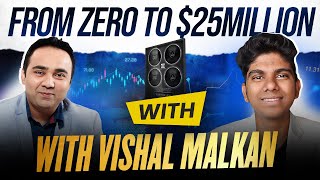
Vishal Malkhan, a 27-year trader and founder of a coaching empire with 45,000 students, built a $25 million business starting with weekend classes and a YouTube channel of 1,300 videos. He teaches a four-step model for trading: tools, system, risk management, and mindset, and expects realistic returns of 20-25% annual growth.
Chapters
So, a good question. I know many people are scared about stock market. They think it's risky, dangerous, gambling, speculation, and all that. Numbers, risk, losses. The problem happens especially with youngsters nowadays is that they want to become like millionaires overnight.
How much time do they really need to invest into trading part to actually make it successful?
Perfect.
One suggestion you would give yourself?
Go deep, not broad. Everything what we are doing is 50% is organic, more than 50%.
Wow, that's Really massive track record.
Anybody can trade. The only prerequisite is you should be ready to work hard. My favorite quote in my trading is focus on the process, not on the profit. So in technical, there are— if I have to become a professional trader, make consistent money, so I need 4 steps. We have a 4-step model.
So hey guys, welcome back to the Nikhil Sai Show. This is me, the Nikhil Sai, back again with another amazing 2Kama Club interview. Today, as you can see, we are not at my regular setup. I'm actually doing my first ever physical podcast. And this is going to be definitely amazing and amazing start to do physical podcast at Dheenikil Sai Show. So today we actually have a remarkable guest, Mr. Vishal B. Malkhan. Hi sir, good to have you. So Vishal is actually a Two Comma Club X winner. He is a professional trader for over 27 years and has been teaching millions of people on how to trade stocks in a very simple fundamental manner and been in the coaching industry for over 15 years. One of the very few Two Comma Club winners from India. Selling in the Indian market. So I was very inspired by looking at his story and journey, and today we'll be uncovering his brain and learn about trading in simple personality type, as well as learn how he actually built a coaching business from the trading point of view. Other than that, he's actually a co-author of #CashTags book. And so, sir, if you're ready, we could pretty much get started.
Yes, thank you so much for having me on this show, and I'm glad that we are doing physical in my studio. So welcome to the studio. Appreciate that. So yes, let's get started.
Yeah, so Vishal sir, we would really like to hear your backstory. You've been in the stock market game for very, very long, before even I was born. So curious to kind of hear your backstory. Where did you start from and how was the journey overall?
Yes, so I got introduced to the world of stock market at a very early age when I was actually in 8th standard, which is 1993. And nothing to do with stock market, my family doesn't belong there. My father was into textile business. But I used to go to his office in Mumbai and people were typically talking about stocks all the time because that was the time a big scam happened in Indian stock market, which was the Harshad Mehta scam, 1992-93. From there I got inspired. I started, got curious about all this. What is stock? Because everybody's talking about that. And then I finally found that more than the stocks, I was more curious about the numbers, the up and down. And then I decided that this is going to be my career after 10th. So after 10th standard, I joined stock market as a part-time trader as well as doing my graduation.
Interesting.
But then I decided this is going to be my life. And then after a long up and down career of learning and making money, losing money, learning different courses, different tools, techniques, doing the fundamental, becoming a finance MBA. So I learned the fundamental side of it, which is finance MBA. And I learned the technical side of it, which is where you learn the charts and graphs. And I found that the technical part, which is charts and graphs, are much easier than the fundamental, and a common man can do it. So started mastering that subject. Finally, in 2007 and/or '08, when before the market crash, I got my aha moment when I was able to predict the 2008 crash just before it happened by using all the tools and techniques I used. And I made a report which went viral a few days after the crash, and then people started recognizing me, started calling me on TV channels. And I thought that after so many years of hard work, finally I found something where I can make money in stock market. And then I thought, let's pass on the knowledge. So I started my training institute, Malkanjiu, me and my wife together in 2008. So we are completing like 15 years of our training institute this year. And it's a long journey.
That's pretty cool actually. So we will definitely get into more technical questions on understanding the trading and if a normal guy, regular guy in America or India can actually start trading, and we can go about those questions. But it's definitely inspiring to see you start doing trading at a very, very young age, and I hope this actually inspires so many more people as we get into depth of the questions. So Vishal, if you would like to explain to a lot of geeks who actually consider stock market as something which is out of the park, or they might not even understand it, or it's just too technical for them. How would you like to explain the stock market concept and the concept of trading in the first place?
So, good question. I know many people are scared about stock market. They think it's risky, dangerous, gambling, speculation, and all that— numbers, risk, losses. So I would like to make it very simple, and that's our USP in Malkansyu, that we make it very simple that even a 10-year-old can understand. So let me give you a simple example that there are two kinds of analysis. When you look at a particular stock, when you look at, let's say, US stock like an Apple or an Indian stock like Reliance, where we look at fundamental side and the technical side. What are fundamental side? There are fundamentals. You look at the company report, the management, the products, the services, the sales, what kind of future projection they have, all the kind of numbers like their sales, their income, the net profit, all those ratios which we talk about— P/E ratio, EPS ratio. Now that sounds very geek for many people because not everybody can understand except if you are into a finance background. So the other side of it is called technical analysis. Technical analysis is basically study of charts, like graphs. So, and in that you don't need any fundamental or any what the company is doing. You just look at the chart and find out the trends. And there are basically 3 trends. One is an uptrend, One is a downtrend and one is a sideways trend. Now, once you start identifying the trends, you just have to follow the trend. Let's say a stock is going up, it's making higher highs and making new prices. That means the company is doing good. Like, some people argue, how can you just look at the charts and trade? So I just give this example that let's say there is, uh, how do doctors look at ECG, the electrocardiogram of the heart? It's basically made of lines and graphs. Based on that graph, the doctor will conclude that whether the heart is good or not. Whether there needs a bypass surgery or not, right? Now that condition can be because of drinking, smoking, stress, or lack of sleep and all that. But the reason is not important, the remedy is important, right? Once the graph is not good, doctor says, okay, you need to go through a bypass surgery. Then the same way, when we look at the charts, it's going up. Why it is going up, I don't know. There can be 1,000 reasons for a stock to go up and a stock to go down. But as long as I know which direction it is going using the trend, I know the remedy, which is if it's going up, I need to buy. If it's going down, I need to sell. And that simple thing we teach through technical analysis tools in our program so that even a common man can trade.
Wow, that's a really beautiful answer, and I hope whoever is actually watching now understands how trading actually works. So Vishal, if you could get into a little more technical answering of how somebody who's actually just looking into maybe trading as a part-time or full-time career, how could actually he start, or what he should be actually learning, or what would be the first step for somebody to maybe start to buy or sell, you know?
Okay, so as I said, I'm assuming that I would go with the technical part of it. Fundamental is not for everyone as it requires finance background. So in technical, there are— if I have to become a professional trader, make consistent money, so I need 4 steps. We have a 4-step model. The first step is to identify the tools. In technical analysis, there are tools. You must have heard about candlestick patterns and Moving averages and RSI. So you can master any 1 or 2 tools out of it. Like I do, I follow RSI, Relative Strength Index. So you've mastered the tools. Now based on the tools, which will help you that which stock is good. Based on the RSI, I can say, okay, this stock is going up. Let's say Apple is going up. I need to buy that. Now that's the tool part. Second part is a trading system. What is trading system? That it's a very objective process-driven system that, okay, if this happens, I need to buy. If this happens, I need to book a loss. If this happens, I need to book a profit. So there's no like thinking and what should I do it. It's not gut feeling, it's process driven. So that's the trading system. Third part, which is most important and many people falter on that, is called risk management. Now you know what stock to buy, you know where to buy and where to sell using the first two steps. Now the third question is how much you will buy. How much you will risk? If you have like, say, $10,000, how much money you will risk on that particular trade? Because it's not 100%, it's not math that every time it will work. We are working on the past patterns. Technical analysis basically is a study of past patterns and which is projected in the future. So whatever has happened in the past will happen in the future. If it happens, you make money. If it doesn't happen, you have to take a loss. So how much loss I'm willing to take? In this particular trade. That's my risk management. And then the fourth and the most important and underrated is your emotions. Because when it comes to money, when it comes to trading, it's more of a psychology. As Tony Robbins says, it's 80% psychology and 20% strategy. It applies to everything, including the stock market. So I know where to buy, where to sell, what stock to buy, but I can't hold on to that profit. I hold on to losses much longer because I feel that, okay, once I book a loss, it will go up. So all those emotions— love, greed, hope, and fear— these are the 3 major emotions which play in the market. So in our programs, like, my part is to teach the strategy, and my wife Meghna Malkarnu talks about the mindset part. She's a high-performance coach, and she's been trained by Tony Robbins and other mindset coaches across the world. So she works on the mindset, I work on the strategy. So the first is tools, second is trading system, Third is risk management, and fourth is the mindset.
Wow, I love that. That's a very beautiful answer. So coming back, I think trading is also one of those things where you need belief and skill set, and you're working on the skill set and actually your wife is working on the belief. And yes, yeah, that's completely understandable. Now coming back, there are definitely so many misconceptions on the trading side. Like a lot of people call it like, you know, you will only lose money if you stay long enough, or you would just end up losing all the money in the trading, or maybe people overcomplicate it by saying you need to have huge capital to actually make a move in the market. Can you break—
So I can break all the myths. First of all, you don't need huge capital. You can start with like even as good as $100, means it could be like ₹10,000 in Indian market, Indian rupees, or even one share. Let's say if you buy one share of Reliance, it's like ₹2,500. You buy one share of Tata Motors, it's like ₹600. So there is no need for huge capital. And it's not always the amount which we look at, we always look at the percentage. Even if your capital is only ₹10,000 or ₹10 crore, it doesn't matter. How much percentage return you generate is important. So there's no huge capital required for sure. Second is when you do it systematically, like the way I explained, then it becomes like a business. If you don't do it systematically, just do randomly like most people do, looking at the television or reading newspapers or friends are recommending or anybody WhatsApp messages are saying that buy this. So if you're doing that, you can't do serious business with that. That's like gambling. That's like gut feeling. That does not have a proven track record. When we have a system, let's say I have a trading system which says buy here, sell here, stop loss here. So we have tried that system over the last 15 years, 20 years on the data and seen that the money system makes money. It's tried and tested, then only I will apply that system. So if you're doing systematic trading, there is no need for— you're not gambling, you're not throwing in the dark, you are just making a process-driven work. So people who are doing without any education, without any knowledge, they are gambling and the risk, and they're running the risk, and the ultimate result of that is going to be loss. And I have done that so many years, I have experience, I've seen people doing it, and that's what we teach. That it's not just like you learn something like any other business, like any other profession. You become a doctor, lawyer, engineer, chartered accountant, you have to study for 2-3 years and then practice and make money. Similarly, if you study the stock market for 1 or 2 years and give yourself that time, and then you can take it professionally.
Fair enough, that's quite interesting answer. Now coming back, there is different types of trading. If I'm not mistaken, there is trading of stocks which you're specifically talking about, and there is binary, there is options, there is commodities if I'm not mistaken. Like coming back to the analysis on how you're actually doing it, you're going after the technical analysis of trading on stocks. Would that differ at a result standpoint whenever you're trading different markets? How would that look like?
That's a great question. I guess that could break a lot of myths about stock market that let's say when I give you that example that we are looking at the ECG which is the heart of the market. So when I look at your ECG or mine or Hibs anybody else in US or Singapore or anywhere is the heart is the same. The ECG is going to say the same reading, right? Similarly, when we look at the stocks, we look at the graph. So whether it's commodity, currency, equity, or derivatives, or even cryptocurrency, doesn't matter because I'm going to say have the same analysis. If it's an uptrend, I need to buy. If it's a downtrend, I need to sell. Doesn't matter. So this is a universal application of what we are teaching, which is technical analysis, and I think it's great. So We have students from all across the world. I teach them, I teach my students in Indian market, but they apply the same strategy in US market or UK market or Singapore market, and it's the same.
Wow, quite interesting. And now let's talk about the difference between like a beginner trader and a pro trader. Like for example, even in my case, I saw the news that, okay, you know, like Bitcoin is going to go up and I invested something, and then I saw 30 days later the portfolio is down by 10%, 20%, and it was like complete, I would say, gut-based decision overall. So how would you go about differentiating between a pro trader and a normal trader?
Perfect. So beginner trader, first of all, as you always— anything you have to start as a profession, you need to learn. So I would recommend to read few books on stock market, on technical analysis, watch some videos. Like I have 1,200-1,300 videos on my YouTube channel where I do every week 2 videos on teaching them the concepts and strategies and the market updates and all that. So you watch videos, you master them, learn them, and then start trading. Like you can say paper trading, like mock trading. You don't put real money, you just put on simulator, and then you start putting small amount of money. Let's say if you don't know how to swim, you are not going to jump in a 20 feet water. You're going to swim in the 4 feet and the 5 feet and then slowly jump. So same way, you start slow and have a long-term vision. The problem happens especially with youngsters nowadays is that they want to become like millionaires overnight. Yeah, they want to buy the stock and it goes to the rock, like goes like a rocket. That's not happening. Sometimes it may happen by luck, but that's not skill. If you— this is like a high-income skill. Like coaching is a high-income skill, trading is a high-income skill, training is a high-income skill, internet or influencer, being an influencer is a high-income skill. So you take it as a skill, and skill development takes time. So you give yourself 1 year, 2 years to master the skill of trading. So by the time you're learning, you are like a beginner, like a basic trader. And once you master the tools and techniques and start growing up, start making money, start doing the mistakes, then you eventually grow to a pro trader level.
Fair enough, that's quite interesting. Now coming back, the biggest overall, I would say, the factor of success in trading is managing the emotions. Yes. And I'm glad you're actually super successful at it and coaching millions of people to handle the same way. Now if somebody is actually watching this interview is struggling with their emotional control while they're actually placing the trade, they're getting too much attached to their stocks and their money. How would you actually give like a few simple frameworks to actually control their emotions while they're trading?
Great. So one thing is that when you are having objective rules, when you have objectivity, then your emotions will go down. So my rules are like, this happens, I'm going to buy. This happens, I'm going to sell. This happens, I'm going to book a loss. So it's a rule-based thing. So you don't have that subjectivity whether I should do it or not. My emotions come into play. I'm hoping for things to happen. I'm getting greedy. It's a process. Like, it's like, it's like a machine. Like, let's say you go to McDonald's, you have french fries. You eat french fries in India or, or China or US or anywhere in the world, it's going to taste the same. Why? Because it is process-driven. There's no subjectivity. So same way, if you turn your trading, which is process-driven, which sometimes becomes boring. Like, it's— you get bored out of it because you're following the same process. But real trading and real money is only made when the money-making becomes boring. So one, to reduce your emotion is to have process-driven thing. Second, to reduce your emotions and be cool and calm is to have long-term thinking. When you have a long-term vision that I want to become a millionaire or $10 million, $20 million, then the current small loss of $500, $10,000 $100 or whatever that amount is doesn't bother you so much. You don't put your life on it, right? You're thinking long-term. Out of the 10,000 trades I'm going to do in my lifetime, this is just one trade. So it reduces that emotion because you're thinking long-term. And of course, all the other things which we teach in our programs, like meditation, visualization, affirmation, removing of your conflicting beliefs, limiting beliefs, all that will help you to become cool and calm.
So Vishal sir, appreciate you giving us a brief on the trading part. Let's get into the coaching side of it. And personally, I have not seen many people cracking the coaching industry at the scale you have done, especially in the Indian market. Now, curious on how you have built the coaching empire. For over 15 years you've been doing seminars, workshops, lot of coaching and different programs. I would love to get a brief blueprint on how you're doing it.
Okay, the first and the foremost thing is that when I started coaching, it was 2008. That time I didn't know what is funnels and what are this VSLs and all that. I started purely as a passion. I want to pass on the knowledge which I gained through the long curve of losses and blunders which I made. So I didn't know how much money I'm going to make out of training. You know, frankly, I was getting bored on Saturday, Sunday because markets are shut. So I said, let's do something related to market only. So I started doing my coaching on Saturday, Sunday, and I used to have this small office where people used to come on Saturday, Sunday to learn from me physical. And then slowly started, they got started getting results and they started making money. And when they come up and say, okay sir, you have changed my life, I started making money, I left my job and become a full-time trader. And then I thought that this is not just like a side hustle, I should take it seriously because it's impacting people. And that's when I started doing in a bigger way. I started doing physical events like, and we started doing in Mumbai, Bangalore, Chennai, Hyderabad, and then we land up at Russell's website and book. And they said that we can do it through funnels and through online presence. And we started doing online very early, like 2015-16. And of course, after which COVID happened in 2020 when we started scaling up. But we were in online because I thought that how I can reach out to maximum people is only through online. I can't do physical people like 200, 500, 1000 people. But when I have to reach out, so the first thing is to write a book. So we wrote a book. Me and my wife called #CashStack, which released in 2018. And then we started doing online courses so we can reach out to our larger audience. And of course, then I also heard Russell saying that people who pay, pay attention.
Yeah.
Right. So then we started doing coaching programs and all these high-end programs because I know people look at YouTube videos, but they're not serious about it sometimes.
For sure.
Right. And that's not proper structured learning you can have. So then we have this coaching program for 1 year where we handhold you from right from basic to advanced to implementation to mindset, belief, and all that. And then that's when they started getting results. So that's how we started. It started as a passion. So the one thing which I want to tell you, tell everybody who's watching this, many people have joined the coaching industry looking at the money. And inside your purpose or your passion is not there, it might not scale up that much, no matter what kind of funnels or what kind of business you do. I can't imagine myself without trading and training. That's, that's in my blood, stock market. So, uh, and I don't even differentiate when I'm teaching on a free YouTube video versus a person who has paid $20,000 to me to learn. I don't differentiate, oh, this is paid, this is free, so I should teach this or not. I just go out and full out and teach as much as I can. And that's, I think, why we have scaled up so much.
Love that. So purpose over profit is what you're basically—
Absolutely, absolutely.
That is completely insane. Now coming back, if you would like to give a basic blueprint, especially to crack Indian coaching market, if you'd like to give a blueprint on where you're getting the traffic from, the leads, the webinars and workshops, would you like to give us a breakthrough on how your funnel looks like overall?
I would say we have tried all kinds of funnels which Russell covers, like the webinar funnel, the book funnel, the high-ticket funnel, the whatever you name it, and we have done it. But one thing which I think is cracking the code is, you know what, is to go on YouTube, on social media platform, and give tremendous value. Tremendous value means almost give away everything, like give away free stuff. They should feel that, okay, this much is free, then what is the paid? And they should start getting results from the free stuff itself. Then rest of the things like running ads and lead capture and opt-ins and free webinars and paid webinars, all that will work automatically in a better way, in a cheaper way, and get conversion better. Why? Because they already know you that this guy provides value. There is some kind of what we call there's omnipresence across. You are all over the social media, you're giving value, you have branding. We do a lot of PR activities also like we have like newspaper coverages and kind of TV coverage. Although as it is I've been on CNBC channel since last 14 years. As a technical analyst and do regular shows with them, me and my wife both. So all this helps that building the brand is important, then the marketing and then the sales. And before everything, build value.
Fair enough. So basically depositing goodwill with your audience is what makes the funnel work. It's not the VSL or the offer or anything, it's basically the result you're delivering.
Everything what we're doing right now, just to give you one example or one number, is that everything what we're doing is 50% is organic. More than 50%.
Wow, that's really massive traffic.
Because that's how we have positioned ourselves that we have 1,200 videos on YouTube and more than almost 7.5 lakh subscribers are there. Soon, I hope this year we'll be touching the million mark and that's where the audience loves, there's loyal audience who every week I do a show called Tuesday Technical Talk and in last 5 years I have not missed a single Tuesday, no matter where I am in the world. Wow! So it's 250 episodes. That consistency of giving value, caring for the customers, giving— it's like a win-win-win situation. I win, the YouTube wins, the, the people who watch win, people who join the program also win, people who don't join the program, they also win because they are learning for free. So when you have this win-win-win attitude, and plus also it comes from my spiritual learning about abundance, and you just give away free. I know people are ripping apart, people are copying, people are taking the same content and teaching. I don't complain. I mean, there's enough for everyone. That abundant mindset is very important. So all that helps in scaling up.
Wow, that's really insane. I mean, a lot of beginners who are actually getting into the coaching, right, they always hide the secret sauce. They feel that it's so important.
There is no secrets actually. I know Russell has been using the word secrets all the time. Even we have used— we have Pro Trader Secrets, we have Option Secrets, and we have all the secrets we have done. But actually there's no secret. I just give away the secrets for free. And that's the secret of scaling.
Love that, Vishal. And let's get into, you travel a lot if I'm not mistaken. I would like to hear like the craziest story you ever had experienced while you're actually traveling, if you'd like to share some.
Nowadays it becomes difficult, or maybe I would not say difficult, but it's crazy to travel in India, is that every time I go at the airport or or a public platform, I meet people and people are taking selfies and people are writing autographs and all that. And like recently, the crazy thing is like I was waiting near my son's school and it was raining heavily. And then I was just waiting there and somebody was passing through, a bike with a helmet and a jacket, and he suddenly recognized Vishal Malkan. He said yes, and he just stopped and he put his bike here and he said, I want a selfie. And like that. Then the other one was in, I was in the flight and there was an air hostess which she recognized me and she said that we love your channel, we watch all your videos, Meghna's videos, your videos. And she wrote a big note and said thank you for all the support and love. And that kind of people meet. And when security guard, when they are frisking me and then he's smiling and I said, you are Vishal Malkani? I said yes. So I feel proud that. So the whole internet thing, the whole online thing has helped me to reach out to smaller pockets of India or to the world where this knowledge can be gained. And that's, I think, so great about this.
Wow, that is pretty cool. I would love to get into some basic questions here. Before that, I would like to ask one more question about the trading part. Is there any specific profile which you would like to mention is good fit for doing the trading part or not good for the trading part? What do you suggest?
Absolutely not. In fact, our main program which we do is called Anybody Can Trade. The name of the program is Anybody Can Trade, which we have done. It was a physical event, now we do a virtual event, and that has happened almost 73 times we have done in the last 8 years, and 45,000 people have attended. And it's a 3-day event from morning 9 to evening 6, and we have got a feedback of 9.2 out of 10 for all the people who attended. And that's the first step anybody wants to join. It's called Anybody Can Trade, and literally anybody can trade because We have people like doctors, lawyers, engineers, chartered accountants, as well as students, as well as homemakers, everybody, even the watchman, the security guard, they have been part of this program and they started trading because it covers the technical part. It does not require any finance background. What I need, as you said, prerequisite, the only prerequisite, you should be ready to work hard. It's not an easy game. It's not like a quick-rich scheme like you can make it overnight. If you're ready to give 1 year, and be patient and be long-term and open and coachable to learn things, then you are ready to make money in trading.
Wow, that is pretty cool. And coming back, just to follow up on that, if somebody is who's an entrepreneur or maybe they are working full-time and they want to pursue trading, how much time do they really need to invest into trading part to actually make it successful?
Perfect, that's a great question. And I always say that in our coaching, our training, we never propagate about intraday trading or day trading because day trading is basically like a job. Like if the day you don't go, you don't make money. So that's not the intention. The intention of becoming a trader or an investor is to have freedom, right? So we have this trading systems, like I'm trying, I'm attending programs, I'm doing programs, but I'm also trading. Last year I took part in the trading investing championship in US and I stood 4th there with 81% return. In the derivative segment. And all that I did 2022, I had 4 US trips and I went to other programs, I did my own programs and all that. All this was passive, or I can call it semi-passive, because I just don't need to track the market every day. I just put my orders, I am free. So for doctors, lawyers, engineers, or entrepreneurs, they can learn these systems of swing trading or positional trading where you just need to put your orders, place your orders, and then you are free to do what you want. Market does its own thing, you do your own thing. And you still make money. Like Warren Buffett says that if you don't make— if you don't know how to make money while you sleep, you will work till you die. So that's the premise. So there are different kinds of trading you can do. So I don't— I'm not a big fan of intraday trading, although I was an intraday trader when I started my career. But then I realized that you can make more money with less number of trades, less time involved, less stress, and you can do many more things also. Then why not? And that's how we evolved to become positional traders and investors where the money makes on its own and you can do what you want.
Oh, completely love that. Now just a personal follow-up on that. I see many traders who I personally know, right, they have different aims to the outcome. Like they aim for 25% a month or 10% a day in growth, or yearly they would like to aim for 20%. What do you think is a good number to actually aim for when they're actually going trading?
So if you look at If you look at Warren Buffett as a benchmark, who's one of the biggest or the best investors in the world with so much of track record of more than 50-60 years, his annual growth is 20% CAGR. So if you're targeting 20-25%, 30% is good on the long term. In 1 or 2 years, you might have a bumper year, like you can make 80%, 100%, depends on the market. But if you can consistently make 20%, I think that's a great number. So I know there are people who sell their programs or who are ambitious and who propagate that you will make monthly 10% or monthly 5%. That's not going to last long. You can do it for a particular month or a particular year, but not every time. So that's first of all, again, reduce your expectation, reduce your ambition and be more realistic. And so once you do it systematically, of course, as you, as you become more pro, like you become senior and you experience a lot, you can target around 30-40-50% and also the market has to support in that way. So 25% in a year is a very good return by all standards. Anything above that will be I think too much ambitious for people especially for beginners.
Fair enough, that's a very important question. So I think that would really allow a lot of people to kind of be realistic and have right goals and I think it helps a lot of people. Now let's get back to the question of understanding when you're running a huge coaching company, and of course coming back to your trading. I would love to hear a simple stack of tools to manage a huge team of 30 people. I see the office is beautiful and everybody is doing the job. So would love to understand like what do you actually follow to manage the projects and everyday life overall, any specific?
So we have specific teams and team roles like there is a studio team, there's an AV team, audio-video team, there's a social media team, there's a funnel team who builds funnels and pages, and there's an ads team And then there's a trading team who looks after my trading and their own trading. And then there's a sales team who are high-ticket closers, and they call up and convert people and all that. So it's all departments are there, and they have their monthly targets and their goals, and they get complete— they get regular training because I keep learning. I keep going to Inner Circle, I keep going to Funnel Hacking Live, I keep going to other programs, and I bring the best and show them that, okay, now you have to learn this, read this book. So continuous learning and upgrading their skills. And also, as we say, funnel hackers, so we keep hacking other people's funnels also and what they are doing. So that's the best way to learn.
That's pretty cool. So you basically pass on your knowledge to your team.
Absolutely.
The best performance. Yeah, that's a great leadership skill. Now coming back, I would love to hear a quick daily routine. I mean, you trade in the market, you travel, you also do your coaching business. So interested to learn about your daily routine.
So daily routine is like, I'm not an early riser, so I work in late in the night when everybody's sleeping, but I still get up early at 6, 6:15 to put my kids to the school. Me and my wife both, we have 2 kids. And then again I take a nap and then get ready. And the market starts at 9 o'clock, so 9 to 10 I look at the markets, I put my positions, my orders and stop losses and all that. 10 to 11, 11:30 I read or I watch some videos or consume content on funnels or marketing or branding or anything else which upgrades my knowledge. And then 11:30 onwards I have live sessions with my students, then I have webinars or I have funnel meetings or I have some shoots happening here for social media till 5:30-6:00 AM in the office and then I go back, play with my kids, I do some dinner and then again play with kids and do their homework and stuff like that. And after they sleep again we discuss the markets, business, funnels, and all that. And then, and that's it.
Wow.
And the best part is because me and my wife have been together since in trading also, and in training also, in coaching also, in Inner Circle also, in Funnel Hacking also. So we always have, we keep talking, talking. And that's a great thing. I think it's great to work with your spouse because there's someone to share and give a critical feedback also at times, and also show you a different perspective. So I think my strongest and the biggest support is my wife Meghna Malkhan, and because of which I am able to scale up. And she has been supporting me in like— now my kids are quite like, they are 10 and 14. When they were young, so we used to alternate when we used to travel. So she used to go for one event to US, and then I am sitting back and babysitting. Then I used to go, and then she used to babysit. But now we go together because kids are there. So it's a great journey.
Wow, that is beautiful. I think entrepreneurship is definitely lonely, and you need somebody who you could rely on.
Absolutely, absolutely.
Yeah, that's amazing. So now coming back, if you could actually go back and talk to 20-year-old yourself who was just getting started in the trading, doing the intraday trades and whatnot, getting frustrated on losing money and whatnot, what would be one suggestion you would give yourself?
Go deep, not broad.
Can you read one?
So when I started my trading, I used to learn a lot of things like this tool, this technique, this strategy, this, this, this, so many stocks, so many strategies, so many tools, so many books, so many mentors, so many coaches. And then I learned the hard way that you don't need so many things, you just need one thing which works, you go deep into that rather than going broad into many things. So that's why again learn in funnels also we just focus on one particular funnel which goes deep and focus on one product and program which is our flagship program Trade and Me program. So going deep and mastering one or two skills in depth is more important than learning too many things. So let's say for example, like there are too many things which are happening right now in the funnel business also. There's AI coming up, there's copywriting and all that. So I'm not trying to do that. I'm going deep in the broad marketing part. Then I'll hire people who are going deep into AI, going deep into funnels, going deep into copywriting. So I can't do everything if I'm then spreading too thin, right? So that would be my advice to everybody that just master one funnel, one business, one product, one company, one tool, one strategy, and just go in for 10 years and you'll be the category king in that.
Yeah, I love that advice, and I think it's very interesting to see what you mentioned, it's leverage. Basically you're buying out the skills you don't have and you go deep into the skill you actually have. Completely associate myself with that. Now let's talk about your life's biggest achievements and any next bigger goals you actually have.
It's always keep going up and up like so. But the achievement is that we have impacted so many people. Now, once you cross a certain number in terms of money, then it just becomes a number, right? So then you don't think about that. You say, how I can impact more people? How can I reach out to more people? How can I give more value? How can I change more lives? That's the biggest goal we have right now. And especially in India where the financial literacy is very low compared to what you have in US. So if that number goes high, automatically it will help towards the growth of the country and the growth of the population also. So that's the main goal. So the achievements is like we just completed 15 years of our training institute Malkanjoo, and it's a long journey. We reached 2-comma club, 2-comma club X, now 2-comma club C also recently. But more than that, we have impacted so many people who have changed their profession to full-time trading. And they always give us that message that because of you, my life changed. And that's the biggest achievement for us as a coach when you see people's life getting changed. And it's not only when you change one particular person, because once a person transforms, the whole family transforms, and then the whole community transforms, and the whole society transforms. And that's how you go like one student at a time. So I think that's where we now look at it. Earlier when we started Funnel, of course, the goal was to CC, to CCX and all that. But now it's happening automatically. Again, my favorite quote in my trading is focus on the process, not on the profit, which is in trading. And now I realize that is the same thing in funnels also. If I do the right process, I give tremendous value, I make an irresistible offer, I give them life-transforming content, then I know I will reach that 2CC automatically. So focus on the process, not on the profit.
Fair enough. Completely agree with whatever you have said. Now coming back, I mean, as entrepreneurs we don't consider our mistakes as mistakes. It's always a learning curve. But if you could name a few mistakes, or maybe the number one mistake you actually feel which you should have avoided, or the people who are actually watching might need to avoid, what would that be?
Okay, as I said that the mistake when I did in my trading career was that going too vast, like to learning too many tools and too many strategies, and I wasted so much time in that. And hiring too many mentors sometimes, I know we are all learning, always learning, but sometimes I also use this quote called one coach, one approach, right? So especially when it comes to specialized skill, like funnel is a specialized skill. So I now follow only Russell Brunson that whatever he teaches, I have to do it for funnels. For branding, there's a different coach. For marketing, there's a different coach. For sales, I think somebody else is a different coach. So like that, if you— I would like to have— those are the mistakes I did. I listened to too many people. In trading, I did that mistake. In funnels also, initially I did that mistake, but I immediately corrected it. Then I said, okay, go with the best. Go with the biggest and the best and just follow what they do. So I think that those are the mistakes which we do. And of course, there are some smaller mistakes which we do in the sales letter or the sales video or offer video. Oh, we should have done this. We could have added this bonus. We could have priced this. We could have done payment plan. All that. So those mistakes happen every day, but those are all learnings.
Yeah, I completely kind of relate with what you just said because I see so many people learning the same skill from several people and there is contradictions. Now you're confused, like, okay, I got the same advice to grow followers this way, now grow followers this way, which way I should go? And they do nothing about it and they learn the new thing again and over and over. That's pretty much very interesting. Now I would love to hear from you your main inspiration for success and key people involved in the journey overall.
So main inspiration, like my, of course I started becoming, I started doing stock market journey. I would say, of course there was a scam involved with him, was Harshad Mehta, but I would say he was the inspiration for which I got into stock market. Then of course there are all the big investors like Rakesh Jhunjhunwala ji and Warren Buffett, all these people who inspired me to become a better trader investor. And all my coaches, like in the stock market, I have coaches like Dr. CK Narayan, I have Steve Nisson, Dr. Van Tharp, Mark Minervini. All these people I've learned and mastered the tools and I've met. Larry Williams. And in the online business, my first introduction to online business was not Russell, but before that was Brendon Burchard. And he inspired me a lot to get into online way back in 2013. So I'm a true fan of Brendon Burchard and Russell Brunson as far as marketing and branding is concerned and funnels are concerned. And of course, I got inspired by Tony Robbins to make it so big. And this studio, what you see here, is inspired by Tony Robbins UPW after COVID. So we did the same. So I have, again, inspiration from different people for different things.
Yeah, I think that's the best way to proceed. Like, you learn something which is working, you just take and embed that into your business. And I love the way you're implementing Quik. Whenever it comes to business and coaching and whatnot. Now coming back, people who are actually watching this podcast today, and if they might want to consider understanding more, learning more about how they could get into trading, where can our audience find you?
So I have a YouTube channel called Malkans View, and there are 1,300 videos there. So you can start, there are some series, there's a playlist of basic videos, there's a playlist of advanced videos, there's a playlist of derivative videos, there's a playlist of option videos. Start watching those free stuff. And of course, every time we do a lot of free events also, like a free challenge or a free event or a free webinar, they can join. They can get the book which is there, #CashTag, which is available on Amazon. We have a book funnel also, you can buy from there. And maybe next ABCD, Anybody Can Trade, a 3-day virtual event which will happen soon, they can come for that. And I am— I can guarantee that once you attend ABCD, your perception about stock market, perception about making money, trading, investing will completely change.
Wow, I completely love that. So guys, whoever is actually having some misconceptions that you might or might not want to trade, consider actually looking at ABCD, and I think that would definitely change your view on the trading overall. Now, any last words before we conclude the whole podcast, Vishal?
Nothing much. Like, I would like to repeat all the lessons which I always keep saying in my podcast and my videos is go deep, not broad. Master one thing. Second is focus on the process, not on the profit. Like, you just look at the whole structure and not on the profitability. Have purpose and passion over profits, right? And just go all the way, do whatever it takes. Like the band says, we always use this as reminder to myself that do whatever it takes. And yeah, and follow one coach, one approach, go all the way.
Yeah, yeah, I love that. And I think my biggest takeaway from the whole podcast was basically Having that objective view whenever you're trading, which is basically allowing your emotions to park them out of them and just look at it completely like following a code of honor.
Yes, it's like money is a byproduct of the process. So you don't focus on the money, you focus on the process. And if your process is right, the money will come.
Love that. So Vishal B. Malkan, guys, thank you so much, Vishal. It was definitely a pleasure.
Thank you so much, Nikhil. And I wish you all the best. And you are doing a great job at this age. What you have achieved is great, phenomenal. You inspire us. I'm almost double your age, so I feel sometimes left out or FOMO that at your age you are doing this. But congratulations at doing the great work. Thank you.
Yeah, thank you so much once again, Vishal, for letting us use your office actually as a studio for our first podcast physically. And I'm glad we actually did this. So guys, hopefully you enjoyed the podcast so far. If you would like to consider subscribing, there is a button down there. And like, share, and share it to somebody who's actually interested in trading or already doing. And definitely subscribe to Malkan's View YouTube channel. There is a lot of free videos where you could learn from, and definitely try considering joining one of the free challenges where you could basically break all your myths. So Vishal, thank you so much for the opportunity. Great connecting with you once again.
All the best. Thank you.
Bye, guys.
More from Nikhil










BURNED $1.5M in his 17years online #digitalmarketing #entrepreneur #onlinebusiness
