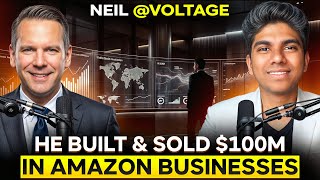
In this long‑form interview on the Nikhil Saj Show, host Dean Bisai (Speaker A) talks with Neil Twa, CEO of Voltage, about his 17‑year entrepreneurial journey that led to building and exiting Amazon private‑label brands worth over $100 million. Neil explains how he moved from affiliate and media‑buying work into Amazon private‑label, leveraging his IBM background to view Amazon as a giant search engine (A9) and develop a data‑driven launch system that could rank any product organically. He details the "Greenlight" product‑vetting framework (four metrics: price, profit per unit, demand/BSR, competition) and the importance of capitalizing inventory to win Amazon’s ranking algorithm. Neil warns of the upcoming "Cosmo" update—a large‑language‑model‑driven ranking overhaul—and advises sellers to prepare or risk being penalized. He shares his marathon‑mindset philosophy, emphasizing long‑term capital allocation, risk‑taking, and purpose over short‑term profit. The conversation moves to Voltage’s acquisition playbook: buying Amazon‑only brands at 2‑3× EBITDA, then expanding them omnichannel (TikTok Shop, Shopify, subscriptions) to achieve 5‑15× multiples, eventually bundling brands for larger exits. Neil outlines the tools his team uses (Trailio, WhatsApp/Slack, ZonGuru, Sellozo, Kaloha, Node Hunter, ASIN Finder, Seller Dashboard, AI tools like Midjourney, Suno) and describes his daily routine that balances business oversight with homestead life. He offers blunt advice to young entrepreneurs: skip college, learn a high‑value skill (e.g., prompt engineering), find mentors, and focus on purpose‑driven capital deployment. Throughout, Neil stresses that systems should free the founder to operate at a strategic level rather than micromanage daily tasks.
Chapters
What was the journey for you to go from like, hey, I'm building some businesses, to saying, oh yeah, I think this e-commerce is my thing?
Businesses and then built businesses. I've seen the boundaries of both sides of that spectrum.
What suggestions or guidance do you have for entrepreneurs who are listening?
Opportunity begins at the end of your excuses.
What was the learning curve overall?
We and I started to study Amazon's system and realized it was a giant search engine.
Do you see the same skill set still apply for you?
We could take pretty much any product and rank it to the top of Amazon organically. You must prepare for Cosmo, or you could be a victim of it. Honestly, I think it's the stupidest thing they could have done.
What would be the number one suggestion you would give yourself?
Nothing different. You're gonna love how it turns out.
How do we find that strong purpose?
Business people are not training their minds, their mindsets, and their money for a marathon. They're training it for a sprint. Truth is, you don't see a U-Haul behind a hearse.
What's going on? What's going on, everybody who's actually listening to this podcast right now? First of all, guys, welcome back to another episode of the Nikhil Saj Show. Which is hosted by me, Dean Bisai. And guess what's going on today? We are back with another incredible guest. I mean, if you are somebody who is an enthusiast on e-commerce, or maybe you are already an e-commerce business owner, or you're exploring your opportunities to build and exit e-commerce companies, this podcast will be a goldmine for you because the guy who's actually jumping on has been in the entrepreneurship game for over 17 years and he has built and sold, you know, different Amazon stores and products worth over $100 million. Leveraging his innovative systems and software tools to automate streamline e-commerce operations. Today we are going to interview none other than the CEO of Voltage himself, and let's not waste any time and actually let's welcome Neil Twa. Hey Neil.
Hi Nick, thanks for having me on.
Yeah, absolutely. Neil, great to see you here. We are stoked. We have had few people who actually have built 8-figure e-commerce businesses, but this is the first time I'm talking to somebody who has built a big business here, sold over 9 figures in revenue with e-commerce. And you have a very interesting game plan compared to what a typical e-commerce entrepreneur does. So I'm excited to learn more about what you're exactly doing with Voltage and how you could actually help e-commerce businesses and what's your long-term play. Before we get into the entrepreneurship stuff, e-commerce, Amazon, tools, operations, systematization, finance, exits, and whatnot. I'm curious, who is Neil? What's your personality? How did you discover entrepreneurship? What was your journey like for you to go from the young Neil, who's maybe 8 years old, still learning how to deal with friendships, to actually becoming an entrepreneur? Can you give us a quick rundown?
Well, first off, I am a Christian. I'm a father, I'm a husband, a guy who loves to be in the country. I'm a homesteader. I have a garden and tractors and other things to play with and 50 acres out here in the country. Business is just one of the things I do that enables me to be that guy, because that's ultimately where I find my purpose. Business has been purposeful to me because, uh, obviously purposeful because it's profitable, uh, when you do it the right way. And, uh, I've learned that journey both on the upside and the downside. Um, having wrecked businesses and then built businesses, I've seen the boundaries of both sides of that spectrum. Uh, I have built both offline and online businesses and found myself predominantly focused on building online businesses for the last 12 years. Incubating them inside of Amazon's framework of demand capture, and then moving them into multi- and omnichannels once we capture some of that brand market share and discover what it is we can sell and who we're going to sell it to, and we could move it into multiple channels. So between launching and growing and scaling and optimizing them, it's also now exiting and acquiring them as we move forward into the acquisition space. Now we're going to be acquiring companies that match up with that brand portfolio. So Voltage is a holding company that has multiple verticals from software to consulting, as well as acquisitions and mergers and exiting.
Interesting dynamic. I mean, you're not just like a digital marketing company, but you basically have took a method to grow e-commerce businesses, and now you're helping a portfolio of companies to grow, and the goal is to exit overall. Absolutely. I love that vision overall. I mean, this— how did you come to that realization? Like, I'm curious, what was the introduction to e-commerce was like? Did you create your own Shopify store, or Were you very early on Amazon? Like what was, what was the journey for you to go from like, hey, I'm building some businesses to saying, oh yeah, I think this e-commerce is my thing because I could see some momentum here. What was the journey like?
Yeah, well, I mean, I discovered it in 2011, so that's relatively early in the Amazon space. 2012 is when I launched my first brand, but I had been doing affiliate marketing previous to that. I was just buying and selling traffic on affiliate offers, mobile traffic specifically. Mobile dating, mobile lead gen app, et cetera, CPI and CPL, CPA, excuse me, on the affiliate side and was actually very good at the mobile traffic media buying. And that was back before Facebook interfaces and Meta was a thing and we were uploading stuff in spreadsheets to systems and sending out, you know, CPI install requests to, you know, countries all over the world just on a spreadsheet, hail Mary into, you know, creative into a system. And so that was way before you know, UI-based media ads that so many people enjoy now was really a big thing. It was growing and growing fast, and the platforms were developing. In fact, a couple of them got developed in the timeframe that I was working on them in a different space. Prior to that, I just— it was out of necessity that I discovered that talent. And trial and error, I had been using the online space to try to build up my management practice, which was in a consulting space. So we were doing business and consulting technology, knowledge management infrastructure, uh, based type of consulting, which I had, uh, launched that company, uh, after leaving my, uh, IBM career in 2007. And so I was expanding and looking for new clients and whatnot and just kind of discovered that I was really good at the media buying side of it and said, hey, let me just see if I could flip mobile-based media buying for advertising. And turns out I was pretty good at it. So what I really discovered was though that I, I, I was just again, flipping product data for profit. I really wasn't building anything intrinsically. Uh, of course, as the campaigns went down, so did the money and nothing was really long, long play. So I kind of decided, well, I should own the offer. I, I finally came to the realization I should actually own the product. I should own the outcome, not just the traffic. So I combined the two and in the process of doing that, I discovered Amazon. Amazon and the physical product side, it made a lot of sense to me having a background in the offline world to have a tangible asset of physical inventory tied to a virtual environment like Amazon online. Because I was doing a purely virtual, you know, digital play at that point. So it made sense to me to buy product, physical product, to put cash into that product. And I could see it, touch it if I wanted to, knew where it was and where it was stored. And so just that mental thing for me made sense in that business model. And then Amazon really was the catalyst to more of a done-for-you solution because I could just ship it all to Amazon and put it into their Fulfilled by Amazon system and not worry about that at all. So I got the physical inventory aspect of touching it, but then not having to touch it as a part of what I was, which was a digital marketer. And so for that, the combination just made a whole lot of sense to me. So I got into brand building and physical products.
I love that transition. I mean, I come from, you know, early of my career into from the affiliate marketing space too. And I think the learnings from affiliate marketing is great, but then you realize you're just making money and you're not really building a sustainable business.
There's nothing sustainable about it. The traffic goes down, you stop running it. No one, someone else has to be taught. It just is fleeting. And to me, that was a lot like the arbitrage world of e-com. That was a lot like the dropshipping world, which didn't get popular until like 2017. That was a lot in the, you know, online and media space and the playing with, you know, product and arbitration. And I wasn't super cool with that. Wholesaling, I got into that for a little bit, but that was again a crime of opportunity. It's kind of fleeting. Nobody wants to buy a wholesaling product company. They don't want a job basically, which is flipping products. And, you know, so none of those really had long-term play. They were all just short-term cash grabs really.
Yeah, so true. Absolutely. And I'm kind of curious, you were very early in the trend, like in terms of like digital e-commerce and it wasn't booming. Like Amazon was not even in, you know, many countries back then when you're talking about 2011 and looking at how we actually got into Amazon. I'm curious, you have the mobile media buying, you know, digital screen media buying. CPA and affiliate marketing expertise and building Amazon stores and being like, be able to successfully get orders and fulfill them consistently and find winning products in Amazon is a whole different new skill set. So what, what actually, what was the learning curve overall? And do you see the same skill sets still apply for you? And if somebody wants to get into Amazon, would the best, what would be the best source for them to continue? Learn.
So as it turns out, we and I started to study Amazon's system and realized it was a giant search engine, okay, that they had literally just taken and, and pointed it at e-commerce products, which was unique, right? And, and, and spent their whole time in the search engine space, what they call the A9 engine. It, it turns out that the code, the similarity, the affect of building the listing on Amazon had a lot of familiarity to it and I couldn't put my finger on it. And in the first year, it finally dawned on me as I was launching some products and watching what was happening inside of Amazon. The familiarity was because I'd developed systems like that at IBM. So when I was at IBM developing knowledge management systems and learning systems and latent semantic search engines and technology in the artificial intelligence space that we were doing in the AI side of IBM at that point, doing some work on the Watson Super Blue computer up in Armonk, it suddenly dawned on me that that's what this engine was. It was a learning engine. Um, and when I realized that there were certain data points, and I'm not going to get too technical, but basically I saw patterns in the way the data was recognized from the title to the image, the bullets, etc. The way the listings were uploaded, we started using flat files immediately once I recognized that, as opposed to going through Amazon's, you know, seller dashboard. We did all flat file management because I could unlock different data points in the flat files that you could not get through the web interface. And because of that, I got the system to react to certain things that it wouldn't normally react and realized it was, you know, this huge organic machine was setting underneath this layer and then realized that it would relate to certain signals, time in market and attention to certain assets, whether it was, you know, they checked out or just clicked the add to cart button. So I did a lot of research and I did a lot of testing. And in that process discovered that, you know, there was a ranking algorithm under there that was looking at new products and ranking them in certain timeframes, 7, 14, 21 days. It was looking for certain attributes to occur off and on Amazon, things to signal. The value of that product listing versus competitors. And so I just started to track it, and I started to write it down and created a launch process on it. By 2014, it was the launch process, uh, and we could take pretty much any product and rank it to the top of Amazon organically. So it was like shooting fish in a barrel, basically.
I love that. I mean, you kind of almost kind of pioneered the, the game plan of, uh, you know, Amazon growth.
I launched the first ones. We told people about it, which was a mistake. So a lot of the platforms and things that you see now in the, in the former launch platforms and the giveaway strategy and the Search and Buy. Those were all things that came out of that time frame. I taught a lot of people how to do— Amazon shut down a lot of those loopholes because they were loopholes in the use of the system and people were taking too much advantage of them, like Search and Buy campaigns that we launched a long, long time ago. Um, but the long story to get to your point was, yeah, these are still algorithmic expectations of the platform. That has not changed at the core functionality. There is one update coming very soon called the Cosmo update that will make a radical change to the way the system has currently indexed and ranked products, the largest change since they launched the original AI that's about to make its move here shortly. They did their test, they published their white paper. It's very, very impactful. It is going to use large language models and all the data they've been harvesting for more than a decade to basically create this Cosmos system. They tested it on about 10%, they got about a $4.9 billion revenue boost, and they increased CTR by like 0.7%. So it was a very successful, uh, test.
Wow.
And so they're going to roll out Cosmo, which will become a fundamental way that the system changes. Um, we're all ready for it. We're excited. I know what it does. I know why the changes are happening and all my clients are prepared to take advantage of that. Those who are not are actually gonna watch any grandfathered history in Amazon possibly slip away from them. So if you're listening to this and you're a seller on Amazon, you must prepare for Cosmo or you could be a victim of it. 'Cause so many people are victims of systems and changes and we've always been innovating and testing and playing. That's just been kind of my MO. And so I see where things are going. I see where the next few years are headed. And either whether you're a beginner or you're a current seller on Amazon, you're going to need to know about these changes, get ready for them, prepare for them, be trained on them, and take advantage of them, or get victimized by them.
Yeah, I mean, the last thing you want to do as a business owner is play victim. That's not going to help at all.
So no, it's a lot easier to complain on Facebook about that. Look what Amazon did again. Yeah, Amazon has its problems. I'm not a fanboy. It's done a great job. I've loved it. But it's also places— certain aspects of it I hate. It's a certain way they treat sellers, the way they're changing the fee structure. Because of the way we sell and the product evolution we've gotten in our business model now, we're not affected by the lower price selling products, by the lower changes in the fees and the lower types of brand building things that a lot of people have done who are now negatively being impacted. At the same time, as a big picture vision to finalize that statement, I can see why Amazon's doing it. It wants to move away from looking like the rest of the market. Now, ironically, I say that tongue-in-cheek because they just decided they're going to try to launch a Temu-killing component and go head-to-head with Temu on Amazon. And I'm like, well, that was a— that's somebody's— honestly, I think it's the stupidest thing they could have done. We're going to wait and see. I think it's going to backfire. I think they'll eventually pull out of it because it's going to be so bad, but they're going to give it a shot. So we'll see what happens.
Yeah, I mean, they got the money to play around, so let's see.
They're gonna try to make a killer on Amazon and see if they can take chemo. And it's all low-priced, fast-moving, direct-to-ship product from China, and I think that's going to backfire horribly, especially if the political powers in America change. It's already been signaled that major tariff changes would occur. With major tariff changes, Temu, Shine, these others, and that thing Amazon's doing will all die.
Yeah, I mean Hopefully that doesn't sound very good to me.
So no, don't get involved in that. That's not gonna— that's not a long-term model.
Yeah, and we can't control it, so we can't complain about it overall.
It will become another place to be victimized by the market.
I love that. I love that view. So let's talk about, like, you know, you have a very unique process, uh, on, like, how you actually use data analytics to actually vet products and opportunities before you kind of spot and scale them. So can you walk us through your green light system and how an Amazon seller could actually take advantage of this? And if you could summarize it in simple terms, maybe we could apply the same principles in general business as well.
Yep. So new sellers always have a challenge, you know, what the hell do I sell, right? Excuse my language, but you know, what the heck do I sell? I don't know how to sell. I don't know what to sell. There's already— I hear a lot of things that people say, all the good products are taken, there's no profitable ones, and you can't launch a profitable product on Amazon, which is actually not true. So when you base it by the numbers, you look at the avatar, you go through— we built up a simple system of checks and balances we call our Greenlight process, and it's all data-driven, analytical. We don't emotionally get involved in the products. And you, as you're a new seller, you should never run your business by gut feel. You should always run it by the numbers. If you're an experienced seller, we typically solve the problem with launching additional products and wondering, how do I expand my brand for growth and scale when I've tried a couple products and they didn't work well? And so I'm trying to wonder how to maximize my current brand or launch additional products in my brand for growth and scale. This process has saved us on both of those fronts. It's allowed both new beginning growth and scale opportunities by simply putting in a little process based on 4 metrics that tell you whether or not you should get— it's green, okay? Green being I should launch the product, it's profitable, it has market competition and demand. It's yellow, which is one of those variables is a caution variable. You need to be careful about whether this doesn't work or the profit doesn't match or the competition doesn't match, or whether or not it's red, which is a no-go, don't sweat it. Now, the problem with existing sellers is when we put them through the green light process and a lot of their products show up red, They often figure out why they're struggling in the business to grow, and then they have to make some CFO-based decisions at that point, which is, do I keep or kill those products, and which products should I launch next? And it's usually a numerical-based decision. Okay. It's based on the cash flow. It's based on operations. New sellers can avoid that by only launching products that fit the right metrics. So what could those be? Well, for us, it's $50 to $200 in retail price point or up.
Okay.
It is more than $12 in net profit per unit after thousands of launches in 12 years. Anything less than $12 in net profit will fall victim to the market competition, saturation, acquisition, or third-party sellers that will undercut you. So you got to get above $12. People like, why that magic number? It's all data-based. You got to be above it. So if you're a 24 or 48, you're going to be doing a whole lot better. So if you're looking at the BSR and demand and profitability and competition, of course we always avoid saturation, but we need to understand something very simple. It's something that new and existing sellers all fail to continue to recognize. Products have a life cycle. Okay. Products can become saturated. What cannot become saturated? What does not become saturated? Brands. Okay. Brands do not become saturated. That's why there's 15 burger joints and 10 Mexican food joints, and there's a Walmart and a Target and Trader Joe's and blah, blah, blah, because brands don't become saturated. Products do. Okay. So we avoid saturation up front, or we avoid saturation in the middle of the business building process by removing or changing saturated products to increase brand value. That's a decision-making process you have to get down to and be willing to do as a business owner. So the Greenlight process helps you adjust on both of those fronts. All right, to determining product profitability, going by the numbers and looking at the data of a product. So the BSR high profitability should be between $50,000 to $100,000. If you're searching for a product that's less than $50,000 in bestseller ranking, and guys, if you're brand new and you don't know what a BSR, it just means Amazon's ranking engine for what product gets to number 1 and they sell the most, why do we not start targeting products at 10,000 or less? Because there's really high competition. It's hard to break into. It takes a lot of money and a lot of time, and usually people don't have a lot of money or a lot of time to do these business models. However, you can grow into it. You can overtake market share. You can slingshot yourself into the second or third position behind the leader, stay there for a while, and then like a NASCAR, when the timing is right, you can come right around them. Okay. And you can even stay in the second position and make really good money, not taking all the arrows from the market because you wanted some vain bestseller badge. So the end result is about profitability and movement. The $50K to $100K means I can enter the market. The barrier of entry is typically higher, so I need more cash to get in. But the opportunity cost of doing that is I am now entering a market where it is solution-oriented, brand-driven buying. Okay. And not just review and price point. Driven, and that's where you can end up failing in this business model. So the Greenlight process helps identify those factors, and then you determine products based on those factors, and you test market those products when they pop out green on the back end. And we know with 100% confidence that product will sell, and then we can take it to a full product launch.
Yeah, I mean, I love that summary. And what I would definitely mention, and I would want to compliment you on this, is that's one of the most simplest explanation on how to basically launch and maintain and scale an e-commerce brand in a nutshell on Amazon. And I love that simply. So that was really helpful. I'm kind of curious. I have talked to a lot of e-commerce brand owners like these guys. Again, I built— I'm talking about sole owners who are still struggling. They have inventory which doesn't sell. They got emotional because they liked that design of the fidget spinner so much. The stories too. Yeah.
Times of opportunity.
To actually people who actually just always refresh new inventory and they ship from different countries to, to— these are just gimmicks overall— to actually people who are building brands. And one of the common reasons I have seen most e-commerce businesses suffer, or the entrepreneurs don't get right, is the finances, the numbers. I mean, you are very clearly data-driven, like you talk with numbers, and it looks like if you don't have data, you don't speak on it. So that's very, you know, like assuring for us to hear from you. But I'm curious, I think a general accounting which usually is done for a business overall is not the same for e-commerce because there is inventory, you gotta— the supply chain, there's commissions, there is certain fees from 17 different things which you cannot expect, and there is returns, refunds, RTOs. Like, it's, it's just a nightmare if you don't know what you're doing. So I'm kind of curious what suggestions or guidance you have for entrepreneurs who are listening who are running an e-commerce business who would like to consider on, maybe you could suggest some things to, to maybe look over their cash flows better. Yep.
Well, I would say in simple terms that the opportunity begins at the end of your excuses. So whatever excuses you have for not doing something, trying something, launching something, or building something is just an excuse. If your business is requiring you to recapitalize or upcapitalize a product line that's doing well, but you are trying to expand too wide as opposed to going deeper, you should put your capital into the top SKUs that are selling. Amazon has 8,600 units a minute moving. Okay, if you think you're anywhere near the top end of the bill of units you can move simply because you're not moving them right now, you're missing some of the core things. So if you're going to go to Amazon, if you're going to be successful in any product base, you have to— in my book, you got to take at least $25K to the chest to go first. Okay, the business itself, minimum $25K, minimum, right? You want to go faster, you put $50K. You want to go really fast, you put $100K into it. That's the truth. Okay, you need to be willing to pull that money from somewhere. Okay, whether you can get it from or wherever person, you know, you need to be able to go to market with a war chest. It is a physical private label brand, you cannot expect to do it for a few thousand dollars. Just very clear, I hear this all the time, it is not the way that this works. If you can't compete at the level we're at, you will fall victim to the market. So I'm simply telling you where you need to come into the market to compete. You may not be able to do that, you may not like it, it may not be the right time, you may not have the finances. Thus, this might not be the right business for you. Okay, so if you're growing and you're above that and you're already looking for more growth and scale, you're going to have to make some hard decisions. The Seller Health account on Amazon specifically— and I'm, I can talk about other channels too, but for Amazon specifically— if your data is aligned and you are making up market share in there, but you have not capitalized inventory at or above your competition in market share, they will continue to own the market share. If all other data points in your listing and time in market are comparable or believed to be better than the competition currently selling on Amazon that has more market share than you, the only other variable the algorithm is going to use to determine to give you more impressions, more page ones, more opportunities to make sales is that your inventory levels are greater than theirs. You are going to have to capitalize that business. So for those who are usually coming to me and saying, well, I don't know how to grow, I don't know how to scale, it is usually the answer: you're not capitalizing the business to the level that's required to get to the next sales tier. Okay. Your competition has, but you haven't. I had a lady, very sweet, come in and has done something not a lot of people have. She's got a $350,000 a year business. She sat on it for the last year and tried to go through a number of other product iterations, which are selling relatively slow compared, excuse me, to two of her SKUs that are doing up 88% of her revenue. Excuse me, profit, 88% of her profit. Instead of removing the lower priced products or letting them sell out of the inventory she got, and capitalizing the two SKUs, she has tried to keep widening that baseline and thinning her profit as well as thinning her cash flows to try to keep up with the additional smaller products that really aren't making her the majority of her profit. And so the answer for her, and maybe some of you, was get rid of those other products in your seller account and capitalize as much as you can possibly, or more than you think you should, on the top SKUs making up all your profit. And then watch what happens in the algorithm. Okay. It will reward you.
Okay. You're going to find that.
It absolutely will. Yep. It will reward you by sending more impressions, more clicks. And of course, if your conversion rates stay at or right of, you know, about where they are, more sales. Okay. Because it will simply propagate you above your competition. And it's about 2 to 3 brands per competition stack that are above you that you need to capitalize into that space to compete, or the algorithm simply won't. It won't let you run out of inventory unless you allow it to run out of inventory. So it will throttle you. And most people don't recognize that. They just think it's a limitation of their strategy, the PPC, or any off-Amazon marketing they're doing because they're hearing all this growth hack nonsense. So they think they need to go run Facebook traffic and do all this other stuff to affect Amazon's algorithm to send them more sales and traffic. And then they watch this little bell curve thing go up and down when they do it. And I can't wonder, why am I not just continuing a straight line vertical towards my hockey stick? Because you are not in line with the algorithmic system. You can't jack around with it.
Okay.
If you up the inventory and you are willing to level up your business, then a 7, multi-7-figure, 8-figure business is sitting in front of you. You are the limiting factor. See, we don't rise to the goals that we set. We instead fall victim to the systems we put in place. Okay. And typically those who are growing the businesses are falling victim to their own systems. And if they would get out of their own way, the business would grow enormously. That may require you to put $100,000, $250,000, or half a million into the business. You're going to have to be willing to do that. For it to reach the next level. And that will typically fall back to the business owner to not want to take that risk.
I love that. I think that's so true, not just for Amazon business, but for any business most of the time, including myself. I just find myself like, okay, like any business owner I'm talking to, we're just standing in our own way. We clearly know what's possible.
It's mindset. It's rungs of risk. Okay, like a tree, it's different rungs of risk. Okay, those who are willing to risk a little more to see what happens on the other side are typically the ones that are gaining more. If you push yourself to a position and you stagnate that business and you're saying, okay, for example, this lady, I hope she does what I advised her to do. She's not a client of mine. She was just somebody who came on a call and wanted to know what to do next. You have a million-dollar business sitting in front of you, easy, but you have kept it at $350,000. And she's like, I have what? And I'm like, you have kept it at $350,000. Your goal now is to overcome those fears and concerns, level up the inventory in those top SKUs and watch what's happening. You will get a million-dollar business out of it. So again, the systems and the infrastructure, so many people think that limits them. They think the marketing limits them, but they are nowhere near the demand yet. They have not gotten aligned with it and it's sitting right on the other side of it. And guys, look, Mark Cuban said it best. If you don't have the resources, be resourceful. There's money everywhere. It's flowing like a river. It may not feel like it's close to you, like you're farther away from the river. Like I can barely see the river, but it is flowing like a river continuously. So what you actually lack is direction and purpose in the time and activities you should be doing. Or you would be confident in putting the money into those activities. So money isn't really your problem. It's the purpose behind the money.
I love that. Yeah, I think this is just so true for any entrepreneur in general. You grow and to your comfort line, then you stagnate and then you complain about everything in the world. The dog barking, which is your neighbor's, you know, which is disturbing you in the night so you can't sleep. So you have to watch Netflix.
My kids disturb me. My wife doesn't understand. My husband doesn't get it. Blah, blah, blah, blah. So what, what?
What mental model is absolute garbage nonsense we come up with as entrepreneurs when we know we can't own for all our shit? Yeah, yeah, absolutely. So I'm curious, how do we find that strong purpose? I mean, you barely need like, I don't know, $30,000 a month. Like, you could live anywhere in the world happily, you could eat whatever you want, and you just don't need hundreds of millions. But to get there, you definitely need a different level of mindset, and you have to have a strong why and purpose. So I'm curious, Neil, What have you found, or maybe working with a lot of entrepreneurs and including yourself, what have you seen as a commonality between finding the right purpose or having a strong why? And what is the most actionable thing which our listeners can do, including myself, where we could actually build a stronger mindset, build a stronger why, and have a bigger purpose to get to that next stage?
Yep. So are you a runner? Have you ran at all other than maybe running for your life?
Not a marathon runner, but yeah, I used to be a—
Not a choice, maybe. Yeah. Okay. Yeah, running for choice would be different than running out of fear. So if you, let me borrow, business is a marathon. That's what I'm gonna borrow from this. Okay. If you're going to run a marathon, then you train above 21 or 26.1 miles. If you're gonna run a 13K, you train above 13. If you're gonna run a 5K, you train above 3.2. You don't train at or below expecting to make up the difference. Okay. So in business, people are not training their minds, their mindsets, and their money for a marathon. They're training it for a sprint. And when they realize it's a marathon, they're already winded and they already want to give up. So the practical thing here is to treat business like a marathon. It is continual problem solving. You have to get up every day and go a little farther. You have to keep going a little farther and a little further. If you're willing to do that, then you have the aptitude of a typical winner in business who doesn't give up when they see a challenge. When they find the wall, they don't sit down and be like, oh my gosh, I can't do this wall. They look at the wall, they say, hmm. How am I gonna get around it? How am I gonna go over it? How am I gonna go under it? The real tenacious ones will say, I'll bore through it, or I'll grab a helicopter and go over the top of it. So the pattern of behavior for those who actually win is their mindset of perseverance and treating business like a marathon and not a short-term side hustle or hobby business. They treat it like a real business. If they don't understand it, they're going to learn it like a real business, either through consuming books like Good to Great from Jim Collins, or checking out my book, The Almost Automated Income from FBA, or looking at books from The E-Myth, that have to do with talking about mindset and growth. Okay. Michael Gerber, very, very good. And they look to train their brain as a muscle to build what is required to travel the distance in business. Okay. And so they look and they see it very differently. And if you're training in that mindset, then you stop looking for shortcuts and growth hacks and immediate gratification. And you start seeing that, okay, in 3 to 5 years, I would like to be here. So in order to get there, I have to start working this every 3 feet. Every 3 feet, every 3 feet, I just got to keep going till I look back and realize, oh, I've gone 3 miles. Great. I could actually run a 5K. I've gone 13 miles. Great. The next 5K, I'll crush it. Okay, I've gone 27. I've gone 30 miles. Great. I could actually run a marathon now. It'll be easy to run 26. I've done 35. So people don't see that in the training. They don't treat their brain like a muscle. They let it atrophy through media, television, and crap. And instead of going home and doing something to train their brain, they sit on the couch and veg out or do some other crap. If they would put purpose above profit, profits would come as a byproduct of the purpose. But so many people put profit ahead of everything. It's got to have it now. I need it then. And when you can't get it, then it's not— there's no gratification from it.
Okay.
We have to start training ourselves to think differently. Does that make sense?
Yeah, it does. It does. And I love that fact overall. I mean, instant gratification is almost a guaranteed trait to be like unsuccessful.
Like, that's why people get into those Amazon automation done-for-you Walmart flipping scams for $50,000 and wonder why they can't run the company and where'd the guy go. And oh, by the way, where's the business? It all just disappeared. I never got an account online. They've looked for immediate gratification in things and they said, well, I want to own a business and I want to make it passive, even though they have no idea how to run the company because they weren't willing to train themselves to learn how to run the company first. Otherwise, they probably never would've spent that money. On those types of things, realizing they have no idea how the business runs. So with people who work with us, they've got to be trained to become an operator, learn how to be a CEO. At that point, the world is your oyster. Buy, acquire, merge, do all those other things. Now that you understand how the business and model works, there's a lot more successful upside potential. But I get it. Not every— I mean, there's a time in market. At one point, I didn't have the money to get into private label, right? It's just, it was more expensive than I could get into at that point. And I flipped a few products until I was like, oh my gosh, I am an e-commerce enthusiast. I love this concept. I want more of it. It was like, you know, crack bag e-commerce. Like I got the dime bag and I'm like, I gotta have more of it. And if you feel like, you know, there's, if you feel like you're that person, then you're gonna have to move to the next logical step. You actually have to build the business, right? Don't just build a side hustle.
Yeah, I love that, Neil. Appreciate you sharing a very interesting perspective and I believe this would be a good wake-up call for most entrepreneurs who are listening. So like, we could talk a little bit more about what you just said. E-commerce businesses are a very interesting dynamic. I mean, especially when you're talking about a smaller scale company, e-commerce stores, or, you know, something which is doing less than a million, you think about just a whole bunch of shit happening here, trying to just barely make the game, barely make, uh, you know, the ends meet. Uh, but you are obviously playing a bigger game, which is building brands on Amazon and acquiring them, merging them together, and making a bigger exit. So can you help us understand what's the game plan? How does the acquisitions game work in the, in the e-commerce industry? What kind of multiples are we expecting? And what happens when you group them together from a smaller revenue to a bigger revenue? Just give us a, give us a almost like a roadmap for acquisitions and your personal game plan for building Voltage.
So just to be clear, while Voltage does incubate brands on Amazon to determine the viability, of the brand, the product, and the demand capture. Okay. There's also demand creation, which would be social media platforms, social commerce platforms like TikTok shops, driving traffic and media to a Shopify, going on QVC, putting up television ads, doing other omnichannel, even retail strategies that go beyond a single channel. Just so we're very clear, it's an omnichannel growth perspective that I take. And so I wanna be clear why we talk a lot about Amazon. It is only a single sales channel. It should not be your only sales channel. Once you've determined you can capture demand in a brand and a product that you have created, you should look at other channels, right? So it's not if, it's when, okay? And when I will usually tell my people is between half a million to a million in sales. Uh, once they've determined that on the Amazon channel, they should then move it into an omnichannel. They should open a TikTok shop, another channel, a Shopify, paid media, some other acquisition of customers, uh, and customer data should occur to widen their brand out in omnichannel. The acquisition component that you asked about means that an Amazon channel could be a 2x to 3x, maybe 3.2 on the high end. That's as far as it's sort of going to get on a single Amazon-only channel business. In my life, that is only the first channel of a multi-channel. So I would buy an Amazon business because it could be moved into omnichannels, not because it exists on Amazon. That makes sense. So if they have at least, you know, 5, 10, 20% customer acquisition, in their brand, okay, even if 80% is on Amazon, then they become a greater acquisition target for us, okay, which means they have 20% demand capture somewhere else on another platform, some other place, or even on their own website. That changes the multiple opportunity, moves it from that 2 to 3x to a 3 to 15x depending upon how it's structured. Okay. So it changes it very dramatically. If they've got Amazon Subscribe Save on one side and they say they set up a, you know, Shopify store over here and they're able to acquire customers profitably, or at least acquire customers into subscriptions on the Shopify channel, you know, you're looking at 5 to 10x. If they open additional channels of opportunity, if they have a TikTok shop with sales coming in, if they've got demand capture from other locations, I've seen valuations up to high as 15x. So they are now meeting with subscriptions. To be very clear, subscription-based revenue businesses are different than just one single customer or two acquisition businesses. Uh, and these are omnichannel as well as multiple brand or multiple products within the brand, minimum 5, uh, usually between 10 to 15 or 20 SKUs or more in them. Okay, so we're not talking about like 1 or 2 one-hit wonder SKU products. That won't fly. Not many people want to buy those.
Yeah.
Uh, but a, a standard based of time, 3 to 5 years of operational, uh, controls. I mean, they're not like brand new. Uh, and then your evaluations change, especially when the subscriptions are involved. They can be as high as SaaS-based valuations.
Yeah, and that's what surprises me, like, wow, like, and in SaaS, most of the times there's like, they get the multiple on revenue, which is very interesting dynamic. Even in e-commerce, is that a possibility? Like you could get multiples on revenue?
You could if it's just, if it looks like that perfect picture, which rarely happens, you can get purchase based on revenues. Typically it's trailing 12 months, trailing 12 months of history will be the acquisition standard we look at. Could we buy on futures? Very possible. If they have certain sales channels where they've opened a component, but we know they really haven't maximized it, and looking through the numbers, the P&L, the data, the marketing, we determine, hey, there's a huge upside potential here that they have not grasped through maybe marketing or additional inventory or expanding SKUs that they didn't approach to that particular market. There might be some consideration of future valuation on it, um, and that is because it's product and brand based. Unlike a SaaS, which is usually subscription-based, and all of it's based on revenues and the future possibility of acquiring those revenues, uh, based on the last trailing 12 could look like, hey, if we simply increased budget, if we tricked, you know, a couple features, if we went after a slight different customer avatar, we could open up this whole new segment. Then you could look at the future buying on SaaS. As I sold SaaS companies, that's what I'm speaking to. Uh, you could look at future valuations on those and say, hey, that could be a greater multiple based on the revenue, not just the profit or the EBITDA, which is what we typically base a business valuation on.
Interesting. So I'm definitely curious. This is interesting to me. Can you give me a rough idea if a business is individually sold versus it is grouped on with similar brands or, you know, similar stores which are having similar products and, you know, the multiple of, you know, the combination of the revenue is getting to maybe a $10 million mark or higher than that. And the profit margins also do look healthy and you could probably see a crisscross between most of the customers and the familiarity between all the audience. How would that change the multiple? And I'm curious on, is this the play? Are you trying to basically gather these businesses, merge them together and sell to a bigger private equity firm? Like what's the game you're trying to play overall with, with Voltage?
So with Voltage, one of the things we've got, as I mentioned, a desire to buy up 5 companies this year. We're actually working with a private equity fund. called Patriot Growth Capital. They are focused on veterans. Okay. So the goal with this combination of, of acquisition is that we're going to raise up veterans, their families, an opportunity for them to become CEO operators, trained and operational in the business until they can actually acquire the business from us. So for each of those businesses, there's an exit strategy with those particular businesses that we're gonna be acquiring. On the other side of the house, it is typically built to exit as our strategy. If there is the ability to multi-brand or acquire a brand segment of another competitor, that might be for sale in a brand we already own that we could simply tag on, then we would compile those brands and make them a single sale point later on. As far as where Voltage is going, uh, there might be an exit for Voltage in the future as we compile all those brands together and exit them. But for right now, I mean, I could literally do this business until I retire, um, because of the way it is, the way I love it, and the way we run operations and controls. Plus, the systems of automations and stuff have caught up so dramatically in the last 12 years that we don't need employees in warehouses. There's so much ability to move freely in this type of e-commerce market and not be tied to your inventory. So for me, there's no real stopping point. There's just a continual process of building and exiting and acquiring. And I don't know when it'll stop.
Interesting. But what gets you excited? What gets you, you know, like from the bed to just show up to the computer and work like there's nothing else other than work that day?
Well, I don't feel at times that I actually work that hard. I've put some systems and people in place. I've got other operators that were trained by us that run the organizations. I'm mainly just kind of in maintenance and oversight mode. I do podcasts, I talk to people, I play on social media, I hang out with my kids and our farm. I, you know, take a few calls for people who might want to join our consulting business. I don't, you know, do a terrible amount anymore of the heavy lifting of the work. So I'm kind of freed up to enjoy my life and have fun. Help the others and support the people within my Voltage community and my business that are running those operations and help them through any processes, stress, finances, or anything that's necessary, uh, to support their growing. And then just spend that time doing that now, uh, because our operations are growing and it doesn't require me to do a whole lot. Um, that's kind of what I do.
I love that. I mean, you are an example of what you said. If, if an entrepreneur is limited by the systems they have built, and looks like you have built decent enough systems, which doesn't require you to run it overall, which is not in the tactical—
they don't want me operating the flat files anymore. I don't touch those.
I mean, that's a relief to know, at least.
Well, and people are like, well, then you don't understand how the business works. It was like, no, I actually understand exactly how the business works. I just don't need to push the buttons anymore. And if you want to learn how to do that, that's what we're talking about. That's not actually something you should criticize if you stop and think about it.
Yeah, you should—
it's something you should aspire to.
Exactly.
It's taken me 17 years to get here. So if I can train you in 2 years how to do that, I think you're getting a pretty good upside there, a 15-year jump, if you will, uh, on getting this figured out.
I agree, that's, that's definitely a worth enough jump to make. So can you walk us through what tools do you use on a daily basis to run your personal project productivity, and any other tools you would like to mention which can help Amazon business owners? Yep.
Well, I mean, we use, uh, Trailio for some tracking. in, in the management of products and pipeline of people. We use WhatsApp for communications and Slack, mostly WhatsApp. We use ZonGuru for listing and keyword tracking and listing and AI optimization scores, which is a really cool tool for Amazon sellers. We use Sellozo for PPC and management automations. They have AI systems that do really well at analyzing data. You gotta have enough data to do it, especially existing sellers. You should have, you know, 3, 4, 5 months of data in your PPC campaigns, and Sellozo will do really well. With the more data you give it, which turns it into more of a PPC automation tool, which is super cool. Because then we can train people how to run that without even needing a third party to come in and help them with their PPC management because the systems do so well. We use, let's see what else, Amazon's, all of Amazon's systems for management. We've expanded into TikTok shops this last year and had some great case studies with clients that have done very well. Tammy heads up our TikTok consultant component there to help people with their either done for you or coming up with maybe some done for you aspects of TikTok shop management, which TikTok's good. We use Kaloha data over there to help look and analyze it, products and brands and creatives and opportunities with that tool, which is a really great dataset tool. We developed a whole system. Greenlight process has Node Hunter and ASIN Finder and Word Crusher and other components and modules that we use to build through the process of identifying and product research is done automatically in the system. It continually looks and researches products and pulls them in with our assumptions and then shows them to us. So that's continuously pulling products in and showing us new product opportunities that our operators can look at. So that's pretty automated now in terms of product research. It just fits to our assumptions and only products appear for the ones we should consider. So that moves relatively fast. And then other than that, we do use an inventory management software, Seller Dashboard, which helps with just-in-time management of the product pipeline for making sure that we have a sell-through rate understood and we know when to order ahead of sell-through rates to ensure we don't run out of stock, which is extremely important. So Seller Dashboards are very good at that. But other than that, you know, I play with AI right now a lot. I've been using Midjourney to play with that and make idea creation of product images and even in use and inpainting of product images into prototyping as well as marketing and graphics for the listings. It's extremely powerful. We don't even have to use photo shoots anymore. Because we use AI for product placement now that's almost hyper-realistic. You can barely tell.
Wow.
That it's not a product placement with an individual, which is super cool and compresses time pretty dramatically. And I've played with AI music using Suno and Udio to look at product, you know, for the digital marketing side, creating our own music that goes with the graphics that goes on the sponsored ads, sponsor brand campaigns, and even the television commercials, which has helped with AI and compressing time. which is of course very cool. And, I'm really interested in Suno and some of the upcoming AI generation tools that are creating video from prompts. Those are extremely fascinating, and moving very, very fast. So we're innovating into some of those areas as we go forward. And, the other stuff I can't tell you because it's behind an NDA. So there you go.
I love that. That's, that's one of the best tools I've ever heard. And these are not just like generating BS tools, but like actual functioning tools, which could really move the needle.
Creating automations and systems. Yep.
Exactly. Yeah. Appreciate you walking us through. Can you give us a typical walkthrough? What happens from the time you wake up to the time you actually get to bed? How does your average day look like?
It's not average. It changes. I, there are similarities, of course. I typically don't, I'm a night owl, so I usually don't wake up until 7:30 or 8 in the morning. I exercise in the evenings instead of the mornings just because of the way my circadian rhythm works. I will typically not, you know, go to sleep until like 2 o'clock or 12 or 2 o'clock in the morning. Because my best sleep cycle is somewhere between 3 and 6. So I'm good to go as long as that pattern stays consistent every day, which it does. My family's always here because we homeschool and we have a homestead of about 50 acres. So usually some day every day something's happening out here. Fencing, fixing ducks, chickens, managing the property, mowing, just taking care of the fence line and managing the property itself. Always has something to do, including getting feed and other things I need from the animals. My kids, like I said, are homeschooled, so we're always here. They're doing homeschool activities. Some effect. They've been, you know, most recently we were disrupted in our normal daily process because they had a big project to do a show, uh, Anne of Green Gables. And we did that a couple weeks ago, was really great, took about 3 months of practice time, so that was crazy. Uh, so our, you know, my day is to usually start a podcasting maybe or something. Uh, do that every Tuesday, Thursday. Um, usually I don't get calls before 9 o'clock, and, uh, then I'll just take calls throughout the day. I check in on the team. I see where people need me. I check on the marketing status. I check in with our marketing people to see how we're going. And then I just kind of float around and see if anybody needs me. And then I'll usually go for a walk in the evening. I try to get 8,000 to 10,000 steps in every day. I understood the other day, I didn't do the math on this, but that's 70 marathons in a year. So apparently by the time I get through one year of 10,000 steps, I'll have done 70 marathons, I guess. I don't know. I got to check the stats on that math. That's what I heard. But, uh, I could be wrong, so somebody fact-check me. It's always fun. So I try to walk every day or do some exercise. I'm actually now on, uh, I've been trying to run 2 or 3 times a week, uh, for at least a mile in between each walk because I'm training again for another 5K coming up. I haven't done one since I was about 35, and I ran my best mile the other day, and I'm 48 now. Uh, did it better than I was when I was 35. That's, that's my day. I kind of eat the same things and do a lot of similarities. And some days it changes. Some days I'll just block the day out and go play with my kids and hang out at the pool because that's kind of something I can do.
I love that. I mean, the systems are pretty much taking care. That's what I can see overall. So love that.
I don't have to be micromanaging everything anymore. And I know that I was for a long time and that's the way the business needed to be ran to get to this point. And I did some really dumb things wrong. Took the— I mentioned the wholesale crime of opportunity. We did that for a couple years. We ran it to 8 figures very quick, but it only had a 7% profit margin. So that was a crime of opportunity is what I call it. And then had to wind the 20,000 square foot warehouse down and get rid of the employees and deal with the aftermath of shutting all that down, which was not fun. But our private label brands were doing much better. So anybody who's like, well, what about wholesale? I can tell you a really good story about wholesale. At 7% net profit, it was not even close to the 20 to 30% we get on our private label brands. So it really was a crime of opportunity and it was a stupid move, but we learned from it and set up systems and processes to keep us away from it.
Yeah, you know, now we have some time to take off, and that's where you really are slacking off and you're ignoring the obvious purpose, which will definitely hit, uh, you know, It's just coming back. It's just a matter of time. You know, the problem will not be solved by itself.
It's really recognizing that we only have so much time. We can only dedicate so much to fixing certain things. Certain things take priorities of time and they need to be there. And other things we reprioritize or think they're this mountain that we have to deal with when in actuality it's not, but we've created one in our mind. And then we think we gotta grind every day for the same hours that we yell at the W-2 people about. Then we go over here to the entrepreneurial world and the business owner world and grind it out. As some sort of accolade, as some sort of trophy, you know, like how many hours did you work today? How much did you hustle and grind? Did you get up at 4:00 AM and go to the gym? Did you write 2 hours a day, you know, social media posts?
Yeah. Yeah.
It's like, no shit, dude. It's like, that's not living. That is just trying to do something for somebody else.
Yeah.
And not being okay with who you are. And I'm just fine who I am. I'm, I'm stopped trying to be somebody. I'm just being me.
Love that. Now, Neil, if you could go back and talk to 20-year-old yourself, what would be the number one suggestion you would give yourself?
I love these questions. Nobody likes my answer. I would tell my 20-year-old self to do exactly nothing different. You're gonna love how it turns out. Don't change a thing. Don't make all the stupid mistakes that you're gonna make. Go marry the wrong person. Crash your car. Go do all the things you're gonna do. And just don't worry, it's all gonna turn out just fine.
If there's a newbie Oh, you know, who is a 20-year-old, or maybe he's 19, he's just joining freshman college, and he's asking you advice, and he's aspiring to be an entrepreneur. What would be the suggestion you would give him or her?
Drop out of college. Stop wasting money in college. AI and technology are going to be so far advanced by the time you get out, you will already be obsolete.
I love that.
Pay the money, learn a skill set, hire a mentor, find out a business or something you can do to you know, learn maybe a prompt engineer and learn how to do that. 'Cause those are like $300K a year and you can work, you know, like hardly any time to do that. Do not get caught in institutional learning that is going to force you into debt when you could take money to create a business. While it may create debt on one side, it is a debt that can be collateralized, collateralized through the usage and sale in the business. Whereas you're just simply acquiring debt in college for the possibility that you really won't get anything but a job. Because if you got an MBA or a PhD, I'm not hiring you. And I know many people in my position are not either. So that is out the door. So you just wasted a whole bunch of money on nothing nobody wants because you're already obsolete. It's a really hard thing for them to hear. If you spend 4 years learning something, I will show you 5 people who've built multi-7-figure businesses in that timeframe, okay? Who have not only learned and earned, but didn't wait for 4 years to get it done.
I like that. I like the sound of it because I'm one of those. I actually dropped out of college at 19 and I built a million-dollar business in 2 years. So I would definitely—
it's really down to the purpose. If you figure out there's something you want to do, then go for it. If you know that other people are making money, find out who they are, work for free for them if you have to for a while, get in. If you pay them some money to teach you, pay them some money to teach you. But one thing is for sure, you're going to learn it a lot faster in real time than learning the theoretical and applied aspects of a college learning, which is really just a default platform for I don't know what I want to do and don't want to spend my money. So I'm just going to borrow the money and hopefully never pay it back, or maybe I'll pay it back, or maybe it's some stupid administration will forgive that debt because I took out, and I'm a moron. Sorry, I'm totally on a rant now. You asked a question that just threw me into a complete rant, um, so I gotta pull out of that one. I dropped out of college too, but for a different reason, very long ago, because I had no purpose to go to college. I was going to be a fighter pilot. When they rejected me because I was too tall and couldn't fit in the F-16 cockpit, my entire dreams of becoming a fighter pilot were destroyed. So I went to college because that was my fallback plan. I applied for a degree in business and initially went to business— excuse me, I initially went to business after I started at the music level. Because I was going to go to be a musician and I got some scholarships to pay for my music career. And then I was like, well, that was stupid. So I transferred to business and then the internet came online and saved me from all that. So I dropped out.
I love that. I mean, what a unique story you actually have. If you could point out a mistake you made, which you could probably learn from and avoid, you know, repeating the same, what would that be?
Well, again, coming back to that 20-year-old kid, I probably wouldn't avoid the mistakes because every experience leads to knowledge and every gaining knowledge position you get will lead to you being wise about how you gain the knowledge from the experience. So to avoid the experience is to try to avoid pain and to avoid pain is ultimately to avoid being human and being alive. We can't avoid the pain. We can't avoid the fear. We have to feel it and do it anyways. So I would say the avoidance of it will just increase how much more painful it's going to be the next time it shows up. So don't avoid it. Deal with it. Appreciate it. Sounds good. We'll keep in touch, brother. Take care. Thanks for your time.
More from Nikhil










BURNED $1.5M in his 17years online #digitalmarketing #entrepreneur #onlinebusiness
