How Ben Has Done Over A Million Dollar As a Brand New Amazon Seller | ft. Benjamin Tan | TNS 49
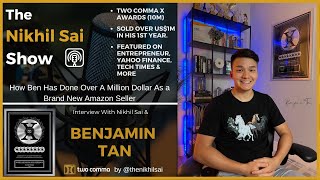
Benjamin Tan built an 8-figure Amazon FBA business and hit $1 million in sales his first year by focusing on understanding customers rather than just picking products. He now coaches other sellers and uses systems like ClickUp and Airtable to scale, while investing asymmetrically in things like a $500k NFT purchase.
Chapters
How would you like to learn the secrets of two Kama Club Award winners on how they have built successful online businesses from almost nowhere to now running multiple 7 and 8-figure businesses by following the simple fundamentals of life? And let's see how they have used the powerful funnel systems, processes, automation, and social media to help their business grow at a different pace. Let's dive into their journey to grasp the strategy, mindset, action plan of how they have done it from almost nowhere to the way up to 7 figures. We are going to uncover and pick their brains of the top performing entrepreneurs on this show, how they have done it and how you can do it too. You are listening to D Nikhil Sai, the host, and welcome to D Nikhil Sai Show. What's going on? What's going on everyone? Welcome to D Nikhil Sai Show, which is hosted by me, D Nikhil Sai. And guess what's going on today? We have one of the craziest today, so just stay tuned and pay close attention to this podcast today. We have one of the craziest guy when it comes to building relationships online and actually helping people to start, kickstart their Amazon business and scale it to over multiple six figures. This is a crazy journey. He may look young, but don't let his looks cheat you, right? This is a crazy story. He started in Amazon in 2017 and made a million dollars in sale in the first year of his business, then continued to do multiple seven figures in sales through Amazon. Now he's helping aspiring entrepreneurs to start, kickstart their Amazon journey and scale to over six figures through his coaching programs, which is freaking amazing. So let's not waste any time and actually welcome Benjamin Tan, founder at AMZFamily. Hey Ben.
Hey, hey, what's up?
Wow, Ben, thank you so much for making out time today. We are pretty excited to have you on.
Thanks for the nice introduction.
Absolutely, Ben. And there's a lot more to talk and dig deep into what you have been doing and how you're actually impacting thousands of people to build online businesses just in the comfort of their home, which is freaking amazing. So Ben, we would love to hear what all the learning curves you had inside the journey which are actually going through right now. So Ben, would you like to give us like a quick intro on how did you actually get started? Like what are these crazy journeys about?
Right, sure. So my backstory, it's, I'll try to keep it really short because I may look pretty young, but I'm already in my mid-30s. So I've been doing business for probably over 15 years now. So my backstory is I actually grew up in a bankrupt household. I grew up poor. And ever since young, I wanted to break out of the whole poverty cycle, the rat race. So I've been reading a lot of books. One of the first books that really changed my life was Rich Dad Poor Dad. And I've been trying so many stuff. But what I realized is every single thing I tried was simply a stepping stone. It gave me the skills, the knowledge, the network required to go to the next level. And I've been trying so many stuff, I've been failing at so many stuff as well. And I think like every time I fail, the rebound, it's always a lot higher. So like every single setback is a setup for the next comeback, and it's always getting greater and greater. So like right now what we do is we specialize on Amazon coaching for newer sellers. So I've been selling for over 4 years on Amazon. We've been doing pretty well. And 2 years plus ago, we came out and we decided that we want to share this knowledge with as many aspiring Amazon sellers. And since then, we have helped countless— I can't even count the number of sellers we've helped to either quit their job, start a business, start a full-time Amazon business from the comfort of their home. So that's where we are right now.
Wow, absolutely, Ben. That's really inspiring. And I believe a lot of people who are coming from that background should really admire this and actually have that hope that, hey, this is possible. Your background doesn't matter when it comes to business. Like, you can do it. It's all about the action plan. Just like Ben consistently kept on learning different stuff and improved his skill. Now where he is, that's beautiful, Ben. And I love, really love the impact you're already creating through your Amazon coaching business. I've seen a lot of your students. I personally spoke to a couple of them. It was just like that. It was really transformational while I see your stuff. That's amazing, Ben. So Ben, Even though Amazon is well-known trillion-dollar company, multiple trillion-dollar company, and everyone knows Jeff Bezos because he's the richest person in the world, and Amazon is like pretty much a keyword everyone knows about, right? But a lot of people don't understand like what Amazon FBA is, how does it exactly work, right? So Ben, as you're already in the business from 4 years and helping thousands of people start their own Amazon business, if you would like to give us like a quick business intro on how actually Amazon FBA works, we would love to hear that.
So to really break it down simply, how Amazon FBA works is just like any other e-commerce business you're going to start. But the only difference is you can leverage on what Amazon has already built up, and they, they probably have one of the best infrastructure when it comes to like selling online. So just a quick overview, Amazon— when we're talking about Amazon, we focus primarily in the US market, and they have like over 100 million US Prime customers, hundreds of millions out of the entire US population of about 300 million. So about one-third of US is a Prime member. And Prime members pay a lot of money to shop on Amazon. So it's very sticky over there, and people just tend to go online on Amazon to shop. Close to half of all Americans shop on Amazon, and Amazon have opened up their platform to third-party sellers. So like myself, I'm considered a third-party seller. For the listeners and the viewers, if you do sell on Amazon in the future, you are also a third-party seller. And by being a third-party seller, you leverage on not just the customer base Amazon has, you leverage on the trust. Because people buy on Amazon primarily for the trust factor. You also leverage on their entire fulfillment network, and they have hundreds of warehouses spread across US, and they have like all the logistics, all the manpower, they have the factories, they have the— not factories, they have the warehouses for you to store all your products. They also collect payment for you, and they take care of the customer support. So what's really left for us to do as a seller is we identify good products, We find a good supplier, we send it into Amazon, and we find a way to sell that product. And that's the most scalable business I can think of right now.
Wow, wow, that's, that's beautiful. And again, it comes to the leverage Amazon is actually allowing to all the FBA sellers, and that easily you can get to that level of trust. Because when it comes to especially e-commerce, customers buy from a store where they actually have most trust on. And Amazon, like, no one can beat Amazon when it comes to the trust factor. Exactly, because it's been there in the industry. So that's awesome, Ben. I think this can literally open a lot of people's eyes that, okay, Okay, there is a huge possibility to become an FBA seller right now, even in 2021, and kickstart their Amazon business. That's awesome. And Ben, this is a crazy journey. Even though like Amazon FBA is more like a hype happened in 2016, 2015 stuff, there was a lot of boom happening around, right? And you're one of those guys who actually made it to a million dollar mark in the first years on selling on Amazon. So how did you actually sell over a million dollars in your first year? That's where the crazy journey starts. The first year. How did you do that? Like, how did you actually do that?
I think it's just my personality, and that's something that I, I hope to be able to share with the listeners and the viewers. It's just my mindset when I come to— when it comes to doing anything. And this is something I've been always a big believer on, a big believer in since a very young age. And I believe that if you want to do something, don't, don't do it half-heartedly, which means don't do it like 50/50. Don't make it a a try, make it a must. So when I told myself that when I wanted to start selling on Amazon in late 2016, in fact, I only started selling on March 1st, 2017. I can remember the exact date because the sale, like, it was the most memorable sale of my life. Your first sale that you ever get. Yeah, so when I started this whole journey, it was actually late 2016, and I was kind of exploring, like, what's the next move? Because we just left one of our old businesses. So I told myself the next move must be something that I can do from home. It must be scalable, and I can— I must be able to do it for the next couple of years. So when I found Amazon, I told myself I want to go all in. I want to focus 100% in this area, and that would be the biggest key that helped us to sell over $1 million in our first year. So of course, $1 million in sales does not mean $1 million in profit. Selling on Amazon has a profit margin ranging from about 20% all the way to even 50%. We do about 30%, which is pretty decent. But I would say it's because of our focus. We did not look at other stuff. We were 100% focused in just Amazon for the entire first year, and that's why we got atypical results. So if anyone who is thinking that everyone who starts selling on Amazon can make a million in a year, is it possible? The answer is yes. Is it probable? It may not be unless you have the same level of commitment and the same level of work ethics. That's required.
Wow, that's beautifully articulated, Ben. That's awesome. I think it really comes to the consistency part of what you're actually doing on a daily basis, right? And the problem is most people who are trying to start an online business in 2021, they keep on jumping from one thing to another, right? And that helps them to lose that momentum and again brings them back to the beginner position and really pushes their, you know, like, success rate to the backwards. That's, that's really a sad part, but your consistency is really what matters when it comes to you actually scale your business. I think this is a key learning for all of the business owner. If you're being in a different area and starting to grow your business. Stay consistent on what's working, never look at different things or trying to crumble things. That's awesome, Ben. Thank you so much for that.
And welcome.
Yeah, so this is, this is one of the most demanding questions, by the way, right? So when it comes to Amazon FBA in 2021 specifically, right, it's more about product because every FBA seller is considered the same, right? The only differentiation is product and the warehouse and the delivery process you're actually following, right? So there is a lot of competition technically in 2021. So as you are the expert on helping thousands of people stand out from the actual market competition and make their first sale, or maybe hitting 6 figures in a couple of months working on Amazon. As per your expertise, what is the best way to choose the right product and standing out on Amazon?
Fantastic question. And the way I'm going to answer the question may not be what you expect, or even the viewer expect. And the real way to stand out on Amazon is not to choose the right product. I'm going to repeat that. The way to stand out on Amazon is not to choose the right product. But to choose the right people you want to sell to. So when it comes to selling online, we always think that we need to find the product, the product. We get very focused on the thing that we are selling. But what most sellers fail to see is that behind every single purchase, there is a person. And as long as you can understand who is the person, who are the people that you want to serve, it's very easy to think about the products that they're going to buy. So I had this mindset shift when I started selling in— after my first year, when I went to learn from one of my mentors, and he told me that to succeed in any business, focus on people, not on products. And it opened up my mind, and he showed me a different way of doing the business. And this is what we teach today in our community. In our community, we teach people that if you want to really make a lot of sales, don't look at what you sell, look at who you sell to. It's more important to understand the end customer, their wants, their needs, their problems, their pains, their aspirations, and finding the product that can solve their problems. That is how you choose the right product.
Absolutely. Wow, that's beautifully articulated, Ben. I think this really applies to every business, not just—
Yes, exactly, not just on Amazon.
Yeah, like, that's where the people stand out like you, who actually understand the customer psychology and understand the customer, because products change, offers change, trends change, but the customer is the same person who owns the credit card. Right? So if you understand his pain points and if you can solve his problems or her problems, that's when you can actually capitalize on a larger scale. That's awesome. That's really awesome, Ben. I'm pretty excited for the next question. So let's move to the next question. So Ben, you've been seeing the trend of Amazon and the e-commerce and how it's going through, right? And it's been, it's been scaling through the roof even in the COVID times. Like, Amazon is one of the strongest businesses who got into more valuation and who's getting crazy level of orders and fulfillment so far, right? So as the e-commerce expert here, would you like to tell us more about like the future of e-commerce with Amazon? How does that gonna look like?
I would say future of e-commerce is definitely booming. Future of e-commerce with Amazon, if I were to say it the way I see it, it's probably gonna get more and more competitive. And here's why. Everyone around the world, not just in US, knows that Amazon is one of the biggest marketplaces for US-speaking countries. Not just in US, but when you talk about Europe, you talk about UK, Australia, it's one of their biggest, if not the biggest, if you exclude the Chinese marketplaces. So everyone who wants to go online, they can either choose to sell on their own website, or they can go on the biggest marketplace, which is Amazon. So that is why there is the most number of new sellers over the past couple of years going on Amazon. So is it going to be easier and easier? The answer is no. It's going to be more and more competitive, and that's why education is the key. Because if you're going to do something, you don't want to be doing something that what people used to do 3 to 4 years ago. You want to be thinking ahead and doing something that no one else is doing. And that's what we focus a lot on. We focus on not just teaching people skill sets, we focus a lot on training up their mindset. Teaching people how to think is a way more critical skill than simply teaching them how to sell on Amazon. Because I've taken so many courses, and a lot of the courses, all they taught me was, this is how you find this product, it must meet this criteria, this is how you sell it on Amazon, click here, list your product, do these campaigns, it would sell. Does it work? Yes, tactics work for the short term, but we teach people timeless principles, and principles never change. So the future of e-commerce on Amazon is going to be tough, and that's when the people who can really think critically they can stay ahead of the curve.
Absolutely. Wow, wow, that's awesome, Ben. I think that that's really on point when it comes to the audience. They can really understand why Amazon is going to evolve at a higher scale and how they can stand out. And that's beautiful when you actually mentioned that a lot of people are actually teaching the kind of what to do but never showing exactly like how to do or exactly the in-detail first principles on the business plan. They give you like a tutorial like, hey, click here, click here, click here. But guess what? In 6 months, the interface is going to be changed. The trend changed, the product changed, but guess what? You're left with those actual strategies which never work in the coming times. That's beautiful. I think people should always think ahead, as you just mentioned. So that's awesome, Ben. And this is a personal question here. I would love to hear your inputs on this, right? So whenever a product owner— as a product owner, let's say if I have a product, right, I have two options, which is, you know, creating my own e-commerce site and creating Amazon, right? So what do you think is the best way to actually proceed if I'm actually a product owner and What do you think is more lucrative when it comes to long-term business matters?
I think in terms of like thinking about whether to sell it on your own website or on Amazon, it shouldn't be a kind of like an either-or kind of thing. Yeah, but if you really want to choose to focus on one platform at the start, my advice, my honest advice, is really to start where all the customers already are, which is on Amazon. Start there because you don't need to build a website, you don't have to find your own customers, you don't have to collect payment, you don't really have to do fulfillment, customer service. You just have to handle the product portion. Amazon handles the rest. If you were to bring it to your own website, you will literally have to handle everything else, and it's probably too steep of a learning curve, especially for new sellers. So for any of you who are a new seller, personal advice, I've tried both approaches. Selling on Amazon is way easier. Once you have established your product on Amazon, then you can bring it off Amazon, build your own site, learn a different skill set, and stack it up from there. But the focus should be on taking the path of least resistance when you're starting out, and for sure that is selling on Amazon.
Wow, wow, wow, that's easy. Like, you literally nailed it down, bro. That's awesome, Ben. So literally now every seller can think of like, okay, before you actually create a website and pay thousands of dollars for a Shopify store and try to spend $1,000 or $10,000 on ads just to see if that works, you can test it on Amazon and see how that's performing. And once you have a customer-based proven product, then you can actually, you know, try your own site and, you know, increase your margins. But of course, traffic has become more costly, so you will be left with the similar margins, not huge profitable anyway. That's awesome, Ben. And Ben, here is the story. After you actually successfully build your Amazon business, you've been transforming thousands of people's life, teaching them the skill set and the mindset and how to think literally about creating their own successful online business when it comes to Amazon. And we have seen a lot of students jumping out into different stuff with the mindset you are giving them and killing different niches as well. So we'd love to hear the journey of AMZ Family on how you have scaled to over 8 figures. That's freaking awesome. How did you do that?
So I truly believe that if you can get other people what they want, you will get what you want. And, and this is something that I've been a big believer on since day one. So from, from day one, our focus was never on the numbers. So it was never like we want to we want to like have this number of people in our community, we want to like sell these courses to these people. It was never from that, that starting point. Our starting point was very simple. When I came out to coach a few years ago, I saw a lack of ethical coaches in the market. I saw a lack of people in the market who was doing it for the impact rather than for the income. A lot of them were just like selling courses, rehashed information, and a lot of them, their students were having very, like, very poor results or very small success rate. So I told myself that if information alone can change lives, then everyone will be rich off watching YouTube. And I realized that there was something missing there. So I think the biggest difference why our community have a very high success rate is because we don't just focus on one area, we focus on every area in their life. So in our community, we don't just teach them like, this is how you sell on Amazon. I truly believe that if you want to excel in one thing, you, you need to make sure that your life is holistic, which means that you must look after your health, you must look after your, your body, your fitness, your, your habits, your, your thoughts, your mindset. Everything adds up because if you are holistic in all areas, it shows in your business and you will excel in your business as well. So the reason why we have scaled pretty fast is because our students have results. And when you have results, people want that kind of results. And that's when we started growing. So I would say why we managed to scale to over 8 figures was simply because we cared a lot for the students and our process helps them to get the end result that they want.
Absolutely, Ben. And especially coming from a standpoint of looking where you are right now and looking into your coaching program and talking to your clients already, it really feels like you're giving that accountability which not a lot of other people do, right? They'd be like, hey, watch this course, do it yourself. Maybe you do it, maybe you're not, we don't care. But you are coming from a different standpoint and giving them the right information with an action plan to implement while handholding them, which is beautiful. Like, not a lot of people are supporting. That's where you're cutting through and being the number one people when it comes to, you know, teaching Amazon and stuff like that. That's awesome, Ben. Thank you.
Maybe if I can just add on a little bit to that. We— our starting program is— it's not even a program. What we do over here is a coaching program, and the minimum time frame we tell people is 6 months. It's not a 30-hour video program, or it's not like, oh, it's a 6-module where you watch like 10 videos per module and you will be a millionaire. No, none of that stuff. We tell people from day one, if you come in, it is minimum 6 months, which means you need to commit mentally and also your time and your resources to put into the business to really see results. Because I truly believe that if you can build a business in 6 days, it will not last 6 months. So it requires that period of time for you to, to change not just the business, not just to put into the business, but the 6 months we focus a lot is changing the business owner. And it requires at least 21 days for anyone to change their habit. So the first few weeks, we are not really working on the the student's business. We are more like working on the student. We are working on their mindset, rewiring them, changing the way they think, changing the things they do. And when they change their habits, then whatever we teach to them, they will be able to implement it. And through our 6 months— and it's a very close hand-holding process, we have a team of coaches, we have lots of touch points, we have live trainings, we have even some done-for-you elements, we even like give them like product potential products to sell Some of the students, we even take photos for them because I have a very big team to support our entire community. So when we help the students out every step of the way, the things that I wish I had when I started— that is why a lot of them have a very high success rate if they stick through the whole process.
Wow, wow, wow, that's, that's awesome, man. I think this is really cool and it should really attract a lot of people, especially if they are a business owner. They need to be thinking about solving similar problems like you are doing in your community. They should be thinking about their end client and see what they can really provide as a business owner for them, which is, which is freaking amazing. And I love the fact that you're actually handholding people for 6 months. That's, that's beautiful. That's beautiful, Ben. And Ben, I mean, I'm following your stuff and you are a crypto nerd. Like, you really love to play around in crypto and NFTs and stuff like that. So we'd love to hear— we have recently seen that you invested close to half a million dollars in NFTs, which is crazy. So we would love to hear about that. Like, what that is. Like, I'm not a crypto nerd. I don't really understand that stuff. So I would love to hear and learn from you. Like, why did you invest half a million just like that on an NFT?
I would say I'm a pretty risk-adverse person, uh, contrary to what you may think. And yeah, even though it was a— I would say it's a pretty big sum, it's not like my— it's not like I dumped everything in there. It was kind of like more like my crypto, a portion of my crypto portfolio. I've been involved in crypto since late 2016. I bought into Ethereum when it was less than $30. I bought pretty heavy. I bought into Bitcoin when it was less than $1,000. I bought pretty heavy. So my kids have Bitcoin. My wife has quite a bit of Bitcoin. I have the rest. So it was more like an opportunity I spotted. So for me, I wouldn't say that I like to look for the next shiny object. I like to spot something and I focus there. But if there is an opportunity that opens up itself to me, I would definitely want to explore it. So like this whole NFT thing, in fact what NFT stands for is non-fungible token. It's basically like a— think of it like digital art. So what if you buy like a Mona Lisa art piece, it's one in the world. If you buy a digital art piece that is like only one in a kind, it will forever be only yours and the value can only go up as long as the demand for digital art increases as well. So what I did last week, I think you probably saw on Instagram or Facebook, is I spotted this new NFT project that had all the checkmarks of something that was going to explode. And when it checked all my checkmarks, I saw that the community was good, the project was good, it had a viral factor to it, and there was this meme culture. It was steeped in meme culture. I think you've definitely heard of Dogecoin and everything. And I realized that this is where the market is going. It's no longer looking at fundamentals, looking at stuff like that. Like the whole thing with the AMC and GameStop in the US. People want to support movements. People don't support companies for the fundamentals alone, they support movements. I saw that there was a movement behind this whole NFT that I bought, it's called PUBG Penguins. So I decided, let's just go in. That's what happened and I happened to go in pretty heavy.
Absolutely, man. And I really love the approach you have done, right? Like, a lot of people think like, oh, these guys have money and they're just dumping just like that. But no, guess how much homework have been done? He's literally been watching the trend and he saw that there's a meme culture around this, so there's a huge potential of this exploding pretty soon. So waiting for that point, bro, I'm really excited to see where this is going.
Yeah, I probably want to add on here because in case anyone who is listening and they, they get the wrong idea To me, I view this as a very asymmetric risk-reward decision. So every time I look at any single thing, before I do it, I will ask myself the two possible things that may happen and the likelihood that it will happen. So I ask myself this question: what is the likelihood that what I buy would drop in value drastically? And if it does happen, will it kill me? So I said, no, this won't kill me, this is my play money. And what is the confidence level, what is the percentage likelihood that it would halve overnight? 'Is probably about 50%. Anything could happen in the crazy world of crypto, NFT. So if I buy it at $500,000, the next day if it drops to $250,000, am I willing to accept that?' So I said, 'I'm fine.' But then again, I asked myself the next question: 'What is the potential for it to increase drastically, and what is the odds for it?' And I asked myself, and I said, 'The odds for it to go up 10x from here is probably about 50% as well.' Wow. I said, if it's a 50% chance that you will drop half, but there's a 50% chance that you'll go up at least 10 times, to me it's a no-brainer. I don't have to get every single one of these decisions right, I just need to get 1 in 10 right.
Wow, wow.
That's the way I approach anything, and so far it has worked out pretty well for me. It's already more than a 10x now.
Wow, wow, that's exciting, man. That's really like a fundamental principles on how you're looking at investment. I really love the concept of asymmetric strategy while you're looking at investment opportunity. I think this is a lot of stuff business owners specifically need to consider while you're actually investing in your business or trying to invest like the play money you have into different stuff. That's, that's awesome, Ben. And Ben, you're an awesome cool dude like who is so calm here, and you're running a coaching business, you're running Amazon FBA business, you've been transforming thousands of people's lives, you're also playing with NFTs and stuff like that. I wonder like how do you get your stuff done? Like like, do you use any tools and processes inside your systems for your productivity? How does that look like?
I would say the biggest reason why I can get shit done is I know how to compartmentalize, and I focus only on 80/20 activities. So I've always been someone that do not focus on the small stuff, because I believe that if you end up focusing on all the small things in your business, you will be working in your business and not on your business. So there's this concept I learned a long time ago, and in fact, I've been attending so many masterminds, paying so many of my mentors so much money over the last few years. One of the masterminds I went to before taught me this concept called the red dot. Okay, and I want to share with you and maybe the listeners as well. And that is, in any single business, when you start, you are the red dot, which means that you are literally the person in the center of your organization that does everything. If you just started an F&B restaurant, you are the cook, you are the cleaner, the cashier, the waiter, and the floor sweeper, and the dustbin, the rubbish disposal guy. You do every single damn thing. And then gradually, once your business stabilizes, you would then replace different people who will be the red dot in that particular area. So for example, if you are a restaurant owner, you will then firstly hire a cook because the cook needs to cook. Then you will probably be the cashier and waiter and get people in the door. And next, once that has been stabilized, you'll probably hire a cashier a waiter, then you hire accountant, you hire a marketer, and eventually once you have hired out all these red dots to fill up all the departments, you extricate yourself and you hire a restaurant manager. And now you manage one person. That one person will have to manage all of the different people in the business, and that's how you can remove yourself as the red dot in your business. So that has been always at the top of my mind every single time I go into any new business, and that is Can I do this business without being the red dot? If no, I will not do it. If the answer is yes, it will take me some time, but I'll get there, I'll do it. Because that is a real business. You not being involved in the day-to-day operations, you managing people that manage your business.
Wow, wow, Ben, that's a real amazing strategy. I think it's literally gonna cut down all of the learning curves every business owner had. And like, literally every small business owner, specifically if they are doing 6 figures or less, is they are the one-man show. They have a couple of team, but they just do them all the things themselves, and they be that sticky scarcity guy who holds on things every time. But I really love the concept of delegation and replacing yourself in different places so that you can be on the business. And that strategy is just amazing. I think this is going to open up a lot of people's mind. That's really awesome, Ben. And also, do you use any kind of tools to manage your productivity, like anything to manage your schedule, like Trello or something like that? How does that look?
So I think that will be more on the strategy side, what I've just shared. If you really want to go tactical in terms of tools For me, in our team, at least our organization, we use a lot of automation. So I don't believe in doing stuff manually. So in every single area in our business, if we can systemize it, we can automate it, we will definitely do it. If we need to like keep repeating certain steps, we will definitely put it in an SOP. And we have a lot of SOPs in our different business, not just in online coaching, Amazon. I have different business on the side as well. We always have step-by-step SOPs, checklists. This is how to do this step. Step 1, step 2, step 3 is very detailed with pictures, with diagram, with video, so that anyone who plugs themselves into that role immediately watches the SOP, they can follow. So we use a lot of Google Sheets, we use a lot of like Google Drive. We also use ClickUp in our team. Certain departments use ClickUp. I have not even seen my team's ClickUp. So I have my project manager who has set up all the ClickUp. I have full access. Till today I have not even logged in. I have no idea what they do as long as stuff gets done. We also use Airtable for our coaching business. So Airtable is how they manage all our, all our students. They track the progress, they use it to onboard students and also like follow up with them. Till today, I've still not seen Airtable, how it works. I just know that it works. We use Slack for team chat. I do not speak to every single person in my team. For me, I only speak to one person, and that's my project manager. So I speak to my project manager, she speaks to the different departments, graphic designers, product researchers. We have people who do account management, people who are copywriters, photographers. She manages them. I speak to her. So I've always been focused on how do I replace myself, and they set up the systems, they set up the tools, and I just manage people.
That's beautiful. I think this is gonna really hit hard to a lot of business owners, and they should be really questioning themselves, like, how can I be like Ben? Be Ben. That's when you can actually have the prosperity in your life and business. That's really awesome, Ben. Mesmerizing. This is beautiful. Like, you're managing things at a very higher scale, and I really love the vision which you're looking at. Like, how can I create more impact by placing yourself in different places so that you can play a bigger game than rather being in that loop of, you know, that hamster wheel you're trying to run yourself? That's, that's really amazing, Ben. And Ben, as we are speaking We know that you get shit done very quickly and you, you are a free family man. We really see and we love that. We would love to know more about like your daily routine for your success. Like, do you kind of have any routines for yourself?
Daily routine, uh, this may scare some of you, but I do this by choice. So in the morning, I wake up with my son very early, 6, 6:30 sometimes. So about in the 6, 6 AM range. Then I spend time with him in the morning until he goes school. At about 8 to 8:30. After that, it's straight to work. I probably put in— I wouldn't say I work very like hardcore long hours, but I would say that it's not the hours you put in the work, it's the work you put in hours. So I get a lot of stuff done due to the way I do stuff. I chunk my time. So like, if I have to get stuff done that is important I get it done earlier on in the day, and I would set aside like 1 to 2 hour blocks, uh, focus work. No Instagram, no social media, no handphones. Set it aside, silent mode. I'll just get it done. And usually by noon time, I can get most important stuff out of the way. I work from home with my wife, so she's sitting next to me. She's not here now, but her, her table is just here. So we just, we just work from home, we manage our team, and then we just have lunch at home. We continue to work. Sometimes we go to gym, we go 2 to 3 times a week as well. Then we go fetch our son at about 4 PM, we spend time with him until 9 PM. And our son— I have a 3.5-year-old son and a half-a-year-old daughter— so we spend time with them until my son sleeps at night. And then I probably work until 12 or 1. Yeah, that's about it. That's my daily routine.
Wow, that's really simple and it's really on point, right? Like, your goal as a business is to have that kind of every single element which you focus on, which is having family time and business time and getting most important stuff done. I really love the way you're prioritizing your day, brother. That, that really excites me and hope a lot of people can actually learn stuff from your routine and probably can input some of the learnings from there.
Yeah, and there's something I may want to share as well, is because I work pretty long hours, I would say, and I don't sleep a lot. I probably get in about 4 hours to 5 hours of sleep every night because at night is when it's the most quiet. I get the most stuff done at night, and I kind of like to work US hours. So I've been trying to practice this polyphasic sleep. So I sleep in chunks, like 4 to 5 hours at night, and sometimes if I'm tired in the day, I take like a 15 to 20 minute shut-eye. And I'm, I'm done. So I, I get as much rest as a typical person in just like 4 to 5 hours, when most typical people have to sleep like a full 8 hours. Yeah, so I got myself accustomed to that so that I can get more hours done in a day, because I don't want to sacrifice on like family time. So I, I optimize my sleep cycle, and I would say it's also like, it's not the hours you sleep, it's the quality of your sleep. So I sleep in a very dark room room with a pretty cold temperature with nice warm blankets. So in 4 hours you feel more rested than some people do in 8 hours.
Absolutely. I think this is more of a high-level stuff like a lot of millionaires, billionaires follow technically, which is managing their sleep productively. Like a lot of business owners think they hustle for 12 hours and they sleep for 12 hours. They think that that's the most productive way to run their business, but it's not. Guess what? He's sleeping just 4 hours a day and he's making the most out of his sleep sleep and getting the rest which his body deserves and, you know, still being on the pace. That's, that's really awesome, Ben. And I really love the way you are actually going to focus on the quality of the sleep than the time you're consuming to sleep, which is freaking awesome. I think a lot of business owners should try to get this skill set of having enough sleep in the right time period. That's, that's really awesome, Ben. So Ben, as we are discussing here, you have been into a lot of businesses, being, being young, trying different stuff even getting into some different coachings and learning from different people, right? You have been failing a lot of time. That's just how business functions, right? So we would love to hear, if you had an opportunity to talk to a 20-year-old you, like if you can go back 15 years and talk to yourself, what will be your number, number one suggestion?
What would be your suggestion to a 20-year-old you or someone getting started now? I would say try more stuff and fail faster because Most people do not try enough stuff because they are afraid to fail. But I would say the cost of failure when you are 20 is so minuscule compared to the cost of failure in your 30s and in your 40s. And the more you age, when you are in your 30s, some people will have a husband, a wife, kids, house, car, commitment. When you have a big commitment, it starts to add up. The level of risk you are willing to take will be way lower as well. And that is why most people who do not try anything in their 20s may unfortunately end up being stuck in the career for the next 40 years, and they will live their life with regret. So I will say to anyone in their 20s, if you think that you do not want to try stuff because you're afraid to fail, my advice to you is try everything. Failure is cheap in your 20s. Failure is expensive when you're in your 30s and in your 40s.
Yeah, it gets expensive as the age progresses. Yeah, I think this is a real learning curve every young person should admit and actually start to do a lot of stuff together. And that really becomes a learning curve, and that creates that stepping stones every single person needs before they actually can achieve one big thing they're gonna hit. That, that's really awesome, Ben.
Yeah, and maybe I can add on to that as well, because I would say for anyone who is in the 20s, he or she may not exactly know, like, what they want. Okay, if I were to bring myself back 15 years when I just started out at 20, I honestly had no idea how this journey was going to be like. All I knew was I was young, I was hungry, literally and financially. And I told myself that I just want to put myself out there. I want to speak to people. But you don't just want to speak to anyone. You want to speak to people who are at the level that you aspire to be at. So put yourself out there, go and network, go speak to the people that you want to learn from. Some of these relationships you have to earn your way. Some of them you have to buy your way in. So since I couldn't afford to buy my way in, I had to try to earn my way in. Network, see how I can add value to their life, see what pains and what problems they have that I can solve using my capability. If not, what are the skills I can acquire that can solve their problems? And then I go there, I offer my service, I offer my time, and if I solve a problem, I build goodwill. And over time, that's how I earn my way in. So I would say in my 20s, I tried so many stuff, but it's not like everything was succeeding immediately, but you will know when you hit on something that you are really good at. For me, it was when I was 23. I realized that I was pretty decent at sales. I read a lot of sales books, I went into real estate in Singapore, and I realized that I just had a knack for selling stuff. Previously, I had no idea. So when I was in property, I was very involved in the local property market in Singapore from 2011 to 2014, every single year I was one of the top producers in the biggest agency in Singapore. 2011, in just 6 months, I won the top new achiever in the biggest agency in Singapore. So it's something that I realized after I failed so many things. This is the one thing that you're good at. If you find something you're good at, go deep, focus, achieve mastery before you try to move on to the next thing. And I was just purely doing real estate for about 3 years, and that was how I made my first pot of gold.
Wow, wow, wow, wow, man, this is so much learning curve, right? You've been into real estate as well, like you, you got so much stuff done, and that's a real—
I'm older than I look.
You really do, you really do. That's, that's awesome, man. I think this is, this is gonna really help a lot of entrepreneurs who's listening to this podcast. And literally, I love the way you actually explain how someone can actually start to network with the higher level community. That's, that's just amazing. Really love the stuff you're actually dropping in, Ben. Thanks for amazing, amazing value bombs. We really appreciate. This is so much fun and so much value pouring in. That's awesome. So Ben, let's get to the next question. So what are your life's biggest achievements so far and any next bigger goals?
Life's biggest achievement, uh, I would say It's still a work in progress. I'm pretty proud of what we built over here in our community. We have a lot of successful students, but not just the results, it's more like the transformation. And the hardest thing I realized is to change people. So it's only when people change, then you see their results and their life change. So I would say that is so far one of my proudest achievements, being able to go out there and impact people by the hundreds. To change their life through the power of selling on Amazon. But I have way bigger goals than just to be an Amazon coach. Selling on Amazon and coaching students to sell on Amazon, I wouldn't say it's a hobby of mine, but it's a passion of mine. I, I am a big believer in education because education in myself, investing in myself, is what changed my life. So I want to go out there, I want to share this with as many people as possible. But to me, this is just a stepping stone. So my big goal of this whole coaching, why do I share this with many people, is I want to get as many people to the 7-figure-a-year level as possible. And then I want to combine everyone. Okay, this is my own personal vision for the next 3 to maybe 5 years, at least in this Amazon business. I want to get at least 100 people to the 7-figure-a-year mark together with me, and then I combine everyone. I agglomerate that And this is something that I can talk more later on. I learned about this model 6 years ago as well in a different business of mine. So I wanted to agglomerate all of them, and the reason is because if you are doing a million a year, you'll be doing maybe $200,000 to $300,000 a year in profit. Good numbers. When you decide to sell out your business, you will be able to sell it for maybe 3 times of your annual profits. Let's just say $600,000. So $600,000 is quite a fair bit of money, but it's not life-changing. Maybe not for— not for some people it may be life-changing, but where I'm from in Singapore, $600,000, it's not retirement-level money. Okay, if you know the standard of living in Singapore where I'm from, you probably need at least $2 million to retire comfortably in Singapore. That's the national statistic, and most people can never retire comfortably in Singapore due to the high level of the high standard of living here. So $2 million is like the minimum. $1 million, you'll be retiring but not really living a comfortable life. So while $600,000 is a lot, it's only because your business is at a certain scale, and that's like a million a year. But when your business is at the $10 million a year level, you, you don't just sell it for like 3 times of your annual profits. The business is now bigger, you sell it for way more, easily 4 to 5 times. How about if your business is now 9 figures? You can now command a much higher multiple, easily 7, 8, even 9 times. So that is my big goal. Rather than me just trying to build my Amazon business to the 8-figure and then selling off for 8-figure, what if I can get everyone there a lot faster by imparting this thing called knowledge, which is all up here, which is transferable, getting them all to the 7-figure a year level, combining everyone together and then we sell out for a big payday and everyone gets a way bigger piece of the pie. So that's my big goal for this business. I want to agglomerate everyone because people are already doing it in the market. There's a lot of Amazon aggregators who have raised billions of dollars going out and buying up all these small brand owners for a couple of million, a few hundred thousand, a million here, a million there. But when they are buying them under their own company, now they are worth 10 to 20 times and they are playing at a different level. So I don't just want to play at this level. 7-figure a year is great, but I want to play at a 9-figure a year level. And to do that, the whole business model changes. It's not just about selling on Amazon. Selling on Amazon is just a platform. Okay, the entire model is now getting them there so that we can combine and sell out to someone way bigger.
Absolutely, bro. Like, you're really creating a complete marketplace in the longer term, which is freaking amazing. And Ben, I really love the way you're not holding anything. Like, literally dropping of value just like that continuously. I really love the vibe, bro. That's, that's really awesome. Thank you so much for so much value. And man, let's get into the next question. We have some amazing question here. So you've been into multiple businesses right now, right? And you've been doing a lot of mistakes, right? So if you— I would ask you like, what was the biggest mistakes entirely throughout the journey, especially in terms of business? What would have it been?
The biggest mistake in my life is when I tried to save money. And I'm gonna try to explain that. Every time when I do something, I think this, this is not just for myself, this is probably for most people, and maybe even you may even be able to relate to this. And that is like, if you can do something like start a new business, there's always two choices. I can learn it by myself for free on YouTube, I can go and download a course and learn something for free, or I can choose to pay. But the typical human decision would usually be, "Oh, if I can learn it for free, why do I need to pay for it?" And that, I would say, is one of the biggest mistakes I've made, and some of you probably have made as well. And that is by not willing to invest to learn from someone, you will pay for your own mistakes. And I truly believe that the cost of making mistake in any single business is way more costly than the cost of making an investment in the right person, in your own education. So for some context, when I started Amazon in late 2016, even though I've been a business owner for so many years, I told myself, I'm smart, I think I can figure stuff out. I went to buy a very cheap course online, I think it was like a couple of hundreds, and I said, okay, that's it, I have all the information I need. I went on YouTube, I watched so many videos, and I said I am now an Amazon expert. So I went to start my own business late 2016 for a couple of months until in February, about 2 months after that, I kind of realized that I thought I had all this info up here, but why am I still stuck whenever it comes to, oh, how do I decide? Do I do this? Do I do that? Oh, is this a good product? Am I sure? I'm not that sure, 50/50. And in business, every time you are unsure, there's a lack of clarity. You were not there to move forward. And I realized that I wasn't moving forward. I couldn't make decisions simply because I had no clarity. And that is when I decided, screw this, I've already committed to doing this business full-time. Let's go and learn from the best. I don't just want to learn from someone normal. I learned from the best. So I flew to US, I invested $8,000 to fly to this, to fly and attend a 3-day event from one of the top Amazon sellers in the world. So his name is Justin Ligeri. He used to run this event called Rank One Pro, no longer running it because it was just for a short period of time. He has been since retired, I believe. So he's the first person in the world to sell $1 million a day on Amazon. That was in 2014. The first person in the world to sell $10 million a month, that was in 2015, I believe. And I went directly to learn from him, to see the way he thinks, to look at the level at which they operate. And it's very different when you learn from someone at 7-figure, you can maybe get to 6-figure. When you learn from someone at 8 figures, you may be able to get to 7. But when you learn from someone who is at 9 figures, now you know you can get at least to 8 figures. So that's who I learned from. And I said, I paid so much money, $8,000 US, because before that I made a mistake that cost me almost $15,000 US somewhere in January. It's a very stupid mistake. When I went there, I spoke to the people there, they said this is a stupid rookie mistake, could have been avoided. And I realized that no longer do I want to save on education, I want to shortcut. I want to pay the right people, shortcut, because not just I save the money, I save time. And in any single business, time is the most valuable asset.
Absolutely, Ben. Wow, that's a great learning curve. I think a lot of business owners should admit this and they should get out of that scarcity mindset of holding off all the money they're making the business and pushing them into the bank or the SRP funds they do. They should be thinking of like, how can I actually learn? And like, I really love the mindset that you have right now, which is like, okay, you learn from someone who is already doing 9 figures. Now where you are right now is multiple 8 figures. That's so beautiful, right? So you only had that kind of access to the knowledge and the mindset as you started to work with that type of person, which is freaking amazing. Guess what? If you would have held on that small investment, like, we wouldn't be connecting on this podcast technically, right? Like, it would be an entire different story, right? So like, it would be like a different story. Oh, that's amazing. I think this is a large learning curve for every single business owner. Like, start investing in the right people. Make sure to check the background, but invest in the right people to help you to shortcut the learning, because it's already costing you the information, the implementation. You're going to learn from a successful business owner, it's already bleeding a lot of money for you because you're holding off. Like, get to the fence and you will really have the success you deserve. That's really awesome, Ben. Thank you so much for amazing story. We really love the vibe here. So I mean, I'm pretty excited for the next question. As you're getting so much successful, right, you already named a couple of mentors in your journey, right? We would love to hear like what is your main inspiration for your success and the key people involved in your journey.
Inspiration for success, hmm, why you want to do it?
Because see, technically a lot of entrepreneurs, once they start making money like that 6-figure level, they feel comfortable because now they have all the bills cleared, they have no debt on them, them. They still have that positive cash flow. They have the lifestyle they deserve, right? So they get into that kind of comfort zone. But people like you who cut through that and you scale to multiple 8 figures, which is freaking amazing. So there is a small mindset shift you have than other people. So I would love to know, how does that work?
I would say it's not a monetary goal. Uh, it used to be many years ago. We've since way surpassed that. And I kind of used to, to set like yearly goals. So like when I started out many years ago, I still remember every single year I'll sit my wife down and I say, this is the goal we have for this year, 2008, let's make X amount of money, and then we'll hit it. I'm like, fantastic! 2009, let's hit X amount. And it will go up year after year, we'll keep smashing through it. And after a while it's like, okay, so what if we hit our goals? What next? And it kind of felt like success to us, or the goals we set was simply like a endpoint. It's like a destination. And after a while, I stopped setting all these yearly goals. Now I set more like developmental goals. Okay, for me, it's more like, how do I become the best version of myself every single day? How do I be better today than I was yesterday? And success to me is no longer just about a number. It's not about, oh, if I can do this big, I can bring everyone to the 7-figure year level, we can sell out for, let's say, $100 million, $200 million, you take yours, I take mine. It's not the end goal. Even if I were to do that, it's not like I'm done for the day and I will just sit on the beach and retire and sip some martinis. Like, I don't think I'll ever retire. It's more like I know I can be capable of doing so much more. Why not push myself to be the best version of myself every day while I'm still around, when I'm still around, and try to bring as many people along with me on this, right? So there's always something that I ask myself, and that is like, do I want to grow up to be the kind of person that my son will look up to, or do I want to be the kind of person that when my son grows up, he look at me and say, I don't want to be like my dad? Because this was something that personally for me, I had that kind of childhood. I grew up with a rather abusive father, both physically, verbally, a bankrupt household. He made a lot of bad financial decisions, and I grew up every single day telling myself that I don't want to be my dad. I want to be the total opposite version of him. I want to be nice to my son. I want to be loving. I want to be caring. I want to spend time with him. I want to grow up with him. I want to bring him out. I want to set a good example for him. So I would say one of the key persons involved, ironically, would also be my dad. Because I told myself, my dad back then— okay, today he's way better— but back then, he's not the kind of dad I would have wanted for myself to be. So it's something that constantly is at the back of my head. I'm always thinking, if I were to do this business, if I were to make this decision, is this something that my son will grow up next time and say, oh, I'm proud my dad did that? So I would say that's something that is keeping me going every single day.
Wow, wow, that's beautiful, Ben. And I think the real hunger you have to be the best example for the world, I think that's really helping you to stay on pace and hit that consistent and create that level of impact you're actually creating. That's, that's really awesome. And I think every person should actually think about them. So like, rather than having like a financial goal or a business goal, try to more be like a personal goal on where you want to be at the different level, how you can be the best version. And that's going to entirely change the pathway, because if you as a business owner become the best version of yourself the business will be in the best version itself because you are the business technically. You attract that vibe. That's really amazing, Ben. Thanks for sharing that story. And Ben, you are amazing, cool dude, so calm, so much value here, dropping off amazing value bombs, a lot of inspiration and amazing value which no one ever shares. And the kind of accountability and the kind of mindset you have, which is so prosperous. I really love the vibe, right? So where can our audience find you mentoring if they want to learn stuff from you?
Where they can actually reach out to So we actually have a free Facebook group for those, those of you who want to find out more about Amazon. We do go on Facebook Lives quite frequently. There's a lot of training, there's a lot of value in our Facebook group. So the website is actually amzackfamily.com/roadmap. So when you go over to that site, you can join our Facebook, and inside the Facebook, we will give you a roadmap of how to get to 6 figures in 6 months. Okay, once again, the website amzackfamily.com/roadmap will give you kind of like a condensed version of like the— in the 6 months, what do you need to do in order to get your first 6-figure on Amazon? We have been using this roadmap and sharing this with a lot of our students. Many of them have done it in a way shorter time than in 6 months. So that's how you can find me. On top of that, you can also, uh, follow me on Instagram. My Instagram handle is Hey Ben Tan. So that's H-E-Y-B-E-N-T-A-N. And you can follow my Facebook page as well. It's the same handle, Hey Ben Tan. Or you can drop me a message on Facebook. I do reply to almost every single one of my inbox messages.
Wow, that's really awesome, Ben. I would love to add all the links which you mentioned in the podcast description. So everyone who's listening to the podcast, in case if you want to connect with this amazing dude, go check in the description. Join the AMS family. You will love it. The vibe is at a different pace. I'm already in it, so I know from the experience It's, it's a beautiful community to be, be in for sure. That's awesome, Ben. So Ben, this is an amazing, valuable podcast session we really had today. I really enjoyed the time. So before we conclude, do you have any last words for the listeners?
Any last words I would say is probably if you are listening to this and you're watching this, whatever you've like gained from this, it's just going to be information. And I've learned a long time ago that information alone is worthless. If you never take it and you implement it, it's just going to be something that you, you learn, you feel good, and then when you sleep and you wake up, your life goes back to exactly the same. If you want your life to change, you first must change. Be the change and you will see change happen in your life.
Wow, Ben, that's a beautiful message. I think a lot of businesses need this is, right? They really need to pay attention to this message because they listen to this podcast and different motivational stuff every day, day in, day out. But when they wake up, as you just mentioned, is the same person. Because knowing and not doing is equal to not knowing. Even if you know the stuff but you never done it, that's just worthless information for sure. That's really awesome message, Ben. Thank you so much for this amazing opportunity for hopping on this podcast. We really enjoyed the time. You had actually been dropping here amazing value bombs. And hopefully, guys who are listening to this podcast so far, there are so many learnings through Ben's journey and all the Amazon stuff you have done and the coaching stuff he's currently doing right now. So make sure to really listen to this and write down notes and start implementing as, as just mentioned by Ben. Just make sure to follow along and be through the journey and make sure to join the AMZ family as well. You'll love the vibe. And hopefully you enjoyed the podcast session so far. And stay tuned for the next interview, guys. We're going to be back with another amazing 2 Comma Club interview so far. So this is me, the Nikhil Sai, and Benjamin Tan signing off. Peace out for today.
Bye-bye. Okay guys, see you.
More from Nikhil










BURNED $1.5M in his 17years online #digitalmarketing #entrepreneur #onlinebusiness
