Master the art of closing high ticket sales with Myron Golden | The Nikhil Sai Show 67
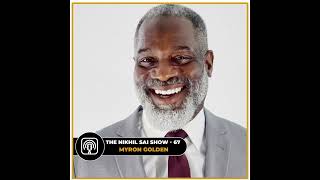
In this episode of The Nikhil Sai Show, host Nikhil Sai interviews Myron Golden, PhD, a veteran entrepreneur and high‑ticket sales expert. The conversation begins with Golden’s personal backstory – growing up as the second of seven brothers, early exposure to his father’s plumbing business, a series of low‑pay jobs, and a painful period of financial hardship that lasted until he began selling financial services in 1985. Golden recounts a slow start in sales, taking 18 months to make his first commission, and highlights the importance of persisting through learning curves. He introduces his "be‑do‑have" framework, explaining the purpose of time (being), space (doing), and matter (having), and connects it to universal laws of energy, entropy, and polarity, arguing that wealth is a high‑energy result that requires high‑energy thoughts, words, and actions. Golden defines high‑ticket sales as delivering a high‑value result that a client is willing to pay a large sum for, emphasizing respect, empathy, and solving a big problem rather than manipulation. He discusses the principle of infinite abundance, the need to deeply understand a client’s problem, and the importance of positioning oneself as the unique source of that solution. Competition is portrayed as a mental construct; Golden claims true dominance comes from owning a distinct knowledge base that cannot be replicated. He advises aspiring entrepreneurs to start with high‑ticket offers (a descension ladder) rather than building up from low‑ticket products, and outlines his own coaching price tiers ($81k, $155k, $1 million) with a 10× ROI expectation. For productivity, Golden relies on automation and delegation, using tools like ClickFunnels, Slack, and Trello, and hires specialists for tasks outside his $25k‑per‑hour value. He shares his daily “adventure” routine—reading, prayer, movement, and varied activities—rejecting rigid schedules. His key advice for young entrepreneurs is to hire a proven coach and follow their guidance without question. Finally, he stresses the critical role of a strong financial team (CPA, tax attorney, credit specialists) to avoid costly IRS issues, noting that making money is easier than accounting for it. The episode concludes with promotional calls to action for Golden’s coaching programs and challenge site.
Chapters
What's going on? What's going on everyone who's actually listening to this podcast right now? First of all guys, welcome to The Nikhil Sai Show, which is hosted by me, The Nikhil Sai. And guess what's going on today? We are back with another amazing 2,X interview. We are having the grandmaster who's been helping coaches who are already at an expert level. So this is going to be a crazy journey guys, make sure to stick around. Despite being an infant who had the cold ear effect, this dude is crazy when it comes to sales. He's been killing it and he's been working with grandmasters like Russell Brunson, Dan Lok, Dan Hendry, Dana Derricks, you name it, he got it. So within just 30 minutes of speaking on stage, he has done over $3 million, $3.8 million actually, when it comes to the sales. So this guy who's joining us right now, expert when it comes to speaking on stages, closing high-ticket sales, and helping entrepreneurs to create the level of impact they deserve. So let's not waste any time and actually welcome Myron Golden, PhD, CEO at myrongolden.com. Hey, Myron.
What's happening? Hey, Nikhil, how are you, man?
I'm doing great, brother. Thank you so much for joining us today.
My pleasure, my pleasure.
Absolutely, Myron. And Myron, like, stuff is so crazy. Like, you're inspiring generations, brother. Like, this is going to be a crazy, crazy epic story for sure. So, Myron, would you like to please start with the backstory? Like, oh, how did all of this craziness started?
Yeah, well, it started I was the second of 7 brothers, and my parents were hardworking, but they didn't know how to make money work hard for them. They didn't have businesses. Well, not initially. My dad had a job. My mom, she basically took care of the 7 of us brothers, us 7 brothers, we 7 brothers. And I had a unique experience when I was 5. I went to work with my dad for the first time, and I loved it. Um, when I was 16, I saw my dad do something that, like, I didn't even realize then how much it impacted my life. And he came home from work one day, and I don't know if he had gotten fired or if he quit or if they didn't pay him enough money, but he said, I'm never working for anybody again. And basically started his own plumbing business. And I thought, wow, you can survive without having a job. And that was the first time I had ever seen anybody in my life, like, make it through life without having a job working for somebody else. Um, fast forward, um, I graduated from high school, went off to college, uh, met a beautiful girl, made her a lot of promises, we got married, and, um, we weren't doing so well financially. And the reason we weren't doing so well financially is because, um, I, I only knew how to be broke. I didn't know how to make money. I didn't know— I didn't know anything about— I totally was an infant. I lived in an industrial town and I couldn't lift heavy things and carry them a long way. And so it was challenging for me to find a job. So what I would do is I would buy old cars, fix them up, sell them for a few hundred dollars more than I bought them for. And I can remember being so poor when my wife was 8 months pregnant with our first child that our electricity and water were both disconnected at the same time in our house. And I knew I didn't want to live that way, but I didn't know what to do. So we packed up everything, moved across the country. Moved from Gary, Indiana back to Harrisburg, Pennsylvania, where I grew up. And I got my first job as a married man driving a trash truck for $6.25 an hour. But the interesting thing about it was I realized that that job was not going to define me, and it certainly was not going to confine me. And what I mean by that is so many people will get a job that they don't really like, and it can't— doesn't really fully provide for them, but they'll stay there for 20, 30, 40 years. Because they think, well, that's what you have to do. But what I did, I had a business on the side, and my business was selling financial services, um, insurance and investments. The only problem was I was terrible at sales. In fact, I was so bad, Nikhil, that when I first started in selling in October of 1985, it took me a year and a half to make my first sale. So I didn't make my first sale until April of 1987. And I remember my first commission check, it was $125.66. And as I've coached a boatload of people since then, thousands, one of the things that I've discovered is that most people don't have the ability or the willingness to last through a learning curve where they're not making any money for 18 months. And people used to say, well, why are you still doing that thing if it's not working? Well, it was working. It just wasn't working for me. It was working on me. And I let it work on me until I became the person for whom it would work. So that's how I got started. And that financial services company was a multi-level marketing company, was called A.L. Williams. And then I did some more network marketing, multi-level marketing companies. Eventually I got good at that. Uh, I started my entrepreneurial journey selling financial services in 1985. I didn't have my first 6-figure year until 1999, and so that was 14 years. Um, but the thing that a lot of people don't realize— people say, well, that's a long time, right? But the 14 years is going to go by whether I make 6 figures or not, right? Within 4, 4 or 5 years of that time, I had my first 7-figure year. And those 4 or 5 years are going to go by whether you have 6 or 7 figures or not. And so what a lot of people do is when something's not working for them, they assume it's not working, so they stop working on it. And as soon as they stop working on it, it stops working on them. And now they get Congratulations, you get to go back, go back to your old life.
So totally, yeah, absolutely, my friend. That was a beautiful articulation of your entire journey, my friend. And yeah, absolutely, as you just mentioned, consistency is the key. Like, despite if this stuff you're working on is working for you or not, that's working for someone else, it will for you. It's just about how hard you are on that thing, how sticky you are to the actual solution you're working on. That's awesome, my friend. So people need to realize that things take time and you need to master skills to get to where you are.
Yeah, actually, actually, the formula for high achievement is be, do, have. The purpose of time is becoming. The reason time exists is so we can become more than we are. That's why we have more time, so we can become more. So being takes time, doing requires space. So the purpose of time is being, the purpose of space is, is doing, and the purpose Let me start over. The purpose of time is being. The purpose of space is doing. And the purpose of matter is having. God gave us a desire to have more, more of what matters, more matter, or what matters to us, right? But in order for us to have more of what matters, we must do more of what matters to other people. In order for us to do more of what matters to other people, we have to become more of what matters to God. So the formula is be, do, have. Be more, do more. Do more, have more. Be a little, do a little. Do a little, have a little. Be a lot, do a lot. Do a lot, have a lot. It's just the formula. Simple, but it has to be done.
Yep, absolutely. And that's what really matters, Myron. And as you've seen, like, your journey starting at 1985 to actually making your first 6 figures at 1999, like, freaking long time. People be like, I want that next month. Doesn't work that way. You should get into reality, right? Absolutely.
Well, it can work, it can work that way. But it doesn't necessarily work that way. How fast you have success when you step into entrepreneurialism is going to be determined by how much influence you have, and how much financial literacy you have, and how much business acumen you have. The more of those things, like if you already have some of the characteristics of a business owner when you step into entrepreneurship and you already have influence, you already have influence over a large number of people and you already have some level of financial literacy, you literally could step into entrepreneurship out of your job and like your first year could be 6 or 7 figures. Yeah, but you, but you've spent years developing the skill sets that are necessary for you to make that happen. Most of us, when we step into the arena of entrepreneurship, we don't have any of those skill sets. And so what we have to do is we get into the arena and then we develop those skill sets after we get into the arena. And that's why it feels like it's so hard for people. It's not. It's only hard for you because you've not yet become the person for whom it is easy.
Yeah, they need to admit the change they deserve to actually become that person. Yep. That's, that's awesome, Myron. And Myron, you've been mastering the art of high-ticket skills like $3.8 million in 30 minutes. My goodness. So we would love to hear about like how someone can actually master the art of high ticket sales.
Well, high ticket sales is nothing more than number one, having the ability to produce a high value result for somebody other than yourself. That's number one. So in order for me to be able to do well at high ticket sales, I have to be able to produce a result that something somebody desires, and they desire it so much they'd be willing to pay $10,000 for it, or $25,000, or $55,000, or $155,000, or $1 million, or $7 million, or whatever, right? I have to be able to produce a result that somebody else is willing to pay for. If you think about it, all of the money that you desire and you don't have right now, it's in somebody else's pocket. So if you want to get that money, you have two choices. You can either illegitimately hit them in the head and take it from them, or you can legitimately deliver them so much value that they're happy to pay you the money that they have in exchange for the value you've provided. And so I think a lot of people think high-ticket sales has something to do with being a good talker or being able to manipulate people into doing something like buy something they don't want, don't need, and can't afford. That has nothing to do with it. Like, I sell from a position of respect, which means if you don't have a need for something, if the thing that I have is not valuable to you, I have no desire to sell it to you. Some people want to sell everybody, but I believe that anything that's for everybody is also for nobody. And so I am looking for a large pool of people that have a big, big problem that they'd be willing to pay a lot of money to solve. And when I find that, well, high-ticket sales is easy. If I don't find that, regardless of what I'm selling and regardless of how much money the people have, selling high-ticket is going to be hard. Selling high-ticket offers, if it's hard for you, it's hard for you. Because the person you're thinking about when you're selling it is yourself. When I'm selling high ticket, I'm not thinking about me. I don't need to make a high ticket sale in order for me to live. I don't need to sell anything in order for me to live. My money makes me more, so more money than sometimes in a day than most people's jobs make them in a year. So I don't need to, I don't sell high tickets so I can make money. I mean, just so I can make money, that's not the primary objective. My primary objective is to create transformation for my clients. But I'm like, there you have to operate within the laws of nature that God wove into the fabric of the universe. What do I mean by that? Well, there are laws that govern our existence on this planet, and you cannot break them. You can only illustrate them. You can break yourself on them, but you can't break the law of gravity. You can break yourself on the law of gravity, but you can't break the law of gravity. Right? Well, some of the laws that govern our experience of life are laws like the law of energy, right? What's the law of energy? Everything is energy. Energy is neither created nor destroyed, it just changes form. That's the law of energy. Well, um, the law of entropy— anything left to itself tends to move more and more towards disorder. So if a— so let's look at the law of energy, for instance. It's a law of energy. It's a physics principle. If, if I look at the results I'm getting in my life and I don't like the results I'm getting in my life, I have to ask myself, what kind of energy am I manufacturing that's causing me to produce these results? One of the principles I teach my students is wealth is a high-energy result, right? Wealth is a high-energy result. Well, that means if I am going to produce wealth, I have to operate at a level of high energy. So, so, so no high-energy result can ever flow to a low-energy source. So if I desire to produce wealth, I have to become a source of high energy. I have to think high-energy thoughts. I have to speak high-energy words. I have to take high-energy actions. I have to give attention to high-energy situations. I have to ignore low-energy and energy-draining processes, right? So, so that's the first law, right? The second law is the law of entropy. What is that? The second law of thermodynamics is law of entropy. Anything left to itself will move more and more towards disorder. So if I have a garden and I don't cultivate the garden, I don't water the garden, I don't pull the weeds in the garden, then the weeds are going to take over the garden. Yeah, right. So I have to put energy into something that's already working to make it keep working. 100% entropy, right? Well, there's another law. It's called the law of polarity. The law of polarity states that for every action there's an equal and opposite reaction. So for every negative there's a positive, for every positive there's a negative. Well, if that's true, if, if, if I desire to create wealth, I have to create wealth in a situation that has equity, right? So if I sell you something and you end up paying me more for that thing than that thing is worth, then you're going to reap the negative benefits of taking advantage of me. If I sell you something that's you pay me more than that thing is worth, I'm going to end up reaping the negative effects of that because nature abhors a vacuum, right? So, so what's really interesting is the, the, the main value of value, which sounds really like a weird thing to say, right? The main value of value is perception. Right?
100%. Yeah.
What do I mean by that? So if I'm hungry, if I'm hungry, and I have money, money is valuable, but it's not valuable as food. I can't eat the money. Right? And if somebody, somebody who owns a restaurant who needs a patron needs a customer, they've got tons of food. And I've got tons of money. So all I got to do is exchange some of my value which to me is worth less right now than the food, for some of their value, which is worth less right now to them than the money. So, so, so that's how value exchange is created. Because like, at the end of the day, all the books in every molecule in the universe have to balance. That's why if you cheat somebody, you are ultimately cheating yourself. That's why if somebody— like, let's say somebody Um, like, there's this guy in California who, many years ago, he scammed me— scammed me, right? Um, out of $6,000, which was only $6,000, but still, it was my $6,000. He said, well, you pay $6,000, you can be in this movie. It's going to be an anthology. Brian Tracy is going to be in it, blah blah blah. And at the end of the day, once the movie's done, you're going to get 500 DVDs. This is back in the day of DVDs. 500 DVDs, so you can sell those DVDs in the marketplace and you'll be able to recoup all your money. Well, I thought, it's cost me $6,000. If I sell the DVDs for $30— I'm an information marketer, I can easily sell a DVD of a movie that I'm on for $30. That'd be really, really easy, right?
Yeah.
And so, so I paid him the $6,000. I flew to California on my own dime, um, was— I like was in this quote anthology movie. It was an— it was a docu— docu-movie Um, it was, was poorly produced. Um, the guy spelled my name wrong on the, on the chyron, on the lower third, and then never sent me a single solitary DVD. And then when I like reached out to him about it, said, dude, you said you're gonna send me the DVD. Like, I never got a— I never got a single solitary DVD. Like, I didn't even get one, and I had duplicators. I could have duplicated myself. Just send me one DVD so I can recoup my $6,000. I didn't even get that. He sent me a low-quality pixelated version of this jive anthology movie, mentary, and with my name spelled wrong, so I couldn't use it for anything. So he got my $6,000, I got nothing, right? But a bunch of people who were in that quote movie sued him. They said, do you want to be a part of the suit? I don't, because that dude has already sown his seed. His judgment. Like, every word is a seed, every thought is a seed, every deed is a seed that I'm sowing into the garden of my future. Well, well, if I don't want to reap a bad harvest, I better not reap so a bad seed. So I, I don't, I don't take advantage of people, not because I'm worried about them doing something to me. If I take advantage of somebody else, ultimately I've taken advantage of myself. It's going to come back. It's a seed.
100%. Yeah. And really, Myron, like the kind of perspective you have, like a very bigger picture, like, like your vision is much bigger. Like you have much more experience. You can really sense that, man. Absolutely. We love the show. And Myron, when it comes to you especially, we have seen your students doing million-dollar days, and I believe like that's kind of mindset shift you have helped your co— your students, your coaching students especially to achieve. So we'd love to learn more about like your You've really seen this transformation of your mindset evolving from actually being in that scarcity mindset, learning like how to make money, having, you know, being in that poverty situation to actually making multiple 8 figures in sales right now. So we'd love to hear like, how does that mindset shift look like to actually become an 8-figure entrepreneur? So what kind of shifts someone needs to have to tap into that level of—
Well, it's an awareness of the principle that I call the principle of infinite abundance. And infinite abundance states that there's more than enough for everybody to have more than enough, and there'd still be more than enough left over. Right? Like, wealth is like— abundance is like oxygen. It doesn't come in limited supply. And so, like, the, the difficulty is not in making the money. The difficulties people have in creating wealth, whether it be in high-ticket sales or anything else, the difficulty that they really have is they have a difficult time having enough empathy to figure out what somebody else wants badly enough to, like, clearly enough to create that thing for them. When one of my clients meets me, the thing they become in a very short period of time, they become intensely aware of the fact that I have thought about their problem and the solution for their problem a lot longer and a lot harder than they have. And so they pay me as a shortcut to solve their problem. It's— I mean, it's really that simple. It's not— for instance, every business needs to make sales. I don't care whether you're a dentist office or whether you're a real estate business, insurance, whether you have a bookstore, a restaurant, a shoe store. The concept of business means you sell solutions to people for money, right? So But the interesting thing is a person can go all the way through college with a business degree and not take one class on sales. A person can go all the way through undergrad, all the way through med school, pre-med, all the way through med school, and then go through like specialization school, and they can become a neurosurgeon or a brain surgeon where they teach you how to work on people's brains. They don't take one single solitary class that teaches you how to get people who have brains that want you to work on them, right? It's amazing. The person goes and gets a law degree and they learn everything about practicing law. They learn nothing about how to get—
how to get clients.
And so the reason businesses struggle is because they don't know how to sell. And so I know how to sell because I've had so many sales conversations. Like, I've had thousands and thousands of sales conversations, and I was paying attention to the feedback that I got because feedback is the breakfast of champions. And as a result of those sales conversations, I eventually went from being one of the worst salespeople in the world to one of the best salespeople in the world, to the place where now some of the, some of the top entrepreneurs in the world pay me to teach them how to sell better. Yeah, that's how it works.
Absolutely. Yeah, absolutely, Myron. Yeah, that the kind of perspective we have and the kind of knowledge transfer you're actually doing is absolutely amazing, brother. And Myron, one of the key things, like when it comes to you and all of the top entrepreneurs you've been actually helping to build their business is like, even though they are not like the expert in the actual concept, like the positioning that you actually have them to become like the dominant of the market, right? So like you've been killing it when it comes to the sales and your students have been killing it when it comes to their own expertise, like their own domain. So we'd love to know more about like when there is too much competition happening in every space, everyone claims that they are the expert, like how someone can tap in and become the go-to and dominate the marketplace.
Yeah, I think competition is highly overrated. I mean, I think it's important, I guess, to some degree. But the reality is, when you discover your real identity, your true identity, you don't have any competition. Like, I don't have any competition. I mean, for instance, there are other people who teach people how to sell. They don't teach them what I teach them. So how could they be my competition? They could learn what that person learned, knows, and what I know, and they'd be way better off. Like, for instance, you named Dan Henry, right? I was just talking to Dan on the phone yesterday. Dan Henry teaches people how to sell high ticket. I teach people how to sell high ticket. I have many of Dan's students who, after they take Dan's class, they come and take my class. I'm sure I've got some of my students that after they buy my program, they go and buy Dan's program. So Dan and I are not competitors. We teach similar things, but we don't teach the same thing. See, I believe, um, that that competition is more a figment of people's imagination than anything else. For instance, I teach people how to sell from the stage. I can think of at least 6 other people that I know of that teach people how to sell from the stage, but they're not my competition. I may be their competition in their minds. They're not my competition in my mind. Nobody teaches what I teach. And I don't mean that from an arrogant position. I just mean I know the stuff I know. I know all of the places that I had to go and all of the things I had to go through in my life to learn those things. Those people didn't have those experiences. I don't have any competition, right? And so, so how am I the dominant? I'm dominant in my marketplace because I've dominated my knowledge base. Like, I dominated the information. And if people want the kind of transformation that my information gives, they have to pay me. And yeah, somebody can go and they can quote funnel hack me, right? You can hack my funnel, but you can't hack my brain. You can't hack my brand, right? You can't hack my brand. You can't hack the words that come out of my mouth and the way they come out of my mouth. So I don't have any competition. You can make your website look similar, but at the end of the day, like, I've even got students who use the same illustrations that I use tell the same stories that I tell and use the same methodologies that I've taught them, but they're not even my competition because a person will hear one of my students and they'll say, I can tell that person learned from Myron Golden. And here's what a lot of students say to me. They say, I want to learn from the people that my coaches are learning from. And so the competition is— I mean, I'm not saying it doesn't exist. I guess it exists in business. To a degree. But if you're really, really good at what you do, like, like, good luck trying to compete with you. Okay, somebody wants to compete with me, good luck, bro. Go do it. I'll be cheering you on. I'll be standing across the finish line waiting on you when you get here, right? And cheering you on. Do your thing, bro.
Absolutely, man. And that was on— and that was absolutely amazing. So yeah, I think entrepreneurs should really have the kind perspective you have on the competition, that they are on the top edge when it comes to their own expertise. It's not like they're trying to compete on prizes or offers or something like that.
And if you're not, if you're not the best at what you do, get better. If you can't get better, go find something you can become the best at what you do. Like, like, keep learning. One of the reasons I'm good at what I do is because I never stop learning. I have— I will never get to the place— I'm 60 years old, I've been in the entrepreneurial game since I was 25. What is that, 35 years? So I've been doing entrepreneurship for 35 years, and I've read hundreds of books. I've gone to hundreds of seminars. I've hired dozens of coaches. I still have coaches. I'm not done learning. You know when I'll be done learning? When I'm dead. I won't even be done learning then, because then I'll be in heaven and I'll be exploring the wonders of eternity. So I will never stop learning.
Absolutely. Yeah, that's, that's a real mindset every entrepreneur needs, man. I really love that spirit. Absolutely, man. Let's get to the next question. This would be so much interesting, Myron. Yeah, you've been starting your journey when you're 25, right? And you, you have like a different perspective as you have been through this entrepreneur journey from 35 years. So we'd love to hear, like, in case if you have the current perspective when you are 25, if you're starting all over with the mindset you have right now, how would you do it differently? How would you take—
um, if I started with the mindset I have right now, I would just come out of the gate, I would learn a very valuable skill, and I would sell it for a premium price. That's the first thing I would do. I would start with a high-ticket offer, knowing what I know now. I would start with a high-ticket offer and then work my way down through a descension ladder instead of starting with a low-ticket offer and working my way up through an ascension ladder. That's what I would do. But like, the number one thing that I would do differently if I started my entrepreneurial journey over I would get wealthy faster by starting with high-ticket offers and then work my way backwards to the lower-ticket stuff.
Yeah, absolutely. And I believe the fastest way to get to the level of the create impact and work with serious people is absolutely working with serious people who pay the price and want to get the results they want to. That's absolutely amazing, Myron.
And Myron, you can't just charge somebody a premium price because you want to make a lot of money, right? So my, my philosophy on high-ticket sales is this: If somebody can't take what I've sold them, like if they can't 10x the value of the money they've paid me in 12 months or less, I've overcharged them.
Wow, I think this is a real mantra to learn how they can price their stuff. That's absolutely amazing.
Yeah, like, like my, my mid-tier coaching program, my, my low-tier coaching program is $81,000. My mid-tier is $155,000. My high tier is $1 million, right? So if somebody buys my $155,000 program, they should be able to make at least $1.5 million in the next 12 months. We've had people do like $1.9 million in a day as a result of being in that program, right? So, um, $5 million in a day. One, uh, a whole bunch of people done $1 million in a day. Um, a bunch of people who've done $300,000, $500,000 a day. So, so I understand the value of what I have to offer. Unfortunately, I can't charge what it's worth because nobody would buy it. I mean, I could, but very few people would buy it, and so I'd be helping fewer people. Like, truthfully, my $155,000 offer should be at least a million-dollar offer, and my million-dollar offer should be at least a $5 million offer. But one of the things about business is You have to charge people progressively and sell them something and help them get a result. And once they get that result, they'll pay you for another result. It's different.
Yeah, yeah, absolutely. Wow, that's amazing, Marin. We really love this stuff. You're actually exploding here. That's amazing. And let's get to the next question, Marin. This would be interesting. And you've been killing it when it comes to the business and helping your students as well. So I would love to learn more about like what kind of tools do you use to manage your clients, your projects for your productivity?
What kind of tools do I use to manage your time and stuff? Yep, I'm gonna say automation and delegation, and delegation for the automation. What does that mean? Automation means tools like ClickFunnels, tools like, um, Slack and Trello and autoresponders and all of that. So that's automation. Delegation is I hire somebody to do everything that I'm not good at and everything that I don't like to do in my business, or something that I don't— if I don't have time for it, if it's like not a good use of my time for time value, because I get— I charge $25,000 an hour for coaching, right? So if I'm doing something that I could pay somebody less than $25,000 an hour for, I'm probably doing the wrong thing. Yeah, um, so, so, um, so I hire people and delegate to them things that just are not a good use of my time. That's one. Number two, I hire people who I— we buy software that is automation software, but I don't know how to use any of it, right? I don't build my funnels, I don't do my Facebook ads, I don't I don't do our Trello boards. I don't do our Slack channel. I don't, I don't do any of that stuff. I don't even know how to do it. I don't know how to do any of it. Right. But I don't, and I don't want to know how to do any of it. And I know that it's like, right. But I don't want to know how to do any of it because I want to use my bandwidth for, I want to only do in my business the things that only I can do.
Hmm. Right. Yeah.
And so, so I hire people I delegate the automation, but I also delegate everything else.
Yep, absolutely, Myron. Absolutely wonderful perspective when it comes to managing your time well. And I think a lot of entrepreneurs just try to save costs, they just be juggling around all the tasks, and they wonder why their business is going down. And you've been mastering this. This is absolutely—
because they're wasting time to save money. See, time is not money. Poor people think time is money. Confused people think time is money. Time is infinitely more valuable than money. You run out of money, you can always get more money. You run out of time, it's game over. So time is not money. Time is infinitely more valuable than money. If you think that time is money, you'll trade a whole bunch of your time for a little bit of somebody else's money. You realize that time is way more valuable than money, you'll spend as much money as necessary to buy back the rest of your life.
Absolutely. Yeah, absolutely. That's a beautiful perspective. Let's get to the next question. I mean, this would be interesting. So do you kind of have any personal routines for yourself? So what is your daily routine for the success?
My daily routine is different every day. I think something in me rebels against routines. So my daily routine is different every day. There are some things I do every day. I read every day. I pray every day. I soak in Epsom salt every day. I lay on my pulse electromagnetic field mat every day. I do some form of physical movement every day. I need to start exercising like I used to when I was stronger, but I move my body every day. I communicate with people that I love every day. So those are some of the things that I do every day. When my body is in peak condition, I play golf every day. So I do something, but every day is different. So a lot of people have routines. I do the same thing every day. I don't do that every day. Like, I would lose my mind if I had to do the same exact thing every day. No, that's why— one of the reasons why I don't like having a job, because I don't like doing the same thing every day. So my routine, my routine is really a lack of routine. My routine every day— I'll put it this way— my daily routine is a daily adventure.
Wow, you want that excitement to be coming in every day, tapping on different Yeah, I want more, more, not necessarily excitement, variety.
I want variety every day. Because most people say, wow, I've got 20 years of experience doing this, I've got 30 years of experience doing that, I've got 40 years experience doing that. And people are so proud of how many years of experience they have doing a thing. But I believe the quality of our lives is not measured by the number of years of experience we have doing a thing, but by the number of experiences we put in those years. So my desire is to put more experiences in my years. Yep. That's why I like variety.
Yep, absolutely, Myron. Love it. Thank you so much for telling that. Let's get to the next question, Myron. So what would be a suggestion to a 20-year-old you, some— or someone who's just getting started right now in business? What would be your number one suggestion for them, um, for success in business?
Yes, find a business coach who has already done what you already desire to do. Pay them whatever they charge and do everything they tell you to do, whether it makes sense to you or not.
On face, that's absolutely amazing, Myron. Yeah, a lot of people really try to hold things on, but the best and fast way to fast-track success is going and hiring the right person.
Absolutely.
Hell yes, absolutely, Myron. Let's get to the next question, brother. Your life's biggest achievement so far and any next bigger goals?
My life's biggest achievement? I don't know. I love my family. Yeah, I love my family. I've been married to the same woman for 36 years. My son and my daughter are business partners in my— in our family business, and they still have their own enterprises. My brothers are my closest friends on planet Earth. My dad passed away recently, and my brothers spoke at my dad's funeral, as I did, all of us who were there. And I listened to every brother that I had. I watched them walk up to that podium and talk about their experience with my dad. And I was thinking the whole time, how amazing is my life? Because this man just passed away was my father. And how blessed am I that these amazing men are my brothers.
Absolutely beautiful, brother.
Yeah, yeah. So, um, I mean, business— see, to me, business is— business achievements are— yeah, I've done a lot of fun stuff in business, a lot of great stuff. We sold over 100-something thousand books, blah blah blah. You know, we've made millions of dollars, blah blah blah. But that's just— to me, business is like a game.
Yeah, right.
It's like, it's like a, it's like playing golf. I've got a hole in one, it's great. But at the end of the day, it's just, it's a game. And the money that we make is how we keep score in the game of business, right?
Absolutely.
But yeah, it also is the tool that gives us the ability to influence and impact the world in a much greater way.
Yeah, 100%, absolutely. So you really need that wealth to kind of create the impact you want to, for sure. And Myron, we would love to hear, like, what was the mistake happened in your life, especially in terms of business? The biggest mistake?
Um, the biggest mistake, um, that I made in my business career was, um, not hiring a good financial team in my first round. I didn't have a good financial team. Um, I had an accountant He was, he was okay. I thought he was great, but I didn't know anything about accounting. And so he did not counsel me to become a W-2 wage earner of my own business, which I am now. I'm a W-2 wage earner. Like, I have a job. I get paid every week. Like, today was payday. Like everybody else in my company, I got paid today, right? Like, all of the money that our company has is like— when I first started business, all the money that we had was like the company's money and my money, and I used it for me or the company, it didn't matter, right? I don't do that anymore. So I use the company money for company stuff and I use my own money for my own stuff. And so not having a good financial team, I have a CPA who teaches accounting at a university who's my accountant. I have a tax attorney who is one of the best tax attorneys in America. I've got a pension planning company. It's one of the most prestigious financial planning services in the world. And so having a financial team to run, like, the business part, the financial part of my business is paramount. It's absolutely paramount. I've got, I've got business business credit development specialists that are my business credit development specialists and coaches that tell me like what business credit cards to apply for and what business loans to apply for. So all of those things, like, I, I, now when it comes to my money, like investing, like I, I do my own trading in my own accounts, like with the stock, with regard to the stock market and Forex and cryptocurrency. But with regard to like long-term, like slow growth, tax-deferred investments, I have a whole team of people who manages that stuff and advises me on that stuff. And not doing that was a mistake that literally cost me more headache and more anxiety in my life than any other thing financially in my life. And we went through 5 years of trauma dealing with the IRS as a direct result of not having those things taken care of. And now if I get a letter from the IRS now, it's just like, it's just a letter from the IRS. Oh, what did they say? Oh, you owe this amount of money. Okay, pay. Okay, we don't— they said we own this, we don't. Okay, send them the proof. Like, I don't, I don't even have to give it any thought anymore. And sometimes I'll get a— sometimes I get a stack of letters from the IRS that thick. I scan them, send them to my CPA. I'm done. I don't have to think about it anymore.
Yeah, yeah, absolutely. And man, like, the irony is nobody teaches this stuff. Like, nobody really talks about this. Nobody talks about how to use business credit, how to do the tax, and how to manage stuff. But yeah, that's a great learning curve. I think every business owner should make sure that they look over what's happening right now because they don't want to regret it later.
Because I'm going to end with this, um, because I've got to go. I've got to get ready for my, my, um, my coaching call, my, um, challenge that's coming up here shortly. But, um, it's interesting to me that, um, that most business owners think— many, I won't say most— many business owners think making money is hard. Making money in business is one of the easiest things you'll ever learn how to do. It's way easier to make a million dollars than it is to account for a million dollars. It's way easier to make $10 million than it is to account for $10 million. You have to make sure you've got financial team managing every dime out of every dollar.
So yeah, absolutely. I couldn't hear you.
I said I'm going to end on that one.
Yes, absolutely, brother. Yeah, it was, it was really amazing, Myron. Again, Myron, thank you so much for this amazing opportunity. It was really great and nice to have you, brother. The value you have poured in this call is absolutely amazing. So guys, hopefully you enjoyed so far. In case you're interested to learn more, to work with Myron, you can go and apply at myrongolden.com, and he would be more than happy.
And better, better than myrongolden.com, um, better than myrongolden.com, they should probably start out— if you, if you are stuck at less than $20,000 a month in revenue, if you're making less than $20,000 a month in revenue, you should go to makemoreofferschallenge.com.
makemoreofferschallenge.com.
Yes, and you should register.
Guys, you will find the— yeah, you'll find the link in the description of this podcast, so make sure to check out Make More offerschallenge.com. You learn how to make more offers and how to make more money and how to build more impact. So guys, hopefully you enjoyed the actual podcast so far. So stay tuned for the next interview, guys. This is me, the Nikhil Sai, and Myron Golden signing off for today. Peace out.
More from Nikhil










BURNED $1.5M in his 17years online #digitalmarketing #entrepreneur #onlinebusiness
