She Survived Hell… Then Built a 7,500-Client Empire.
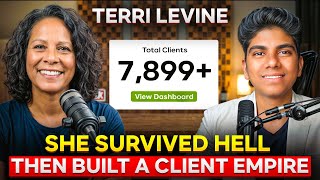
Dr. Terri Levine built a 7,500-client coaching empire using "reverse marketing": no pitches, no closes, just authentic conversations. She landed 30 clients in her first 30 days through phone calls, handwritten letters, and local sponsorships, rejecting social media and paid ads entirely.
Chapters
clients in 30 days. So I knew I was doing the right thing.
What do you think you would need to do different to do the same today in 2024?
There wasn't social media, there wasn't Zoom, none of that existed. I literally took all the books on sales, all the programs I had on sales, every single thing. I went to a dumpster and I let them all go. No pitch, no close, and I'm not going to overcome objections.
That was a big one, and you can save it. What would that mistake be?
$1,000 to defend. It was a 17-year court case. A $300,000 mistake. Got a neurological disease which is known as the disease of fire burning or hell and is the number one suicide disease. So nothing compares to it.
And let's not waste any time and actually let's welcome the soul behind Heartpreneur, Dr. Terri Levine. What's going on? What's going on, everybody who's actually listening to this podcast right now? First of all, guys, welcome back to another episode of the Dheenik Gitsai Show, which is hosted by me, Dheenik Gitsai. And guess what's going on today? We're back with another amazing guest. I mean, this is not just a normal guest. The guest we're talking about today, who's going to jump on, has been in the industry for over 4 decades, and she has consulted over 7,500+ business owners and helped them scale through a very heart-centered strategy. I mean, this is going to be transformation. She's a bestselling author, keynote speaker, and she's dedicated her life to actually make marketing heart-centric. We are definitely going to dive into very interesting philosophies of reverse marketing and whatnot. And let's not waste any time and actually let's welcome the soul behind Heartpreneur, Dr. Terri Levine.
Thank you so much. I'm happy to be here.
Hey Terri, appreciate you showing up. I mean, you have been in all major publications anybody can ever imagine. CNBC, NBC, Forbes, TEDx, Shape, BBC, Fortune, I mean, Huff Post, whatnot. So we will definitely get into the business stuff. I am excited to learn how your strategies of growth consulting can actually help a lot of entrepreneurs to become heartpreneurs and, you know, do a more centric approach in building their businesses. But before that, Terry, who are you as a person? What was your journey like? How did you get started? Talk about your childhood. How did How was your upbringing and how did you end up here?
Thank you. So I was born in Yonkers, New York, and I grew up very, very poor. The interesting thing is I really didn't know I was poor. I thought everybody had what we had. You lived in a very small apartment building. Yeah, you shared a baked potato with 4 people for dinner, and I just thought that was all very normal. My parents were really wonderful, treated me amazingly well, even though we didn't have any money. And then in the summer of 4th grade, my dad changed jobs and we went from being lower middle class to middle class, like literally overnight. We moved to a house. I'd never seen a house before. I thought everyone lived in apartments. And then life was very different. And I saw a big contrast in how other people were living in this environment. I'm glad actually that I started in the way that I started. Because it made me realize that yes, money has a place and there can still be a lot of things that are more important in life and money isn't my number one. So I'm glad that that was a learning for me. And along my journey, I had been very entrepreneurial. I started as a speech language pathologist, started my own clinic, sold that, started an art business, sold that. I could keep going. And my mistake that I will share is, and it was all ego, I became president of a national healthcare company for 5 years. And while they loved me and I was making them money, I hated every day of it. And so about 32 years ago, I just said, I'm done. I walked out and I began to use my coaching and consulting certifications and licenses, my clinical psychology background, my positive psychology background, and opened up my coaching and consulting business. And I had 30 clients clients in 30 days. So I knew I was doing the right thing, and this has been my journey ever since, and it is my passion.
Wow, wow, that's— what a journey. I mean, so many unique turns and a lot of experiences, and especially looking at the time horizon you've been in the industry, there's definitely a lot to learn from you, Terry. So interesting. Now, I mean, obviously at a very young age, I'm assuming that you have achieved very high status, you know, in business, in life in general overall, with the positions you have achieved, what was with the job which wasn't so fulfilling? What was like the make or break moment for you to actually get into entrepreneurship in the first place?
So, it's almost like I'm gonna cry sharing this, and I will share it. So, here I am, CEO of this national healthcare company, and they are changing the way that healthcare companies are paid. So, we're going in Medicare to something called prospective payment, which means we're going to be paid about 80% less than we've been paid. So the company notifies me, you're going to have to lay off about 1,000 workers. And my job became months of laying off workers. And on a Friday, I had laid off a whole group of therapists and I still remember where, Atlanta, Georgia. And when I got to work on Monday, there was a voicemail from a gentleman. And he said, I just wanted to let you know that my wife killed herself yesterday. When she became unemployed, she couldn't figure out how we were going to manage the household and she killed herself. Thank you very much. That was the message. That was it. That's when I left. I said, I'm not here to destroy people's lives. I've always been here to lift people up and make a difference. And I'm not making a difference. I never shared that story publicly, I don't think.
Oh wow, appreciate the vulnerability. That was a really heartbreaking moment to actually know. I mean, that's so concerning to see somebody in that situation ever. I hope that never happens in anybody's situation whatsoever, ever in life. I mean, you know, I'm definitely hoping and praying for a better environment for all of us, but I'm glad that you didn't respond to it in an aggressive way where you got low with that situation, but you actually did the right thing, which is Okay, let's control what we can control, which is how you react to it. And you moved on and you went on to change 7,700, 7,500+ businesses, which is what I'm stoked to talk about. So Terry, interesting. So you were this good employee, you know, at top position. Then you started your business. You had 30 clients within the next 30 days. Wow. That's what I call it pace, race car pace. So how did that happen? Is it because of your network? What was the game plan like? What do you think you would need to do different to do the same today in 2024? After 30 years of doing this again?
The most interesting thing I can tell you is I would do the exact same thing all over again, and it's not what most people are currently doing. So back when I started, there wasn't a lot of email. You know, there was, you've got mail. There weren't a lot of websites. I had one of the first websites in the coaching industry, and there wasn't social media, there wasn't Zoom, none of that existed. So what I did was grassroots. I didn't know a lot of people. I'm not even from this area. I called everybody that I knew and I would be like, hey, I just have something so excited. I quit my job. Do you have 15 minutes? I want to tell you what I'm doing. And then I sent little letters to everyone that I knew, kind of telling them the same thing. And I just got on the phone and I literally talked to people and every single day for 30 days, I just had conversations and 30 people hired me. And to be very transparent, I wouldn't change that if I started today. I would not rely on social media. I would not rely on email. I would use this thing that everybody has called a phone. And that is what we have it for, not to text people. We actually have it to have a heart-to-heart conversation. And by the way, anytime that I want to expand my business, I still do it the exact same way.
Yeah. I mean, at core, we are connection beings, right? Like we need that human connection in the end to make decisions, especially coaching and consulting or business growth is. Such a unique dynamic of life, and we want to be understood before we make a decision. So like, I am comfortable working with somebody who understands me, and if they don't talk to me, I don't feel understood. So then why would I make decision? And this is a missing point most coaches miss. They want to avoid the obvious and still get the result, which is kind of concerning in extent. So we will definitely change that dynamic, Terry. I'm stoked overall. So you would not change a single thing and you would do the same exact playbook. Call people you know, tell them what you're trying to do and see if they're a good fit and you just have conversations. Wow, such a simple game plan. Now, sorry, for sure. So kind of walk us through, can you describe the philosophy of reverse marketing and how different it is from the traditional marketing approaches in coaching?
Yeah, so this is kind of fascinating. My first mentor that I hired when I had no money and had to take out a small business alone well over 40-something years ago was Zig Ziglar. And Zig Ziglar taught all of these sales techniques and I went, it doesn't feel authentic, you know, the Ben Franklin close and the penny close. I could probably repeat the closes. And I tried one of them in my art business and I felt I sold quite a bit of art and I felt sick when I came home. And my husband's like, what's wrong with you? I just wore the person down, I feel, until they said yes, and it doesn't feel right. So when I started in the coaching and consulting business, I literally took all the books on sales, all the programs I had on sales, every single thing. I went to a dumpster and I let them all go. And I said, I'm just going to have heart-to-heart conversations with people. No pitch, no close, and I'm not going to overcome objections. So I just did what coaches do. I listened. I said, tell me what's going on in your business. Tell me what's going on in your life. What are your goals? What are your dreams? What do you think I could help you with? If I could help you, what would you want help with? That was it. And at the end, I'd say, do you think you might want to work together? If they said yes, I would tell them what it looked like. If they said no, I'd say, now that you have an idea of what I do, who can you think of that I can help? I'm here to impact people. And it's that simple. So there's no sales. And reverse marketing works in this way. For example, I might post something like, I have a brand new jumpstart program. It's totally free. If you want to get in, you know, just say me below. That's them. It's the reverse, them raising their hand, not me going, here's a link and shoving it down their face. And that works extremely well for us on social media. We get about 19 leads a week, of which 9 are usually qualified. So leads flow in like a conveyor belt every day.
Yeah, I love that. I mean, especially the, the, I, what I have observed going over your brand particularly, because we have seen and worked with thousands of coaches at this point very closely, and I've had over multiple thousand conversations with business owners, your brand is very authentic in sense. It is very raw and just so human. Like, you know, like if I look at your content and go over your brand, I wouldn't be intimidated to kind of request and know more and try to talk to you because I feel that connection between myself and the brand you're trying to build. And I believe this is very different from other coaches who are just positioning as like somebody who is like 100 miles away and you can't touch them and they're untouchable. Like, you know, they're very far, 100x bigger than you, and that You know, sense of relativity is very important, which is what you're crushing it with. So, I mean, you've been on 3,000+ podcasts, so I would love to know more about how the podcasting side of the business has helped. Is it into generation of traffic? Is it into building authentic connection? Is it for content creation? And do you believe that coaches should be on more podcasts like these, as an example?
I love that question. First of all, I love being on podcasts because I love sharing and teaching and helping. And I have met the most amazing podcast hosts. I've become friends with a lot of them. I've hired some of them. Some of them have hired me. Um, some of them I've then brought over to my community and said, hey people, you need to know this or you need to listen to this podcast. So I feel like it's a very important piece of our businesses as coaches. And I encourage people to get on more of the right podcasts. If you don't have one yourself, you might even want to think about having a podcast. And finally, not to get on podcasts because you're hoping, oh, maybe if I get on, somebody's going to buy something. Just go on and create value. And that's all that I ever show up for. If I can be of value, be of service. I actually wear this little bracelet on the front. It says serve and create. And then at the end of the day, I flip it over and it has little checkmarks. So I'm here to serve and create.
I love that philosophy. I mean, you, you get about a very interesting personality. You convert everything into little frameworks to, to, and use those mental models to make decisions. I'm definitely stoked to talk about that a little bit more. I'm curious, I mean, you have gone through very interesting personal experiences overall, you know, severe neurological situations as well. How does that change your business ethos? How did that impact your personality and your business?
Oh, I'm glad you asked. So gosh, it's about 20 years ago now that I suddenly got a neurological disease called reflex sympathetic dystrophy, which is known as the disease of fire burning or hell and is the number one suicide disease. And it is also number one on the McGill Pain Scale. It's here, a brain tumor is here, an amputation is here. So nothing compares to it. Oh my God. To it. When I first got the disease, I had to be on 29 medications a day. And also ketamine, which is elephant tranquilizer, was ported into my veins. So I was hallucinating. I spent 18 months in bed unable mentally to function. I had set up my business because I owned other businesses not dependent on me. So I set up every business not dependent on me. When I was unable to work for 18 months, I had a team and everybody stepped up. Everybody did what was needed. In fact, the company grew while I was laying in bed for 18 months. And at some point I used the power of my mind to try and figure out how to live with this disease, get off of all that medication. Took quite a while. And the impact for me is I've always talked about being present. I'm more present than I have ever been. I realize in any second life could be over, something could change. And so I feel more blessed, more grateful. And the biggest thing is I started focusing a lot more on what was really a priority in my life, people and experiences. Money comes after that for me. So I live my life based on people that I choose to have and to love, experiences I choose to have in love, and then money.
Wow, great philosophy. I mean, such a strong woman, Terri. Massive respect for what you have achieved there. I mean, it sounds— I almost felt like a punch in my gut while you're explaining like the situation you have gone through. And I'm glad. I really want the story to reach to millions of more people so they can inspire. And if they're living in pain, or if they have a family member who is living in pain and going through a tough time, it is so easy to emotionally break up with yourself and, you know, go into that negative rabbit hole and just fall into that trap of, you know, not having any positive thoughts anymore. But I'm glad you are a standing example on how somebody can take control of their own life regardless of their health situation and turn it around. So, I mean, you, you have the energy of a 20-year-old. I'm like, this is so interesting to me. How do you maintain this? Like, what's the secret? Like, do you do biohacking? Like, do you maintain your diet in a specific way? You don't eat carbs? So what's like the secret? How do you have so much energy? I believe it's, of course, you have the heartful connection thing and you have that real intention. That's probably one of the reasons why you are so authentic and why you have so much energy. But I'm curious, especially on that side, psychologically and, you know, from a diet perspective, how do you manage yourself from a health perspective?
So first of all, I focus on what I call GID— gratitudes, intentions, which is how I choose to feel, and D is delegations. The stuff I don't know, it's like, universe, I'm delegating that, figure it out so I don't stress over it. The second thing is I meditate every day. I journal every day. I walk every day. I lift weights every day. I follow a very strict macro count every day. Now, it doesn't limit me. I can still eat carbs. However, it's very protein heavy. And, and I'm also sure that I drink a lot of water every day. I avoid most things that are not good for you, things in packages and boxes. I eat very, very healthy, organic, raw, and all of that actually contributes to my mental health, my physical health, and finally also my spiritual health. I do believe that there is something outside of me out there.
I love that. And I'll tell you, I'll compliment that you're taking well care of things even which are not in your control. So, you know, thank you so much for giving us an idea overall on how you're operating. I mean, you have been kind of forced into a situation with that neurological disease that, okay, you can't run these businesses yourself, your team has to step up and run those businesses. And that's like, again, that was a forced situation for you, but most people have that dream of how can I build my business with operators who could run without me? That's like a question mark for every business owner, including myself at this point. So I'm curious, how do you— what are the first few steps? What is a playbook you have seen which has been working really well for your life, which you can share with other coaches who are listening?
I'm happy to do that. And I start all my clients here too. You cannot ever build a business without the end in mind. So a lot of people go into coaching like, I'm going to be a coach, I'm going to make some money coaching. I have my clients step back. What is the end game? Do you want to sell the business? Do you want to have a wealth dynasty that you pass on to your family, a legacy? So number one, you have to start with the reason and the end game. Then you have to look at what your zone of brilliance is. If your zone of brilliance isn't social media posts and creating emails and web pages, you should not be doing it. And the way that I teach my client family members is ask yourself Think of a CEO past or current that you really admire. I'm gonna use Steve Jobs. I used to really dig Steve Jobs. I always ask myself before I do anything, would Steve Jobs be doing this? Really, would he be posting on social media and DMing people and answering DMs? Would he be email? So every time you go to pick up a piece of paper or do anything, you ask yourself that question and you build your team immediately from day one. And people say, well, I don't have any clients yet. That's okay. Go get someone who's going to help you get clients. Go get an assistant. There's so many people that you can hire in other countries. We have a very amazing team of very loyal people. Some of them are in other countries where my $3 or $6 an hour is a heck of a lot of money for them. If you say, well, Terri, I'd love to do that. I don't have any money. Go to a local college, a junior college, go to a high school. We have bartered, I'll call it bartered. I mentor those students. They come and they do the work. They're amazing. Then they get references, recommendation letter, and in one case, I hired them after college to join the team full-time. So, there's always a way. Find a way or make a way. Stay in your zone of genius from day one and surround yourself with a team.
Hmm, yeah. I mean, such a simple playbook, so hard to execute, especially from an execution perspective. You got to show up every day, repeat yourself, delegate the right responsibilities. I'm curious, I mean, you've been in the business for over 4 decades now, and I believe, I'm assuming, you have been in many, many, many leadership conversations. I mean, you know, fruitful conversations and a little tough conversations as well, where you gotta, you know, hit the nail in the head. Uh, you know, I'm kind of curious How do you find those leaders who you could actually give control to? How do you spot them? What are, like, the common traits you have observed when you are actually hiring and building great teams where you could find somebody and be like, "Oh, that's a caller I could rely on, and they will be accountable to this responsibility in my company." How do you find them?
Good question. So, first, I watch people. I'm like a stalker now. However, I knew I wanted to bring on a director of operations because we're at that point where I needed one. And before I put it out on social media, I just watched who shows up in my Heartrepreneur Facebook group, who is really engaged with my blog on LinkedIn. Let me look at their profiles. Let me see what they're up to. Let me look at their kinds of posts, what they've done in the past. And then when I had about 4 people that I thought were good candidates, I just reached out and said, I don't know where you're at or if you're interested. I'm looking for a director of operations. There's some things about you that resonate. "If you'd like to have a little chat, we can see if it's a fit." I think I was gonna do 4 conversations. After conversation number 2, I just knew. It was real obvious to me that this person is like, thinks and speaks just like me. And so they're in. Let me be clear though, I have made some mistakes along the way, right? And those mistakes were because I was too quick. I would just be like, "You know what? I need somebody to fill this. Oh, you look like you know how to do LinkedIn. Yeah, okay, I'll hire you." without actually giving people a bit of a test. So when someone comes on board now, for the first 2 weeks, they're being, I'll use the word tested, but they're really being watched and groomed to see whether or not, are they trainable? Do they have what we need? And if not, we're very quick to say goodbye and explain to them why it won't work. I put my time and energy into training and being the visionary of the company.
Interesting. Wow. I mean, that's such wonderful advice. If you as a founder are not training your employees and you still expect them to succeed, that's the first format of failure. You're just setting them up to fail and then you blame them or yourself, you know, overall. Thank you so much for sharing. That's wonderful advice. Now, Terry, I'm curious, walk us through the heart-centered approach and how does that actually change coaching businesses and kind of give us a summary of what do you mean by that? Heart-centered approach and explain the heartpreneur thing overall in a mini masterclass.
So I wanted to disrupt the way people do business. I find that people do business, everyone's a transaction, another number. And even when people go, ka-ching, I'm gonna ring the bell, somebody just paid me, I find that extremely insulting. I'm not a cash register and I don't want to be treated as a cash register if I buy from someone. So what I do instead is there's 3 words that Heartrepreneur stands for, which is integrity, authenticity, and transparency. So I ask myself, how could I have an authentic conversation with someone being transparent, being authentic instead of cold DMing someone, which somebody does it to me, I block them and delete them and I would never buy anything from them. Instead, I ask, how can I add value to this person's life? Right? The bracelet, serve and create. How can I add value? So as an example, I saw somebody on, I think it was Facebook, that was talking about a rather big issue that they're having with an employee. And I just said, you know what? I've got like 5 tips I'd be happy to share with you. And I also have a PDF that might be helpful. "If you're interested, let me know." So I'm engaging in true authentic conversation. By the way, I have nothing to sell that person. I don't help people in that area, I just have resources. So the person came and said, "I would really love that." Gave them 15-minute conversation, sent them the little playbook. They sent me a video, which is unbelievable, of how much I helped them. And they said, "I paid a coach $15,000 last year who didn't help me as much as you did in 15 minutes." Okay, so that's what we do at Heartrepreneur. We connect with people heart to heart, asking ourselves, how can I make an impact? How can I influence? And how can I assist, serve, and create? And that's it. No attachment to any outcome, certainly not to pitching, closing. I don't want to close anybody. Not manipulating and never overcoming objections. That's how we roll. Wow.
Wow. Such beautiful, beautiful core values compared to what's typically happening in the coaching industry. Because again, I am deeply into coaching industry and our clients have processed about $500 million. And what you're saying is actually right. It's all a numbers game. Like, hey, how many leads, how many appointments, how many closes, how many upsells? Like, you know, like what's the average revenue per client? Like that's like the key metrics we are always discussing and optimizing for. But this, approach is very unique and authentic and, you know, more refreshing, I would say. And you just sleep well at night while you're running this business. That's the best part of, you know, running a business like yours, right? And I love that fact.
Yeah, I'll speak to that for a moment. I've had some clients that had so much sales training that they were a little bit on, and I've told them, look, you're a little on the obnoxious side when you're talking to people because it's real obvious you're not listening. And you just wanna get to your agenda. And I've begged them to just release all of that. We do a lot of inner work on how they think and mindset. And then I just get them to be more authentic in how they have conversations. And I have one client, she hated to be on the phone. She's like, I hate being on the phone. I'm terrible at sales. I'm like, you're not selling anything, just helping someone on the phone. And at the end, you just extend your hand. I'm gonna equate it for you. If you came to my house here in Pennsylvania and you'd had a long trip, I might say, would you like some lemonade? I'm extending my hand. If you say yes, I give you lemonade. If you say no, I don't go, really? I just made it. You really should have it. I don't try and guilt you into it. I don't overcome your objections. That's just it. So it's a pretty simple thing. You don't have to sell. You just explain and you make an offer. And a no is a no. A yes is a yes, a maybe is okay, get back to me if you decide. It's pretty simple and it helps my clients also not have to feel, not feel like they have to take a shower after they have a conversation.
Oh yeah, I know that feeling. I mean, I could see, I think like it's coaching industry is a very unique marketplace compared to other businesses. There's no black and white, you know, there's a lot of gray area in here and there are missionaries and mercenaries, right? Like Missionaries are the ones like you who stick around for decades. And then there are mercenaries who come in, who play around for a year or two, they make the money they're complacent with, and they just walk away from the game overall. I've seen that happening over and over and over again. I believe it just repeats overall. So I'm curious, you are leading absolutely with authenticity and transparency as an approach. How do you think this will actually impact a coaching business the day we are actually living in right now?
I think this is what people are looking for. Coaching is an interesting industry. When I first came into the industry, if I said to someone, I'm a coach, they would always say, what sport or what team? They really hadn't heard of this. Who knew, right? And now most people even know what coaching is. There's cartoons, there's comics. They talk about coaches on TV shows. I mean, it's pretty common. The issue is that people have just entered this industry with no background, no training, no experience. And you could be so fake on social media, like, let me help you grow your business to $1 million. And they're not even making $100,000, right? You know, you see this all the time.
And so it frustrates me so much.
Right, right. It drives me crazy. What I've seen are two things. One, during COVID everybody became a coach. I'm a coach. I'm a coach. The good news is those people are fading away. They couldn't make it. Their reputations are harming them. And they're fading away. The second good thing in today's world is that I see more and more people not working with coaches that are taking the standard approach to in-your-face, what I call in-your-face marketing. I see more people aligning with people who create value, good content, are helpful. So I think the industry is having a pretty big shakeup. I think it's going to be interesting over the next 5 years. I do believe that you'll have a lot of people that just can't make it and will exit the industry. No offense, some of them need to.
Yeah, I agree. And you are spot on explaining what's happening, you know, with the COVID money, the easy cash flow, the no loan on credit cards and whatnot, the easy payment options. I've seen the same flood happening, you know, in the 2021, 2022, high ticket coaching was like, Yeah, people who don't know, you know, see in the coaching, they have built coaching business and made a lot of money. And yes, you're right. They're flushing out and customers are more conscious than ever before. They're not just making buying decision because they're on a sales call. They're obviously checking the credits earlier. We have seen a $20K program cycle in as less as 24 hours. Like somebody would come in, discover this new brand in 24 hours, they would make a $20K buying decision. Now it's no longer like that. Again, it's not just about the price. The customer is more aware. He's definitely looking into more factors. And if you're not really leading with value in your marketing approach, then your sales will be way tougher. No matter how much objection handling you're doing, you can't crack objection because they don't want to buy in the first place. So appreciate you sharing that dynamic. I'm curious, Terry, what the biggest problem which I see in the coaching industry right now, especially with coaches, when they're trying to make the business work, you know, they have the heart in the right place and they want to serve people. The biggest problem is the cost of marketing, hiring a social media team to post on behalf of them, or even like, you know, being able to continuously run advertising to get leads and appointments is expensive right now. Like an average lead is costing $25 when you're running paid ads minimum. So I'm curious, what do you believe is the traffic source to get attention right now? And how would you break if you're starting as a brand new coach to build a successful business like you've done right now?
So I'm actually going to tell you a quick story about a brand new coach. She came to me, didn't have a brand, didn't have any clients, just was starting. And she wanted to do social media ads. And I said, what's your budget? And she said, $50. And I said, you're not even going to get an eyeball at $50. She says, what about $500? I said, no, no, we got to Social media is expensive. So I said, forget social media. I want you to do a grassroots community effort. I want— I'm going to make for you a beautiful brochure, flyer, and business card, but they're really high quality and really nice. I want you to start joining local networking groups. I want you to go find 3 or 4 organizations or associations that you believe in and can support, and I want you to be active in them locally. I want you to sponsor everything, whether it's a peewee baseball team or a soup kitchen. I want you to be out there. I want you active and out there and actually engaging with people, not to sell them, just to engage with them. And she is 2 and a half months into that. She has a waiting list of clients. It was almost no ad spend, almost zero. It's brochures, I made them brochures, flyers. She had to print them. And a very nice pamphlet. That's it. She doesn't even have a website yet. Okay, so I want people to get this. It's very possible these days to still market without being online, and most coaches don't get that. I also have another client. I'll share this. I created a lumpy mail for him. Lumpy mail is you get something in the mail and there's something in the envelope, right? I get a lot of pens in the mail that have my company name, but we made something pretty cool. I won't share it because it's proprietary. And we sent it out to 50 people. Of those 50 people, 5 became clients. Now her program is $5,000 apiece. It's not super high ticket. It works. And so what I want people to take away from what I'm saying here is you do not have to spend all your money on ads. You do not have to spend all your time on social media. Despite what you're hearing, I'm going to tell you that the old grassroots marketing, even if you're global, starting local. When I first started, I wasn't looking global. I was all about, this is my local area. I went to every event. I did everything that I could. So I want people to think about that shift in the mentality of going back to what I call grassroots marketing or guerrilla marketing, which is what I'm master certified in.
Yeah, I love that approach. I think this is so unique, refreshing. Everybody wants to talk about building an 8-figure business when they haven't made $8,000 first, and that's kind of concerning to me, especially in the business coaching side. Yeah, you got to aim big, you know, go worldwide and like make all this content and spend all this money on social media. But yeah, you're right. If they go deep into one network where they already have highest leverage trust factor from, they're born and living in that place from some time and they already know a few people, like that's the highest leverage you can ever have. And it's so easy to, to like change them into buyers from people who you already know and trust. And I think that's a smart playbook, Tarun. We appreciate you sharing that overall. I'm curious about your writing skills. You're published what, like 43 books and over that right now? I'm curious. So walk us through this journey. Why do you love writing? How do you write so much? What inspires you to continue doing that?
I was probably in first grade when I wrote a poem and I gave it to my teacher. And she said, you're going to write books someday. I, like, this stayed in my head. It was in first grade. So then I lived in New York and they had a contest for writing a letter to Santa Claus. And so I wrote a letter to Santa Claus and my parents got contacted that I had won this letter to Santa Claus contest. So I knew that writing is something that just comes naturally to me. I write all the time, whether I put the content online, whether I don't, whether I publish it in a PDF, whether I give it away, whether I do nothing with it. Writing is a way for me to express thoughts and ideas. And so writing comes natural to me. And I tell coaches, everybody's like, you have to write a book. No, you don't have to write a book. You absolutely do not have to write a book. If you like to write, write a book. If you don't like to write and you like to do videos, do YouTube, do Facebook Live, do whatever. So I want to take that away from people. Lots of people think you have to write a book. You do not have to write a book. I have clients that are doing $4, $5, $6 million a year who are pretty new in the industry. They're going, do I need a book? If you want to write one, yeah. If not, no, absolutely do not need a book. However, writing comes natural to me. And why do I do it? Some of my books have been translated into 10 or 12 languages. I'm not traveling all over the world. My message is getting out. I'm transforming more lives and helping more people. That's what I feel like I'm on the planet to do.
Such a deep message. And yeah, I believe it's the heart. You know, the intention you have is what is giving you all the power, you know, you are executing on. And I'm so stoked that you're actually doing that overall. Terry, I have a curious question for you. You are one of the most present personalities I have seen, meaning you're just trying to live the moment. You're so conscious of your environment, and you just have that true excitement, you know. You're just like that feeling of excitement of, okay, let's see what comes and let's react the best way possible kind of mentality. I— and most people, including myself, uh, you know don't live in the present most of the times. We are either anxious about the future or worried about the past and constantly in that battle in between. I would love some actionable advice for people, including myself, on how we could be more present, how we could be more clear with our mind and thoughts and actions so we could, you know, live up to our fullest potential. I think this is very important.
So the first thing I'll say there's nothing we can do about the past. And we just have to understand that consciously. It's over. You can't go back, you can't fix it, and you can't change it. So even if it didn't look the way you wanted it to look, just accept that in that moment, it was perfect. The future is so not a given. Any of us can be done at any moment. We know our birth dates, we don't know our checkout dates, so to speak. So the only thing that we have is this, right now. I have nothing in this moment other than our conversation. I hope I have another moment after this. I'm not assured of it. So I'm not gonna sit here like, you know, let me get on email while you're talking, or people do all kinds of interesting things. I know that, and so do you. I'm going to be present with the person in front of me or the experience I'm having. And I keep my mind really clear by scripting my days. And it's a very disciplined practice where the night before, I literally set out my entire day starting at the time I wake up to the time I go to sleep. What am I doing? And I build in a lot of cushion. So there's a certain time of day I check email. There's a certain time of day I check in my Slack channel. There's a certain time of day I don't look at social media posts. There's a certain time of day I help people in my group. Certain times of day that I do certain things. I live that plan. It is a script. It keeps me in the moment and it keeps me focused on what are my core values and priorities. And if I'm gonna write something down during the day and I'm like, that's not that important, it goes away. So I'm living in this moment for the moment because I don't know that I have another moment. I don't have goals. I don't have a bucket list. I only know that I have this. It's a different way of living, and it's a lot of positive psychology and mindset work, and I bring that into my coaching and consulting as well.
Yeah, I love that. You almost created a self-sustaining algorithm for your life on how you want to live, and you're just following that. You know, you're not just— that is a very systematic approach. Appreciate you mentioning that. I think the willpower you have and the strength and discipline you have is immense, and, you know, I believe most of our listeners who are listening could actually practice that with you. So yeah, I'm curious, Terri, can you walk us through a list of tools you use on a daily basis to manage your productivity, your personal projects, and your clients?
Yes. And so we use, uh, very, very heavily, we use Slack. My clients have different Slack channels with me, a help channel, a sales channel, a marketing channel, uh, uh, my program is called Promising Profits, a Promising Profits resource channel. So everything that I help my clients with every single day is organized. I know what kind of help they're looking for, and that Slack channel really works for my client family members. I have a second Slack channel, which is just my team members. We also use something called Chanty, C-H-A-N-T-Y, and I assign and delegate all tasks to my team there, and I can see their progress and what's been accomplished. We don't use funnels in the way that most people use them because it doesn't feel ethical to me to say, here, get a $9 item. No, you don't really need that. You need this. No, you really need this. I just feel like you have to offer people what they really need. However, we use ClickFunnels for our landing pages. Really like ClickFunnels. My courses reside in Kajabi. It's, for me, it's been super, super reliable. And then most of the time I was the fourth beta tester on Zoom in 2011. So I've been on Zoom all day, every day since 2011. So I will say, yes, we, we use Zoom quite a bit and then we use Hype Theory and that does— it does a lot of interesting tweeting and responding to tweets. And so those are the basic tools that we're using on a regular basis. We definitely use Google Drive. That way my team and I can share documents, make changes to document, clients can upload documents. And that's really about it. Not a lot.
Yeah, appreciate that. I mean, simple and effective tool stack. Can you walk us through like a typical day of Terri? When do you wake up? What do you do? When do you sleep? How do you plan?
So the night before, so I'll start there, I have scripted my day for the next day. And I have also written down my one priority, the one thing. If nothing else happens and that one thing happens, I've done what I need to do. I usually get up about 5:30, 6:00. I love to get up when it's quiet and most people aren't up and there's no activity. Soon as I get up, I do a process called GID, my gratitudes, my intentions of how I wanna feel, and my delegations for what the universe can figure out. The next thing I do is I usually go for a walk, then I lift weights, then I come back, I journal, I meditate, then I finally get showered, get dressed, have a bite to eat. And then the first item that I do when I get to work has nothing to do with social media, email, or Slack, because my priority is whatever I said it was for that day, whether it's— today was creating slides for an upcoming webinar. So that time is blocked off after that, which is usually between 10 and 11 AM. Then I'll check social media. I'll take care of my Heartrepreneur Facebook group. I'll look at Slack and see what my clients need and what other people need, check email. And then I go through the day, usually the afternoon, our podcasts, um, could be meetings. And when I feel like I have delivered all the value that I need to deliver, depending what time it is. Could be 1 o'clock, could be 2 o'clock. I don't usually go beyond 4 PM Eastern because I do get up early. That's it. And so I love to read. I'll either go read, sometimes I'll take another walk. Part of the year I live in Mexico on the beach, part of the year I live in New Jersey on the beach. If I'm there, I'll go for a swim. And then I just kind of let my mind relax. I do a little bit of deep breathing. So that when my family is here, I'm fully present on them. Work has just kind of gone up in a bubble. I'll see you tomorrow. And I'm fully present with my family.
Such an interesting and balanced algorithm. Again, you have almost made it a system for you to live in a specific manner. I love that. That's inspiring. Now, curious, Terry, if you could go back and give that 20-year-old Terry, who's just getting started, a little excited, you know, maybe in her jobs, you know, in the initial first few jobs and whatnot. What would be the piece of advice you would give yourself?
Stop listening to what people say you should do and ask yourself, what do I want to do?
Hmm. Interesting. How would one find out what they actually want to do? How did you discover that?
So actually, this is my first book going back to probably 2000. I wrote a book called Work Yourself Happy. And I revealed the process of how I figured out what would bring me joy and happiness. And the way that I, it's got 5 steps in the book, but the biggest step that I'll share with you is go decade by decade. So let's pretend I'm 20, decade by decade, 0 to 10. What did you love to do? Oh my gosh, I love to play outside. I love to be creative. I was already speaking on stages. I started speaking on the first stage at 5. I did a commercial when I was 6 years old and another one at 7.
Oh my God, you got to be in Hollywood now.
I love to draw. So I had all these things that I love to do. Then you go the next decade. All right, so 10 to 20, then what was it? For me, I'd become a leader of an organization. I was also giving speeches and traveling around and speaking on stages. And I was also helping a lot of family and friends. I was constantly on the phone with people giving advice. So in a way, I started coaching and consulting. I just didn't have a name for it. When I saw the things I love to do, then I said, okay, what could I do that will incorporate as many of those things that I really love? And I'm going to give you one further. I took away the big should that I had when I was young. My father said, Terri, you just have to work really, really hard your whole life. And maybe someday you'll get to retire and enjoy your life. That was a big should. And when I realized how miserable I was at work and that I was doing this thing 'cause my father said I should, I released the should with a lot of love for my dad who gave me the best advice that he knew. And I discovered my own path. So I recommend people actually do that exercise. I just had an 82-year-old client do it and decade by decade, and then, Man, we just, we nailed it. She's actually buying a franchise, believe it or not. So yeah, there's a way to nail what you want to do.
Wow. Wow. Such practical advice, Terri. Appreciate you sharing that. And yeah, like beautiful learning. Again, I think parents always have good intention for us, but sometimes rarely their advice might not be the best. And you got to understand and digest that and use it the way, because in the end you should listen to everybody and do what's best for you. Because you know the best for yourself, and that's all matters in the end overall. So yeah, Terry, what's like your life's biggest achievement, and what's like the next big goal you have for yourself?
The biggest achievement is being married to my husband. We just celebrated our 45th wedding anniversary.
Congratulations! So happy for you.
And I say that— thank you— I say that because we met at age 16, we became friends, we're both dating other people. The achievement for me is just being in a relationship that is just so loved and so loving and where I can make contributions. It's just one of the biggest blessings of my life. As I said a little bit earlier, I really don't set goals because I don't know what's going to happen tomorrow. So the biggest goal that I have each and every day is to live my life as fully as I can on that day. So if it ends up being my last moments on the planet, it's okay. I've had an amazing life and I've told my family, whenever it is that I go, because we all go, I just want you to celebrate the things that I've done and who I've been and how I've been. And I don't want any sadness because I don't feel sad. I feel like every day I'm living a full life.
I love that mindset, and I think that's a powerful message. I mean, 45 years of marriage is definitely a very good accomplishment, and I'm so happy, stoked. What do you believe is one thing which contributed to the most? I know there's always ups and downs in relationship, obviously, but like, what is that one thing which you could share with other people who would probably take as a relationship advice and start implementing today to make the relationship better with their brother, mother, spouse, whoever it is?
The biggest thing I can say is the word respect. You know, you don't— I was telling one of my nephews who doesn't like his mom. It's true. And I said, you do not have to like her. She's your mom. Just respect her. You don't have to like her. Respect her. The people that I love, like my husband, I just always respect. So I'm not going to say something that I'm later going to regret. I'm not going to do something that could be harmful or hurt him or intentionally make him feel bad. So whatever you're going to say or do in all of your relationships, before you say or do anything, just ask yourself, am I being a person who is showing respect or not?
I love that frame.
And I'm going to tell on myself. I wasn't the most respectful person when I was age 20. I wasn't. And I worked consciously to do that. So even if I totally disagree with someone on something, you know, one of their beliefs or something they feel strongly about. I can still respect and honor they're another human being with an opinion, which is why I don't get all caught up in all these, you know, hate this group and hate that group and conspiracy theories. I respect that we're all humans and we're all allowed to have opinions as long as you're not harming anyone. I respect you.
I love that. I think that's such a beautiful framework, and I believe this would solve 80% of the relationship problem in any sort of relationship. I believe— I think, like, respect is the core pillar for any relationship, uh, and just fixing that part could lead to much fulfilling life in general. Appreciate that. That's great advice, Terry. I should definitely appreciate you on that for sure. Thank you so much. Uh, I know as entrepreneurs we don't look at our mistakes as mistakes. But I'm curious if you could look back at your journey and be like, oh, that was a big one, and you can save it, what would that mistake be?
Oh my gosh. So years ago, I owned a coach training school, and a woman contacted me, and she said, oh, I'd love to be a part of it, you know, blah, blah, blah. And I eventually said, okay. She was doing sales for the company, and she was quite good at it. And then one day she came to me and said, well, could you change the website and say that I'm a co-founder? Because people don't like getting on with me because I'm doing sales. I did that. Shortly after that, she tried to claim she owned the company and she sued me. Um, so it cost me $300,000 to defend. It was a 17-year court case with a 9-day jury trial. And yes, we won. And it was a $300,000 mistake.
Wow, so don't label your co-founder salesperson as co-founder ever. You gotta have clear contracts and expertise. That's beautiful advice. I mean, especially when your business is not doing so big and you are early in the journey, it's so tempting to just do whatever it takes to, you know, get through today, right? Hey, you know, you want to be the co-founder? Like, sure, you know, I'll give you— take it. Yeah, but then 17 years later you find out that it cost you $300K and a lot of emotional time. And that's what—
Oh, emotional. I'm glad you mentioned the emotional. The initial emotion was, how could someone do this to me? Right? And I was angry and blah, blah, blah. And then all this money's going out the door. And then when we're in court, it was very stressful being with the jury for all those days. I'm like, yeah, I'm in this situation. It's emotional, it's stressful, and it just feels really needless to me. So I always advise people, if you're going to, you know, have a partner, have an official business partner. Don't call anyone co-founder, partner, and just, it taught me to have very, very tight contracts, all done by attorneys, not done by me, because there was a line in my contract that was too vague, which is what led to the jury trial.
Wow, appreciate that vulnerability. I think this will save a lot of people from a lot of troubles. Appreciate you sharing your scar overall. So, I'm curious, Terri, what inspires you to wake up every day and show up to work? What are you excited about every day?
I love my client family members. I cannot tell you how much I love them.
Your client family members, not even them directly, it's like their family. Wow. Exactly.
Exactly.
Never heard this.
Yeah, they're referred to as my client family members because in my life, family comes first, my client family members come second. Partners near and dear to me. I have had more than 80% of them over 20 years. I've had a lot of them over 30. We've established many businesses. In some cases, we've sold businesses. In some cases, we now have them out of the day-to-day. They have teams behind them. One case, two cases, we franchise their business. So there's reasons that they stay long-term. I wake up every day excited to be with them. Excited to see what they've done overnight. What are they doing on the journey? What's happening? How can I help them? That is just, it's, it's my why. It, it really is my why.
That is interesting. Terry, appreciate you. What a wonderful guest you are. If anybody wants some help and they want to learn the heart-centered approach in growing their business, how can they get in touch with you?
The best way is just to go to heartrepreneur.com, my website. And there's a contact form. Fill it out. It comes directly to me. Don't think, you know, Terri's not going to see my note or my message. I actually get it myself. As I said, I only do things that are in my zone of brilliance. One of my zones of brilliance is being able to see if I can help someone and either giving them some free advice or a free resource or tool, or if, if they're really interested, potentially having a conversation. So heartrepreneur.com is best place.
Appreciate that. So guys, if you need some help, you want to talk to somebody who could actually care for you and help you out to grow your business, check out heartpreneur.com. And any last words for us to conclude the whole show, Terri?
Yeah, the last thing I will say is for me, it is about coaches, consultants living well first, earning well second. Just make sure your priorities are right. And you have the vision and the mission and the values for your life, design your life and then design your business to fit into the life, not the other way around.
Hmm. Yeah, appreciate that. That's such powerful advice in the end, because a lot of people build their business, they don't know what life they want, and then it just conflicts the business they have just built. And appreciate you sharing that overall. And Terry, this was such a beautiful podcast episode. Thank you so much, guys. Hope you enjoyed the podcast episode for today. And if you have enjoyed, please make sure to share this with another amazing entrepreneur, you know, and don't let this be a motivational talk for you. Take actionable things. Terry has exactly told you how you can go after your local community, build a small network, and close clients without spending thousands and thousands of dollars on advertising or any crazy social media. Or without using any unique sales scripts and tactics, by just having heart-to-heart conversations, you do that. And I completely agree with her. Everything, Terri, you have said was very valuable, and appreciate you showing up for this show. And I believe this will reach a million more people, and your story is worth sharing. And thank you so much for standing as an example for us and giving us more hope to be excited for the future overall. And guys, stay tuned, subscribe to the podcast. I'll be back with another amazing guest. Just like Terry. Appreciate your time, Terry. Yep, it was really beautiful connecting with you today. We are stoked to have you on second part if possible. Have a good one. Bye-bye.
More from Nikhil










BURNED $1.5M in his 17years online #digitalmarketing #entrepreneur #onlinebusiness
