The C.O.R.E Method To Scale Your High-Ticket Offer Predictably ft. Dave Arena | TNS 09
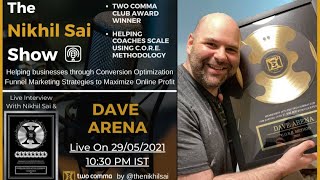
Dave Arena, CEO of Conversion, explains his CORE method for scaling high-ticket offers: test a mid-tier offer ($297-$997) for 1.5-3x ROAS, then layer on backend products ($2,500+) and front-end lead funnels. Funnel sequencing matters: front-end breaks even while backend drives profit and lifetime value.
Chapters
What's going on? What's going on, everyone who is watching this show right now? First of all, everyone who's watching this show, welcome to The Nikhil Sai Show, which is hosted by me, The Nikhil Sai. And guess what's going on today? We are back with another amazing interview today, another 2 Comma Club Award winner. So guess who is coming to the show right now? This guy is crazy when it comes to building up next-level marketing system to businesses, to help them scale at a predictable rate. And let's not waste any time and welcome Dave Arena, CEO at Conversion and creator of 3X Marketing System.
Hey, hey, how are you?
Yeah, brother, we are super excited. We are super excited, brother. You're doing great. How are you?
Good, good. I'm real good.
That's awesome, Dave. And we are glad that you have— you are on time. And everyone who's watching this, Dave is a genius when it comes to building predictable marketing systems. We're going to be having crazy value coming along on this podcast, so make sure to stick around. And Dave, let's not waste any time. Can you please start the backstory, like how did all of this crazy journey started out?
Um, yeah, that's a good question. Uh, actually, I started on the publishing side. So I— and just a little bit of my background, I, I really help, uh, coaches and course creators, and that's, that's really the niche that I specialize in. So I actually started on the publishing side as a, um, trader. So I was in, um, my, my background is in investments and trading. I was a stockbroker back in another lifetime, it seems, ago. And, uh, yeah, so I, I got into Forex when it was just starting in the retail space. So, um, it makes me a dinosaur in terms of that. Um, but yeah, so I, I started, um, getting into Forex education and coaching and having my own programs, and I built that coaching business up to, uh, 7 figures. Um, and then I started a marketing agency to, you know, because I, I really fell in love with the marketing end of it. And, um, and, and so I, I started a marketing agency along with coaching and consulting on digital marketing and funnel strategy. So, um, I kind of I have a unique perspective because I could see it from both ends. I know my clients, I know what they struggle with and their challenges being a publisher of content, and I also know it from the marketing side.
That's awesome, my friend. And I think that really makes sense in the end of the day that you know the both sides of the actual picture. Now you can be creating the right strategy and the structure to any offer and help them scale up. And that's really amazing. And that's a great story, whether being on Wall Street, then turning out into Forex, then now into marketing and scaling businesses. It's a crazy journey, amazing turns. Now, you know, as your marketing genius here, like every marketing agency we find out, every customer or a business who's actually trying to get more customers, they struggle without you while they're trying to test new offers or test to find out the right actual campaigns which actually give them good results. 'Cause that's what really turns out hard when they're scaling up, right? And for a fact, every business, when they want to scale up, they need to test a lot more, right? "Dave, we would love to hear your strategy on testing and finding out real winner ad campaigns or funnels, emails when it comes to building out predictable systems." Yeah, and that's really the basis of my core method is I wanna really prove that I can sell a core offer typically in the mid-tier price range.
So $297 to $997. And again, Being in the coaching and course creating space, that's typically a webinar funnel or some sort of masterclass funnel.
Yeah.
And so the one thing that I want to point out that's unique to my method and my, my approach is that I really want to prove that core offer with no upsells, no downsells, no crazy funnel strategies, you know, no front-end funnels. And that's important because most people start with the front-end funnels. They start with the lead magnet or something of that nature, and that's really not the right approach because it's hard to get those to work economically. And we'll— I'll get into that in a little bit in terms of why that is. Um, so really what I look for in terms of testing, if, if I can get 1.5 to 3x ROAS on that initial core offer on cold traffic. And that's important too, right? I need to be able to go out into the market and say for every dollar I put in, I get 3 back out. Not a warm audience, not, you know, I need to be able to have predictability. So if I can do that, then I have something there that then we can build out the back-end funnels, the front-end funnels, and upsells and downsells and all that stuff. But You see where most people do it the opposite way and they're trying to do all these different things and they're wasting a lot of time and money before they know if something is, is going to sell, you know what I mean? So yeah, it's, it's, it's really putting those, putting those funnels in the right order so that there's congruence throughout the, the whole process, you know what I mean? But you've got to start with really testing that core offer and making sure you have something there and then you can go from there. And also I do wanna, you know, I wanna say the CORE method actually is an acronym. It stands for CORE Offer Riven Engineering, which, and riven means to splinter off. So basically we start with the, you know, so the big key for clients is that this method shortens the time and the money spent on all these marketing efforts and focuses on proving that you can sell something. You know what I mean? And it's also very forgiving, right? So, you know, with a very small amount of ad spend, whether you have something in the core offer or you need tweaking, you know, so you're not spreading yourself too thin. You're just, you're quickly testing that. And then when you have something, you can actually make a profit straight away only. And that's the other important thing, right? That funnel alone as a standalone funnel can make you money without doing anything else. And that's really what I'm looking for when I'm trying to test. And then we go from there.
Absolutely. And that's so beautiful because when it comes to people putting out new offers, they try to complicate it with, yeah, let's have 6 funnel steps with 3 different upsells, membership areas. And in the end, it's like they need multiple 6-figure ad spend to just test if it's going to work out or not, because you will be so much complicating the sales process that you will be ending up paying more for every single customer you're going to gain. And I think you articulated it really well by just explaining that you need to create a simple funnel with one offer and just make sure that it actually goes directly to the cold audience and sell. And I believe every single dollar you spend, if you're making 3 back on a cold audience, that's where the real goal is. Now you can be like, okay, my offer is bulletproof, it's done. Now adding more customer value is what you should be focusing on. That's awesome. And I really got crazy after I look into your core methodology. So we'd love to hear out how you scale businesses with your core methodology? Like, let's go in detail, the cold process on how that works out.
Yeah, so that's the fun part, right? Is like, once you, once you have— so in this kind of, um, this piggybacks nicely on the question before, because once you have that core offer proven, right, then there are two parts to scaling. The first part is to build out the high ticket on the back end. So usually we go from that mid-tier, which is $297 to $997, and I, I I use those, you know, whenever we talk pricing, I use that loosely because that really does depend on your market and what you're selling. You know, if you're, if you're a business opportunity or something, it could be a lot higher. But what you want to do there is then you build out the back end from the core. So, you know, let's say you're selling a $297 course or a membership or something, then you want to move up to typically like a group coaching program or something along those lines somewhere in the you know, usually the $2,000 to $3,000 up to $10,000 range. Okay. Um, typically you'd use a sales force with that, you know, a sales team. Then the second part is then you go back to the front and start building out the front-end funnels with lead gen in mind. So that's where you want to maximize the lead. So the goal there is to really break even on those front-end funnels and max out leads. And so you're talking your free challenge funnels, your free plus shipping, you know, your book funnels, you know, all those kind of funnels go on the front end. And you could see, I mentioned before, that's where most people go wrong. Most people start with the free funnels or the lead magnets or the tripwire, and then they try to build out. And the problem is the economics of those front-end funnels will never work for you. Like you'll never, because— and the other mistake people make is they think that those are for profits, and those are not for profitability. Those are to max out the leads that you're sending to the core funnel, and then off the backend where the real profits are in the backend. So if you think about putting that all together in one system, your frontend funnels are all the different ways you can get people in the door. I just wanna break even on those, okay? So if I could break even on those, I'm maxing out my leads, right? You could even lose money eventually on some of those if your backend is strong enough. And what I see people— people don't understand the long-term game with that whole thing. The game is to max out leads and be able to acquire more leads than your competitors, drive them through your core funnel. That's where you start making some of that ad spend back on that 1.5 to 3 times ROAS. That's where you start making that ads spend back, and then your higher end off the back end, that's where you start scaling and where your profitability is. And then you can even go further than that. You can then start doing higher ticket sales. So say $10,000 plus. So that's where you get into your masterminds or if you want to do retreats and stuff like that. So you're now maximizing profitability and you're maximizing lifetime value on the back end. So when you put that all together and you realize the big picture, you could see where most people make a mistake of thinking, well, I got to get this book funnel profitable. No, that's not what that's for. You're there to maximize leads at breakeven or even a little bit less and then drive people through your entire funnel. So once you have that all in place, that's where the scaling— you can scale that to the moon once you have that all in place.
To the moon. Absolutely, Dave. And I think that's really fundamental. They need to understand the offers they're putting out in the sequence when they need to sell their audience. Right? Yeah, that's what, as you just mentioned, they don't need to confuse themselves by putting different offers in the front end and some crazy offers in the back end, and definitely shouldn't expect profits with tripwire funnels. Yeah, funnel cannot make a million dollars in profit.
That's exactly right. And people just don't want to accept that sometimes. But if you do it— but that's why I start with the core funnel, because if you can get some profits right away and you're not bleeding money on ad spend, now you could be comfortable going back to the front end and not, you know, and just breaking even, you know. And it's hard to get people to think that way, but yeah. And the other thing too is that using my method where you're always splintering off, and what I mean by that is if you have a core offer, that's say a course or a membership, and then the next logical step is, okay, well now I can offer some kind of group coaching, you know, where they get some of my time. And then on the front end, if you have a book or you have something that leads into it, Now there's congruence all the way there, you know, you have that congruence all the way through instead of just throwing offers. And like, that's, you know, you probably see that too. People just throw offers and all that don't connect with, you know, and if you— if there's any disconnect in that whole flow, the audience knows and they're gonna— they're gonna— even if they can't pinpoint it, they're gonna feel like, oh, this— what is this offer? You know what I mean?
Yeah, absolutely. And I think that's the main problem going around there. Like, we see people coming up with new offers every week, often. Yeah, yeah, crazy enough, right? Which is crazy enough. But I, again, as you just mentioned, do not overcomplicate it. Simple front-end funnel, the group coaching, the next high-level mastermind, one-on-one stuff. I think that's your simple value ladder. You're not complicated. And don't make it— the harder you get it, the harder it will be to scale. And that's awesome. And Dave, like as people are coming up with these different offers and all these crazy courses, coaching, mentorship programs, there should be like a system in the backend to actually help them create a customer journey and have a sales process in the backend. And I know no one better than you when it comes to building out customer journeys and sales processes. So as per you are already helping these big businesses have a clear sales process, Would you like to talk about your dream marketing system for your clients, like the customer journey and the sales process, like how you build it, like in a nutshell?
Yeah, yeah. And that's a great question because I think we've pretty much went over that in detail, the detailed steps. But if I were to recap that whole thing, core funnel selling a core offer. So typically a webinar masterclass funnel, that's gonna be $297, $997. So some kind of membership program, core, usually it's a course or something. Do-it-yourself type of course. You know, there might be a little bit of coaching, like a call a month or something like that, but it's typically in that range. Then you build the backend funnel, which is the group coaching program, say $2,500 to $10,000. Um, so that gets into a little bit more in-depth for people. That, that's, that's more a do-it-with-you type of service, you know, done with you. Then front-end funnels for lead generation. So challenge, uh, book funnels, um, quiz funnels, you know, all those kind of things that can lead gen on the front end. Um, and then go back and do high-ticket funnels on the back of the group coaching. So for the group coaching people that are paying $2,500 to $10,000, take the 10 to 20% of those that want to raise their hand and say, hey, I, I want to be in a more exclusive club, you know, and that's where you get into your masterminds or weekend retreats, or, you know, if you want to do a, you know, we've done cruises and stuff like that where, you know, people are paying $25,000, $50,000 and above, you know. So that in a nutshell is kind of the dream marketing system and bringing people through, uh, the journey, the value ladder, and then having, you know, maximizing that lifetime value.
That's awesome, Dave. And would you like to go like a little in detail on like CRM they need and the backend emails and kind of chatbots? Like I know we don't need to complicate it, you know, having a lot of stuff together, but like if you can give us a glimpse of if they really need like a robust marketing system, how would that look like?
Yeah, so—
Follow-up is really important.
Yeah, yeah, yeah. And that's where, again, once you prove out that core offer and you have something, then you could start building out the upsells, downsells, all the email automations, you know, all that, you know, however you want to communicate that, SMS, you know, message bots, all that kind of stuff. Um, so yeah, that, that is definitely important once you get to that point, but you don't need to really even work— you can get away with some of the basic just confirmation emails. And, you know, until you have something that's proven, now then we start building out those automations and all the if-then sequences. And, you know, if You know, if they don't, you know, let's say they get on the webinar, but they don't get like— so we tag people based on everything they do. So we know if someone saw the offer at the end of the webinar or if they just attended but didn't quite make it to the offer. So then we structure the email automations based on that very— so we're always talking to people, we're always picking up the conversation exactly where we left it. So If they made it through the presentation but didn't see the offer, then we're gonna pick it up there and try to get them into, you know, or try to get them into a trial or downsell them into something. So yeah, absolutely.
I think that's beautiful, Dave. And I think this should be really like getting into the business owner's message, right? Like they're really confused. Like, okay, they give away some lead magnets, then they'd be like, okay, buy my stuff on the email. It doesn't really work out, right? It's not like you generate leads, you start selling them.
No, well, I was going to say the other thing on that too is that especially in the coaching space, you always have to provide value as well. So you can't just say buy my thing now. You have to— like, everything we do is structured where we're providing some sort of value. Even in the email communication, there has to be some sort of education or value added before we get to the call to action because The whole game is, you know, they need to know, like, and trust you at the end of the day. You know, that's what it's all about. So you're building that in every communication that you're doing, whether you want them to watch a video, a webinar, a piece of content, you want them to read something, it's an email, always has to provide value first.
Yeah, absolutely. And I agree on the part which you just mentioned that they should be pre-sold before you pitch them. Like directly pitching them really won't work. And that's awesome, Dave, super amazing answer, so golden nuggets. So let's get to the next question, Dave. Like you are really working with big clients, huge companies, and like it's really hard for a beginner agency or someone who's just getting started out to start getting some clients, or even someone who's having some clients, they are on this roller coaster ride where they're having some lucky months, bad months. So as you're already running a successful marketing agency, would you like to mention like the best strategy on how to get clients as a marketing agency in 2021?
Yeah, I, I, um, I go back to a few things there. Um, first is I walk my own walk, right? So I think you have to set up the similar structure for your own business. You have to have— now, if you're an agency that's— let's say you're an agency that just wants to get clients or prospects on the phone, right? And you don't have, you know, you're you're more of a done-for-you service, you still can create a core funnel that's more of an application funnel or a booking call funnel, you know, with the goal in mind instead of selling something, you want to get them on the phone or have them book a call, right? But that's still the same methodology is you prove that out and you say, okay, now my key metrics are how how low can I get those costs per, per booking? You know, you know, how, how much is it, how much is it costing me per call? And then what am I, and what is my ROI on that? So I think you need to, you, you need to have that core funnel that, that does that. And also though, I think, and I'm gonna get more, I hope it's okay to get a little bit more methodology or philosophy based than actual tactics, right? But, but I think that— I think what I coach my clients on is like when they are positioning their offers, right? Like, like people buy frameworks and they buy systems, right? So they want to know that you have a proven framework or system that has gotten others in their situation the results and transformation they want. Right? People, us as humans, we feel cozy with like knowing that, okay, you, and even if you, you know, and that speaks to like your unique mechanism, right? Like what are you gonna call your method or your framework that differentiates it and where people can wrap their head around like, okay, this guy's got something or this girl's got something that is different and in the marketplace and I see where they've gotten others results. They wanna plug into a proven system. You know what I mean? They don't want you just to, be consulting them or coaching. So, and actually that's why I named my agency 3XP Marketing because the P's are position, right? How are you positioning yourself and your offer in the market? Your process, right? What is your process, your secret sauce? Again, I call this the unique mechanism. Others have used that term, you know, in marketing. It's not a new term, but it really, it's, it's What's different about your offer that the market has not seen before? At least, you know, and again, that's your— you may even be teaching much of the same types of things or the same tactics or the same strategies, but what are you calling it and what are you, you know, what is that step-by-step that's unique? And then the third P is proof, right? What indisputable proof do you have that your system has gotten the results and the transformation your clients seek? You know, and so I think if you get all those right, you know, position, process, proof, if you get all that right, you know, even if you have to give away some of your services just to get some of that proof, or, you know, or have a discounted version until you can get the, that proof, when you get those three right, you can get, you know, again, without getting into the tactics of like whether you should do Facebook ads, you know, all that stuff works, But you really got to nail down those kind of those 3 Ps. And if you get that right, you'll not only get more clients, but you'll attract the dream clients, you'll attract the ideal clients and repel away the ones that you don't want.
Yeah, absolutely, Dave. And that's so beautiful, man. Like you have so strong fundamentals and I never expected that the 3XP has so intense name inside it. And that's so beautiful that we need to get more clarity on what we're really doing. I think that will really get us, you know, the proofing, as you just mentioned. I think that, that sells itself. And the way you just mentioned it, like, everyone is doing the same Facebook ads, same funnels and automations, but the way you're packaging it, the system, the framework you've got is what it sells. As you mentioned, you just need to package it differently, as you mentioned. So let's get to the next question, Dave. Like, you have— you are running a marketing agency, so you definitely need a lot of talented people as your crew, like your team, right? And the question is where you can find them and how, how you can hire them, right? Like, we would like to know like a sneak peek on how you actually hire talented team for your company especially. That would be so great.
Yeah, I, I mean, I do a lot, you know, of course everyone uses probably the same tools like Upwork and things of that nature, but I think what's the key there is not really so much where you're finding the talent. But what I've learned, what I've learned with talent is you really need to figure out exactly what you need and when, and then you need to really get specialists and experts in that specific area. Okay, so what I mean is like, even like ad platforms are a good example, right? Because that's an, that's an easy example where they are so nuanced now. Like Facebook is so different than running YouTube ads, you know. Yeah, you really need to find— say if you're looking for a Facebook media buyer, you, you need someone that eats, sleeps, breathes Facebook ads.
Yeah.
And you also then need to find someone that's different that eats, breathes, sleeps YouTube ads. You get what I'm saying? Like, you, you really— we're really in a market where, uh, specialists rule, and you really need to find those specialists that you can, you know, because again, everyone promises, you know, these big promises and results and all that. But I think if you really stick to knowing, like if you really stick to that specialist mentality, you can really dig down deeper and say, okay, when, if you're looking for a Facebook media buyer and you get all these people that apply that are just not like, or, you know, or they're saying, hey, I can do this, this, this, and that, you can almost eliminate them right off the bat and kind of focus on the people where you see, okay, this, this person is all about Facebook ads. They're showing me results that are specific to Facebook ads. You get what I'm saying? So I think you really need to focus on the specialty. And I also think you need to be flexible, right? Because the team who gets you from point A to point B is probably not the same team that gets you from point B to point C, right? So as, as you scale and as you can afford more, you need to really always be looking at the next step because there are specialists that you just couldn't afford or wouldn't have been on your radar at the beginning. And then they can take you, but you know, once you get to a point where they'll take you on, you can really get to the next level. Like a good example there is like a sales force or a sales team, right? There's lots of, you know, you can get an individual salesperson that really doesn't have their own processes to be able to scale you. But they'll get you sales, right? They'll get on the phone and they'll do a good job. But then once you're getting ready to scale to that next level, you need a sales team that has their own processes to scale, you know, setup people and closers and people that help with finance. And, you know, there's levels to everything that you do. And so that's what I've learned is you really need to be flexible and constantly Like you need specialists that can scale with you, you know, where you are and can scale you to the next level.
Absolutely, Dave. And that's so intense, man. Appreciate the golden nuggets you're dropping off. And like, it's so important what you just mentioned, that hiring specialists, right? You should be hiring someone who knows Facebook, YouTube, project management, graphic design, funnels, emails. You don't need that all, right? You just need someone who can fix the missing part, right? Yeah. Let's say it's email. You just need that one person who is really good at email. right? And as you just mentioned, brother, we should be really flexible and leveling up always. I think that's just like an investment. It acts as an investment to help us scale our agency at the same time.
Yeah, and that's— you actually, just real quick, because you mentioned like email marketing is another good example, right? Like most people don't think, or they think like, okay, I'll get a copywriter, which, you know, normally a copywriter can handle all that, but there are really good like, I only do email copywriting, you know what I mean? And they know how to split test subject, you know what I mean? So And sometimes you may not when you're first starting out. That's another thing for people that are starting out, right? They can't afford all these different specialists either. So it's okay to go a little bit more general or find like a good copywriter. But as you scale, you want to really start specializing and say, okay, I could get a really good email copywriter that only deals with that. They know how to split test subject lines and they just eat, sleep, and breathe that. You know what I mean?
Yeah, absolutely, brother. That's so beautiful. And I think that's, that's really key for any business while they're really scaling. And I think this is a really good, uh, takeaway for every business owner who's actually running a marketing agency and want to scale. You should hire specialists because they're going to drive the more results. The more you give results, the more clients will attract at the same time.
That's absolutely— yep.
Let's get into the next question, Dave. Like, you get a lot of stuff done in the meantime because running a marketing agency is not an easy job. As you know, you got clients rolling in, projects pending, and all this stuff, fixing all these missing pieces. So what kind of, you know, tools, uh, you use to manage your projects and clients and team for productivity?
Oh yeah, that, that's a good question. So, um, but my tech stack basically looks like this. So I, I use ClickUp for tasks and operations. Okay, so, um, and there's others out there, right? Like some people use Asana or Monday, or, you know, but ClickUp has really been— we've— I've I've actually used, um, we actually switched from Monday to ClickUp, uh, probably several months ago. So I use ClickUp for tasks and operations. I use Slack for communication, right? So not only communication with my team but also communication with clients. And then in terms of what we use for our own, and again, we walk our walk, right? So we, we use the same tech stack as we we want our clients to use that we implement. So ClickFunnels for marketing pages and funnels, again, it's, um, I've always found it's just the easiest and the quickest to be as agile as you want to be. Meaning if I want to just change something and just test out a new page, or ClickFunnels just allows me that flexibility, right? I don't care what your main website is built on or what, you know, but for marketing pages and being able to you know, test funnels, ClickFunnels is the way to go. We use Kajabi for courses, content, membership areas, uh, WebinarJam, EverWebinar for live and evergreen webinars. And then we use ActiveCampaign for email automations and also email automations broadcast. And we even use it for our CRM for the sales team as well. So, um, they have a built-in CRM, so we keep it all And then for like call booking, like we use ScheduleOnce to— but there's a lot of them out there, Calendly and things like that. So that's my basic tech stack in terms of— and again, everything we use internally for our own team, we also suggest that clients use as well.
Absolutely. So you know what you're doing. So you're teaching them similar structure.
Yeah.
It's actually working in your business. Yeah. That's really important. Like I've seen Facebook ad experts who don't run Facebook ads for their agency but try to do it. I know funnel designers who don't design a funnel for themselves but try to do it for clients.
Right, right, right.
And that's awesome, Dave. And you're getting so much stuff done, brother. We would like to learn more about your daily routine for all of the success you're achieving in your life. Would you like to talk about that?
Oh yeah. Yeah, that's big. You really need to set up your day to win, right? And one of my biggest clients that I'm actually chief marketing officer for is big in the personal development space. So I'd be in trouble if I didn't have my daily routine and all my stuff down pat. But yeah, so in terms of morning routine, I mean, I'm usually up by 5:30 AM every day. Start with a huge glass of water and supplements and all that. Um, then I get into my, like, meditation. I watch my Mind Movies. Uh, if, if you haven't heard of Mind Movies, go check it out. It's— I don't, I don't, I don't get any, any, uh, kickback from them, but it's a really good program to be able to visually have, like, uh, it actually basically takes, like, your vision board and makes it into, like, a short film. And they, they have, uh, other ones that are already pre-built and stuff. So, um, yeah, so meditation, watching my Mind Movies, and then I write. I write for usually a couple hours. I write in a gratitude journal. And then I've also been a stand-up comedian and comedy writer for over 15 years. So that's my time each day to kind of write while nobody else is up and it's quiet in the house. So I do all that. And then I usually start my day, by the time I get all done with that, it's usually about 8:30. 8:30 or so in AM. And then I, I really, from, from that time to noon, I really tackle the most impactful tasks that I can for the day, which I've already set up the night before. So I kind of know what those critical— so that I, so that I, I'm— and that's important for me because I used to be too reactive to everything, whether it's somebody gets me on Slack or something, you know, and I get pulled in all these different directions I really want to focus that time on getting the most impactful things done, you know, for the day and being done with those by noon, you know. And then if nothing else, if I got nothing else done the rest of the day, at least I have the most impactful things done. And then after that, I work out, I do another meditation in the afternoon, kind of. I could call it meditation. It's basically a small nap, you know, in the afternoon. And then when I get up from there, I then And then I tackle any other tasks that, you know, maybe didn't make the most important list, but anything else that I have to do. And then in the evening, I'm usually performing comedy. You know, I'm here in New York City, so it's a great city for comedy. So whether it's an open mic or a show or whatever, I'm doing that in the evening and then try to be in bed by 10 PM and rinse and repeat from there.
Absolutely, Devon. That's a beautiful routine and super exciting. We love that you're actually having that passion into comedy, and that's so amazing, right? Yeah, very few people who are into marketing do the comedy, right? Right. Yeah, that's amazing, brother. That's so cool, brother. So Dave, let's get into the next question, brother, because now we see a lot of young people getting into, you know, the marketing space. Also, when you were in, you were also a little confused on what to really do, right? What to get done, right? So what will be a suggestion to a 20-year-old you or someone who is just getting started right now?
Yeah, um, I love that question. Um, I guess from a, from a macro point of view, I think, you know, you have to invest in yourself always. That, that's one of the biggest things that I, I've never been afraid to invest in myself, whether it's taking a risk or a chance on a business or investing in courses or, um, you know, something that's going to elevate myself, especially when it comes to high-income-producing type of, of, uh, skills, right? So, you know, if you can learn copywriting, you know, even if I started as a copywriter, so even if you don't, like, as you progress, like, I'm at a level where obviously I'm not in there writing individual emails as much anymore, or writing us, you know, we have people on I have to do that, but I know how to do it, and I can always fall back on that as a high-income-producing skill, right? So I think that's important. So to invest in yourself, always be building that toolbox, and, and do it with things that are valuable in the marketplace, right? Um, you know, if you can learn how to— you know, again, we were talking about being specialists, right? So if you can learn how to really be a a ninja at Facebook ads or something like, you know, that, that's a high income-producing skill that, that's in demand, right? Um, you know, and I also think, you know, you have to really believe that everything is inside of you that you need and believe in yourself. Always, you know, trust the process of what you're going through and that if you put in the work and you, you know, that things will work out, right? So I've always had that philosophy of, you know, jump off the ledge and then learn how to fly, you know what I mean? Like, you, you have— you always have to be growing, and because of that, you can't really settle for being comfortable, especially if you want to have your own business, and that's, that's the, the way you're going, right? Um, and then I think if we want to get down to, like, the tactics, and we've kind of mentioned this before, right? It's systematize, systematize, systematize. You know, like, if you— you have to be able to have a system that you can replicate over and over, not only for your own marketing and how to bring clients on, but how do you onboard clients? How do— how do you make that experience the same? And how do you have standard operating procedures that are documented where you can take yourself out of the business and, and put people in place, whether it's an operations person or something, and you can get the same results over and over. A, that's how you get the best— that's how you get consistent results for clients, right? By having that system and, and knowing that if I do X, Y, and Z every time, I'm— we're pretty much going to get the same results, you know. And that's That's what clients want to feel. You know, they want to feel, okay, you have that system, but also for your own business, having that system in place where you don't ever want to be the bottleneck, right? Because if you end up just having a job where you're working 80 hours, you really don't have your own agency or your own business. You really need to have a systematized business that anyone can go and look and say, okay, this is how we do things and this is the, this is the process. And you can't scale if you, if you're the bottleneck. So that's probably the number one thing is the earlier you can do that, the quicker you're going to scale and grow.
Absolutely. And I 100% agree on the point which you just mentioned. Like, I think this is a core problem in most of the businesses, especially when it comes to agency space. Like, they are literally the guy who is getting results as an agency owner. They should be on the Facebook ad session, they should be on the email marketing. They should be on all of these missing pieces. They should be figuring that out. They don't have a real system. And in the end, if they just want to back off and be like, okay, let the team do, it's going to bluff out, right? It's going to not work out.
And one of the things too, and this took me a long time to learn, right? You have the tendency to think that every client is different and you should be doing all these custom things. And that's not the way to go. Every— if you're in an— if you're truly niched down to something that you are an expert in, like I deal with you know, my niche is coaches and course creators, right? For the most part, that whole, you know, you may change some tactics here and there, you know, but for the most part, all those clients are seeking the same type of results. And they— my system, I don't need to do any custom work, right? Everybody gets the same system. And it's actually better for the clients because that's how you get predictable and consistent results for them. You know what I mean? So Yeah. You got to resist doing custom things or doing proposals that are different for it. Then you take up 40 hours a week just doing proposal. You know, it's, yeah, you can't scale that way.
Absolutely, Dave. And I 100% agree. And I think that's the most powerful golden nugget you ever given on this show because it's literally like you are productizing your agency where now you have this clear SOPs, clear system where you can tap in the right expertise and they can give the similar results to the new client, same like the existing client or the previous client. I think that that can really help you to track and help you grow your agency faster and get more predictable results. That's awesome, Dev, and that was a golden nugget. Again, thank you so much for amazing value you're providing here. And let's get into the next question, brother. What are your life's biggest achievements so far and any next bigger goals?
Yeah, well, I've raised 3 daughters, so that's a pretty big— the youngest are 15 and 16, the oldest is 30. 20. So to, to get 3 kids pretty much near adulthood is, is pretty big. Yeah. Um, I think also for me, if you're looking at a macro level, probably the freedom that I've been able to, uh, build out in my life. You know, I, I quit my job in 2001 right when my oldest daughter was born. So you can imagine I mean, you want to talk about jumping off the ledge and then learning how to fly. Right when my first daughter was being born, I decided to quit my job and do this full time. And that was a scary time, right? I'm just becoming a father. I don't, you know, a lot of question marks there. But I haven't had to work for anyone else but myself since then, which is, you know, now over 20 years. I think that's a big accomplishment. Um, you know, I've built two seven-figure coaching businesses for myself, let alone, you know, all the other clients that I've helped to do the same. Um, currently, um, I helped a client go from under— they were at about $18,000 in monthly revenue when I took over the marketing, and now we are consistently getting over $300,000 per month and growing rapidly from there. So we hit our first a 6-figure month 4 months after I took over. So, like I said, with that core method system, yeah, it likes speed, right? It likes it. Like, once we can prove it out, then we go from there. And so now we're trying to scale to the next level, you know, which is kind of that million-dollar-a-month-plus range, which we'll probably hit, you know, we'll probably hit that by the end of the year for sure. Of course, my 2 Comma Club awards are pretty nice as well. You know, it's nice to be recognized in that way. And I'm halfway to that, that $10 million, uh, that 10x one, which will be, uh, yeah, I just, I love it. I think that's a cool looking, looking discs. They're looking—
it is.
Yeah.
So I presented—
yeah, I look forward to getting that.
We're excited. We're excited to see that award in your hands, man. That would be so great. And man, like, that's so crazy. Like, you literally 15 times increase the revenue within just a couple of months.
Yeah.
So amazing stuff, bro. That's awesome. So let's get to the next quick question, Dave. Like, what was your biggest mistake in your life, especially in terms of business?
Yeah.
Wow.
That's a tough one because there's been a lot of, you know, that's part of the game, right? Well, that's what I was saying, like, with that question about your younger self and the advice is that you're going to make a lot of mistakes, right? That's part of growing. You got to fall forward, you know what I mean? And you got to be willing to fall on your face a lot of times, you know? So there's been a lot, a lot of mistakes. I'd say probably the biggest mistake I made was several years ago, someone had made me an offer that I really couldn't refuse to go become their chief marketing officer. So what I did is I actually shut my agency down for a time and went to work for them. And then eventually the owner got into some hot water, some legal trouble. And the business shut down. And then I found myself, you know, after 3 years starting from scratch with, you know, because I had shut everything down. So I think the lesson that came out of that was you— and this is for all of, you know, again, this, this will be a great one for the, the younger, uh, people listening that are starting their agency or getting in or trying to grow to the next level— is, you know, have, have multiple revenue streams and control your own situation, you know what I mean? So try not to get into situations where everything is totally dependent on someone else, right? Because at the end of the day, that's not your business. First of all, you're, you know, you're never going to, um, you're never going to own or control that situation if it's not your business, or, you know what I mean? And then diversify and have all other revenue streams, because if something does, um, yeah, you know, happen, then, then you have stuff to fall back on. So I think that was my biggest mistake, is putting all my eggs in one basket and putting it in a basket that I didn't own or control, if that makes sense.
Wow. And that's a great learning, Dave. And I think that's, that's one of the crucial lessons for every single person listening to this podcast, that they should— they shouldn't get tempted to something else and just break what's actually working. Yeah, you just need to try to automate it at least to get you at least with the best so that you have some control on your entity and your life and what's going on. And that's a beautiful lesson, brother. Thank you so much for sharing your story. And let's get into the next quick question, brother. Your main inspiration for success and key people involved in your journey.
Wow. Yeah, that's another— I'm inspired by so much. I'm, I mean, really, um, I'm inspired by greatness, really, in any endeavor. And what I mean by that is— and I don't mean to be so— I hope that's not too general or too, you know, but I, uh, I think when it comes, like we mentioned, comedy, right? So when it comes to comedy, when it comes to business, I've always been really intrigued and curious about the greats, right? Not, not the people that are just really good and carved out a decent career. I'm talking about like what separates those really great achievers from the ones that are just really good, you know what I mean? Like, that's always fascinated me. And that's— I always, you know, I do a lot of reading, you know, on those kind of autobiographical type of, you know what I mean? So super cool. Yeah, yeah. I'm always, I'm always curious and trying to find out what separates them, you know, from, from the people that are just good. And that really drives me. You know, I want to be truly great in anything that I take on. I also need to be passionate about it. So again, when, when I'm talking to younger people that are just getting started, I, I think that's a big, big part of it, right? You need to really have the passion, and, and you really want— like, don't take it on if you don't feel like you could be great at it or that you don't have a passion. Even with clients, right? Like I have to be able to be somewhat passionate about what they do and also see that they can be great. You know what I mean? So when I'm evaluating, of course, now I'm at a point where I can be that choosy. Like when you're starting out, you just have to do what you got to do, right? But I really look at those clients that I'm like, okay, I look at their content, I look at what they have going on. I'm like, wow, this person is really great at what they're doing and I could help them get to the next level. So that's really what I'm always looking at. I'm always looking to like get to that great level. And, and I would think in terms of people along my journey, I mean, I, I have to mention my wife. You know, my wife is my person. You know, we've been married 20 years, uh, actually we just celebrated our 20th year in April, and we've been together 23 years. So she's been through it all, right? She's been through that whole journey with me, the, the ups and downs, you know, making it, making a ton of money, losing a ton of money, you know. And she always allows me to be me and to take chances when I believe in something. And I think you need— it doesn't necessarily have to be a spouse, but I think you need that support system, you know, or you need to go find that peer group, that peer group that will allow, will support you, and that always, you know, that understands that you're always trying to strive. Because I think, you know, you you really are who you hang out with at the end of the day, you know what I mean? So I think, yeah, and if you want to get to other, you know, to, um, if you want to increase to different levels, you, you have to up that, that peer group and who you're hanging around and surround yourself by people that have, have done it and that are smarter than you, you know. So I've, I've been pretty good at that, knowing like I'm not— I'm never the smartest guy in the room, you know what I mean?
So Yeah, that's a great thing, right? You hang out with eagles who know what they're doing and, and really understand the deep sense of we definitely need to have someone who can, you know, guide us and track us and help us to take the right decisions, back off when something is not good, and cheer us on when we are taking the right decision. And that's really important. Yeah, that you actually had that kind of journey overall. Let's get into the next awesome question over there. Like, you're so cool, man, like when it comes to providing value, delivering great results, So where can our audience find your mentoring or maybe start working with you?
Oh yeah, um, 3xpmarketing.com is, uh, is my main, uh, site there. So yeah, with, uh, you know, and I— what I'm working on in the future, and I'll have to let you know once I have everything built out, and maybe you can update with some links, but I'm, I'm definitely transitioning more I definitely want to transition more into consulting and coaching and kind of having my own marketing courses and stuff like that. So, you know, I'm building out— like, I built out a cloner tool for ClickFunnels. So, I mean, you've seen some of those out there probably, but, you know, it comes along with really how, how to hack different Facebook ads, like how to go to, like, people that you know are being successful and see what they're doing. Not, not in the sense of copying them or infringing on their their intellectual property, but modeling the people that are successful, right? Go, go in, and I have a whole system on how you can find out what they're doing in, in their Facebook ads, how to go to their funnels and grab, you know, those funnels and being able to look. And then of course making it your own with your own copy and your own imaging. And then even down to content, right? Being able to hack the, you know, if you liked a webinar or, you know, what, what is the structure they're using? And, and again, and we talked about it, right? Systematize and, and being able to, um, have a system where everything's a formula, right? If you know they're having success with it, you just have to really model that formula, make it your own, and then you'll have a similar success. So yeah, I'm transitioning more into like the coaching and the courses myself, so that, that's coming in the future.
That's really exciting, Dave. So I'm gonna drop the link 3XP Marketing. You can just talk to Dave if you want to. And definitely, man, that's so exciting. Like, if you can have good reference of what's actually working, I think that would be gold. If I'm not wrong, anything you cannot value, right? Like, it's something that you cannot value, right? You just know what's actually working. I think that could be like a great reference. You should never copy it, by the way. You can— yeah, it could be like a great reference for you, your client, and help you to figure out all the missing pieces. That's awesome.
Yeah, you know, there's ethics involved, of course. You don't want to copy anybody, but There's a reason why, there's a reason why ClickFunnels has even themselves, they have Funnel Hacking Live, right? Like, so they know that you— why reinvent the wheel, right? Find the people that are already successful. I mean, if someone's running— I mean, you could look at someone's Facebook page, right? If they've been running ads for 5, 6 months to a certain funnel, either they're the dumbest people in the world and they're just spending money, you know, for no return, or it's working, right? More than likely that's working if they're going 4 or 5 months, you know, so you can—
methodology—
all that is transparent nowadays, right? You can go to someone's page, see the Facebook ads, see how long they've been running them, and then you're like, well, wait a second, if they've— if these big guys, right, have been— and you know they have a lot of ad spend, a lot of ad budget— if they're spending money for months and months and months, something's got to be working here. So let me go and model that. And, you know, as opposed to what most people do, right? They go and try to find someone, you know, and they start— try to start from scratch, and they spend way too much time and money trying to do their own custom things when all the information is there. Just model after people that are already doing it well, make it your own, and, and you shortcut the system, you know.
Absolutely. And I definitely believe that's gonna— that's gonna fast-track the results, at least to 10, 20, 50, 100 times, probably. Yeah, just do it the right way. And that's awesome, dude. That's awesome. And that was so amazing, brother. Any last words before we conclude the whole podcast session today?
No, I think, um, man, I, I do have to say that you're, um, I really enjoyed this because your, your questions were, uh, spot on in terms of, you know, I, I guess I don't have any last words, right? Because we went through pretty much everything I would, I would want to teach someone if they're starting out, you know, again, mostly just get that system, get that process in place for your own marketing and also for your business so that you can get clients that— those replicatable, consistent results. And I think that's what it boils down to.
Absolutely, Dave. And thank you so much for the kind words about the show, brother. And we are really glad that you enjoyed the time on the show, man. And again, thank you so much for the amazing opportunity, Dave. It was really a pleasure to have you on our podcast, and it is so exciting. And I really need to look back and actually take a lot of notes for myself to implement them instantly in my business as well. It was so valuable, brother. We appreciate you and everyone who's watching this. Hopefully enjoyed the session. So just stay tuned for the next interview, guys. Looking forward to it. Thank you so much, Dev. Peace out. Peace out.
Thank you. Thank you for having me.
More from Nikhil










BURNED $1.5M in his 17years online #digitalmarketing #entrepreneur #onlinebusiness
