The PODCAST Secret That's Helping Creators Reach a Global Audience
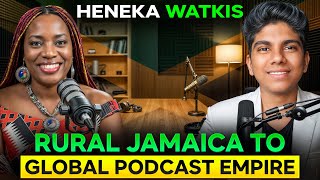
In this episode of The Nikhil Sai Show, host Nikhil Sai interviews entrepreneur, author, and podcaster Heneka Watkins-Porter. Heneka shares her humble upbringing in rural St. Mary, Jamaica, her early ventures in clothing, a double major in sociology and management, and the trauma that shaped her mission of "life transformation through inspiration." She recounts how she transitioned from a local radio show (The Entrepreneur in You, 2014‑2016) to a podcast after being inspired by John Lee Dumas' Entrepreneurs on Fire. Major challenges included tech‑fear and consistency, which she overcame by diving in, using free tools like Audacity, and committing to regular releases since 2017. Heneka explains her guest‑booking strategy: deep community engagement, giving before asking, leveraging early high‑profile guests, and using tools like Hunter.io to find contacts. She details her daily workflow and the suite of tools she relies on (Zoom, Headliner, Canva, ChatGPT, Grammarly, Google Suite, Calendly, WhatsApp, etc.). She reflects on her biggest mistake—settling a legal dispute over a sauce line instead of fighting it—and highlights her proudest achievements, including launching a clothing line and the social‑enterprise mentorship program Race to Grow for women. Her motivation stems from a desire to inspire others and provide for her two nieces. Listeners are invited to connect via her website, WhatsApp, and email for coaching, podcast production, or mentorship. The episode closes with Heneka’s mantra about mindset, daily habits, and the power of incremental progress.
Chapters
How did you actually end up where you are? Why did you even start a show?
I'm in the rural parts of Jamaica, St. Mary, I guess.
What prompted you to actually start the Entrepreneur You podcast?
Oh my gosh, I could do big things and people were actually inspired by me.
How do you actually approach these guests? What's the process? But yeah, please walk us through how to do that.
Why, why suffer the book? Why not start a radio show?
What's your life's biggest achievements? And what is the next big goal?
Starting my clothing line because— so I did that without having any blueprint.
What makes you excited to wake up from the bed and get to work?
Life transformation.
What's going on? What's going on, everybody who's actually listening to this podcast right now? First of all, guys, welcome back to another episode of The Nikhil Sai Show, which is hosted by me, The Nikhil Sai, and guest What's going on today? We're back with another amazing guest. I mean, this is going to be a very, very interesting podcast if you're somebody who are willing to learn podcasting or create your own TV show in the future. And today we have a prolific entrepreneur, dynamic author, and international speaker who is also the host of The Entrepreneurial You podcast and TV show. And she has actually interviewed global leaders like Richard Branson, Seth Godin, and founding initiatives that empower and inspire many more. Hundreds of thousands of people. Let's discover by talking to her on how she has built one of the best networks and fastly growing podcasts on the internet. Let's not waste any time and actually let's welcome Heneka Wakis-Oter. Hey, Heneka.
Hey, Nick. Thank you so much for having me on the show. I am really, really excited to be here and a wonderful, wonderful hello to your amazing audience.
Appreciate that. We are stoked to having you. Thank you so much for jumping on time. Now, Heneka, we will definitely get into all the juicy entrepreneurial questions, but before that, I would love to go behind the scenes and learn how you became you. Can you talk a little bit about your journey? How was your early childhood? How did you actually end up where you are? Why did you even start a show? Like, walk us through your early childhood. What was your story like, uh, you know, before you actually became who you are?
Okay, well, let's, let's start from the very beginning. So grew up in the very rural parts of Jamaica, uh, St. Mary. I guess. And I was this little child who was really shy, no confidence, no self-esteem. I didn't have my parents around at the time. I didn't go with my parents, you know. Um, went through just being an average school student, you know, wasn't very bright. But it's funny enough because persons thought I was bright, but I didn't see myself as bright, you know. I I was an average student, didn't like math, didn't like anything to do with the sciences. I ended up at university, but before university was high school, where I did a lot of, uh, uh, like, you know, food and nutrition, clothing and textiles, things that have nothing to do with what I'm doing today, right? So I did that, and then I moved on to university after working for some time. I went on to university to pursue a double major in sociology and management studies. So that's pretty much my school journey. I grew up in church and had a lot of, you know, trauma in my childhood. And I find that those traumatic experiences are actually what provide that foundation, um, that fodder for me now to use as support and inspiration for others. So in the long run, it worked. Although it wasn't the best, you know, experiences, they turned out to Um, be able to be doing some good, let's put it that way, to inspire others, as my life mission is life transformation through inspiration. And I continue to allow people to live by curiosity through my eyes as I inspire their next team.
That is definitely inspiring, coming from a very unique background and still making it to the top. And the best part is taking the different traumatic situations you are in and looking at them positively, looking at them and then having a right perspective and converting that into a mission is definitely an important add-on you have achieved, uh, Haneka, and we are stoked. I believe this story will actually inspire a lot more entrepreneurs who actually want to do the same in their life, who are struggling with those traumatic situations, and now they get a better perspective of what they could do with those experiences. Now I'm curious, what prompted you to actually start the Entrepreneurial View podcast? How did you even get that idea? What was the, the thought process? What was the vision? When you're actually thinking about, oh, I'm going to interview podcast, uh, you know, do podcast with the successful entrepreneurs?
Ah, great question, Nick. I had a— so when I started entrepreneurship, I started entrepreneurship— my entrepreneurial journey started about 2007. Pretty much started before that, like selling apples at my gate to try and get money to go to school, things like those, right? Selling stockings and perfumes. Over time, my formal entrepreneurial journey, 2007, where I actually— 2007, where I started a clothing line. And if you see my office now, so apparently that's the name of the clothing line, and it's still very prominent in, um, although it's not being operated on now, it's still very prominent in my mind and even in my office, right? Because it is the first business I started where I would use Jamaican expressions and put an interpretation in English, versus like that. So when I started that journey, I realized that, my gosh, I could do big things. And people were actually inspired by me. And so I'll be invited to speak on entrepreneurship to inspire girls, young women, stuff like that. And I realized, you know what, in, in order for me to reach many people, I need to write a book perhaps. And I, my first book was 15 Games for Entrepreneurial Success. And then the idea came, why, why stop at a book? Why not start a radio show? And so the radio show in 2014 was born called The Entrepreneur in You, and that was on traditional radio right here in Jamaica. I did that for 3 seasons, 13 episodes each season, 2014, 2015, 2016. And then by the end of 2015, 2016, when, when I was into my last, um, my last, uh, season for The Entrepreneur in You Radio Edition, I was searching because by then I still had my radio, my, my clothing brand, clothing line in a store, you know, brick and mortar. But I wanted to transition out of that. I wanted to go digital. Some conversations, one conversation after the other, lead me into a podcast. A friend of mine introduced me to 3 major podcasts and I became hooked on John Lee Dumas' Entrepreneurs on Fire. And once I became on JLD's EO Fire, I thought, you know what, podcast it is. And so I was excited, I was learning and leaning into John as he shares with his community. He would do a free course, how to start a podcast, and, and I would just be tuned in and very zoned in into what he was doing. Got very connected, um, as part of his community. And before you know it, JLD is on my show. So yeah, that's how I pretty much started.
That was definitely interesting to see how you actually started your own show in Jamaica to interviewing people and then getting onto the entrepreneur's fire and then actually making it your life's mission. So I'm curious, what challenges did you face when you started your podcasting career? How did you overcome that?
So I think the major challenge I had was all in my head, if I must be honest, at the initial stage. And that challenge was Oh, it's gonna be so hard to do the tech stuff. Like, I'm not a techie. How am I gonna do all this thing? So I was actually productively procrastinating. What do I mean by that? I was doing everything else for the podcast. I was, you know, researching how to set up this. I was working on the website. I was working on everything I need to know, you know, what software to use to record, everything else, getting the actual technology of the microphone, etc. When it came on to doing the actual recording, I'm like, oh my God, I'm so afraid. And the truth is, I should be, because there it was. I already had the radio show, and in the final season of the radio show, I did the Caribbean edition where I interviewed people virtually from all over the Caribbean, because the radio station would not absorb the cost to make those telephone calls. At the time, they would have to be telephone calls, and the radio station wasn't going to absorb those costs. And so I had to find a way to do it virtually by having those persons online, you know, Skype at the time is what I used. So with that— excuse me— with that, I just thought like, oh my gosh, it's going to be so hard to do the actual thing, like, when I'm doing it myself. Because what would happen is that I would do the recording for the radio show, the Caribbean Edition, and I would send it to the radio station, and they would do the edits and everything. When I was doing the podcast, I'm thinking, oh my gosh, I'm gonna have to learn how to edit. I'm going to have to learn how to do this. And I was so, so daunted by it until I started. I actually decided, you know what, you've got to start. You've got to hit record, girl. You've got to hit record. And I actually started. And in starting, I realized, oh my gosh, but it's so, it's pretty much very, very simple because I use Audacity and there's a tutorial for every question that I could perceive and conceive. There was Audacity right there online with a tutorial. I'm like, okay. Like, even when I didn't know the term to use, I would just put in a random search and I would get the response. I'm like, look, this is easier than I thought, you know. Why was I just procrastinating all along? So that was the biggest challenge I faced, um, immediately. And then it's always the, um, the biggest challenge— I don't know if it's a challenge, just a reality of what podcasting is about— and it's just being consistent. Because I have consistently put out a show since 2017, because one of the biggest pet peeves I have, no, being a podcast coach, consultant, producer, all of these things, one of the biggest things that I, I detest is what we call pod fade. So people are so excited about starting your podcast, they launch and upload their first 3 episodes, and that's it. You never hear from them again, right? Um, and, and, and so that happens because a lot of persons underestimate the time it takes to actually get a podcast episode on the road, especially if you're an indie podcaster, you are just doing this thing alone. It takes a lot of effort, right? You have to like, yeah, leading up to the guest, you have to get the guest, you have to research the guest, you have to, uh, you know, do the content planning, script it. I mean, right now, thank God for AI, it makes a lot less cumbersome, right? But you still have to put some work into it. You have to know once it— once you've confirmed the guest, you have to schedule that, you know, do that interview, uh, you edit, you, you do your show notes, you do your blog posts, you do your social media, you do your audiogram, you do all of these things, uh, you pull quotes, whatever it is, right? So it does take a lot of work and effort, and many people are not ready for that. And I think that's one of the biggest challenges. But I was always somebody who— I've always said to persons, you can't out-determine me, you can't out-skill me, But you can over-determine.
Yeah, that is beautiful. I mean, what's so interesting is how you actually did not let that incapability in you let you, let, let take over your personality overall. And, you know, facing that fear, still doing it with fear, and then figuring out is probably one of the things which I really enjoyed hearing from your journey. And I believe that's what it takes. I've heard the stat that beyond 20 podcasts, If you upload more than 21 podcasts, you are in the top 1% of the podcasts on the internet. That's like, like many people start, but they don't do it consistently. And like you said, you see, like from 2017, you're doing it over and over and over again, regardless of situations you're going through, which is very, very inspiring. So that's really, really helpful, Hanneke. Now I'm curious, starting a podcast is probably one of the most leveraged activities most business owners do, but the thing you have done differently is getting prolific guests. Like I'm talking about Richard Branson. I'm talking about Seth Godin. So walk us through what's this strategy or how do you get these gigantic entrepreneurs or business owners or highly successful influential people who are authors, who are New York bestsellers author, like, like how do you get them to come up on a podcast? What's the trick? What's the strategy? This would really help. I hope you show behind the curtains, like, so people can understand, like, it's not magic science, but I would love to know in your own words, how do you actually approach this guest? What's the process? And, uh, yeah, please walk us through how to do that.
That's one of the most, um, asked questions of me when I get in the space. And I like to answer this question. And I like to say to people, it's much easier than you think it is, right? Way easier than you think it is. So number one, and, and before I even go into that, there's been different strategy for different guests that I am approaching, right? So take for example Johnny Dumas, which is the crème de la crème of all podcasters. Um, he has one of the biggest podcasts globally, which is Entrepreneurs on Fire. How I reached out to Johnny Dumas was, was first of all, I didn't even know I was going to talk to him. I didn't want anything of him. I didn't connect with him because I want anything. I was simply being a part of his community, an engaged member of this community. And I remember I was listening to one of his episodes and he said something to the effect— by this time now I was ready to start a podcast— and he said something, because I was listening to his free course, and he said something to the effect of, if you send me a screenshot with your rate on 5-star rate and review something of my podcast, I will do your audio bumper. Well, say less. I did it, screenshot, send it to him by email, and he did my audio bumper. That was the first interaction. And I continued to show up in his community. I bought his— he has a couple books. Um, this is the first one I used, uh, the Master Journal. And I would go on the beach because I was— I am easily distracted. So I knew that, and I had to really focus when I was doing the, uh, podcast launch. So I use this, his master journal, to help me. And I would go on the beach, you know, very busy working from the beach and taking picture and selfie with this thing and tagging him in it, right? So I'm really showing up where he's at. And then I also got his Freedom Journey. So that's, you know, that's just a part of the story. So by the time I was ready for an, for an ask, he knew who I was. I was really, really engaged. I might have engaged him 20 times before I reached out to him to ask him for anything, right? So it's— and I think, um, it's Gary Vee who says, uh, jump, jump, or something, whatever he says to that effect. But essentially saying yes, yes, right? So essentially, give before you ask, give before you take, right? So that's what I did. And so having Jay Ali as my first guest, um, I was able to leverage to get other guests. Say, hey, this is what I'm doing in Jamaica, this is what I've been doing, and I'm an entrepreneur, and I give my track record. I didn't have track record in podcasting, but I had a track record in entrepreneurship. I had a track record, you know, and just the other stuff. So I would share that as I reach out to others, in addition to, hey, JLD's on my show, join JLD and be a part of the entrepreneurial community. So that works. In the case of Richard Branson, it was just leveraging my community because I'm a part of the Branson Center of Entrepreneurship Caribbean. And with that, the Branson Center was being relaunched from the, they are moving from the Montego Bay office to Kingston. And so when, when Richard was coming to Kingston and I was going to attend the launch, I reached out to the organizer. I'm like, hey, you know, I'm starting this new podcast, you know what it's about. I want to start, I want to interview Richard. Right? And that— and it was such a great interview. I mean, I have the most amazing pictures because Richard came into the room, my hair stood up because I had braids and they were colorful, and it was like he kind of took them, put it over his head as though he was wearing dreadlocks, and that picture just went around, right? So there was that. Then there was Seth Godin. The first time I reached out to Seth Godin, I simply stalked him on the internet. Um, there's an app that I, that I, I normally tell people to use, which is Hunter.io. There are other variants of that, similar variants of that software, where you pretty much can find the contact information for anybody you want, right? And so I was able to find Seth's, um, email, and I sent him an email, and he responded, yes, right? And so the second time when he came on the show, he was launching a book shipping The Practice, Shipping Creative Work, bought the book. I said, hey, hey Seth, let's talk about your new book. Let's come on the show to celebrate my 200th episode and talk about your new book, right? That works. What's in it for me? Because everybody is tuned into the radio station, WIIFM, what's in it for me? Les Brown was through a mutual acquaintance of both Les and myself. I've actually, before Les came on my podcast, I had interviewed him when he came to Jamaica at a conference that I attended. Hosted by, um, Alicia Little. And yeah, a mutual friend. And when I was ready, because I know they're very close, I was like, hey, I need to speak with Liz on my show. And she made it happen. Uh, Lisa Nichols, it was a friend of a friend who got it to happen. So at every guest, like I'm saying, every guest has been different, right? The strategy has been different. But for each of them, I realized that I had to show nonetheless what's in it for them, because I could be a friend of the queen, whatever, or the king If it is, there's no value for them. It doesn't matter. But I had to show what's in it for them. And what's in it for them, you may wonder, oh, I'm just starting a podcast, I really don't have much to show. But can you show a track record of you accomplishing something great, of you doing something, you know, wonderful in the past? And how can you, you know, share that and let them want to be a part of that? And also, which is now in turn adding value to them. So don't just Tell them, show them.
Love that. Yeah, that's beautiful, Haneeka. And I think that's so true. Like, it's so easy to, you know, kind of stay relevant with the guests you're trying to get and build that trust. And then, you know, like you said, jab, jab, jab, and get the first guest, leverage the first guest name to get all the other amazing guests. And you could, it's like a ladder, you know, you could always go up and up and up and up, you know, like, who knows, you would be, you know, interviewing much, many more. Futuristic Entrepreneur very soon because you already have built the portfolio you have actually built. And yeah, it totally makes sense. And yeah, you're right. Like, what's in it for me? And I believe if I can add something to what you said, it also kind of— some people, like, at least the biggest guests I've had, they don't really care about like the little podcast marketing, the little exposure. They kind of care about the mission of the podcast. So, you know, for some people it's about what is the podcast about? Like if I share like, hey, my podcast is all about sharing the journeys, you know, who wouldn't usually make it, but they made it to a different level so we could prove the fact that anybody can make it. That mission statement would align with few guests as well. And they would be like, oh, you know, I'm open to inspiring few more lives and in that kind of works as well. So pretty helpful suggestions from your side. Thank you so much. Now let's get to a different set of questions. Can you walk us through a different, a unique tool list you could personally use to manage your podcast, your clients, your productivity, your projects, and work?
Say again, I missed that.
The tools you use on a day-to-day basis, like what are all the tools you use on a daily basis?
Okay. So, wow, there's so many. So in terms of like marketing, I use Headliner.app a lot for audiograms. That's one of the biggest ones when it comes down to the marketing aspect. There's also Canva for artwork. Absolutely can't do without Canva. I can't do without ChatGPT. I can't do without Grammarly. So I use ChatGPT to, you know, I put in my— to create my outline nowadays. I mean, before I was doing it on my own, but now I just say, okay, create the podcast script with intro. This is, this is a bio of the guests. Create the, um, the intro, the outro, the interview questions, write an affirmation and tell it Based on all the segments that I have in the show, I just tell ChatGPT what I want. And then once that is hap— once I— it returns that response, then I run it through, um, Grammarly to make sure, because ChatGPT, when it— the, the, the grammar is, is sometimes off, and it's most times in the— what's the word I'm looking for? So it's not written in the— with standard English, you know? So I run it through Yes, through Grammarly. So it's more in the— okay, here it is. It's more in the passive. ChatGPT returns it in a passive voice. I want it in the active voice. So I use Grammarly a lot to do that. Of course, good old Google Sheets is what I do my running order. Calendly for sure does my scheduling. Then there is Google Drive, which I share with my team members, upload files, stuff like that. So those are the basic, basic tools. Of course, now I'm recording with Zoom. I want to try Riverside. I think I'm going to try Riverside. I'm not so sure. Like, people either love Riverside— I mean, like, the feedback I get for Riverside is really, really great or really, really bad. Like, there is no in-between, right? So I don't know. And then there is Zoom I use. I've used StreamYard as well, but predominantly Zoom. And my podcast editor is in Kenya. So I'm able to, you know, just share files. Also WhatsApp, like WhatsApp is a big part of my communication aspect of my process because I communicate a lot outside of regular emails. I communicate a lot via WhatsApp with my team. So yeah, that's pretty much it in a nutshell.
That helps a lot actually. You know, you have given like a clear rundown list. Appreciate that. And explain the functionality as well. So that's really helpful. Now, Heneka, if you could go back and talk to 20-year-old yourself and give a single suggestion, what would that be?
I would tell my 20-year-old self, Heneka, 20-year-old Heneka, please relax. You may not know exactly what you want to do right now, but believe me, you will figure it out. And it is going to be okay. And guess what? You may choose something today, but it's okay to change your mind later. It is open, so relax.
Love that. And can you walk us through a typical day, Heneka? How does your day-to-day look like from the time you actually wake up to the time you actually sleep?
Okay, interesting. Are we ready for this? Yeah, let's do it. All right, so my day, and it varies depending on the season. So now that school is on summer break where my two nieces that I'm overseeing are no longer at school, they're at home, so I kind of wake up a little early, a little later. But usually it's like 4:00, from 4:30. So I am a big old school girl, right? I love my writing, my actual writing. This is my, my, my thing. And from 4:30, so 4:30 to 6:00 to 5:30, I'm doing my meditation, praying, affirmations. And from 6:30 to 7:00, 5:30 to 6:30, I'm doing, depending on what the task is for the day, I'm doing something for that task. So it could be that I am preparing email newsletters in that, in that hour. And then now it's time after, between 5:30 and 6:30, it's time to do breakfast for the girls to go to school. Between 7:30 and 8:30, I'm transiting to school and I'm going to the hill to do my exercise. Between 8:30 to 9:30, I'm back, I'm resting. Between 9:30 and say 10:30, 11, you know, I am doing another, um, uh, focused work, whatever it is that I'm doing for the day. And then at 11, if it's a Monday, I'm joining my prayer partner for prayer. And then after that, it's another focused hour, then back to school to go do pickup, then come back, do lunch. After lunch, I rest. Then after I rest, I, I spend some time with the girls. And after that, it's time to do another 2 hours By about 5 to 7 in the evening, I'm doing another 2 hours of focused work, and then I'm off for the day. Um, putting the girls at that time to bed by about 9 PM, right? By about 9 PM after that, I know I used to scroll like social media after I've had a long day. I used to scroll social media to relax and usually TikTok, right? I used to go on TikTok to relax, or I would read some something on the Kindle or just read something. But I have now totally locked off the electronic devices— TV, computer, phone— by 9 PM. And I'm now big on reading, not even self-help books like I love to read, like I used to read a lot in the past, because I realized in doing that my brain was not slowing down. I was still like going, going, going. So what I've started to read only, um, from 9 till about 11 are novels. Oh my God, novels, they are like the new, the new entertainment for me.
Hmm, I love that. That's pretty insightful. And thank you so much for walking us through your average day. Now, can you talk a little bit about the biggest mistake you have made in your journey so that we can save ourselves from repeating it?
The biggest mistake I've made on my journey had to do with when I started a sauce noun. Where is it? I have year, um, nice little sauce line that I, I had. And to put a long story short, I had to do a legal battle in court, and I didn't want to go through the pain of having this long drawn-out contesting and stuff. So I decided to settle with the party involved out of court, do an out-of-court settlement with the party involved. Nick, I tell you today, I don't live my life in regrets usually, but if you were to ask me, what's the biggest regret you ever had? I would tell you the biggest regret I've ever had in my life is to make that settlement, because hindsight is always 20/20, right? And in looking back, I know without a doubt and from good sources that I would have legally won that battle, and I spent a pretty penny to settle out of court just because I wanted peace of mind, but it was the biggest mistake I ever made.
Makes sense.
Yeah. You never saw that coming, did you?
So that's interesting actually. And yeah, I think, I mean, you know, it's kind of a tricky place as entrepreneurs, you know, we use our mind, ready up things, but then if it's just too much, we want to just have some peace instead of everything we tried. So kind of makes sense. I've had similar stories as well, but in a different dynamic, but anyway. Moving on, uh, Haneka, what's your life's biggest achievements and what is the next big goal?
Oh, what's my biggest achievement? Because there have been so many. I think the first one I'd have to credit to starting my clothing line, because coming from my humble background, I had no idea that I could start a brand that would allow me to travel the world, that would allow me to get some recognition, you know, award-winning entrepreneur. All of that. So I did that without having any blueprint, seeing anybody in my family did that. So I think, and I think that's why I remain so proud of the brand, even keeping the logo so prominent in my office, even though it's not, um, a business that I am operating right now. So I think that's one of my biggest, yeah, my biggest accomplishments. What was the part 2 again?
You actually broke up for a second.
Oh, how far do you— how much do you—
yep. So my next question was What's the next big goal? Like, what is the aim you're trying to achieve?
Okay, so my next big goal— so while I'm doing all of these things, um, this entrepreneurship and, you know, podcasting and stuff, one of my real big loves is to motivate and inspire women, to help women out of trauma and so on. And so a couple years ago, I started a social enterprise, a social enterprise that is called Race to Grow, and Grace to Grow is a mentorship program for women. They, the women pay nothing to be a part of it. It's sponsored by Corporate Jamaica and their fundraising activity. And the next big thing for me is doing, um, yeah, expanding the program to continue to mentor these women and, you know, have them graduate from the program and being able to support them outside of the program ending. So that's big. It's something that I continue to work on. It's near and dear to my heart.
Yeah, that's exciting. And I'm curious, what makes you excited to wake up from the bed and get to work? What's the inspiration, the motivation, the real reason you actually work hard on the podcast, the coaching side, and everything else which you're doing here today?
You know, when I, I always tell people when I coach them, in my mentoring coach, that as Simon Sinek says, start with why. And the why for me, as I mentioned earlier, Nick, is life transformation through inspiration. When I know that what the next thing I'm doing is about inspiring others, it's something bigger than me, right? When I know that and I'm living for that, sometimes I'm tired, I get tired, but I know that I must inspire. But I also know that I have two young nieces that I'm taking care of and I must give them the best experiences, right? So I have to take care of my family and I have to inspire. Are those who might come in contact. So those two things for me are really big and inspire me to get up daily, even when I'm tired.
Awesome, awesome, Heneka. Now, if somebody's listening to this podcast so far and they might need some help, how can they get in touch? What's the best way for them to connect with you and get your help?
Oh, I'm glad you asked. So I'm available across social media platforms, but specifically to my home, henekawatkinsporter.com. And if you go there now and sign up, the website is going to be re-released. Um, in a couple of days. So you'll be able to— there's a coming soon right now, so you'll be able to sign up for a free, free ebook on how to interview like a pro, right? So you can reach out to me there. You can send me a WhatsApp, 876-849-2571, or email hennifer@henniferwhatiswork.com. And earlier, Nick, we talked about a podcast and how it takes so much effort. You may be listening to this show and you may be thinking to yourself, you may want to start a podcast, but I can't, but I would work. That's where I come in because I'm also a podcast producer. All you have to do is show up and do the interview and I produce the show for you. So reach out to me for that. Reach out to me if you want me to coach you on how to podcast, if you want to, um, get the podcast for a book, if you want to buy my course, all of those things.
Right.
It's all about podcasting for me. And I'm so, so happy that I got to share my experience that I got to share with you and your listeners.
Appreciate that. And I hope the people who are actually listening so far would be interested to getting some of your help to make their podcasting journey more easy. And that was really wonderful podcast, Anika. Thank you so much for sharing some amazing insights about how to actually do podcasting, how to actually connect with amazing entrepreneurs and You know, the best way to convert the mindset overall to, to be an achiever in life overall. And thank you so much for the amazing opportunity. We are looking forward, you know, for our audience to getting some more help. Now, any last words before we conclude the whole show for today?
Okay. So here's the thing, whether you believe you can or cannot, you are correct. And so if you think whatever it is that you, whatever goal you have, if you're thinking to yourself, I can't do this. You're right. And if you also think that you can do it, you're also right. So which it is that you're gonna think? What are you going to hold the image of? What image are you going to hold? Are you going to hold the image of seeing you at the finish line, uh, realizing your goal, achieving your dreams? If that's what you want to do, if that's what you desire to do, by all means do it. Hold that image of your success. Hold that image of seeing you accomplishing the things that you've always wanted to do. And every single day, get up and work towards it. Movement brings momentum. Darren Hardy talks about the compound effect. Um, The Atomic Habits by James Clear is another big book that I expect— um, I would not expect, but I recommend that we all read, because that reminds us that it's the little things that we do daily. It's not getting up today and doing something big, and then tomorrow you never do anything again, it's little things that we do daily. So hold that image and work towards it.
Makes very much sense. And those were one of the most wise words I've heard. And thank you so much for reminding us about the reality of your perception, which actually will turn into your reality again. And Haneka, appreciate you jumping on, and we are stoked to publish this podcast. And guys, hope you enjoyed the podcast episode and got a clear action plan on how you could actually, regardless of situations you're coming from, build a podcast, get amazing guests, and actually spread your message by connecting with amazing entrepreneurs while creating a positive impact in the world. And this is me, D Nikhil Sai, with Heneka Wakis for today. And I'll be back with another amazing guest. If you liked this episode, please, please, please share this with your friends. And you know, this information which you learn about how to build a podcast is not valuable if you do not execute. So sit down, make 5 things you should be doing today to start your first podcast or continue your next guest or whatever that is and make it clear list, you know, type down the top 5 guests you would like to invite and go to Hunter.io or whatever the way you could actually get them, you know, to see your message and get them on your podcast. I would challenge you to do at least 5 podcast episodes if you already have a podcast or if you never have done one, start. Because podcast is probably one of the most leveraged activities as a business owner you could do. With that being said, Hanneke, appreciate you jumping on and thank you so much. Namaste for today. Bye-bye.
Thank you. Namaste. Thank you, Nick. All the best. Bye-bye.
More from Nikhil










BURNED $1.5M in his 17years online #digitalmarketing #entrepreneur #onlinebusiness
