How to Measure Blood Glucose Levels
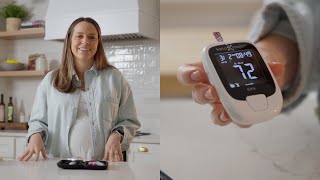
Brigid Titgemeier shows how to use a glucometer to track blood glucose at home, walking through the finger-prick procedure with a Keto Mojo device. She explains target ranges: 70-90 mg/dL fasting, 70-120 mg/dL one hour after meals. She uses her own pregnancy to show why daily monitoring matters for metabolic health.
Chapters
Today we're going to talk about how to measure your blood sugar levels from home to collect that data in order to better understand your overall health from a glucose perspective. This is important because statistics show that up to 50% of Americans have blood sugar dysregulation. We know that just a third of the population has pre diabetes, which just a third is of course a large amount. So I'm not trying to minimize the significance of that. And more than 84% of people that have prediabetes don't even know that they have it. So this is where taking your health into your own hands to better understand your own data can be so beneficial. Because unfortunately, the annual physical isn't set up to have a really great pulse on what your blood sugar levels look like. When you go to your annual physical, your doctor will usually test a fasting blood sugar, which is what we're going to test today. I'll show you exactly how to do it. They'll test the hemoglobin A1C sometimes, which is your three month average. And then if you're really lucky and your doctor is really progressive, then they'll look at fasting insulin, which can be very helpful for looking at whether you have a risk of insulin resistance or not. But most of the time you're not aware of how your blood sugar is fluctuating on a day to day basis. And we know that people's diet, stress, poor sleep habits and lack of exercise is contributing to the absurd metabolic health crisis that we're faced with, where up to 90% of Americans have been shown to have poor metabolic health. So we're gonna look at an easy way that you can test this. This is kind of like looking at the field of biohacking or hacking your way to health, which is the idea of collecting data and doing interventions that help to optimize your health and taking your health more into your own hands. So this is a glucometer that I have in front of me. A glucometer is a super easy way to just like an entry level place to start with testing your blood sugar levels. You can also test it on a continuous glucose monitor. We work with a software company that provides continuous glucose monitors where you can just order them to your house. And we help people interpret their numbers based on their continuous glucose data so that we can help them better understand how they can improve their blood sugar levels based on their lifestyle and their nutrition choices. One thing to note is if you're using a continuous glucose monitor, sometimes it can be helpful to have a glucometer for you to be able to compare the glucose readings that you're getting from the glucometer to the cgm. The reason that I say that is because sometimes people's blood sugar will drop in the middle of the night on a continuous glucose monitor from like the pressure on their arm from wearing the device. And when you test on a glucometer, it's a little bit more accurate as far as being able to understand the discrepancy. And the other thing is that it helps with recalibrating the continuous glucose monitor. If you're using a dexcom and you're getting these crazy high readings that aren't typical for you, it could be that either it's a faulty device or that there's something wrong with the way that you've installed the continuous glucose monitor. And having that comparison with the glucometer can really help to recapture calibrate the dexcom to make the readings a little bit more accurate. The continuous glucose monitor is something that you wear on the back of your arm. I'm currently not wearing one, but I do wear one several times per year to get a baseline of what my blood sugar levels look like. And it's so helpful because you get a continuous reading of your blood sugar levels throughout the entire day and then you're able to correlate it with how you're sleeping and what foods you're eating and those sorts of things so that you have more transparency around how your diet is contributing to your health. The continuous glucose monitor just has a really small needle that's measuring your interstitial fluid levels of those glucose levels to be able to give you a 24 hour data point or access to the data in order to understand where your blood sugar level is at all times of the day and night. Now, the glucometer that we're gonna go through today, this is just less expensive and doesn't give you as much data as the continuous glucose monitor, of course, but might be an easier, more expensive way for you to start. If that's something that you're looking to do. You can use a glucometer to test your fasting blood sugar levels first thing in the morning. If that's something that you're trying to keep track of over time. You can also use it after a meal, ideally one hour after a meal, which is when your blood sugar will be at that peak, in order to be able to see whether the meal is spiking your blood sugar levels too much. Ideally we want to aim for blood sugar levels between 70 to 120 within that one hour time frame and after your meal to ensure that your meals are low glycemic and not contributing to any blood sugar imbalances right now or long term. Because we know that blood sugar dysregulation slowly occurs over years and years before a person is actually ever diagnosed with something like pre diabetes. Also, as a background, something that I'm personally doing right now, because I am in my third trimester of pregnancy and I'm using a glucometer to test my blood sugar levels every day in order to make sure that my blood sugar levels are controlled. And I'm using this instead of the traditional gestational diabetes test, which of course, everyone needs to do what works best for them and work with their doctor to better understand what that looks like. But this is just something that I'm personally doing. So I just ate breakfast an hour ago and had Greek YoGurt with about 2 tablespoons of chia seed pudding, a tablespoon of peanut butter, and I had something called mitopure, that is a mitochondrial support powder that I mixed into the yogurt, and then some blackberries on top with a dash of salt. So we're gonna look at what my blood sugar levels are doing right now using the glucometer. So I have in front of me this brand is called Keto Mojo. But you don't have to get a Keto Mojo. There's lots of brands that are on the market. You can buy it from Amazon, you can buy it from a lot of stores, actually. And then you get the glucose strips and the actual little packets that have the lancets that have the small needle inside of them that you're gonna insert into the pen before you actually prick your blood sugar levels. Now, these also will come with ketone strips typically too. So you can measure not only your blood sugar levels, but also your ketone levels if that's something that you're looking at trying to increase your ketones. This device has come a long way over time. So this is one that I got five years ago, maybe six years ago at this point, when the product was a lot more archaic. You weren't able to connect it with like Bluetooth to see the data on your phone. This is an upgraded version that I recently purchased in order to be able to have the data actually all in my phone instead of writing it down on a piece of paper. So if you don't have a glucometer, I would suggest A newer version that connects with Bluetooth so that you're able to track it on your phone instead of having to have a pen and paper that you're using to track your blood sugar levels over time. Okay, so I'm going to move on to this, to the new device. We're going to take the glucometer and I'm going to turn it on. And then I'm going to put this glucose strip inside of the machine. So we're going to put that right in here. Okay. And then I'm gonna take this pen. And the pen, I already put the lancet inside of it. It has the actual small needle inside of it. We're going to close that off and then you can adjust the settings based on how much you want the prick to happen. So you'd want to set it on a 1. If you typically bleed easily and you just want a small prick, if you're someone who doesn't bleed easily, then you might want a larger prick at a setting of a 5. In order to make sure that you have enough blood to actually cover the strip. I'm going to keep mine at a three, somewhere in the middle. And then I'm going to prick the side of my finger. I'm going to click this little button to prick the side of my finger. You'll hear a little jab. Okay. So I'm getting some blood. And then you want to just try to push enough blood out to cover the strip. So then I'm gonna take this blood and then put it right up to the glucose strip. You'll see the glucose filling the strip. And now it's counting down and we'll see what my blood sugar is. So my blood sugar is back down to a 72 and it's been about an hour and a half actually since I ate. It would be ideal if this were within an hour time frame so that I could see the peak blood sugar level. But this is a good sign that in that one to two hour window, your meal is when your blood sugar levels should be going back to baseline. So my blood sugar is already back to close to baseline, which a fasting blood sugar level ideally would be between a 70 to 90. Some health experts that are in the metabolic health space and in the biohacking space in functional medicine will recommend a 70 to 85, an even tighter blood sugar window. For fasting, we typically recommend 70 to 90. Anything less than 100 is technically normal from a conventional medicine standpoint. But we know that because blood sugar levels continue to creep up and create blood sugar dysregulation over time. It's better to be a little bit more proactive with the numbers that you're looking for to be in that true optimal range. So 72 I'm pretty much back to baseline from my blood sugar, which means that my breakfast was low glycemic and is helping to support great blood sugar control, which is so important for supporting your energy, for decreasing cravings, for supporting mood imbalances and so many other things. A healthy pregnancy too. So I hope that that was helpful. I hope that walking through that little tutorial was helpful and something that you can use to track your blood sugar levels. If you're interested in tracking your blood sugar levels and adopting more of a low glycemic meal plan, you can also look into our Blood Sugar Reset, where we have tons and tons of nutritious recipes that are low glycemic. We test them on a continuous glucose monitor, actually to make sure that within one hour of E that we don't have a large blood sugar spike. We keep the blood sugar increased to less than 30 for every single meal in order to make sure that it's as low glycemic as possible for the majority of people. Of course, there's an individual variation that happens there. If you're interested in joining us for the blood sugar reset, you can click the link in the notes that I'll include so that you can learn more about these nutrient dense recipes, meal plans and grocery shopping lists to make your life easier, easy, delicious, and then also low glycemic and nutrient dense. I'll see you soon.
More from Brigid








She Used to Crash Every Afternoon — Here's What Fixed It | The Wardrobe Consultant
