How to Cut Reporting Time from Hours to Minutes | Otuvy Webinar
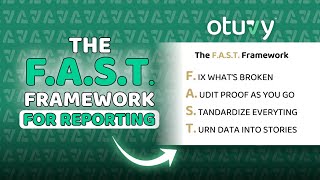
Sam, Otuvi's COO, walks through the FAST framework for cutting reporting time: fix broken processes, audit as you go, standardize everything, and turn data into stories. Customers report saving around 300 hours a year using Otuvi's AI dashboards to centralize data and auto-generate reports.
Questions this video answers
F: Fix what's broken; A: Audit proof as you go; S: Standardize everything; T: Turn data into stories.
$427,000 annually in wasted labor, preventable errors and client churn (speaker attribution).
About 300 hours a year (customer-reported).
Quality inspection reports, inspection summary reports, work order reports, and completion reports via the Frontline app.
Yes — the new AI dashboards support scheduled reporting (requires the appropriate operational intelligence package).
Chapters
Welcome, everybody. Good to have you all here today. My name is Sam. I'm COO with Otuvi, and I have spent over 12,000 hours in my career helping businesses like yours find the bottlenecks and gaps in their operation, helping to determine the top priority that leads those companies to greater success. One of the main challenges found in most businesses that I've consulted with or have worked with is reporting. So I'm going to share with you today a framework that you use to enhance the flow of reporting. But before I do, I want to briefly go over the challenges and the opportunities and some hot principles that you can think about and consider as you are looking at and assessing and really trying to understand how your reporting really is working. We'll go over the FAST framework and then make sure you stick it out through the end because we have a bonus principle as well that you're going to be able to utilize as a coupling to the FAST framework to really make it even faster. And so stay tuned, Stay with me. I'm excited to share with you what I have planned today. First things first, I want to ask the question what the toughest challenge that you have seen that is caused by slow and inaccurate reporting? One of the things that does happen is firefighting client escalations. Right? This is one of the biggest ones. I'm going to go over some of the challenges that I have seen as I've worked with companies like yours as well. This is something that I deal with. So the first one that we came up with was firefighting client escalations. This is something that happens all the time, right? By the time a manager compiles last week's missed trash pickups, right, the client is already emailing them with new complaints. Slow reporting always equals being reactive. The goal is to become proactive, right? But slow reporting leads to a reactive state and it's never proactive. And so one complaint is all it takes for a client to cancel. One of my favorite phrases is is it takes minutes to make a good impression, but it takes years to forget a bad one. It is so true, right? Firefighting, those client escalations, going out to do the job of the person you've hired to do the job, but they're not doing it. Definitely something that can be improved, but is a challenge for sure. So the next one is leadership thinks you're hiding bad news. Some of you may be the leaders in your company, but when you have employees working on the front line to deliver this quality, you need that report, right? If you are one of the managers that needs to report to leadership. This is huge. As a coo, one of my main jobs is to make sure that the business is running day to day and that the operation is running smoothly. And one of the ways that I know that's happening is reporting. Right. I ask for a report from my team members and when I don't get it, it arrives late. We as executives assume the worst, right? What's going on? Are they actually doing what they should be doing? That's why reporting is so critical. But it can't be something that's an afterthought for both the company and the client, right? So for leadership, it even goes to the customer, your client. It has to be something that is consistent and is given. Because if it's not, the challenge is people are questioning those leaders and customers are questioning. Are they actually doing what they said they would do? It goes back to that lack of trust. Are we giving that visibility to make sure that they trust what we're doing? Without live updates, without good data, you're making decisions on outdated data. Having data is important. Some of you may not even be utilizing a lot of data to make decisions. I would recommend that you start implementing those tools to get that data to make decisions. But oftentimes, in our current processes, in our current operation, we're getting out data, data, data that we don't trust, data that if we make a decision on it, isn't viable, it's not appropriate data, data to use, right? So when it comes to a challenge of slow and inaccurate reporting, that's the question that was posed earlier. Without consistency and without good data being frequently accessed, you're always playing catch up. You're always having to ensure that it's right. So you're spending more time, just make sure it's right rather than just going and doing the thing that is necessary. And that's actually the last challenge before we move into kind of the opportunity is reporting, when done manually is a huge time suck, right? Needing to report takes time. It takes so much time. And so I think we can all agree that reporting is important and critical. But wouldn't you rather run reports fast, make decisions fast, and spend more time executing on the tasks that can move the needle for the business. And you can spend time on what matters most. So it goes hand in hand. There needs to be a reporting system in place, but you also have to make it faster. You have to make it viable, something you can trust. The opportunity lies within the actual process and operating procedure of how you manage and run. And Receive data for reporting. DID Lake is one of our customers. They're awesome. We work usually directly with Brandi. As we talked with Brandi about her process and how she's implemented OTUVI in her flow, she implemented the FAST framework as it stands before it was even really created. Right? Implementing what you're going to learn today with the help of Otuvi is really going to improve employee training based on the data that's captured, save hundreds of hours in the year thanks to the digital capture and reporting functions. It improved the client communication a ton. She mentioned to me those old filing cabinets that were super long when she came in a long while back. I think she's been there 15 plus years now. Just files. She said that she was told that she just had to sift through all these files and there's got to be a better way. So she had to implement some type of reporting process that would get her information quickly. Here's a reality check, okay? On the flip side of that success story with DID Lake, so many in the Jansen industry don't realize the true cost of inaction if you don't improve this approach. Inefficient reporting costs, commercial cleaning businesses with 150 plus employees on average, $427,000 annually in wasted labor, preventable errors and client churn. Think about that for a second, right? This is a crazy stat revenue when you think of revenue for your business. But this concept of when you think about the value that your service team brings and when you have to rework the work that you're supposed to do for your customer is costing you money. It is a labor cost. So when you think about the annual amount that it takes for somebody to rework missed tasks or forgotten jobs to be done inside of the contract and you go do those things, that is extra work. So to avoid those things, it is absolutely essential to figure out your reporting process so you can find those areas to improve. So a few hot principles before we get to the framework. The first hot principle is uniformity over flexibility. Right? Oftentimes I hear from businesses like you say to me, oh, I need to do what the client asks me to do. And you do, right? Like in their process, they say, hey, I want to use this tool and I want to use this function. And you do that, right? Because you want to appeal to them, you want to please them, you want to satisfy them. Right? However, I would argue that therein lies a challenge in and of itself, right? The flexibility you give your customer is valuable, but it also can lead to the use of different checklists, formats, the definitions of clean for different people. So when it comes to data, it's going to be a fragmented, chaotic mess. Using different systems and approaches for different customers is going to lead to chaos. And so for your subcontractors, your teams and your sites, I would push you to standard operating procedure, make it uniform. I know that might be hard to hear and it is difficult. It's not easy to do that. But I know based on working with individuals and companies that have decided, hey, I'm going to build a standard and I'm going to make that standard universal across all my clients, and I'm going to use these tools to make sure that everybody's on the same page inputting it the same way. So that is definitely hot. Principle number one is uniformity over flexibility is going to change the game for you client first, storytelling in the age of AI, anyone can tell a story now, right? You can tell AI to write you a story and it'll tell you a story. What is going to be the difference maker, though, in storytelling is when a client or customer glances over your data, they care about those numbers, right? They want to know that risks are prevented. They want to know that compliance is nailed on the head. They want to make sure that their reputation is protected. They have people they need to make sure are happy. Tell that story to them through data. Help them realize, like, hey, we did all that you asked and then some. And here's how we did it. Being transparent through storytelling about them, right? Make it about them and use that data to tell that story appropriately. Which actually brings me to the next top principle is transparency isn't optional. I can't tell you how many times I've worked with a building service contractor who says, oh, well, I don't necessarily want my customers to know my quality scores. Sure, there are some that you may not want to share, but I can say to you that if you are transparent with them about the data that you're capturing when it comes to the level of quality and completion and compliance of their contract, right? Contract fulfillment is going to change the way that they trust you, that they see you, right? Vague reports equal instant distrust. Okay, no, reporting would definitely bring distrust, but vague reports equals instant distrust. But transparent quality reports equals loyal customers because they don't have to chase you down for that data. You are giving it to them. You're saying, hey, here it is, we have nothing to hide. We want you to know that we have a high quality here and we care about that quality. Imagine if you went to a restaurant and the menu that they brought, you just said you can order a burger, fish or chicken. There's no details on what you get with the food, but it tells you it's burger, fish or chicken, and you can spend 10 to $20 on it. You don't know how good it's going to taste. You don't know what's involved in it. You just know it's a piece of meat. Right. Would you trust that restaurant to deliver something worth eating at that price? Probably not. I wouldn't. Right? I'd want to know, well, what's on it? Tell me more. I need to know what you're going to do for me so I can pay you. Right. It's the same with your customers. They want to know. Clarity is king. And when it comes to reporting, that clarity comes from transparency. And so this one's a huge principle that to consider and the final principle before we get to the framework itself. Technology is your friend. This is the bonus principle that we're going to talk about later on. But collecting the data, centralizing it, being able to generate reports in seconds instead of hours, goes hand in hand with modern tech. There is technology out there today, OTUV included, that is the way to generate those reports in a fast way based on the quality data that you're capturing. So don't be afraid to play around with the software that is out there that can make you and your team's life 10 times easier if you take the time to implement it. So we're getting to the meat of it now, the meat and potatoes. So the FAST framework it stands for, the F is fix what's broken, the A is audit proof as you go, S is standardizing everything, and T is turning data into stories. So all the things that we mentioned about the HOT principles and what you want to accomplish, this framework is going to help you do that. So I'm going to dive into each one of these. The first one of the fix what's broken part of the framework is take your most requested important report and map out each step of how that report is generated. I imagine this being just one of those flowcharts, right? You take a box and you say, this is the report. Then where does that report need to go? Who needs to see it? Right? And then making sure you know how it's generated, how it's being sent, and it's getting to the right people. That's. Step number one is map it out. Step number two, trim it. Look for redundant steps that you can chop. Oh, we don't need this, right? If you put it in a flowchart, you'll know. If you map it, you'll know. Yeah, actually, this isn't necessary. We're doing more than we should or we're not doing enough. Let's add more. Right, but the idea is to trim the redundant steps so that there are more people, or just mentioning that there are more people approving the report than you need. That's something you would consider cutting. Who really needs to see the valuable data? And finally, template it out. Once the process is ironed out, create a template for the report plus a documented playbook. Playbooks are key when it comes to operations. If you can provide more detail through Playbooks and with AI, there's free AI tools that will help you write the playbook. You don't have to do it on your own. Right. You can create a quick template and say, hey, every time I need to create a new playbook, this is what I'm going to use. But specifically for reporting, this is a way to fix what's broken, Map it out, trim out, trim the fat and template it out and put playbooks in place. So the outcome of this specific gear is productivity. The relationship built between your employees that are doing the cleaning and the work on the front line to the managers and between the managers is to get the optimal productivity state by fixing what is broken in the reporting process. How are they reporting success and completion of those tasks? How are we showcasing to leadership and customers that we have a quality score that has reached 90%? Right. And what are we doing to continue to increase that all plays into this idea of fixing what is broken through this flow. Okay, I'm sure many of you do this already, but the idea of the A is to audit as you go. Some of you and many I have worked with in the past, don't take it a step beyond this though. So auditing as you go should also include timestamps, right? Timestamps on when, where photos. Right. Photos is really important. I know many of you probably have a library of dirty things in your phone that is just sitting in your photo library next to your family picture, right? That is great. You need to have those photos. I would recommend putting them in a software, something that can be housing your photos a little bit better. But when you implement these two things along with auditing as you go, that will bring trust. And so you mentioned it earlier, Ricardo, this is the way, right? Make sure whatever you're sharing with your customers has that timestamp. When did you do it? Who did it? Why? When? And then what's the quality? Right. What was the before and after? Right. No more. Who forgot to clean the bathroom on floor two near the main office in the downtown building? He said, she said, Right. The step is easier said than done. I know that. But when you're dealing with subcontractors, customers, making sure that this step is in place with these types of information are really important and free. Tip. What's the best way to know where the problem areas are? When you are actually capturing what you're auditing in a digital way that you can then see that data to quickly clean and say, oh, this is a problem area. Let's fix this. The S in our framework is standardizing everything. So one checklist equals less confusion. If subcontractors, your teams on the front line, if they're using different checklists, your reports will always be a mess. Right. This was the principle earlier, pushing the same format to all locations, even if it's paper checklists to start with a standardized format. This is what we're going to do every single time. This is how it's going to be reported. This is a way to ensure that tracking and access the results are had. Right. And so by standardizing, you're getting your report and data faster. So sometimes we just say, oh well, we just need the data. So just send it when you can. No, create a process, build it out and implement it across the teams. Make it one checklist, make it one process so that you know no matter what, you know when that report's coming and how it's coming. One idea you could do as well just thinking about it. You could hold a 30 minute training or a stand up meeting to align on that procedure. Right. Once you create that, you outline it. You use maybe a free AI tool to create that playbook for you. Run it over with your team, say, hey, this is the flow we're going to be doing. And make sure that you're consistent in following up how it's working. Right. Especially if it comes to tasks from frontline employees. The completion and report of completion each week should be part of your process. Your standard operation and software can help with that for sure. So no exceptions, know their way, but rather the way for better tracking and reporting. Right. That's the route you want to go. Okay. The final piece to our FAST framework is the T. Turning data into stories. Zero risks equals happy clients. An idea of where to start for better storytelling is on every task completion report that you run for a Customer share. One to two wins that protect their reputation. Again, make it about them. So you're creating a report, you're saying, hey, we completed these tasks that you had us do this week, this month at the top, or inside of that report somewhere you say, hey, here's some of the wins that really showcased and protected you to make sure that things were taken care of and that your reputation is sound. Zero compliance. Compliance misses this month or a key takeaway section at the top would be awesome, right? Be transparent with any tasks you've missed, but help them understand that you tracked the issue and got it resolved. Your clients don't expect you to be perfect, right? But I know that sometimes it may feel like it. They just want to know that they're being taken care of. And so telling that story behind the data is super important. So turning that data into stories, that's the trick here. So recap. The FAST framework F is to fix what's broken, map it out, right? Audit proof as you go. The A S is standardizing everything and T turning data into stories. But as I mentioned, there's a bonus principle to all this, and it really is technology is your friend. If you remember earlier that slide, it is critical that you consider the use of technology along with this framework. Best way to illustrate that is that manual can get it done. But tech crushes the clock, right? It centralizes the data, it auto generates reports, it sends it off to clients ready for client ready proof before your coffee gets cold, right? It can be faster with a technology. And so if you take the FAST framework, couple it with software, you are truly going to be able to to take your hours of reporting and turn it into minutes. And so if you implement the FAST framework, it will make you go faster, right? You're going to find where the problems are, you're going to find the gaps and really move forward with it. But it is time consuming even to approach the FAST framework without tech because it is a manual effort. And so if you can hone in on the manual processes and really understand where the chance is for software to help you mitigate those manual processes, it's going to accelerate your ability to see more contracts come in and growth. I should say this as well. Manual processes often are the way for a smaller business. So if you're a smaller business that aren't managing several large profile clients, manual can work, right? But as you scale, the manual process without software will actually hold you back from growth. And so this is the key to saving up to 300 hours a year in Reporting to customers and internal team members. And that's not from us, that is from our customers saying, yeah, I see about 300 hours saved a year by just implementing a tool like otuvi. And so I do want to share a little bit about OTU's operational intelligence and the reporting capability that is offered through our solution because it has sped up that standard operating process for reporting for many of our customers. And I want that same thing for you. And so in our new operational intelligence dashboards, what's really exciting about it, it is AI powered dashboards. Now you can use AI powered search to pull key performance insights without digging through endless reports, right? A pile of reports, no longer a thing. You look at the data on a dashboard, boom, you found it instantly. Natural language, just like your other AI prompts that you're writing on a daily. Keeping clients in the loop. That's one of the most important things. You can hand over the real time dashboards that are in OTUV's operational intelligence and prove that your team's impact is there before they even ask, right? Give them that visibility, that transparency early on, put the resources where they matter, right? With dashboards and data that is AI powered, you can spot trends instantly, shift the priorities, deploy crews with precision, maybe know where robots could be so that you can bring more human capital somewhere else. No wasted time, no wasted effort, because you know where the challenges are and you can fix those things. And so definitely utilizing the operational intelligence. But it's important to know as well how it's captured in our software. And it is through the O2V solutions. There's inspections, there's a work order system, the task management. This will help you maintain top notch quality. It's going to help you build client trust and simplify operations. And so this is the suggestion, the fast framework with a software O2V or whatever is definitely helping you to get those reporting capabilities in place and in motion. I know we're just a few minutes over, past the time that was expected, so I want to bring it up to questions. You know that for that customer, this is what we're going to be doing and this is how we are going to operate with it. And that's what I mean by one checklist is how are you going to operate on the checklist of tasks that need to be accomplished for the contract and make sure that process is universal across all customers, right? It shouldn't be a paper checklist for this customer, a digital checklist here, an Excel spreadsheet here, making it uniform, making it One process, one checklist. That's what I mean by one checklist. I got another one here. What is the difference between business intelligence and operational intelligence? So business intelligence is operational intelligence, but not AI powered. The operational intelligence allows you to use AI to find the trends and insights instantly through AI help. Right. I will help you find the trends through natural language prompts and input to say, what are the top inspection scores of. Of all the locations inside of what we're working on or what are the lowest? Right. Where are the the biggest problem areas? Right. It's the restrooms on floor two in the downtown office. Okay. Let's make sure that we add a little more people or more training there. Right. Using the data to make decisions for your business is why you have operational intelligence. To capture it, have it land historically in one place and then be able to search that information easily through the detail. What kind of reports can be run in OTUV? Some of the most widely used in O2V is quality inspection reports, inspection summary report, work order reports and even completion reports through the new OTUV Frontline app. Knowing what tasks were done, when, where, by who, Question, can you schedule reports to be run and sent? Yes, our new AI dashboards have that capability. So I know there's some customers on the call that is a function if you want scheduled reporting. We do have that now you just have to have the certain type of operational intelligence package to get that access. And then finally there's one more. What kind of AI capability do the dashboards have? I've kind of talked about it already, but it is that natural language where you can analyze the data in the dashboard and then be able to find those points and use those points to create new dashboard dashlets that really give you the insight you need at a glance for you stakeholders, leadership, customers that you could run the dashboards and put it into a PDF. So much function to just make reporting so much faster. So I hope this was helpful today. If you are a current customer, you just need to email us@vipot2v.com and that will give you one of our customer relations specialists who then would help you find a time to meet where you can learn more about it in your current business and use of otuvi. And we also have a help site that they'd be able to direct you to. So lots of resources. We want to help you get that information and making sure that everybody on your team and customers are informed of the quality of service that you deliver, making your operation more successful and speeding up that reporting process making you faster. Thanks so much, everybody. Appreciate you. Have a good one.
More from Caden

How Otuvy Transformed Controlled Contamination Services' Workflow | Full Story