Filling Up The Funnel With Outbound Prospecting - First Impressions
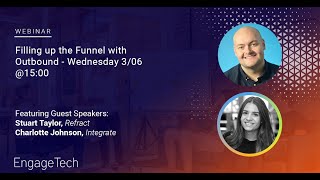
Stuart and Charlotte, sales development leaders at Refract and Integrate, share how outbound prospecting shifted during COVID. They discuss reframing pitches from revenue growth to cost savings, testing tactics like voice notes and LinkedIn chat, and achieving roughly 20% response rates on LinkedIn through personalization and humor.
Chapters
We might as well jump in there. Firstly, just wanted to say to anyone who's joined today, thank you very much for giving up your time. I saw Charlotte shared something the other day that said webinars have gone up in about 480%, and so there's a lot more of them around. And I'm also aware that Company Outreach have got one with Daniel Disney today, and James Ski at Sales Confidence also got something kicking off around this kind of time. So thanks very much for supporting selecting us. I suppose just as a wider comment from EngageTech coming into this today, we've definitely seen that there's been a lot greater intent from some of the larger tech businesses, likes of Microsoft are about to go into their new year and are definitely in a position to pass out some funding, but we've also seen the IBMs, the Dells, the HPEs with similar behaviours, and I think the main thing is when those guys open their checkbooks, it normally shows a good intent into the wider tech market, at least. And I can perhaps ask the guys in a little bit, but we've definitely seen some intent in the market where deals are moving through the cycle a little bit quicker, and there's definitely an appetite for businesses to make up for a slower first half of the year in the final, final 6 months. So definitely a lot more optimistic than perhaps some of the first webinars that we were running. As always, please make sure if you've got any questions that you want to send across that you send it to everyone. Just so we can perhaps get a little bit of chatter going. And we will try and get to those questions because the topics that we've laid out are our best guess. We'd like to keep it as relevant as possible. Just on to the panel. Firstly, we've got Stuart. You're based at Refract, Stuart. Would you mind just giving us a bit of an insight into your role there and just a little bit about what Refract do?
Yeah, yeah. So I guess the marketing line is Refract is a conversation intelligence platform that unlocks the black box of sales conversations. I'm not really a fan of saying what we do. I think it's more about how we help. And Refract, what it does is help sales leaders and reps hit their number by, you know, helping them to have better conversations. We share what top reps do differently with everybody else so they can level up and improve the quality of their sales conversations. And I'm the head of sales development. So get involved in pretty much everything. I look after the sales development team who are responsible for creating opportunities for our account executives to close, probably similar to a lot of the people on the webinar in their roles. And yeah, been at Refracto for 4 and a half years now, so all good.
Thanks, Stuart. And just my understanding from speaking to you guys briefly on over LinkedIn, things like that, is like you're passionate about coaching, particularly from a sales development perspective. You guys have run a very successful webinar since like moving to work from home. What's at the core of that as like a kind of company ethos?
Goes right back, so the story is our CEO, I worked for the previous company, had a successful exit at a previous business, and a lot of the challenges we try to help solve now, challenges we experienced firsthand. As the team grew, he found it really difficult to give sales teams the support and coaching that they needed to be as good as they can be. You know, every professional industry you look at, whether that be doctors, professional sports, lawyers, solicitors, they've all got fantastic training programmes and constant help and support. Sales reps were a little bit guilty sometimes as managers and leaders of giving somebody a phone and telling them to make dials. I don't feel they get the support and help that they need to be the best they can be. And that's what Refract is trying to change, you know, make professional sales more professional, give reps the support and the help that they need to be the best they can be. And that's why the business is there to try and help do that.
Yeah, I mean, it's hugely important, right? You don't get any kind of like formal education in sales. You can't go and do a degree in sales, and it's, yes, it's very unique in that way, right? That you're just kind of thrown in.
So we had an intruder there.
Was that you again?
Intruder, my name is my colleague Rich. Alright. Good afternoon, Rich. He feels left out because he's not part of the panel.
Our biggest fan.
Sorry, Callum, you'll have to repeat the question.
It's all good, everyone at Halifax are welcome. It wasn't really a question.
You could have asked.
It wasn't really a question, it was more just an observation about the fact that sales is one of the very few roles that you can end up in where it's very rare that you get a part of your formal education that revolves around it. You can't go and do a degree in sales, or it's actually only like very new concept. And so interestingly, whatever age you pick it up, like pretty much you're at the start of that journey and coaching is such an important part of it, right?
Yeah, I think a lot of people fall into it. You know, sales is not that profession. When I was a 14-year-old lad, I didn't dream of being a salesperson and that's not to be detrimental of the career. It's just, I have found myself wanting to earn some more money and wanting to make some commission and that's the reason I went into sales. It was the easiest path for me to make some money. I didn't really know what was involved the long term or where that path would take me. And that was the reason I fell into sales. But, you know, a lot of people, I think, become good at sales because A, they try and develop themselves, or B, they've got like a little bit of a natural drive to be successful. And I still feel even myself in the early part of my career, if I could have had a little bit more guidance, a little bit help and coaching, I'd have probably made far more commission than what I have today.
And just in terms of maybe to look at the last 3 months, you— I assume you're the beneficiary of, of the tool that you, that you take to market, and, and the insights that your customers put through there must inherently benefit Refract sales process. So what have been the main takeaways from you, um, for your team that you're seeing across like the market? Are there any kind of niche things that you're really seeing being quite effective at the moment?
The big thing that's changed is definitely the language. You know, Refract analyzes the conversation and can see what comes up in conversations, the language people are using, you know, COVID budgets, et cetera, et cetera, is all coming more increasingly more common. But there's positive signs as well. What we're finding is the companies that are successful at the moment have really changed their pitch. And I'll give you an example by what I mean by that. And we've done it personally ourselves as well. In the past, we may have been trying to sell Refract as something that'll increase revenue. So we'll increase your demo-to-deal ratio, help you close more deals, get more pipeline, get more business through the door. We've changed that subtly at the moment. And we've changed that to try and save money. And how we do that now is you need less marketing leads to close the business you did before. There's less investment that way, and we find it easy to get deals signed off when we can go to the CFO or the finance director and say, "We're now going to save you money rather than make you money." I think businesses certainly over the last 3 months or so have been really, really conscious of, you know, cutting costs, and if you can pitch your product to be something that can help in that way, then that makes it easy to get it over the line.
That's really relevant because companies— I think there was a stat like 70% of companies are lacking business leads and sales opportunities. So actually having each one and being able to bring it over the line is so much more valuable.
Totally.
And I suppose we've had a few different guests along the way, but just, it's such a good advert for the fact that your messaging isn't fixed. It can change.
It can't be, you know, I think we've all learned that things can change overnight. There'll be companies who were sitting going swimmingly well, everything was looking rosy, and you know, overnight the bottom fell out of our world. There's so many things outside of your control in any business, but those are going to happen unfortunately. What you've got to focus on is controlling what you can, and that's the big thing that we found. You know, the companies that are getting through this are adapting, changing, and finding something that, you know, works and what can still win in this downturn.
And was there someone in your business that just sort of had a lightbulb moment and said to do that, or?
I can probably ask Callum Henderson. Sort of. There's a company called Price Intelligently.
I don't know if you're familiar.
I think they've changed the name actually. They used to be Price Intelligently, and they've done a lot of research on kind of what was resonating with prospects and how the changing times, they're really current and fresh in their thinking, it's always up to date. And we got some feedback from that on how buyers were not looking to make money anymore, they were looking to save money. And we changed that tack. You know, small software company like us, we can almost change overnight. We change the messaging and the prospecting, we change the conversation. In the discovery calls to be more focused on saving money, and we noticed pretty, you know, pretty much out the gate that that was having far more, far better impact. So yeah, we kind of learned from others, but that's a good thing. I think, you know, what these webinars are all about, sharing what works as well. You don't have to reinvent the wheel. If something's working for somebody else, then don't be too proud and feel free to piggyback on the back of it.
Yeah, plagiarism is absolutely fine. Sense of community can really support people. Changing your message is a super natural part of the process and should be encouraged.
There's no Turnitin in the real world once you get out of university.
Thanks, Stuart. And yeah, we've also got Charlotte on. Charlotte, could you introduce a little bit about your role and just talk a little bit about Integrate and also just at Crew and how they fit into the picture?
Yeah, so I'm the team lead for the sales development in London. We also have a team out in Phoenix. So there's 3 of them and 3 of us there. Yeah. So Integrate basically provides a software that enables marketers to generate demand across the top of the funnel. So things like webinars, live events, content, etc. And it ensures that the leads coming from these different channels are entering your CRM and they're not just actionable, but they're also compliant, standardized, and enriched. And Accru, which is where I originally came from, was the missing gap in Integrate's top of funnel, which is why they acquired us. And it is now known as Integrate Events, but it is a lead capture solution that allows you to capture quality and compliant data that flows directly into your CRM. But more, more appropriate when live events are back again.
And you did allude to earlier, and it's not really a surprise that the events industry has been hit, that's been relatively well documented. Are there kind of subtle changes that are coming into play? Obviously virtual events seems to be the favorite option, but it'd be interesting to understand your inside track on that.
Yeah, so there is a kind of light at the end of the tunnel. We have seen some countries starting to do events again. So I think China did one. I think last month they did their first trade show as well as I think Germany are starting to do them as well. Probably a bit too soon for England. But our predictions realistically, we're going to say like Q4 will be like smaller, more regional events and then Q1, hopefully the larger scale events.
Yeah. Calendar year, yeah? That's on the calendar year, so Q4 is in—
Yeah, exactly.
And so can you do sales development for the entire Integrate portfolio, or have you found that, or were you only focused on the events part, and if so, how has that impacted your, your role?
Yeah, so I, me and the team previously just sold the event solution, So as soon as obviously events started to cancel, we had to pivot and had to learn all the other channels that Integrate offers, which is pretty lucky that we have these kind of backup products that are currently thriving with the lack of events. But being, being in sales is tough anyway. But being in sales in lockdown, lockdown is even harder. But then when you're learning new channels as well. Yeah, it's been, it's been an interesting ride.
What was it like, the thing that you most like took from that process or learned in that, in that process about how to do, how to do your job well?
I think prioritizing your time. I think that's something I probably struggled with initially when working from home, but if you— I learned this from Sarah, who's one of the SDRs at Gong. And at the beginning of the day she'll write down her, like, targets for the day, and at the end of the day she'll write down has she achieved these targets, if not why, how has this affected her, and what can she do to overcome that for next time. And I think prioritizing your day and setting just small targets each day, I think that's really important.
Is it Sarah Brazier? Is that who you're talking about? We've got a point at the end just to talk about people that we follow on LinkedIn who we think are good value for content, but that's definitely one. One worth jotting down.
Yeah, I think that's often underlooked, that element of being able to focus on what you can control, those lists of things that you know you can do makes a massive difference.
Yeah, exactly. But like he said, there has been a huge shift towards webinars. I think, like you said at the beginning, On24 reported that it was something like 480%, which is mad. And with this increase, my queries are around how companies are not only just differentiating themselves, but how are they driving enough registrants and attendees through all this noise as well, which isn't easy.
For sure. Thanks for the— thanks for the intros, both of you. Just before we dive into maybe the major topic, just quite keen, Stuart, for you, what are the areas where you think you particularly play strong in the sales development piece, or what's at least like a platform where you really enjoy prospecting?
So me personally, if you ask me personally what I prefer, it's the phone. I prefer telephone prospecting because it's kind of my background. Like, I come from working in an outbound call centre selling PPI, so I'm probably one of those guys that Martin Lewis hates. And all those PPI claims. I used to work for a big bank. I used to ring people, sell loans and PPI and home insurance, ring you in the middle of their tea or dinner and interrupt them and try and sell them some kind of PPI. So I've done that for quite a few years, you know, really successful, enjoyed it. So the phone's always been my best friend. You know, when I first start selling in software and I realised that you could email people and do a mail merge and send it to 200 people, I thought like all my Christmases have come at once. I didn't have to ring people for 8 hours a day, and I thought that this was kind of the future and this was a piece of cake. But the all multi-channel definitely come together, I guess, is what I'm trying to say. And it's using all the things that you can at your disposal. We're finding a big uptick at the moment in LinkedIn, but using LinkedIn in a different way. We use it, we call it sell by chat, and it is what you would imagine. You know, if you think of a conversation you have with a friend on WhatsApp or on Messenger, the messages are really quick and backwards and forwards, you know, 5, 6, 7 words, something like that. And we're trying to make that kind of messaging through LinkedIn and selling by chat. So it's really low asks, um, where you might ask a basic question. So one of the opening questions we might have in a connection request would be, for some of you, hi Callum, how are you and the team finding working from home? Yeah, it's really low ask, it's just engaging you in conversation and trying to get you to start that conversation. And that LinkedIn By chat is, is the most successful we've got at the moment. That's been probably the turn of this year. And one of our SDRs kind of went on his own path and done it himself and, you know, moved from the cadences, and he's proven that it works, and he's kind of made that his baby. And now the rest of the team's starting to do that as well, and it's working really well.
Is it— I know it's slightly different because in, in the scenario I'm going to talk about, someone's on your website, but you've seen like companies like Drift and Intercom have built like conversational sales or automation on their site in exactly the same way by breaking down and just having like one line, one line, one line, simple questions, small progress through the funnel, right? That's it.
It's copying that method really, Callum, and taking that method from inbound chat. When somebody lands on your website, it's very conversational. It's backwards and forwards. You want to keep somebody's attention rather than getting them to write really long detailed responses, but it's also building it up as well. Like, don't go in at the deep end straight away and ask a really difficult question. Make it really casual and conversational, and then start to build that up slowly in the conversation and try and move it to see if they're experiencing any problems that you can help with, you know, what challenges they're having. But it's very much light touch and low ask in the outset, and then you can start to dive a bit deeper if somebody gets committed to the conversation.
Sure, that makes sense. And for you, Charlotte, what, what platform or platforms are your kind of go-to?
So again, obviously utilizing all of them, but email is probably not so much at the moment. I think they're like 39% more saturated. So the chance of you getting seen now than before is pretty, pretty low in comparison. Again, like Stuart said, LinkedIn is a big one for us, but not just kind of sending things on the chat, but also being a bit different and doing things like voice notes. Or videos has been working quite well. But when you're adding someone, like, a big thing that is a pet hate of mine, don't just add them and pitch them straight away. Do what Stuart's doing and say, like, for small asks, but also engage with them, engage with their content, tag them in relevant content, and play more of like a longer game rather than initially, like, as soon as they accept you being like, 'Oh hey, blah blah blah blah blah.' The other thing I get on that channel as well is just generic connection requests.
Yeah, just to personalize it or do something different. Like, that also really annoys me when somebody just sends a generic request and you have to probably, you know, they've got my name, that's about it. They haven't bothered to do anything else. Just takes 2 seconds.
Or they'll add a personalized request being like, 'I saw you posted this, this is really interesting, I want to connect,' and then you connect with them and they're like, oh, you, um, just a little bit about me, I do this, and it's like, oh yeah, talking about them rather than you seems to be like a relatively good practice to, to get into.
So not, not using words like I or we about anything that you do and talking about the prospects seems to be a generally good rule. I think I saw you post something about that as well, Stuart. Not too long ago.
Yeah, it's a big thing for me that I bang on about all the time. Like, it's not about us. You know, as salespeople, we normally think that we're brilliant superstars who are going to close every deal, but it isn't about us. It's not about us. It is about your prospect. Whenever you engage with a prospect, you need to keep them front and center of everything you do. It needs to be about them. And like you say, whether it's an email, removing the I's, the we's, us, whatever, as much of that as you can and making it about the prospect. Will make it far more valuable. But also in your conversations as well, when you're having cold calls, you know, if somebody says to you, what do you do, people are just going to pitch mode automatically and tell them every feature and everything about their platform. But it's not about you, and the prospect's not interested. They want to know what you can do for them. So you've got to be relevant to your prospect. And that's true of, you know, from prospecting all the way to closing deals. If you can make it about your prospect, then you're halfway there.
Sure. Just on the point of that LinkedIn message, going for kind of small small chunks. We had a guy on, Greg, a little while ago, and he was basically just like of the view that, you know, people have got enough friends, we're not here to chit-chat. So he does that but then moves it to the kind of business dialogue, not as quickly as possible, but like in a reasonable time frame, right? And so I could imagine there might be some people who are listening to this today who are of the view that, like, where's the line on on when you'd suddenly move it to a bit more of a kind of business-related chat? And also, what kind of dropout rates are you getting on, you know, if you're messaging someone like something quite generic, what are your response rates? Are we looking at 20%? Is 30% good?
Yeah, it's a good question. And to be fair, it is always business-related, but it is friendly as well. Like, I try to say at the SDRs as well, in cold calls and messages, speak to the people. Like, the 'are you friends?' because at the end of the day, the people just like we are, you know, they're no different, and you want that casual chatting nature in all of your outreach and your cold calls. But as for the dropout rates and things, it's really, it's really easy to engage with people once we connect with them. And if we connect with them, or we're connected with them already, because we've got big networks. What we try to do is have a big network, so then you can try and utilize that network, and some of those networks could be potential prospects as well. What we'll do is then go through the network, but they'll not be generic requests. It'll normally be a question with some kind of personalization, and if we can can. And John, who's been doing it predominantly, we get a 1 in 5, give or take, response which can initiate a conversation. So it's 20%, you know, it's better than any emails that we can get. And then he starts the conversation, and it might be, you know, that they aren't a good fit once we have the conversation. John qualifies out just as many as what he qualifies in, so it's not going into that conversation thinking, you know, I'm going to book a meeting with this person. He's simply having a conversation to see if they've got something we can help with. If they can, great. If they can't, that's also great, you know, we move on and speak to somebody else.
That's good insight on the numbers as well, like 20%, 1 in 5, is still not a lot of responses, and you could see how someone would be like sending out a few messages, not getting a lot back, and being like, oh, maybe this isn't working.
So yeah, it's not— there's no silver bullet, you know, and 20% probably is going to drop. I do think this is new, I do think this LinkedIn by chat, and Charlotte made a good point as well about the LinkedIn you know, voice notes, I think they're really powerful as well. I think they work now, but it's current and that'll change. You know, people will probably get inundated with them and get sick of them and then know what everybody's up to. So you've got to try and like, you know, make the most of it while you can, but be ready to pivot and try something else. That's why, you know, we try to give the SDRs at Refract that autonomy to try new things. John, who's one of our SDRs, found this on his own back. I was almost on John's back saying, John, you need to make more cold calls.
And he was like, 'Well, Stu, I'm booking 3 meetings, 4 meetings a day with LinkedIn by chat,' and I was like, 'All right.' Yeah, I was going to mention this at some point, but I remember John ran an email campaign, like, basically pulling out people's football teams that they support, I think from their Twitter, and then using that in the subject line for the emails that he sent them. I remember a colleague of mine got it, and I saw a few other people on LinkedIn talking about it, so he's obviously a very resourceful young man. Like doing, doing well.
Is that for anybody? Because I don't know, and this is a tip, you know, for somebody to take away. What you can do is search LinkedIn via Google. Okay, so what you can do, you can search head of sales developments who support Man United via, via Google, and what Google will do is find all the LinkedIn profiles where somebody's got a certain job title but they've got that interest on the LinkedIn profile, and then you've got a prospecting list of somebody with interest. Doesn't have to be Man United, it can be red wine, it can be fishing, it can be boxing, whatever it is. It's just that little bit of personalization, which is something you can use to try and open the conversation.
Yeah, sure. Charlotte, you said that email for you right now is maybe an area where you're not focusing as much. When you have played on that platform previously, what, what's the kind of first impression that you, you like to set? What kind of subject lines have you seen work for you?
So, I mean, I I think email currently, it is saturated, but it doesn't mean to stop using it. I think as Stuart said, like, there are these trends, like things that are new, like the voice notes on LinkedIn, that will thrive for a short amount of time, but then they will also become saturated. So it's important to kind of use all of the different channels. Not just focusing on, say, LinkedIn or just calling because they will all come back in their own time.
For sure.
I feel that about cold calling. I feel like it's in the last 3 months been massively rejuvenated. Well, EngageTech have been banging the drum on it for a decade, but like it's suddenly become a way to shortcut a lot of effort. It's a skill that's now required. So yeah, that, that, those skills across the board are important.
People were nicer for a period, weren't they? It was a lot easier, I think, you know, during the pandemic first started, everybody was really receptive and and I think it definitely worked. But I think for me as well, it doesn't necessarily matter what you do. Yes, there'll be trends and things will work, but the big thing that we get the most success from is daring to be a little bit different and doing it in a different way, you know, whether that be a little bit risky messages sometimes. Or I sent an email to a woman once who was a massive fan of The Bake Off, and I said, like, have you got a soggy bottom, Karen?
I think that's so key, not just in terms of personalization, but making it human. I think people often forget that your prospects and these leads, this list of leads you have, they are actually human. So talk to them about things that you would interact with also.
Totally.
I kind of, um, think on that point it's important to look at the fact that the only objective of that is just to get them to the next stage. Which is potentially just to open. If that's enough to get them to open, and then the next thing is just enough to get them to reply or just remember your name, that's the objective. And just because you've sent something humorous, like, it doesn't mean that you're not a serious salesperson looking to provide them with a top product that can help. What did she say?
She just laughed, I think I got a little bit— and we ended up having a conversation. I can't remember what happened, it was a while ago now, but yeah, she definitely replied. But things are— When I try and write like an email like that, if I can't get them on the phone or whatever, you can write an email when you've got that personalization. When I send that email, I think like she cannot not reply to me on that email. That's when I know I've sent a good email. But also, if she doesn't, I'm going to ring her because I'm almost annoyed she hasn't. I've put all that effort into creating that email. I'm going to chase them and be like, Karen, I sent you the best email I've ever written. Why did you not reply? She might not have got it. It might have been hitting her spam folder. She deleted it. Who's this cheeky bastard?
There's a guy in our sales team who's literally said that to me so many times, like, how can someone not reply to this email? So he's going to be sat there agreeing with you, Stuart, for sure.
Dead right, dead right. That's when you've got a really good email.
I think utilising like PSs as well can add a bit of humour and add that human element as well. Like me right now, my standing desk is comprised of an ironing board and a box. So kind of putting things like that in the PS, I guess I'm writing it, I'm writing this email from my makeshift desk, which is an ironing board. It just adds a bit of humor, makes them want to interact more.
Absolutely, for sure. We've done a big split test on this and A/B split tested very similar emails, but with PSs and without. And we've got something, I can't remember the figures off the top of my head, but something like a 16% increase in reply rates with a PS. And that was the only real difference in the email. And the PS, it was anything really. Like you say, personalisation is great. We even found a lot of people who were fans of dogs, and we sent a picture of one of the salespersons in the office had a puppy, and we got the picture of the puppy, and she was sending that picture of her puppy and her as a PS in from one dog lover to another, and things like that. You know, it is definitely different thinking outside the box, and you know, you get the results back when you, when you do things like that.
Or in that scenario, kind of doing a Vidyard or a LinkedIn video with the dog in it and using that as an intro. Instead of being like, oh hi, I'm from this company, be like, oh hi, this is my pal, whatever its name is.
Who's not going to reply to that?
Exactly.
What do you think's stopping salespeople doing that? Because not everyone is.
I think sometimes it's management, you know. I think some people still have this old-fashioned idea that you need to be professional at all times, you know, and it's not not being professional. I think Charlotte nailed it, it's being human, you know. We are humans at the end of the day, whether somebody's a CRO for Microsoft or they're they're an SDR, you know, at Refract, there's no difference, we're all humans, we're all the same, we all have conversations with people and you've got to get yourself on a level playing field with your prospects. And you know, that's the first thing, but also I think managers don't allow people to have the freedom to do that. Some of the best, as I said, some of the best results we've had have not been ideas from me, it's been from the team themselves trying things, and that's when you get success, it works. But if we didn't give the team at Refract the autonomy to do that, then they'd still be doing what I told them, and we'd probably be far less successful because they know better than I do at the end of the day. They're the ones who speak with people all day, every day, and they know what works and what doesn't. So giving them that freedom, I think, is essential.
And I think people are always stronger in different channels as well. Like you said, you like to do a lot more phone calls, whereas other people might want to be more creative by doing videos and things like that in their approach.
One thing that I feel helps you to make a good first impression, or at least backs it up, is having like a personal brand, whether that's on LinkedIn or in other areas. Stuart, earlier you mentioned that you typically do the chat messaging on LinkedIn into like almost like a pre-established network. So what's been the kind of thought process about generating that network? And then yeah, like how do you How do you use that kind of brand that you've generated to effectively prospect?
I was going to say something that made me toes curl there, like network your net worth or whatever grandpa says. I must say that. My colleagues on this webinar, Richie's probably laughing because if you'd asked me this question 12 months ago, I probably wouldn't have been that bothered. I wasn't really one for writing posts on LinkedIn and I didn't write blogs and I didn't really connect with as many people as I should, but he kind of proved me wrong, to be fair. Rich went out and, you know, created his own brand. He got a lot, he got a lot of attention and he got a lot of connections. But what started to happen is he started to close deals on the back of it. He started to get business. And then me being, you know, the greedy salesperson I was, I was like, hold on a second, Rich is getting deals that I'm not because he's doing something I'm not. So that kind of, you know, put me in a place where I had a leap into action. But it's twofold for me. I think whenever you prospect somebody, if you send an email, for example, One of the first things a prospect's going to do is look at your LinkedIn profile, so that's your shop window. So you need, again, not to make all the profile all about you, how you've won numerous sales awards, you've been to President's Club, blah blah blah, and all these other things that you've achieved. Make it about them, you know, when they land on their profile, on your profile, they can see what's in it for them and why they should consider speaking to you is the first thing. And getting your LinkedIn profile to represent that brand. But also personal brands and putting content out there. A little story, I put a post out a few weeks ago which went viral for me about why I didn't demo somebody. Somebody booked an inbound demo of Refract and I not refused, but didn't give a demo. I asked some questions and they weren't forthcoming, didn't give me any reasons why they wanted the demo, weren't working with me. And the short story is I refused to deliver the demos. I don't know what I can show you, it would take me 3 hours to show you everything. I think what you need to do is find out what you're looking to achieve, and we can have a conversation again. That went pretty viral, you know, it was stirring up a little bit of conversation. Bit of chat. Some people disagree, which is fair enough, you know, there's no right answer, it's about conversation. The reason I'm telling you that story is because somebody else got in contact with me, said, loved your story, Stu, hadn't heard of Refract, checked you guys out, can we have a chat? Last week we exchanged contracts for that order, which is, which is £20,000 plus, and that was just purely on the back of that post. So, you know, the fact that I've done that is generating business for me as well. So I'm a big convert, and I think everybody should be, you know, creating their own brands and starting to make the most of their networks on LinkedIn. That's good.
Completely agree. And it's almost like the easiest way to book someone as well. It's like they're coming to you. It's like an inbound by just Ensuring that you consistently post. I think it was a stat like 60% of buyers will decide whether they want to interact with you just based on your LinkedIn. So making sure, like Stuart said, it's not about you and it is about them and how you've helped people. Make your headline compelling and the featured section really interesting.
I just completely agree. That first impression thing's so, so important. Other things, if you engage with people in the sales process and connect with them, and then every other day they see you posting something on their feed, which is in some way helpful for them, you almost get a recrack at that sales pitch every day. Yeah. Just on the point of Richard that you mentioned, Stuart, I've told him this direct, but I think in terms of his content and the way he approaches what he posts, I think he's like the best in the UK doing it right now. There's no like clickbait. Say again?
Apart from me now.
Yeah, yeah, of course.
Yeah, yeah, and me.
Yeah, yeah, like there's no clickbait. It's pure value. And you can tell he's like built it up over a period of time just through like sheer consistency and just talking about like normal things. There are a few others out there where it's just for a reaction sometimes that the content's—
It's real as well. Rich shares real stories, you know, and they are genuine stories. Normally he'll jump off a demo or he'll have a conversation with somebody and then something in that conversation will be the reason that he puts that post. And that's valuable for everybody to take away because a lot of people say, what do I post? You know, you're all having conversations with customers every day. If something happens, post it on LinkedIn and talk about it. And some people say to me, I'm an SDR, Stu, I've been doing the job 6 months, what do I know? I was like, you know, a hell of a lot. You've spoke with people for 6 months, but even if you don't know, you can ask for advice, appeal to other people to help you. You know, if you've got something that's a question or a query, you can use that as well. And that was something I used to procrastinate loads thinking, what should I write? And then in the end, I'd spend an hour and write nothing. Now I kind of set myself a time. I've got 20 minutes, get something down, Stu, and get it, get it posted.
Yeah, I think it's that fear of not getting much interaction as well. I know people in my company have said that. They're like, I don't want to post in case no one likes it. But you're not going to get anyone to like it unless you keep consistently posting. You can't just build up an audience overnight.
And look, I mean, Charlotte, you're on this webinar today because I saw you posted some good content and reached out. I think it's an advert to people that you are engaged, like taking your career seriously. All those kind of things are really important to people who want to buy or want to potentially network with you, which is one and the same, like can be linked. Just quickly on the first impression thing, are there any cardinal sins to to absolutely avoid in terms of any first-touch engagements with a prospect on any platform?
Yeah, so I think— oh God, we need to have a separate webinar just on this. So obviously there's the obvious one of personalization, but one that really irritates me is when they'll start the first line personalized and be like, look, I saw you posted this. We do this, we do this, we do this, and then just talk about themselves. As well as the fact that, okay, we know that Salesloft and Outreach and all these tools can add those little brackets in where you can put someone's first name or their company or their title. It doesn't mean that they're not going to know that this was an automated email, probably to 50 or 100 people. We actually got one yesterday. And this person had a bit of a tragic moment because they'd sent an email to the generic marketing@integrate.com, but they'd actually sent it to like 5 different people within the marketing team. So in all of our emails, in all of our inboxes, we were just getting like 5 emails after each other, literally the exact same format.
Sure. So the tools aren't foolproof in terms of Making it seem personalized versus like, what's your name, basically.
Especially in my case when I'm, I'm selling to marketers. So they, they do this every day in terms of when they're emailing existing customers or their database. They know that these different features exist.
We have kind of a rule on that at Refract. The first email or the first message, we kind of check it and it has to be, it has to pass the test that this couldn't be sent to anybody else. So there needs to be enough within that email so that that person knows it's a personalised email, and that is through like, you know, Outreach, Salesloft, and the other tools as well that can do quite a lot of personalisation, but you've got to go that little step further. But the big thing for me as well that works quite well is what you've got to do, which goes back to what Charlotte said, is you've got to tie the personalisation into the value prop. Unless you do that, it just sounds disingenuous, you know, Charlotte loved your post the other day about XY and said Refract does this, should we speak tomorrow? Like, it's just, it stinks of you being a salesperson, you know, with your own agenda. You need to try and tie them in. You know, Charlotte writes a post about how she thinks discovery is the most important part of the process. I could ask her a question, how often she gets to listen to those discovery questions, those discovery calls. Does she listen to them as much as she wants? Yes, that's tying into Refract and what we do, but it's also, you know, it's relevant and it isn't just stinking of me. Giving her a sales pitch.
Yeah. And also not just like personalizing for the sake of personalizing. If they're not posting on LinkedIn and there's nothing that relevant that you can link to them, don't personalize it on them. Personalize it on their company or something you've seen in the news or someone, a similar role to them that you've spoken to.
Yeah. It doesn't— it doesn't just need to be prospect related. There are some different ways you can go about it. And sure, if you can't make it that relevant, in terms of this couldn't go to anyone else, is that like you're off, you're off the email, like you don't, you just don't send one?
Probably not, probably not. We try something else. I wouldn't say that's appropriate for the phone. Yeah, so no, no, yeah, yeah, we still contact people by the phone, so they would probably be phone first, and we try and give them a call on the phone. That would be the preference. But really, I just, we just know our reply rates for generic emails even if they are, you know, personalised to their job role or their industry and things, are less than 1%, you know, it's almost just not worth the hassle. We might as well just move on to somebody else.
Yeah, makes sense. Charlotte, you touched on earlier Sarah from Gong as someone that you've obviously taken value from their content. Who else would you recommend following in the sales development space?
Yeah, I mean, she's pretty great. People don't, don't follow her. She's actually who inspired me to start posting and to build up my network because it was one of the first people I saw who did it in such like their own style. I really liked that and messaged her and spoke to her and just gave me that confidence to start myself. Um, but a big person I'm a fan of is Josh Braun. I think he's pretty great. Um, He has an exceptionally good guide. It's called like B2B Badass Growth Guide, and it is full of gems. Like, it's so useful. Rich from Refract also, hopefully he's listening. So shout out to you, to you, Rich. But yeah, always posting really relevant content all the time. I think every day or multiple times a day. And then one who I've started following recently is Alex Ollie. He's from Reachdesk. And he is, I think, the co-founder. And he's recently adapted his role to become a BDR to help with their sales. So he's kind of posting his life as a BDR, what's working, what's not. So that's pretty interesting.
Cool. And for you, Stuart?
I was going to pick Rich, but his head's probably— I'm not getting any more credit. Josh Brown's great, great shout, Josh. And if going back to what we said earlier about looking at somebody's profile, Josh Brown's profile is a perfect example because he tells people what he does, how he helps, but he also starts to qualify them out. Like, as in, if this isn't for you, then you don't need to read any further, but if it is, then read on. You know, he's really nailed it, I think, in his opinion on his LinkedIn profile. And one that I've been a fan of quite a while is Kevin Dorsey. He works for Patient Pop, I believe.
KD.
Yeah, KD. I'm going to start calling myself ST, I might. Kevin's great. He shares a lot of content. Like, you know, he's a really switched on guy, knows sales inside out, VP of inside sales. So certainly for this audience, he's really relevant. He's always sharing kind of scripts and things that they use and questions. There's some really solid questions. Some solid content from Kevin.
And, um, just quickly, like, number one sales book you've, you've read?
Um, so the Challenger Sale, a lot of people have read it, but I just find this— I've, I think I've read it like 3 times now. We also had like some Challenger training, and I just think this is like one of the most basic things that people need to do And a lot of people don't. I'm also reading a book by Seth Godin called This Is Marketing, not to just get into my buyer's kind of mindset, but also understand, like, how do I position myself in the marketing, in the market? So not finished it yet, but so far so good.
Thanks for that. And Fisiu?
I've read loads, honestly. And the problem I get with sales books, there's a lot of the same. I feel like I've read the same things over and over again. I still do, um, new ones when they come out because I'm a glutton for punishment, I guess. But a lot of them, a lot of them are very repetitive. Jeb Blount's— yeah, Fanatical Prospect. And there's a lot of actionable things that you can do and things you can start to put into action now. That's a really good book. But I, I tend to like venture outside of sales books now and look at some other things. One that is really probably the book we talk about more than any other in the office is by Chris Voss, Never Split the Difference, an FBI negotiator. And some of the tips he shares in there, you know, make you better at sales, but they'll get you a cheaper car and they'll let you win arguments with your wife or husband. And there's some really, really like life actionable tips in there that you can start using in your conversations. And the other one I've read this year, which is relevant, was David Goggins, who's some Navy SEAL who's some kind of crazy endurance athlete. And it's just, I'm all big on the mindset. I think if you get the mindset right for anything, and SEALs included, then, you know, the rest kind of takes care of itself. So yeah, those three.
It's good to hear that Never Split the Difference is good. It's literally my book after this one that I'm going to read. So really excited.
Awesome. He's actually, Josh Braun, on Josh Braun's podcast, Chris Fox as well.
Yeah, I know, I know. It's like one of his inspirational people that he's managed to get on, so it's pretty cool.
I think that, that's a wrap. Really appreciate your time and insight today, guys. The chat stuff on LinkedIn seems great, personalizing of emails, not just using the individual but the wider company view, and also just if this could be sent to anyone else, then maybe it's not worth sending. Were some gems. Appreciate your time, and we'll see everyone in a couple of weeks.
Pleasure. Thanks for having us.
Thanks for having us. Cheers all.
Bye now.
Bye. Take care.
More from Callum
Filling Up The Funnel With Outbound Prospecting - Data, The Good, The Bad & The Ugly
Outbound Prospecting: Is Calling Still the Best Way to Reach Someone & How Can You Stand Out?
Outbound Prospecting: Closing & Maximising Your Prospecting Efforts (Webinar - Ep 4)
Outbound Prospecting: Building Relationships Vs Building Pipeline (Webinar - Ep 3)
Outbound Prospecting: Running a Remote Sales Development Team (Webinar - Ep 2)
Outbound Prospecting: Sales Development Basics When Prospects Are Working From Home (Webinar - Ep 1)