How To Argue Against Someone Who Twists Your Words
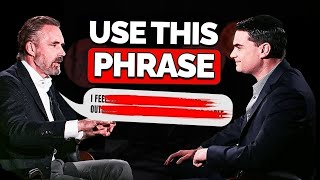
When someone twists your words in an argument, they're often experiencing cognitive dissonance, a psychological state that makes them resistant to what you're saying. The video uses debates featuring Jordan Peterson, Ben Affleck, and Sam Harris to show how this plays out, then explains how to communicate through it.
It seems to be harder than ever to get through to people logically. In fact, some of the smartest people have the most sophisticated psychological booby traps when it comes to heated subjects. So in this video, we are going to break down why sometimes people won't listen to reason even when they're smart. And what techniques you can do to finally get through to those people so that they see the light. The first thing that you need to realize is that people can fall into a pit that makes them impervious to reasoned argument. What pushes them into that pit is called cognitive dissonance. Cognitive dissonance is the state of having thoughts, actions, beliefs, or desires that are inconsistent with one another. The classic example is someone who smokes knows that smoking kills, yet says that they want to live a long, healthy life. Their beliefs and their actions don't seem to match up. Now, having one's own cognitive dissonance pointed out is uncomfortable. That's because there's often an unspoken cost to changing certain actions or opinions. In this case, stopping smoking would lead to painful withdrawals. So the most common way that people make cognitive dissonance more bearable is by sneakily changing another thought or action, even. Even if that one makes them irrational. That means that our smoker who can't quit only has irrational paths out of cognitive dissonance. They may point to individuals who smoked without consequence, insist that they have the healthiest genes, or say that they don't care if they die early, even when they really do. The big takeaway is that sometimes, especially in politics, religion, or emotional life choices, the most ridiculous belief that we have is the one that is most difficult to change. That is why smart people cling to silly positions. It's also why it's critical that you recognize cognitive dissonance if you're ever going to get through to those people. Because the worst thing that you can do in moments where people are deep in a cognitive dissonance shutdown is to continue with logical argument that will just drive them deeper into irrationality. So here are seven tells that someone is going into a cognitive dissonance shutdown, and you need to tread carefully. Keep in mind that none of these are perfect indicators. There are times when each tell is entirely reasonable, but. But if you see several tells, it's likely you're encountering cognitive dissonance. Also, my intent here is not to make fun of the people in these examples, just to learn from them, because we all get caught up in cognitive dissonance from time to time. So the first indicator is being Stunned by new information without conceding or adjusting your perspective. Take, for example, Cathy Newman after she had asked Jordan Peterson about why he feels that he has the right to offend people in the pursuit of truth.
You're doing what you should do, which is digging a bit to see what the hell's going on, exercising your freedom of speech to certainly risk offending me.
But you haven't sat there and I'm just trying. I'm just trying to work that out. I mean.
Ha.
Gotcha.
You have got me. You have got me. I'm trying to work that through my head.
Yeah, yeah.
It took a while. It did.
It did.
When someone is stunned, it means that they encountered surprising new information. And to not adjust one's perspective based on that new information can point towards cognitive dissonance. But I repeat that that al is not enough on its own, which is why you should pay attention for number two, being unable to accurately summarize the other side's perspective. And this is often preceded by, so.
You'Re saying, you're saying that trans activists. But you're saying, so you're saying that anyone who believes in equality. So you're saying give people equality of opportunity. That's fine.
We see Ben Affleck do this in his conversation with Sam Harris. When Sam is critical of aspects of the doctrine of Islam.
We have been sold this meme of Islamophobia where every criticism of the doctrine of Islam gets conflated with bigotry toward Muslims as people. Right.
You're saying that Islamophobia is not a real thing. Now, this needs to be contrasted with summarizing the other side's perspective in a way that genuinely attempts to portray them in their own words. This is to be encouraged. And you can see Jon Stewart do it here with Bill O'Reilly.
Let me, let me go to a different point, if I may. It sounds like what you're saying is, and correct me if I'm wrong, and I don't want to be wrong when I'm with you because, you know, I got mad love for you. That's a rap phrase. I got it. All right.
The third tell is mind reading the other side's intent, especially when the intent is presumed to be nefarious. Ben Shapiro made this mistake in his conversation with Andrew Neal. Assuming that Andrew must be on the left because he asked him pointed questions, Ben continued to disbelieve Andrew even when Andrew had indicated that Ben had misread his intent.
You as a journalist are proceeding to call one side of the political aisle ignorant, barbaric, and sending us back to the dark ages. Why don't you just say that you're on the left?
Is this so hard for you?
Why can't you just be honest? Seriously, it's a serious question, Mr. Shapiro.
If you only knew how ridiculous that statement is, you wouldn't have said it. So let's move on. Would you vote for this?
I think it's pretty evident from your own questions exactly what you are Trump.
The fourth tell is regularly moving goalposts. It's of course okay to clarify your position, but if you notice that someone is regularly adjusting the criteria by which they judge an argument, you're likely willing Witnessing cognitive dissonance for context. In this next clip, Stewart and O'Reilly are arguing whether it reflects poorly that Barack Obama had Common to the White House given that Common has defended someone accused of killing a police officer. Jon Stewart points out that Springsteen, Bono and Bob Dylan also did the same thing. And we get this exchange.
Wait, let me reply. Okay, so you say that because Bono, Springsteen. No, no, no. Bob Dylan wrote songs defending people who were accused of heinous things. Yes, that I have to give common a pass. No, because he did the same thing.
You have to be consistent with your outrage.
Let me give you.
Let me be consistent.
I will. Common visited, went to see the fifth.
Tell is yelling or getting angry, especially self righteous anger. And you just saw it with Bill O'Reilly a bit. But here's another example from Ben Affleck and Sam Harris for context. While Ben does make good points that most Muslims are good human beings, he's not not responding to Sam's criticisms at all. You can hear Sam try to explain his actual position, but he can't get through because of the yelling.
More than a billion people fanatical who don't punch women who just want to go to school. Wait a second. And you're painting the whole group religion with that?
No, no, let's the sixth tale of cognitive dissonance is attacking someone's character instead of addressing their arguments. And it's often a sign in light of a losing argument. This a last resort who you are.
In terms of your group identity.
You're just saying to provoke, aren't you? I mean you are a provocative. You're like the alt right that you hate to be compared to. You want to stir things up and.
Seven is retreating from a point without any concession. This is the least of a giveaway since there's often good reasons to move on in an argument. But it should be noted Nonetheless, especially if someone retreats rather hastily to move.
Along now and then. I'm not interested in provoking.
But what about the thing about, you know, fighting and the lobster? Tell us about the lobster.
Well, that's quite a segue.
If you see two, three or more of these signs, stop debating. Stop with logical arguments because they will not get you anywhere. You are in the midst of dangerous cognitive dissonance. Instead, your first order of business should be to re establish rapport with the person you're communicating with. We've covered this at length in our videos on Crowder and Trevor Noah, which I'll link to for a thorough breakdown of rapport. But for the fact fastest effect mid conversation, crack a joke that does not insult the other side like this.
Kind of fun though, is it not?
Yes.
And my frustration is not with you again. It's watching the entire system.
I know you load the network, but you kind of loathe me a little less. I got.
No, no, no. I don't even.
Let's talk politics.
I actually enjoy your company. I feel like we should get together outside of this weirdly egg shaped table.
Good natured jokes are especially effective because cognitive dissonance is like a shell that prevents new information from coming in. As long as you are perceived as a threat, the other person's shell will stay up. But if you signal that you're not a threat by making someone laugh, they will feel safe enough to finally open back up. Once the other side has opened back up, you're gonna have to employ three counterintuitive mindsets to finally get them to listen. First, demonstrate no superiority. If they switch to your side when you rub winning an in people's faces, they will slip back into cognitive dissonance. If your aim is to change someone's mind, you need to resist the urge to do things like this. You talk a lot about the Pareto distribution. Yes. That doesn't mean I defend it well. Okay.
You.
No, not well. Okay.
Yes.
Second, do not force people to immediately live out their new values. Our hypothetical smoker is going to have a really hard time conceding that smoking is ruining their health if they're forced to quit cold turkey in that same breath. So you need to allow people space to separate honesty from integrity. Third, do not hold past inconsistencies against people. People have a strong desire to defend things that they've said and done in the past. So when you bring up those inconsistencies, it can drive them to abandon the new belief that they're trying out just so that they can remain consistent with their past selves. But all of this stuff is worth only so much if you use it just with conversation with others. Because the most dangerous cognitive dissonance you will ever encounter is your own. Your cognitive dissonance is what makes you the smart person with some dumb opinions, and we all have some. Now admittedly, spotting cognitive dissonance in yourself is harder, though the seven tells can tip you off if you have super high self awareness and the solution of allowing yourself to crack a joke, forgive your past inconsistencies will help you move through cognitive dissonance gracefully. But there is one more piece that helps the most with your own person, and that's when you feel yourself losing track of an argument, you start to raise your voice. Or you just get the sense that you're trying to win instead of learn or commit. Communicate. Connect with your body, literally look downward into your chest, placing a hand on your heart or belly, and take a deep breath. Cognitive dissonance often feels like panic if you tune into it, which is why people enter fight or flight in those arguments. But when you slow down and you pay attention, you'll find that you're actually just having a discussion and exploring a perspective that may be more in line with reality. And your sense of logic will start to come back to you. Now if you can do this in real time, you won't just be part of the solution to communication breakdowns, which is amazing in and of itself. You will see things that other people cannot see. You'll take your ego blinders off and be better prepared to succeed in politics, relationships, work, or life. If you don't do this, you'll find yourself in a near perpetual state of shock and outrage when the world doesn't match your predefined expectations. And worse, you'll be poorly equipped to do anything to improve it. Thanks to our sponsor for this video Audible. Audible is having a special holiday offer where you can get six months of Audible plus for just $4.95 a month at audible.com charisma or by texting CHARISMA to 500 500. Audible plus gets you unlimited downloads of Audible originals from creators like Mel Robbins, Mark Manson, Kevin Hart, and Neil Gaiman. Plus it gets you unlimited access to classic books like 1984 or the Art of War. The nice thing about Audible is that you can listen to it while you do things like run errands or do chores. So no matter how busy your day is, you're always able to find time to and to grow. You can go to audible.com Charisma or text Charisma to 500500 to get six months of Audible plus for just $4.95 a month and then $7.95 after that. The link is on the screen and in the description. Either way, I hope that you've enjoyed this video and I look forward to seeing you in the next one.





