How To Command Respect Without Being A Jerk
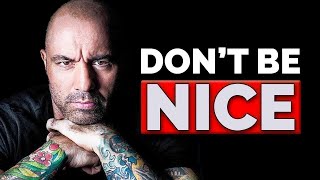
Joe Rogan shares how to handle conflict without being a jerk, using examples from his own confrontations. He emphasizes honesty and nuanced truth, separating behavior from personal attacks rather than attacking the person.
Joe Rogan has the most popular podcast on the planet. And I think a huge portion of that can be credited to the fact that his audience respects his authenticity, especially in the face of conflict. So in this video, we're going to talk about five things that you can do which will command respect in those tough situations without having to act like a jerk. Now, the first thing that Joe Rogan does that cannot be discounted is that he is a trained fighter. He knows how to defend himself physically. So he's more likely to speak up around people who act violent than you might be if you were afraid of getting hurt.
Come on over here. I am still. You're the biggest on the planet. Hey, hey, hey, hey. What are you doing? What are you doing? You can't assault people. What are you doing? Oh, but he. Well, you're. Yeah, it's called strategy. He's yelling at you. You can't run up to him and hit him.
When a lot of us see this sort of terrible behavior, we may not want to speak up. We fear that someone is going to get in our face and escalate things to a level that we don't want to go. And a big value of knowing martial arts is not that you go around picking fights, but that you feel more comfortable saying what ought to be said, knowing that in the worst case, Scenari, you can protect yourself. Which is exactly what happens here. The guy who is dating this woman gets into a shoving match with Joe, and rather than knocking him out cold, Joe simply puts him into a tie clinch so that no one gets hurt. And hopefully the guy learns a lesson.
Look, if you and your husband hit each other, that's one thing. You don't run up and hit other contestants. No, hey, hey, hey, hey. Don't. Hey, hey, hey. He got in Joe's face, and then he got too close to Joe. Please, please. Oh, my God. And then all of a sudden, they start going at it. And I was like, all right, I gotta break this up. Cause Joe's gonna kill him. Hey, hey, hey, hey.
But physical confrontations are the exception. Usually we're more afraid of the social consequences of confrontation. Joe is okay, though, if people do not like what he says. He believes that honest conflict has more social value than dishonest harmony. And that means that he's going to risk upsetting people, being yelled at, or being despised if telling the truth requires it. Take the Carlos Mencia incident several years ago. Carlos had been stealing jokes for Less famous comedians for years, and it was an open secret in the comic Industry. Almost no one did anything about it until Joe Rogan walked onto stage with Carlos and started chewing him out in front of a live audience.
You did another joke the other day. I saw you put a joke about licking a. Like licking a battery. I saw a guy do it in Vegas. I go, well, that's where you got it from. The Reverend Bob Levy from the Howard Sven Show.
All the other comedians who valued social harmony as Paramount kept quiet and just whispered about Carlos behind his back. But nothing changed, and Mencia got more famous off the work of these other comedians. It took Joe standing up in front of an audience that started out not very receptive in order to actually make a shift.
If someone steals a riff from a song that's in the news, constantly steal and make it on hbo. They steal. Put it on television. What are you saying?
And to be clear, Joe had to do this publicly because when he would ask his comedian friends to speak up about what was happening, they didn't even want to say it on the record. That's what happened with Bobby Lee, for instance. In this next clip.
Do it. But is this.
Where is this? Who cares? It's reality. Anyway, it's good to see you.
This is the reason why comedians get away with stealing, because comedians like you.
Are afraid of confrontation.
This can be a tough but critical mindset if you want to be authentic and command respect. The intermediate stages of confrontation are usually not fun. Sometimes people will yell at you, and you're likely to feel very uncomfortable. You're usually not going to want to bring the issue up, whatever it is. But if you want to stop a particular behavior and you want to win the respect of everyone else who is thinking the same thing but is afraid to say it, you must speak up. Now, this same thing applies to telling friends difficult truths. In this next case, Joe's friend Brendan Schaub was a heavyweight UFC fighter who had looked very sloppy in several fights and whose lack of technical ability was liable to get him hurt. Now, as a fighter, Schaub wanted to continue past all obstacles. But as his friend and an analyst, Joe knew that the difficult, honest truth could wind up saving his friend from serious physical consequences.
It's not that you don't try hard. It's not that you're not dedicated. It's not that you're not disciplined. It's not that you're not intelligent. There's that other people can do that you can't do. If you had a wrestling match with Cain Velasquez, how well do you think you do straight up wrestling? Yeah, I think people be surprised. Really? You think so? Mm. I think you'd be surprised. I really do. I think he'd F you up. And I say that as a friend and a guy who loves you.
This was a hard conversation, essentially telling your friend that you don't think he has what it takes to achieve his dream. During the podcast, Brendan wasn't dead. Tears. And you're only going to have the courage to begin these tough conversations when you accept the fact that being nice and avoiding harsh truths isn't necessarily kind and it's not being a good friend. Encouraging Brendan's dreams could have wound up with him getting serious brain damage. So telling the truth and upsetting Brendan in the short term was actually the caring move from Joe. Now, this isn't to say that you should just blurt out every mean thought that you think if you're going to be confrontational, you want to do it appropriately. So how should you handle these conflicts? Well, we actually have a full bonus module on this topic in our course, Charisma University. That module goes far beyond what I can cover in this YouTube video about handling conflict charismatically, making the other person respect you more for bringing up these tough issues. So if that sounds like something that you're interested in, definitely check out Charisma University if you want to be more confident in those situations. But for now, here is what we can see from Joe. First off, it's often a good idea to acknowledge that you don't enjoy the conflict and that the person that you're speaking to may not either. This is particularly useful for situations where you're entering into conflict with someone that you're close to. Take the conversation with Brendan Schaub as an example.
This is hard for me to say because I love you as a friend, you know, it's hard for me to say, but this is just a reality. The guys who are at the top of the fucking mountain, they're performing at a different level than you. Sucks, right? It sucks for me to say it. I don't like it coming out of my mouth. I don't like it. And the reason why I don't like it is because I love you as a human being.
Whether someone is doing something that is upsetting to you or you're just worried about them. A great phrase to kick off a potentially confrontational conversation is this. You start by saying, look, this is something that I've been wanting to tell you, but I've been uncomfortable about it and I haven't wanted to say it. That Sentence opens the other person up and makes them less likely to jump down your throat if the news is on the harsher side. The second tip is to allow for nuanced truth. Oftentimes when we are in conflict, we feel as if we disagree entirely or not at all. So when someone says something, we disagree reflexively rather than listening to what they say and agreeing where possible. Like this, for sure.
What about the Gonzaga? You beat Gonzaga. That was a good fight. Yeah, you're a very good fighter. That's not what the issue is. The issue is, can you become a champion? If you can't become a champion, are you comfortable with getting knocked out three or four more times?
Take Eddie Bravo's conspiracy theories for another example. Joe doesn't just say that Eddie is dumb and that every case of his doubt is stupid. Instead, he disagrees with very specific issues that he raised. And in this case it's Eddie's belief about a flat earth cover up.
When you start thinking that the world is flat, the dinosaurs aren't real, all this nutty sh t you believe and you just jump into it with the problem is it discredits all these other things that you believe that might be real because the other things have some validity to them you just haven't looked into.
Similarly, you want to accept that as certain as you are in your perspective, your opinions and your perceptions are fallible. So avoid statements about being absolutely right and instead speak like this, totally.
Yes, you could do it. You're a big guy, man, you hit hard. You know, if you land the right shot at the right time. But if I was objective and I was standing outside looking at it from the outside, and I had a bet, I would have to bet on him.
Couching your statements like this keeps you from devolving into pointless. Is what you're saying objectively true arguments? Because like it or not, the other person cannot deny your opinion about the facts or where you would decide to place your bets on how things would turn out. Which brings us to the third point, and that's that whenever possible, you want to confront a particular behavior and not a person. In the heat of the moment, it is easy to forget that you don't disagree or hate anyone entirely. It's impossible. What you have an issue with, and maybe it's a huge issue, is a particular pattern of behavior. So that means that you want to avoid saying things like you're a jerk, which are blanket statements, and instead stick to speaking about the exact behavior that you take issue with.
That's just showing to you that your interest in me is. Let me tell you.
This mentality leads to Rogan's fairly unique ability to like someone as a person completely separate from their political or social views. Now, this is the case with Alex Jones, who Joe has known for years, despite the fact that he disagrees with a lot of what Alex says.
Alex Jones, I love you, buddy. For real. But you say some silly that's where this all comes from. Doesn't mean I don't love you.
You'll see a similar pattern of validating the person while objecting to specific behaviors when Joe speaks to Owen Benjamin about what he writes on Twitter.
I wanted to talk to you about social media, okay? Because I love you. I love you too. I think you're a very good guy, I really do. But you are the worst representative of yourself on social media.
The point is that when possible, realize that you don't have a conflict with a person, but with a pattern of behavior. And if you begin to think that you are in conflict with an individual, you will dig in your heels and make things worse. You're likely to conflate the person with their ideas. And when this has happened in some of Joe Rogan's podcasts, they create some of his worst moments.
Couldn't care less. People want to smoke joints. You're an ideologue, buddy.
Really?
That's an ideologue position. By saying leave it to the States. Yeah, you're locked in, man. Really. And that's why you proved it full of about Colorado and traffic deaths. Should we go and f you up with this too?
So remind yourself what particular behavior you are trying to change and realize that any name calling beyond that is only damaging the respect that you were building by having the courage to confront the issue in the first place. Now, like I said, if you really want to master those moments of conflict in your life, which can be pivotal for how people respect you, we have a full module on conflict in our course, Charisma University. And if you want to get a taste of what that course is all about, I've set up a video which discusses the the four emotions that lead to an amazing first impression. Consistently, if you nail these, you dramatically reduce the risk that you're actually going to get into a conflict like this in the first place, since the other person is going to think so highly of you. And it's not like you're definitely going to get in conflict if you miss these opportunities, but you are more likely to just be ignored or forgotten during that first impression. So if that's something that interests you, click the link in the description, drop your email, and check that video out today. Also, if you've enjoyed this video and you haven't yet done so, make sure to subscribe to the channel and hit that notification bell. I know. Actually last week we were an hour late in getting the upload up, so if you want to make sure that you don't miss it when it does go live, hit that notification bell. It's super helpful. Anyways, hope that you guys have enjoyed this video and I look forward to seeing you next time.





