How To Get Better At Public Speaking Fast
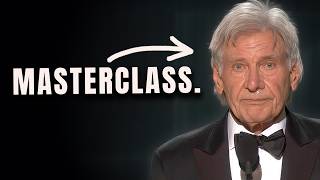
Charlie Houpert breaks down Harrison Ford's SAG-AFTRA speech using a five-step framework called FARTS: open with humor, acknowledge people, share a story that shifts from "I" to "we," give a takeaway, and end with a clear sign-off. Great speeches plant ideas that change how people act.
Chapters
Well, I'm here to receive a prize for being alive.
I've been living in Los Angeles for 2 years and I've never been this cold in my life. Stay hungry, stay foolish. These are some of the greatest speeches of all time. People have been talking about some of them for decades, and if you watch them back to back, they look totally different, but they are all doing the same exact underlying thing because every great speech is performing Inception. Once an idea has taken hold in the brain, it's almost impossible to eradicate. A great speech is built in a way that plants an idea into the mind of the audience, and that idea's whole purpose is to make the audience act differently, whether they realize it or not. So if you want to understand or even give one of these incredible speeches, there is a reliable 5-step process for pulling off Inception on demand. So I'm going to break these down using a speech that a lot of people are calling the best acceptance speech of the year. That is Harrison Ford at the SAG-AFTRA Lifetime Achievement awards. All you have to remember is just one word: FARTS. I know, sounds very goofy, but you will remember it because FARTS is the acronym for the 5 steps that you want to hit in order. And that first letter, F, stands for funny, because 90% of the time you want to start with humor. Ford starts with a quip about Woody Harrelson, which gets a chuckle from the audience, but then he drops this.
I'm in a room of actors, many of whom are here because they've been nominated to receive a prize for their amazing work. Well, I'm here to receive a prize for being alive.
And his next line doubles down on the joke.
That said, it is a little weird to be getting a Lifetime Achievement Award at the half point of my career.
Now, the reason that you want to start with something funny is because the first thing that you must do in any speech is capture attention fast. And on a per-second basis, Jokes are the fastest way to do that. Now, there's two very easy ways to be funny immediately, even if your mind is racing. First, you can tease the MC, and technically that is the first thing that Harrison does.
"Thank you, Woody, for that restricted introduction.
Thank you." Now, this works best when it's gentle and it's done to someone who is in a position of status, like your boss or the groom at his own wedding. Now, the second way is to tease yourself, which Ford actually does twice.
"Well, I'm here to receive a prize for being alive." Half point of my career.
Self-deprecating humor will almost always hit when you're in a position of status, and giving a speech is a position of status. So if it's a birthday speech, lines like, "This is gonna go horribly wrong, but thank you all for being here," or, "Honestly, I can't believe you all showed up," make for very easy laughs right off the bat.
Are you serious?
This takes us to our second step, which is acknowledgement, the A, because almost every great speech will have gratitude baked in. And whether that's a wedding toast or a work project wrapped or a birthday dinner, Somebody helped you, somebody showed up, and that means that people will feel left out if you don't acknowledge them. But there's two mistakes that people make here. First is that they skip the acknowledgments altogether, and that can make it seem like they think that they did this all on their own. And second, they will linger on acknowledgments for too long. Now, Ford does his acknowledgments in about a minute, and there's a great line in here that you can use whenever you're at this stage.
None of this happened on my own. "Thank you, George Lucas.
Thank you, Steven Spielberg." None of this happened on my own. It's a wonderful line for acknowledgments because it's always true and it includes a wide variety of people. Now, this is going to take us to the third point, the R. This is critical. You must relate to the audience. By far, this is the most essential part of any speech because if a great speech is Inception, R is the part where you're bypassing people's defenses. If you do this poorly, it will tend to go poorly. For example, Billie Eilish got into some internet drama when she said this at the Grammys. Don't feel like I need to say anything, but no one is illegal on stolen land. Now, at the time, the room responded positively because they were aligned politically, but the online backlash that she received would have been greatly reduced if she'd related more to the general public before jumping into her tea, which is the takeaway, but we're going to get back to that in a moment. So how do you relate in a way that opens people up to your deeper message? Well, there are 3 main ways, and we tend to see them in different contexts. In political speeches, you often see talk about shared history or shared future vision. The speaker is speaking for the audience. You see that in MLK's I Have a Dream speech and JFK's moon speech.
We choose to go to the moon in this decade and do the other things, not because they are easy, —But because they are hard.
In religious context, you'll often hear a parable. Jesus told dozens of parables in the Gospels, and you're going to hear this a lot in modern sermons. What's interesting about parables is they open people up to the lesson of the story without activating the part of the mind that tends to argue. But by far the easiest way to relate when you don't have any parables in your back pocket or a shared vision of the future is to do what Ford does, and that's you just tell a personal story. Now, a lot can be said about great storytelling. I have a whole section on it in Charisma University, but at its core, great storytelling is sharing your specific life events with a keen eye to the emotional relevance of those events to the audience. This is what bad storytellers don't get. They're all facts and no feelings. But watch what Ford does.
In my third year of college, I was a little lost. I was failing at school. I felt isolated, alone. And then I found, uh, the company of people putting on plays. People I once thought were misfits and geeks turned out to be my people.
I found a calling. And he repeatedly allows the recollection of these emotions to impact him, and you can watch how those moments impact the audience.
And being able to deliver the work we create together to an audience is an honor, and because of that privilege, I've come to know myself. I'm indeed a lucky guy. Lucky to have found my people. Lucky to still be doing it.
This one-two punch of specific events plus emotion hits because even though the specifics of our lives are totally different from Harrison Ford's, we share similar emotional experiences. So when you tell a story that is about you but you make the emotional journey the focus, the audience will instinctively feel, oh, I'm like him. And this sets you up for the next part of relating, which is the part where you shift from saying "I" in your personal story to "we" in the collective story, and Ford nails this.
As actors, we get to live many lives. We get to explore ideas. The stories we tell have a unique capacity to create moments of emotional connection.
So once they feel like you are like them, they're way more open to accepting the move from this "I" to "we." And it means that they're going to be open to following you to the next step, which is the T in FARTS, which is the whole point of the great speech. This is the takeaway. And the takeaway answers just one question: how does the audience walk away changed? Now, unless you are an incredibly skilled public speaker, this is something that you need to consider before you give your speech. It's the one thing you need to know in advance because you're building everything around it. Ford wants the audience, who are all successful actors, to reconsider how they treat the younger, less experienced people on their sets. That's exactly why he told that lost college kid story. So when he moves on to tell them about their responsibility to pay it forward, that's going to land because they just spent the last few moments empathizing with the kid that they're thinking about.
Success in this business brings a certain freedom that comes with responsibility to support each other, to keep the door open for the next kid, the next lost boy who's looking for a place to belong.
And you notice here he uses the same exact phrase, "lost boy," to describe himself at 20 as he does to describe the people that he wants the audience to care for. So generally speaking, it's very good practice to have a handful of really good stories in your back pocket, and you want these with widely applicable takeaways. Especially important, this is going to come in handy for interviews where the classic question is, "Tell me about a time you succeeded in a difficult situation or a challenge you overcame," and most people freeze here because they don't have these stories pre-built. Knowing a handful of key stories where the takeaway is, "I can work through challenging things," will come in super clutch in these situations. Now, there are actually two kinds of takeaways, and it is worth knowing the difference. You've got your soft close. That's where you're asking the audience just to see something differently. Ford's "keep the door open" is a soft close. It's a belief shift. It's not a concrete action. And then there are the hard closes. That's where you're asking the audience to do something specific. Donate to charity. Call your mother today. Buy Charisma University. These are hard closes, and hard closes involve immediate action, which makes them more powerful but also much more challenging to earn. You need to really nail this relating part, the R, to justify that hard close takeaway. Now, this takes us to the last letter, the S, the sign-off. By this point, you have done what you need to do. You open the audience up with humor, gratitude, emotional connection. You have planted your takeaway. This is now just about letting people know, hey, we're done. The big mistake that people make here is they linger. They're not sure how to end, so they drag things out and they ramble for 5 minutes and then they just kind of peter out and the audience thinks, okay, it's time for applause. The way you want to avoid this is to pre-plan one sentence that signals you're out. I always know if I get lost in a script, I can just say, either way, hope you've enjoyed this video and I look forward to seeing you in the next one. So what you want to do is just plan one line that can be your exit. Ford tends to land on a light joke, and that's a great idea.
And thank you to SAG-AFTRA for honoring me with this prize. This is very encouraging.
So now you've got these basics of building an amazing speech, even on the fly. And if you want to go deeper into the storytelling aspect that I mentioned, so you can whip these killer stories out at a cocktail party or an interview, or you're just interested in raising your confidence across the board in any social setting, you may be interested in joining Charisma University. It's a step-by-step It's a 30-day program that tells you exactly what to do every day so that by the end of it, you are radiating confidence and charisma without even thinking about it. Here's just a few things that our past members have said. "I had confidence in some areas but not in others. Then Charisma University changed that for me. Since beginning the program, I have seen noticeable changes in my life. It has helped me unlock the confidence that comes with knowing that I can go into any social situation and crush it." Another member wrote, I've always been bad at expressing myself in situations that weren't one-on-one in conversations. I'd find myself hesitant to speak, or I'd get caught in my own head overthinking things. After CU, I am now way more confident in saying what I think. I feel much happier all the time. I was even able to talk to a woman I've had a crush on for about a year and made a great first impression. Overall, I love this course and I keep going back to it when I need a refresher on the daily action modules. This program is literally guaranteed to change your life, which means that you can take the entire course and if you don't think it's worth every penny, you give yourself a full refund right from inside the program. So if you want to see if this course is right for you, click the link on the screen now or in the description below. Either way, I hope that you've enjoyed today's video and I hope to see you in the next one.





