How To Instantly Make Someone Like You
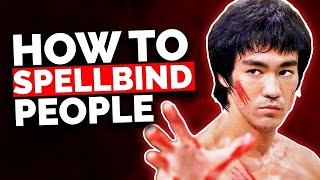
Charlie Houpert breaks down rapport building through genuine smiling, active listening, and body language, using Bruce Lee as an example. These techniques help you make better first impressions and get people to like you faster.
This is Charlie from Charisma on Command. And today I want to talk about how to get people to like you. This is a process that's called rapport building. And it is that state that you fall into when you begin to get into sync with someone, when you like them and you want them to like you back. Now, as humans, we are doing this all the time, whether you realize it or not. So you might as well begin to understand how it occurs and how you can do it better. And for that, this example of Bruce Lee is fantastic. Now, I gotta say, the guy has charisma oozing out of his pores. There's so many different things I could do about him. His leadership is phenomenal. But for the purposes of this video, I can't. It would take hours. So I just want to focus on how you can build rapport and how you can do a better job of making people like you when you meet them. So let's get started.
Voice is used, right?
Definitely, definitely.
You just make the words. Doesn't that sound strange when you go.
To the easiest place to start, right? A genuine smile. If you want people to like you, you need to be genuine and you need to radiate positivity. Now, I've done a video on this, but the three pieces of a smile are in that video. The most important one is the muscular tension around the eyes, because that is the most difficult one to fake. That's what makes it genuine. So rather than focusing on what you're doing with your lips or your eyes or anything, if you focus on actually engaging people and think of the sort of radiating warmth towards them, you will engage those muscles involuntarily and your smile will come across as much more genuine. You can play around with it in the mirror, but the truth is you're going to see it the realest when you actually laugh. And it's real. So get in the habit of smiling, not just with your teeth as like you're baring your teeth, but of genuinely smiling at people. It will make them respond much stronger.
Movies, especially in. In Hong Kong, in your own town, and you see yourself with somebody else's voice.
Well, not really, you see, because most of them.
So I just want to give you a heads up what's coming. When people start to fall into rapport with one another, they begin to mimic one another in terms of what they say, how they stand, the tonality. So watch for this repetition that's coming up right now.
Mandarin picture done here are dubbed anyway.
They dubbed anyway.
Anyway. I Mean, disregard.
I'm gonna play that back one more time just so you can see it super quick.
Most of the Mandarin picture done here are dubbed anyway.
They dubbed anyway.
Anyway, I'm in disregard.
So the interesting thing is that this is both a sign and a way to get into rapport with someone. Right? You can start to tell that they're getting there, but what you can do in conversation is when you're listening, to be an active listener. Repeat back what you've heard. Now, you don't need to be a parrot, you don't need to do it every single time. But if after someone talks, rather than just nodding, you start to say back the last few words that they said, you'll be surprised because they'll continue to speak and they'll feel like you get them much more because you're using their words in affirmation. Very, very powerful.
I mean, they shoot without sound, so it doesn't, you know, make any difference.
So the next thing that's coming is affirmations. People who are in rapport, there's this sense that they are similar, that they're beginning to find out all the ways in which they're alike. And they have a tendency to affirm one another. They say, yeah, they build off of each other's ideas rather than cutting them down. So start to listen as questions get asked. Oftentimes, the first word that people in rapport will say is yes or yeah or oh, my God, totally quite make.
The right words, do they?
Yeah, well, that's where.
So you hear that.
Yeah, well, the difficulty lies, you see. I mean, in order to. Because the Cantonese have a different way of saying things, you know, I mean, different from the Mandarin.
Yeah.
So I have to find, like something similar to that and keep a kind of a feeling going behind it. Something that. Matching the mandolin deal. Does it sound complicated?
Like the old silent days. But I gather in the. In the movies made here, the dialogue is pretty stilted anyway.
So he says, I gather in the movies that the dialogue is pretty stilted. And watch what Bruce Lee does.
Yeah, I agree with you. I mean, see, to me, a motion picture is motion. Yeah, I mean. I mean, you.
So what I said there, he says, yeah, I agree with you. He's saying, yes, the dialogue is stilted, but. But also that the motion picture isn't about the dialogue. Now, a clumsier way to do this. The guy could say the dialogue is stilted and he'd go, well, it doesn't matter that the dialogue is stilted because it's not about that. But first he affirms him, right. When you have a slightly divergent point with someone. But there are points of commonality. Get to the points of commonality first. That's how you don't destroy rapport with someone. And then you can elaborate from there to say, well, actually, you know, it's. The motion picture is about motion. So even though the dialogue is stilted, that's not so important.
Gotta keep the dialogue down to the minimum.
Did you go to. Did you look at many Mandarin movies before you started playing in the first place?
So now I want to jump ahead to another part of this film and show you what to do when you actually don't agree with someone totally. Right. How do you do that affirmation stuff when maybe you're not on the same page?
One of your students, James Coburn, played in a movie called Iron Man Flint, in which he used karate. Is that what he learned from you?
He learned it after.
So this is interesting. He thinks that his student learned karate and he wasn't doing it, apparently, according to Bruce Lee, very well. And so rather than correct him and just say, no, that's no way. Like, he was. He was terrible at that. He corrects him with that smile on his face. This is something I see people do wrong often. If you do need to correct someone, there are multiple ways of communicating. You've got your body language, your tonality, the expressions that you have on your face. If you make all of them negative, as in you're saying, saying, no, that is incorrect, and my face is stern and my tonality is just going, no, that's wrong, you're going to feel terrible. So what you need to do is make sure that some of those ways of communicating, when you're telling someone that they are incorrect, are positive. This is how you can correct people and still not have to be just a complete yes man while maintaining rapport.
Oh, he went, oh, yeah. After he played an army.
So let's go ahead and cut to another part.
Movie the Big Boss, which was such a success here and rocketed you to stardom in Asia, was that you did your own fighting.
Again, very important here. One thing that I notice with people as they're building rapport is they think they can only do it when they're speaking or when they're verbally consenting. Active listening is so important. And if you look at Bruce Lee's smirk and his eyes, he is smiling at him as he speaks. So critical. I know people and have friends that when they're looking at you, they have this kind of blank stare on their face and you can't tell if they're actually listening or completely zoned out. You do not want to do that when people are speaking to you. If you get that squint in your eyes, that smirk. And again, the way to do it is not to focus on the muscles, but to actually, one, engage with them, and then two, smile without showing teeth, right? Think warm thoughts as you're listening to them. Nod your head a little bit. That is active listening. That will make them feel heard and validated and continue to build rapport.
As I talk about Chinese boxing, how does it differ from, say, our kind of boxing?
Well, so another piece of building rapport with someone else is first being in rapport with yourself. And what that means is if rapport is matching, you need to match yourself, right? The words that you say, the tonality that you say them with, the expressions on your face, when those are all congruent, people are going to feel much more drawn to you. It's going to give them many more ways to actually mimic you. But when there's a mismatch there when you're saying, oh, yeah, I'm really excited, that leaves people feeling confused, like you're not being genuine and honest. So the more of those sorts of modalities, right, the body language, the tone, the content of what you're saying, your expressions with your eyes, the more that you can get them in sync with one another with every word and have them shift and flow, as you'll see Bruce Lee do here. The more that people will begin to fall in rapport with you because you are in rapport with yourself.
First we use the feet and then we use the elbow and use the thumb. You name it, man, use it all you have to. You see, because, I mean, that is the ex.
Notice that, that everything gets intense. He moves quickly when he says that.
Expression of the human body. I mean everything. I mean, you know, not just a hand. And when you're talking about combat, again.
He punctuates that word and everything does it. His eyes, his fists.
Well, I mean, if it. If it is a sport now, now you're talking about thumbnails. You have regulations, you have rules. But when you're talking about fighting as.
It is, no rules.
With no rules, not real fighting. Well, then, baby, you better train every part of your body. And when you do punch, now I'm leaning forward a little bit, hoping not to hurt any camera angle. I mean, you gotta put the whole hip into it and snap it and get all your.
Look at that. I love this part because he's got that intensity, intensity, intensity. Then he brings it back. It's almost like a performance, but that is something that spellbinds people.
Punch. Now I'm leaning forward a little bit, hoping not to hurt any camera angle. I mean, you gotta put the whole hip into it and snap it and get all your energy in there and make this into a weapon.
I don't want to tangle you on any dark.
So one of the interesting things about rapport is when you do a lot of those things. Right? Right. You shine positivity on them with your eyes, you agree, you affirm. When you correct, you make sure that some part of what you're doing is positive. And then you get into rapport with yourself. Everything that you do match, people will start to mimic you and they'll start to mimic you in bigger ways. So watch over the next 20 seconds, how the host begins to. Who he's been still this entire time, starts to move his body more immediately after, Bruce Lee stands up and shows how he punches.
Right. Now, you came at me pretty fast there. What is the difference between Chinese boxing and what we see these young men doing at 8 o' clock every morning on the rooftops in the parks called shadow boxing, which they're always.
Well, actually, there's one, he's gonna do.
Another, you see, that is part of Chinese boxing.
Yes.
There are so many schools different.
Everybody here seems to be, you know, going like this all the time.
Well, that's good. I mean, I mean.
So anyway, you start to see this and the host really does start to get more animated, as Bruce does. That is the power of rapport. It's not just matching, but what happens after that when you begin to lead. So that is a topic for another video. I want to talk about how Bruce Lee then leads this interaction in. If you want to get that video, of course, subscribe to the channel now. As soon as I have it finished, it's going to be up here. And this is just part of what it takes to make an amazing first impression. Right. There's actually four emotions that if you hit these emotions every single time in the right order, you can be guaranteed that you will make a good first impression on whoever you are with. Hit them in the wrong order or skip one and you just might be sunk. So if you want to find out more about what those emotions are and the order that you must hit them in the go ahead now, click the link. It'll take you to a page where you can drop your email and I will send you to a page that has a video that you can watch in the next seven minutes talking about what those emotions are and the order that you need to hit them in. Honestly, the order is the toughest part. So subscribe to this channel. Go ahead and please comment if there's anyone else you'd like to see. You can even include a link. That's where this came from. And I will see you on the next video.





