How To Leave A Rude Person Speechless
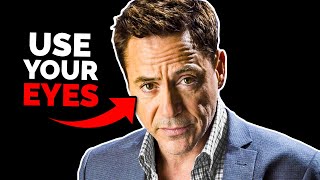
Charlie Houpert breaks down a four-step method for handling rude and passive-aggressive people, using examples from interviews with Robert Downey Jr. and Russell Brand to show how to stay composed and keep the upper hand in uncomfortable conversations.
People can be hostile with a fake friendly demeanor. It becomes tricky to know whether to confront them or just smile through it. And that's why in today's video, we are covering a four step method that you can use to stand up to rude passive aggressive behavior without acting like a jerk. And we'll be using a TENSE Robert Downey Jr. Interview that we covered in one of our first ever videos. But we thought that an update with more concrete advice and visuals would be useful. So the first step in the method when someone is being rude is to non verbally warn them to stop.
Stop.
You see Robert do that here. When asked an uncomfortable question at a press junket.
I'd really like to ask you about a quote you gave to the New York Times and I don't want to pry, so if you don't want to talk about it, that's fine. But what you said to the New York Times once was, it was about. It was after your incarceration.
The reason we start with nonverbals is because they are subtle, which is important. You don't want to jump down someone's throat when it's possible that you're misinterpreting their intent because that would just make you look needlessly defensive. When using nonverbals, there are three broad options. And the first is what you just saw from Robert. Nonverbal signals that ask, what are you doing? Note how Robert Downey Jr. Uses his eyes to indicate that this line of questioning is confusing and displeasing to him. The second type says, I see what you're up to. Stop. A steady but calm stare communicates this very effectively. And you see Russell Brand do it on MSNBC when the interviewers were treating him rudely. This had the desired effect based on just that body language. One interviewer changed her approach to Russell totally and was complimentary just seconds later.
That you look fantastic.
That is a very kind compliment. You also look.
The third type of nonverbal communication that acts as a deterrent for rude behavior is simply ignoring the person doing it. In this next clip, you see Russell's attention wander and it immediately makes the hosts feel like they need to be more kind in order to win him back.
It's funny though, because I travel a lot.
All these people are at work. Are they?
Yeah, they're working.
They're just at work.
I'm gonna ask a serious question. Can I try? I'll try.
Try. It's never gonna go ahead.
Everyone asks, what do you like better? TV movies or stand up, which actually which one's more difficult?
Feel free to mix and match and use whichever style best suits your personality and the moment. But know that the commonality with all of these nonverbal communications is that they act as negative reinforcement. It's not comfortable to talk to someone who's indicating confusion, opposition, or disinterest. And for that reason, it's very likely that nonverbals will put an end to rudeness before it even becomes overt. Sometimes, though, nonverbals can be missed, so a less subtle approach becomes necessary. And that brings us to the second step, the indirect warning shot. Like this.
The statement sort of stands by itself, doesn't it? I mean, does that mean you're not a liberal or that you came out of prison not being a liberal?
Are we promoting a movie?
Indirect warnings are impossible to miss, but they allow that the other person is being oblivious instead of intentionally rude. The key here is not to attack the other person. Instead, speak without assuming any malicious intent. Questions like Robert Downey Jr. S can work, as do descriptions of behavior that you like and don't like, which is what we see Russell do here in that same MSNBC interview.
The thing I enjoy most is stand up comedy. Because you're direct with your audience, you can't be misinterpreted. People can't get confused. You know what happens if you work in media. People like to change the information so that it suits a particular agenda.
You see in these examples both negative and positive reinforcement, and both can work in your own life. Phrases like that's an odd question are subtle negative reinforcers, while ones like, you know, I really appreciate when can positively reinforce different behaviors, combine these to indirectly warn people to be more thoughtful while still allowing them to save face and in the moment. Now, nearly all conflicts will be handled by this point, but the rare exception will continue and necessitates the third step, where subtlety goes out the window. The call out. It looks like this.
Well, I think we've got three more minutes on our. On our agreement.
Your foot's starting to jump a little bit. You better get to your next question.
And I just wondered whether, you know, you think you're free of all of that or whether that's still something.
Sorry, I really don't. What are we doing?
Well, I'm just asking questions, that's all Right.
When calling someone out, you do not want to lose your cool and blow up. It's counterintuitive, but the more matter of fact you are, the more powerful. The call out is a simple rule of Thumb is to calmly describe the behavior that the other person is doing and then tell them that it's rude, like Russell does here.
I think it's not listening to him. It's experience. It's just sort of taking it all in.
You are talking about me as if I'm not here and as if I'm an extraterrestrial. You know, I'm from a country that's near to you.
The moment of the call out might seem like the pinnacle of confidence and social power, but it's important not to skip right to it. It is always possible that you've misheard someone or misunderstood them, which is why the nonverbal and indirect steps are so useful, presuming that you followed all the steps up to the callout, though, if you receive anything less than an apology, we get to the exit the situation. You need to be willing to remove yourself from all of those situations where people are treating you poorly. Otherwise, opportunists will. Will treat you like a doormat. So separating yourself as calmly as possible ensures that you don't have people emotionally abusing you throughout your life. We see Downey do it right after going through the N, I and C steps.
Bye.
Thank you. Are you. I'm sorry.
It's okay.
Yeah, you're right.
Thank you.
Of course, you'd prefer the walkout to be a rare outcome, which is why it's important to remember to invite de escalation of the situation at every step. And Robert did this. He was smiling, offering other conversation topics and at least some answer to questions that he felt were inappropriate.
Are we promoting a movie? To me, the thing is that it's. I'm certainly not going to backpedal on anything I've said, but I wouldn't say. Actually, I wouldn't say I'm a Republican or a liberal or a Democrat.
The overarching strategy is to warn someone less and less subtly while remaining open to a productive conversation. This sets up a powerful dynamic where things get uncomfortable if passive aggressiveness and rudeness are pursued, but enjoyable if the dropped. Now, everything that we've covered here gets much easier if you are confident in yourself and know that you don't need any individual to like you in order to achieve your goals. Now, this can be especially difficult when there's someone who you feel you can't risk upsetting. For instance, someone you're attracted to, a boss at the office or a colleague that you need to work with all the time. The nice method still works in these situations, but it needs to be Accompanied by a mindset that gives you the guts to arrive at a call out and an exit if necessary. And that mindset is that you do not need any particular individual, even your current boss. With skills, charisma and time, you can always form new, more positive relationships, be they social or professional. So don't allow the fear of upsetting a particular individual stop you from demanding to be treated with respect. Instead, become a person who knows that they're better off starting over than settling for poor treatment. Beyond just conflict, though, Charisma can be a huge accelerator at work. In fact, I think most people underrate its importance when it comes to promotions and raises. And if improving yours is something that you're interested in, you might be interested in our flagship course, Charisma Unique University. Charisma University is a 30 day video program to help you not only handle conflict confidently, but also to inspire and impress anyone you meet. We've had thousands of people join and many of them have seen huge impacts on their success in the workplace. And here's what a few have had to say. Anton says, I don't even have a bachelor diploma yet. They want me to fill this position. And when asked why this was the answer. You have great social skills, which is rare for an engineer. You can think quick on your feet and are open and self assured in your demeanor. You have truly changed my life because without Charisma University, I wouldn't have qualified for that position in a million lifetimes. A second member says, I interviewed for dozens of places for jobs after medical school. At the end of my interview days, the doctor pulled me aside and said that hands down, I had the best interview out of everybody and they would love to have me at their program. They ranked me number one and it's my current job. And one last member, Miguel, says, Charisma University was one of the best investments of my life. I received a new job offer three weeks ago. The reason they chose me for this job is as follows. Your charisma and your ability to connect with everyone are rare and of great value to our company. So Charisma University the course is designed to fit into your busy life. Just 20 minutes a day for 30 days and the money back guarantee lasts for 60 days, which lets you go all the way through the course, see the results in your life, and if you don't love them, you can get every penny back. So if you're interested, you can click the link on the screen or in the description to check the course out and I really hope that you do. It's one of the best things that I have ever made, and the results that people get from it are awesome. Either way, I hope that you've enjoyed this video, and I look forward to seeing you in the next one. Cobra Kai never dies.





