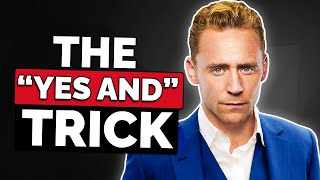
Charlie Houpert explains the "yes, and" technique for building rapport in conversation. By agreeing with what someone says and then expanding on it, you make them feel heard and create connection. He uses interviews with Gray Drake and Tom Hiddleston to show how this works in practice.
What's up, everybody? This is Charlie from Charisma on Command. And today I want to cover one simple thing that you can do to make people like you, to build rapport. And if you don't know what that word means, it's basically to form a connection and to make people like you. So the thing that we're going to cover today is called yes, ending. And what that means is that basically in conversation, there's an infinite number of things that you can say at any given point, but they can usually be divided into two camps. Or on the one hand, there's the things that you say that agree with people and expand upon what they've said, and on the other camp, there are the things that disagree with that they say and try to move conversation into a different, perhaps contradictory direction. So in this interview, what I want you to notice is that the woman who was interviewing, whose name is Gray Drake, she, yes, ends all the time. And there's certainly a place for disagreeing with people. But typically speaking, if you are trying to build rapport and make people like you, if you can do this without being inauthentic, if you can, yes. And you will build more of a connection. So I wanted to show you what that looks like first, in kind of a laid back, small talk way.
Hollywood wants to put you in a clear box a lot. Yeah, let's get you outside the box every single time it happens. Magic.
Yeah. True, true. I guess I wasn't in a box in Warhorse.
So, interestingly, Tom Hiddleston agrees with her and then says, well, actually, there are these exceptions, so this is kind of a yes, but no. And watch how she responds.
I was on a horse.
That's true. You were on a horse.
Yeah. Midnight in Paris. Not in a box.
Deep blue sea.
Deep blue sea. Not in a box.
Not in a box.
I'm in a box in this film. What can I say?
Exactly.
Think outside the box, guys.
Think outside of it and then the magic will unfold. Okay, there's one line.
So if you notice there, not only she says, you know, Hollywood wants to put you in a box, he starts listing the ways that he's not in a box, and she starts to agree with him there. And then he cracks sort of joke about, you know, thinking outside the box, and she makes that bigger. This is the essence of yes, ending. It's when you agree with what someone has said and then expand upon it. Now, if you're talking about serious issues, like, you know, your stances on politics or religion or whatever, and you're having, you know, a serious conversation where the point is to communicate and perhaps persuade. This actually still is a good tactic. You will oftentimes want to start with agreeing with them and then going to what your differences are. But for the purposes of small talk, almost 90, 95% of the time, you are better served to agree and expand. Right. You're in the box, you're outside the box. Who cares? Let's just have this conversation and make it fun. So I want to move on to a couple other things that you can see her do very well.
Feel like I get to the top of a mountain and I go, oh, look, there's another one. I'll go up that one. And that's how life is. That's how I keep myself. Can you hear that wind howling?
So dramatic.
This is the Loki room.
So that is a very, very quick yes. And. But again, so he says, can you hear that wind? And then she goes bigger. Right. This is a comedic theme that I've talked about in the past, but one, you involve your body and you just take what the other person has said and expand upon it. It's going to be funny to them because it started in their brain and you have taken it to perhaps an absurd point. That's one small bit with, yes, ending. And I want to cover one more from a humorous perspective before getting to a little bit more serious one.
There was one very passionate, and she was actually sweet young girl who said, can we have a picture? Can I jump into your arms and you carry me in the picture? And I was like, sure, I guess.
Look at you, Muscles McGee. Who needs Chris Hemsworth?
Come on.
So this is an example again of an encouraging joke. Now, this is not necessarily a yes, and. But what it is, is in comedy, similar to you can go agree with and expand or disagree with, you can make jokes that build people up or jokes that tear them down. So it would have been just as easy for her to crack a joke about, well, how are you gonna do that? You're low key. What we really need is Chris Hemsworth. And he might have laughed just as hard. But if you're looking to build rapport, just like you want to go with agreeing and yes ending, you want to crack jokes that place people in the roles that they would like. Look at you, Muscles McGee. And he's a little bit embarrassed, a little bit sort of bashful about it, but still, this is going to endear him to her because even when she's joking, she's not doing it at his expense. She is building him up. So now I just want to move on to one more yes and, and this is in a serious case. You've seen now a couple of examples of more humorous yes ands. But this one is going to be. This will show you how you can do it in parts of conversation that aren't necessarily just for laughs.
My mum always taught me the value of knowing, recognizing and acknowledging when you'd had a good day. You know, like I know that sounds cheesy but you know there are, there's so many bad days we all have in our lives and it's like good to know when you had a good one.
The fact that you wake up in the morning and are able to take a breath on your own is a gift, you know, and it starts as simply as that, I think.
Yeah.
And perhaps it's the reason that, you know, you have such a great momentum and are in so many fantastic movies is just being grateful.
So yeah, maybe, maybe, maybe that's it. I mean I love what I do, I love.
So that's just another example of yes, any he's talking about. He says I know this is cheesy and she could, you know, crack a joke. That is cheesy. Hahaha. And maybe get a giggle out of him. Which is fine, that's not going to ruin all conversation. But again, generally speaking, if your goal is to form more of a connection with people to get them to like you, yes, ending is the way to do it. Interestingly, on occasion when you disagree, there's a point for that that actually can build respect sometimes. Not something that I want to touch on in this video. The whole point of this is that when you are going to be a bit more likable if you can authentically and if you look back on all of these, she's either having a good time laughing or you can just tell she is being authentic about, you know, being grateful for the good days. She's not agreeing just for the sake of yes ending. She actually holds that belief and is voicing it. If you can show the ways that you are like other people, show the ways that you agree with them, expand upon their ideas, they are very, very likely to feel connected to you and to like you more. So hope that has been helpful. Till next time. I'm Charlie and I will see you soon.