How To Never Be Boring In Conversation
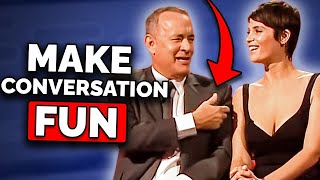
Charlie Houpert breaks down Tom Hanks' approach to staying interesting in conversation. He covers storytelling technique, how to read the room, and ways to pull people into what you're saying instead of talking at them.
Tom Hanks has one of the most captivating personalities in Hollywood. What's interesting is that his charm has much less to do with what he's saying compared to how he says it. So in this video, we're going to break down four habits that make everything Tom says more interesting and how you can use these to ensure that you are never boring in conversation, even if you don't have super interesting topics to talk about. The first thing you can learn from Tom has to do with how he launches into new conversational topics. He usually doesn't just leap into them out of nowhere. Instead, he gives his listener a reason to care. And he does so by using a story gap, basically hinting at what you can expect without telling you outright. Here's an example.
I'll tell you one thing that happens to Tom Hanks, Little Tommy Hanks. On that, on that. Larry's brother Larry. Larry's brother. I'll tell you what happens to him. He gets screwed. And I'll tell you how the question.
Wait, how did he get screwed? Immediately pops into your head. And that is the whole point of a story gap, to raise a burning question in the mind of the listener that makes them intrigued. Now, it's important that the story gaps that you're creating have a mystery with emotional stakes. If Tom had said, you'll never guess how normal my day was, no would care. So you want to stick with high positive and high negative connotation words when you do this, and to be clear, you can be even more subtle and get the same effect of people hanging on every word you say. In the next clips, Tom creates a story gap just by implying that what's coming next is unbelievable or surprising.
My brother is an entomologist, so this is true. But you are a recording artist. Oh, dear.
You can use these phrases to instantly make people more interested in what you have to say. But the high order point is that Tom doesn't take his audience's attention for granted. Granted, he earns it. And it only takes this simple phrase to start with. But that isn't where he stops, because you can bore people if you don't deliver fast enough when you finally start speaking. So Tom continues to earn his audience's attention by using a technique which is our second main point. He completely inhabits whatever character or action he's talking about. For instance, when he's telling a story about Ron Howard, Tom adopts a different accent, face, and even hand gestures. And if the volume were off, you would see still see him flip between Tom Hanks and the Ron Howard character, as the story continues, your job is.
To love the girl.
You need to love the girl, all right? That's your job. And I just said, are you gonna fire me because of this? And he said, no, no.
Most people stay very flat in their faces when they speak. Same with their gestures and their accent. And it means that they can only be fascinating if the literal words they are saying are fascinating. And in this case, they might blame their inability to hold the attention of a group on their life circumstances, saying that nothing interesting happens to them. This is only half the story, though. The other half is that there's nothing of interest beyond the words, particularly visually. So don't hinder yourself in that same way when you allow yourself to inhabit the actions that you were talking about. It doesn't matter if every joke isn't perfect or if a story drags a bit, you're still fun to watch. Take a look at some examples of Tom demonstrating this.
They have a conversation and that whole buildup to action would make the horses go like. Like this. Had to stir 50 shades of gr. Shades of gray. I don't understand what that means. I have a feeling the problem now is there's an awful lot of spit coffee on people's laps. Are you kidding me? I think a lot of that's a.
Simple way to practice this is to simply force yourself to pantomime the next time that you're speaking. So if you're talking about running, do the running thing with your arms. And if you're talking about playing guitar, the air guitar is your friend. You will be shocked how much livelier conversation becomes and how much easier it is to get a laugh. Now, from everything that you've seen so far, you might assume that Tom is always over the top and huge in his expressions. But if you watch this next clip, you'll see something interesting. Tom actually has a mode of conversation that is much quieter and subdued.
Everybody says, hello, I'm Julie. I'm Simon. Hello, nice to see you. What do you do? Well, I'm the Duchess of Westmoreland. What do you do? Well, I run British Intelligence. How are you? Everybody's. It's kind of like on a first name basis. Did you meet her? Oh, yes. Oh, yes, indeed.
This is a demonstration of dynamics. It's when you shift the size of the gestures or your volume or your tone within a conversation. These shifts can be as big as changing the tone of a story to match a different emotion.
They say, oh, you know, the Tahitian Islands are beautiful to Go biking because it's so flat. Nonsense. I don't know what the French word is for that. It's. It is not.
Or. These changes can occur within a single sentence. When one word is different from the rest.
Here's what happens. You're there and every day is just like crazy. Love Boat Scandals Resort Fantastic.
Playing with dynamics is important because being fascinating is not just about always being big and boisterous. You see, people notice and pay attention to things that are different from the baseline. And being loud and animated when you start a conversation is interesting because it separates you from most other people. But if you keep it up non stop at some point, everything that you say is the same and it can become overblown and boring. So shifts from sad to happy when appropriate, or loud to soft. These are what get people reinvested in jokes or stories, regardless of the content of what you're saying. Here's another example.
I always love running into you and seeing you wherever I see, because I always run up and do bits and I just scream at you.
That's right.
And then your security team.
And I just. I just yell your name back at you.
When it comes to dynamics in your own life, a good rule of thumb is to come in one level higher than the situation calls for. Like I mentioned, this is going to separate you from others in a positive way. But once you've captured people's attention and a group is listening to your story or what you have to say, don't be afraid to downshift when it makes sense with what you're saying. Great opportunities might be when you're playing a quiet character or shifting the tone of a story for comedic effect.
And we said, you guys work here? And they said every single day. I said, the President's not even here. Why do you have to be there? And they said, in case of nuclear war, you know, say something happens.
The fourth point that Tom demonstrates incredibly well is in his inclusion of multiple members of a group. People naturally pay attention when we feel like what is being said is to us specifically. And the simple act of greeting someone can make them feel like the next conversation is for them. So including more people in introductions when you enter a room is a smart move. But you can also call an individual out in a positive way or ask them a question. Though this might feel like a diversion from the main topic of conversation. When you go out of your way to include more people in a group, it becomes more interesting because more people feel like the conversation is for them. Another option to do this occurs when you're about to speak on any kind of topic and you can mention how it relates back to various members of the group, even if it's not something that directly affects their life, the simple act of acknowledging some some relation to them is going to make them pay closer attention.
Every interview will be about Forrest Gump. At some point, you know you'll hear the same thing. You'll be answering questions about St. Joan for the rest of your life.
Now, in larger groups, this may be impractical to do for every single person. So when you're in that larger group and you can't possibly give everyone a personalized reason to listen, eye contact while speaking is huge. We've talked about this in the Tom Holland video, but again, the three second rule is in effect to maximally make them feel like you're talking to them. Give each person, or at least each side of the room, roughly three seconds to come in a bit under. That's not a deal breaker. Even a glance can help engage someone quite a bit. Now, we've purposely focused a lot on how to be fascinating, independent of the content of what you're saying. It's a fantastic skill, but what to say is important too. And if you want to be able to confidently connect with people in a meaningful way so they remember you, you want both. And if you'd like to go deeper on that topic, you might want to check out our flagship course, Charisma University. Charisma University is a video course, and the entire point of it is to get you more confident and more charismatic in just 30 days. It goes into the exact, step by step things that you should do over the course of those 30 days, so that you're not only avoiding being boring, but that you're developing a charisma that makes you stand out as the person that people want to get to know and to be around, whether that's in the professional world or socially. And it's different from this YouTube channel in that it's not just random, interesting things about any particular celebrity. I've got no problem with that. It's fun. But rather, this course is a comprehensive system to install charismatic habits in your life. And it's going to guide you to develop your own style of charisma as fit, fast and as reliably as possible. So if you're looking for the fast track to more charisma, more confidence, I definitely would recommend checking out Charisma University. You click the link on the screen to join today or to go ahead and learn more. Either way, I hope that you have enjoyed this video, and I look forward to seeing you in the next one.





