How To Win (Almost) Every Argument
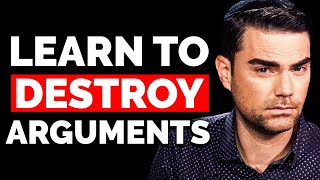
Ben Shapiro's debate tactics broken down: how he catches weak arguments, demands specifics, and shifts from abstract claims to concrete examples. The video explores both his rhetorical strategies and their ethical limits.
Ben Shapiro is one of the most famous and skilled political debaters out there. And even if you're not into politics, his arguments are fun to watch. In this video, I want to explore why Ben is so talented in debates. Specifically, I'm going to give you seven techniques that you can use no matter what side of an argument you represent, even if you're on the wrong side. Three caveats before we begin. First, I am not saying that Ben is right or wrong on any of his points. What I'm going to discuss are some of the rhetorical devices he employs that can be persuasive, even. Even if they aren't always logically foolproof. No matter where you fall in these issues, there's a lot to be learned from Ben's style of debate. Second, you probably don't want to focus on debating in your interpersonal relationships because the goal of debate is quite different than the goal of most relationships, or.
You'Re debating somebody on a stage, in which case your goal is basically to humiliate that person as badly as possible.
And third, Ben obviously does quite a bit of research, which is really tough to combat without figures of your own.
If you're richer, you tend to be married longer on average. People who are poorer tend to get divorced longer. Where did you get that? Statistical Census Bureau.
Now, research is necessary, but I'm more interested in the tactical side of the debate rather than the prep, so I won't go any further into it. Let's begin then with Ben's defensive debate tactics, starting with catching non arguments. And that's because not everything that sounds persuasive actually constitutes a valid argument. For instance, when you hear that 9 out of 10 fill in the blanks believe something that doesn't necessarily prove a point, that is an argument from authority. And though it might be compelling, more evidence is required to be deemed conclusive. So when people lean on authority in arguments, Ben knows to call them out on it. Like in this example, we urge you.
To listen to the American public and to the law enforcement community in support of ban on the further manufacture of these weapons. That was Ronald Reagan.
Okay, so I can disagree with Ronald, right?
You keep one of the great right wing presidents of modern times. Agreed with me.
So another common debate tactic that maybe isn't done on purpose and doesn't constitute a valid argument is getting emotional, particularly when the other person gets upset or offended. Now, when Piers Morgan did that, Ben wisely didn't engage him because simply being offended doesn't prove anything.
He's mere standing on the graves of the children that die there. How dare you.
I've seen you do it repeatedly, Piers.
Like I say, how dare you?
I mean, you can keep saying that, but you've done it repeatedly, what you do, and I've seen you do it.
On the program, the late Christopher Hitchens put the same idea rather bluntly. If someone tells me that I've hurt their feelings, I say, well, I'm still waiting to hear what your point is. Now, you don't necessarily need to be that abrupt, but pointing out that a point needs something beyond simple emotion in order to make it valid can make other debaters flustered. And from there you can segue into the third defensive tactic that we are covering in this video, which is pushing for specifics. People often hold very broad opinions very strongly without necessarily being able to articulate what they mean concretely. And of course, this happens on all sides of the political spectrum. So when Ben is grappling with a very broad spanning charge, he takes the necessary first step of pushing that other person to provide specific examples.
You know what the Republican beliefs are. I mean, you're a young guy, but you certainly remember two years back when they were beliefs were completely the opposite of what they are now. They were free trade.
This is absolutely critical. Do not get wrapped up in defending generalized statements, even if you don't like them. Because if any sort of blanket label is asserted against your position or its large institutions that are being branded one way or another, if you try to defend against that single phrase, you are already buying into an argument you don't understand, and that would be absurd. So instead push the other person to relate exactly what they mean specifically. Like in this example, are you even.
Talking about when you say institutional racism? It's too broad. You at least have to name me the institution. Which one is the racist one? Which institution is racist? Tell me which. Like, so we can fight it. Seriously, so we can fight it together. Just. I want to be on your side. I do. I want to fight racist. I think racism. Again, I think racism is. I think racist. Racist behavior is evil. I want to fight it with you, but I can't fight it if you're not. If you're not showing me what it is.
Similarly, and lastly, on the defensive side, Ben knows his arguments inside and out, so he doesn't get sucked into defending points that his argument doesn't require. For instance, in this next clip, Ben is talking about how Trump will say outrageous things knowing that it sets the media ablaze. And his point is that Trump knows what he's doing, and he does it on purpose in order to control the news cycle. Now, when Don Lemon responds, saying that Trump shouldn't be doing that, Ben doesn't bother defending the morality of his actions. He's only talking about the purpose of them.
Says some things that are outrageous, like people in the media aren't patriotic, knowing that people in the media are immediately going to turn it up to 12 on the, on the Richter scale. But Ben, don't you think he should.
Be truthful in his comments? Even if he's, even if he's funny and if you give him that, shouldn't he be truthful? And he wasn't, of course.
And I think that this is where the media. Here's my advice to people in the media.
Now, recognizing that you can and should agree at points with the person that you're debating seems obvious, but it can be especially hard to do when people insult you. A general rule of thumb is that if the other person winds up attacking you, you are actually winning the debate. So Ben us get sucked into defending his own honor. And he shows a great example of that here.
Called it a hit piece. And in it, writer Jane Coston says you have hollow bravery, calls your campus speeches shadowboxing. And if you wanted to be genuinely brave, you challenge, quote, some of the wrong headed ideas held by your right wing fans. How do you respond to that?
Number one, I've never really attributed bravery to myself. I don't think that it's brave to walk on a campus and talk to kids. I think it's brave to be a member of the military. I think it's brave to be a cop. I think it's brave to be a firefighter. I don't think it's brave for me to walk with a security team at my side onto a stage. If I thought that I was gonna get shot and murdered, then I probably wouldn't do it. So I don't consider myself part of that group.
Anyway, Ben wisely doesn't bother defending his own bravery and instead sticks to the points that he knows are strongest to his argument. And that takes us to Ben's offensive strategies. One of the big ways that I see him stump his opponents is through the use of Snuk premises. Essentially, you introduce the exact point of contention as a given, and that's through the clever use of language. Now, this isn't to pick on Ben, because we all do this from time to time. So first off, see if you can find the snuck premise in this next.
Case from Planned Parenthood. As you may have noticed, I'm mostly against abortion. If you want to go to Planned Parenthood and get a contraceptive, go for it. I don't care. I do care when you start killing babies. This is a problem for me.
Again, a snuck premise introduces a contended point as a given. So what counts as a snuck premise shifts with each position of each person involved in a debate. Now, in the context of the abortion debate, pro choice versus pro life, what is the snuck premise that Ben just said? Here it would be the words kill babies. This entire debate hinges on the personhood of the baby fetus, and using the word baby implies personhood. So with that word, Ben is able to sneak in a premise that most of his opponents would probably disagree with. But he does it in a way that they don't notice, so they are stuck. Stuck coming to the same conclusion that he does. Here's another example, this time in a debate over the morality of socialism, communism, and other economic models.
Income inequality in the United States is also quite high, right? There are people who are Bill Gates and Jeff Bezos, and then there's the local checker at your grocery store. But if the local checker at your grocery store is getting richer, then it seems to me they have nothing particularly to complain about in how the economy is operating. They don't have a rights to Jeff Bezos's money. They don't have a right to Bill Gates money any more than Bill Gates or Jeff Bezos has the right to their money.
What is the SNUK premise in this case? It would be the idea that it is their money. A socialist or communist might see the money that an owner of the means of production has, AKA another rich person, as being stolen. So it wouldn't be their money in the minds of a socialist or a communist. But when Ben assumes the idea that it is their money, he makes a point that again, his opponents might find disagreeable, but they won't really know where to poke the hole because they adopted his premise as soon as he said it. Now, in my experience, most debates are won or lost on snuck premises. In concealing the steps we take to arrive at our conclusions, we can get there without the other person knowing exactly how they disagree with us, but still being stuck. So if you want to win cheaply without having your ideas challenged, this is an excellent tactic. That is how you can win a debate even if you're wrong. But to the degree that you can catch yourself, you're usually better off avoiding this. And it's usually more insightful and Better for the relationship to bolster the opposition side, as we discussed in our video on Jordan Peterson, which I will link to below. Again, not to pick on Ben, just pointing this out as an example. I'm going to leave this for now and move to another effective rhetorical tool that I see from Ben. It's moving from the abstract to the concrete. And it looks like this.
I think that focusing on poverty is a good thing to do. I think focusing on income inequality is not a good thing to do because there's no correlation between income inequality and relative rates of poverty. Right? There's tremendous income inequality in a lot of places on planet Earth. In fact, in all places on planet Earth, if you go to Sudan, there's gonna be a rich warlord there, and then they're gonna be a bunch of people living on $6 a year.
This works because the specific example seems to prove the broader point that preceded it. Even though a single example cannot prove a rule, it is useful shorthand for persuasion and explanation. I do this all the time with the examples that I give you in these videos. It's very, very common. And when you add an element of humor to the specific piece that you are saying, it makes it even more persuasive because wrapped up in laughing that they don't necessarily evaluate if they disagree with the point that you made.
The people who are currently acting in criminal fashion in the drug war aren't going to be out acting as model citizens. As a general rule. A lot of those people are going to be committing other crimes because this has been the history of the United States. When you make a substance illegal, the people who are criminals were criminals before and they're criminals after. Al Capone was not going to turn into a banker after prohibition ended.
And the final piece for this video at least, is that you want to emphasize the conditions under which you would agree with your opponent. And what evidence would you need? Now, we previously saw Ben do this with regards to institutional racism in a previous clip.
Racist behavior is evil. I want to fight it with you, but I can't fight it if you're not. If you're not showing me what it is.
Here he is talking about Trump's impeachment and the Mueller investigations.
But, dude, I'm happy to wait for the Mueller indictments. If they come down and they target Trump, I'm happy to see him impeach, but I need to see evidence. Where's the evidence?
Just throw it in the trash.
And if he throws it in the trash or quashes the Mueller investigation, then yes, impeachment should be on the table.
Thank you, Ben.
When done in good faith, this is a really admirable way to build consensus and settle a debate. But since I said that this video was going to have elements of how to win even if you're wrong, this can also be used as a smokescreen to make your opponent lose sight of a more effective way to win an argument and instead focus on giving you the evidence that you asked for. By the way, I am not saying that that is what Ben is doing here. I'm just saying that when you outline the conditions of what it would take for you to reverse your position, and it can work as a diversionary tactic. So there you have it. Seven reasons that Ben Shapiro is so difficult to best in a debate, and seven ways that you can win even if you're wrong.





