Trump v. Clinton: Who Won The Last Debate?
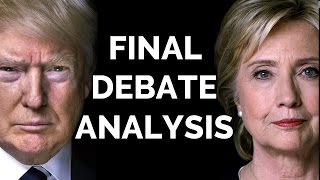
Charlie Houpert analyzes the second and third 2016 presidential debates between Trump and Clinton, breaking down charisma and credibility through their use of numbers, how they handled tough questions, and emotional connection. Clinton had the edge in charisma.
The second and third presidential debates are in the books and everyone is talking about who won. But today we're not talking about policies or strength of argument. I want to analyze who won strictly from a charisma angle. So let's get into it. The first thing to note is that previous debates, especially the primaries, were defined by zingers and there were a handful, mostly from Trump.
And she said things WikiLeaks that just came out and she lied. Now she's blaming the lie on the late great Abraham Lincoln. That's one that I have.
It's just awfully good that someone with the temperament of Donald Trump is not in charge of the law in our.
Country because you'd be in jail.
Secretary Clinton.
There was a different vibe in this debate, though, since the audience couldn't laugh out loud and there were longer uninterrupted stretches to answer questions instead of punchy one liners. These debates came down to two main principles. The first was credibility, basically appearing to be an authority on the issues. And I want to make this clear. We don't actually know from what they're saying what either of these candidates is an authority on, but we're triggered by certain cues. The first cue that I want to discuss, used by both candidates, used many times, was the use of specific numbers.
We have 33,000 people a year who die from guns.
No, the border patrol agents. 16,500 plus ICE last week endorsement.
We have 11 million undocumented people. They have 4 million American citizen children. 15 million people.
She wants 550% more people than Barack Obama.
Is 33,000 gun deaths a lot. Is 550% more immigrants too many? And are those numbers even accurate? Now, my point here is not to cast doubt or say that either of those figures are off, but just to say that most people don't know the answer to those questions. And we really can't make a determination of if those numbers are big or small when they're taken out of context. But when candidates quote these numbers with a high level of specificity, it gives the impression that they are an expert. It gives the impression of credibility. So for your own life, it's important to resist the urge to equate specific numbers to authority. Specificity does not equal truth. And the size of a number, of course, means nothing out of context. Perhaps I'm going to make another video on how easy it is to use facts to back weak arguments and how it's done all the time in marketing. But for now I'm just going to leave it at that. Another huge indicator that humans look for to determine who is more credible is the degree of comfort in answering difficult questions. And there were quite a few of those over the course of these debates, including, for instance, in a speech you.
Gave to a Brazilian bank for which you were paid $225,000. We've learned from the WikiLeaks that you said this. And I want to quote. My dream is a hemispheric common market with open trade and open borders. So that's the question. That's the question. Please quiet, everybody. Is that your dream? Open borders?
Now, the standard response from both candidates when they were faced with a very pointed question was almost always a brief answer followed by a redirect like this.
Well, if you went on to read the rest of the sentence, I was talking about energy. You know, we trade more energy with our neighbors than we trade with the rest of the world combined. And I do want us to have a. An electric grid, an energy system that crosses borders. I think that would be a great benefit to us. But you are very clearly quoting from WikiLeaks. And what's really important about WikiLeaks is that the Russian government has engaged in espionage.
While those redirects are often effective at shifting the focus from something that might be a negative to something that is perhaps a negative about the opposing candidate, they can be countered when people call them out. And that's because when we sense that people are ducking questions, we feel like they have something to hide or that they don't know what they're talking about. And to Trump's credit in this case, he called Hillary out for redirecting tap.
In any of our elections before.
That was a great pivot off the fact that she wants open borders. Okay, how did we get onto Putin?
Hold on, hold on.
But while both candidates used redirects to difficult questions, it was Trump who repeatedly got taken to task by the moderators in the second debate. And it made him look like he was in over his head, avoiding questions to which he really didn't have good answers.
Russia is killing isis and Iran is killing isis. And those three have now lined up because of our weak foreign policy.
Mr. Trump, let me repeat the question. If you were president, what would you do about Syria and the humanitarian crisis in Aleppo?
And that was the line.
What do you think will happen if Aleppo falls?
I think Aleppo is a disaster. Humanitarian crisis.
What do you think will happen if it falls?
I think that it basically has fallen. Okay. It basically is fun. Let me tell you something. People stay There. I've been reading now for weeks.
Tell me what your strategy is.
I've been reading now for weeks about Mosul.
In addition, there was oftentimes a sense that candidates were using the questions they were given to launch into totally unrelated points. And in a previous video I noted that was especially true of Hillary. But in the final two debates, she did an excellent job of segueing from the question as it was asked to a point that she maybe wanted to make. And she did this by repeating the question asker's own words throughout her answer.
Believe you can be a devoted president to all the people in the United States.
So I have a deep devotion to use your absolutely correct word per TV.
Parental guidelines, knowing that educators assign viewing the presidential debates as students homework. Do you feel you are modeling appropriate and positive behavior for today's youth?
Well, thank you. Are you a teacher? Yes. I think that that's a very good question because I've heard from lots of teachers and parents about some of their concerns.
That last clip, by the way, is extremely reminiscent of her husband's performance in a 1992 town hall debate, which she no doubt studied. Check it out.
Tell me how it's affected you.
Again.
You know people who've lost their.
Jobs and lost their homes.
Well, I've been governor of a small state for 12 years.
Moving on, though, the third and fourth major contributors to credibility are conviction and congruency. And it might seem crazy, but we often judge the value of someone's position by how certain they are of that position. Now, previously, this was an area where Trump was very strong, but in these debates, he was decidedly mixed. Here's an example of a lower conviction answer from him. Notice how much less animated he is than usual.
My opinion is going to uphold the Second Amendment and all amendments, but the Second Amendment, which is under absolute siege. I believe if my opponent should win this race, which I truly don't think will happen, we will have a Second Amendment which will be a very, very small replica of what it is right now.
I think Trump purposely went with a more calm demeanor here in order to come across as more controlled and presidential. But unfortunately, it detracted a bit from his conviction. Still, he did have moments where the conviction was on full display. And these highs generally topped what we saw from Hillary, which was more even throughout.
But they were in line and they're waiting to become citizens. Very unfair that somebody runs across the border, becomes a citizen under her plan. You have open borders, you would have a disaster on trade, and you will have a disaster with your open borders. But what she can say is that President Obama has deported millions and millions of people just the way Secretary.
Finally, the candidates vied to see who could create a stronger emotional connection with the audience and with voters at large. Again, for this point, I'm not arguing which candidate truly cares more. I'm just pointing out that there are cues that make us feel like someone is more emotionally connected. The first thing to consider here are the stories and images that they invoke. Numbers are very important for credibility, but it's stories and strong imagery that connect us to others. Hillary put a huge emphasis on painting pictures of real life individuals, particularly in.
The third debate, often the most heartbreaking, painful decisions for families to make. I have met with women who toward the end of their pregnancy, get the worst news one could get, that their health is in jeopardy if they continue to carry to term. As he was talking, I was thinking about a young girl I met here in Las Vegas, Carla, who was very worried that her parents might be deported because she was born in this country. But they were not. They work hard. They do everything they can to give her a good life. And you're right, I don't want to rip families apart. I don't want to be sending parents away from children. I don't want to see the deportation force that Donald has talked about in action in our country. I am not going to slam the door on women and children. That picture of that little four year old boy in Aleppo with the blood coming down his face while he sat in an ambulance is haunting.
Donald instead spoke more generally. Most of the time. His stories when he told them cited big names to give credibility. But there wasn't much in the way of emotional connection. Hillary also did a better job of personally addressing the individuals who asked questions in the town hall format by China.
And Steel or anything else, you know, because it sounds like you're in the business or you're aware of people in the business. You know that we are now, for the first time ever, energy independent. We are not dependent upon the Middle East.
This was especially obvious in the closing remarks of the third debate. When addressing minorities, Trump used the word they and the awkward phrases the African Americans and the Latinos. He was speaking to groups that he wanted to vote for him in a way that highlighted his emotional distance from them. And I don't think he picked up any votes there.
Our inner cities are a disaster. You get shot walking to the store. They have no education, they have no jobs. I will do more for African Americans and Latinos than she can ever do in 10 lifetimes. All she's done is talk to the African Americans and to the Latinos.
Hillary, on the other hand, smartly spoke in second person, meaning she used the.
Word you, our country, what it should be to grow the economy, to make it fairer, to make it work for everyone. We need your talents, your skills, your commitment, your energy, your ambition.
And while for much of the debates Hillary had stared downward and hurt her ability to connect emotionally, in her closing remarks she did look the camera dead on, giving viewers an increased sense that she was talking to you. So who won overall? Again, I'm just commenting on who won from a charisma perspective, which isn't what you should base your vote on, even though some people may. So that said, I would say that Hillary beat Donald in the final two debates in very similar fashion to one another. Yes, Trump won on zingers, but those were far less impactful. In these quieter debate styles, Hillary hit on more triggers of credibility than Trump did, and in terms of emotional connection, neither candidate had a real slam dunk. But again, I would say that Hillary did beat Donald. I'm hoping that this is the last video you see from me on the election. It's been fun, fun, but I'm looking forward to getting back to some other charismatic personalities. Speaking of which, if you haven't yet, make sure to click the button on the screen right now to see lots more charisma breakdowns of all sorts of different kinds of people. We also have videos that answer your questions and help you to become the most charismatic and confident version of yourself in those moments that count the most. So be sure to click the button here and subscribe so you never miss one of those videos. If you have any suggestions on topics or like breakdowns that we should do, whatever it is, go ahead and write them in the comments. This video is for those of you who in the comments kept asking about the second debate. I did not plan on doing this or any more for this election, but I do really care about what you want. So if there's anything specific that you'd like to see, just make sure to go ahead and write it in the comments. Until next time, I hope that you've enjoyed this video and I'll see you in the next one.





