David Mandel - Managing Partner at Emerging Ventures Capital
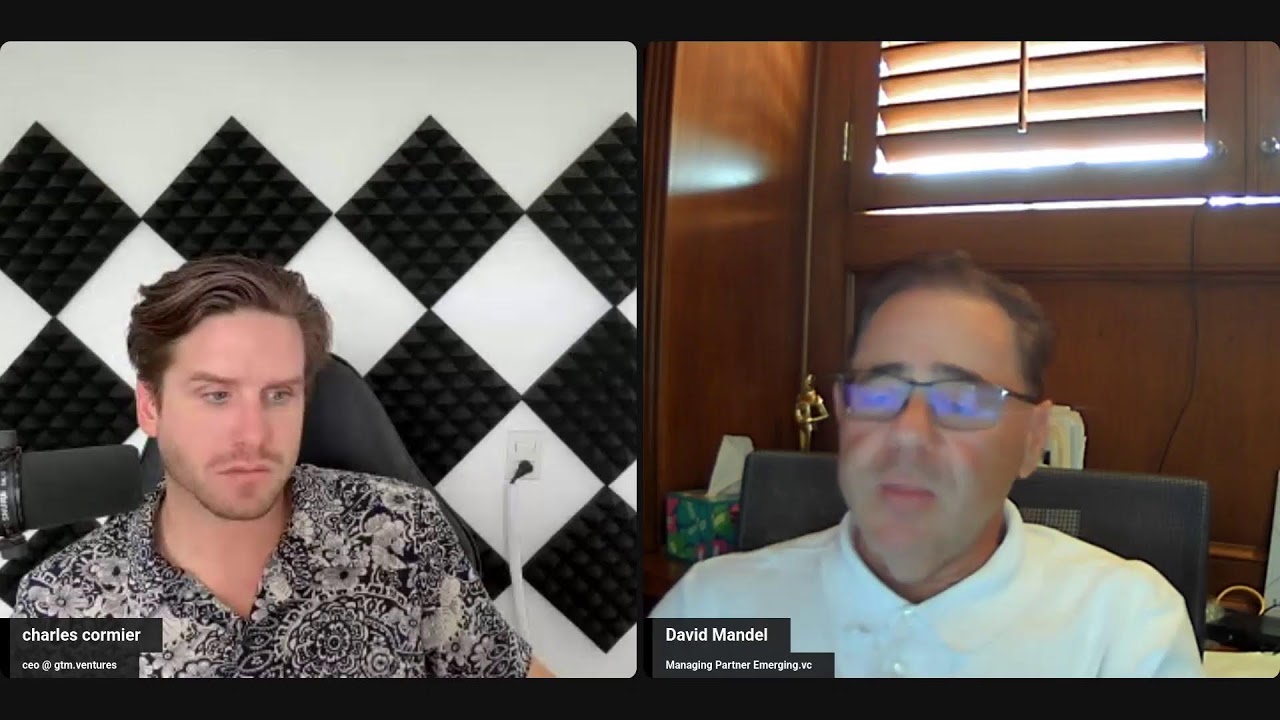
In this VC Wisdom podcast episode, host Charles Cormier interviews David Menzel, Managing Partner of Emerging Ventures Capital. Menzel recounts his 30‑year career building and exiting underwriting businesses before pivoting to tech investing around 2014. He explains how exposure to early InsurTech and machine‑learning tools sparked his shift from insurance to full‑time angel investing, eventually leading to the launch of Emerging Ventures Capital’s three funds. The conversation covers his capital‑raising experiences for insurance firms, his investment thesis—favoring B2B tech that leverages AI but only when backed by durable moats such as deep industry relationships (people moat) or proprietary data. Menzel warns against “AI‑for‑every‑vertical” startups lacking defensibility, emphasizing execution, speed, and grit as the founder traits he values. He describes his day‑to‑day workflow: reviewing ~30 pitches daily, filtering through a steep funnel to a few quarterly checks. He shares examples of high‑return angel exits (46‑50x) and reflects on the randomness of success, attributing outcomes mainly to execution and adaptability. Menzel also discusses his continued angel activities alongside the fund, the rationale for creating a fund to aggregate capital, and his limited current use of AI tools for internal analysis. The episode concludes with pointers to his LinkedIn and emerging.vc for further information.
Chapters
Welcome to another VC Wisdom podcast. We have David Mendel with us today. He's a managing partner at Emerging Ventures Capital. He's investing in seed-stage US and Canada-based B2B tech startups. He's an emerging tech super angel. He invested in over 500 startups in the LA area where he is. So David, welcome to the podcast. Tell us a bit more about yourself and what you've been up to.
Yeah, Charles, thanks for having me. As you mentioned, I'm the managing partner at Emerging Ventures Capital. We're on our 3rd fund. We invest in B2B tech startups with a particular narrow mandate. In a prior life, I built and exited 4 businesses over almost 30 years that were all underwriting businesses in finance and insurance. I'm a lifelong underwriter. And to me, you know, startups is just another asset class to underwrite. So, and I mean, short version of how I got to where I am is, you know, go back to around 2011, 2012. And in my day jobs at that time, running both a regional auto lender and an auto insurance underwriter with pretty high volume of transactions and so forth, I started to see some really great vendors come to us with unique products that opened my eyes to where tech and particularly machine learning AI was at that time and got me super excited about tech because what they did seemed like magic and kind of went all in, started attending tech conferences, flying up to Silicon Valley from LA and so forth and went down that rabbit hole and Fast forward to 2014 and I decided I want to be a full-time tech investor. I really like where tech was, didn't want to miss out on the tech wave, like starting businesses, didn't like running them when they got bigger. So got investment bankers involved, exited the 2 businesses I had at the time over the next couple of years and evolved into a full-time angel investor, which eventually by 2019 Evolved into a partner and I starting a fund so others from my network can co-invest with me. And that's where we are today.
Yeah. What a background. Well, let's start with the first insurance firm that I see here. Low Cost Insurance Services. What did you learn from that one? You lasted in that one for like 18 years. That's great.
Yeah. So that was the only one that wasn't an underwriter. That was an actual just retail agency. And from there I learned the basics of the business and eventually went to the wholesale side and never looked back. So the interesting one is Alliance United Insurance Company, which I got involved with, took control of, and then grew it from a tiny little company to something that was insuring over 1 million cars on the road at any time. So we took huge market share in California. In a really fast time. And it was all through technology and providing, you know, the independent insurance agents and brokers in California just a better product as far as user interface and way of doing business with us that really resonated. And that's where, you know, so technology really made it. We were really kind of a B2B technology platform that happened to sell insurance or provide agents tools to sell insurance. And then obviously we were the underwriter, we owned the risk, we handled the claims. So it was quite an interesting experience growing a business, you know, from a handful of people all the way through to like 600 employees and 2,500 independent agents and eventually exiting. Sold that to Kemper, which is public information, and in 2014. Which didn't actually close until early '15 and stayed on there for 2 years as an EVP, which was another interesting experience of being an executive in a public company. We're subject to all of those rules of a public company. And but during that time, I was already becoming an active angel investor and had my exits. I had my nest egg and Wasn't sure what was next, but really started investing in tech and kind of never looked back. It kind of took off and that became my thing kind of accidentally. Never planned to be an active angel investor. Definitely never planned to be a VC or be a fiduciary for other people's money. It's like the furthest from my mind to ever be. And somehow that's where we wind up.
Interesting. Did you have to raise capital for these underwriting businesses? What was your first experience raising capital yourself?
Yeah, that's a good question. And for the insurance company, yes, we had— it needed capital. So we had about 30% of our cap table was other investors, mostly our producers, our independent agents that invested back in the platform, which was kind of interesting. And we almost made a deal twice with different private equity firms at different times to infuse capital. At the end, we chose debt instead and took several large senior bank lines combined with reinsurance treaties. So another way for an insurance company to get capital is in a sense to share risk with other larger insurance companies. So we won't wind up going that route without getting into the weeds. We wind up, instead of giving up control and bringing in private equity, we wind up partnering with other larger insurance companies that are in the business of providing reinsurance and sharing risk. And we are the operator and they're providing capital by us offloading some of the risk to them and being able to write a lot more against our limited surplus. And at some point it got too big for us, and that's where we had to have an exit. And we did a process and eventually, uh, wind up exiting to Kemper as opposed to bringing in private equity, which would have been an option. Uh, but I wanted to move on and focus on other things and, um, chose to have the exit to Kemper instead of bringing in private equity.
And why pivot to, uh, VC and the VC world investing in startup? Like, isn't the insurance big enough and satisfying enough for someone to stay like their full career in there? Why did you pivot to this?
Well, for sure. And as I said, really around 2011, started to really get excited about where technology was and initially kind of by accident because I was in my own space. But we had these providers come to us, which are basically InsurTech startups providing interesting data services, various tools to help us underwrite better and manage claims better and get insights on our data. And what they were doing at the time really seemed like magic. It's like, wow, I didn't realize AI has come that far because back when I was in college in the late '80s, early '90s, I wanted to focus on AI and it really wasn't there. And what these guys were bringing to me was amazing. I was like, I have to learn more. I have to go all in on that. So that's where I got involved and started going to tech conferences and started angel investing and eventually joined angel groups and kind of went all in on that rabbit hole, got really in. And that's why I exited the insurance industry, because by 2014, I was spending probably a third of my time, if not more, on technology and going out to tech conferences and starting to do angel investing. And it's like, I like that a lot better than going back to the office and doing my day job. So at some point it's like, I want out. Technology is amazing where it is now. I want all in on that. I want out of insurance and eventually out of finance and focus full time on technology.
And why is that? Is it because the world— this world is much more exciting? much more risks, much more aliveness, and I don't know, brain cells generated in that space versus the classic insurance space?
Yeah, well, I just— technology was at a very interesting pivotal point, which appeared to me, which turned out to be true. I was a little early, but it turned out to be the beginning of what's now absolutely amazing. But it seemed like we're at an inflection point where the new technologies were absolutely amazing and gonna change the world. And I wanted to be part of that as opposed to part of the old world. And I didn't want to stay in one industry. I want to be exposed to all the technologies and see where they go globally and just focus on that. And that's what I did.
Yeah, because if I check your profile when you got into angel investing around 2018, yeah, it was the SaaS revolution going on, the internet revolution. Was right on the way. There was some hints about AI, right? Like there was Geoff Hinton working on the first model, Yoshua Bengio in Montreal, right? And there was DeepMind as well during these days, but nowadays it's pretty much exploding, right? It's pretty crazy. How are you investing your money nowadays? Like what companies are you betting on? Because it's pretty confusing as a founder. Uh, the big bad Claude is always lurking, right? Like always ready to crush your business. Claude Code can pretty much do anything that a SaaS would. It can build any SaaS in seconds nowadays. Uh, what do you invest in? How do you find moats nowadays?
Right. And those are all good questions. So it has evolved a lot. And yeah, going all the way back to 2011, machine learning was live. They didn't call it AI per se, but the idea of machine learning was really there and they were using that to take unstructured data and give you insights and connect the dots, which got me excited in the first place. So that's going back 15 years. And where we are today with the LLMs, no one really envisioned that back then. It's come a really long way and it's really amazing and it is confusing and it is moving so fast. So honestly, I'm staying on the sidelines and I've written about that. I've given a lot of thought to it. I've written multiple blog posts over the last 2 years, kind of updating my thoughts about that space as it's gone from LLM wrappers for specific verticals to then agentic AI. And it's kind of still where we are now with workflow and agentic AI for each industry and so forth. I'm generally avoiding that whole genre. Because there is, for the most time, no moats. And it feels like most of whatever someone's doing would be obsolete in like 6 to 12 months. So I'm not that excited about the gazillion startups that are out there that are just, you know, AI for each vertical, AI for dentists, AI for doctors, AI for plumbers, AI for HVAC contractors. I mean, at the end of the day, yes, everyone's gonna use AI. And AI is gonna be embedded in every tool we have, in every business, in every aspect of our lives, in every way. Everything we do is gonna be AI-enabled and it's just gonna be there. It's just gonna be part of the fabric of society, you know, and, but investing in startups that are creating AI for a particular vertical without starting with a moat. won't give them a moat, at least in my opinion. So I don't invest in any of those. If I do invest in AI startups, it's when they have either a people moat or a data moat. And a people moat could be someone who is working really closely in a certain industry for like their whole career. And like say they are consultants, you know, for agricultural credit unions in the Midwest. That help small Midwest community lenders lend to farmers. That's a pretty niche item. If they were working with these credit unions for 30 years and consulting for them and helping them with their IT systems, and now they come up with AI to help these banks do better, I will invest in those guys because They know their customer. Their moat is their Rolodex and the trust they built over 30 years of the credit unions. You can take the 2 brightest computer science data scientists out of Stanford or MIT or anywhere else. They can build maybe a better product, but those credit unions won't trust them. They won't even get to talk to them. So the moat is the people in that case, and I'll invest in the people as a moat. On the other hand, if someone does have proprietary proprietary data. And so an exclusive to— and that's very hard to get. I don't see too many of those. But if someone has an exclusive to some industry's deep data and they're going to work with that source to build AI for them that is based on that proprietary data, that can also be interesting. For the most part, I'm investing in things that are around AI. Every startup now is an AI startup. They're all using AI and they're all implementing AI tools in their user interface, but they don't have to be exclusively an AI startup. They just have to be solving a problem for some industry and they happen to use AI as one of the tools to provide their services. So if they can provide a better tool for a business that solves the business's problems and they know how to build it, And their customers are willing to pay for it, then I get interested.
Got it. And if founders are the moats nowadays, like what traits do you look into these founders?
Well, in the case I was talking about, their network. It was all about because that's the part that you can't replace easily. If someone has 30 years of selling to a certain industry and the trust of the key people in that industry. Then that's a moat by itself. Their network is a moat. They're a moat. Otherwise, there's very little moat. The exceptions could be someone who's done deep in the deep tech field and they've done— they have the IP and the IP can be a moat if they've done some work and, you know, they've done their PhD thesis on something and they've stayed on as a postdoc and developed some technology in the lab that is unique. And now they're going to commercialize that. And that's then that's the most— and that's usually more in deep tech, hard tech kind of situations, whether it's material science or, you know, something applicable to communications or chip technology, wireless energy transfer, whatever it might be. All those kind of deep tech kind of areas, which are also very exciting right now. Space tech is very exciting. This morning I was making a commitment to another space tech startup, which I can't name yet. The deal's not finalized, but super exciting space tech, not necessarily AI.
Yeah, I was referring to founder traits, right? Like in their characters, what they value, what they're good at. There must be something other than their network which Execution.
My whole underwriting philosophy is execution.
Speed.
Yeah, it's all about execution. Nothing but execution. It's the guys, the guys that get shit done. You know, you can call it grit, but grit is kind of generic when it comes to business. That grit translates as execution. You do a lot with a little. You move fast. You get it done. And you get it done in an economical way with limited resources, capital, and other resources. You know, you don't spend 5 years planning something. You actually just go out there and build it and get it done and do it amazingly. And that gets me excited when I see how much someone's— a small team has accomplished with limited resources, and how far they've gone on a shoestring budget. That's like, wow, that's impressive. And they're the guys who will figure it out. Everyone's gonna have to pivot. So the guys who know how to execute will figure out their pivots and continue to execute and not collapse.
Yeah, because even agents, right, they need to be orchestrated by humans and it's still gonna be a while still since the time that agents are gonna be like truly independent. Independent and gonna run stuff by their own, and they still need to have like an epicenter, right? Like a core and someone to propel them, right? So what we're seeing right now is even more winner takes all. So founder that has very high energy and was still dominating before is even dominating even more because he's replicating himself through agents. Have you used some of these agents yourself to pull out investment decisions?
I'm not using it for investment decisions. I have looked at some tools. I don't think they're quite prime time yet, but they're getting there. We do use AI in every aspect of our lives and business nowadays, though everyone does, because every tool has AI embedded in it, whether it's summarizing your emails, reminding you of appointments, summarizing a PDF when you open it. and giving you, you know, highlights, you know, reminding me of this meeting, whatever it might be. AI is in every part of our life, but I'm not using it yet. And I am using it to create, say, projections that go through a deck, compare a deck to a data room, take all the financials out of a data room, then take the forecast out of the data room, Feed it those files, feed it the deck and say, okay, analyze all of that, compare and contrast, create me a summary. The same thing I would give an analyst instead of giving it to a human, and a human might take 2 days to go through it. I give it to AI and it takes, you know, maybe 3 minutes.
Got it. What have been your best investments so far? And looking with foresight, like, why was that the case?
Yeah, the ironic part always is the best ones wind up being the ones that were almost least likely to succeed, which is why we all need diversity in our angel investments. And, you know, I have some exits from my earlier angel investments that have been, you know, say 46x. I've had another, several in the 50s. They were relatively small investments, you know, early on, you know, if I write a $10,000 angel check and 6 years later get back $460,000, that's pretty nice. Although you wish that that was the $100,000 check and not the $10,000 check. And, you know, because a lot of times we write smaller checks to a lot of small angel deals individually that we're like, okay, whatever, this is interesting, let me write you a small check and you collect a bunch of those. And then there's some that you really like and you write them a bigger check and it turns out the ones that were giving you the big return always wind up to be the small checks. So it's kind of ironic and that's life and there's a lot of philosophy out there about keeping level bets, and that's another whole topic. As far as what makes a good investment or a bad investment, they're really— if we knew that, then we wouldn't make the bad ones. So we really don't have any way to tell. It's really so random as far as what succeeds because so much changes over time. Like you started in the beginning, we had some SaaS companies that were doing amazing enterprise SaaS, and they raised a Series B, a Series C. They're almost unicorns. They went from, you know, we might have invested at a $10 million valuation 8 years ago, and now they're up at a $700 million valuation. That's awesome on paper, but now they're struggling because they can get all these AI competitors coming out and building the same product in months instead of years and taking their customers away. So things change and they're completely unpredictable. And I don't have an answer for you on that. There's no way to put a finger on What succeeded versus not, other than the ones that succeeded, all executed well. Back to that, it's all about execution. If they can execute well, then they grow and they get momentum and they pivot correctly and they raise more capital, and it's just a great cycle. And those who are a little more sluggish on the execution often fail. But there's a lot of other things that can make a startup fail, from unexpected changes in the economy such as COVID or now AI. to co-founders splitting up to personal emergencies such as illnesses or anything else that can happen.
Right. And you said you were sort of sitting on the sideline, right? But I don't think that's true. You're still pulling moves, right? Like you're still deploying checks and checking out the outcome of these, talking to founders, right? Tell us a bit more about your day-to-day.
So I do see on average about 30 pitches a day. Like today, my calendar has 6 meetings on it and 4 of them are founders and one's you and one's a follow-up with a co-investor. And that's out of a bunch of pitches. So I see like, say, 25, 30 pitches or more that are direct inbound or through events or wherever else. Out of that, I maybe select you know, 3 or 4 that I might want to meet with. I schedule them meetings, then we have an intro meeting, and then, you know, I basically write a check once or twice per quarter. So it goes, it's a pretty steep funnel. It goes from hundreds and hundreds to a few meetings to 1 or 2 checks eventually at the end. It's a very, very steep funnel for that. And yes, what I am investing in is not necessarily the LLM wrappers or the current agentic AI for different industries because they're a dime a dozen. There's so many of them, I can't tell them apart. So I'm just not investing in any of them right now. I need something to get me excited that's different. And most of what I'm investing in today is in some way using AI, but it's not a straight AI startup.
Last question for you. Why keep on being an angel? I mean, you have your fund as well, right? Like, Why did you make the switch from angel to VC?
Yeah, so, you know, I was a very active angel investor and I started catching up with people from my prior life, former coworkers, vendors, associates, so forth. And they're all curious. They haven't seen me around the insurance industry or the auto finance industry. It's like, what are you doing? I would be super excited about Being an angel investor about technology, about where technology was, and they all always say that's really cool. Let me know next time you're doing a deal. I want to write a check too. And I thought about initially just syndicating some deals or just referring people into some deals. And at some point, it's like it would be a lot easier if we made a fund and collected money. So many people said, you know, how can I invest with you? So at some point. I felt I had enough support to launch a fund. And so I did. And that's where Emerging Ventures Capital Fund 1 came about in 2019, launched Fund 1. Of course, then COVID hit right afterwards and we kind of pivoted, went virtual and eventually 2021 launched Fund 2. Now we're on Fund 3 and it still makes sense to have the structure. of a fund and be able to write larger checks and be able to have the brand and so forth. And I'm still a very active angel investor. Anything that's maybe not a fit for the fund, the fund has a pretty narrow mandate. So, and there's, I'm still a very active angel investor, still a member of various angel groups, still do a lot of work with university programs and so forth. And I'm always wearing multiple hats where appropriate. I'll send people into angel groups. I'll deal with them personally as an angel. I also have my nonprofit, which is the Menzel Institute. So I wear these 4 hats whenever I'm talking to a founder.
David, thanks for being on the pod today. Where can people find out more about you?
Best place, I mean, either find me on LinkedIn or just go to emerging.vc and there's links there to everything.
That was David and Charles.
More from Charles





Elizabeth Holmes and You Can See Everything: The Real Theranos Story Behind the A24 Documentary