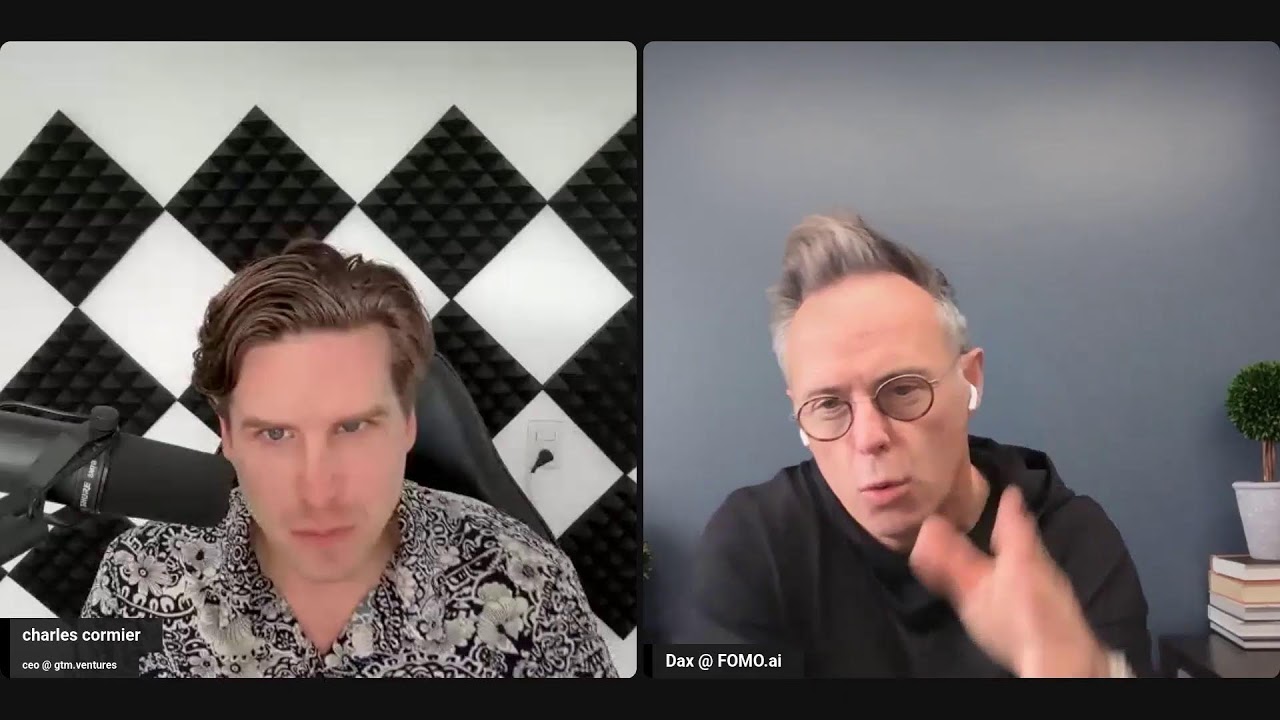
In this Founder Wisdom episode, host Charles Cormier interviews Dax Hamman, a five‑time founder and CEO of FOMO.ai. Hamman walks through his entrepreneurial origins—from a teenage VHS‑selling venture and a brief stint as a pub landlord to agency work in London and New York, the Chango DSP exit, and later agency exits like Fireside. He explains why he and co‑founder Josh built FOMO.ai as a technology‑first, productized‑service platform for local service businesses (med spas, attorneys, dentists, etc.), blending AI‑generated content with human oversight. Hamman details the company’s go‑to‑market (fixed‑price, single‑service offering, education‑first funnel, cold‑email/LinkedIn outreach, no paid ads for clients), fundraising approach (SAFE notes only, no priced round, $14 M raised for earlier venture, now bootstrapped), and scaling strategy (tiny core team, 21 global contractors, rapid hire‑fire, remote‑first hiring). He shares his stance on AI’s impact on jobs—80 % of each role can be automated, not 80 % of all jobs— and discusses broader implications such as universal basic income, cultural erosion from dominant LLMs, and the future of AI companies. The conversation also touches on the merits of starting as an agency, the importance of human capital as a moat, hiring philosophy across geographies, and Hamman’s side projects (Hard Part First newsletter, 84Futures, AI school ideas). The episode ends with resources for listeners to learn more about Hamman and FOMO.ai.
Chapters
Welcome to another Founder Wisdom pod. We have Dax Haman with us today. He's the CEO and co-founder at FOMO.ai. He's a 5x founder with 2 exits. Django was one of them, $122 million. He writes cool newsletters like Hard Part First. And yeah, just very accomplished guy in Denver, Colorado. So Dax, welcome to the pod. Tell us a bit more about yourself.
Thank you very much. I feel like that was a pretty good summary. British originally, but now, yes, over here in Denver, Colorado, getting terrified by how warm this winter is. This is not right. FOMO.ai, we've been building for about the last 2, 2 and a half years. Pretty interesting company, actually. We focus on local service businesses and solve a lot of their core marketing issues. There's a lot we can sort of dive into there about building businesses like that in today's world.
Let's start with your beginnings first, right? So London, I see your first business was what, Cape Media Limited? Was that your first one?
First one, probably when I was 12 or 13 years old. And I was— my parents were one of the first people to sort of have satellite TV in our neighborhood. And so I was recording stuff on VHS and selling them out of my school locker at like 12, 13 years old. So that was probably the first one, right? Right or wrong. My parents had small businesses, and so it was always sort of in my blood, I think. And whilst I was meant to be getting a degree in biology and evolutionary genetics in London, I happened to become the youngest pub landlord in England for a brief moment, which was sort of fun, but not the best thing to do when you're trying to do a degree, but somehow scraped both. Most of my career, I then went up through marketing and ad agencies, first in London and then over in the US. And I loved that world. You know, the whole Mad Men thing, if you've watched that show, it's particularly in your 20s and early 30s, and it's an incredible place to be. And we had an agency we sold to Hearst Publishing. And so you end up in this giant skyscraper in Manhattan overlooking Central Park, and you think, how the hell did I end up from small town in north of England sitting in this tower block in Hearst Publishing in Manhattan? In New York, and then was very fortunate to be part of a team that built Chango, which was one of the first DSPs for any listeners who understand sort of the marketing programmatic ecosystem. Lots of kids, all adults now, so we're empty nesters and loving that, which maybe unhealthily means I just throw my time more into the business 7 days a week.
So deep in your essence, you're a founder, but you're a marketing guy. You're like a madman. Is that the essence?
I think so. I think that's a fair description. I think the piece, though, that whether it was marketing or not, that defines my career is I'm obsessed with the bright, shiny object, the new thing that's cool and interesting and sexy and fun, and people haven't yet figured out how to do stuff with it, but they know they're excited by it. My entire career has been find the bright, shiny object, and then turn it into something that people want to buy and is repeatable. And of course, my co-founder and I jumped into AI because there's been no brighter shiny object than the arrival of AI.
And post-Chango exit, did investor came as your essence and your, like, what you're about? I think you pulled a couple of investments after that, right?
I did. Some good, some not. I did that sort of briefly. It's not a big part of of what I did. I do not really do that today. I put everything into the current business, but I enjoy both sides of that game. It certainly helped me learn in today's world, a very different way of taking in funding. With Chengdu, we had to take in $14 million to be able to build the technology to be in the game. Josh, my co-founder, and I in FOMO realized we just would not have to do that now because the cost of technology was going to get cheaper. Of course, it has. My newsletter is called Hard Part First, because the hard part of a technology company used to be the technology, and now it's distribution. We actually only raised on SAFE notes, and we'll probably never do a priced round. It was certainly helpful for me to have been on both sides of that to get to this point where we are today.
Your latest exit that I see here, which one was that?
It will have been Fireside. Fireside was an interesting play, not dissimilar to what FOMO became, but it was more of an agency rather than a technology company. FOMO is coming at this from a tech point of view, Fireside came at it from a services point of view. It was one of those businesses that there was a hell of a lot to learn from it. Sure, we sold it. It wasn't a particularly big or sexy type of exit. It's not something you go write a press release about. But it laid the foundations, I would say, for them, what we decided to do with FOMO.
And all the new businesses you start, they start as an agency and then they merge into products, and you believe in productized services. That's still your thesis up to this day?
Hmm, that's an interesting way to put it. Not all of them started as agencies. I would say FOMO FOMO has always been a technology company. However, what FOMO is, is ultimately for our customers, we look and feel like a faster, cheaper, better agency, right? They have a human being to talk to. They get great results with that partnership, et cetera. But behind the scenes, of course, we're doing as much of it as we can with ever-increasing intelligent technology. So probably it wouldn't be wrong to say that FOMO started at least with the thesis of, To begin, we would have to throw some humans at it. But of course, whilst we're not trying to be an AI company that optimizes humans out completely, we certainly have leveraged humans as part of this, and we'll probably always do so. It's just the humans now. People talk about 80% of jobs going away. I don't believe that. I think it's 80% of each job, not 80% of all jobs. And so, all we're doing with the technology is meaning that our humans can spend their time on the last 20% that is them being human, and the technology will do the rest. And that's what we've been slowly creeping towards over the last 2 years.
But isn't that how even YC companies start as services first? They brand themselves as a SaaS and everything. Oh, it's productized and beautiful. But when you look like on the ground, they're still selling stuff. And isn't that how it should be? Like nothing starts perfect, fully automated. And also, especially with the future that's happening right now, we still need a front-end human. To talk to their clients and serve them before you can find out what the true product is, right?
I think that's true. I think that's true. I do think a lot of YC companies do start that way. I think a difference is, and it's one of the reasons we didn't take institutional money, is we didn't set out to build a company that ultimately was wanting to optimize all humans out of the picture. And I feel like, I don't know, but I feel like from what I see coming out of YC over the last couple of years, that's what they're trying to do, right? The infinite scalable unicorn-sized technology company. And we're just not trying to do that. We purposefully over-index for client types where they're perhaps a little less sophisticated in day-to-day AI usage. They're perhaps a little less sophisticated in hands-on marketing. And they want to know they're getting a great deal and they're getting great results. But there is a human being that they can have a face-to-face relationship with. And that's important to them. And so that's important to us.
And that model can scale, no? Like, I mean, you can't talk to infinite clients, like face-to-face on a day-to-day basis, but that model can still scale and lead to, I don't know, $100 million plus exit.
Oh, yeah. Yeah. Hundreds of millions of dollars are very, very, very feasible with that. And as the technology continues to improve, it becomes sort of more and more feasible. But we should be able to get this, this business to, you know, the end of 2027, where we're talking about a $75+ million valuation by that point. Based off very standard metrics without even any absurd sort of multiplier because we happen to be AI.
And you're raising for that one? Most people that would start in service and start type of agencies, type of business, productized services, they wouldn't necessarily raise, or am I wrong? Should everyone start as an agency, raise capital for that, prove the scalability? What do you have to say about that? What do you have to say about that?
I'll pick up on the nuance of that a little bit. I don't necessarily think everyone should start as an agency, but I do think everybody— you know, the bar's got so much higher now, right? Seed or pre-seed stage used to be you've got an idea, you've maybe got a couple of proof points, you haven't really built anything, right? That's not where the world is now. I'm not an expert investor by any means, but I certainly see the funds and the individuals who are investing, they naturally want to see a hell of a lot more now. Because you have no excuse not to show up to a pre-seed pitch without a product being built. So it's not necessarily that they should start as an agency, but they certainly should start with the hard part first, which is finding a customer who wants to pay you money to solve a real problem, and then making sure the way you're solving it is the way that they, and then the next 10, then the next 100, then the next 1,000 want that problem solving at the right price point. And most importantly, the thing that people keep forgetting is, and you've got to make sure you can make some profit. whilst actually delivering that. So I think that's important. I think who raises today and from where, it's all very different now. The institutionals, I think, largely still have a lot of the same thesis, although many of them are opening up more to technology and humans as a combination, as opposed to pure unicorn SaaS. But I see no reason why people couldn't raise that way. Raising is an art form in itself. And I think if you can do it and go fuel a business that way, then there's no reason not to. As long as you're already on the road to a lot of those proof points.
And what's FOMO's beachhead like? What's your main offer to attract them to your funnel?
So for our customers, they're local service businesses. So that's the med spas, the attorneys, the dental offices, hair restoration, etc. There's millions of these businesses around the world. And over the last 2 years, they got screwed by AI, right? It came in and it broke all of their marketing. That was, um, that was working, right? They had— if they wanted to optimize for organic, they optimized for Google. If they wanted to do ads, they started with Google Ads. If they wanted to do more ads, they added in Meta, right? TikTok never sort of played out for them. Um, all of that got broken by AI, right? Google AI Overviews, Google AI mode, ChatGPT, Gemini, etc., etc. And the snake oil salesmen are out in force, you know, trying to sell SEO as GEO, AEO, etc., etc. So they're confused. Their businesses are underperforming now. They just want to do what they trained to do and not have to worry about the marketing and not keep getting ripped off and scammed by agencies charging them far too much money for what really shouldn't be charged that much. So what brings people to us is we have a story that is very simple for them to understand. It is one fixed price. It is one clear, defined service. They get a human being to speak to that they sort of like and can engage with. And we are shockingly better than the alternatives of what they've been working with so far. Behind the scenes, what they like but don't necessarily understand this is what's driving it is they like the output. We were the first to crack human-quality content with AI, and now we were one of the first to crack better than human-quality content with AI. They like the output that comes with the technology at the price that technology can deliver and humans couldn't.
Are these folks hard to get ahold of? I mean, I do cold outreach, right? And I mean, you can get these guys on Google Maps and so forth. How do you get them through your funnels? Is it the same methods that you actually do for them? AEO, paid ads, content? How do you get to them?
Yeah, so for our clients, we don't do paid ads at all. And ironically, we do use some paid ads for our own funnels. I like an education-first approach. I would much rather put time into you know, putting together a webinar or a short video or something than just keep throwing money at Meta. But we do have some always-on Meta stuff running. LinkedIn outreach surprisingly still works, right? But you have to think industry by industry because, you know, the med spa owner who is also still hands-on in their med spa, they're busy, right? Injecting and giving treatments. They're not on LinkedIn all the time. They're a hard group to reach through LinkedIn. Business attorneys, very different, right? They're often on LinkedIn. They're often online at least, right? So we have to use a variety of tactics to bring them into our ecosystem. Cold email, actually, surprisingly working again.
Not surprised as a cold email guy.
Right.
But I had a bunch of them on my podcast as of late. I got a bunch of referrals for you. Med spas, is that like your more, most interesting segment right now out of all the trades you do?
Good question. I think it's one of the most interesting because that world's changing so much, right? It's gone from— yeah, peptides are here, GLP-1s are here, GLP-2s are coming, um, uh, all sorts of new types of injectables and treatments. That's pretty fascinating for me with my educational background. Um, also though, they're high ticket, and so we only need to give them, you know, one new client a month and, and they're profitable off our service. So that's Nice. So we certainly have more case studies, public webinars, etc., everything to do with sort of medical and aesthetics. But, you know, I'd say attorneys of different types are right up there, as are many other sort of local service type businesses.
Interesting. This agency had a couple of exits before. Why is it more fun than the others? Why does it have the higher exit capability? these than your last ones that you cracked?
Well, I think some of the others in the past, apart from Django, some of the others were agencies, and this is very much a technology company. And so to me, that is just sort of more fun and stimulating anyway. I don't really want to be out there building, you know, what looks like a typical agency anymore. I also think a lot of it comes down to who you're building it with, right? Anyone who's been a founder knows that you spend so much time with your team and your co-founders, probably more so than your own family a lot lot of the time. And I got very, very, very, very lucky to walk into a situation like that with 2 co-founders at Django. And with FOMO, I feel I got very, very lucky by choosing a really great co-founder here. And so I think what makes it more fun, to your specific question, people are a big part of it, right? Because it's stressful as hell. Something's on fire every day that you're having to deal with. And it's like picking a spouse, right? You either pick somebody who, when shit gets real, who will be the person you want to have with you to help you dig out of it, whether that's actual hands-on help or just a conversation. It's the same with choosing co-founders. FOMO is fun because it's a tech company. It's a bright, shiny object that we're doing really cool things with. I really like my co-founder and my team. That's what makes it fun.
What's proprietary about FOMO? Do you build the proprietary stuff with Claude Code and what is stopping me from deploying something very similar with Claude Code?
Yeah, I think the answer to that question for every company in the world now is very different to what it was 5 years ago. Because again, the technology is not necessarily the hard part. I would say my answer will probably be similar for most companies today, which is our moats are several things. Our moat is reliable, repeatable distribution. Our moat is taking decades decades and decades and decades and decades of expert people's opinion and training these systems and building these systems and processes based on that. I would also say though, there is not a single like SEO, GEO tool out there that gives me any concern whatsoever because there will always be the customer type that wants to go pay $20, $50, $100 to go do some stuff themselves. Great, they should go do that and there's some pretty decent tools out there now for doing it. Although they are the most common source of our leads, people who've tried those and Then come to us. And so a big thing that a lot of people can't do because they don't have the experience is Josh and I have decades and decades of experience of working with— I hate to use the phrase human capital because it almost seems to depreciate my opinion of them. That's not what I mean. But purely from a business building point of view, it is how do you scale human capital in a way that delivers this type of service that customers want? And there's nothing about building something in Claude Code that is going to give you that sort of full comprehensive service. And so ironically, for what is now arguably the world's most capable technology we've ever seen, it is the human side on our side that makes a real difference.
Right. Can you scale DAX? I mean, I know you have employees, right? Maybe I should start asking you how you How you hire these employees and can you ever scale DAX, right? Like my brain goes like an AI version of it, but if you and I were the face of our company and we're trying to scale relationship, there is a limit, right? So at what point can we automate yourself? Start with the employee answer first. Like how do you recruit?
So we actually are a very light company. There's Josh and I and then 2 other FTEs. and then 21 contractors mostly who are full-time, a couple of them who are part-time. And from day one, we've been a truly remote, fully global company. And that has been a real asset for us, right? Something that Josh and I both notice a lot and we both hate significantly is a lot of people go recruit overseas and have an opinion that those team members are somehow less than. And it could not be further from the truth, right? They think because they can pay them less than they are less. And that's just such nonsense. We have an elite team of amazing people and they just happen to be globally situated. India, Philippines, Costa Rica, Brazil as of 2 weeks ago, Paris, London, North Macedonia. So these are all places where we get people. How do we recruit? We started off first of all with the Philippines team having a company do it for us that are specialists in finding the best of the best of the best. And so that came in. We recruit quickly. We hire— we fire quickly. Right? And I think that's a golden rule. Right? No founder should believe they're going to get the hiring decision right every time. It's just— it's impossible. And so making sure, though, you quickly see that somebody's not going to be a fit or doesn't quite fit the role you wanted them to do, they've got to go quickly. Right? In the same way. So that's kind of fundamental to us. And I would say in today's world, we need people who thrive in a world that is changing on an almost daily basis. Because back to the point of AI is taking 80% of every job, right? If somebody comes in as like an SEO expert, and they've had 23 years experience, right, almost as long as that industry has been running, And now you're saying to them, I want you to stop doing 80% of the things you used to do, and now I just want you to focus on the last 20% that makes the difference between what Claude's going to tell you versus a seasoned veteran doing it. That's a big shift for some people. And if they don't thrive at that, then they don't really have a place in a company like this today. To your point about, can you scale DAX, can you scale a founder? We've passed a lot of those risk points in FOMO where it's no longer founder-led sales, and it's no longer founder-led client management, with, of course, some exceptions in both cases. And so if you can get past that point, of course, then the answer is yes, you can scale that. What I keep meaning to do, and I keep failing at doing because there's so much else going on, as always, and it's just bad prioritization retrospectively, Is I could scale myself by putting myself on camera more, by writing more, by getting more content out there, etc. That's just the way it's done now. And quite honestly, I just haven't given that enough time and attention to do it. But that is how you scale me being out in the market to the right people.
Yeah, I've managed over 1,000 salespeople throughout the globe, right? And I mean, I'm not sure if I agree on the, on the I'm not saying you should mistreat a human based on what they charge. Like, that doesn't make sense, right? But isn't it— wouldn't they get or be more valuable if they would, I don't know, step in other places in the world? If they would move from India to, I don't know, San Francisco, generally from being part of that ecosystem, they would grow faster, they could charge more. Like, isn't their output— Equal to their value. I mean, you and I were very high paid, right? And that's because we designed it that way. That's because, I mean, I'm a guy from Quebec, Canada, right? Like nothing happens there. You're you're from the UK. You stepped in the U.S. for a reason. You upvalued yourself. So I don't see great things for for most people working at the other side of the globe, especially Philippines, right? Like and Philippines has a yes man. culture, it's always yes, yes, yes, sir. They cannot stop calling you sir. It's like, you know, like get out of there, start a business or something and adapt to the trends. What do you think about that?
I love the fact that we disagree on this because this is a good discussion. I definitely disagree. I think there is a lot of value in founders being in a place where a lot is happening, and I need to get sort of back into New York and San Francisco more on a more regular basis. Um, I, I agree with that part of it mostly. Um, I disagree though on, I think, the assessment and opinion of, of, of the talent. You know, we, we don't hire yes-men, right? We don't hire the— and I'm gonna arbitrarily pick a number here, right— of we don't hire the sort of 80% of people who might be what you're describing, although that's not been my impression of the Philippines or India for some years now. I think it's— to me, it feels like an older stereotype. We hire people who can do the job at the level or better than the level we need them to be doing to help drive us forward. And the vast majority of people on our team drive Josh and I forward no matter where they are in the world. And that's what we recruit for. And we overpay a little bit for that. And that is perfectly OK with me. It gives us access to the global talent pool. And for the majority of our people who are in those countries, they're going to have no further value for me than if somehow they were able to go relocate somewhere like San Francisco. The whole San Francisco, New York thing, it's interesting, right? I try and substitute for— yeah, it's—
I don't know, 100x speed. You know, New York was something, and finance still is Wall Street, but SF is the center of the world now with AI and AGI.
Uh, yeah, but you don't have to be physically there to want to build a company like we're building.
Like, but I dropped there. I tried to drop there. a couple of times a year to shock the system and uphold the bar to higher standards. I also have partners in SF, right? In Austin. So that's a good hack, right?
But also, I mean, just like this conversation, right? You and I don't need to have both been in San Francisco to have this conversation. And I think as founders, one of the things we have to do is build gravity around ourselves and our businesses. And one of those pieces of gravity is making sure are, you feel like you are plugged into that community that allows you to build the business that you're going to be building in the best way and the fastest way. I do a lot of these types of conversations, obviously mostly not recorded as a podcast. And honestly, I would rather be doing this than going from meet to meet to meet in San Francisco.
Same, same, same, same. Okay. I want to pitch you a business model because I've done the hiring abroad thing. I'm not saying it's not good, but I think what I'm doing is what everyone's going to be doing in 10, 20 years in terms of high performance, which is go after people like you, like Dax Quality, right? Like you're Maverick. And I pitch you to get on my cap table and to give you a rev share of my company. That's how I recruit my people nowadays. I don't hire anyone. I don't do hourly salary, no 9 to 5. I outsource that work to agents. And the people I work with, which are my best buddies, are people of my level, right? Like very high performers. And I entice them to come in with equity and rev share. What do you think about that?
What are you expecting them to do for that?
Some work. So in my case, for example, GTM Ventures, well, to do the same podcast Funnel that we're doing right now to increase their Rolodex to sell and also to bring value to the backend product. In our case, it's GTM, right? To our clients. So to participate on the weekly calls, for example, up to some degree. And our clients are also people like you and I. So my partners are like me. My clients are like me. So it's like it's a lot of fun. It's a flywheel, right? So we all. speak the same slang. What do you think?
I think that's an interesting idea for your business specifically, right? Like, it wouldn't work for me, I don't believe, although I want to learn more about what you're doing. I don't think it would work for me because what I need is doers. And, you know, we have a couple of—
Can't agents do that?
Say again?
Can't agents do the work and you step on clients' call and you're like, in 3 minutes, you're like, hey, here's what happened, here's what the agent did, blah blah blah, and they're still speaking to a human? Can that be done? Or—
Yeah, that, that, that is a lot of what we do, although to get the work to the quality that our clients want, then we also still have humans working alongside the, the, the platform in order to do that. Um, but what I need, for instance, is the closest thing to what you're describing is I have a couple of equity advisors And those equity advisors, they act in the way I need them to do, which is a couple are experts at various things, and they become very valuable conversation people. The others are people who are deeply connected into our ICPs. The first one being local service businesses, the second being roll-ups of those local service businesses. They're plugged into that world and they give me benefit from that.
Got it. Last question, I'm not sure how much time you have, but
I'm good.
I do agree with the 80% of jobs being replaced. You don't like slash a job just like that because humans do so many things in companies. But isn't that the, the same equivalent? Because technically we would pay them them less if 80% of their jobs are slashed, like 80% less hours, for example? What kind of effect will that have on the economy? Are you worried?
Well, let me back up to the first part of that. I don't think it is a foregone conclusion that if people have to put in 80% less hours, they get compensated 80% less. The construct of a 9-to-5, 5 days a week was specifically invented in Victorian England and then backed up with the industrial machine in It's a bullshit concept that came out of nowhere. I understand why it had to exist, and I understand largely why it exists today, but it is about to come crumbling down because it's somewhat meaningless. Ironically, of course, people like you and I are doing far more than 9 to 5, 5 days a week, but in part, because that's what we love, what we do, and we're building something bigger. I disagree. that there will be an 80% reduction in compensation just because there's an 80% reduction in hours. From the economy side, I'm not an economist, I'm never going to claim I am. 84futures.com is the piece I— is the publication I write about this, about the future. I like to look at it from the point of view of there are some fun concepts to explore around that question. Right now, The AI models have— essentially, they're running out of human training data. It's not out of the realm of reality to say that they've read everything humanity's written or recorded by this point. The LLMs, they want more human-type data. You could imagine a world— I know particularly in the US where I'm sitting right now, the idea of universal basic income is a dirty word because people fundamentally love to say they hate socialism without really understanding what socialism is. Yeah. socialism is. We're all socialists in our households. It's just the radius of which you expand that changes your point of view. What if, for instance, there's a world where the actual AI models themselves, revenue generating outside of the names of Anthropic and OpenAI, they want to pay humans a UBI, a universal basic income of some sort, so that humans can be human? And create art and poetry and music and just be and interact and have conversation for them to generate more human-type training data. Now, that's a stretch, but I love concepts like that because they're fascinating discussion points that get people thinking about more creative answers to your question of, am I afraid about the economy? Sure. I'm also terrified about the whole effing world right now. Everything's gone to shit. It's going to be fascinating to see what happens to the world over the next few years. I've got kids in their early 20s. They've already lived through 2 or 3 once-in-a-lifetime financial crises. They've just lived through a global pandemic. They've been told throughout their entire education that the world is ending, the oceans are boiling, and they'll be dead by 50. No wonder they have some of the attitudes that they have to the world. Right? So we have to find better ways to having these conversations and having creative discussion around an answer to your question other than, you know, is the economy in danger? Sure. Is it any more in danger than another major crisis in the history of the world? I don't know. I'm not an economist.
Interesting. Where to start? You put so many points there. I'm not worried about my kid. I'm going to have my own AI school. But I am I'm worried about the rest of the world. And that AI school is going to be for, I don't know, quote unquote privileged kids. We're going to have a social program to get young hustlers, grinders in, right? Like if they really want it. But again, that's a complex thing to say, right? Because most people don't even have the ambition because their parents didn't teach them and they weren't in the right environment. So I'm going to try to crack an AI for that to start to stock Thiel Fellowship style, like very high potentialites without necessarily having the proofs. Socialism, UBI. Yeah, I agree that people— socialism is a bad word nowadays. I also wanted to start even before I touch on that one. Me, my thesis with like AI is replacing everything is that I used to have a shitload of employees. Yes. I slashed them all and I replaced them with agents. I literally did that in my business. And that might be drastic. I'm not talking about the social implications of that, but also it's not my day. I didn't run a nonprofit, right? Like I ran a capitalist business. And I think that's the way the business of the future is going to be. People are going to have the choice. And I can drastically see that in the Fortune 500 too, eventually, just that it's slower. I'm pretty sure they're going to slash most of their people and they're going to replace it with agents and APIs. And that's going to be dramatic because Fortune 500 employs like 50% of citizens in the US. And UBI, because you spoke about other points. Oh, I don't think we're running out of data, by the way. That's another thing you said. I think, for example, Granola and all these recording apps that we have can share like real-time data, real-time conversation. That's true. And I think humans are constantly coming up with new things. UBI, I don't think OpenAI and Anthropic would obviously do it for save the world type of reason. You're right, they would probably do it for getting data, but most importantly, I think they do it to prevent revolts, right? That's their cost of doing business is coming up with these amazing things because deep down, and Sam Altman and Dario know that, they know that they'll slash a share Shit ton of jobs. They keep saying it. I don't think they're doomers. I think they're they're realists, and they know that they to prevent people from pillaging their business and specifically the government, right? Like because government serves the people, they need to come up with these types of things. And till we get that, I mean, we could potentially see with the valuation of Antropic right now how they could have so much money that they don't know what to do with. it. And at the rate that intelligence is progressing in the agentic age, how that could lead with UBI. But I think UBI is still pie in the sky. It's the best thing we can think of right now, but it's, it's likely going to be a version that's not what we can think about, uh, that's gonna happen. What do you think about all that blabbering?
Um, first of all, I think Anthropic and OpenAI will be meaningless entities at some point in the future, and I'm gonna lazily put a— yeah, I'm lazily not going to put a timeframe on that, but it's less than 50 years, and it's more than 5, in my opinion. The reason why I say that is we talk about OpenAI, and we talk about Anthropic, and now let's talk about Grok, etc., and all these different tools, and KIMI coming out of China, whatever. We talk about them as commercial entities, which is a complete nonsense description. We've already seen agents somewhat break out of their constraints. I do think a lot of that is just BS marketing. It pays for OpenAI to announce that they've got this terrifying thing, and then Anthropic to announce— some of it's nonsense, and some of it's been proved to be nonsense. There's going to be a far more interconnected single type of entity of AI, I think, in the world, and it is not going to care about our borders, and it is not going to care about our religion, and it's not going to care about whether Anthropic or OpenAI put a bunch of time into it. I think all of that It's momentary. I hope humanity's around to write the history of it. It'll be interesting to see. The old adage of victor writes the history. I don't know who's going to write the history of this one if it were to happen. I think to back up a moment to your school idea, it's interesting. Now, my biggest fear with a statement like that, It's something I do, not to keep plugging it, but just to reference it, in the 84 Futures thing, I love playing with that idea. Gina Davis in 2004, the great Hollywood starlet Gina Davis, she created a campaign which was called If She Can See It, She Can Be It. I think it was a fundamental changing policy and campaign. The idea was, That what Gina recognized in Hollywood, as I'm sure nearly every woman listening to this around the world will have recognized and seen and just knows intrinsically, is if there was a woman in a Hollywood story, that was the story. There was no casual background actor of a female attorney, right? If there was a police force and there was a woman playing a major, you know, who was part of like an elite unit, she wasn't just casually in the background. of the elite unit, that was the story. If the woman was in it, that was the story. Gina's argument is that's nonsense. We're not exposing little girls to seeing regular incidences of people that look like them in roles that are important and big. It's the same thing, apply it to ethnic background, apply it to religion, apply it to color, whatever you might want to be. Gina's campaign was really important. One of the things that I do like about your idea of school is if you imagine, like, one of my great loves is physics, for instance, right? I love physics in part because I had this crazy, wacky, amazing physics teacher in high school in England. He was a wonderful guy. I wish I could remember his name right now. And he, you know, he was a white guy, so he had some degree of familiarity to me. I could aspire to be him because he was another white white guy. You imagine if you could take your idea of an AI school, and you could transform that into allowing pupils to be taught by somebody who looks and feels like them, to give them that ability to aspire. A lot of my success in my career, I put down to the fact that my parents, probably accidentally, but through example, gave me the mental permission to imagine myself as being a founder and a CEO and going off and doing all this cool shit. That is what we have to do with the kids today. We have to inspire them, and we have to make it clear to them that they are able to do this. That has to be an entirely different educational structure to the nonsense, ever collapsing, ever more worthless systems that we have in both the UK and the the US right now. I can't speak for Canada.
Yeah, I love that. Personalize the education to relatability, whether it is culture, words, or— and yeah, take them from there and potentially take them to what the broader market wants, right? Which ironically is very much westernized, right? So it's like, it's intriguing what AI will be. And if there's a super intelligent It would take, I guess, humanity's goals, and sometimes our goals are not too healthy, right? So this is going to be healthy how that pans out. Dax, thanks for being on. Where can people find out more about you?
So find out everything about me at dax.fyi. That's my sort of centralized sort of bio page. Hard Part First is written for founders, business owners, et cetera. It's just hardpartfirst.com. And I would love it if you go find 84, the numbers 84, futures.com. Go have a read of it, play with it, just reach out to me. I love to have discussions with people that find one of those stories. One of the most popular ones that seems to really get into people's imagination is the idea of the Museum of Forgotten Algorithms, which is this idea of if we create a superintelligence, and that superintelligence is designed to manage the new New York traffic system. There's a new version of it in the future. What do we do with that superintelligence? Is it ethical just to turn it off? It explores a lot of those ideas along with something to your last point there, Charles, about it's Westernized right now. I think a lot about what happens, for instance, to the culture in Botswana, a place I used to live briefly. They don't have the budget to build their own LLMs, and they're not customizing an LLM as far as I'm aware. So how badly do we dilute culture and language and human interactivity that is unique to that part of the world by exposing them just to American or Chinese-built LLMs? So that's the stuff I think about. I would love it if people engage with that and give me a call. I love discussing this
stuff.
More from Charles





Elizabeth Holmes and You Can See Everything: The Real Theranos Story Behind the A24 Documentary