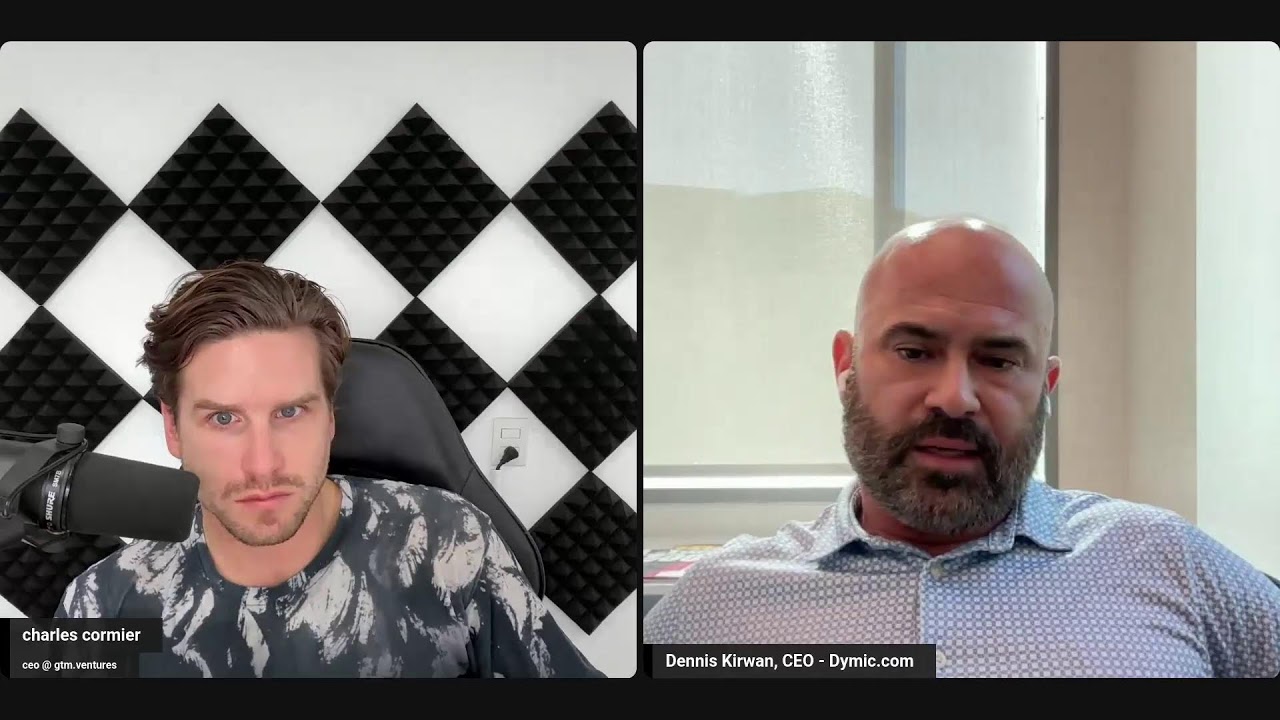
In this Founder Wisdom Podcast episode, host Charles Cormier interviews Dennis Kirwan, CEO of Dymic Digital, about the agency’s 13‑year journey from a traditional SEO shop to a specialist in “AI visibility.” Dennis recounts his early career as a top salesperson at a leading SEO firm, the industry shake‑ups caused by Google’s Panda and Penguin updates, and the decision to launch Dymic in 2013. He explains how the agency now focuses on getting clients discovered not only through Google but also through large language models (LLMs) such as ChatGPT, Perplexity, and Google Gemini, coining the term AI visibility. A key differentiator is a proprietary multi‑LLM visibility dashboard that the agency offers for free to prospects, showing where a business appears in LLM‑driven searches. Dennis describes the agency’s growth pattern: early rapid expansion with a flagship client, later scaling to high‑value retainers ($50k/month) and achieving 55% ARR growth over the past three years, culminating in an Inc. 5000 listing. He outlines why clients churn—often due to internalization, acquisitions, or external events—while emphasizing that poor performance is rarely the cause. The conversation turns to the perceived “agency apocalypse” as DIY AI tools proliferate; Dennis argues that deep experience and strategic thinking remain essential, likening tools to a basketball that only a skilled player can use effectively. Lead generation now blends inbound ChatGPT discovery, strong local SEO reputation, outbound email and paid ads, and thought‑leadership pieces (e.g., Forbes articles). Regarding staffing, Dennis notes that AI reduces the need for entry‑level roles, prompting a shift toward AI‑orchestrator positions, yet he remains optimistic about new job creation. Finally, he shares his 2024 CEO priorities: increasing in‑person networking to build referral pipelines and reviving human connection in a noisy digital world. He directs listeners to his LinkedIn profile and the upcoming Dymic 2.0 website for more information.
Chapters
Welcome to another Founder Wisdom Podcast. We have Dennis Kirwan with us today. He's the CEO of Dymic Digital. It's AI visibility for established service brands. Dennis was featured on Forbes Agency Council. He was quite successful in this agency, I believe like $2 to $3 million a year. So glad to have him on. Dennis, welcome to the pod. Tell us a bit more about yourself and what you've been up to.
Yeah, thanks for having me. Yeah, so Dymic Digital, we've been around now since 2013. We just made the Inc. 5000 this year for the first time. Definitely took longer than I thought it would to get there, but happy that we finally made it. So yeah, I think what's been happening for us is, you know, like you said, digging into AI visibility more and actually being able to do it. So a lot of people out there will just kind of jump on the bandwagon and see an opportunity and try to sell something that they actually don't know how to fulfill on. We're the opposite. So we try to make sure that we test things, we have skilled people that can actually do the job, and then once we have proof of concept, then we bring it to market. So yeah, that's what's been fueling a lot of our growth lately.
Interesting. And if we check out your background, right? It seems you launched the agencies in what, 2013? What were you doing before that? Were you in sales?
Yeah, I was a sales manager at an Inc. 500 SEO company. And so they were actually the number 1 SEO company in the country. And what I mean by that is back in those days, if you would Google SEO company, They came up number 1 organically. So we got tons of inbound calls and leads for people that were sharp enough to realize if they want somebody to help them with SEO, they're gonna Google it and whoever comes up at the top organically, they wanna work with, right? So we used to get a lot of leads like that, like that. And it was a great company to work for, learned a lot. I helped them open a sales team office out in Edinburgh, Scotland too, which was really awesome to have them endorse me for that and go out there. And yeah, I was the top salesperson there on and off the few years I was there. But yeah, it was a great company, big company. They had over 100 employees at the time. But then if you follow the algorithms of Google, most people don't, but if you happen to, 2011 or so, there were some big shakeups with some big algorithms that were rolling out, Panda and Penguin into 2012. And that started to cause some turbulence specifically for that company because a lot of the things they were doing suddenly no longer worked that well anymore. And they had to make changes and those changes took time because of their size. So that's sort of what got the gears turning about, you know, hey, maybe we should start our own agency. And, you know, myself and a couple of my colleagues there started this agency during that kind of chaos over there. And we had the idea that there's a lot more to marketing than SEO, right? So we felt it was, in some ways, they were a bit of a one-trick pony. I mean, albeit it was a good trick for a while there. Again, great guys, love the team over at that prior agency I was at, but we just wanted to do things differently. We look at ourselves as more of a holistic marketing agency that really gets to the bottom of what helps people grow and tailor marketing strategies accordingly.
You've been 13 years in the game now. That's a crazy amount of time. Are you still in love with the game as much as you were when you started?
Yeah, I've always loved business, you know, even when I was a kid. It's like I've always been drawn to it. There's a story on an old outdated website I have somewhere. I think it's myname.com. I built it many, many, many years ago and I don't check it. So don't email me through that site. I won't get it. But it has a story on it, which is kind of cool. It's an old story of, you know, back when I was in junior high. And I think it was in 7th grade. And I saw people, you know, paying a dollar for a soda or something, a machine, which at the time was pretty outrageous. And I thought to myself, like, the first thought I had, just kind of how my brain works, I guess, is I was like, well, what if I would— because I remember seeing them at the store for a lot less. I thought, well, what if I fill my backpack with cold sodas and get them at the store wholesale and then just stand by the soda machine and sell them for 50 cents instead of a dollar? And so it's just a way to hustle, make some money. And I did that for a little while and Until probably the school told me to stop doing that. But, you know, it's just those kind of things all the time, right? So whether it was— another thing I did when I was younger, very young, was back in those days they didn't have the recycle truck that would come to your house. You just kind of threw everything in the garbage can. And, you know, my family would save cans and they would take it to the recycle center. We'd get money. And I thought, well, why is no one else doing this? Or why, like, why is everybody just you know, part of it was environmental. Like, I was like, I don't like people throwing this stuff away. And the other part was like, hey, I can make some money. Um, so I, uh, went to my mom's work, used her computer, which this is like— I mean, this has got to be, you know, 1992 or something. So, um, even back then there was a computer that you could make a flyer on, and probably a pretty generic one, but, um, printed out, passed it around the, uh, the condos that we lived in and my community. And I was like, hey, put your your cans out front in a bag this time, this day, once a week, and we'll come by and pick them up. And so I created my own little recycle business in my community. So I just, to answer your question a really long way, my entire life I've always just thought business ideas. And what I love about marketing is that I'm working with all kinds of different businesses. And so I've— we have clients of all types, uh, pretty much across the spectrum, you know, anything from an attorney to a med spa, you name it. And, uh, it's, it's what, what makes it really interesting for me is just figuring out what moves the needle for these companies, um, and just learning their business. And I, I just have a love for business. So yes, I still, because of that, love what I do because I get to talk to all kinds of business owners all the time.
And your main thing nowadays is SEO, AEO, is that your beachhead?
Yeah, you know, we, I would say our agency isn't necessarily, you know, calling it AEO or GEO. You know, we've been saying more like AI visibility because each one means something a little bit different. So, you know, we originally were doing a lot of SEO and that's sort of morphed into Okay, SEO is part of it, but the other part of it is, you know, how do you get found on some of these prominent large language models, LLMs like ChatGPT? And each one of them works a little bit differently. You know, there's, there's like training data that they have kind of, you know, in the core, so to speak, or their, their, you know, their, their main thing they're pulling information from. And then they have, you know, the retrieval part of it, which is using oftentimes some kind of search engine. to pull that information in. And so, you know, Perplexity, for example, has their own kind of crawlers that scour the web on their own and pull that information in like in real time. While, you know, ChatGPT is actually using Bing because it's a Microsoft product. And of course, Google Gemini is using Google when it needs to. So they're all a bit different. And so we try to be mindful of that with our clients and think about You know, the buyer's journey and where their clients are, what tools are they using, and, and where the gaps are with their clients and how do we, how do we get them found more prominently in those conversations.
Interesting. So what's a beachhead? Like, why should someone take a call with you? Like, initially, like, what's your top of funnel and what's the offer for them to accept a call with you when there's so many other agencies?
Yeah, one of the, um, one of the really cool things we do, uh, that I haven't seen a lot of agencies do yet— it doesn't mean they're not going to eventually, and I'm sure there are some that do it— but we actually have a, a custom, um, it's a, it's a, a visibility tool that we have that we built ourselves that shows the visibility, um, of oftentimes a, you know, it could be a local business or a business with a franchise, multiple locations, whatever. You put all their company information in there, and what it does is it not only shows their visibility in those local areas— that's, you know, that's been around for a long time— but the thing that makes it a little bit different is it actually looks at, uh, the top 4 large language models and shows their visibility percentage of surfacing for their primary services in those, uh, chatbots. And so That visibility report, I think, makes ours a bit unique, and we offer that as a complimentary value or service to get people interested in talking to us, saying, hey, look, you know, we'll show you where you surface and where you don't and what you need to do to, you know, show up better on these tools.
Have you seen growth in the agency, especially in the last couple of years? You made it to Inc. 5000 list. What has been What has been the growth, right? Has it been like, I don't know, year 1, 50%, then 75%, then it's like decreasing growth and then stable? Tell me about the growth in the last 13 years.
Yeah, so, you know, we started off really, really hot. Our first year, we had a really big client come on board and that really funded our operations and helped us, you know, continue growing. You know, we had a sales team, you know, for a while. We grew out our sales floor. We had people calling businesses all over the place and offering them services. So we created a bit of a foundation of a lot of small clients or smaller clients, some, you know, medium-sized ones in there. And then as the years went on and we became more skilled and we had more skilled people working for us, we were able to just sort of through osmosis attract bigger clients. And so what's changed for us and what I think the big difference was the last few years and propelled our growth, which was over the last 3 years I think was about 55%, um, you know, but when you're talking millions of dollars ARR, it's a, it's a big number to, to go from one, you know, 55% over 3 years growth is pretty solid when you're that big. It's, it's obviously when you're a startup company and you don't have much revenue at all, it's really easy to grow 1,000% because you don't really have much revenue, right? So But the growth from that is what's changed is our ability to attract these larger retainers, larger clients. And so, you know, go back in time 10 years ago, we were getting a lot of smaller clients that are spending, you know, $1,000 a month or something like that for some basic local SEO campaign. And now we have clients that are, you know, investing and making, you know, the decision to move forward on $50,000 a month retainers with us that include multiple different services. But oftentimes these bigger, let's say mid-sized companies out there, the challenge they oftentimes have is that they might have a CMO that works for them that's wearing like way too many hats, spinning plates, expected to do everything in the world, which is not realistic. And they come to a bit of a crossroads where they realize they need to work with an agency like ours that has experience working with the same situation that they're in, where we can become sort of an extension of their team and really help their CMO shine and do what they do best. And then us complement that and find other gaps they didn't even know they had. And then kind of bringing it all home, bringing it together, removing the fragmentation and the complexity that comes with trying to manage multiple vendors and all these different things that people run into that are these big companies. where it gets really messy at some point and it becomes very unorganized. They don't even oftentimes know how much money they're getting back truly from the marketing and they're seeing a lot of different vanity metrics and they're looking at different things and it just gets really confusing for a lot of these companies. And so we come in and we bring clarity to the chaos, as we like to say. And I think we've gotten really good at that and now we're starting to get referral business from a lot of our larger clients, Also companies that are part of maybe an, um, they're in an umbrella of a private equity firm, for example, is another, um, good, good, I guess, case study to bring up is that we did really well for one client who happened to be part of this portfolio of clients. And then next thing you know, we're talking to the, the PE firm about, hey, what other brands in our portfolio can you help like you did with this other company? So that's really, um, those kind of stories have been the primary reason we've grown the last few years.
What are their reasons to churn from your agency? Do you see like sometimes they start doing these things internally, right? Like why would they keep you and why would they actually churn from an agency like yours?
Yeah, you're right. I mean, that oftentimes happens where, you know, you clean up the mess, right? You get everything rolling smoothly. And then at a certain point, they might want to try to take efforts in-house. You know, perhaps they feel like it, depending on the size of the retainer we're talking. In some cases, they might feel like, hey, you know, I could do this, you know, in-house and, you know, maybe hire another person. And now that this mess is cleaned up, maybe we could, we could make it more cost-effective and do it ourselves. Sometimes we hear back from those people. But, you know, it— that's, I would say, a common reason for some of these larger ones. What's happened recently to us too, and this is like something people don't think about, is— this is a true story— we did so well for this one company that they ended up selling their company. So we doubled the size in one year, we doubled their revenue, and then they sold their company. And so we lost a client because of that. And sometimes there's nothing you can do about that. Sometimes, you know, if you play your cards right, you can get the company who acquired them to continue doing marketing with you. And of course that's always the goal. But yeah, there are a lot of things like that that come up that are sometimes out of our control, but we're not— we've gotten to a place at our agency where we're not losing clients because we're not doing a good job. There are usually outside factors that could be a million different reasons that someone cancels, but those are just a couple examples.
Right. Do you think there's an agency apocalypse out there? People just cracking the code themselves with tools like Claude Code and deciding not to hire agencies nowadays, or is that—
Yeah, I think you're right, and I think that applies to the basic agencies out there. So I'm not saying we're completely immune to every single thing. There are definitely some services that we don't offer as much due to AI, but the value we bring is the, you know, the years of experience, right? As you mentioned at the beginning, you know, we've been in business since 2013. I've been in the game many more years than that working for another large agency. So that experience and the ability to understand businesses and know how to build strategy, that's something that is a little bit more challenging to kind of all piece together. And what I tell people is, yes, you have these fantastic tools, right? It's like, I just thought of this right now, but you could give me that same basketball that LeBron James is using. I can't do what he does with that basketball. Right? I might be able to make a jump shot or something like that with no one defending me. But, you know, it's usually who's at the helm of the tools that make the tools as brilliant as they can be. And, you know, that's just the reality, right? It's like, I could even buy the nicest golf clubs in the world and I'm still not going to be very good at golf. I've been trying for 30 years. I'm still not very good at golf, you know? So I'm just not— that's not my thing. And so I enjoy it, so I still go do it. But I think people quickly realize when they're using these tools that they end up spending more time trying to figure out how to do all these magical things they hear about and wasting a ton of time, ton of bandwidth, and really getting subpar output. So I tell people all the time, garbage in, garbage out, right? So if we have our agency using these tools on our client's behalf and, and, you know, 10xing the output we could have 4 years ago because of these tools, So people getting more bang for the buck when it comes to marketing. These are some of the ways that we're creating value and people don't wanna leave is because we bring that high-level thinking. We help them build the strategies that are gonna make them succeed. And, you know, we know how to piece everything together in a way that you wouldn't know how to do unless you've been in the game a long time.
How do you get your new clients nowadays? What do you invest in?
We're getting more and more clients that are finding us on ChatGPT, which is not so surprising because that's, you know, one of our core areas of focus these days. So that happens pretty often. We still get found very well in our local region on Google and places like that because of our stellar reviews across the board. And so that 13 years of getting 5-star reviews on, you know, Google and Yelp and places like that, we get incoming leads that way. As far as outbound, you know, we're doing everything from email marketing to, you know, also paid ads, things like that. But yeah, I mean, it's, as you know, it's a moving target and the way that you develop leads changes because things that used to be effective might not be so effective anymore. You know, whether you're talking about LinkedIn marketing or email marketing, those are both way more challenging than they were a few years ago, as you know, and you have to be really good and know how to evolve to still cut through the noise and get leads through those channels. So we still do outbound, kind of leveraging some of our own skillset we have as an agency, but we also get quite a bit of inbound from people finding us from our reputation and things like you also mentioned, my Forbes articles that I've been doing for the last 10 years, stuff like that really gets picked up and indexed well as a powerful citation in these large language models. And so when I write about you know, our areas of expertise and people are having conversations with these chatbots about these subjects. Sometimes I'll come up in those conversations or we'll come up in those conversations. So yeah, kind of a mixed bag.
Right. What's been the hardest running this agency of yours in the last 13 years?
I think our newer challenge, well, I'd say the biggest challenge over the 13 years has been just the pace of change, how quickly things are— I mean, the pace of change is really accelerating, and AI has just thrown fuel on the fire with that as far as how quickly things are changing. The big change that I'm seeing now is the search experience or the customer journey altogether is shifting from what used to be mostly a Google search that was kind of vague and not super long with context to now a much richer contextual conversation in these large language models like ChatGPT and people really digging into these, you know, these AI tools to find the precise service provider that they want for their specific needs. Um, and so that's— it's, it's been a, it's been a long road from the, from the early days to now, and a lot's changed, you know, going from, uh, the Google prominent era to the whole shake-up from COVID and then now AI. So yeah, it's just navigating change I think is the, um, the biggest challenge.
Are you still hiring? Uh, how big is the team? Uh, do you feel the team will grow with the years if you're outsourcing mostly to agents nowadays?
Yeah, so, um, I think we've— we went from, um, you know, even though we've grown in revenue, we, we've, um, not necessarily grown in staff. And that, like you said, um, you know, when you have really high-level people working for, uh, your agency who know how to leverage these tools properly, um, you know, in some scenarios you can deploy an agent instead of hiring like a low-level, entry-level, uh, person. And I think that's where the disruptions happened a lot in the workforce or starting to happen are these entry-level positions that, you know, you used to need that you don't need anymore. And this is really something that is, you know, a tale that's been going on for a long time, right? It's like you could go back in time over 100 years ago and there were stories like this, whether you're talking about, you know, the invention of the tractor and what it did to people with the old tools they used to have and they're doing working in the fields and how the machines replace people in factories. And every single generation has an experience like this, like the AI experience. And what happens is that jobs change and new jobs are created. And so I tend to be optimistic with that. I feel like I could already name some new jobs that have been created from AI. And I think people just, the smarter people, are going to have the advantage, right? People who are really, really wise and keep their finger on the pulse, and instead of trying to ignore AI or boycott it or hide their head in the sand and pretend it doesn't exist or whatever, those are the people I think that are going to have a really hard time in the future. We believe it brings a lot of value, and we work hard to keep our finger on the pulse and know what's going on so we can not only help ourselves and stay relevant, but also our clients,
right? Yeah, I mean, this one's really special though because we're creating like other Dennis's and Charles's, right? Like, uh, we're creating other brains that learn on a daily basis. For now, these things, they don't have human rights, which is probably the only thing holding us from mayhem, right? But you can think of AI buyers and sellers happening Pretty soon, it's changing the full thing, and I do agree it's creating more jobs. There's like orchestrators and so forth, but I think most of these are like temporary. I think ultimately it'll be mostly like AGIs running the full show, right? And yeah, some of us humans will decide to biologically change ourselves and to follow the waves of what's happening. But this is not another tractor, right? It is the human on the tractor, and It is greater than the human also. It is like a full swarm that understands the laws of physics, that is understanding science, math, is discovering new stuff at an unprecedented rate, right? But, and yeah, we're in the middle of that. It's really exciting. It's a weird time to be alive as well. Yeah. We haven't been alive before that and witnessed like a Electricity and such inventions, right? Or capitalism, matter of fact. But how's that changing the nature of agencies, right? Like, I think clients still want to deal with client— with other humans on the front end, especially older clients. They still want the human touch. Buyers, agents, buyers and sellers will happen. Agencies are building their own tools and are ditching tools sometimes, right? Is what I've been talking with Sean Clark right before you. How is this revolution sort of changing the shape of agencies and their meaning in the business ecosystem of things?
Yeah, absolutely. I think there are a lot of tools and software and different things like that that people are canceling, us included, by the way. I mean, because as you start to have the ability to build your own custom SaaS and using AI and some of these tools that could be replaced for sure, Some of them I still find very valuable, and I think it's, you know, we're always trying to figure out how to integrate everything, how to make everything more connected. But yeah, it's, the pace of change is crazy. I'm seeing the same things you're seeing as far as, you know, people creating more things using AI and not using outside services as much. So there certainly is a huge disruption happening, and who knows how it's gonna shake out. You know, if you ask Elon Musk, he'll tell you that in 10 years we're all gonna be on some kind of, you know, payment system where we're just getting paid, you know, some universal income and crazy stuff like that. And he's a smart dude, so it's scary to hear somebody say that. But he also believes in simulation theory, which I don't. So it's, you know, he's a genius, but he's a bit eccentric, and some of his ideas might be a bit wild. But I'm not going to pretend I know more than him, so I'm just kind of hoping that he's not right. I'd like to think that People will always be needed and wanted, that people would prefer to interact with humans over bots. And I'm sure we all have our own experiences with that. We've all probably already spoken to an AI bot of some sort at some point in time. And there's just something about it that, at least now, that I feel like people are still going to want human connection, want to interact with humans. I'd rather, you know, it's like whether you're talking about somebody getting a massage, I'm sure they'd rather have a human do that than a machine. You know, whether you're talking about the human connection, right, I don't think that the machines are going to be able to develop such a connection as a human might. So there's just— I think humans will always have a place. I'm optimistic in that regard, but there's no doubt that there's a huge disruption happening, and it's certainly affecting agencies, and the ones that are not moving with urgency are Possibly gonna be facing quite a bit of pain.
What are your top goals as a CEO this year?
My kind of random unique thing that I've been doing more of this year, which is something I haven't really done systematically ever, is I've been doing a lot more in-person networking. So going out there and actually showing up to tech mixers and random things and just shaking hands and meeting people out there in my region that I'm in right now. And I've been, you know, I picked up some clients already that way. I've also met some great people, you know, expanding my referral network. And I think that's just a kind of one of those random things that I'm starting to try out just because I've never done it before. And I do feel like there's a bit more, kind of to double down on the point I was making earlier, there's more of a craving that's starting to happen, in my opinion, where people want more human connection because they feel like there's so much noise being created digitally now. And like, you maybe you don't even know what you're watching, like if it's real or not on social media. And I think people are just kind of getting fed up and wanting more, more reality in their life. You know, they want to go out there in the world and meet people. And I think they're just— it's getting to be a bit much for some people. And so I think I've— I personally have noticed a bit of a resurgence in almost like traditional marketing or traditional networking. Which is interesting considering I'm in digital marketing, but I think the two work hand in hand and are great together.
Where can people find out more about you, Dennis?
Yeah, I think the most recent stuff and content, I would go to my LinkedIn, quite honestly. My LinkedIn page is the place where I post the most current stuff going on at our agency. We've been building a really awesome website. We call it Dymic 2.0. It's gonna be released any week now. It's not yet. So going to dymic.com, while it's a great website, it's not completely up to date with our most recent work and things that we're doing. But the website is dymic.com. But I would just look me up on LinkedIn for the— and follow me there to get the latest.
Love it, dude. How is Dennis?
More from Charles





Elizabeth Holmes and You Can See Everything: The Real Theranos Story Behind the A24 Documentary