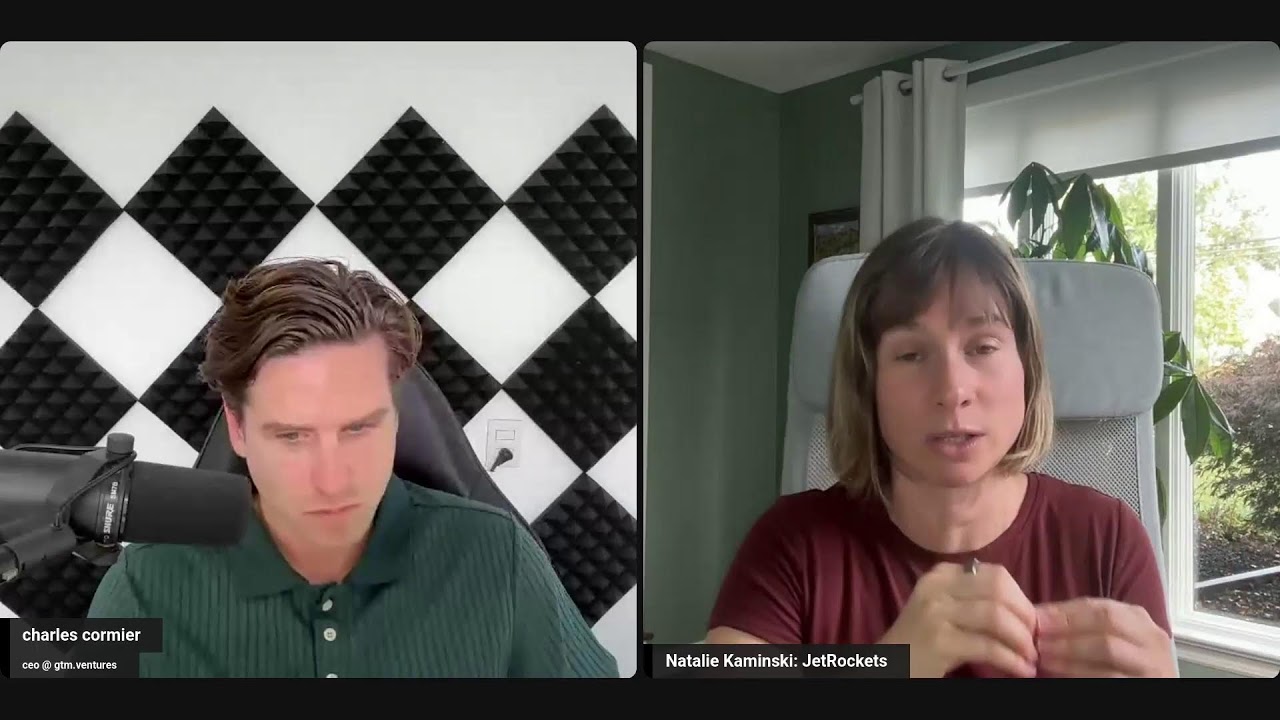
In this Founder Wisdom Pod episode, host Charles Cormier interviews Natalie Kaminski, co‑founder and CEO of JetRockets, a Ruby on Rails‑focused software agency that has grown to roughly $5 million in annual revenue. Natalie shares her personal journey from corporate roles at Cryco and DataRite to launching JetRockets in 2009, describing how motherhood sparked her desire for independence and a lifestyle business. She explains the agency’s organic evolution—from a solo freelancer to a multi‑founder operation, the strategic decision to prioritize profitability over vanity headcount growth, and the recent downsizing from 87 to 46 staff to protect margins. The conversation delves into hiring practices, including a mix of LinkedIn sourcing, referral programs, and sponsorship of the Latin‑America Ruby on Rails conference, as well as a shift from pure technical testing to valuing analytical, product‑oriented skills in the age of AI (Claude Code). Natalie discusses the impact of AI on engineering roles, the challenges of working with corporate versus SMB clients, and the agency’s new productized offering, JetEngine, which packages their 15,000+ years of collective experience into a self‑service or managed framework for rapid AI‑augmented development. Throughout, she reflects on the entrepreneurial mindset, the importance of supportive partners, and the broader implications of AI‑driven workforce changes.
Chapters
Welcome to another Founder Wisdom Pod. We have Natalie Kaminski with us today, co-founder and CEO at JetRockets. She's a Ruby on Rails expert. She's a board advisor, speaker, member at Hampton, one of my favorite mastermind groups, and a marathoner of all things in New York. So Nat, welcome to the podcast. Tell us a bit more about yourself.
Thank you so much. I mean, you said it all. I mean, aside from the things you've mentioned, I'm also a mother of 2 2 girls, well, a young woman. My older one is 20 years old and my younger one is 12. So, you know, 2 young women. And I recently adopted a dog. So I'm also, you know, a dog parent now. So there we are.
I love it. I have 5 myself here in Mexico and 5 is like a rookie number. It's like, yeah, most people have like what, 6 or 7 or 10 because there's this stray dog problem in Mexico. Oh,
we're talking about dogs. I thought kids for a moment. I'm like, wait a second.
No, no, no. If I have 5 kids, that would be a next level challenge. Yeah, even with one, it's quite intense, right? Like you need to have all these systems around to optimize and make sure like everyone's happy. How's that been for you to raise kids? Like, was it as challenging as a startup or?
Well, you know, funny you should say that. So I, I find that having a dog, especially like a puppy and sort of like a rescue puppy, is a lot more difficult than raising kids. So that's one, but that's just me.
That's crazy.
You know, that's just me.
For me, it's like totally the other way around.
But, uh, you know, I started my business when my older daughter was 3 years old, and she was actually part of the reason I decided to launch my business because I felt like at the time I was working for a corporation. I was, you know, gone, you know, 9 to 5, but like really like 7:30 to 6:30 every day, you know, because the time takes to get home and office, etc. And I felt increasingly I was getting this feeling of I'm missing all the milestones, you know. I can't— like, she's with the nanny, she's with her grandma, she's like, she's everywhere but not with me. And the fact that I was working for somebody and kind of driving somebody else's agenda did not make me, did not make me feel good. And so she was sort of like this, this engine behind, hey, I gotta find a way to make money to be able to spend more time with my kids. And then, you know, when that finally worked out and I started my own business, started making money, and things started to roll, having children was never an impediment. It's like I, I felt like I never had to choose between, am I going to spend time with my kids? Am I going to spend time in my business? I mean, a huge part of it is my husband is extremely supportive, and, you know, having a supportive partner is, is like super important in that. Um, but also because kind of early on in the process I was like, listen, you cannot like throw away the guilt trip. You can always find something to feel guilty about, right? And sort of like be okay with the decision. And sometimes a decision could be working late But then, you know, be there, be present, make the time count and make the time useful and make the most out of that time. Or sometimes it may be, you know what, I'm taking the day off fully. Like I'm not even opening my laptop. I'm traveling with my family, or I'm just deciding to take a random day off, or maybe my kid is sick and I'm just gonna tend to them and I'm gonna disconnect and don't feel guilty about that either. So like, as soon as I was able to kind of put that in my mind, it never presented a challenge. Yeah.
Because I look at your LinkedIn here. So I guess that was Cryco. Was that like the last organization, Data Rights?
Yes. Yeah. Well, these two are different companies. But yes, I worked for a company called— well, at that time, the company was Cryco. It was a risk management foundation of Harvard Medical Institutions. And that was located in Boston. And then I moved to New York And I took a job with a company called DataRite. And actually, that company taught me the business of software development. You know, prior to that, I've been in the trenches, kind of, you know, building software in like a variety of roles. But joining DataRite and kind of becoming the Chief Operating Officer at some point, you know, I joined as a Director of Operations and then kind of moved into COO role. it opened up the opportunity to learn about what it takes to run a software development business. And of course, back in, you know, 2008, it was very different than it is now. But I've learned a lot. So that was the opportunity for me to really understand that, okay, there's a big difference between writing software and running a business that does that.
Right? Because you started JetRockets in 2009. And then you started a couple of other businesses like Spawn Zoo, For example, you accepted some roles sometimes in between, but overall JetRockets have existed for 17 years, which is crazy.
Yes. So I mean, it started out as freelancing, right? So it was just me. And it wasn't at that time, it wasn't even called JetRockets. JetRockets, I mean, the name came about maybe 2012, 2013. But, you know, the first couple of years, it was me freelancing and working with a variety of clients. Doing like a project here and a project there, kind of, you know, trying to keep up my earnings. And then I got a project that required, demanded me seeking out help from outside world. And I found my co-founder, you know, person who later became my co-founder. And that's a funny story, but might be a bit long. But anyway, I found my co-founder and we started working together still as 2 freelancers, you know, kind of like together working on a project. And then things kind of like snowballed from there. You know, another project came on board, like another client reached out and we kept working together. At some point we involved our 3rd co-founder and then hired a few people to help us because we couldn't manage the workload. And I think it was maybe 2013 or even '14 where we finally sat down and we said, wait a minute, I think we have a business. It's like, it was never like, you know, let's put together a business plan or let's figure out, you know, how to build a company. It was just like very organic and it was kind of like leading, like one event led to another and it just happened. And we, I remember us sitting down in the room meeting for the very first time in person, because before that, it was all remote. And we signed our operating agreement, you know.
And today, it's scaled at a couple of millions a year, but it's not always been that way. Like, how did you get there?
So we are, in terms of revenues, we are, you know, more than a couple of millions. We're a private company, but, you know, doing pretty well. We're about, you know, close to 5-ish, something like that. Yes. But, um, has it always been that way? No, we've had ups and downs, and it's been, you know, it's been a ride. Um, the good news is that from day one, the precipice— like, the reason for founding the company was to make a living. So, like, you know, speaking of lifestyle businesses, I know many people think that lifestyle business is something to be frowned upon. But to me, that was always like, that's why I want to have a business, to have a certain lifestyle, right? And so profitability has always been key. And so we've always been operating at the profit. Yes. So there was a moment in time around 2022, 2023 where, um, certain vanity metrics came to mind. Like, you know, we, we grew to 87 people and my internal goal became, oh, I wonder if I can get to 100 people, because that sounds cool, you know. And I kid you not, getting to 100 people was an actual goal in our, like, sort of milestones for the, for the year. It, it's— I'm ashamed of that.
I know, I know, I've been there too. So
it's like, and then I sat down with my CFO and I'm like, how are we doing? And he's like, look, the revenues are up, you're doing good, but The margins, where are the margins? You're not making any money, you know. So the margins have shrunk significantly at that time. And we said, you know what, no, this is not why we're growing this, like, so too much headache. And like, for what, you know. So we're down to 46 people right now. I mean, age of AI, I still think we are a big company in the age of AI, we can do so much. Yeah. So we'll see what happens next year. I mean, we don't have any active plans on kind of, you know, becoming smaller, but we'll be responding to the market as needed.
And how do you hire your talent? Right? Is it overseas talent as well? How do you get these 100x engineers in your company?
Oh, so it's been a whole lot of different approaches throughout the years. I mean, 17 years in business, we've tried everything. But, uh, our current approach is we have a recruiter who works with us on a part-time basis, and she helps us with very specific talent searches when needed. But we rely a lot on LinkedIn, to be honest. We rely a lot on LinkedIn, on the presence of my CTO. Uh, we do— we have a lot of kind of referral programs within the company as well, where our employees are attracting their friends or, you know, people they know. Um, so that's been That's been our recent approach. So we're not doing any, you know, like huge recruiting events or anything like that. I mean, one, one thing that we do do, I should mention, is we sponsor the largest Ruby on Rails conference in Latin America. It's called Tropical on Rails. We've done it 2 years in a row and we're going to do it again this year. And that attracts a lot of talent from Latin America. And which I have nothing but great, great things to say about those folks. Yeah.
Right. And do these people use Claude code? Is that like part of the interview process? Like, how do you make sure that they're super engineers, you know, not just someone you constantly need to reprompt to have stuff done? They're recursive. They self-motivate themselves. They produce extra stuff that sometimes the client didn't even ask for. Yeah, and that question comes in because if they're that good, why wouldn't they start their own software agencies? My question.
Well, let me, let me get to the why not start. Let me first start with the first question, which is, again, this year we've changed our approach to hiring. In the past, it was all about technical skills and very rigorous interviewing process with tests, tasks and whatnot, you know, because we were looking for like the best of the best of the best. The best. Uh, at the same time, uh, JetRockets also had historically huge success with raising junior talent. So we would often hire like very junior people who are hungry for knowledge, and we would bring them on board, um, under mentorship programs, and then we would raise them up and kind of, you know, develop them into like full-stack engineers. And, and, and many of them continue to work with us and are now like senior engineers within the organization. Now, now the role of software engineer is changing so rapidly, like you just mentioned, right? Um, what we're looking for now, it's very different than what we were looking for even 6 months ago. Now I'm looking more for analytical skills. I'm looking for— you gotta know what you're doing, not only like how to do it. You don't even need to know so much how to do it because Claude can help, but you need to understand the why behind it. You need to have taste in terms of like which feature is best for this particular use case and why. Yes. And that comes unfortunately only with experience. And I say unfortunately is because it's leaving a lot of junior talent, you know, without opportunities nowadays. And that is a huge problem in the industry that, you know, I'm hoping that the whole industry will come together and figure out how to tackle. But I'm just I'm telling you as it is, like right now the types of people we're looking for are multitaskers, people who are product-oriented, people who understand and willing to dig deep into the client's product and industry and to figure out how to best create, you know, use AI to then create the best products available using their, you know, set of skills. Now to your second question as to why can't they just launch their own agency, I mean Running an agency, as you probably know, it's not just about coding skills. It's a lot more. It's the accountability that comes with it. It's the relationship you build. It's, you know, my employees, they come to work, they do their work, they go to sleep and don't think much about, you know, what comes next. I am the one who has to make sure that they get paid, right? And then they have the next project, which also is not as easy to come by. So, you know, I'd say it's not as simple. We've had throughout the years, I remember we had a couple of folks who, and I'm talking like years ago, maybe 6, 7 years ago, we had a couple of people who quit the JetRockets and they went on and they said, I'm going to found my own agency. And they did not succeed. And again, I'm not smiling because like I'm smiling because of that. It's just, you know, they did not succeed. It's not as easy. Besides, running an agency is, for many, it's sort of like a temporary gig until they move on to their what I call real business. For me and for my co-founders, we happen to love what we do because we get to work with a lot of different businesses. We get to learn a lot about a lot, which is cool.
Yeah, yeah. Just the day before yesterday, I was speaking to an ex-employee of mine and she was telling me how one of her ex-colleagues, which was also an employee of mine, launched a business. And I was like, oh, I'm happy. I'm happy he launched a business, right? Like my goal in life is to create as many founders, but another part of me right now is like, I don't think he's going to stay in business. I know this guy and it's like, it's so hard. It's so hard to, yeah, it's like ultimate accountability, right? Like why were you built that way? And you know, a bunch of your ex-colleagues in your corporate world, they never went on and launched a business, especially like a $5 million business a year. Why? Were— did you always know you were built that way?
You know, I think from— yeah, I'd say yeah, I've always had this entrepreneurial streak in me. Uh, part of it is I was always seeking some independence. Like, my personality, it's, you know, I've always struggled with like having authority over me, you know, at the workplace. Like, I've always struggled with having to answer to someone or having to like Do somebody else's business.
Follow orders.
Yeah, yeah. And not like— I've had— I was so fortunate. I had amazing bosses, amazing managers in my corporate career, and I took— I mean, I mean, I made the best out of it. I've learned so much. And, you know, thinking back, I'm super grateful. But I joke sometimes that like at this point, at this stage in life, I'm completely unemployable. It's like I would never be able to take a job, you know what I mean, for like anyone else. And as a result, I have no choice but to make sure that JetRockets is successful.
Yeah, just yesterday I was talking to a guy I'm about to have on the podcast. He worked with like all the biggest brands out there, but he was telling me how sometimes working with corporate means like taking orders from people and, you know, playing political games. And I was like, dude, even for $10 million per piece per year, I wouldn't ever like bend or, or, uh, go on my knees for anyone, right? Like, that would be the end of me. How could I even look at myself in the mirror? I'm so curious. I have a bunch of questions for him. Maybe that's not what he does, but playing like— do you have clients like that sometimes that you need to play?
I was just gonna say, I have, you know, most of my clients—
Must drive you nuts.
Yeah, so most of my clients are Small to medium-sized businesses, and so like, and we mostly deal with kind of like founders or at least like the C-suite.
Well, that's good.
But but I do have a few corporate clients, and you know if they listen to it, they listen to this. But it's it's difficult to deal with corporations because it almost feels like there is no you know
there's no soul, there's no accountability.
Don't care as much about the success or failure of the project.
Yeah, they pay you a whole bunch of money, then it's like, okay, you guys say this, you should obviously listen to me. I had like so many more clients like you. I already have a proven process. But then you understand that if I adapt your process, then the results is not guaranteed and we don't get to the results most of the time. And then they're like, ah, it's fine, just keep the $100K. And I'm like, okay,
but But also, like, everything takes forever. It's like everything takes— like, decisions are made so slowly. And like, you know,
sometimes 7 people making one decision, like, how does that work? You know, like,
so much redundancy, like 5 people responsible for one thing. And you're thinking, well, that's why AI is going to replace like 4 of you.
Yes. And that's coming to an end. That's the good news for us, I think. Corporations are going to keep their financial moats, their piles of money and their brands and all of that. And, but they're going to slash a whole bunch of humans, which is good for companies like us because that means like we can hyperscale these companies, we can make more money, waste less time, but it's also preoccupying. It's like, how will these people find jobs? If they don't have jobs, then we'll need to carry them in the economy ultimately because we're taxed payers and so forth. So that's preoccupying, isn't it? Because corporate America is, is what's keeping shit together in society. I feel that's what's holding people like— that's— they employed like, what, 40% population?
Well, I think so. I think most people are employed by small businesses. But
that's a good question, actually.
Yeah, I don't have the statistics in front of me. But if I'm not mistaken, majority of US people are employed by small businesses, which is good, right? Which is good news. But yeah, corporations, I mean, that is definitely a huge issue for hopefully the government to figure out, is like what to do with, you know, even if it's 40%.
It's 50%. Oh my God. That's why I'm saying it's keeping shit together.
Yeah.
So without this, society goes downwards.
Yeah. Well,
so that'll be interesting. I don't even have questions for you because I want to Follow up with like a couple of other questions with your company, Ruby on Rails, right? Like we talked about, I remember using Ruby on Rails around 2017, was like the best programming language. I was learning this and Python, I feel, and Python is still very much relevant, by the way. Yeah. What happened to Ruby on Rails? Because that's to program apps. People are still programming apps, but is it also web? And you said it picked up traction during AI. How did that happen?
So, Ruby on Rails is, is not like— Ruby on Rails has never gone anywhere. Like, it's always been active. And Ruby on Rails is probably one of the easiest and best and more enjoyable frameworks for developers to work with. And if you know, there are a few tiny companies out there, like, I don't know, like GitHub or Shopify, you know, Airbnb, they're all running on Ruby on Rails, you know, at least like big portions of them. Um, Ruby on Rails got a bad rap at some point during, I believe it was Twitter, when Twitter couldn't scale with it properly, etc. But like, honestly, like with any other technology, technology is only going to be as good as people who use it. Yes. So Ruby on Rails has never really disappeared. Uh, now Ruby on Rails is definitely becoming more of a, you know, talking subject again, primarily because it works very, very well with AI. I mean, Ruby on Rails, like I mentioned, has always been about developers' leverage, right? So like, think about like conventions over configurations, like mature abstractions, accomplishing more with smaller teams. And that is exactly like what you need for AI to be effective. You know, it at the very least, it's going to use less tokens, you know, at the very least. So, again, if building any web platform, Ruby on Rails is probably one of the best solutions out there to go and kind of, you know, spin up a quick—
For companies that have apps, right? Is that okay? Hmm. So who are your clients nowadays? Give me some examples. And do they hire you purely for maintenance, create new features? Tell me a bit.
So My clients tend to fall into like, let's say like 3 buckets. One bucket is, yes, it's strictly Ruby on Rails. So maybe they have a Ruby on Rails platform that was developed, I don't know, 5, 10 years ago and it hasn't really been maintained and they need it upgraded, especially now they're trying to make it play nice with AI, but they can't because it's so outdated. And so yes, they come to us for our Ruby on Rails expertise. We help to upgrade them, bring them up to the most modern tech, and then we kind of continue from on. Yes. Uh, so that's kind of like one set. And, and amongst those clients, I have both. I mean, I have enterprise clients who do that, but I also have like small businesses, um, who have developed those platforms. Uh, second set of clients are kind of— I call them tech agnostic clients. They came to us because they wanted to build some sort of a digital product. They couldn't care less if it were going to be Ruby on Rails or, or Node.js. Like, it didn't matter to They wanted a product built and we did it for them. And we continue, like with a lot of those clients, my relationship tends to last very long because as they grow their business, as they succeed, and as you probably understand, if you build a product and you're successful, you will continue to invest into the product. You will continue to grow it, add new features, your client, you know, keep your customer base and user base. You know, interested in your product and competitive. So they typically tend to work with us in the long term, and we become their product development team. And, you know, some examples of such clients are, um, one of our biggest clients probably is a company called Safari Portal, um, and it's a travel-based enterprise-level system that we've built for them. It's a SaaS platform. You know, we've— and, and, and the third kind of types of clients are people who are looking for some sort of like one-off support, but we have those less. Like, not, not a big fan of those types of clients. I mean, 70% of my business comes from retainers. So like about 70% of my business month after month are clients who have been with us for like longer than a year.
Way back.
Yeah, yeah,
interesting. Hmm, how much agents are you deploying for your clients? Like agents that try to find bugs or agents that auto-fix shit?
Yeah, so, um, we have actually— it's perfect timing for us having this conversation because we just recently announced a new way of delivering our services. And, you know, one of the big questions right now is how do Businesses like ours, how do they change the business model? In the past, it was all about, I don't know, billable hours, you know, just like lawyers. Now it doesn't make sense for us to bill hourly because things take less time, right? So like, I can give you—
For output.
Yeah, right? Like, I can give you a platform that was worth $100,000 a year ago, and I can give it to you in half the time or even like third of the time. Does it mean you should pay me less? Well, probably not because it's my skills that you're taking advantage of, right? Yeah.
Yeah. It's like, hey, we scanned this competitor that has this feature that might bring them a couple millions a year. Here's a prototype of what that would look like for you. You can test it. You can try it. Let's deploy it to 100 users, get feedback and scale from there, right? It's pretty magical what what we can do nowadays. Hey, last question for you because I know we're soon to be on time. What are your priorities this year? Is it— it's probably not growing the teams, probably spending time with these agentic products, right? What's your priority? Getting sales, of course.
So the goals, the priority is to solidify our new business offering, which is called JetEngine. And it's essentially, we've, you know, if you go to Claude, and you go to Claude Code and you say, build me a platform that does whatever, it'll build you a platform, or at least something similar to what you ask. But you as a user, especially if you're not technical, you have no idea what technology it's using. You have no idea what conventions it's using, what standards it uses, et cetera, right? And unless you know what to ask for, you wouldn't know to ask for it. And so what we've done, we've built what we call JetEngine. It's like a framework of building products using our 15,000 plus years of experience. Yeah. And this is our new— like, this is how we now deliver software. So you can use it as a self-service model where you pay us, you know, for the product, or like to set you up with JetEngine and then kind of to support and maintain it. Or you can have a managed model where we use our own JetEngine to build your product over time. And so the goal for this year is— for the rest of this year is to solidify this offering and make Like, it's already semi-official. We're testing it out with a couple of clients, but, you know, I'm trying to figure out how to launch it officially.
Yeah. Thanks for being on, Natalie. Where can people find out more about you?
So come and visit me on LinkedIn. Actually find me under Natalie Kaminski, my, my name, or at our website, jetrockets.com. That
was Natalie and Charles.
More from Charles





Elizabeth Holmes and You Can See Everything: The Real Theranos Story Behind the A24 Documentary