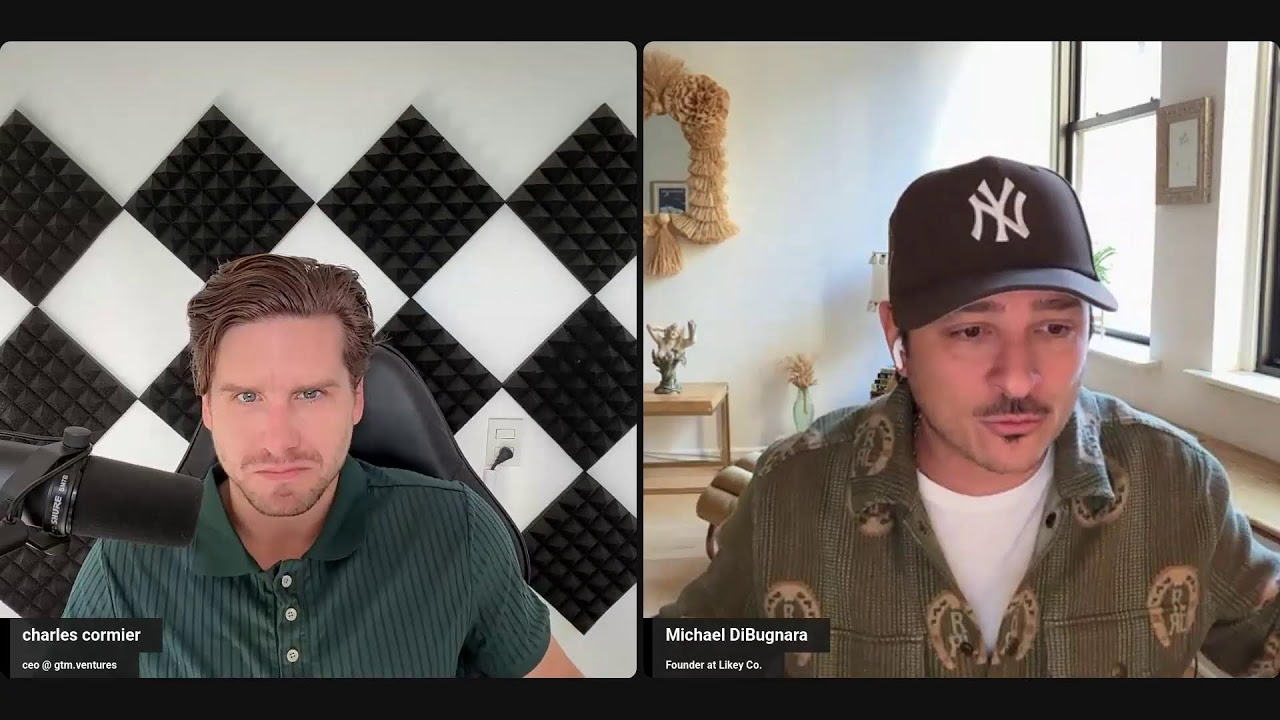
In this Founder Wisdom podcast episode, host Charles Cormier interviews Michael DiBugnara, founding partner and Chief Creative Officer of Likey Co., an experiential marketing agency based in New York. Michael recounts his unconventional entry into the marketing world, starting from a stint in commercial printing after college and evolving into a passion for creating live, immersive brand experiences. He describes the agency’s rapid growth from its 2018 launch, highlights a pivotal client relationship with billionaire Ron Baron, and explains how the COVID‑19 pandemic forced a complete business model pivot toward digital activations and influencer‑driven content. Michael details how AI has become an indispensable creative partner, enabling rapid concept rendering, real‑time client iteration, and enhanced ideation, while emphasizing that human cultural intuition remains a critical moat. He shares his day‑to‑day routine—early mornings, workouts, mentorship of interns, extensive travel, and the challenges of maintaining habits on the road—as well as the agency’s growth tactics, which rely heavily on referrals, social‑media showcases, selective paid campaigns, and a forthcoming website redesign. Looking ahead, Likey Co. is expanding internationally, securing high‑profile activations such as an upcoming Formula 1 event, and contemplating future scaling versus maintaining a hands‑on creative culture. Michael also reflects on New York’s unique creative energy, the importance of teaching emerging cultural trends to clients, and his personal motivations that keep him engaged beyond monetary gain. Contact information for Michael and Likey Co. is provided at the end of the episode.
Chapters
Welcome to another Founder Wisdom podcast. We have Michael DiBunyara with us today. He's the founding partner and chief creative officer at Likee Co. in the New York area. We're going to talk about agencies today, creativity, and the role of AI and founders in that crazy revolution we're part of right now. So Michael, welcome to the pod. Tell us a bit more about yourself and what you've been up to.
Yeah, sure. Thank you, Charles, and also awesome pronunciation of my last name. That is very rare for me when somebody nails it that way, so I can't tell you how— only if I'm out of the country usually somebody can pronounce it the right way, so I like that a lot. Yeah, but thanks for having me on. Yeah, so things are busy here at Likee Co. We founded the agency in 2018, and essentially experiential is back in a really big way because people are really back into trial in person. So, you know, we're moving and shaking with everybody else with this AI revolution of everything that's happening, like kind of changing in real time of how we approach projects and approach creating experiences for people based on that AI. So it's been a really exciting time adapting to that and, and kind of having to keep pace with it to keep up with what everybody else has got going on and how fast things are moving with it. But Honestly, really exciting. I'm having more fun now, I think, with experiential than I ever have because of it all.
Tell us about experiential, what it is exactly and how you got into it.
Yeah. So essentially, my career started at the horse track. I was at the races and I was finishing up college. And I met this guy who had a fancy watch and a fancy suit on. And he said, why don't you come once you finish college and come do sales for me? I said, well, what do you sell? And he was selling commercial printing and promotional products for the marketing world. So I went and jumped into that with him, and after 6 months he was bankrupt and out of business because he was gambling and spending too much of his money on, on horses and women and partying and entertaining. But it kind of got me into that world. And, and, um, you know, a friend of mine who— he jumped into it with me. We just started figuring it out on our own, figuring out how to kind of like sell these products to the marketing world. And I really always was interested mostly in creative services, even though my studies were in psychology. I just really was more of a creative soul and wanted to work in creative services. So the more that we produce products for people that were marketing, the more I kind of opened my eyes to how we could create things in real life that would activate and leave an impression on people inside of an experience. You know, in that stemmed from setting up events and, you know, materials that were at events to small things like guerrilla sampling in the streets. So I really kind of got an education early on from my clients that were doing this on the other side of things. And then I just slowly but surely started art directing more graphic design and kind of taking the leap into directing photo shoots. And I just would try my hand at everything I could possibly convince my clients to let me sell to them. And that's really where I got my education inside of experiential, just bringing things to life, which is how I really loved living my life. I loved experiencing things. You know, I thrive in travel. I thrive in being social and being out. And, you know, understanding that you could do something as a profession where you can like bring people's products and brands to life and leave an impression with them and give them something that's fun for them to do while that's happening, tasting something really good or being at an event that's really great or seeing a new technology somewhere that's really inspiring to them, that just really motivated me, and it still does to this day. So, you know, I've been doing this for a long time, and I think that with the evolution of technology and how that's changing things, I think people want to be in person more and more, you know. And I'm sure you see it too, Charles, and talking to all these founders and all these people, like this connectivity that we're all really striving to create with each other, I think it's just growing. I don't think technology is taking that away. I think, I think it's actually growing it.
So you got into it, I guess, because you— it was a natural extension of you. I was also, uh, sort of in that phase, uh, from what, like 16 to 19? Like party, party, party, right? Um, when did you actually discover that you could make good money from this?
I think the first real moment where I discovered that there was actually real money in it is I had this client And he was a billionaire. His name is Ron Baron, and he owns Baron Funds. And every year he rents out all of Lincoln Center, not just one building, every building. And he invites all the people that are— anybody who buys into Baron Funds, which is thousands of people that own, you know, probably more than that, that own his fund, they can come with a plus one to this event. And he takes every single building and he puts a different star to perform throughout the day. So you start at like 8 o'clock in the morning with breakfast, and you can go see James Taylor sing. You can— I've seen Lady Gaga, I saw Jerry Seinfeld, I saw Elton John. I mean, he strives to get the biggest and best stars in the world. For years he was chasing Paul McCartney and he got him. And I used to do a lot of the printing and the signage and hang the banners for it and the t-shirts for it. And I was watching this happen as I was delivering these materials, and I was like, this is incredible. This is one of the richest guys in the world, and his passion is to like create this event for people. It's not even what he does every day. He lives for this moment all year long. So I kind of of said to myself at that point, if one of the richest guys in the world, like, is more interested in entertaining and throwing, like, an exciting event for people, then that's the real get, you know? No matter how successful you could possibly become, if this is what you want once you have that success, and if you could do that as a profession all the time, then I just couldn't think of a better way to spend my time and, and, and to aim my career. So, you know, I spent a lot of time on the manufacturing side, on the production side for many years, and it just, it wasn't really Even though I was dabbling in photo shoots and graphic design, it wasn't scratching that itch enough. So in 2018, I founded LIKEY, and from there it's just been kind of, you know, there's ups and downs like every business, but it's, it's really been a dream to, to create experiences for brands all the time and, and have a voice in the room to like basically look at their brand and look at who they are and say to them, here's a really great idea of how we could amplify your brand and create something in real life that people can touch. So I, I think that's really
Did you struggle during COVID Like, how was that for you?
Oh yeah. So I mean, 2019 was like our really first like full year and we were off to the races and it was great and we were gaining the trust and we had some really great clients. We had Welch's Fruit Snacks. We did a tour for them, an amphitheater tour for them all over the country, which was amazing. We were doing sampling and I came up with this idea to do this ball pit and people were jumping into a ball pit and getting snacks and getting water and getting drinks. Max, and we had all these pop-up restaurants and all the stuff that we were doing. And 2020 was going to be incredible because everybody was starting to book all of these new ideas and all these new things that we were pitching. And I just thought it was straight up from there. And then as soon as COVID hit, every single piece of business that I had got canceled. I mean, it was gone in a flash. So any revenue, any income that we had, any, any employees that we had— we were staffing up, we were, you know, recruiting a lot of really great talent in a very short period of time. It was over. So I had to completely pivot. And the way that we pivoted was we told everybody, let us create these experiences for you in the digital world. And I always had an experience with dealing with influencers because I'm part of a restaurant project that had started sometime before that. And I was always bringing influencers into the restaurant project to kind of amplify. So basically I moved more into the influencer world, but instead of just saying, hey, I'll bring an influencer to just taste and say your brand is great, we came up with a lot of really innovative innovative ways for people to activate at home to try these products. Like, as an example, we had Sabra hummus as one of our biggest clients, and they were launching a kids line in the middle of all this, and they were losing so much share because airports were a huge place for their revenue, and they were really struggling. So we came up with this tactic of launching their kids line at home, and we created a game called Truth or Dare. And essentially, it was a game that families could play together to learn about, like, healthy food and snacking, and also laugh have fun, and then kind of create content that they could, they could, you know, post and publicize back on that. So the whole trick for COVID for me became, first I had to sell myself as a new experiential agency, and then I had to sell myself as a new content creation influencer agency. But it was terrible at first, but in the end, now I've kind of woven that into the fabric of what Likey is full-time. And now our niche is Not just creating these in-person experiences, but making sure that people understand that we're creating something that's photo-worthy, that's Instagram-worthy, that people could actually take and like, you know, publicize out on all of their social media channels. And for their investment of, let's say, doing a restaurant pop-up or branding a food truck, they could also gain content from that that they can use in their channels for people that can't be there in person. So, you know, as terrible as it was, it made us who we are in the end. And we became much stronger of a concept of who our agency was and our identity was based on it.
I'm guessing as a guy that's life is organizing events around humans meeting each other and socializing, it was a bit outrageous for you to see that the governments were blocking people for actually meeting each other and chilling and being humans, right?
Oh yeah. I mean, you know, as soon as COVID hit, I packed my family up and we got out of New York because I live in New York City and this is where I was. And it just, it felt like really constricting, and I just didn't want to be caught in the box of an apartment. So we drove down to Florida and, and we stayed down there. And, you know, even being in an environment like that, that was warm weather at the beginning, you know, people were so scared to do anything. We were wiping our groceries down. So I most certainly was thinking about like, what's next for me and my family? And like, what are we going to do? Like, is this the end of the world as we know it? Like many people were. Um, And now we're facing that again, right, Charles? We're facing that again with AI where people are like, oh, all jobs are going away, all jobs as people know it. It's what happened with COVID in a sense where we've got this fear factor in us that the world is going to change so completely now because something is affecting it. In that case, it was a very scary virus. In this case, it's a technology. And the same thing is happening now where people are afraid that everyone's going to lose their jobs and industries are going to change completely. There's going to be nothing left. But, you know, at the end of the day, we have to adapt and we have to change, or we're not going to survive no matter what comes down the road. And you speak to every generation, you go speak to your grandparents, your great-grandparents, your parents, every generation has these things that come along that change the world in one way, shape, or form. And you think this is the end, but, you know, we got to just keep adapting. Otherwise, you know, that's what makes us human. That's what makes us, you know— I mean, you know, you, you could say that AI, the intelligence of it, is going to surpass us in many ways. It probably will, because it's going to be able to remember facts and And, and contracts and, you know, replace those things. But the nuances of who we are and the nuances who human beings are and, and the resiliency that we have, I mean, that's, that's the strongest tool we have in our toolbox, you know, for each individual person as far as I'm concerned.
Yeah, the social part is tough to crack for an AI, the social cues, because it also has to do with like body language, right? So like technically need a robot that has physical knowledge and know-how. And I don't think that's about to happen for a while. So you have a moat for quite some time there. What about the creativity moat, right? Like, because an AI technically could be creative, it could try out new stuff, could have new ideas, it could take some polls data and be like, oh, let's try this because of this data. And I read this there. And I quizzed that person. And do you think Creativity can— is a human moat, or do you think it'd be replaced by AI also eventually?
I think for me, my experience thus far with it is it's become my greatest partner. I mean, it's essentially become an employee that's invaluable to me because, you know, let's say a client comes to me and they're like, hey, you know, we have this idea for this gallery that we want you to build and design and So I'll go into chat and say, here's the brief, here's the ask, here's what they want from me, and they'll come back with exactly what you're talking about. Here's statistics on how many views you can get for putting green color into this, or inviting it here, or putting it into the zip code. For all those reasons, it's great, and it'll give you ideas. Well, maybe you should call it this, maybe you should design it in this way. All those things are just, in my opinion, helping us have more creativity. Now, if you just take what they're giving you in that gift-wrapped box and you're presenting it to the client, that doesn't differentiate you, and you're not going to be Excellent. What makes you excellent is actually being open to taking all of the things that you get from something like Claude or ChatGPT and then adding your paint strokes to it, you know, changing the color, changing the size and scope of it, and not just for ego purposes, but to make it better, to make it more human, to make it more accessible. You know, one thing that, you know, I hold strong to are like these cultural signals and like what we watch, how people move. So, you know, artists, artists on canvas, singers, you know, chefs, all these people that create. I study that constantly and like what trends are happening inside of that. AI is never going to be able to, you know, they may give you a recipe, but they can't go into a kitchen and make you the greatest pasta dish you've ever had in your life. They may be able to say, hey, I want this abstract painting that's inspired by the Spanish Revolution, but you're not going to be able to get anybody but a real artist to do that painting. If you go into a museum and you look at just the shading on something, You know, there are things that we can do that I don't think can ever be replicated by a machine. I just don't think it. So I just think that it should be the greatest compliment for us, but that's how we have to adapt to it. We have to learn how to use it, and I think it'll make us more creative and it'll make us faster, quicker. I mean, Charles, if you said to me today, hey, I want to throw a party for my podcast, I'm going to invite all of the founders, all the people, we're going to have a Christmas party. You know, I would use AI to start a concept of where, when, and how, but I would look at you and who you are and, you know, your likes and dislikes. We would research into, you know, what's the style of you, what's the style of your podcast, what's the style of your guests. You know, I don't think that AI will ever be able to get these real human emotional signals and cultural signals to accomplish what we can as humans. I just don't.
Yeah, especially looking at you. You're like a New Yorker. You've been there for what, like 20, 30 years? That's so much data and cultural and social know-how, and it's so hard for an AI to replicate that. Tell me about New York as a city. Like, obviously you love New York, right? Like, what's special about it?
Yeah, I mean, it's so interesting because I'm from here. I was born here. I lived here my whole life, and I know diehard New York people. Um, my curiosity— I was raised by an educator. My father was a teacher. He taught language, and then he was a school principal, but he was really interested in history and travel. So, you know, even though we didn't have much, we always moved around, and that— he instilled that in me. So I've always traveled a lot and loved to see the world. And I just came from, uh, as an example, I just came from Madrid. Amazing city. Loved it. Beautiful, great walking city, amazing museums, great food scene. But as a New Yorker, you always go and you look at these things and you go, of course, on the plane ride home, you start comparing it to New York and just the energy of what's here. I've not found it anywhere else in the world. And I've been to some really great places. I just think that people come to New York to, you know, if you can make it here, you can make it anywhere. I think that just always really rings true. And I think that from a perspective of finance and art, and fashion and filmmaking. It's just every bit of that is here. And, you know, you keep seeing on the news that the place is going down, or you hear it's too expensive for young artists to move here. This has been the narrative my whole life. I've heard this even when this place was a disaster zone in like the late '80s and early '90s. It's just always been the narrative about it. And it's still always producing all of this amazing culture and finance and, you know, entrepreneurship. Like all of this is still coming out of this place more than I've seen in any anywhere in the world. So for me, there's nothing like it. I, I still have it on top of any place I've ever visited.
What's your day-to-day as an agency owner? What, uh, what is happening, uh, on a day-to-day basis? What habits you cultivate at what time, etc.?
Yeah, so I start early. Um, you know, I used to start early and make sure I got to a desk early. Now I start early and I throw the laptop on my lap in bed because I just want to like get these fresh ideas out in the morning and like Have that kind of quiet space to like work as much as I can before the noise begins. I usually try to fit in a workout after that so I can kind of like get my body right and get my mind a little bit clear and kind of get more clarity on that. And we usually in agency life start our calls like, you know, 10 o'clock is kind of one of the earlier call times for agency life, which is nice that that's kind of the norm. And, you know, I'll probably usually be on a decent amount of calls during the day, whether it be on ongoing projects or pitching new projects or things of that nature. We run a pretty extensive internship program. I love mentoring interns, so I usually carry at least 2 or 3 interns that I'm meeting with 2 or 3 times a week, you know. And then there's a lot of site visits and there's a decent amount of travel for that. So sometimes, you know, it's— we're working on the road, we're working because we're setting up somewhere else. I mean, we operate nationally and we're actually this year coming up, we're going to start operating internationally. So we're going to be Working on projects in South America, working on projects in Europe. So, you know, there's a decent amount of travel involved in it as well. So, you know, the routine has to fit that as well, because I'm sure you know this, sometimes when you travel, you just completely lose your routine and then you get completely thrown off. I mean, this trip that I just mentioned to you, I was in Marrakesh and then I was in Madrid. You know, you're— that was actually a vacation. But when you're on that, you know, you fall out of workout habits, you fall out of work habits, you fall out of eating habits. So— You've got to be able to rein it back in. But, um, I think that routine is really super important, and I'm kind of happiest when I'm in a routine and I've got everything kind of organized for myself. But with experiential, there's a lot because it's in person. So, you know, we're on, we're on the move constantly.
What's been the most challenging, like, post-COVID about running an agency like that? Is, is it constantly growing? Do you want to constantly grow?
You know, when I think about growth and I look at, you know, agencies, we have partnerships with some agencies, some of, some like big experiential agencies that will trickle work down to us if they, you know, that we have trusted relationship with them. Sometimes the projects may be too small for them and we're a smaller size agency, so they'll, they'll push that down to us. And I kind of look at the scope of who they are. So, you know, 100+ employees, offices all over the country. Yeah. You know, and they're obviously just trying to build to sell and to get a check at the end of the day and to get acquired by somebody else. I mean, I respect that business model. I think it's great. I mean, I do want to grow Likey to a point where eventually when I am tired of this, I will be able to sell it and take a check. So I like that. But I don't want to lose the ability to be across everything. And when I say across everything, I want to be across everything creatively. So I don't want my clients to feel like we've grown to a point where they can't access me or my partner. Because once we get to that stage, it's, it's, it's not the same reason why we went on our own to begin with. We went on our own to begin with to take projects we could be passionate about, not just passionate about scaling to make money and sell. So believe me, Charles, I like money. I love traveling. I love buying nice clothes. I love nice things. I love eating in beautiful restaurants. I love it. I don't want to not make money. It's just kind of secondary to me wanting to be happy doing what I do every day because I spent a lot of time in my career thinking I was chasing money and not being passionate about what I did. And now it's kind of flipped. It's flipped to I'm more passionate about what I do and money secondary. And to be honest with you, I make more money being passionate with what I did than when I was just chasing money. It just kind of happens organically when you like what you do.
Right. And growing such an agency, like what's your top of funnel? I must guess you Have a lot of referrals, word of mouth, but do you have like paid ads or AEO, cold email, LinkedIn outreach going?
So we've tried it all. And obviously referrals is my greatest source, which is nice, you know, and it makes you kind of lazy in a way with chasing everything else when referrals are coming in. When they don't come in, you start to panic and say, where else can I go? I utilize social media a lot. And I spend— I do paid on social media to kind of showcase the work that we do and have it speak for itself. That's a big one. I've gone down the path of other things like Google Words and LinkedIn campaigns and things of that nature. And, and, you know, LinkedIn is, is a place where I kind of have a little bit of a controversial opinion on it because in as much as I respect some aspects of it, a lot of it I don't. And a lot of it I feel like even like I did a paid campaign on there and I was like, why am I dropping into these people's inboxes unannounced? You know, what value am I offering to them just telling them that I'm an agency that they can come and work with? You know, most people that need a vendor or an agency or a partner, they're looking for that person. So right now we're in the middle of a website redesign that I'm really hoping is gonna be done soon. And I think that offering people value in what you do, sometimes it's they, they need to find you so you could help them find them. But I've kind of gotten turned off to the kind of cold call aspect of reaching out to people and, and telling them I could bring them value versus them finding me and, and, and finding value. So that's, I'm, I'm, and I'm usually utilizing, uh, chat for that as well and AI for that as well. To kind of look where I can push to have people find me and show that I can bring them value versus me kind of approaching them when they may not need me.
What's, what's new for the agency then? Like, you've been running it for 7 years. What's— what have you discovered as of late that is like eureka moment in terms of growth, in terms of managing client projects? How are you leveraging AI and agents, for example?
I mean, look, the, the first thing that comes to mind for me when you say that is I used to have an idea in my head of what I can bring to a client. They have a project, they have an idea of what they wanna build, and I would have to go off and try to build a deck and Photoshop some images and find a mood board to inspire them. I think the greatest thing that's changed for my agency is that when I have an idea now, I can literally create that rendering in moments. I mean, when I— and when I tell you, for 20 years looking at high-end rendering artists, and I feel bad for them because they're probably the ones that are really gonna be outta work, but waiting a week plus for a drawing of an idea that I had and then having it come back and not be exactly what I wanted to, I could spend 10, 15 minutes with a concept that I have on chat and bring back an image to a client of what this activation's going to look like and allow them to have their input and be like, well, you know, we don't really like using pictures of almonds on the wall or whatever it may be. I can change it while we're talking to each other in real time and alter it to the vision that we're cohesive on and that we both agree on. And it's, in my opinion, it's made us so much more successful to be able to give people back what they want in real time. It's revolutionary for our agency and it was always this stumbling block. I can't tell you how many times I did my best to give people a 5-page deck on one idea with images and paragraphs of me explaining what it was all about, and then they still didn't get it. People are visual. People want to see something and understand it, and they want to have their own input into that. And the fact that we can do that in real time now, I think it's completely changed the creativity of how people market, how people create, how people dress, how people build, how people— I mean, right now I'm using— I'm doing a renovation on a new apartment, and I'm using all of this to help me design the new space. Sourcing tiles from overseas and then putting it into a, a floor plan from an architect and seeing what it looks like in real life. I mean, it's amazing. It's, it's like being able to close your eyes and see something and dream it, and then you can show someone exactly what that looks like. It's a miracle for me.
Yeah, I love it. What's next for the agency then?
So we actually have a lot of stuff coming up before the end of the year here. We're activating at F1. We're activating a couple of things overseas for the first time, like I had mentioned. So that's kind of new for us that there's some big projects here coming at the end of the year because it's the end of October, almost into November. So usually by this time of year, like, things are kind of wrapping up, but now they're just actually still ramped up. So we're in the middle of trying to find a couple of new hires. We're in the middle of just still like hitting the ground super hard. You know, I usually like to shut down between Christmas and New Year's. I don't know this year if it's going to happen, but that's a good thing. You know, it's always good when you're busy, and I'm always really, really happy to be busy. So, you know, that's kind of like where our mindset is right now. And listen, I've owned businesses my whole life, so, you know, as a business owner, Charles, like, be happy when things are busy because it's not always going to be that way. Every business has its peaks and valleys. So I'm in a moment of like great appreciation that my biggest problem is, is that I'm working too hard.
And would that lead to an exit one day, or is that your life's craft and you, you can't ever like step away from it?
I mean, look, I am definitely the type of person that can enjoy his free time, you know. I love to travel, I love going to see live music and live performances, and I, I love to read. I love sports, I'm a big sports fan. I think I could fill my time without working. It's just I don't want to do that until I feel that the energy that I have on both sides is dwindled. Like right now, I feel a strong energy to do it all. You know that won't last forever. It doesn't last forever for anybody. So that's really how I feel like I will base. Like when is it time to? I don't need to to work and get the adulation of projects to for my ego to keep me going because quite frankly, most of the time when we create something, there's somebody on site at the project taking credit for it that had nothing to do with it. I haven't. Happen almost on every project. So, you know, I've had to put that aside. In the very— in the beginning, I was like, doesn't everybody realize that I designed that logo, or I picked that color for the wall, or I picked that person who's working here at the project? At the end of the day, you know, people want to kind of shine the light on themselves when they're working inside of things. So, you know, I've kind of learned to step away from that finally and let go of it and, and, and just give that to people. So that's not what keeps me going. I think what just keeps me going is creating. And I feel like it keeps you young to create. It keeps me around young people and young voices and, and emerging cultures and and teaching people that don't have that understanding that that's happening. You know, I can't tell you how many times there's a cultural thing that's happening and I'm putting a client onto it, and then they're on their phone looking at it like, oh yeah, this looks like it's really going viral, and this is going to affect how people look at records, this is going to affect how people look at the sky. And I like that. You know, it's a teaching moment. I have teaching in my blood. So, um, I think for as long as I, I enjoy that part of it, I'll keep going, and hopefully I'll just keep building it up so when I decide to stop, I'll have enough money so I could forget about it
Love it. Where can people find out more about you, Michael?
Yeah, so my Instagram is my name, so it's @michaeldibagnaro.com, and my company's website is likeyco.com. We're also on Instagram @likeyco.com.
So that's Michael and Charles for another Founder
More from Charles





Elizabeth Holmes and You Can See Everything: The Real Theranos Story Behind the A24 Documentary