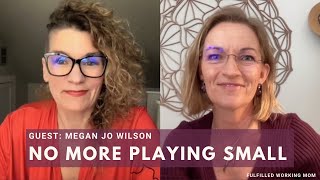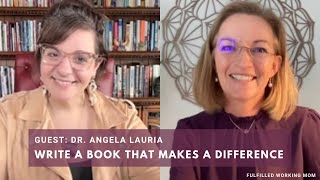
Dr. Angela Lauria, founder of the Author Incubator, talks about being fired from corporate jobs, her autism diagnosis, and building a business that helps people write impactful books. She addresses imposter syndrome in authors and what it takes to know you're ready to write.
Chapters
Hello everybody. Welcome to this conversation. I'm just closing this browser here because otherwise I'll hear my ego. Welcome to this conversation that we are recording live in the Facebook group, Fulfilled Working Moms. I'm your host, Charlotte Freeborg, and I am the coach for moms 45 years or older who wants to advance their career. For their own fulfillment without shortchanging their kids. Once a mom, always a mom. In Fulfilled Working Moms, we teach, we talk, we inspire on a lot of different topics we as moms like to know about to help us to create and have a fulfilled life while we also make money. And I love to have guests in here who are experts on different topics. And today I have a very special guest. She's been my coach for almost 3 years, I think, if not 3 years, and she helped me write 2 books. And yeah, Coach, we will talk about her expertise in a moment, but I just want to give a quick, more, um, like, official introduction. This is Dr. Angela Lauria, and she's the founder of the Author Incubator and creator of the Difference Process for Writing a Book That Matters. She has been helping people free their inner author since 1994, and she has helped over 1,000 authors.
I think it's close to 1,800, 2,000 now.
Yeah, right. In writing, publish, and promote their books. Angela is a Wall Street Journal and USA Today bestselling author of 5 maybe 6 books. Yeah, new one, new one. She has a bachelor's and master's in journalism and media affairs from the George Washington University and a PhD in communications from the European Graduate School and lives in Washington, DC. Angela, welcome.
Oh my God, thank you for having me.
I'm so excited to have you here. I've been wanting to do this for a while, so here we go. You just a few weeks ago, a month ago, released your 6th book. And that's when we talk about, let's have this interview. I would like to start talk a little bit about moms who may desire to start a business. You are a mom. You have been in business for many, many years. Any— could you talk a little bit about any moms who have that thought, have that like, shall I do it or not, but doubting if they can manage it all?
Yeah, yeah, yeah. I want to go back to the beginning because for me, um, I'm sort of an accidental entrepreneur. I had corporate jobs and, uh, we'll talk about this maybe a little bit more later, but I had a— while I had a corporate job, I would pretty regularly get fired and I would usually keep a job for about 18 months or so., and there would be like HR interventions and great bosses that loved me. It usually took that long to fire me because I, um, because I would make them lots and lots and lots of money. So I was usually in charge of the revenue and marketing, and so the results would be insane, but people— positively insane, um, but people would say I didn't play well in the sandbox. And I kept trying to fix that, like with the HR interventions and signing agreements and signing up for therapy and coaching and church and praying and begging. And I knew I didn't want to keep getting fired, but I knew there was something in me that I had to fix, like clearly, because I would blow things up and I didn't know why. And usually what people would say to me was like, Take a deep breath, center yourself. And I'm like, that advice is not working for me. And I didn't know why. And anyway, one day I had a 6-month-old, maybe he was 9 months old. Yeah, Jesse was born in February and it was December of 2006. I had my dream job and I thought it was going to solve all my problems because I was the managing director of my own firm. So I wasn't really— it was kind of like one of those intrapreneur roles. So this company was in Montreal, had been established for a long time, and they were having me run the American office. And for the first year, I was training in Montreal. So I had a newborn, and I was going every day to— every Monday to Montreal, coming back on Thursday. Like flying every week. My— I had my nanny and my husband home with the baby. I was pumping milk and I was sending it FedEx so the baby— so that my supply didn't dry up. I have literally pumped in every like airport bathroom, train station bathrooms, and a very high-profile job with lots of travel. And I would literally pump in meetings. I'd be like under the table. Yeah. And that was like a huge sacrifice, but it was like the best thing ever for my career. And then I got fired dramatically on December 18th, and they fired me over the phone. My lease on my corporate apartment was up at the end of the month. It was like up at the end of every month, and they said, we'll pay for your apartment till the end the month. It was December 18th, and I said, "Will you fly me up to Montreal to get my stuff and clear out the apartment?" And they're like, "No, get up here on your own." So I drove to Montreal, cried the whole way. My apartment was near the office, so I like found all the back roads to try and avoid seeing anyone. I was like so embarrassed and filled with shame and just mortified. I packed up my car, I drove the whole way home.
It was pouring.
I went to get gas at this gas station, I think it was like in Vermont or upstate New York, and it didn't have like a cover. There was no awning. And so I had to get out of my car in the pouring rain, and then I had to drive the rest of the way soaking wet. But I was like on empty, so and it's the middle of nowhere, like middle of nowhere country, Vermont, whatever. And I get outta the car, I'm standing in the rain, I'm pumping gas, I'm crying. And I was like, I will never work for someone again. I cannot, the humiliation. My baby was not verbal yet. He was like, you know, 9, 10 months. But all I could imagine was the humiliation of having a 5-year-old or a 10-year-old or a 15-year-old watching their mom get fired like that. Yeah. And I made this decision standing in the rain in the middle of a gas station in the middle of nowhere. And I was like, I have to figure out some way to never get fired again.
I— yeah.
And that's—
I just want to add something here because that's something I know both you and I are on fire to change the system here. Like, why not? Give a mom in a situation like that a time, like some time to figure out what's next instead of just— that's so wrong.
Oh yeah, and I was like missing Christmas too because it was December 18th, so I ended up like Christmas got messed up, presents got messed up. I've been like driving, filling my car, it was awful, it was so awful. And I later— that was 2006, so it was probably about 5 years later I ended up having the same thing happen. I was in a coach training certification program, and I had decided I was going to become a life coach. I actually decided I was going to help people write books, which is what I had been doing. And a lot of the people I was helping write books were life coaches. So I joined a life coach training program to, like, understand coaching better. And I basically got fired from my coaching program. And I did end up finishing my certification, but it was the same thing. It was like I got fired. I'm like, how am I getting fired again? Yeah, I, and I didn't understand it. And I finally got the help that I needed, which is I was diagnosed on the autism spectrum.
Oh, which I wanted to talk to you about because this is something that is why I kept blowing—
I mean, it's not why, but the challenges that kept repeating, that therapy wasn't helping and church wasn't helping and having great bosses, which I did have a lot of great bosses, even great female bosses. Like, I had great bosses. Nothing could get me out of this. And once I got that diagnosis, then I was able to start getting the right tools that matched with my neurology instead of tools that matched with other people's neurology that weren't working for me, like just breathe. Right.
Yeah. I like that. So, and here's the thing, many bosses have to work under a system, so it's not always about the boss or that person, but what they have to navigate within. We have to remember that. Where, where do we— where's the root for, for— yeah, we need to make the change. So, so I hear in what you say more freedom by being a business owner.
Well, I think for me, a lot of people, especially as moms— and I was also going through a divorce at that time— so on the one hand, the number one most important thing for me as a mom was to provide my child stability. Which is why I didn't want— I mean, not that I didn't want to be an entrepreneur. I didn't even think about being an entrepreneur. I thought about getting a good job, getting raises and promotions and opportunities. And I'm like, I have to fix whatever this thing is that gets me fired because I know I'm the smartest worker in the room, but I need a good stable job. I remember around that time, not, not exactly then, but at one point, like, applying for government jobs. Because I went to usajobs.com and I was like, maybe if I get— I actually did take a government job for 6 weeks. I got fired. Um, it was not a good fit, but I was like, I just need a stable job. If I'm going through this divorce and I'm going to be a single mom, I have to have a stable job. And then I kept getting fired, right? So I had this revelation that day of the only way to have a stable job is to be an entrepreneur. The only way that I can know I'm always going to have money every month to take care of my child is if I go make that money myself and I don't put my life into the hands of a corporation that could just fire me, even if they do have good reasons, but, you know, whether I did something wrong or they're just not— they don't have business or whatever. But I needed to be 100% responsible for my money and taking care of my child. So having a business and becoming a business owner, for me, especially with my personality and some of my neurodiverse challenges, but having a business was the only way I could think of to support my kid and be the kind of mom I wanted to be.
Yeah. And I, I want to thank you for sharing about your struggles and how you experience being a person on Earth with autism and what that means and how other people can better support people with differences. But I think this is something I know from being in your community for a while, that everybody are different, right? And we can design, we can design, you create a structure, but we can, you write, we write a book with a structure, we can create a business with a structure. But within that framework, we are individuals, right? And one of the things that I have studied for a while now is Human Design. And as I open up to that, I remember in the beginning, I'm— we're so different in our Human Designs, me and you.
Yeah, we should do a little crosstab.
We can do that. We can do that offline here, or maybe online sometime. It's fascinating. But we don't have— we can't— we can, but we can still like feed off each other without being like the other. That's the beauty of it and how we can. Yeah. So I want to— so I would like you to share about, since we talk about moms with maybe with older kids, just, you know, deciding what's the next step. When do you know you are ready? Let's talk a little bit about books. When do you know you're ready to write a book.
Yeah, I want to talk about older kids too though because I have a thought on that one. So my kid is now 16. So when I started my entrepreneurial journey, uh, Jesse was like 10 months when I was fired. It took me another 3 or 4 years to start a business really. I was doing freelance ghostwriting, stuff like that. So I started the Author Incubator you know, when he was a little bit older. And one of the things I love about what I do is I help entrepreneurs write books. And one of the really fun things was Jesse, actually my son, when he was 10, he wrote a book, which was very cool having him experience that and see entrepreneurship in action. I have a lot of events at my house. He knows a lot of my clients. They've watched him grow up. Um, and now we're looking at colleges. We're actually coming down to Florida. That's, uh, I was up late last night booking a trip to Florida. He wants to look at University of Miami and University of Florida, I think. So we might, might know when you're here down there. Yeah, exactly. Um, so, uh, having him really understand the pros and cons of entrepreneurship having lived with a mom who had a business is really interesting as he's looking at majors because everything he's thinking about includes entrepreneurship, you know, some aspect of it includes working with entrepreneurs, and it's interesting.
It reminds me of— I stayed home for years with my kids after we moved to the US in 2006, at least 8 years, I stayed home full-time active. I'm a generator, so I always do things. But I remember what I went through, that what will my kids say? Will they feel I let them down or forget them, or I'm not caring as much about them if I go full in and start a business and all that? And actually, it was the opposite. I remember each of their reactions, as different they are, they were excited about it. It was like, 'Yay, Mom!' So I think that's— yeah, like, by doing that, by depending on how— what our strategy is, like, you are responding to, to things, right, with your design. But as we do that, we can inspire our kids.
Yeah, I, I do think it's very empowering, and I think we're moving as a society certainly to more more business owners, more people having control of their schedule and contributing work to bigger projects. But the path of being an employee is just one choice now. It's not like the only choice, and you're a crazy rebel if you have a business or freelance company or whatever. For me, books, my first love, books were always an escape for me. I wrote my, you know, I wrote books as a kid, wrote a book of poetry when I was— started it when I was 7. I think I finished it when I was 10. I wrote a book when I was 13 that was like young adult fiction. And when I graduated from college, I got a job for a New York Times bestselling author. And from there, never thought of myself as a business owner, never had a website. I had business cards. Um, but I never did anything to promote myself. I never took out an ad. I never did anything, but I went from one book writing job to another. I wrote a lot of tech books, so a lot of my jobs that I got hired for, they would hire me as a ghostwriter. I'd write a technical book, and then they'd bring me on full-time to promote the book and get leads for their software company. I did a lot of books in politics um, when candidates would run, I would ghostwrite books for candidates. So I had a pretty— and then I spent 3 years doing the weirdest thing in the world. I don't know if we've ever talked about this. I wrote books on the Y2K problem from like '97 to 2000. Do you know what the Y2K problem is? No. But the whole idea was when the computer dates rolled over to 2000 all the computer systems were gonna shut down. Oh, it didn't happen, but I spent 3 years of my life working on that. That's how I got into tech. Anyway, I always— wherever I went, I would always get these book writing projects. And I later came to learn that that's what it looks like when you have— my friend Rachel Tallatin calls it a god job. So if you're like pushing for something and it feels really hard, or you're like, I should be a doctor, but you hate med school, that's probably not what you're supposed to be doing. Yeah. But no matter what I did, I would get book writing. I'd be standing in line, I'd get book writing jobs. I would take a class. I took a sign language class. My sign language teacher hired me to write a book. Like, no matter where I went, I would get these jobs helping people write books.
Clear signs.
Clear signs. Yeah, they were like super clear signs. It took me a while to catch on. So then when I started the Author Incubator was when I decided to accept this is what I am on the planet to do. This is my dharma, to help people write books.
And you're so amazing at it.
It is my thing.
It just— yeah, it is your thing for sure. How do you see that? Actually, I want to talk about that. I want to talk a little bit more about that, but when we are ready for it. But I also want to talk a little bit because we have hung out a lot with Marianne Williamson on many, many, many, many hours, like during COVID And one of the things that— because what I want to get into is about being ready, being brave, like hearing that, getting into the correct— because there's a lot about that transition, like, okay, shall I do it or shall I not? Like, yeah, this is something she talks to. And one of the things that I like about her is, I mean, She clearly has been on the platforms for her entire career since she was very young. So there's that both end. She talks into let's get over ourselves and get the things, our messages out in the world. And then there's that both end. We also have to be ready. We have to been through the, like, whatever we want to share and be an expert about or write about or help others with, we gotta have to heal those wounds, to authentically talk about it. I know this is something you work a lot with your clients about, getting over the, like, who am I to do this? So there's that, like, break through that thing.
Can you talk a little bit about that? So when I started my company, I had worked on 56 books and I had ghostwritten 29. So the total was 56. 29 is a subset. I definitely did not in any way feel like a book writing expert. I felt like a girl who stood in line for shoes and randomly people gave her book jobs. Like, I majored in journalism. I maybe felt like an expert on how to write a newspaper article. But even though I'd done 56— you know how many people have worked on 56 books? I— there are a lot of people who write a book with me and then start a book coaching company, and they've done like 2 books, or they work for me for 3 months and start a book coaching company. Like, when I started, I had worked on 56 books and 100% felt like an imposter. I'm like, people any minute are gonna find out I know nothing about books. So when I see people write 1 or 2 books with me and then they start a company, I'm like, well, that's fucking obnoxious. Like, I was mortified at 56 books, like, that it wasn't enough. And so when I started my company, my first book, uh, my first book, which is right here, it's called The Difference, which I do need to update— 10 Steps to Writing a Book That Matters. Actually came out almost 2 years after I started my company because I was so afraid to write down how to write a book. And then I thought people would read it and be like, this girl has a book company, this is her advice on how to write a book. Now at that point, I think I'd probably done another 30 or 40, but I was probably close to 100 books. Books before I wrote my first book on how to write a book and was so nervous, so nervous. I invented this process called 3 Days to Done, and I wrote that book in 3 days. And the reason why is if I gave myself another minute longer, I would have quit. Like, I had to gather up my courage and just like Yeah, right. Spit it out on the page.
So yeah, and I know that's what you're so good about supporting, like, whenever that— because it's, it, it will come, that doubt, it will come. Like, we're humans, so we cannot not have that doubt.
And I can't believe now, looking back, especially seeing how many people with no experience have gotten into the book coaching space, because I guess you don't need to know anything to do it. Um, I can't believe at 56 books I was like mortified every day that people were gonna find out I knew nothing and I was not an expert. Wow. Yep. Wow. So it's very interesting, like what I would say to me now at when I first started is write your book right now. You've done it 56 times. But at the same token, when I see someone who's written a book with me and not done much else, and then they start a book coaching company, what I would say to them— like, I get a lot of people come to me who want to be business coaches, and the reason why is they're not making any money in their business. Like, so I see actual imposters. Yeah, all the time. The industry is filled with imposters. I think your imposter syndrome is the best thing you have going for you. Because let me tell you, if you work for me for 3 months, then you start a book coaching company, you are what an imposter looks like. That is being an imposter. So, yeah, I— or did one book with me and started a coaching company, like, that is being an imposter. When you have actual experience, yeah, being able to see it can be hard. I couldn't see see that 56 books was experience. I'm like, yeah, but that one doesn't count because it's just a computer manual, and these 10 don't count because they were all in the Y2K problem, which wasn't really a problem, and this one doesn't count because I was only making $10 an hour on a re— as a research assistant. It— none of it counted. So this is why I think people need coaches and why I think the work you do is important. And even, um, you know, even things like Human Design or other personality quizzes, is job number one is identify where you are not an imposter. Yeah. If you're feeling like an imposter and you've done 56 books, you are missing the point. If you feel like an imposter and you're trying to sell someone else's program with your name on it, you are an imposter.
Yeah. Finding our strengths and finding where we have experience, where we are authentically can show up and help someone else. That's—
yeah, yeah, yeah. Like, where— what have you actually done? Because you've done something.
Yeah.
If you're alive on the planet and you're, I don't know, over 25, you are an expert in something.
Yeah.
It might be really small. It might be something you could only sell for, I don't know, $20. Yeah. But there is something you know how to do. I was It will not surprise you to find out that I was the top Girl Scout cookie salesperson for 3 years running for the Girl Scouts cookie drive. I have my Girl Scout cookie badge. That was, I think, 6th, 7th, and 8th grade. Might have been 7th. Yeah, 6th, 7th, and 8th grade. I was the top cookie selling person. By 9th grade, I for sure could have taught a class on how to sell more Girl Scout cookies. I had done it. I won the award 3 years in a row. Like, I had real experience. Now, is that a $100,000 a year coaching program? No. But could I have done a $10 class? Could I have gone to all the Girl Scout troops as a 9th grader? Could I have reached out to all the Girl Scout leaders and said, hey, I'd love to come, my speaking fee is $10, I'd love to come teach your Girl Scouts how to sell more cookies?
Yeah.
So I think people look for— I know what I was— I'll speak for myself— what I was looking for that day in the rain at the gas station, because one of the vows I made at that point was I was going to be a personal injury attorney who was going to go to law school and be able— anyway, I was looking for what do other people see as an expert? What's the certification I can get that will make me an expert? If I go to law school, then I'll be an expert. If I incorporate a company, then I'll be— what's the external thing I can do? So I felt like an imposter because I didn't have that external. If I looked internally, I could be like, oh, I worked on 56 books. That's pretty fucking impressive. Yeah, but it had to do with—
but it's also having that coach next to you that will remind you, like, and that whenever you fall off the wagon, hey, Yeah, remind me who you are.
Yeah, I— when I was trying to figure this out, um, I was reading— it's a great book, it's called Finding Your Own North Star, it's by Martha Beck. She has all these activities in it, and, um, one of them is name 3 things you lose track of time doing.
Good.
And my answers were like Talking to friends about the meaning of life, uh, reading self-help books and meditating. And I was like, but this is not a helpful exercise because that's not a job. Like, I'm gonna read books, that's not a job. That's so good.
I think that doubt comes through. That, that's not a job.
I'm like, this is a stupid exercise, that's not a job. And I like blocked it. I went back and read it like years later, and I'm like, ah, it was right here. Write books, talk to people that care about philosophy, meditate. Like, that is exactly my— just like my job description now.
Yeah. So, and how many have heard their parents and others say, no, you can't do that, that's not a way to make money? That's so good. Time flies. And there's so many other things I wanted to talk about. I have— I want you also— I have a few more questions, like quicker ones, And then I want you to share where people can go and find you. But maybe work with me.
I'll be good. I'll be short-winded.
So I want to— this was just great. I want to know, do you actually know how many books you have read?
How many books I've read? No, but—
I know you at least have read about 2,000 books that you are authoring.
Yeah, yeah, yeah. It's got to be close to 10,000. It's got to be close to 10,000, but I do— most of those were in grad school. I think most of those were in a 2-year period. They tortured me in grad school.
No, but I know you always read, and I mean, I recently had the honor to do a workshop in your— one of your homes, your apartment. I mean, there are always books out, right? Every one of those. And I also heard once—
I have read every one that you saw in my apartment. I've read every— except for there's some decorator books. I haven't read. Right. But except for the— even those I have read, a few of the decorator books.
But also, I remember one time you mentioned something like you eat words. I love that. It's like, oh, that's how she can— because I'm very— I'm not a fast reader because I process with all my definitions. But you said I eat words, so I can totally see that.
Like, it's a very weird— it's a very weird way that I read. Because I don't know how to explain it, but it's like I read the whole book at once.
Okay.
I always read books in a single setting, in a single sit-down.
Oh wow.
Yeah, sometimes it'll be like over the weekend. I very rarely like shower when I'm reading a book. Like, there will not be showers involved. Like, it— like, when I start a book and when I finish it, there is no shower in between. Oh wow. Um, and it's like I can holistically consume a whole book. Sometimes I read it out of order, but then my brain can put it back in order. I almost always start with the end. I, I read for structure. I, yeah, I'm a very weird— and then I'm just a speed reader, so most books will take me about 2 hours to read. Philosophy books will take longer, but it is. And that I do think is a part of my neurodivergence, but also grad school, because I had to read hard philosophy books one a day for years.
Yeah.
And I just had to find another way to read. So I don't read— I don't read sentences. I eat books.
Yeah.
I devour them.
Yeah, you eat the words. Eat books. That's not the worst thing to eat.
It's somehow I don't have to read the words. I can look at them and they go into my head. I can look at a whole page. Yeah. And then absorb it without reading each word. And if I like what I absorb, I might slow myself down.
Fascinating.
Yeah.
Fascinating. Well, we could talk about that. Now I'm just thinking that you're also very open, so you're very receptive. So fascinating. I did have one question because I actually offered others to tell me what question to ask. And this is actually from my daughter. She asked if there was one book that you— she asked me to say, what is the— no, wait a second. She asked it in a way was like, that didn't make sense, but she's way better in English than I am. So it's Okay, I know I don't— I wrote it down, I can't find it now. So she said if there was one book you were— you wanted to read again like it was the first time, like, you know, when you have— she explained to me when you have that experience, like, yeah, yeah, yeah, yeah, what book would that be?
You know the answer to this one. A Return to Love.
Oh yeah, yeah.
It was funny, last night I was on the phone with Marianne at like midnight and we were talking about something, and so much of— if you guys have not read Marianne Williamson's A Return to Love, just turn this off right now, go to the bookstore, buy it, do nothing. If I could read that book for the first time again, I've read that book so many times. Anyway, I didn't realize how much of my program, even the Creativity Temple, like, so much of my program is quoting that book. The Creativity Jumbles, Marianne, it's all like, so much of what I do is based on Marianne's work. And now, how crazy, we're friends. So I was having a conversation with her like I would with any friend last night and began quoting Marianne to Marianne. I'm like, you know what Marianne Williamson said? This is so bizarre. Oh, I love that. Yeah, it is so fundamental. That book is a part of me. Like, it's not even a— it's so fundamental to each cell in my body of how I have made sense of the world and structured the world. And I remember Not that I would wish I would discover it now, but I remember the moment I discovered it, and it was like, oh, the whole world makes sense. Oh, why did no one tell me? I was 21, I think, and it was— and I'm still learning. I still— I'm still learning that book. Like, it's still— it's still unfolding. But it was like I suddenly understood the world, and there was so much freedom and joy in that moment that to have that experience again, which I think is what your daughter was getting at, is just to like— if I could find a book like that now that would help me make sense of this moment in time that I could read and be like, oh, the whole world makes sense now, that would be fantastic. Mary Ann is working on a new book. I hope it does it. But I've never had that experience.
Now you are helping your authors bring out— so I guess that was the platform, like a heavy, like solid platform for you now to be able to do the work and lift other— your authors up.
And yeah, what you get from most books or movies or TV shows— for me, the movie that I would say that I would love to see for the first time again is Dead Poets Society. That's my favorite movie of all time, um, for a very similar reason. And most movies you see, like good movies, or most books you read, like good books, you get— and most of the books we publish, you get like, that's a good idea. You get like a little— yeah, a little something something. Yeah, nice. You're like, oh, I could do that. Oh, that's a nice idea. Oh, I like that turn of phrase. Yeah, but most books and movies won't shift all of the molecules in your world, and that's where it's like, oh, I love that.
That's what happened for me. So thanks for sharing that. I have one final question before we want you to share where people still go and find you, and that's a question I ask everybody. Time is flying together here. That question is, what is your definition of fulfillment?
Oh God, that's changed so much. Um, so for me, what fulfilled used to mean, um, was increasing levels of responsibility and being able to meet those challenges, like new challenges and being able to meet them. And that was pretty consistent for me until the pandemic. And now that— and we've talked about this, um, because it was partly inspired by Danish culture— but now for me, what fulfillment is has much more to do with intimacy, coziness, connection, being seen. Uh, I used to be like climbing a ladder, and now it's more like a cup of tea in front of a fire. So like, even with my kid, and maybe it's because he's 16, but my relationship with my kid was always like wanting him to do better and wanting him to achieve and be successful and overcoming obstacles. And now I just like want to be able to have a nice conversation over dinner or planning this trip to Florida and driving around. Like, so intimacy and coziness and really being seen is for me where I feel most fulfilled.
It gives a sense of we are connected when we go to that level, right? Like we are connected, we see each other, we value each other.
Yeah.
And we can only do that by slowing down.
Yeah, yeah, yeah. I think that's the big lesson of COVID for me is like to be fulfilled doesn't mean you always have to be chasing the next brass ring.
Right.
And you can do it your way at your pace. Like, I've slowed way down to just be able to hear and feel more what I want. Yeah.
And we can choose when we do it. We can choose when we do the goal.
I also think there's seasons, right? Like, sometimes being fulfilled— and I'm sure this will be the case for me again. Sometimes being fulfilled is going after the next thing. It is the hero's journey. It's the whatever, going for the A or trying to get into Harvard or trying to get a job or whatever all those things are. And sometimes it's slowing down. And only you can know what season is your season. And all the social media— I think that's why social media is so hard. Because you're like, well, she's going for it, shouldn't I be going for it?
Yeah, but that's really— that's what's so— because that's what I'm so much about. Like, let's create like our own daily structure and rhythm within the bigger life rhythm. Where are we right now? Let's design life right now so it fits into— if we want to write a book, and I want you to talk about, you know, share whatever you want people to go, but whatever you want to do as the next thing, how do we make that work? You know, so also can have that coziness and connection, but do express ourselves, but do what you talked about earlier, what other people might have told us we can't do that, but maybe we can.
Yeah, yeah, yeah, yeah. So one of the things for me that I've been seeing for the last 2 years, um, are a lot of people in the online marketing space doing these challenges. The first one I saw was called 75 Hard. Have you ever seen 75 Hard?
No, but I've seen a lot of challenges.
Okay. This one is a 75-day challenge where for 75 days you work out twice a day. No excuses. Oh, one of the workouts has to be outside, even if it's raining or sleeting or hailing. You have to drink a gallon of water. You have to read, I think it's like a book a week. And there are 75 things I think that you have to do. I don't know. It's, it's this list of things. And when I first saw it, I just looked at it. I mean, I, a bunch of my friends were doing it. They're like, hey, you want to do 75 Hard with it, with us? And my brain was like, yeah, like if somebody invites you to, you want to do a marathon, you want to do that, like I was like, yeah, this looks fun. And then I looked at it and I'm like, Jesus, no, I don't want to do— no, there's nothing in me that would like to meet that challenge. No. And, and that one is an easy one because it's so hard that it's kind of like easy to say no to. It's not like the challenge is walk for 5 minutes for 5 days in a row where you kind of feel like an asshole if you're not willing to do that. Right. But I've seen there's so many challenges for everything. The green smoothie challenge, the upside down yoga challenge, the whatever. And I have been so— I'm like, I don't need any more challenges. I don't want— yeah, I don't want that. So anyway, that is what happens when you see these outside influences, whatever. Girls on Instagram in bikinis, or now everybody's on TikTok, or now everybody's on Clubhouse, or now that you're like, I guess I should be doing that. But we don't know how to ask ourselves, do you really want to do Clubhouse? I mean, if you want to do Clubhouse, by all means do Clubhouse. I'm not against challenges or Clubhouse or bikini pictures on Instagram. Like, I'm for all of it. But I think it's hard for— harder in this environment for us to listen to ourselves about what we want.
Yeah, yeah, it's important to know our strategy.
Yeah, yeah, it's important and it's hard and it gets harder.
It takes practice and discipline.
Yeah, you know, Maryam and more talk about like, did you meditate this morning? Which sounds very frivolous, but if you don't do that— oh yeah, it's so much harder to be like, I guess I should be doing a challenge, I guess I should be doing TikTok, I guess I should What do they call that? Shitting all over yourself, right? Yeah.
Yeah. So good. Angela, where do you want people to go? Where do you want— Yeah.
Well, I am not doing a challenge next week, but if you are watching this live or soon enough, from April 4th to April 8th, I am doing a free week of book coaching. So you can be my book coaching client for one week. Me and the whole team will work with you on design, coming up with an idea for a book, designing your outline, coming up with a publishing plan and a marketing plan. Uh, it is called the 5-Day Book Launch. So in 5 days you are going to be ready, uh, not to launch your book into the world, but to launch your book project for yourself. So 5 days you'll be ready to write your book. Every obstacle will be removed.. And, um, you will know how to write your book in 3 days. I, you mentioned I have a new book that came out called Be Happier Now. This is that book. I wrote the whole thing, wrote and published everything in about 2 weeks.
Wow.
So you will be able to move very quickly when you've got the right plan in place and you know it's aligned with you. And you may at the end of a free week of coaching be like, oh, I don't wanna write a book. That sounds hard. Or you might be like, that is exactly what I wanna do. I'm going all in and very quickly get your book done and out in the world and making a difference. So I am leaving nothing on the table. I will treat you like a 100% client, just like I've treated Charlotte for 1 week. You get me as your coach, but you gotta sign up at 5 Day Book Launch.
And if you are in the Facebook group for Food Working Moms, we'll drop the link below there.
And, uh, yeah, maybe we'll find out what is your medicine, what is your actual expertise. We'll manage that. My answer to imposter syndrome is don't be an imposter, and we're gonna find a way. Maybe it'll be a book about how to sell Girl Scout cookies, but we will find what your expertise is and we'll, we'll make a book plan, and it could be a fun 2022 project.
I love that. Angela, thank you so much for— okay, now we only need to keep talking for 4 more hours.
I have so much more I want to share, but I love this group, and I'm in here, so if you comment, I will comment back.
Yeah, comment. And if you watch this later anywhere else where we shared, you can still leave comments. We will, yeah, reply. But thank you, Angela. Maybe we can get you more time to chat another time.
But fantastic. Thanks for having me. Thanks, everybody. Bye.
More from Charlotte

You are not stuck.You are being asked to listen.#innerauthority #selfawareness #growthmindset