11 Lessons From 11 Years of Podcasting
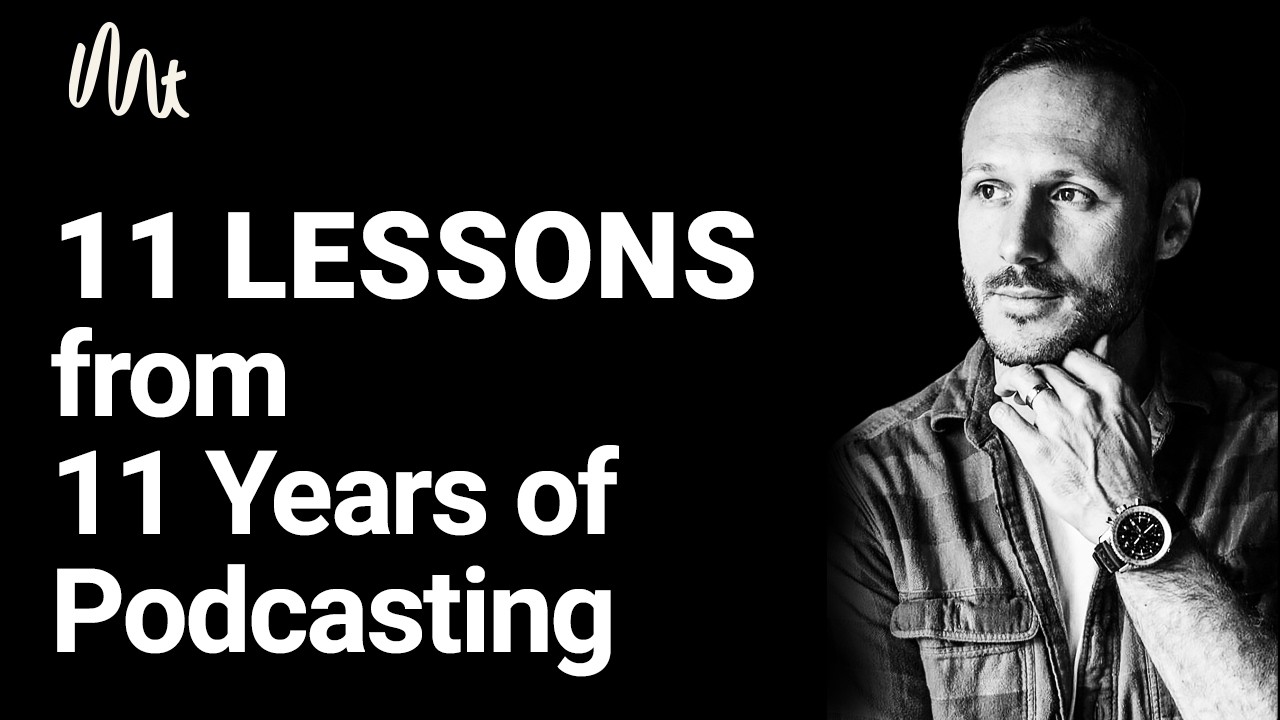
In this solo ManTalks episode, Connor Beaton marks the 11‑year anniversary of his podcast by sharing eleven core lessons he has distilled from a decade of producing weekly interviews and solo shows. He opens with a candid account of his humble beginnings, the lack of a breakout moment, and the value of slow, incremental growth that eventually placed his show in the top 0.5 % of podcasts worldwide. The lessons cover: (1) confronting avoided challenges; (2) building systems instead of relying on willpower; (3) regulating the body before trying to fix the mind; (4) insourcing self‑worth rather than outsourcing it; (5) earning respect through self‑respect, not external approval; (6) prioritising repair over perfection in relationships and parenting; (7) recognizing that anger itself isn’t the enemy, but suppressing it is; (8) practising relational leadership through containment and direction rather than control; (9) understanding that purpose is built, not discovered; (10) healing cannot happen in isolation – pain needs witnesses; and (11) accepting that a man is never a finished product. Throughout, he weaves personal anecdotes (e.g., the Real Talk Summit with Gary Vaynerchuk, a morning conflict with his son, moving his family to Colorado) and references to guests such as James Clear, Dan Millman, and Thomas Hubl. The episode blends memoir, motivational advice, and practical self‑development tactics for men seeking growth in personal, relational, and professional realms.
Chapters
11 years ago today, July 6th, 2015, I released my very first podcast episode. 11 years. I didn't really know anything about podcasting. I didn't really know anything about how to run one or operate one. They were still relatively new. I had never actually even listened to or subscribed to a podcast. But a friend of mine that was working with me at the time, Mr. Roger Nairn, who was absolutely phenomenal. I trusted him, said, "Dude, you need to start a podcast." And so I did. And here we are 11 years later with thousands of interviews. I have released an interview every week for the last 11 years, and I have released a solo episode every week for the last decade, for the last 10 years. 11 years later, thousands of episodes, 8+ million downloads, and sitting across from some of the world's smartest, most incredible people. I mean, I've interviewed some of the top therapists, psychologists, some of the top entrepreneurs and athletes and bodybuilders. It's just astounding what this particular avenue of podcasting has brought. I have gained so much wisdom and insight, and I thought, how cool would it be to celebrate 11 years of podcasting than sharing with you 11 of the biggest lessons that I have learned along the way. And these aren't 11 lessons about podcasting. These are 11 lessons, sometimes from the guests that I've sat across, but also 11 lessons that I've learned in just producing this show, that I've learned about myself, that I've learned about business, that I've learned about being a human. And so today I wanted to share some of those lessons with you. Because my goodness, there have been a lot. As always, I'm Connor Beaton. This is the ManTalks show. If you are not subscribed yet, please do. Please hit the like button. Please subscribe. And don't forget to man it forward because that's how the show grows. The first thing I want to say before I even get into the big lessons, I want you to know that I never had a kind of breakout moment. I never had a hit it big moment. I've been doing this show for 11 years, and for 11 years, It has been slow, consistent, steady grinding. It is the unsexy type of success that almost never gets talked about, right? You see the, you know, the Jay Shettys and the Joe Rogans and the Chris Williamson's and the, you know, whoever it is and their shows. And this is not to knock them, okay? Joe Rogan's been around for a long time, but it's not to knock them, but for most of them, they started producing their show. And within a couple of years, their show really took off. And that wasn't the case for me. For the first couple of years, it was a grind. You know, I was getting a couple thousand downloads a month. You know, obviously, when I first started, it was a couple hundred downloads. But why I'm saying that is because I don't want you to get this idea that, you know, certain things in life are just going— you're just going to hit it big. And I think a lot of people, including myself, when I first started this, I was like, oh, I had this lottery mindset. I'm going to hit it, right? This show, I'm going to have this guest on and then the show's just going to hit it. And there's going to be this inflection point where all of a sudden it blows up. It's going to be this big thing. And that, that just hasn't happened. And I'm actually grateful that that hasn't happened because it's taught me a lot about who I actually am and how I actually operate. And how I operate is the kind of jaguar in the background, the leopard that's slowly stalking its prey, the person that's putting in the work and putting in the hours that is silently just getting incrementally better every day, every week, every month, and every year. And that is more my style. I probably won't ever have the big breakout moment with the Man Talks podcast, and that's totally okay. Maybe it will happen, but that's not really actually important to me. The main thing that matters to me is this experimentation of incremental growth. And incremental growth can sometimes turn into exponential growth. But often, more often than not, incremental growth is just incremental growth. It keeps growing, keeps growing, and it gets bigger slowly over time. And that's what I have experienced every single year, pretty much every single month. If you look at the stats for the Man Talks podcast, which I am now in the top 0.5% of all podcasts in the world, which is pretty damn cool, you know, like maybe I'll inch my way up to the 0.1%. I don't know if I'll ever crack the 0.001%, but that's okay. But I have slowly and incrementally crept my way up in the rankings, in the standings, getting more downloads, getting a bigger following. And that has just come through consistency. So lesson number one, lesson number one, the thing that you are avoiding is the thing you need to confront. It's the thing you need to address. Every man who's ever come on the show, who's been doing the work, any individual that I have ever interviewed says the same version of one single sentence, which is the door that I didn't want to open was the one that I actually needed to walk through. Right? The door that I didn't want to open, that's the door I needed to walk through. And 11 years in, I am absolutely convinced that this is a kind of master key. You know, it's a kind of secret sauce for life. When in doubt, walk through the door that you know you should walk through, need to walk through, but absolutely do not want to walk through. And another way of saying this that has been my motto for 15, 20 years is I let change change me. I'm not trying to force change to happen. I'm looking for what is change as a proper force, as a kind of gravitational force in life, in existence. Change for me is a kind of physical truth. You know, if there's laws of physics and thermodynamics, well, in the laws of psychology, if I was to write one of the laws of psychology, it's that change is an actual elemental force that we often stop by not going through the doors that we need to go through. So allow change to change you. Sometimes change doesn't require you to do anything more than to surrender, than to allow, than to walk through the door that is already beckoning to you. Lesson number 2: Systems beat willpower every single time. Systems will beat willpower every single time. I remember years ago, I was fortunate enough before James Clear blew up to have him on the show to talk about Atomic Habits. I think it was actually before Atomic Habits even came out. And he said something that I've quoted a lot on the show and in my life, which is just that a habit must be established before it can be improved. A habit must be established before it can be improved. You can't optimize something that doesn't even exist yet. And in our current world and society and mindset, a lot of the focus is just on hyper-optimization. And so you're trying to go from 1 to 2 or 1 to 10. But what many of us need, and this is what I needed, maybe you need this, is to go from 0 to 1. How do I even start this frickin' morning routine? How do I just get out of bed at 6? How do I just do breathwork every single day? How do I just go from 0, not doing the thing, to 1, doing the thing? And I'm kind of the guy that really believes that when you create the system, And I'll tell you a little bit of background here. I spent years trying to get up early. I spent years reading the Robin Sharmas and the 5 AM Clubs and the 4 AM Clubs, and it didn't do shit for me. I just couldn't do it. And the reason for that was because I was trying to force myself into it. I was trying to leverage willpower to force myself to kind of comply to the habit. And that habit never actually formed because there was no system in place to support the habit. So this is kind of a masculine principle for me, which I think for you as a man, you'll probably appreciate, which is that structure, structure is going to trump strength the majority of the time. Structure and systems are going to trump strength almost every single time. And most of us as men, we try and we think of willpower as a kind of strength. Maybe I can just force this in. I can willpower this in. And that's not how habits work. So And what you need to do is put the system in place. So how I started to wake up early, how I started to record a podcast every single week, record a solo episode every single week, is I created systems that I could just follow, right? So waking up early in the morning, as an example, I filled a big 32-ounce Mason jar of water and put it beside the bed. I would drink some water before bed, sort of force me to wake up and take a leak early in the morning. And then I would force myself to roll out of bed in the morning. I had all of these incremental systems. To just get myself to get out of bed. So put the system in place and stop trying to willpower your way through it. Lesson number 3, big one for me: regulate your body before you try and fix your mind. Okay? Regulate your body before you try and fix your mind. For me, psychology is a bottom-up approach. In psychology, maybe you've heard me talk about this. There's a concept called the elephant and the rider. And the elephant is basically your physical body. It's your soma. It's the intuition, the intelligence of your body, the wisdom that exists there. And in our culture, we have really been taught as men that the rider, your rational mind, can solve everything. And if there's anything wrong in your rational mind, if your thoughts are sort of dysfunctional or not good, then what you should do is just fix your thoughts. But a lot of the times those defunct thoughts, that thinking process, the, you know, bad belief system or inner critic that's happening inside of you is because you have a deeply dysregulated body. You have a deeply dysregulated nervous system. And so you're, you know, I think my grandpa used to say you're trying to put lipstick on a pig, right, to make it look pretty. It's just not going to work. You can do all of the manifestation uh, mottos and mantras every single day, but it's not really going to resolve the undercurrent of your psyche. And what I have learned is that doing things like the breathwork and meditation and cold plunging and, uh, nervous system regulation, embodiment practices, tai chi, qigong, those types of things that really get you into your body, so that you know how to interact with your emotions, with the sensations, with the information of your body, is far more powerful than any mantra, than any mindset hack that is going to create a kind of quick fix, but not really patch the foundation. Lesson number 4, you cannot outsource your worth. Now, if you've been tuning in to my show lately, you will have heard me talk about this quite a bit. But if I had to name the kind of pain or the wound underneath most of the men that I talk to, whether they come in to share about relational issues, or, you know, there's a disconnection and discrepancy in their sex life, or whatever it is that they're dealing with, a lot of the times it's that they, one, feel like they lack a sense of self-worth, and two, have outsourced that worth and that value usually to society, performance, or women. And they're trying to chase that validation. They're trying to get that validation. They're trying to get that recognition of their worth from something outside of them. And it never actually works at all. Doesn't work because you cannot ever feel a sense of worth and value inside of yourself simply because somebody told you that you are worthy. Now, of course, it does feel good to have somebody say, "You know what? You matter. You really do matter. And you're important to me. And I think that you have value." And I feel that way about a lot of— every single man that I come across and that I work with. But that doesn't resolve the internal experience of "I feel like I'm broken." And I remember before I started Man Talks, this is something that I really struggled with. I had walked through the majority of my life really, truly, fundamentally believing I was broken. Like, that was the core operating experience of me every single day. If you could have been in my head, you could have been in my body, you know, 15 years ago, what you would have experienced is, I feel broken. I feel like there's something wrong with me. I have to figure out what's wrong with me. I'm fundamentally flawed. And I have to resolve that. And that self-worth issue is usually an attachment issue. It is rooted in some type of fractured or insecure attachment. And there's more on that that you can find in my videos and in my show that you can go down the path of attachment. But generally speaking, when we resolve our attachment issues and we start to feel a sense of security within who we are and not just have it be based off of what we do and how well we've done it and how well we've performed and, you know, how much praise and admiration we've gotten from other people. But we actually know that no matter what we do, we are lovable. No matter what we do, we are valuable and worthy. When we start to insource that by actually giving ourselves recognition— so you have to start to give yourself recognition and validation. Then you start to insource that sense of self-worth. Number 5: Respect follows self-respect and not approval. Respect follows self-respect and not approval. I remember when I— in, I think it was 2017, I was going to put on an event. I did put on an event called the Real Talk Summit with Gary Vaynerchuk, and I hired Gary Vaynerchuk to come out to Vancouver and to speak at this event that I was going to put on. And it was this idea that I'd come up with, and I was definitely a little over my skis. I was like, I got to put on this 2,000-person event. I'm going to pay Gary Vaynerchuk. I think his cost at the time was, you know, something crazy. I mean, it's even more expensive right now, but I think it was like $80 grand at the time, right? $80 grand American. I was in Canada. That was a crazy amount of money. And at the time, I remember finding this inflection point where I was partially doing this because one of the goals that I created was I want to speak on stage with Gary Vaynerchuk. And it was something important to me at the time. And I was building up myself as a speaker. I was speaking on stages all over, you know, all over North America. And I was speaking on stages with Man Talks all the time in front of hundreds of people. But I wanted to sort of push the bar and test myself. And part of that was I was building respect in myself as a speaker, as an entrepreneur. And one of the things that I started to find was that as I did that, I no longer was seeking the approval from other people. Do you respect me? Do you respect what I'm doing? And that was really important because when I first started ManTalks, I remember having conversations with people that I really respected. And them saying, "Your idea is never going to work. You know, helping men is never going to work. Mantox is a stupid name. You should never call your business that." And if I had listened to them, I would have never gotten where I am today. I wouldn't be sitting in front of you here 11 years later, having built the business that I've built, having helped tens and tens of thousands of men all over the world, having had this podcast run for 11 years. This wouldn't exist. And so that was me trusting myself, respecting myself enough to say, I need to do this whether it works or not. And sometimes in the name of dignity, in the name of self-respect, you have to take a risk to do something you know you need to do regardless of the outcome. And the funny thing is, I'll share this one last piece, then I'll go to lesson number 6. That event with Gary Vaynerchuk, total success. It like, you know, fluke, one in a million. And it had nothing to do with— I mean, I had some good ideas that helped, but the team that I built, specifically the person that ended up becoming my COO, really made that event happen. But the following year, I tried to do Real Talk Summit again with a different person, and I ignored my gut. I ignored my intuition. And I ended up having to cancel the event, lost a whole bunch of money. I think I lost like $50,000 or $60,000. It was rough. But that was one of those examples where things worked out really, really well. And I trusted my gut. I trusted my intuition. I knew that it was going to work. And it was about me building this sense of trust and respect with myself, not about other people's approval. And then the second year, you know, I ignored my gut, ignored my intuition, hired somebody. That I didn't actually want to hire, which was Grant Cardone. I didn't think it would work. I didn't believe in it. And the whole thing fell apart. So, so respect follows self-respect, not approval seeking. Lesson number 6 is repair beats perfection. Repair beats perfection, especially as a husband, as a significant other, and as a father. Now, when I interviewed Erica Commissar, which is a recent episode. We actually talked about divorce and the sort of like the right time, you know, when's the least damaging time to get divorced. We talked about attachment. And I also talked about this with John, John Guston, who runs the Tired Dad on Instagram. And they both talked about the reality of being a parent. Being a dad, modern fatherhood. And the same truth really surfaced in those conversations. And it surfaced in many of the conversations that I've had about parenting. But this also applies to relationships, which is your kids don't need you to be a perfect father, right? Your spouse, your girlfriend, boyfriend doesn't need you to be a perfect person. They need you to be a repairable one. They need you to be somebody that's able to initiate the repair. And this goes into secure attachment. One of the biggest things that research has shown around secure attachment is that a huge portion of, of what creates secure attachment is that after some type of rupture happens, that there's repair around that rupture, right? So if you're a father and you lose your temper sometimes, or you miss something, you drop the ball, you I totally forgot something. It's in the repair process that you create secure attachment. It's in the repair process that actually creates the type of connection, the type of appreciation, respect, trust, safety, all of it that you're really looking for, whether it's with your significant other or with your kids, right? You're going to get things wrong. You're going to forget something. You're going to get reactive. Going to happen. Unless you are some perfectly enlightened being like the Buddha or maybe Eckhart Tolle, and you don't have any emotional reactions anymore and you're completely unfazed because you've reached this non-dual experience, you're going to get things wrong. And so when that happens, instead of drowning in shame, instead of beating the crap out of yourself, instead of taking yourself down or getting defensive or attacking them, we initiate repair. And I'm going to give you one quick story about this because it's so, so, so valid. A couple months ago, my son and I were— we were having a tough phase in our relationship. He was really battling, combative, uh, pretty defiant. And that really lit me up. Like, I've joked around in the show before that my son might be the only person that has the launch codes to my nukes. Inside of me, you know, like I'm so chill with pretty much every— I can handle any situation. I can be in a room working with clients, working with men where huge stuff is coming up, whether it's trauma or anger or whatever, completely unfazed. It can be coming at me, totally unfazed. But my son, for whatever reason, man, he can activate me. And we were butting heads and I was trying to get him out the door to go to school and he just wasn't having it, you know, screwing around. And I got short with him. I lost my temper a little bit. I was like, "Dude, in the car now." And I just like got him in the car. It was super forceful. And I was sharp. I was a little harsh. And I remember having this moment as I'm driving him to school, where I'm like kind of going in, my wife calls me the jackhammer sometimes. I can get in this space where I'm just like, da, da, da, da, da, and I'll just hammer home a point. And I was hammering home this point with him on the way to school. And I was just like, I'm gonna stop. Because this isn't helpful. And that night when I was putting him to bed, my son, I'm putting him to bed and we're laying in his bed. I told him a story or sang him a song or whatever, you know, whatever I did, 'cause I do those things at night with him. And he turns to me and he says, "Dad, I want you to apologize for this morning. That wasn't nice." And man, I cannot tell you, my heart melted instantly. And I knew in that moment, that I was a good dad, that I was doing a good job, that my 5-year-old felt safe enough and trusted me enough to say, "Dude, you need to apologize to me." I mean, it blew my mind, you know? And I was like, "Yeah, you're right, little guy. You're right." And I apologized to him and we talked about it. And then he said, "I love you. Good night," you know, and fell asleep. And so that's it. Repair is going to beat perfection. Now, of course, you need to do your work as a man to unravel the patterns, to make sure that that stuff doesn't happen all the time. You know, you're not losing your temper every single day and then having to repair every single day. You have to do your work to get better at those things that are causing disconnection, of course, but the repair is vital. Lesson number 7 is that anger, your anger, is not the enemy. Suppression is. Okay, your anger is not the enemy. Suppression is maybe not the enemy necessarily, but it is the arbiter of bad news. It is the arbiter of chaos and harm and destruction. And the shadow, right? So this one's kind of personal, but it's also, it's very much what I see in a lot of you guys that end up coming into our ecosystem, that come and work with me, that come out to our men's weekend. There's this big theme that you have seen your grief or your sadness as the enemy. You've seen your anger as the enemy. Maybe you've seen your dad as the enemy. But what you haven't looked at is the suppression of whatever it is, right? The suppression of grief, the suppression of sadness, the suppression of anger. And this is what I did for years. I suppressed my pain. I suppressed my anger. I tried to be a nice guy. I suppressed my grief and my sadness and the hurt that I experienced from my childhood. And that suppression led to me really struggling. Suppression is the masculine dragon, right? You've probably heard Jordan Peterson and many other people talk about how at some point you have to face your own dragon. You have to be willing to enter the cave and face the dragon of your life. And for most men, it's being able to confront the psychological material and energy of everything that they've suppressed. And for some of you guys, it's going to be really big. You know, I've worked with a lot of men who say, you know, as soon as we start to get to this place of uncorking some of the stuff that they've suppressed and the energy and the emotion and the truth that they have suppressed for decades, some of the men really get to that threshold and they're like, I don't know if I'll survive that. I don't know if I'll be the same, which of course you won't. I don't know if I'll be able to perform. I don't know if I'll want to stay in this marriage or this relationship. And that is true, right? That is the kind of risk that you need to be willing to take. That is the threshold that you need to be willing to cross, is that when you start to move into and let out everything that you've suppressed, you— change can't help but happen. Now, the beauty of it is you will also begin to know who you are in a much deeper way than you could have ever before, because everything that you suppress is still you. Your insecurities, your inferiorities, your fears, your doubts, your pain, your grief, your sadness, your whatever it is. Everything that you suppress it's still you. And it's just a part of you that you don't want to know, that you don't want to see. But your pain has its own intelligence. So everything that you end up suppressing— and again, I'm not saying that certain things, you know, if you have urges to do immoral things, that's probably not good to act on. I'm not advocating on those extreme things, right? If that's the case, you probably need to go and work with somebody. And what was coming to mind was the Michael Jordan meme, right? Like, get help. But I mean that in the most loving way, right? If, if you have those types of thoughts and experiences, then you might actually need to go and work with somebody to get support on how to deal with them. And for some men, they don't know how to necessarily deal with the darker urges that exist inside of them, whether they're darker urges sexually or physically, or a kind of violence or a rage. And there aren't a lot of spaces for men to go and talk about those things that are challenging for them to deal with. So whatever you're suppressing needs to come forward in some form of expression, whether it's in your men's group, with your therapist, with your coach, whether it's in a place like the Man Talks Alliance, which is a great place to do that work. It needs to come forward and have a seat in your life because if you don't, it will direct your life and you will call it fate. Your pain has its own intelligence. Everything that you suppress has its own intelligence. And for most men, for a lot of the men that I've seen, what ends up happening is everything that you suppress ends up becoming the energy that causes you to sabotage. It ends up fueling your sabotage, which is absolutely infuriating. Lesson number 8, leadership in a relationship is not about control. Leadership in a relationship is not about control. And I've done a lot of episodes on relational leadership and just the concept of even self-leadership. My good friend Dewey Freeman's got a great saying, which is that when you are trying to control, there is no trust. Where there is control, there is no trust. And real relational leadership is specifically about the willingness to stay present and to be as non-reactive as you can, to be grounded and to do a few things. Number one, it's to create containment. Real masculine leadership, from what I have seen, what I have experienced, what I teach men, is really about this art of containment. Can I contain what's happening inside of me and still be present with you? Can I contain what is happening inside of me, my instant desire to be defensive or go on the attack or, "Yeah, but you," or can I contain that and still be present with you and hear you and deeply understand you? Can I contain what's happening in our relationship? Can I hold what's happening for you emotionally? So that's a huge part of leadership within a relationship. The second piece of leadership in a relationship is creating direction. Can you create direction relationally? That doesn't mean making every single choice. That might mean creating some options. We're going to, you know, dinner on Friday night. I was thinking option A or option B. Which one do you want to go for? Right. So I'm going to pick you up at 7:00 and we're going to go to this place. Are you good with that? Right. So it's those types of experiences where you create direction in the relationship. You sort of hold the vision of the relationship because you as a man, you keep the pace of the relationship, right? For the most part, women especially are— they look to men for the relational pace, right? If you've ever heard the saying, women are the gatekeepers of sex and men are the gatekeepers of commitment, it's kind of a harsh and crude way of saying it, but it's largely true. The majority of relationships in a heterosexual dynamic, the women are looking to you as the man to set the pace of the relationship. When is this getting more serious? When are we monogamous? When are we moving in together? When are we getting engaged? When are we getting married? When are we having kids? A lot of that is about you creating the direction. So direction is really about pace. And for you as a man, you need to start to understand your natural tendencies about pace. You might be the type of guy that like rushes things forward as fast as humanly possible, and then it all collapses. You might be the guy that goes so slow because he's terrified to go any faster. So you need to start to have some awareness around your leadership style and where you're maybe dragging your feet and causing confusion in the pace and the direction of the relationship. Lesson number 9, only 3 more left. Purpose is built, it's not found. Now, this is something that I have experienced in my own life. Years ago, I had actually Dan Millman on the show, and he came to talk about finding life's purpose. And I've had a number of people on the show over the years to talk about purpose. I've talked about purpose, but I kind of expected You know, sometimes the conversations about purpose are kind of mythical and ethereal. You know, they're vague. But what I got from Dan was a much more grounded and useful answer, which is that you don't necessarily discover a kind of pre-installed purpose inside of you, like a hidden treasure, you know, that all of a sudden you've opened up this box inside of you and you're like, aha, there's my purpose, right? It's that you build it You build a sense of purpose through the things that you commit to and who you ultimately become in that process. So I like to think about purpose as a result of being more congruent with myself. When I am more congruent with my actions, with my decisions, with my choices, with the things that I want to build and create in the world, when I'm more congruent with my gifts and my talents, and I use those gifts and talents towards an outcome, towards building something, towards being of service to other people, purpose arrives. So I like to think of purpose as an arriving at an intersection of using my gifts and talents, using the natural strengths that I have to serve other people that I genuinely care about, to serve something bigger than myself that ultimately matters to me. Me. And part of that end result is that I have a deeper sense of meaning and purpose in life. But that is something that you have to build. You might have to build the strengths, you might have to cultivate those talents and those gifts. You might have to work relentlessly to discover who or what you want to be of service to. All right. So it can take time, but it's something that you build.. It's not necessarily something that magically occurs to you in your life. That might be the case for like the very few 0.001% of people who sort of magically stumble across it. But I think far too many men are waiting for purpose to arrive in their life rather than for purpose to be built in their life. We are builders. Lesson number 10, You as a man cannot heal in isolation. You cannot heal in isolation. Grief needs to be witnessed. Anger needs to be witnessed. Pain, trauma, all of it needs, needs some type of witness. And this is, this kind of goes against one of the most repeated rules that most boys will grow up with, which is Handle it yourself, do it yourself, figure it out yourself. Don't be a burden to other people. Other people's problems are bigger than yours. You know, you're a— I'm going to be crude, but like, you're a pussy for needing help figuring out your problems. Don't talk about what you're going through. Those are the types of things that so many of us hear. And, you know, I think it was earlier this year or last year, I had Thomas Hubl on and I talked about this kind of collective and generational wounding that most of us men have carried. And it really hit that some of what you carry and are dealing with never was yours to begin with. And that might be the story, the narrative that you've inhabited. It also might just be a generational, you know, this like your dad was abused by his dad who was abused by his dad. And so that was just the, you know, the lineage that you kind of grew up in. And you have a choice to step out of that lineage or not. So I think one of the things that I found with this one is the potency, like in the Man Talks Alliance at the men's weekends, we have the saying, which is, "Your work is my work. Your work is my work." I can see myself in the work that you're doing, in your story, in your process. And it's incredibly healing because for most men, and maybe you've experienced this, you walk through life and you're thinking to yourself, you know, I'm so much more broken than those other people, or they have it so much worse than I do. And so I shouldn't even gripe about my problems. And so we do this thing where we pain compare, you know, we pain compare. It's like, how bad are my problems compared to John's? Oh, my problems aren't nearly as bad as John's. So I'll just keep ignoring my problems. Right. And this is what we as men do. But what we need to do is come back together and actually deal with our pain, deal with our challenges in community, in relationship with other men. That's how we've done it for ages and ages and ages. It's just recently that we haven't done that. All right, lesson number 11, final, last but not least, you are not the finished product. You're not the finished product, and that is good news. So the last one I wanna talk about is, One of the things that I've realized in doing this is that there isn't really a kind of finish line. And for some men, that's deeply frustrating, right? A lot of men come into personal growth work, relational growth work, and this is something that I've really been focusing in on lately, which is I really believe that yes, there's personal work, personal growth work, but a lot of what we need to do is relational growth work. It's you learning how to be a more congruent, more true, more self-led version of you as a man within the context of relationships with your kids, with your wife, with your girlfriend, with your partner, with your boss, with your significant other, with your colleagues, with your mom and dad and brother and sister. It's how do you lead yourself as a man in relationship? And so that's a huge piece of what we do in the Alliance, at the men's weekends, etc. But the thing that I've learned is that it's not about reaching some perfected outcome. You know, it's not about reaching this finish line where you are this completely perfect version that has ascended and transcended into, you know, some, some perfect ego bliss, right? That's a false flag op. But it's also not about staying in this process of navel-gazing at yourself for decades on end and constantly turning yourself into a kind of project. It's doing the work, doing the work intentionally and meticulously and rigorously, and really being dedicated to becoming the version of yourself, the man that you know you could be as a husband, as a father, as a significant other, as a business owner, entrepreneur, artist, or whatever it is that you are, and learning how to enjoy that process, learning how to be in the act of, wow, I'm really doing it. And I'll give you an example of that, which is I just moved my family to Colorado. We moved from New York to Colorado to have a bit of a different lifestyle and raise our kids in a different way than we were in New York. And we got here and moving trucks unpacked and yada, yada, yada. And I took my son and my daughter out for a hike while my wife was trying to unpack our closet, her clothes, mostly her clothes and my clothes, but mostly her clothes. Sorry, babe. And I took them for a hike and I chose a hard hike. It was like up the side of the mountain. I've got my daughter on my back. My son is walking with me. He's 5 years old. It's a, it's only a 2-mile hike, 2 miles up, 2 miles back. Um, so it's 4 miles in total, which is a lot, you know, for kids. And we're going up the side of this mountain that overlooks this beautiful, beautiful view. And I was like, man, I'm really doing it. Like, we're really doing it right now. And along the way, there was moments of, you know, impatience and moments of joy and moments of elation and excitement and connection and good conversations with my boy. But it was just this reminder in that one small moment of this, you know, couple-hour hike with my son and my daughter of how much we can do work to be in a good place and still not be a kind of finished product. And I'm not a finished product in any way, shape, or form. I have flaws, I have imperfections, I get things wrong, I forget things, I, you know, I do people wrong sometimes still, but I do my best to own those things, to repair those things. I do my best to overcome the things that have led me to that. And so I wanted to leave you with that piece because for a lot of men, what is preventing them from finding themselves in a really great place in life is knowing that they don't need to reach perfection. Perfection is just an illusion that always will prevent you from being deeply present to the work you've done, who you've become, what you've overcome and moved through, and to actually celebrate and really stand in reverence of who you are and what your life looks like. So thank you so much for tuning in. Thank you so much for being a part of this show, of this podcast, for however long you've been here, whether it's, you know, this is your first episode or you've been tuning in for a decade. Thank you. Thank you. Thank you so much. Don't forget to man it forward. And as always, until next week, Connor Beaton signing off.
More from Connor







How to Raise Strong, Unshakable Boys in Today's Culture, with Dr. Shefali Tsabary



