5 Steps I Used to Unf*ck My Life
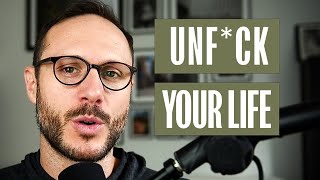
Connor Beaton walks through five steps he used to turn his life around: stop lying to yourself and correct immediately, handle the hard stuff like exercise and finances, swap destructive habits for generative ones like meditation and journaling, do more of what you love, and learn to regulate your nervous system for better impulse control.
Chapters
All right, team, welcome back to the Man Talk Show. Today I'm going to give you the five steps that I use to unfuck my life. I've been thinking about this for a long time. One of the guys that came out to a men's weekend recently was asking me, you know, he read my book and he was like, listen, man, I feel like my life is a mess, and I'm curious about the, like, simple tactical things that you did on a daily basis to actually get your shit together, you know, to live a better life. And so I've put together a few things here that were really, really impactful, and I'm gonna rip through them. So number one is I stopped lying. I was a chronic liar. I was a classic withholder of information. That was my, probably my go to way of lying. Lying through omission to. So I would just omit certain details. I would leave certain things out. I wouldn't talk about certain things. You know, when people asked me directly, I would find a way around answering. And I had a very good way, which is, you know, in hindsight, at the time, I think I thought it was like this great trait that I could talk my way out of anything. Like, I could really talk my way out of anything. But what I started to realize was that that got me into more trouble than almost anything else. Because while I was charismatic and, like, smooth talking sometimes, I also could get out of things that were genuine. You know, I could get out of having to tell the truth about something. And that really left my life damaged. It really screwed my life up because in many ways, most people didn't really know who I was. And I didn't feel like most people really knew who I was because I didn't want them to know. Because I didn't like who I was. And I didn't like who I was because, guess, ta da. I was lying all the damn time. And so it might seem small and insignificant, but my challenge to you is for the next 72 hours to catch yourself in the act of lying, of not telling the truth, of embellishing something, whether it's in a story to a colleague or a friend or a family member, and call yourself out. Just call yourself forward and say, hey, listen, actually, I think I got that wrong. Or, you know what? That's not right. You don't need to say, oh, I'm lying, unless it's, you know, something where you really just need to own the truth that you're lying, but just correct yourself, right? I called this autocorrect I had to go through this process of autocorrecting myself for probably like nine to 12 months, where every single day when I was in conversation with people, I would just autocorrect. Actually, you know what? That was wrong. It was this. And I would correct and tell the truth, and I would correct and tell the truth. And I'd say, oh, you know what? Actually, I left something out. This happened, or I said this, or I did this. And by doing this, I started to tell the truth on a much more regular basis. And it was incredibly empowering. So that was, number one, I just stopped lying and I started telling the truth. Number two is I did shit I needed to do, but I didn't want to do or I lacked the motivation to do. Right? Going to the gym, eating healthier, not, you know, having the. The midnight bowl of popcorn, you know, 11, 11 o' clock bowl of ice cream. The stuff that I knew was making me feel bad, I. I stopped doing those things. And I started to do the things that I knew I wanted to do but lacked the motivation to do. The going to the gym, the buying healthier groceries, the, you know, keeping track of my finances, having an Excel spreadsheet, which literally makes me want to vomit. Like, I just. I think I've. I just can't stand Excel spreadsheets. I'm just not that guy. I've never been that guy. I don't know what it is about Excel spreadsheets for the people that are out there that just love them and get off on them and are very good at them. Kudos to you. I admire you to the nth degree. I just can't do it. But I forced myself to do those things because they were the necessary things that were keeping my life in disarray. They were keeping my life disorganized, and they were reinforcing the internal story that I had that I was undisciplined, that I couldn't do certain things, that my.
Lesser evils always got the best of me, et cetera, et cetera, et cetera. So I started to do the shit that I needed to do that I lacked motivation to do or just didn't wanna do. Number three, I shifted my coping mechanisms to generative habits. And you've probably heard me talk about this one before, so I'm gonna just give this one to you. Very straightforward. The porn, the weed, the booze, the whatever it was, those coping mechanisms, doom scrolling through social media, sexting people that I knew I didn't want to date, that I knew weren't good for me. I moved all those coping mechanisms to generative habits. Yoga, breathwork, meditation, working out, journaling, all of the stuff that we all know that we could do and deploy to elevate our life, to genuinely make our life better. I just systematically chose one at a time. I said, okay, I'm going to get, I'm going to stop watching porn. I don't care how long it takes me, but I'm going to stop watching porn. And every single time I want to watch porn, I'm going to force myself to sit down and meditate, or sit down and do breath work, or go and do yoga, or go and hang out with a friend or whatever it is. And I did that. And it took me a long time, but I moved through that coping mechanism and then I started to work on the next one and then the next one and then the next one. And so now I've been porn free, I've been booze free, I've been weed free, I've been sexting free, and infidelity free and all of these things for a very, very long time. All because one at a time, I started to replace those coping mechanisms with generative habits. Habits that actually elevated my life, made me feel personally better, stopped the shame cycle and the self deprecation cycle and actually helped me realize that I have much better discipline than I had before. Number four, plain and simple. I just did more shit that I loved. I just did more shit that I loved. Like, I think honestly the amount of people who are doing so much stuff that they hate on a daily basis and so little things that they actually enjoy is way too high. And so when we can start to add in the things that we really love, the. For me, it's like going outdoors and hiking, it's going, you know, and spending time with friends. It's taking my camera and just going to get lost in the city and take photos. It's like listening to great music or an audiobook or it's writing and being, being creative or spending time with friends, adventuring and traveling the world. I just did more things that I loved on a daily basis. And once I started to do that, I found that my level of satisfaction went up and my willingness to go back to number two, do the stuff that I didn't, that I knew I needed to do but didn't want to do. That also started to elevate because I was doing more things that I actually enjoyed. So create a list of the things that you really love that you really want to do. And just start to incorporate them, even if it's just five, ten minutes a day. Number five. I learned to regulate my nervous system, AKA I got better impulse control. I cannot over overstate this one enough. This is a massive one. I think this is probably the biggest one in the list. A lot of the challenges that I had before were there because I was driven by my impulses. I had very little impulse control. And anytime that my system was dysregulated, anytime that I was feeling something I didn't want to feel, I would move towards some type of coping mechanism. I would move towards the porn, the sexting, the, you know, the booze, the weed, the et cetera, in order to help myself feel better. And I didn't know how to move myself through tough states that I didn't like. Being overstressed, feeling anxious, being angry, being frustrated. I didn't know how to deal with those things. And so over the years, I have systematically worked very, very hard. I have worked very diligently to focus in on learning how to ground my, how to work with my nervous system and regulate my nervous system so that I am more grounded, more calm, more present for my friends, for my family, for my clients, for my work, for everything that I do for you when I create this content so that I'm actually present and grounded instead of thinking about, you know, a thousand other things or feeling super anxious or dysregulated. Because the truth is that all of us share the nervous systems of the people around us. And so if you're dysregulated constantly, it's very likely that that's what you're attracting in your life. And you know, we can co regulate, we can have people that support us and help us when we're dysregulated, when we're just upset or anxious or whatever. But the reality is, is that all of us need to develop the skill of learning to regulate our own system of learning how to, to get our impulse control dialed up so that we can actually let go of those impulses and learning how to better work with our own energy and our own bodies and our own systems. So there's more on this front. I'll be talking about more in terms of how I actually did that. But comment below and share the one thing that you have done to help unfuck your life. Thank you so much for tuning in. Don't forget to man it forward. Share this video with somebody that you know needs to hear it or the podcast, if you're listening to it on the podcast. So until next week, Connor Beaton signing off. See you then.
More from Connor







How to Raise Strong, Unshakable Boys in Today's Culture, with Dr. Shefali Tsabary



