Are Women More Radicalized Than Men?
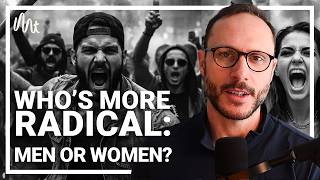
In this solo‑host episode of the Man Talk Show, Connor Beaton challenges the common narrative that men are the primary victims of radicalization. He begins by citing cross‑national survey data (U.S., Germany, UK, South Korea) that show women have moved markedly leftward over the past two decades while men have remained relatively stable, creating a widening partisan gap. He then explores how radicalization manifests differently for each gender: men gravitate toward status, power, hierarchy, and physical aggression, often externalizing anger and defining identity through opposition; women gravitate toward safety, moral purity, relational threat, and social aggression, using moral policing, cancel culture, and character attacks. Beaton links these patterns to online platform algorithms that reward dominance for men and moral signaling for women, amplifying tribal identities. He argues that both genders are reacting to a broader cultural collapse—loss of meaning, trust, and communal rites—yet express it through gender‑specific lenses. Finally, he proposes gender‑tailored de‑radicalization: restore agency and purpose for men, and rebuild relational safety and trust for women, emphasizing that both forms of radicalization are dangerous in distinct ways.
Chapters
All right, team, welcome back to the Man Talk Show. Connor Beaton here. And today we're gonna be exploring the question, are women more radicalized than men? Now, like me and like many people, you've probably been inundated with media articles and narratives that men have become very radicalized, that men have become pushed more and more to the right. And in fact, there is a kind of hypersensitivity online to men who are moving to the that men are becoming more conservative or men are becoming red pilled or whatever it is. And I started to see this more and more and more in my content where if I interview or speak to anyone or talk about a subject or a topic that could in any way, shape or form be misconstrued or viewed as right wing or conservative or red pilled, or I'm being radicalized in some way that immediately there's hostility and commentary or on that content, people want to very quickly come forward and say, oh, you know, this is red pill. You know, men are being radicalized, we need to do something about it. And in fact, this has gotten so bad that in the UK you actually have programs that they are starting to roll out where they're going to be teaching young boys anti misogyny lessons and teaching young boys how they should be treating women, not, not treating young, not teaching young girls how to treat young boys, not how to interact, not how to actually have coherence, but specific lessons about being anti misogynistic. And in my opinion, this is not only going to be not helpful, but this is more than likely going to produce the types of outcomes that people are seeking to get around. So let's start by looking at the data, because the truth is that the data actually shows a radically different story when it comes to whether or not men or women are being more radicalized. And what ends up happening is that narratives, people, online media outlets, et cetera, latch on to individuals, right? The Andrew Tates, the Nick Fuentes of the world. And they say, look how radicalized men have become. Can you believe that these men are saying these types of things, et cetera, et cetera, et cetera. But when you actually drill down into the data, what you will see is a very different story. And so you've probably seen this graph here before. If you're listening to this, the graph is basically just showcases that over the last decade or two, men and women have diverged from being more centrist, being more towards the middle. But what it shows in the us, in Germany, in the UK and in South Korea, that Women have moved more to the left than men have moved to the conservative right. So the data actually doesn't show that men have somehow become more extremely radicalized, that they have moved way more to the right. What it shows is that, and you can actually look at this one here, which shows the partisan gap between young men and women, it has almost doubled in the last 25 years. But it's not because men have shifted radically to the right, it's that men have moved a little bit to the right and women have moved disproportionately to the progressive left, and women have moved radically leftward, while men have, on the whole, remained largely steady and a little bit unchanged. Right. So there's some variation, there's some variance in terms of men moving a little bit more to the right, but it is not at all the same. There's a 23 point gap between men and women that has emerged. And largely that gap is because women have, over the last 20 years, moved radically to the left when it comes to politics and ideas. And this is starting to show up in a bunch of different areas. And one of the areas is where men and women actually fall on free speech. And there was a study that was done recently that I thought was really interesting, and it showed that on average, men who have extremely differing political choices, right? So men that are really far right and men that are really far left and everything in between, those men will, all of them will actually have a higher level of coherence when it comes to freedom of speech compared to women. So, for example, a man on the far left and a man on the far right will have a higher tolerance, a higher acceptance of free speech than a woman on any part of the political spectrum. So what we can see is that women, on average, according to the data, right, this isn't some, like, personal opinion that I've just pulled out of my butt because, you know, because I feel this way. This is actually data that you can go and research and find. But what it shows is that women on average, across the political spectrum, have a lower tolerance, a lower desire for free speech than men, and also in tandem with that, that women have over the last 20 years, moved disproportionately towards the left more and more and more. Now, when men and women become radicalized online or through culture, the direction of that radicalization often looks different. Not because one sex is better or worse, but because male and female psychology tend to externalize threat, power and identity in different ways. And so what I want to talk about here is not Is, you know, are women being radicalized worse than men and finger pointing and blaming people? That's actually not what this episode is all about. This episode is about looking at how men and women get radicalized differently and what a radicalized man and what a radicalized woman will actually look like. So understanding the psychology, the social behavior, the cultural behavior of these types of individuals, because they are wildly different. And what has started to happen is that a radicalized man has become unacceptable within modern culture and society and a radicalized woman has become largely acceptable and a norm. And it's okay. So let's talk about the core high level difference, and this is how I would really break it down, of the fundamental difference between men and women when it comes to being radicalized. Men tend to radicalize around status, around power, and around hierarchy. So when men get more and more radicalized, what you'll notice is that they really move towards figures of power. They move towards wanting to accumulate in a mass, you know, an incredible amount of status. You can see this in somebody like Andrew Tate, who really encourages followers to like, basically do everything in your power to make as much money as possible and buy the Bugatti's and get the status, right? Like that's the game. That's the only game that you should play. There's no other game. It doesn't exist. Everything else is pointless and a waste of your life. So it really revolves around a hierarchy, playing the game to get to the top of the hierarchy as fast as humanly possible and regardless of the cost, regardless of what it does to other people. And when women get radicalized, they tend to radicalize around safety, around morality, and around relational threat. So you can kind of see how those two forms of radicalization is in opposition. They don't necessarily mix well together. And this real, like this sort of single difference really explains a lot of what we've seen online. So now I'm going to break down how radicalized men tend to behave and how radicalized women tend to behave. And this, what I'd love for you to maybe listen for is look for the behavioral patterns that maybe are in yourself or the people that you know. And to be mindful of that, because one of the things that we want to do is to step out of radicalization in a time of turmoil and transition. It's so easy when chaos starts to unfold for you to become more and more manipulated, to, for you to start to shift into this unconscious, radicalized, sort of extreme, polarized perspective because people want to find those groups. So let's start with men. Men generally externalize anger and will try and chase a sort of. They'll seek power, right? So radicalized men will often move towards ideologies of dominance, of revenge, of hostility, of restoration of some type of lost status. And the narratives of betrayal are very, very prominen. Right? Women are to blame, the system is screwing you over, elites are out to get you. You know, weak beta cuck, soy boy drinking. Men are the fundamental enemy. And in this area, a type of hyper competence control. Physical and sexual domination are often positioned as the, the tool of choice. They are the solutions that you should deploy and usually the cost that you have to pay is any type of empathy or compassion. So you, you move more into a kind of role psychology identity that's quite quick to dehumanize other. And the behaviors that go along with this, that coincide with this are a lot of aggressive rhetoric that sometimes isn't backed up. I don't know if you saw that one mustache dude that got sort of like bitch slapped by, by the big guy online. And he's, you know, he's like the dude that's constantly, he's like super right wing and constantly sort of shit talking people on the left and I don't know what his name is, I don't watch his content. I just, you know, some just get completely laid out. But there's a lot of aggressive rhetoric from these types of men. There's a fixation on who's winning, who's losing, right? The winners and the losers. And there's always this fixation on I'm winning and those people over there are losing. And there's a strong predilection towards idolizing strong men. Or at least men that showcase or present themselves as being strong men, warriors, the alpha archetypes. This is why a lot of these guys, you know, are, they've built this brand. I've seen this guy online that's like, you know, tall and has like the goofiest curly hair that I've ever seen in my life. And he's, you know, super buff and he's always showing off, you know, this woman that he's with and she's got super fake boobs. And he's like presenting this alpha lifestyle and trying to teach gym bros how to make money, you know, so that's, that becomes very, very common, right? That becomes very, very common. And attraction, there's a, there's a kind of an attraction to an absolutist solution, right? Burn it all down, take it all back. We have to go back to the way that things were. And psychologically, this is really an unintegrated quality of, of aggression and a shame around powerlessness. So the men that really get rad, how men really get radicalized, is because. And when their sense of powerlessness gets preyed upon, right? So anytime you as a man, and this is really important for you to know, anytime that you as a man feel like somebody is communicating to you about your powerlessness, about how you're the victim, about how society or women has effed you over, that is a form of moving you towards a more radicalized narrative and message because you become more malleable and compliant in that space. Because for men, part of the masculine shadow is about feeling powerless. Anytime that you feel powerless as a man, that is a dangerous place to be and what ends up happening. The final piece for these radicalized men is that there's a huge sense of identity through opposition. So a lot of the identity is hyper opposition based, hyper war based and radicalized. Men usually define themselves by who they are, not who they are fighting who they are against, who is to blame. That becomes a sort of bulwark and a really big part of their identity, kind of foundational pillar. And what this produces is extreme polarization. It gives you a very clear enemy. And so there's lots of narratives of who the enemy is and lots of suspects. And it can lead to a very quick dehumanization. So you don't see the other person as human. And, and beneath that, there's a need for purpose, there's a need for respect, there's a need for direction, there's a need for initiation. And there's actually a need for relationality and empowerment. You know, a lot of these men that end up getting radicalized are looking for empowerment. They feel left out, they feel dejected by women or society or government or culture or whatever it is. And what they're really seeking and looking for is a deep quality of belonging in a culture that they feel has. Has ostracized them. Now let's talk about how women tend to behave and are radicalized when women are radicalized. So big part the difference between men and women you can kind of look at is that when men get radicalized, there's more aggression, there's more physical threat, there's more volatility there, more dehumanization, less empathy. And for women, it's actually the exact opposite. It is moralization that is a kind of control through virtue. So morality becomes a weapon, virtue becomes a weapon. And how you control outcomes and narratives and people is by using morality and virtuousness and righteousness as a weapon. So radicalized women, they often tend to move towards ideologies, sorry, not surrendered, centered around harm prevention, safety, moral purity, being in the right and just position. There's a real strong in group, out group moral sorting, right? And this is where cancel culture has really come from initially, although it's sort of filtered into the right in some ways. But cancel culture really is like, this is the in group. You have to think this way, you have to believe these things. And if you don't, you are in the out group and we will cancel you. We will deplatform you from social media, blah, blah, blah. There is a lot of language around danger, trauma, oppression, accountability. And this, again, this really has led to the rise of cancel culture because the core premise of it for women is that they are the oppressed and they are fighting against and warring against the oppressor class. And that duality really becomes prominent and a cornerstone to radicalized women. Everything gets filtered through the oppressor, oppressed lens. There is always a victim and a villain. And this kind of dualistic thinking becomes layered over pretty much every single political controversy, every social issue, every cultural issue, every relational issue. Radicalized women will see that through the lens of, well, that person's the oppressed and that person's the oppressor. And this can infiltrate their relationships as well as behaviorally. What this looks like is massive amounts of social shaming. Massive amounts. Because again, remember, radicalized men are going to use the threat of violence and physical violence, and women are going to use the threat of emotional social castration and violence, right? So instead of threatening physical violence, it's, I'm going to shame you into oblivion. I'm going to cancel you. I'm going to completely destroy your reputation. And there's kind of a mob mentality. So for the individual, radicalized man, he might be a little bit more isolated, but for radicalized women, it is usually a pack mentality. It's like hyenas, right? They all move together. It's matriarchal in nature. And there's a mob attack that happens that is designed to take down your reputation. And psychologically, this is really unintegrated fear. There's a lot of fear and a hypervigilance that gets turned outwards. And so the notion internally is I need and want to feel safe. And the only way for me to do that is by controlling external circumstances and how I'm going to control external circumstances is by controlling you and controlling your behavior and controlling community and society and culture by, by really filtering and, and controlling what people say and controlling their behaviors through shame, through manipulation, through character attacks and character assassination. And so women radicalize when relational safety collapses and threat feels omnipresent, okay? And that is very, very common in today's society. So lastly, women get radicalized through a kind of moral superiority, a kind of righteousness and virtue. And radicalized women will often identify them as being on the morally superior side, on the right side, that their actions are justified because they are protecting others, specifically those who they have identified as being the weak, the meek, the oppressed, the ones that are unable to quote, unquote, protect themselves. And they'll define themselves through their policing language, the policing norms, the policing boundaries. And a lot of it is meant to in some ways cast the perceived oppressors, cast the, the perceived violators out of the community, right? And so whereas the individual man, it's the, the, the radicalization of men is more about the individual, right? That individual guy will be, it's more about his self identity, it's more about him as an individual. But for radicalized women it is. We need to band together and cast out anyone who kind of disagrees or goes against the narrative. And what it produces is, oddly enough, intolerance disguised as care. And this is why you see, for in the name of tolerance, in the name of inclusion, in the name of safety and protection, it really is an intolerance, an inability to hear and understand and talk to and interact with anybody who disagrees. So disagreement becomes a form of an, or at least an excuse, a reason to cancel a relationship. Disagreement becomes a reason for an individual to cut off and sort of kill off a relationship. And it really is, it can produce emotional coercion where any type of dissonance can't be withstood. And so what that ends up doing is there's a weaponization of empathy. There's, you know, how I feel is more important than maybe what is objectively true. And this is where you get into the. This sort of speech is violence. Language can become perceived as violence. That's another way of, of sort of safeguarding the, the, the emotions. And then there is, there's sometimes a justified aggression. Again, the aggression for radicalized women is more often than not, it's social aggression, it's character attacks, it's social manipulation and attacking an individual to, to cast them out of the. In group. And this again beneath it is a need for safety, for belonging, for Trust for ensuring that those things are there. But the shadow of it is that it is cruelty. It's social cruelty. It's sort of individual cruelty masked as virtue. Now, to contrast this again, just to briefly go through it radicalized mention. The primary emotion is really anger, whereas for women, it's fear. The core wound for radicalized men is an experience of powerlessness, a deep fear of powerlessness. And for women, it's unsafety. The expression, how it gets expressed out for radicalized men is physical or verbal aggression, sometimes threats of verbal, you know, threats of violence. And for women, it's social and reputational aggression. That's how it gets expressed, right? You should do better, be better, you should know better, you know, you shouldn't have a right to whatever. The moral frame for radicalized men is really about strength and dominance. And for radicalized women, it is the centering of wanting to produce, wanting to prevent any type of harm, needing to instill absolute safety, and coming from a place of being, the virtuous one. And the truth is that, and we all know this, I'm not saying anything new, that online spaces really intensify. The social media really intensifies this, because the Internet rewards outrage. It removes any type of embodied feedback. You're not actually in relationship with somebody else's nervous system, right? Like 80% of communication is non verbal. Well, in online spaces, there is no non verbal communication. All you're getting is the written text of the individual or, you know, this part of their body. And it really amplifies a kind of tribal identity of we're in this group and you're not. And it encourages these kind of performative extremes. And so you see a lot of performing, performative virtue, performative safety, performative alphaness, you know, performative, et cetera. So for men, the algorithms really do, they really do reward dominance, displays of dominance, displays of, of status. And they reward certainty, right? Because for us as men, we look for certainty. We want to know what is and what is not. And for women, the algorithms really, really reward moral signaling and a kind of emotional authority that there's a righteousness of. I'm right, because I feel this way. And both are dopamine loops, both keep people stuck, push them into extremism, push them into polarization. They are not designed to put you into contact with the truth. And here, from my perspective, is the deeper truth. And this is what so many people miss. Men and women are often reacting in our culture right now to the exact same thing. And it's that same thing that they're reacting to that's creating the extremism and the radicalization. They're reacting to collapse. They're reacting to the collapse of meaning. They're reacting to the breakdown of trust. They are reacting to the disintegration of a shared reality amongst our culture, amongst our society. And they're reacting to an absence of initiation, of rites, of communal spaces and of repair. It's just that men and women are expressing it differently. So I want to make this clear again. I'm not saying that radicalized men or women, that one is worse than the other. We can look at the data and we can see, yeah, women have disproportionately moved farther left than men have. It's just that within our culture and society, physical threats, physical violence will always be deemed to be more dangerous than character assassinations. Moral superiority in group, out group. But radicalization is what happens when pain meets ideology instead of integration. And what do I mean by that? It's what happens when instead of being able to assimilate our individual, collective, communal pain and suffering and to understand just gets filtered through the lens of an ideology. So ideologies will always play on the your individual pain and suffering and will weaponize that to put you into camps. So what actually de radicalizes people? And this is the hard part. I've been thinking about this for years, but this is the hard part. Debate doesn't usually de radicalize people. It puts people again into camps of right and wrong. Oppressor, opposite, oppressed victim, villain, shaming is not going to de radicalize people. That usually pushes them more into radicalized camps. And unfortunately, facts alone are not going to do it. But if we look at what radicalizes men and women, we can see that there are two important things. One is necessary for men and one is necessary for women. Men need a restored sense of agency. The more that we can have conversations, the more that we can acknowledge that for many men, agency has been depleted. Their ability to provide, their ability to earn has been infringed on. Their ability to contribute to society has been diminished. That men are actually in decline statistically in almost every single area, right? Less men are graduating from college than ever before. They're dropping out of school more often. I mean, you can just go down the list. I've talked about it endlessly before. But men need restored agency. So the more that we can produce content, produce systems, produce institutions, produce places, opportunities, relationships for men to have agency, the less likely those men are to become radicalized. And for women, we need to restore a sense of safety and trust in a more holistic way so that it's not being filtered through only a political ideology. Because I think for a lot of women, what ends up happening is when they don't feel safe socially, relationally, et cetera, what they do is look for that safety, right? That desire for agency for men doesn't go away, just like the desire for safety and trust for women doesn't disappear inside of them just because it's absent within the culture. And so what ends up happening is that ideologies prey on this and say, hey, here's your safety, here's how you build trust. And so the more that we can restore safety and trust for women from a relational sense, from a social sense, the more that we will be able to de escalate and de radicalize those situations. So this is a hard conversation, right? And again, the main point that I'm making in this is not that one is worse than the other. It's not finger pointing. I am pointing out, however, that women have become more radicalized according to the data than men have. That that is more commonplace. But I think it's become more acceptable to say, well, radicalized men are far more dangerous than radicalized women. And I think that that's a misinterpretation. I think that radicalized men and women are dangerous just in different ways. Radicalized men are dangerous from a physical sense, from an aggressive sense, from a violent sense. Again, physically and radicalized women are dangerous from a social sense, from a character sense, from an in group, out group sense. So I'm curious to get your thoughts. As always, this is a complex topic. Comment below. Don't forget to man it forward. Share this with somebody that you know will enjoy this, this conversation. And as always, until next week, Connor Beaton, signing.
More from Connor







How to Raise Strong, Unshakable Boys in Today's Culture, with Dr. Shefali Tsabary



