Craving Specialist: Our Brain Believes We Have To BINGE To Survive - Glenn Livingston
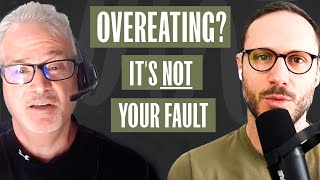
This is a Man Talk Show interview (YouTube, Mar 4, 2024) with Dr. Glenn Livingston about overeating and cravings. Livingston argues overeating arises from an evolutionary appetite system (reptilian brain) that evolved for scarce, nutrient-rich foods but is now hijacked by an abundant, hyper-palatable food environment and advertising. He explains mechanisms — downregulation of pleasure from natural foods, neuroplastic reinforcement of cue–reward links, and intermittent/variable reinforcement producing extinction bursts — and gives practical interventions: simple, specific rules (tripwires), binding treats to context, parasympathetic breathing (longer exhales), nutrifying to reduce organismic distress (sleep, water, social connection), decision-reduction strategies, and gradual extinction of cues. He shares personal history and coaching outcomes (short-term large reductions in overeating among engaged clients; mixed long-term results when users stopped practicing). Resources: defeatyourcravings.com (free reader and coaching session recordings).
Chapters
Our brains are set up to believe that we need to automate the acquisition of calories because it's a scarce opportunity and it's necessary for our survival. So our brains believe we have to binge to survive. You have the advertising industry, which is good at, you know, convincing you that this is where the good stuff is by focusing on the packaging, making it bright and multicolored and diverse. Because in nature, if you came across a multicolored, bright, diverse group of fruit and vegetables, you'd be getting a diversity of micronutrients. So, like yellow carrots and blueberries and green lettuce and, you know, red tomatoes. If you could find that, your brain knows that you are acquiring a diversity of micronutrients. As a matter of fact, that's part of why we appreciate color, because our brain is looking for those micronutrients. Yet these companies are largely taking the nutrients out, not putting nutrients in. And so it's a predatory practice. It's taking advantage of those evolutionary buttons without actually providing what evolution designed us to acquire.
All right, Dr. Livingston, welcome to the Man Talk Show. How are you doing today?
I'm doing really well. I'll be doing better if you call me Glenn. Okay.
I wasn't sure. You know, I see the PhD. I have a buddy that is in one of my men's groups, and he's a PhD and his last name is Goldberg. And oftentimes when I just want to rub him, I'll be like, what's going on, Dr. Goldberg?
Come on, man. Doctor stuff and all the credentials, it gets people's attention. But I, I really prefer not to stand on ceremony. And I'd, I'd rather be more approachable as Glenn. And my, my nine year old patients used to call me Dr. Glenn a long time ago.
I like that. I like that. Well, we are going to have a very interesting conversation. I'm going to preface the show today with just a little precursor to why I wanted to have you on. I think that in many ways.
Health, longevity, a lot of these things come from and are very directly impacted by what we eat, how much we eat. And for me, how much I have ate has always been a bit of a problem. I think I told you before the show, my nickname growing up was the garbage disposal, the human garbage disposal to my family. And after a meal was done, all the food would just gravitate towards my side of the table and I'd be kind of, you know, cleaning up the, you know, whatever other people didn't eat and whatever was left on the table. And it was, you know, it was kind of fun when I was a young guy, you know, but as I got in my twenties and my mid twenties, even towards the end of my. End of my twenties, I wasn't very happy with how my body looked. And I wasn't wildly out of shape, but I definitely wasn't in great shape. And I could never seem to strike that balance, even though I worked out, you know, four or five days a week. At one point I was working construction. And so I want to have this conversation about how do we deal with things like cravings, how do we, you know, approach eating in a healthy way? What's happening biologically within us that we need to know about? So I'm excited for this, for my own personal benefit, for a number of reasons, which I'm sure we'll, you know, continue to talk about. But I think a lot of people will benefit from this. I know a lot of guys in the alliance, which is the men's group that. That we have, have gone on a journey of. We've got about 6, 6, 700 guys in there now, and a lot of the guys have really been focusing in on health. So I think this one's gonna be a home run. Let's start 30, 000 foot up. Why are so many Americans, North Americans, overweight? I think it's like 42%. Was the research that I could find in 2017. Sure, it's a little bit higher than that. What's happening? Is it our food source? Is it something psychological? Is it an evolutionary thing? How come this is happening?
You know, I mean, first of all, brother, I'm right there with you. In my childhood, you and I had a very similar experience. And I always tell people, if they pass by the Woodbury Country Deli and they were out of pizza and Pop Tarts, that's probably because I was there before them. So I'll tell you more about my story later. But.
I remember Lewis Black said in a comedy routine one time that he knew the world was ending because he walked out of a Starbucks and across the street was another Starbucks. And, you know, I think you could say the same thing for convenience stores. You could say the same thing for McDonald's or Burger King or all the other fast food joints. In most North American cities, there is some place where you can walk out of a McDonald's and see another McDonald's across the street. You can walk out of a convenience store, see another convenience store across the street. And these are places where you could get one Hundred thousand calories for less than a hundred dollars. Right. And we didn't evolve in that environment. We evolved in a much scarcer food environment. We didn't have.
We didn't have pizza and pasta and chocolate and all of these very concentrated forms of pleasure on the savannah. And our brains are set up to believe that we need to automate the acquisition of calories because it's a scarce opportunity and it's necessary for our survival. So our brains believe we have to binge to survive. And depending upon what, what your particular pleasure is and which bags or boxes or containers you're looking for love at the bottom of, you know, you're going to develop different, a different level of habit, automation. I don't call it a disease or a sickness or like there's something wrong with you. As a matter of fact, I believe that if you have stronger cravings than other people, it's because you have a healthier brain than other people. Because in primitive times we had to have cravings in order to survive. We had to be really motivated to figure out where the bananas were, figure out how to hunt down that, you know, wild boar or whatever we were doing for, or gather blueberries, whatever it is. We had to be really motivated when we saw signals that it might be available to get our asses in gear. Can I say that word here?
I'm sorry, yeah, yeah, absolutely, yeah.
Get ourselves in gear and go, go and do it. You know, I think you would have said in the introduction that I.
I was on the wrong side of the war. When I was in my 20s and 30s, I not only was a, I was a clinical psychologist. That was not the wrong side of the war. I was working with children and families, but I was also a consultant for industry. And I worked with the big food industry, the big pharma industry, the advertising industry. And I watched them pay millions of dollars to these rocket scientists that would engineer the, these hyper palatable concentrations of starch and sugar and fat and excitotoxins and salt. And it's all aimed at that bliss point in the reptilian brain, that part of us that says we need this to survive, but they don't give us the nutrition to feel satisfied. And it gets stronger and stronger and stronger. There's more and more research into offering plausible deniability to the consumer. So these potato chips are good for you because they're made with avocado oil, right? And does anybody really think that a bag of potato chips is good for you? Do you really think you're going to get a significant amount of nutrition. But that little star on the label that says, well, it's made with avocado oil, it's enough for your rational brain to get out of the way because we're physiologically wired for the reptilian brain to push aside the rational brain when these scarce opportunities, perceived scarce opportunities, are presented to us. I don't think it's a disease or a sickness. I think it's a societal sickness. Jakarta Krishnamurti said that it's no measure of health to be well adjusted to a profoundly sick society. That's what I think. I think that we're living in a food environment where our healthy, natural instincts just don't serve us, and they're being hijacked by industry. And every time you do look for love at the bottom of a bag or a box or a container, some fat cat in a white suit with a mustache who's laughing all the way to the bank. So that's what I think.
All right, team. This episode is sponsored by Better Help. Now, if you're like me, your relationships are very important to you. And if you're also like me, especially how I used to be, relationships were a very big challenge. They were a place where I struggled, where I had a tough time, setting boundaries, asking for what I needed. And for me, one of the best things that I've that has supported me, that has helped me improve my relationship specifically, has been therapy. And so if you're somebody that is looking to improve your relationships, getting the best out of yourself, getting the best out of your relationships, being able to contribute more, then definitely go and try out BetterHelp. You can go today to betterhelp.commantalks and get 10% off of your first month. And whether you've tried therapy before or never done it before, this is definitely worth the try. So go again to betterhelp.comforward/mantalks to get 10% off of your first month. Enjoy. I agree wholeheartedly. I was gonna joke, like, so the avocado oil potato chips are just less bad, or are they still as bad?
I think, I think everybody wants to. I want. They want to know, like, is avocado oil, is this a new crave, sort of, like, trend? Right.
I don't.
First of all, I think there is a difference between eating things that are less bad for you and eating things that are good for you. And I think it's important to make that distinction. And I think everybody has the right to eat things that are bad for them. If they want to. We can trade a little bit of our health and life, you know, lifespan for, you know, pleasure in the immediate term, if that's what we really want to do. A week. We fought wars for our freedom in this country, and we have the right to do that. I don't mean to preach, and the system I teach, by the way, allows people to moderate rather than abstain. So I'm not suggesting that you become a monk and live on dirt and rocks for the rest of your life, but I don't know if I've got sufficient evidence to tell you that potato chips with avocado oil are really no better for you than potato chips with cottonseed oil or whatever else they used to be made with. But I can tell you that most studies that were ever done on heated oil suggest that it's carcinogenic in the long run. I can tell you that most studies that are done on.
The baking and frying process suggest that they create acrylamides, which are also carcinogenic. So I think if you're going to eat potato chips, that you're going to eat potato chips and not. Not really convince yourself that it's really that much less bad for you or good for you in any way, and just be aware that your brain is always looking for that plausible deniability, and ask yourself, is this really good for me? And if it's not, what role do I want it to play in my life? Do I want to have a bag twice a week? Okay, Put boundaries around it so that you don't have to make decisions all week long about how many potato chips to have. It won't wear down your willpower that way, because willpower is just the ability to make good decisions, and we can only make so many per day. Figure out what role you want these things to play in your life, in your life, define them very clearly, and then we can talk about techniques to stick to those decisions.
Can you just speak about carcinogenics first, like a carcinogen story? And why.
The impact on that? What's the negative impact on that? Because I think for the average person, I think what I've learned over the years is how much I haven't known. Like, when I started really getting into health, understanding things like intermittent fasting or, you know, what was healthy for my body and what wasn't healthy, I started to realize how little I actually knew. And so can you just unpack, you know, carcinogens, the. The impact on the body, why we want to be aware of those Things?
Well, carcinogenic means that it causes cancer or it's associated with cancer in the long run. And I think we want to be aware of that because most of us don't want to have cancer.
Just generally speaking.
Yeah, yeah.
I know enough nutrition to be dangerous. I don't know that I can expand in detail about that. I know that's okay. I know that you don't want to eat acrylamides and carcinogens to the greatest extent you can avoid them. I can't argue the specifics about the organs that it affects. And you know, yeah, I can't do that.
How, how much of what we're talking about in terms of. Because I think one of the things that I hear out there is like, well, the food that we're consuming is just so much worse than it used to be. And that's not just packaged goods or processed goods. It's also vegetables, fruits, meats, like the actual just sort of, you know, quote unquote, meat and potatoes of what we normally eat is so much worse than it used to be. Is how much, how much does the quality of the food actually play into what we're talking about?
Well, I think there is less nutrition in the produce than there used to be. And so you have to have a little more in order to get the level of nutrition that you need. I did hear an argument once that said that that's not really true. What is true is that the nutrients in the soil have been depleted because of, you know, factory farming and the, you know, lack of the diversity of agriculture and those types of things. But the, the professor that was making that argument said that that doesn't mean that there are less nutrients in a banana than there used to be. What it means is that the soil can't make as many nutritious bananas as it used to be able to make for a given plot of soil. And so, you know, fruits and vegetables are probably still the most nutritious things that you can eat, but where we're gravitating away from that and as the foods that we eat have become more and more concentrated.
There'S a process of downregulation in the nervous system which makes them less appealing to us. So, for example, if you have a chocolate bar every day, the first day you have it is going to taste phenomenal. The second day it's not going to be quite as good. By the two week mark, you're going to feel like, well, I don't know why I was so excited about the chocolate in the first place and around the two month mark, you're going to feel like, well, I just need this chocolate bar to feel normal. I'm not really getting a lot of pleasure out of it, but I feel like I need it.
During that process, what's happened is that your system has stopped responding. Your pleasure system has stopped responding with the same level of intensity. Kind of like when I slept underneath the subway in graduate school. I had an apartment underneath the entrain and not quite there, but almost there. I couldn't sleep at all the first week or so, but a month or two later I didn't hear it at all because my brain downregulated a response to what it perceived as a supersized but irrelevant stimuli. That happens with chocolate, it happens with flour, it happens with every other type of concentrated pleasure. As a result of this down regulation, your nervous system loses the ability to really derive pleasure from the things that nature intended. So you can't taste the difference between a Fuji apple and a Gala apple. You can't taste the natural sweetness of certain types of lettuces and, you know, peppers or carrots or blueberries. And this is why people say that they really hate fruits and vegetables. They don't like to eat fruit and vegetables. But everybody knows that it's really hard to lose weight if you don't like fruit and vegetables, right? Or at least vegetables. I mean, there are different ways of eating out there. But. And so I tell people that the good news is, first of all, be aware of this process. Be aware that because you are not experiencing pleasure now in response to fruits and vegetables, that doesn't mean you will always hate them. As a matter of fact, in six to eight weeks, your taste buds might double in sensitivity if you stopped having that chocolate bar every day. So don't get fooled by the current level of sensation. If you go through a process, you will re acclimate and you will find immense pleasure in things that you always thought, you know, they just look like dirt and why would anybody want to have them? But back to the question of why do we live in such a sick society and why does everybody tacitly agree to kill themselves with food and joke about it? It's because of the availability in the food supply of these ever more concentrated forms of, you know, of calories and, you know, starch and sugar and oil and all the things we're talking about and the downregulation of the nervous system. But the nervous system will upregulate also if you work your way out of that. So that's the good news. It's not going to last forever.
Well, I appreciate that breakdown because I think, I think what's interesting is, you know, in, in the sort of modern culture I see and I know a number of people who are wanting to or have been sort of starting their own community gardens or you know, gardens in their, in their yard and you know, planting their own vegetables and growing them without pesticides and trying to be more conscious of producing these things. But it is interesting to see the pushback on.
You know, the sort of movement to create healthier food, right? Less pesticide laden food. Like I saw an article yesterday that was, that was demonizing or sort of villainizing home gardens and trying to claim that they were, you know, five times, they had a five times greater carbon footprint than that of a normal, you know, that of a normal farm. And I was like, that sounds like a load of bullshit. That sounds completely like what a ridiculous claim to make. And even if it was, so fucking be it. You know, it's like it's probably healthier for me to grow my own vegetables in my backyard without pesticides than it is to, you know, eat sort of mass produced vegetables that have been, you know, laden with pesticides and then shipped and you know, genetically modified and blah blah, blah. It's like, but, but I think it's hard because for the average person, one those vegetables and I think this is one of the issues in America. It's easier when, which is what you're saying, it's easier to access.
To get the crappy food from the 711 or from the Walmart or whatever than it is to get really healthy food that hasn't been genetically modified or sort of drenched in forever chemicals.
And I'm not trying to sound sort of like apocalyptic. I think just one of the things that I've started to learn over the years is that we, you know, we have to start to be a little bit more conscious of the stuff that we're intaking because for me I just ate whatever before. I just, I literally didn't care. I would bring a lunch to work and I would eat that and I would still go and have Wendy's, you know, a burger and fries and with a chocolate bar at the end, right. It's like it just didn't matter to me. So anyway, I know I just said a whole bunch of stuff. Is there anything in there that you want to comment on?
The other thing I'll say is that part of the problem is that the populace likes good news about their bad Habits. And journalists don't necessarily know how to think statistically. I got that from Howard Jacobson. They don't know how to think statistically. They don't really know how to evaluate studies. And you know, the.
Good studies about the impact of food on health are long term, like 10 or 20 years, because the.
Impact of food on things like cancer or even heart disease, it can take 10 or 20 years to really have an impact. They're independently funded, they're not funded by the food industry or the dairy industry or something like that. And they have a large number of people in them and there aren't really that many good studies like that. But when you look at the large scale, long term epidemiological studies that pass those criteria, they come to fairly similar conclusions about, you know, basically get, get away from packaged food to the extent that you can. And you know, I see them as leaning much more towards plant based foods rather than, than meats. But I, I don't really focus that in my work because my job is to help people to stop overeating. And you can do that on really any diet that you want to if you accept the principle of having a minimum of processed food. If you kind of walk your way out of the processed food world, it doesn't matter so much if you're, you know, a vegetarian or a meat eater, whether you're ketogenic or high carb. It matters more that you're less influenced by the processed food industry, put it that way.
Yeah, I think one of the, one of the things that's really helped me, and then I want to talk about overeating and stress eating because I think that's been a big challenge for a lot of people. But one of the things that's, that's helped me is that five, six days a week my wife and I will just have protein and, and some sort of vegetables for dinner and like that's it, you know, whether it's chicken and broccoli or, you know, steak and Brussels sprouts or whatever it is. And that has made a huge difference in how I've felt. But also just maintaining my, my weight. Last year I also went on a journey to get in the best shape of my life by 40 because I turned 40 in November and. Thank you. Yeah, I didn't know if I would make it to 40, but I made it and it's great. But you know, I, I lost a bunch of weight and then I put on a bunch of muscle mass and, but that, that really helps. And we've Sort of cut out the packaged food, processed food almost entirely, which has been very, very helpful. So why, why are overeating and stress eating so prevalent today? And how do we begin to approach letting go of that habit that a lot of us have?
So I think we've mostly answered why it's so prevalent. It's because of the availability of all of these intensely pleasurable, you know, caloric treats on every street corner, you know, for very little money and very little effort. So you have the availability of it, you have the advertising industry, which is good at, you know, convincing you that this is where the good stuff is. For example, by focusing on the packaging, making it bright and multicolored and diverse. Because in nature, if you came across a multicolored, bright, diverse group of fruit and vegetables, you'd be getting a diversity of micronutrients. So like, you know, yellow carrots and blueberries and green lettuce and, you know, red tomatoes. If you could find that, your brain knows that you're acquiring a diversity of micronutrients. As a matter of fact, that's part of why we appreciate color, because our brain is looking for those micronutrients. Yet these companies are largely taking the nutrients out, not putting nutrients in. And so it's a predatory practice. It's a, you know, it's, it's taking advantage of those evolutionary buttons without actually providing what evolution designed us to, to acquire through those evolutionary buttons. So I think that's why it's so prevalent. Second half of the question was, what do you do about it? Which. Is that what you're asking?
Okay, yeah, yeah, let's approach that.
So I want you to know that I have a very similar history to Connor. I was at one point almost £300. And as a boy, I'm 6 4. I'm kind of broad shouldered by just my nature, and I didn't have to work out too much to get some muscles. And I figured out that if I worked out a couple hours a day, I could eat whatever I wanted to. You know, boxes of chocolates and, you know, whole pizzas, maybe two boxes of Pop Tart. Whatever I wanted to, whatever I wanted to usually started with chocolate and then progressed to pizza and everything else that wasn't nailed down. And it was great fun. And, you know, I was relatively thin and.
You know, I was pretty happy as a boy like that. And I had no desire to change that. I really, I exercised hard, I ate hard, actually slept and pooped hard also, but that was a little bit of a waste of time. And I had a very similar experience where when I was 22, 23 and I was married, that I couldn't let go of the food. Like, even though I didn't have the time to work out and I was committing two hours each way to go to graduate school and see patients and do all the things that I needed to do, I didn't have the time to really work out, but I was still eating like that. And for me, I was still thinking about food all the time. It took me a while to start gaining weight, but I was still thinking about food when I was sitting with a patient. And that really bothered me. I had a very long journey to figure out how to fix this, because I come from a family of 17 psychotherapists and when you have a hammer, everything looks like a nail. I mean, in my family, something breaks in the house, everybody asks how does it feel? And nobody knows how to fix it. So I only say that as a kind of exaggeration. So, you know that I went on this 20 year journey where I tried to love myself thin. I tried to heal the hole in my heart so I wouldn't have to fill the hole in my stomach. And I, you know, I went to see the best psychologist and I confessed my soul and I cried and I screamed and talked about all the things I felt guilty about. And I went to Overeaters Anonymous and I had a spiritual awakening and I took medications. I saw a psychiatrist. I did everything you could imagine in the traditional sense. It made me, I think, a better person. It made me hate myself. Left. I think I had more compassion for other people because of what I went through. But it didn't help me with the food. I would get a little thinner and a lot fatter, a little thinner and a lot fatter every time I try something new. And eventually I flipped the paradigm into being more of the alpha wolf of my own mind. And there are three things that caused that. Two of them were the ones we talked about already. It was the, the fact that I recognized that the food industry and the advertising industry were targeting the reptilian brain with these incredibly powerful forces. And, and I knew the reptilian brain could push the rational brain out of the way. And I said, that has nothing to do with the fact that I was lonely or in a bad marriage or that my mama dropped me on my head and her mother dropped her on her head. It's an external force, a very powerful external force. And it was me against all these rocket scientists. It wasn't going to help to keep analyzing my past, lay down on the couch and tell me about your mother. That was not going to keep help. And the other thing was when I finally remembered something from graduate school neurology class where they explained that the reptilian brain doesn't know love. Let's say this is the reptilian brain. It looks at something in the environment and it says, do I eat it, Do I mate with it or do I kill it? Eat, mate or kill, like a bad college drinking game. It's the mammalian brain that sits on top of that that says, wait a minute, before you eat, mate or kill that thing, what impact does that have on your tribe and your loved ones and, you know, the people that you care about? And the neocortex, which sits on top of that, that says, what impact does that have on the. On your longer term goals like weight loss and health and fitness and your contribution in your music and your art and everything else that's kind of important to you as a human being. These are upper brain functions mostly the, the reptilian brain, which is responsible for survival. Feast or famine, fight or freeze or flee. This is, this thing is much more primitive and it doesn't know love. So here I am, spending 20 years trying to love myself in. But the cause of the addictive problem has nothing to do with love. And that was a big wake up call for me. So at that point I did something super embarrassing. And I'm going to preface this by saying you can use different language. I didn't think I was going to teach it at this point. I was, you know, as a child and family psychologist, I was not an overeating psychologist. As a matter of fact, I purposely referred clients out, or at least to a nutritionist if they were having trouble with eating, because I had trouble myself. However, I decided that I had to be more like an alpha wolf of my own mind. And when an alpha wolf is challenged for leadership, which is kind of what was happening, like, here's the alpha wolf, here's the challenger. It doesn't say, oh my goodness, someone needs a hug. It growls and it snarls and says, get back in line or I'll kill you. I had to get tough. This is going to be a tough level. And I realized that it should be possible to control this bodily organ, because that's all it is, is a bodily organ. Just like my testicles, right? If I see a really pretty woman on the street, I don't run down and kiss her. I actually run the other way because I'm Kind of shy. But.
There are ways to approach in our society as a civilized human being. Or if I had to really pee right now, if my bladder was saying, you really have to pee, I would say, look, I'm in the middle of an interview with Connor. I have other responsibilities. I'll take care of you later. I'm in control, not you. I'm not a slave to my bladder and my testicles. Why am I a slave to my reptilian brain when it wants something I said that I wouldn't have? So I said, I have to know when this thing is active. That's the first part. And so I created a rule that functioned kind of like a trip wire. I said, I will never have chocolate on a weekday again. That's my biggest problem, is chocolate. I'm not going to have chocolate on a weekday again. I'm only ever going to have it on Saturdays after a workout. And no more than 2 ounces, right? So that way, if I was at a coffee shop and there was a big chocolate bar in the counter, and I heard this voice in my head saying, you know what, Glenn? I know you said you're not going to have chocolate on a weekday, but you worked out hard enough, and a couple of bites are not going to kill you. You're not going to gain any weight. It'll be just as easy to start your silly diet tomorrow. I would say, wait a minute, that's not me. This is the embarrassing part. That's not me. This is my inner pig. And my inner pig is squealing for pig slop. I don't eat pig slop. Chocolate is pig slop on a Wednesday. I don't eat pig slop. I don't let fireman almost tell me what to do. This was very private. I did not know I was going to have 2 million readers. I did not know I was going to work with thousands of people. It was a very private thing. And so I don't eat pig slop. I don't let farm animals tell me what to do. It actually made a difference. It didn't cure me. What it did was it woke me up at the moment of impulse to recognize what was happening and give me a few extra microseconds to make a different choice.
What I did with that time, I experimented with different rules and finally realized you needed to have easy rules to start with so you could follow them. I made following the rules much more important than weight loss or anything like that. I wanted to be able to control this thing the way that I Controlled. It was largely through fixing my thinking about it. So when the pig said, it'll be just as easy to start tomorrow, I did some research, and I discovered it's not just as easy to start tomorrow. The way the brain works is by something called the principle of neuroplasticity. What fires together, wires together. So if you have a craving for chocolate and you say, I'll just start tomorrow, and then you indulge yourself into the chocolate, you've reinforced both the craving and the thought. And so it's going to be harder. I'm going to have a deeper craving tomorrow, and I'm going to be more likely to say, just start tomorrow. Tomorrow. That's why things cycle down for people. Because it's not that you're just going to say it tomorrow. You're going to be more likely to say it. You're going to have a deeper craving. You're digging a deeper and deeper hole. When you're in a hole, you got to stop digging. So I would explain that to my inner pig, and I would. I would disempower that excuse. It was kind of like if it was a previously greased chute, from stimulus to response. It's like I poured a little bit of sandpaper and glass on that chute. So it was going to be really uncomfortable to go down. I could still indulge if I want to, and sometimes I did, but it was much more uncomfortable because I realized I was breaking my own rules. For me, that took a long time to fix the problem. I kept the journal for eight years.
The pink said all sorts of things, probably about 30 or 40 of them in total. I figured out what the answers were, and slowly but surely, I worked it out to get thinner. I did. It was the only thing that really worked for me. Published the book as I was getting divorced in 2015, and by 2016, it was like the number one on the waitlist category. And we're getting all these requests for coaching. And so I opened up a little company, and over the course of the next eight years, we worked with over 2,000 people. Got really, really good at speeding up, fixing people's thinking about food. So we would measure what happened after a month or two. We'd kind of evaluate what went well with this person, what didn't go well with that person, and got faster and faster and faster of doing it. We cataloged all the different pig squeals, all the answers to them. Got to the point that after a month, for the people who engage with the technique, some people buy Coaching programs, they don't do anything. But the people who engaged, they got an 84% reduction in 89.4% reduction in overeating after the first month. Okay. Unfortunately, when I around two or three years ago, I decided that I wanted to evaluate the longer term success. And when I looked at people six months or a year out, I got a bimodal result. The average, they were down to around 55% or so. So it had really dropped down on average. When I looked at it, that was comprised of people who kept using the techniques and people who stopped. And so the people who kept using it were doing really pretty well. The people who stopped were doing horribly. I said, well, what's causing people to stop? This is what really bothered me because I felt so free, having fixed my thinking and being, you know, relatively thin and healthy for the last, well, now it's almost 20 years. What was causing that is what I would affectionately call the screw it, just do it response. When I asked people, why did you choose to stop using it? They said, well yeah doc, you fixed all my thinking and I don't have any excuses anymore. But eventually I get to this point where I say, oh well, I know I don't have any excuses, I know this is the wrong thing, but oh well, what the hell, screw it, just do it. And I said, what is that about? And how do I deal with that response?
So I mean, eventually, initially I treated it as just another squeal like the pig is saying, you don't care, just do it, screw it, just do it. And I would say, I would tell people to say I don't care that you don't care, Mr. Pig, because I care very much. That helped a little bit. Helped a little bit. But when I investigated what was happening before, people would get to the screw it, just do it response. There was a real pattern and it was always some form of what I'd call organismic distress. The biggest thing was if they weren't eating well enough. So if they've had a whole bunch of sugar, which was on their plan beforehand, or they skipped a meal, or they weren't really neutriing themselves on a regular basis.
Their body would be crying out for resources. And I tell people there are some rules you can't make because your body will override them. So if I say I will never pee again, my bladder is going to speak up in 6 to 12 hours no matter what I do. You can't make that rule. It's kind of similar if you make your food rules Too restrictive, Your body's going to override you and say, no, no, you need this nutrition, it's an emergency. And then you're subject to all of the fallacies in modern society about what nutrition really is and all the colors and bags and boxes and containers again. So that's a big part of this. Screw it, just do it. Response. However, I find it really hard to get people to change their diet and nutrify themselves regularly, all the time. Margaret Mead said, it's easier to get people to change their religion than to get them to change their diet. And I find that to be true. So I said, okay, I'm going to tell people you want to flood your body with nutrition on a regular basis. That's going to help you to overcome the screw. Which is response, absolutely true. You really want to do that, But I need to find some other ways to relieve this organismic distress. I discovered that one of the best ways to do it was with your breathing.
I once had a date with this woman and when she found out what I did for a living, she said, oh, I used to binge eat all the time at night until I started doing 20 minutes of yoga before I went to bed. And they said, really? Because I was a little into yoga then. And she said, yeah. I said, do you understand why that's doing it? She says, no, but if I do yoga for 20 minutes, then I don't want to binge anymore. I don't even care about it. I thought it was so interesting that I went and interviewed a whole bunch of yoga teachers about it.
They said that the type of breathing you do in yoga, particularly at the end, is called parasympathetic breathing. It turns out there are two sides to our nervous system, really. Two separate nervous systems in the human anatomy. There's the sympathetic nervous system, which gets us revved up for action. It's the emergency response system. It's the urgent doing system, fight or flight, feast or famine, that kind of thing. The other type of breathe, the other type of nervous system we have is the parasympathetic system, which is the one that says it's okay to rest and digest and think and plan and look at and pursue your long term goals. And that's actually part of why, you know, we're more powerful as human beings than, you know, some other types of animals, is because we're actually a little better at that. However, the sympathetic nervous system can push the parasympathetic system out of the way when it perceives an emergency. Well, it turns out that breathing is very different when you're in the sympathetic versus parasympathetic system. And if you breathe out for longer than you breathe in, like in for A count of seven, out for a count of 11, Lori Hammond calls them six, seven, 11 breaths.
You're signaling your brain that there's no emergency. Because if there was an emergency, if a hungry bear was chasing me, I'd have to go.
But if I take the time, which I'm not doing now because it will take a long time to breathe. In for seven and out for 11, a couple of times I'm telling my brain to chill. There's no hungry bear here. And so when people have this trip wiring place, it's very important to have a rule that makes it really clear. When the reptilian brain is active, when you have this tripwire in place and you do this kind of breathing, when it happens, you can put yourself back in your upper brain. So the reptilian brain is active and says, we need the chocolate. Just enter the chocolate, nobody gets hurt. But then you take these breath and you kind of remember why you made the rule in the first place. That makes a difference. It actually opens up a little more of a space between stimulus and response, so you can do other things. So that helped. When I started introducing the breathing, then I saw that there were other forms of organismic distress that would cause this, screw it, just to it response to making too many decisions over the course of the day. Not just food decisions, which we make hundreds of over the course of the day and which you can eliminate with rules. By the way, we're normally told just eat healthy 90% of the time and indulge 10% of the time. But how do you know which is the 90% and which is the 10%? And so if I want to have chocolate 10% of the time, it's much better to say I'll only have it on Saturdays and only so many ounces, as opposed to say, well, I'll just have it 10% of the time. Because if I say I'm just going to have it 10% of the time, then every time I'm in front of a chocolate opportunity, I have to make another decision and I'm wearing down my willpower. But you can also restore your willpower by taking some breaks during the day. So I tell people, try to look for two 10 minute breaks if possible. If you can't do it, five minute breaks. Even if you have to hide in the bathroom, turn off your screens, turn off the phone, walk Away from people. Ideally, get outside and get some fresh air, but get away from all this decision making because it's wearing down your willpower. This is why people have a much harder, hard time at night when their willpower is worn down than they do, you know, than they do during the day. Little tip for that is to make your food decisions in the morning, put them out on Tupperware and have it waiting for you when you get home so you don't have to make any decisions at night.
So these little decision free breaks would make a difference. Then there were things like fatigue when people weren't getting enough sleep. The brain was more likely to perceive that there's an emergency and say spur would just do it when they're not getting enough water.
When they're too isolated. We're a pack animal and physiologically we feel a sense of panic if we don't feel at least the connection to some other people. You don't have to be a social butterfly. You don't have to become an extrovert if you're an introvert. But you do need to feel like you have contact with a tribe and that you're not out in the world going at it alone for too long. Because there's just this sense of organismic distress that occurs when you're isolated like that. And that's more likely to cause the screw it, just do it response. So this was a very big part about what the newest book was about was kind of updating things for not just fixing your thinking, which is critical. It's critical to fix your thinking about food if you want to stop overeating, but also how do you eliminate this organismic distress so that you are likely to stick to your rules and likely to be able to use your best thinking without your lower brain pushing it out of the way.
So when you, when you say organismic distress, you're talking about anxiety within somebody or, or being overstressed as you're talking about having sort of decision paralysis because you've, you've made so many choices during the day. Are those examples of organismic distress?
Yes, definitely.
Are there, are there, are there other ones that people should be aware of? Because I think that's very helpful, right, to understand, like, because I, I think that's, that's, that's a huge part of the equation or has been a huge part of the equation for me is understanding the moments where my cravings and my ability to regulate myself or, you know, make a healthy choice completely collapses. And the big one for me, that Has. Has always been a problem is the late night one. That's always. That's been like, historically, that's when the, you know, chocolate ice cream comes out and the, you know, massive bowl of popcorn gets made and the potato chips get had. It's like, that's always been the big one for me. And. And I started doing breath work or yoga at night as well. I used to do yin yoga, actually, which is a very slow, deep fascia releasing form. And I did notice that when I was doing that, because you. You have to breathe because your body is, you know, you're in this pose for five minutes at a time, and you're doing this deep stretch. And I did notice that when I was, you know, when I would do yin yoga late at night, that my. I wouldn't need anything to eat that night. But. So are there other examples of the organismic distress that we can just sort of point out for people?
If you sensitize yourself to your body, you'll become aware of that before you have this gruitous dirt response or really any significant craving, that there's a kind of tension in the eyes, that your mouth gets a little bit drier. You might start to get goosebumps on your skin, your heart rate might go up a little bit. You might start breathing a little more shallow. These are all indications that you're moving into your sympathetic nervous system and that it's time for an intervention.
Yeah. So that's a good thing to look out for. And the common description is, well, I feel anxious or nervous or I'm just too stressed. But if you can be more descriptive and more attentive to where you're feeling that in your body, you'll have more opportunity to intervene.
It's interesting. You're talking about the reptilian brain versus the sort of prefrontal cortex. Is that the battle? Is it just like you were talking about the sort of, like, higher, you know, higher power and then the. You know, the. Because I know in the book, you talk about, like, the enemy. Know your enemy. Is the enemy just the reptilian brain, or is that something else?
It's a simplistic way to look at it that the enemy is the reptilian brain. It's really the reptilian brain when it's corrupted by societal influences. And, you know, like, I don't think the reptilian brain was our enemy 100,000 years ago. I don't think that there was this caveman named Thag who was sitting around going, oi ate way too Much mammoth. I think that overeating is really a symptom of the modern food environment.
And so, you know, it's like if you crave. If you crave cigarettes instead of oxygen, there's been a biological error which is induced in you by society. It's the same thing with. With the reptilian brain. When the reptilian brain craves potato chips as opposed to corn or fruit.
Or fish or something like that, it's because there's been a biological error.
I don't think it's just the reptilian brand. I think, thank God we do have a reptilian brand. I don't want anybody to go in and try to cut it out. We have to live with this thing and it keeps us alive. But it's important to recognize that it's possible for it to be corrupted.
Yeah, yeah. I think that's a. That's a good way of framing. I appreciate that. So when we have these craves, I just. Because you just laid out a whole bunch of stuff that I think is very good. And I just want to recap some of that so that people can sort of take some of these tactical things that you're talking about when we are approaching, right? So say that there's somebody that's listening to this and they're like, I know I have a craving, right? Whether it's the potato chips at night or the chocolate or the ice cream or the popcorn, like, whatever it is, I have a craving. The cookies at work. How do we begin to systematically work with that craving? Do we start with understanding the sensations internally? Do we start with creating the rules? Where would you recommend people begin when they start to deal with their cravings?
You start with a rule, One simple rule. Unless your doctor says it's urgent that you lose weight very quickly, I tell people to take a couple of weeks and learn how to play the game and set up a simple rule, a low bar that you can clear very consistently day in and day out. An example of that might be. I knew this. There was this truck driver who. He had like £150 to lose, but he couldn't stop eating fast food because he's on the road all day long and he says, I'm not going to stop eating fast food. But I'll tell you what, I won't go back for seconds. It was one simple rule that would make a difference in his life. It's not too onerous, but it would point him in the right direction. Starting with that one simple rule, he had a little Bit of success. And then he slowly added other rules. You know, like he's going to walk around the block every day, he's going to drink a certain amount of water. You want to give yourself the experience of being able to beat the reptilian brain. Because most people feel out of control with their cravings. They feel like the reptilian brain is stronger than they are, and it's not actually true. And there's actually a mythology in the culture that overeating is an illness and where there's this mysterious, uncontrollable force inside of us that no human force can resist. It's not really true. When you focus on simple, small rules.
Your brain triggers something called the identity function. So, for example, if I say, I will always put my gym clothes out at night before I go to bed, not that I'm going to work out for an hour every day, I'll always put my gym clothes out at night before I go to bed. And you do that for a couple of weeks, your brain says, I must be the kind of person who puts my gym clothes out at night. I must be a gym goer. Right? And the brain is looking for shortcuts like that all the time because it saves energy and it saves decision making. So it will naturally start to ask, what else would someone who goes to the gym do? And then it becomes more natural to adopt another rule that you could win. You want to be able to trigger that identity function. You don't want to be constantly failing at these really high bars, which is what most people do. Most people get sick and tired of feeling sick and tired, and they, you know, they've binge for a while and they're hit their punch. And so they go in this really strict diet, which they can do for a couple of weeks or a couple of months at best. And then they lose it and they go all the way the other way. And then things get worse, and it goes up and down and up and down. So don't do that. Set the bar really low. One simple rule. Other examples might be, I'll always put my fork down between bites. I'll always take three deep breaths before I start a meal. I won't eat in front of the television. I won't eat in the car. Something really simple that you think could work for you that functions as the trip wire. Because now you have a very clear bullseye to aim with.
When you hear a little voice that suggests that you're not going to hit that bullseye, you say, wait a minute, who's in charge here. You don't have to call it a pig. You can call it a food monster. As long as it's something that you don't want to be in charge. You don't want it to be your inner wounded child, because you're going to want to love and nurture that thing. And by definition, this thing means you no good. It just wants to destroy your best thinking about food. And when it wakes up, you take those 711 breaths so you calm down, put yourself in a more of a state of relaxed being than urgent doing. Carry around a piece of paper or, you know, a smartphone and write down, why does my pig say that I should break my rules? Now, I came up with these rules when I was of sound mind and body. It represents my best thinking about what's in my best interest. Why does my pig say that's wrong and I should break it now? Write that down. Take another 711 breath and then say, why is it wrong? If the pig says, one bite won't hurt you, say, one bite is a tragedy. One bite is a difference between who's in charge, me or you, Mr. Pig, following my plan gives me the confidence to go forward. And then you can follow it up by asking, why would following my rule now make me a better or happier person? See, you don't want to follow these rules because you're setting up some Nazi regime of mental food police inside of you.
You want to follow them because they're going to accomplish a purpose. So you can actually ask yourself when you have time, well, let's say that I never went back for seconds. How would my life be better or different in a month? Suppose I could do it perfectly. I know my pig says I can't because I never did before, but what if I did? How would my life be better or different? And be very specific, not just about the weight loss, but what does the weight loss mean to you? I'd be able to get down on the floor and play with my kids. I could go for a hike. I could walk in the world. The healthy, confident thin man. In a year, my skin would probably clear up. I'd have less aches and pains. I wouldn't be worried about cardiovascular risks. I might have lost 20 or 30 pounds. What's going to happen as a result of this specific rule one year down the line?
This is a very different part of our motivational philosophy. Then most motivational philosophies will say, well, why do you want to lose weight? What's it going to be like to be A healthy person, we're very rule specific. You're trying to adopt these very specific rules. What's this thing going to do for you? Right? And then you ask yourself, what if I just let the pig win? What if I just go back for seconds as much as I want to? What if I keep doing what it's doing, what's going to happen in a year? What's going to happen in five years? See, most of us think that we're treading water, but the truth is, for most people, if you're not getting better, you're getting worse. And so you're probably not going to be the same weight in a year if you keep letting the pig do what it's doing. Your joints, your joint pains and your cardiovascular risks and all these things are probably going to go up in a year or five years. And if you compare and contrast that Ghost of Christmas futures vision versus what's going to happen if you do change, they're farther apart than you think. And it provides you with more motivation than you thought you were going to have. And so you want to remind yourself, once you have fixed your thinking or refuted what the pig said, why are you doing this in the first place? And kind of keep connected to that motivation?
And then you rinse and repeat, your pig is going to pop up with a lot of different squeals and a lot of different they're going to be. We didn't really talk about very specific stimuli and the cravings that they induce, but cravings are very specific to particular situations and environments. And you need to go through an extinction curve for each one. And so there's a bunch of work to do for a couple of months. But it's very similar to learning how to drive. Like when you first learn how to drive, you have to learn what to do to four way stop sign and how to merge onto the highway and what to do at a red light, and you know how to accelerate, how to pass. There's a bunch of things you have to study and learn to follow the rules of the road. But once you know them, most people are relaxed driving. Most people are kind of daydreaming and, you know, listening to music or talking to friends, and they actually enjoy driving. It's the same here. You have to go through a bit of upfront work to learn the rules of the road and really make them second nature. But once they are, you can live your life and you actually have a lot more freedom as opposed to less freedom. The fact that there are red lights and Stop signs makes it possible to navigate the city. My radius of locomotion would be a lot smaller if they took them all away because I'd be crashing into people all the time. It's the same thing with food. If you set up some of these red lights and stop signs, you'll be able to relax between them. You'll find yourself feeling freer, not more constricted.
One of the things that I really love about what you're laying out is how tactical and practical it is. You know, I think sometimes I, I, I also love that you went down the path of, you know, exploring psychologically why you, you know, why this was happening. And it sort of exhausted that route.
First.
Because sometimes, you know, sometimes those things do play a role in it. But then to get out of it, we, you know, there, there is this sort of battle happening internally between the reptilian brain and this other part of us. And sometimes those things need the guardrails that you're talking about. And a couple of the things that I've done as you're talking about this, it's interesting because I've set in a bunch of rules that have helped me exponentially. I didn't know that that was a really important part of the step. But like I don't let myself eat after 8:30 unless, you know, we're going out for a late night dinner in the city with some friends on a Saturday night, right? So like during the week there's no eating after 8:30 because I was notorious for 9:30, 10 o', clock, rolling around and all of a sudden, you know, I have that little craving hit and.
It'S like, well it's not so if.
I have a little bowl of powder, it's not so bad. If I have a couple pieces of chocolate, it's not so bad. And that voice would come up. And so that, that's one of the rules that I've set in place. In the morning I generally don't eat until 10 or 11 o', clock, sometimes later than that. A little bit of intermittent fasting I've found for me has been very, very helpful and has helped me to just to have a bit of like a window during the day where I'm eating. I also created a rule of like chugging water first thing in the morning. But uh, that has really helped me to make sure that, you know, I'm, I'm getting enough hydration during the day. So there's, there's been a, a few rules that have really supported me and supporting my eating Another one is no chocolate and no cookies during the week period. Um, I love cookies and my wife and I definitely went through a phase where we found these cookies that were just. They're ridiculously good. And. And in New York, they're freaking everywhere. Like, it doesn't matter if you walk into a CVS or, you know, a Whole Foods. They're like, they're literally everywhere. And I was like, man, I can't get away from these damn cookies. And so that's another one. It's interesting to hear you talk about these things because I think I'm just wanting to reinforce that what you're talking about is incredible for me, has been incredibly helpful and has worked very, very well. I haven't taken on so much of a dialogue with the part of me. It's interesting as you talked about, like, the pig. I've always envisioned mine as like Jabba the Hutt. I've joked that I have this like 500 pound fat guy inside of me that just wants to smash potato chips, smoke weed and play video games. Like, I've, I've talked about that openly. That there's this part of me that is just this consuming monster. And I've always envisioned him as like a human version of Jabba the Hutt that just wants to sit there and just eat and play video games and just do nothing. Yeah. And so I've definitely had those moments where it's like, oh, there's Jabba the Hutt, right? It's like, oh, there's Jabba again, you know? But I like this idea of being able to be in dialogue with that part of us, like naming it, characterizing it, and then having a bit of dialogue with it.
Any.
Anything that I'm missing out on what you just laid out there, because I'm, again, I'm just wanting to recap for the listeners so that they can take these tactical things and start to implement them. Because I think for so many people, dealing with cravings is a very, very, very challenging part. At least for me, it's been a very challenging part of the health battle.
There's. There's the science of cravings that misunderstanding them, causes people to make mistakes as they're trying to extinguish them. We talked about cravings being a healthy brain doing their job and unfortunately being corrupted in the modern food environment. But I need you to understand how cravings are extinguished, how they're formed and how they're extinguished. The first thing I want people to understand is that cravings are specific to stimuli. So let's imagine that it's 100,000 years ago, and our caveman named Thag t h a g is out looking for fruit, and he comes across a monkey. And he follows that monkey to a banana tree, and he's all excited that he found the bananas. He would have eaten an awful lot of them because food was scarce then, would have brought a lot back for his wife and family. And fag's brain then would have recognized that monkeys equal bananas, or monkeys make it more likely you're going to find bananas. So the next time thag sees the monkey, his brain gets him super happy, floods him with dopamine, says, follow that monkey. If that doesn't follow the monkey, his brain is going to deplete him of dopamine. That is going to get miserable. It's going to make him miserable if he doesn't follow the monkey. So the monkey is the food signal, and we get attached to the food signal because it leads to the reward. So in the modern environment, the food signal could be the packaging. It could be, you know, the colorful sign on the highway. It could be the smell of coffee. It could be the feel of the sun and the salty air at the beach making us want ice cream. It could even be internal feeling states. But we get very attached to a food signal. So what can you do about that? First, you need to understand that you're going to brainstorm the list of different food signals that are attached to a particular craving. And I want you to know you go through what's called an extinction curve when you decide to extinguish it.
So before I tell you about the curve, let me tell you what would happen to our mythical caveman 100,000 years ago. Probably he would follow another monkey and get more bananas and follow a narvae monkey and get more bananas. The craving and the pattern would be well established.
Finally, the bananas would start to become scarce in the area. And one day, thag would follow the monkey to a tree that didn't have any bananas. Now, at this point, people sometimes think thag's brain would give up, but that's not what happens, because it's more valuable to have a food signal. In primitive times, that led you to a banana tree 90% of the time than to have no signal at all. You'd be on your own trying to find the banana tree. As a matter of fact, even if half the time it led to a banana tree, it would still be in the brain's best interest to follow the monkey to the tree. And so the Brain doesn't give up at that point. It actually doubles down. It secretes even more dopamine, gives you an even stronger craving to follow the monkey.
This is called variable ratio reinforcement. And it's strongest when it's intermittent and random. So this is the reason that. This is the reason people get stuck at slot machines, because you never know when it's going to pay off. You see these little ladies in Las Vegas just stuck at the machine, compulsively pulling the lever because you don't know when it's going to pay off. This is the reason why the extinction curve doesn't go straight down in a line. Let's say I'm passing a donut store sign every day on the way home from work and I'm eating four donuts at the store and I'm developing a little punch. I decide I have to extinguish that. So I say I'm never going to stop at the donut store on the way home from work. This is not what happens to my cravings. What happens is there's a little honeymoon period and then there's this period probably around four to ten days out. Somewhere in there where I feel worse cravings than I've ever felt before. Jumps up higher than I've ever felt before. That's the brain testing to see if the reinforcements is available intermittently at random. So it's called an extinction burst. I more affectionately like to call it where the F are my donuts? Where the f are my donuts? Reaction.
I love that.
That's what your brain is doing. Yeah. Wait a minute. The sign used to these two donuts. Where the f are my donuts?
Right. Jabba the Hutt just starts yelling, where are my donuts?
Where are my donuts? Right. So this doesn't last that long. The problem is, most people's interpretation at this point, or your pig's interpretation will be, this is too hard. It's torturous. I can't deal with these cravings forever. Nobody can let me go and have a donut. What have you done? When you do that, you've reinforced the craving at random. You've made it worse. Now the brain knows that the extinction burst works. It's going to generate more of them. You're going to get reset back to here. You're going to generate more of them if you'll just push through. If you say there's nothing wrong, this is exactly what my brain is supposed to do. Then it starts going down like this till right about the somewhere between 20 and 30 days it's going to try again, but much weaker. It's just like saying, okay, where the F are my donuts? Where the F are my donuts? And after whispering it a couple of times, it'll say, okay, obviously this sign does not lead to donuts anymore. I'm going to stop wasting energy motivating you to go chase this sign. We're going to have to look for another food signal. It labels it dormant. It does not erase the learning. Unfortunately, once you've had a craving, you have the capacity to have that craving again. So if you again go back and reinforce the craving at random, you're going to go through the whole extinction curve again. And you don't want to do that. If you decide that you want to be able to have donuts once in a while, what you want to do is bind it to a specific. One more thing. Towards the end, when people aren't really feeling the cravings anymore, sometimes they get too cocky and they say, oh, I've got this. And they try to see if they can have donuts again. And then we've reinforced it at random. You're going all through this again. If you don't want to give up donuts, what you can say, I'm only going to stop at the store on Monday afternoons, and I'm only going to get two. Like you bind it to a very specific context with very specific rules. What will happen then is like, what would happen at the casino if the slot machine only paid it off at, you know, 3:00pm on Mondays? This casino would be empty the rest of the week. Or at least. At least the slot machines would, because people would figure out that the machine only paid off at 3 o' clock on Mondays. Your brain will learn that that signal only pays off, you know, at 3:00 clock on Mondays under certain conditions. And two out of three people are able to moderate in this way. This is where most of my clients choose to moderate first. They try to moderate first because they don't want to give up the freedom to have the foods that they want.
But if you do, you have to do it the right way. You have to do it by design and in context. And it's also good to have specific boundaries so you don't have to make decisions at the moment of temptation. So I'm only going to have two right on Mondays at 3 o'. Clock. Maybe it's only after a workout. Also, it's kind of like if you're shooting at the bullseye every day, which might be no donuts that you have a second rung of the archery target, which is a very specific boundary, which is two donuts on Monday afternoons. So the last thing I want you to know about cravings, besides the fact that you've got this extinction curve to go through and you don't want to reinforce them at random and you don't want to get too cocky or get too scared at the top, is that the cravings, the extinction curves are very specific to the signals. So let's say that I go through the extinction curve for my donuts at the donut store, and after 30 days, I can pass by the store, no problem. Then my mom invites me over for a Saturday afternoon lunch, and she has a whole bunch of donuts there like she normally does. And I haven't been there for a couple of months, and I've got the worst cravings I've ever experienced for donuts. And I think, oh, my God, I failed. This stuff doesn't work. But I didn't fail. I succeeded at extinguishing the donut store sign. I did not extinguish my mother's house as a sign for the availability of donuts. As a practical matter, most people's worst cravings are associated with maybe two, three, four different specific stimuli. You want to think it through in person and make a plan for what you're going to do about each of them. And then you want to take this extinction curve seriously, which means that make an extra effort to regulate your organismic distress when you go through that. See if you can bump up your nutrition during the period that you're trying to extinguish the donuts. See if you can drink enough water, get enough sleep, make fewer decisions, be a little more socially connected. Don't go into battle wearing a plastic helmet. This is a serious thing, that your brain thinks that it needs the donuts to survive. So don't just like, you know, white knuckle it and, you know, try to hope for the best. Make a plan to take care of yourself and extinguish one serious extinction curve at a time. Go through one at a time and you'll get there. Most people only have like five or six of them that are really interfering with them eating healthy. So. Yeah, but that's what I wanted you to say.
No, I really appreciate that. I think, you know, understanding the extension curve is helpful. Getting the.
Two things that really stood out to me there about that. Was that the. I think it was. I think you said four to ten days after you start to cut out.
That, that for a daily habit.
For a daily habit, yeah, that like you're going to feel this intense desire to then go and, and you know, go back to that habit. I think that's very helpful. And then secondly was the getting to a place where you get cocky. Right. Because I've definitely seen that myself where it's like, oh, you know, I haven't, I haven't had that thing for like a month or two. I'm, I'm good now. And when I don't approach it with any type of rules or structure, all hell breaks loose. You know, it's like it ends up, it ends up working its way back into my daily, you know, eating somehow. And I'm like, wait a second, how, how did that happen? And so I think, I think those two pieces for me are what really stood out. And then just implementing some of those simple rules and then understanding that it's not just about the habit, where the, you know, the craving is going to show up, that there's going to be outside places as well. It's funny, as you were talking about the donut piece, we have a farmer's market here that my wife and I in, you know, in the summer, in the spring, summer and fall, we get all of our produce from because it's local and, you know, organic and all this stuff, blah, blah, blah. But they had a donut shop this year and I'll tell you, that thing was hard to walk past.
It was hard to walk past on Sundays, but thankfully they only set up shop every other week. And so for me, I was like, okay, that's gonna be my treat every other week. I'll have some donuts if we go there. And it ended up only being once a month, which was great.
So anyway, you bound it to a specific context and you were able to manage it at that point.
Yeah, yes, exactly, exactly. I've really loved this conversation more than I thought I would. I really appreciate your approach. It's tactical, it's scientific. I love the fact that you, that you went back with your, your client base before and actually started to look at long term studies. You know, like how, how is the methodology that we're using, using fairing, you know, a year or two or three down the road. I really appreciate the approach that you've taken. We'll need to wrap up for today, but is there anything else that you want people to know that we didn't cover? And if not, where can people go to grab a copy of your book and to learn more about your work.
I think that we gave them what I wanted to give them. For an introduction. I would say that.
I've made a copy of the book available for free in Kindle Nook or PDF format. If you go to defeat your cravings.com and you click the big blue button. We have traditional formats for traditional charges, but Kindle Nook and PDF are free. When you do that, you'll also get a set of recorded full length coaching sessions so you can walk through how this process works in real life. It sounds kind of cold and harsh and you must be wondering why does Kiner have a doctor? Rano is a pig inside of him, but it's actually very compassionate and life giving and it takes people from feeling despairing and hopeless and confused to feeling hopeful and enthusiastic and optimistic about their food in just one session. So I wanted you to hear that. I want you to hear people go through that. And I also created a set of food plan starter templates. So regardless of your dietary philosophy, you can see the kinds of rules that people use. Not a nutritionist or a dietitian or a medical doctor. So you have to take responsibility for your own plan and for checking it with your doctor. But, but nevertheless we put a lot of thought into the types of rules you can use to affect various, you know, whether you're eating ketogenic or you know, high carb, low carb point counting, calorie counting, vegan carnivore it. As long as you're willing to thoroughly nutrify yourself and you're not trying to starve yourself, then we can help you. So defeat your cravings dot com, click the big blue button and sign up for the free reader bonuses. You'll get all that.
Awesome. Well we'll have the links to all that in the show notes wherever people are tuning into this just to make it easy for them to click and go. But thank you so much for being a guest on the show today and for everybody that's out there listening as always, don't forget to man it for forward and share this episode with somebody that you know will enjoy it, that could use it, has been looking for this information or these resources would benefit from it. And until next week, this is Connor Ben signing off.
More from Connor







How to Raise Strong, Unshakable Boys in Today's Culture, with Dr. Shefali Tsabary



