Dr. Lori Brotto - Understanding A Woman's Desire And Arousal
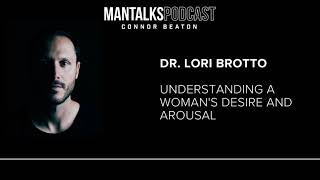
Dr. Lori Brotto explains why physical arousal signs like lubrication don't match what women actually feel, and why stress matters far more than hormones. She recommends sensate focus exercises, scheduling sex without orgasm pressure, and mindfulness to quiet distraction.
Chapters
Foreign.
Welcome to the Man Talk Show. Training for Men, Answers for Women. I'm Connor Beaton and today Joining me is Dr. Laurie Broto. And Dr. Broto conducts research on women's sexual health and difficulties, develops and tests psychoeducational interventions for women with sexual desire and arousal complaints, and studies many aspects of sexual healing, including cultural and sexual sexuality, hormones and sexual desire, cancer and sexuality, concerns about HPV and sexuality, asexuality and more. Dr. Brodo received a PhD in clinical psychology from the University of British Columbia, where I happen to go as well. She also trained at the University of Washington where she completed a one year internship in the Department of Psychiatry, followed by a two year postdoctoral fellowship in reproductive and sexual medicine. She is also a member of the National Academy of Sex Research, the Society for Sex Therapy and Research, the Canadian Sex Research Forum, and the Canadian Psychological Association. She has published over 150 articles and book chapters, has given 200 invited presentations, and is frequently contacted by the media as a guest expert on the topic of sexuality. So clearly just based on her bio, she has done a tremendous amount of work around, around sex and specifically has focused quite a bit on women's sexuality, sexual desire, and that's what we're here to talk about today. So one of the things that has been coming up quite a bit in the Man Talks alliance and in my work with men and women and couples is some of the myths around women's sexuality. And one of the biggest questions that seems to come up when the conversation of a woman's desire in relationship arises, whether it's in a, whether it's within a relationship or just a woman that's single and exploring her own sexuality, is where to begin, what some of the myths are and how to move through some of those blockages. And so I've had many guys reach out over the years asking very similar questions of, you know, I've tried having conversations with my wife, with my partner about what she craves, what she wants, what she really is turned on by and she doesn't seem to know or there's a lot of shame or the conversation never goes well. And so I've wanted to have an expert in this field on the show so that we can take a deep dive into a few really important aspects of a woman's sexuality. And so we talk in this episode specifically about low sexual desire within women, loss of sexual arousal within women, fear and anxiety over sexual activity, changes in sexual function.
What constitutes for arousal within a woman and what doesn't, how to create that, how to create the conversation for you as a couple to start to engage in allowing your partner's sexual arousal to be present. How a woman's sexuality and sexual arousal differs from that of a man. So some really, really interesting content, research, and dialogue in this episode surrounding a woman's sexuality. And we really. I really wanted to debunk some of the myths that are out there around a woman's desire. And so Dr. Broto is one of the leading experts in the world on this subject. And so this is a really wonderful conversation. So whether you are single, whether you are in partnership, I encourage you to check this podcast out. If you are in a relationship, I would encourage you to listen to this with your partner. I think it'd be very beneficial in getting the conversation started because one of the things that we discuss is how to have the conversation around sex and intimacy, what you're wanting, what you're wanting to explore, and. And some of the main hurdles and obstacles that women often face when it comes to tuning into and connecting with their own sexual desire. And then we talk a little bit about what we, as men, we can as their partners do to facilitate that sexual arousal. So this is a phenomenal episode. I really enjoyed this conversation, and I hope you do as well. So without any further delay, please welcome Dr. Laurie Broto.
Thanks so much for having me.
Yeah, I'm excited about this one, and I've actually had quite a few people reach out to tackle this topic. We were doing a bunch of research about who we could have on the show to sort of dive into this, and you were first and foremost on my producer's list, and so very happy to have you here. Yeah. So let's just start off with the question I ask everyone, which is tell us a story about a defining moment in your life.
So it's probably the story of how I came into the field of sexuality. And it's often a question that I get asked by, you know, random people that I meet, family members. How on earth do you devote your entire career to sexuality as both as a researcher and a clinician? And it's interesting because I grew up in a very, very ultra conservative Italian Catholic household where kind of all of the stereotypic myths around beliefs about sexuality being sinful, engaging in masturbation, would lead to, you know, terrible things happening to you. Everyone would know, and so on and so on and so on. I was sort of bathed in those beliefs growing up. And so it's somewhat ironic, but also serendipitous that I landed in this. In this field of sexual health and sex therapy. But it certainly was by accident, it was not by choice. What's interesting for me is to think about, wow, had I not as a, as an 18 year old undergrad started volunteering in that lab studying animal sexual activity and that then subsequently leading me down this career path towards more clinical issues in sexuality, had those things not happened, I would probably be a very different person today and still very much locked with those early negative and frankly wrong beliefs about sexuality. So I'm quite lucky in that way. And it provides for me, I think, a lot of empathy to folks who have not had other opportunities to really challenge their beliefs about sexuality. For me, as both a researcher and a clinician, it again, just reaffirms why I'm doing this work and why it's so important to get accurate information about sexuality. And we also know that early negative beliefs about sexuality can change. But of course it requires one to be aware that their beliefs are inaccurate and harmful, harmful to them. So that's probably my story because it's what keeps me so passionate about this work and also the recognition that there's still a long way to go. And you know, I'm sure we're going to dive into it around women's sexuality, women's sexual desire. But the whole study of women's sexual desire is really quite, it has a much shorter timeline than the much longer history of studying men's sexuality and men's sexual desire. So again, much more, much more work for us to do.
Yeah, yeah, awesome. And you know, I think, I love that you unpack that because I think most people can relate to growing up in a climate or an environment where sex is not talked about. There's a lot of repression, there's a lot of messages that keep sex in the dark. And then we sort of have to fumble through trying to figure out sex and intimacy as we go along. I am curious the first thing that came to mind and we will talk quite a bit about, you know, women's desire and, and whatnot. But I'm curious, like, how does one do sexual research? Like, I think, you know, immediately I was like, wait, are you, are you like, are you watching people have sex?
Like what we are, right?
Yeah, yeah, yeah, exactly. It's like, wait, you know, I'm sure that there's people that are like, oh, where do I sign up for this? But, but what is, what does sexual research even entail? And how do you start to, how do you start to produce an environment where you can cultivate this data and then link it to.
Yeah, great question. You know, thankfully there's not one way to study sexuality. And so, yes, there are the traditional objective ways of measuring sexual response, and that's actually where I started out during my graduate studies was I was really interested in physical sexual arousal. So what actually happens to the body as a person becomes interested in sexual activity and subsequently aroused? So there's a variety of different instruments that can measure sexual response. In men, there's a penile plethysmograph. In women, there's vaginal photoplithysmograph, there's clitoral doppler imaging, there's different thermographic ways of taking photos of the genitals. And as arousal happens and blood flows into certain areas, it shows up on a heat map. So those are absolutely some of the more objective and structured ways of measuring sexual response that many sex researchers, myself included, use. But it only tells you a very small piece of the much larger picture because oftentimes what a person says doesn't always agree with what their body is indicating. And we see that, what we call discordance, that disagreement between a physical response and a self reported response, we see that more in women than we do in men. So in the psychophysiology studies of men's arousal, usually there's agreement. If a man's physically turned on, he'll self report. Yep. Feeling in the mood. I'm feeling turned on. And more often than not with women, those two processes are not in sync with one another. And so that feature the fact that the kind of body response and self report response are usually not in sync for women has for me become a central question around does it matter? Is it relevant? What does this mean for a woman's high versus low desire? And do we have interventions, psychological interventions, that can bring the body and the mind more in sync?
Yeah. Okay. There's a lot in there that I think we could probably dive into. I am curious about that discrepancy because I think we as men, I know personally, for myself and for a lot of the men that I've worked with, there's sort of like this period of time that we go through where we believe or treat women like their sexual desire and arousal is the same as ours. Right. That it's just sort of like a touch or a look or something like that can trigger arousal. And from my understanding, it's quite a bit different than that. So when it comes to the gaps between male arousal and female arousal, what are some of those pieces that we need to be Aware of.
Yeah. So first of all, given that this discordance is more the norm than the exception for women, I think a really important take home message for any person is to not rely on a woman's, say, lubrication, vaginal lubrication or other physical signs of arousal as indicating whether she's in the mood, whether she's consenting to sex, whether she's turned on. And the sort of, the default should always be ask her, ask her. And again, lubrication is not a sign that a woman is aroused. It might be, or it might just be that automatic physical response that happens when women see something sexual or are in a sexual scenario. So there's certainly kind of an evolutionary adaptation that happens that allows a woman to become lubricated, but it's not necessarily that she, she is in the mood. So that's, I think a really important take home message is always asked that a woman's mouth is indicating more than her body is. But I think another really important difference is what happens within longer term relationships is that for, for women the, the kind of pattern and expression of her desire looks different over time over a longer term relationship. And it might also in men, but it might take longer within that long term relationship. So I'll give you a really specific example. So in a new relationship, and let's just take, for the sake of simplicity, let's take a heterosexual couple. So a man and woman paired in a, in a brand new relationship, how they experience their desire might be very similar, right? They feel in the mood when they see the person, they fantasize about the person. They have the feelings in their body, the quote, butterflies in their, in the pit of their belly and they want to have sex. And that might look the same for both of them. So they can both kind of relate to that same feeling of desire, but over time. And part of this is hormonally driven because men have such higher levels of testosterone. Women have about one tenth the level of testosterone that men do. It means that that spontaneous physical driven desire for women declines. And it doesn't mean she's losing desire for a partner, doesn't mean she's, you know, less attracted to a partner. It just means that that initial desire gets replaced with, with a different form of desire. And so much more common for women in a longer term relationship to first get aroused and then have desire afterwards. So her body might start to respond further first, even if she's not necessarily in the mood to have sex, but with attention and focus and, and sort of an enjoyment of what's happening. Desire can emerge from that. And that might be quite different from how a man experiences sexual. The kind of relationship between desire and arousal. He might continue to first be in the mood and then get aroused secondly. Whereas for women, the opposite direction is more often the norm.
Okay, so I think what I hear you saying there is in long term relationships this spontaneity on, I mean, I think on both sides, but generally what you're saying on the woman's side will naturally decrease over time and it'll be less about the spontaneous connection in the moment. So what does the research show in terms of being able to re engage that intimacy? Because I think, and I do want to talk about some of the myths which I think will lead into this nicely, but how do we start to re engage that? I'm just getting the, you know, the big questions right up front here that I can sort of hear a lot of couples asking because this is a big thing. You know, my wife's a couples therapist, we work with couples quite a bit. And I think one of the interesting things is that this discrepancy in long term relationships seems to come out quite a bit. Right? Couples are together for a year or two or ten, they have a kid, and that spontaneity starts to decrease. And so how do we start to combat that? And what do we specifically need to know about a woman's sexual arousal and desire in order to create that reconnectivity?
You know, let's address one really prominent myth right off the bat. And that is the belief that we only have sex because we have desire. Right. And that actually is a myth, what the data tell us. And there have now been several very large studies that have directly asked men and women, why do you have sex? And believe it or not, there are 237 discrete reasons why people have sex. And, and many of those have nothing to do with desire. So they might relate to wanting to connect with a partner and share intimacy. Wanting to communicate in a way through sex that doesn't happen through words. To get to sleep, to manage stress, to celebrate a birthday, to get revenge, to dissipate anger. Again, 237 discrete reasons. So if we accept that we can consciously decide to engage in sexual activity for many different reasons, then it means we don't have to wait to feel in the mood to engage in sexual activity. So if we sort of take that a step further, it suggests that we actually stand to gain when we consciously think about our reasons for engaging in sexual activity. It's actually A useful exercise to think about why engage in sexual activity. And again, it can be for any one of those many, many reasons that have nothing to do with sexual desire. So when you. When you think consciously about those reasons, then you might be more willing to initiate sexual activity even when you're not necessarily feeling in the mood. But of course, with consent. So consent is. Is explicit and implicit in this. It's not just, you know, do it anyways, but it's with consent and with potentially several different reasons that have nothing to do with desire. And then once the encounter starts to unfold, knowing how to elicit arousal, trusting that arousal gives way to desire. And if we can stay present and focused. And here's where a lot of the work I do with mindfulness meditation becomes really relevant because people are often distracted and women more so than men. But multitasking during sexual activity, thinking about other things that have nothing to do with. With a sexual encounter, or perhaps worse yet, worrying about the outcome of the sexual encounter, so much so that it directly gets in the way of feeling arousal and feeling that responsive desire, which. So we can certainly talk about that. And, and, you know, why are women more prone to distractions? Why. Why do women catastrophize more during sexual encounters than. Than men do? Men do, Absolutely. And I see a lot of, unfortunately, young men in my practice who become very concerned about, you know, body and their body's appearing a certain way, so much so that it actually impairs their erectile response and they might be prone to losing their erections during a sexual encounter. So, yeah, we sort of started out talking about, you know, the. I think one of the more common myths, which is that we have to feel desire before we engage in sexual activity, and we just want to eliminate that. And we want to be conscious and deliberate and even curious about what might be some of those other reasons to engage in sexual activity.
Yeah, I think that's. I think you're touching on a very important subject, because I think the idea, what I've seen with a lot of couples where there's discrepancy sexually, where there's maybe dysfunction or.
Sexless marriage or sexless relationship, is often that idea is very prominent, that there should be some sort of intense desire.
We almost overlay Hollywood expectations onto our relationships, even five, 10 years in. So I guess my question there is. It relates to low desire within women. Because I think what you're sort of alluding to is that we maybe have been mislabeling low desire within women, and that low desire is Maybe a byproduct of our distracted lives. So maybe can you speak to the myths around low female desire and what some of the actual contributing factors are and what the research shows?
Yeah, so first of all, we know that low desire in women is fairly common. So the very large studies that have looked at the proportion of women across ages who actually report low desire for a significant amount of time, so three months or more over the last year find that about a third of women across ages. So it's not the case that this is just impacting postmenopausal women or say women after a major medical issue or cancer or surgery, etc. It affects women across the ages equally. So that's, that's important. Secondly, what's important, which you mentioned, is what are the causes? If this is so common, what on earth is contributing to this somewhat global issue? You know, an issue that's more common than diabetes, more common than asthma, more common than depression, all of which we have so much more comfort talking about. And patients or individuals struggling with those issues have greater ease getting care for those issues than we do with low desire. So a lot of the research has attempted to look at what are those causes. And certainly one of the most common questions I get asked is, is this hormonal? Right? Is there something that can be tested in a blood sample that points to my low desire? And the simple answer is no. And the research has looked at this question, Is it estrogen? Is it testosterone, Is it dhea, Is it oxytocin? You know, is there something else? Is there a neurotransmitter that is imbalanced, that's contributing? And while all of those hormonal and neurotransmitter factors play a role, their role is relatively minor compared to the other more common predictors. So the leading predictor actually is stress. And we certainly live in a stressed world now more than ever with the COVID 19 pandemic, stress levels that are at an all time high, appropriately, people concerned about finances and living situations and social interactions and stress. And what I mean by stress is sort of the day to day grind. It's not a single traumatic event. It's the ongoing chronic life events that amount and pile up and impact sexual desire in a very, very significant way. So one of the ways that it does that is it impairs our ability to be present. And sexual arousal and sexual response is not just a reflex. It's not just, you know, if we press that button in the right way long enough and hard enough, arousal and orgasm and satisfaction happen. That's absolutely not the case. And I'm sure your listeners would immediately grasp that as yes, of course it's not just a simple reflex. So the brain plays a pretty pivotal role in all parts of sexual function and sexual satisfaction. And so stress directly impedes that ability for the brain to get aroused and also for the brain body connection, which is vital for sexual response. So when we look at what could possibly assist with this, it's basically the same strategies that we use for stress management in general. It turns out that those tend to be, you know, frontline most effective for reducing stress and improving sexual desire. So I've been really interested for a long time in mindfulness meditation as one particularly effective way that people can learn to manage stress. And we know that mindfulness meditation works. We know that mindfulness changes the brain. And it turns out through a lot of our research that we've found that it can directly improve sexual desire as well.
Very interesting. Yeah, I mean, I think, I mean we, my, again, my wife and I have led a whole bunch of workshops with people and one of the things we have them do sometimes is different exercises to get them present and dialed in and connected. And we'll sometimes give homework for them to do, do these specific exercises that rid them of distractions and help them drop in mentally, physically, emotionally with their partner. And it's so surprising time and time again with just simple things. Eye gazing, breathing with one another, forehead to forehead, hands on each other's body, and these simple things where people have been together for years and suddenly say like, oh, I actually realize I haven't looked my partner in the eye in, in months and never mind just held each other for a minute or two and it's like, okay, well so there's clearly some basic things that we can do to start to reduce that stress.
Is there any data or information about using sex for stress relief specifically? Because I think I can think of times in my life where I can think of clients where they are actively using sex as a means of, of, of release from stress.
Yeah.
So any, any thoughts on that?
Yeah, interesting that you asked that question because, you know, if we look at depression, say, so depression being a clinical diagnosis that is, is made when a person has at least a two week period of low mood and changes in appetite and changes in sleep patterns and hopelessness and helplessness and also loss of motivation for their typical activities. And we know that most people, when they're in a period of depression, they also lose interest in sex. Right. So, so more so for men than for women. But the studies have also consistently found that there's a small subgroup of people, much higher proportions of men than women, that during periods of depression, they actually have an increase in sexual desire. And then the same happens with stress. And so what it looks like is, among those individuals is that sex actually becomes a coping mechanism. So it's not necessarily that they have more desire when they're stressed or when they're depressed, but because their mood is low and their anxiety and stress levels are high. Sex has become their coping method of choice. Whereas for someone else, it might be a different coping method. Coping method, whether adaptive or maladaptive. So we do want to pay attention to that group. Because, of course, if sex is used as a coping mechanism, is consent consistently being used? Are there out, maybe out of control sexual behaviors where the person is engaging in sex in unsafe ways where they normally wouldn't? And so we do want to pay attention, but it is, it is definitely a subgroup of people. It represents about 10% of men when they're depressed.
Really? Really. Interesting. Yeah, because I think, yeah, I'm just like. I'm thinking about, like, people that I've worked with before where that. That has shown up and been a part of their coping mechanism, whether it's through direct sex or, you know, pornography as well, you know, excessive uses, Excessive use of pornography. So. Okay, interesting. So I want to kind of get back to this, this topic of, like, you know, female sexual desire. And I think I told you before we got on the show, like, a good subset of my listeners are women. And so I would love for you to just kind of address some of the gaps that you most often find in women's idea of sexual desire, of their own sexual desire, and some of the missing components for them. Because I think we as men, I think often underestimate some of the narratives and stories that are thrust upon women for a very long time from society and religions and families and stuff like that. So what are some of the gaps that women are faced with?
Yeah, there are a lot of societal messages around how women should be, including their bodies and their sexuality. And so recognizing that what you see in the media, what you see on social media, what you read, what you see in movies, what you see in pornography or erotica is not reality. You don't see people take socks off. You don't see people put kids to bed. You don't see them plan sexual activity. And I think it's really important to debunk the myth that only spontaneous, unplanned Sex is good sex. And I often say to people, you know, what else do you do in your life that you look forward to that's of value, that you're excited about, that's not planned? Nothing. You'd be hard pressed to find those things in your life that you really look forward to and are excited about that are not planned. We want to normalize planning, the planning of sexual activity. And there's a way to do that that's sexy and fun and maybe leaves a bit of room for spontaneity. But when you plan it, when you plan a sexual encounter, then it means you can kind of cultivate the necessary psychological space to transition from other activities into a sexual activity. And because, again, we live in such a multitasking society where multitasking has become so prized, so coveted, I often hear people say, I'm a great multitasker. As if that's like the gold standard for where we want to be. And yet the science tells us that we actually don't multitask. We think we're multitasking, but what we're really doing is switching our attention from task to task to task. And each time we do that, there's a toll that it takes on our brain in terms of attention and accuracy and other things as well. And so we need to be aware that we're taking that into our sexual encounters. So if this means that planning sex, allowing for appropriate transition from other tasks and other activities into sexual activity, more time during sexual encounters, then we want to normalize that. We want to say, yeah, all of this, all of this kind of planning is part of the sexual encounter. And I often say to people, you know, foreplay starts when your last sexual encounter ends, right? So the sexual encounter ends now. You start foreplay for your subsequent sexual encounter, which might be a month down the road. But the idea being that you sort of kind of cultivate the idea, the erotic thoughts, the planning, the anticipation, all of which are going to bode very, very well for your subsequent arousal and desire. So I guess we debunked a few myths within that. One is that, you know, foreplay is just the two minutes before you get to the real action, which is intercourse in a heterosexual relationship. And that's actually not true. And here's another myth, the myth of the vaginal orgasm. And we are going to go there because it's such an important myth to debunk. Most women don't reach orgasm through vaginal intercourse alone. 80% of women do not. And so clitoral orgasm is a Much more normative way of experiencing orgasm. For women, there can also be simultaneous clitoral or vulvar stimulation during intercourse. So for a lot of women who do reach orgasm during intercourse, there's a very good chance that there's simultaneous stimulation of the clitoris or the labia or the nipples or other parts of the body. It's not necessarily vaginal penetration per se. There's simply not enough kind of nerve pathways in the vagina that lead to orgasm for vaginal intercourse. So, yeah, so lots and lots of myths that are in there. And because most of us, myself included before, I immersed myself in this field of study, because we don't get accurate information about sexuality, these myths continue to perpetuate unchallenged. And we take those with us into our sex lives and then we don't talk about them, we don't challenge them, and they just continue to perpetuate.
Yeah, I mean, there's a lot in there that you just unpacked. I think one of the things that stood out to me, and this is going to. I just can't get out of my head is just like the person taking their socks off in a porn, you know, like, you just never see it. It's just like. It's like, yeah, what would that. I mean, that would sort of be a weird scene, right? Like the pizza guy taking off his socks. Awkwardly awkward, you know, taking off his socks while he's losing his erection. Like, I gotta take my socks off. Right? That, that, that shit just doesn't. You don't see that stuff, which is hilarious. I feel like there should be like a blooper reel of like, shit you don't see in porn, you know?
Yeah, yeah. Condom breaks or someone knocks the door, whatever.
Yeah, yeah. All the. All the awkwardness. But I think, you know, one of the things that I really love about what you were unpacking there was creating these rituals around sex and intimacy, you know, and. And having that, you know, you call it planning and I just call it rituals. Having that methodology there. I think a lot of people are resistant to it because we have sort of pedestal this ideology that sex should be super in the moment and like really wild and passionate. And again, it's. It's, you know, pornified and Hollywood glamorized. And so how. How can couples start to do that? Because I think one of that I'm hearing you say is one. When it comes to a woman's desire, removing distractions is incredibly important.
If we want to elevate that or assist with allowing for desire to come forward and be present. Two, a little planning is not going to hurt. But also three, I think there was something really important about what you were saying in terms of the psychological component of that. And I think from some of the research that I've seen, you know, we do differ between men and women and that women are often aroused in a very sort of psychological way. I think I read somewhere that men require sort of like one quote unquote touch point, whether it's again physical or mental. And then women require something like 20 to 22. And so I'm wondering if you can just speak a little bit to that. Is that accurate? Is that what the research shows? And then if so, how do we, how can people sort of take this away and start to create rituals and scheduling that allows for some of that psychological component to be present in their relationship?
Wonderful. Yeah. And you're right in terms of the range and the diversity of different kinds of what we call triggers or stimuli, that's what researchers call it to elicit arousal for women. And that becomes important firstly because it suggests that what you might know about your partner in terms of what turns them on might not consistently hold for the rest of your 60 year relationship. So it's an opportunity to continue to dialogue and explore and use some of like the touching exercises that you've described in your workshops and sensate focus, which is a staple tool that we use as sex therapists to continue to discover what are those triggers? For me, those stimuli that elicit a response And a lot of things over the course of our lifetime change our sensitivity to different triggers. So pregnancy, breastfeeding, hormone changes, surgeries, scars.
Even even several psychological factors can change our sensitivity to stimuli. So when we think about, let's take some of the visual triggers like let's take erotica and I'm differentiating erotica from pornography here because they are different. Porn is the kind of massly available, tends to be more male focused with a focus on heterosexual pleasure and erection and orgasm. And erotica is an entirely different genre that is often female directed female created with women's pleasure is the focus. And what the data tell us is that women might would respond more to erotica in terms of their own physical arousal and psychological arousal than they do to porn. Even though porn might get the juices flowing and the blood going and maybe even that lubrication present, but it does not necessarily trigger that that interest in sex in her mind. So just staying on this topic of stimuli, you know, one of the unfortunate things that I see in a lot of the couples that I work with is that they don't talk to each other about what feels good and what doesn't feel good. And the number of times that a woman might kind of disclose in a therapy session, you know, that thing that we've been doing together for the last many decades, not only does it not turn me on, it actually hurts. Right? So, for example, direct clitoral stimulation for a lot of women, they'll say, it actually hurts. It doesn't turn her on. Now when she's aroused, that same touch might feel really good and really exciting, but pre arousal, it's actually painful. And sexual communication is actually globally very poor in couples all over the world. And this. This question has been asked in many, many of the large surveys because sexual communication is also found to be a major predictor of sexual satisfaction in a relationship. So if you do nothing else other than work on how you talk about sex even without having it, let's just work on our comfort level with talking about it. That's probably one of the best things you can do to enhance your couple sexual satisfaction.
Can we pause that one? Because I feel like I can hear.
The men in my ear being like, okay, what do I do? How do I do that? I think one of the biggest things is that I've seen is, you know, a lot of the men, especially in the, you know, that are. That follow me and that are, you know, listening to this podcast generally really want to be better, be more equipped. They want to be successful. They want their partner to feel good. And. And it is sometimes a challenging conversation, right, to hear, oh, that thing that you've been doing for the last couple years actually doesn't feel good. It actually hurts. And so I think a lot of men are like, okay, how do I engage this conversation? How do I create the conversation and the space for my partner and I to have that dialogue? So what does healthy sexual conversation look like? How can we start to facilitate that within our relationships? And if you can just provide maybe just some insider pointers as to how couples can start to do that, where they should start, what they can just begin to talk about in a way where people can listen to this podcast, maybe together, and then implement some of these things. Because I agree, I think that sexual communication is by far the most important foundational piece.
Yeah, great. So I think importantly, doing this outside of the bedroom is really important because within that sexual contact, sexual setting, there's already so many emotions involved and expectations as well as arousal, and there's Just a lot going on. That's not the best place for learning is in the midst of a sexual encounter. So I personally am a really big fan of. Again, I mentioned sensate focus before.
The instructions for sensate focus are very easy to get. There's an entire manual, illustrated manual on sensate focus. And essentially what it is is it's kind of a slight step by step touching exercise that a couple can do that's solely designed to allow the receiver of the touch to feel and then to communicate back to the other partner what that feels like. So the whole goal is communication and tuning in. The goal is not arousal, and it's definitely not sex. In fact, sex is not allowed when you're doing a sensate focus exercise. So it's a rich opportunity for working on and refining how do I give this feedback to a partner in a way that's actually going to be constructive and fun and sexy and useful and not judgmental. Right. So providing feedback to a partner about how to touch is what we want to normalize. It's not a criticism, and it's certainly not a sign of lack of attraction or, you know, other signs of things not going well in a relationship. So sensate focus is definitely one way of doing it, but another way of doing it without the touching part of sensate focus is again coming back to carving out the time sitting down and maybe even saying, I listened to this really interesting podcast. They were emphasizing the importance of triggers and stimuli and for women, arousal. Really emphasizing arousal as a precursor to desire. Let's talk about that. Let's kind of roll up our sleeves and kind of dive into our own sexuality and talk about what feels good, etc. So there's different ways of doing it. But again, ideally, outside of the sexual.
Scenario, I think, I think the follow up to that is.
What would you say to the women that are listening to this or the partners about how to explore that for themselves? Because I think one of the things that I've heard consistently from men is, okay, I sat down, I had this conversation with my wife, with my partner, I asked her what feels good for her, and all I got was blank stares. And I don't know. And so there was a lot of empty spaces there. And I think a lot of men are like, I don't know how to lead her into these conversations or into these explorations. And so what would you say for. For the women that are listening to this, like, where should they start in exploring their own sensuality and their own Desire and arousal.
Yeah, well, you know, masturbation is one. Masturbation is such a powerful learning opportunity for people. And I think here is where also we see a stark gender difference. Men discover. Young boys discover masturbation at a much, much younger age than young girls do. I know with my own boys, they discovered it at age 2 when they were in the bathtub and the feeling of the water on their penis, you know, they were like squealing with delight. And I said, all right, this is where masturbation starts. Right. And also because, you know, the genitals are so much more external for young boys than they are for girls. Plus just our kind of societal normalization of masturbation in boys. Right. This is a normal, this is a prized rite of passage for young girls and for young boys and for girls it's pathologized. Very, very much pathologized. So it's certainly never too late to discover one's own body. And it doesn't have to be self touch for the goal of orgasm. It could be purely self touch for the goal of discovering what feels good and what different pressures and what different objects of stimulation, whether it's your fingers or a piece of velvet or something else feel like. So we want to normalize that because that's really the best opportunity for one to figure out what feels good.
Yeah, I think that's really good insight and is going to put an individual into contact with the stories and narratives around their own desire and their own arousal. Right. Just because there's naturally going to have the obstacles around wanting to do that, the embarrassment, the shame that might come up. Any sort of thoughts on how to deal with the sexual shame that a lot of people have? Is it in the act of starting to move through this exploration that we start to de shame it? Is there different sort of psychological or emotional work? Is this where mindfulness comes into the practice? What are your thoughts on that?
Yes.
All of the above. Everything.
And, and you know, often shame might interact with a person's own history. So if there's any history of sexual assault or sexual abuse, then that, that trauma and that shame become much, much more complicated. And depending on the story around that, especially if the person's carrying any degree of responsibility or self blame around that and in those kinds of situations, you know, working with a qualified health professional around really unpacking the, the, the shame and the trauma is, is I think often necessary. In other cases it's not. It could, it certainly could be the case that in going through the behaviors in Going through the acts and that kind of positive reinforcement of oh, when I do this kind of self discovery work, I feel better, I learn what I like. In turn, I communicate with a partner more. Our sexual encounters become more rewarding and then it becomes sort of positively reinforcing in and of itself. So that's sort of the, that that's kind of the best case scenario is you engage in the behavior first and then the attitude change and the changes in feelings result from, from that as well. And of course we have to keep in mind that for a lot of people this happens within a relationship context. Right. So it's one's own beliefs and emotions and behaviors. But then their partner might have their own separate beliefs, emotions, behaviors and histories as well. So it can get pretty complicated and tricky sometimes. But sexuality. And as a result of a lot of the really excellent research on different interventions, behavioral couples based, psychological, mindfulness based interventions, we know that it's never too late to improve one's sexual satisfaction.
Wonderful, wonderful. I guess, you know, just an effort of time. We're going to wrap up with, with two final thoughts. One, you know, do you have a practice that you would recommend, a mindfulness practice that you would recommend to couples? And then secondly, I would love for you, you had mentioned this, this idea of knowledge translation and you know, sort of how do we find out the real facts and research about sex and sexual desire and how we go about sourcing that. So let's just end off with those two pieces in whichever order you feel.
Is best.
Yeah. So I think to the first piece is consider scheduling an encounter that does not have orgasm as the goal of the encounter. Right. So you're actually going to go into the encounter saying, you know, we're actually not going to focus, in fact we're going to deliberately try and not orgasm and we're just going to use this time to touch and feel and explore and communicate and be really present. And ideally without a ticking clock in the background where you're monitoring the time. So that I think eliminating the hyper focus that a lot of people have on the seeming gold standard of orgasm suddenly opens up a lot of opportunity to truly feel. So that, that's, that would be one that I would recommend your listeners to try. And to your second question, you know, again, because a lot of us simply don't have access to good information around sexuality and our sources of information are the media and social media and movies, etc, it means that we're not having those beliefs challenged. So we started, we've been doing a Variety of social media knowledge translation campaigns. Currently, we're nearing the end of one of our campaigns called Debunking Desire. And we've been using social media and a targeted campaign to take a lot of the scientific findings about women's sexual desire and share them, get them out to the public in a way that they can use in their life. So we're using, you know, pretty much all, all vehicles of social media. And we have a website, www.demunkingdesire.com, with lots of great links to animated videos etc. So it's, I think, a call for your listeners to ensure, to really question the sources of their information around sexuality. And just because it's on the Internet does not mean that it was vetted, invalidated and to really kind of take those active steps to make sure they're getting good information.
Yeah, I like it. It sounds like debunkingdesire.com is almost like a sexual snopes.com, i don't know if you know what Snopes is. S N O P E S. Like the fact checking site, right? It's like a sexual fact checking site.
Exactly.
Amazing. Amazing. Well, this was a wonderful conversation. I really enjoyed my time with you and I feel like we could have gone into a few of those a little bit deeper, but this is a really, really great place to start. And so if people are wanting to learn more about you, about the work, they can obviously go to debunkingdesire.com where else can they learn more about you and the work that you're doing?
So all of our research and research findings you can find through our website, which is www.broadolab.com. so Brado, my last name lab.com and then I'm pretty active on Twitter, rloribrato. And I often link to new scientific findings in sexual health of all genders, not just women, not just men, but all genders. And so that can also be another place for any listener to really stay on top of, you know, what's kind of what's the latest and greatest in the field of sex research.
Amazing. Amazing. That sounds fantastic. I never got into Twitter myself. I've always like, give me your tweet pitch on why Twitter. I'm always so curious about why, why people love it so much.
Oh, I love Twitter. Yeah. On Instagram you'll just see pictures of my kids, but on Twitter.
You'Ll get real science. Yeah, I mean, I love, I think because our attention spans are so finite, having the limited character count with the take home messages but then with the link for those who are intrigued to read the full article. For me it just really appeals to again my mission around knowledge translation when it comes to sex findings.
Wonderful, wonderful. Well, thank you so much, Lori, for joining me. For everybody that's out there listening to this show, please do listen to this with your partner. This is a great conversation to start the conversation wherever you're at in your relationship, whether you feel comfortable with your sex life, who knows what you can learn or you and your partner could use a little bit more of a deeper dive. So share this with one person, man it forward, send it to somebody, listen to it with your partner or listen to it with a friend in the car. That's always fun. So this is Connor Beaton signing off. Join me next week for another inspiring conversation with another inspiring individual.
Sam.
More from Connor







How to Raise Strong, Unshakable Boys in Today's Culture, with Dr. Shefali Tsabary



