F*Ck New Years Resolutions, Do This Instead
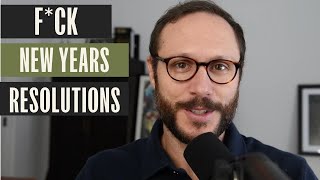
Connor Beaton says New Year's resolutions fail because they rely on hope instead of discipline. He suggests a memento mori practice instead: calculate your remaining days (he uses 16,792 until age 80), set a visible countdown, and journal each morning about living one of your last days. He found it clarified priorities and created pressure that actually stuck.
Chapters
All right, man. Welcome back to the mantalk Show. Final episode of the year. Excited for this one. It's going to be brief, it's going to be short, but it's going to be direct. So you can probably tell by the title, I do not believe in New Year's resolutions. The data is in, the research has been done, and we can pretty much unequivocally say that for the majority of people, New Year's resolutions are absolute garbage. You know, this notion of like, New Year and new me, a new career, a new life, a new relationship, none of it works, right? The majority of it doesn't work. And there's been a lot of research on why it doesn't work. My gut and my experience with New Year's resolutions and having worked with people and seeing what causes change and what doesn't, is that New Year's resolutions rely too heavily on hope, on the notion of hope, right? People set a New Year's resolutions because they hope that some form of change will come, will arise, right? They hope that they can lose the 20 pounds. They hope that they can start working out frequently. They hope that they can save more money and prioritize their finances. They hope that their relationship will get better. And the reality is, is that hope will run out at some point in your journey of change. Hope will run out at some point. And the real hard part of change and transformation is when you get into that territory where hope ceases to exist, where you really start to question whether or not you want this change, whether or not you really want to lose that 20 pounds, whether or not you really want to save that money, whether or not you really want to learn investing or whatever it is that you've said as your quote, unquote, New Year's resolution. And we can see this in many different forms of psychology, in spiritual practices and even in. In frameworks like alchemy, where they all sort of talk about how there's. There's not only merit in going into your own sense of. Of darkness, but that darkness is in some ways, whether it's psychological or emotional or spiritual, is where the hopeless exists, right? Where hope ceases to exist, where we can't really see why we should be hopeful anymore. And we also know that, you know, motivation is something that generally comes afterwards, that we need to focus on discipline first and motivation comes second. And far too many of us, when it comes to things like New Year's resolutions, are over indexing on motivation, right? So, like, okay, I'm going to go to the gym and we start off strong and we. We have all of this sort of gusto to tackle this New Year's resolution. And it fades. You know, it wears down, it wears out. Because the truth is that chains and transformation are sometimes a grind. You know, sometimes the real change that you are trying to make is going to take years of training, you know, years of practice. And we all cognitively know this. But when it really comes to executing on it, and it's much harder than we've expected, and that's where the quote, unquote, rubber hits the road, right? To just use the cliche saying that's where we really are tested is when hope has run out, when we've exhausted our motivation, when we don't have any motivation left and we have to rely on pure determination, pure grit, pure discipline of this is my commitment. And we have to align, right, our whole being towards that commitment. And that's part of our masculine core. And so as you go into this year, I actually encourage you and challenge you to let go of hope as a means of change and transformation. It might serve you for a little bit. There's nothing wrong with it. I'm not advocating against it. I'm not saying that it's horrible or terrible. I'm saying, know in your experience and in your mind that at some point that hope is going to turn on you, that's going to turn against you, and it'll become the thing that you wish you could get back as a means of feeling motivated towards change. Now, one of the things that I have found to be deeply rewarding and deeply meaningful in my own change and transformation in my own life, and this is what I really wanted to talk about today, is that you shouldn't be that I think, don't set New Year's resolutions, but what you can do is practice remembering death. And I say this because for a period of time in my life, I went through this big phase where I was studying quite a bit about stoics and spiritual practices. And I kept sort of hearing and reading about this concept of momento mori. And so I thought I would give it a try. And so one day, I think it was in my early 30s, I was like, 30, 31. I sat down and I calculated out how many days I thought I had left to live. And at the time, again, I said I was like, 30, 31. And I calculated out to. I think it was 80. I just picked a number. I was like, I think I could prob to 80. And I think I can probably live longer. But I just, you know, chose an arbitrary number to get a sense of. Of how long I had left. And I calculated out in days how many days I had left if I was to live to 80. And it was something like 16,792. I'm pretty sure it was pretty close to that because I remember sitting there at my desk and being like, that's a strange number to sit with. And it was really strange for me to sit with that number because at that time, I had more debt on my credit cards than I had days left to live. And that kind of fucked me up. You know, it kind of screwed with my head because I was like, how do I owe more money than I have days left to live in my life? Like, that seems pretty strange. It seems like something's wrong in my life. And not wrong in the sense of like, I should shame or myself or, you know, should all myself for it, but to just be honest of, like, that, that doesn't feel right for who I know I'm capable of being as a man. That doesn't sit right with me in terms of who I want to be and what do I want to do and what I want to accomplish. And so what I did was I set a countdown timer on my computer, and you can download apps that do countdowns. And I set this countdown to be on my computer so that every time I opened up my laptop, there was a countdown right there. And it had how many days left I had to live. And so I would wake up every single morning and I would look at that countdown timer and I would open up my journal and. And I would write about what I wanted to do and who I wanted to be on one of my last days to live. And for about a year, I did this process of just writing and being very present to the fact that I was going to die and being very present to the fact that 16,000 days, while it might conceptually sound like a long time, really isn't. Because as you count down the days, even if we only spend three months doing this or six months doing this, or, you know, a year doing this, you start to realize how quickly this time actually moves, how quickly your days start to go by. And I got very present to the fact that I knew, you know, I was again, I was like 30, 31. I knew that by the time I was like, 50, 60, your body's going to change. My body was going to start to change. And I knew that I only had a certain amount of time to really, like, hustle and see What I was capable of physically, financially, within my career. And I realized that I was wasting that time. And so by getting present with death each and every single day, by sort of sitting with it and befriending it and letting it enter into my life, although it was sometimes a pretty frightening thing, sometimes it was a little bit disparaging, sometimes it really made me question, like, why the hell am I doing this exercise? You know, is this. Is this really worthwhile sitting here thinking about my own mortality? But what it really did for me was give me a sense of the finite, of the limitations within my life. And as men, I find we are often avoidant of those limitations and those endings. And we, as men, experience time, I think, fundamentally different from women. I think that we experience time different from women. And I say that because our lives are this very long arc where we have these moments of some change, some interruption. You know, if you get married, if you have children, those things can really alter and put you face to face with the movement of time, with the movement of your life's time. But for women, it's quite different, right? When a woman hits puberty, she'll go through menstruation, and then every single month, she has this sort of thing that forces her body, that forces her mind to become deeply present to the moment, to her physical experience, to what she's feeling internally. And that. That in and of itself can cause a woman to see time very differently. Not to mention that, you know, if you just look at reproductive cycles, we, as men, can have children. Some men can have children, like up until their 70s, you know, they can impregnate a woman up until their 70s. Whereas for a woman, there's, again, there's a very finite experience of when you can have children. And so for most women, you know, when you start to get close to 40 and in your early 40s, it's very much a danger zone to have a child for women. They look at time and experience time very differently. And so women will start to get into their 30s and often sort of feel this psychological and physical pressure that will start to emerge that says you. You need to do something, you know, if you want to have a child, if you want to start a family, if there's something that is important to you or matters to you. And for as men, we don't necessarily have that. So we have this much longer arc where I see a lot of men hit that midlife crisis. This is why we have something like a midlife crisis, which is the. The sort of middle passage of life where if a man is lucky, and I really sincerely mean this, if a man is lucky, he will have this kind of harsh awakening in this middle passage of his life where he'll begin to question everything that is happening in his life, everything around him, whether he's with the right person, whether he's really satiated and fulfilled by the way that he lives and the things that he does, whether he has ventured into the right career. And if a man is really lucky, he'll experience this sort of questioning at some point in his life that will call him towards a more fulfilling and a more depth oriented version of himself and version of his life. We can kind of kickstart this as man. We can produce that same experience by coming into contact with death on a regular basis, by really paying attention to our own mortality, our own limitations, our own endings in life, and by letting that be an active part of your life. This year that will arguably, I think personally, because I've tried New Year's resolutions so many times, they just never worked for me. But what did work for me was sitting with death consistently and making a commitment to let that be a part of my life for a long period of time, to be very aware of it. And so rather than setting some BS New Year's resolution and hoping that it's going to work out and trying to leverage your motivation, rather than doing that, see if you can make a commitment to do this practice that I just laid out to calculate how many days you think you're going to have left in your life if you're lucky. Right? If I'm lucky, I'll get to live till 80. That's, that's wonderful. That's. If I don't come down with some disease or, you know, I don't get in a car accident or whatever the case may be. And so calculate out how many days in your life you think you have left and then set a countdown timer and write it out and sit with it every single day and spend 5, 10, 15, 20 minutes writing out what it's like to live out one of the last days in your life that you will never be this young again. You will never be this young again. And to really notice what that does about how you relate to the conflicts in your life, the challenges that you think you have. So one of the things that I really got out of that experience was just the simple notion that some of these things in my life, in my relationship and things that were really bothering me weren't really that big of a deal. And it was much easier to let them go. The other thing was this kind of pressure that began to mount, and not in an unhealthy way, but a pressure that propelled me forward into the things that I wanted to do, into the person that I wanted to be. You know, pressure isn't a bad thing. It's just that most of us are surrounded by this kind of constant pressure that that isn't healthy, that we don't like, that we don't want, that we don't even want to have in our life. But there is a kind of healthy pressure that we can put on ourselves. And pressure in any psychological framework, spiritual framework, I mean, even in an alchemical framework, is needed and necessary in order for any kind of change or transformation to occur. And so this was the sort of fuel and this wonderful pressure that started to mount that propelled me forward into, I want to take action. I actually want to live like, that's why I'm here. I want to live my life and see what I'm capable of. I want to write, I want to create, I want to build. You know, it took a little while for that to start to happen as I explored this relationship with my relationship with death. But after a period of time, it really started to become something that was magnificent and something that brought me face to face with wanting to explore my limitations and my edge and to really get to see what I was capable of in this lifetime. And so I hope that you take on this challenge rather than setting some New Year's resolution that you're likely going to, you know, flop on by the end of January, set a commitment for yourself to sit down, to create this countdown timer and to journal each and every single day, even just for a couple minutes, about your relationship to death and endings and limitations, and start to see what that brings forward within you, what that reveals about who you are and who you want to become and the type of life that you want to live. So if you enjoyed this comment below, let me know what your thoughts are. Let me know if New Year's resolutions have ever worked out for you. If so, how did you do that? And then let me know what you enjoyed about this concept and this conversation about remembering death and seeing how many days we have left to live and letting that inform our action and our being. So thank you so much for joining me. Until next week, this is Connor Beaton signing off.
More from Connor







How to Raise Strong, Unshakable Boys in Today's Culture, with Dr. Shefali Tsabary



