Falling to Rise: The Power of Descent in Personal Growth and Masculinity - Michael Meade
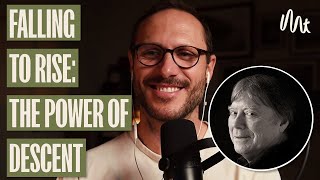
A long-form interview (Dec 30, 2024) between Connor Beaton and mythologist Michael Meade exploring "descent" as an essential process in male psychological and spiritual development. Meade argues descent (ritualized separation and immersion) reveals the deep self/soul—often via water symbolism—and that modern culture, technology, and loss of elders have disrupted these rites, producing dangerous informal descents (addiction, depression). The conversation includes Meade's personal descent story, reflections on myth versus AI, and practical advice (natural water immersion, poetry, weeping in groups) for re-accessing soul-life.
Questions this video answers
December 30, 2024.
Living Myth (weekly).
mosaicvoices.org.
Chapters
And a man isn't someone who has never fallen. It's someone who has fallen deep enough that they found themselves. The elder wasn't someone who hadn't slipped and made mistakes and fallen down. The only kind of elders you want is people who have fallen hard and found a way back. So when you fall, they help you and they actually have compassion for your falling because they found a compassionate sense of self when they fell.
Foreign.
Mr. Mead, welcome to the Man Talk Show. How are you doing today?
I'm good. And it's good to be with you, Connor.
Likewise. Thank you so much for joining me. I've been very much looking forward to this conversation and so much so that I have been. I got a sauna recently and I've been listening to. And re. Listening to some of your work in the sauna, which has felt wonderful. Just sort of like in this sweat lodge environment. The drumming is going, the story is being told.
Yeah.
I'm like holding. Holding circle just with you on audio. But, yeah. So let's. Let's start by talking about what I would love for you to sort of lay out what the role of dissent is within a man's life, within a man's psychological and spiritual development. Let's just sort of start there.
Are you saying descent?
Yes, like descent. Going down.
Oh, okay. All right.
So.
Well, it's a key thing, and I think it goes back to. Rites of passage is really where you begin to see a cultural focus on the process of dissent. And in rites of passage, there's three classic stages, the first of which is separation. So we're talking about men. So.
An adolescent or post adolescent boy would be separated from his family, his parents, from everyone he knows, except possibly others of the same age that are going through it. Because male initiations were group initiations, typically.
And so the first move is separation, but the next part of separation is descent. And my understanding is the descent is necessary, appropriate, primary, because the soul is found through descent. So one of the old distinctions between spirit and soul is spirit rises like the air and soul descends like water and like earth. And so in that sense, the awakening of.
The full psyche, the deeper soul in a young man would be found through descending and connecting to water and earth in particular. And so.
When we don't have rites of passage in contemporary culture, which is mostly the case.
We don't have a formal guided.
Descent.
In which a young guy learns. Also, you have a soul, and your soul has this range of feelings. And you may have a fiery spirit, but you also have a watery Soul. And it's also in that descent that a young guy realizes, oh, the feminine is in me. I may be more or less a model of masculinity, or not so much whatever, because the range is always wide. But the feminine is found inside as well. And that's typically found through a descent. And so cultures had lots of ways traditionally for men to experience that descent or boys to experience it on the way to becoming men. And nowadays you have a modern culture that's based on ascent, upward, onward, higher and higher, bigger and bigger. And that does not lead to a development of soul or to a kind of roundness in the personality. So then the idea of rites of passage or initiation is a specific form of. It is so important, it's archetypal. It's so important to the psyche and the soul that the world provides the opportunity for dissent. In other words, if there isn't going to be a formal dissent, there will be an informal one. And it's often created by the world, the young person encountering the world, and realize, oh, I'm not as kind of invincible as I thought, or I'm not as courageous as I thought, or whatever it might be. And that beginning of a distinction between the ego self that grew inside the family, especially during early life, and then the encounter with the outer world is usually what causes this, the descent to begin with. And then since this is so important to the psyche throughout life, I think a man will grow through descent over and over again. And then it becomes possible to not simply fall because we've been tripped or we fell off the path or something went wrong, but to actually intentionally descend. And there were all kinds of rituals for that that were built into all traditional cultures.
It's interesting that as you. As you talk, one of the things that I've spoken about before is that as we've moved further and further away from these rituals of initiation and initiatory practices for men that I. I see a lot of men creating these kind of uncontained or pseudo initiations through bottoming out. You know, like, I look at my own life, and I think back to when I. I hit rock bottom in my own life and had sort of been destroyed. A lot of the stuff that I had been building up in my life, and in many ways it was because when I look back and I know what I know now, part of it was that I didn't have any real initiation as a young man, and I didn't really have elders as a young man that were sort of transmitting this transition into the Next stage of manhood or masculinity or this descent. And so can you speak a little bit more to what that descent can look like for a man? Because I think sometimes for men that are in modern culture, they understand the importance of it. But there is a, almost like a knee jerk rejection to the notion of even going down.
So I agree completely. And the rejection's happening on several levels. For one thing, the ego, which is constructed not to experience dissent and certainly not to go anywhere near a sense of loss that could be thorough. The ego is usually constructed not to do that. Modern culture itself refuses dissent. Typically when the. When the stock market goes down, it's a problem when the stock market would have to go down in order to go up. Just like a forest goes down and goes up. It's the nature of the world to rise and to fall. But then the ego, in psychological terms, but also a whole culture now is organized not to experience the natural conditions which would be include descending or failing and falling. And so then usually what happens is a young guy has he fails in school, or he makes a mistake and gets locked up, or the first love of his life comes to an end.
And it's as if everything is wrong.
And when everything is wrong, it's as if I am wrong. When really the dissent is there to take a person closer to the deep soul or the deep self, you can use either term. And so the one difference with healthy rites of passage, it would be understood by everyone guiding it and creating it that there's something deeper and valuable in each person that we find by descending to it. And they would have lots of ways of informing each young person that they're carrying something valuable within that needs to be encountered and become conscious. And once that happens, they have something meaningful to give to the world, to give to the community and to benefit from giving themselves. And so then sense is made out of actually failure, loss and death, because death is the big descent. But the old idea was you die before you die, which meant before you get to the big death which is coming for everyone, you have a series of small deaths, which psychologically could be understood as the death of the ego. My sense of self, ego, self dies a little and I become deeper and therefore I become bigger and I become more sympathetic to other people having trouble and I become more compassionate because I actually understand what it's like. And since it happens to everyone, it doesn't mean I'm wrong or they're wrong or the world is wrong. It just means I now hit that place of Dissent. And so the whole education of it is missing. And so I've worked a lot with young people in trouble, and often that first experience of falling can turn into suicide because they don't know there's something down below that, and they don't know that it's natural to let go and to not know what's coming next because they haven't been held in a meaningful form culturally or ritually or psychologically. And so, unfortunately, it happens now informally. And so then you get a repetition of dissent, sometimes in addiction and sometimes in just repeating bad relationships. And you're getting a repetition because the soul needs this depth. And the person hasn't found out, hasn't become conscious of what's trying to be learned and become known. And because many of the adult models of manhood or whatever don't look like they've ever been through it. And if they did go through it, it looks like they didn't learn anything from it.
Yeah, yeah, I agree. I. I think I did a series right after my son was born called the Wisdom of Elders. And I had Francis Weller and Stephen Jenkinson and a few other men that came in and spoke.
And it was just this kind of exploration. And one of the things that. I don't remember who. Who said it exactly, but there was. There's a. An abundance of olders, but not an abundance of elders. And I think that. That notion that. What you're talking about of. I think sometimes the younger generations can look at people who are older than them and see people that have maybe had that descent, who have fallen, had some type of deconstruction happened, but then didn't really learn. Or. Or I think you would probably maybe use the words like drink from the water at the well at the bottom or bring the water of life back. And. And so it almost seems like there's a bit of a vacancy there and that we've externalized that to a great degree. Like, one of my big worries is that we've externalized a lot of the unconscious and the collective unconscious into technology. You know, like, when I look at things like Facebook and the Internet, it's very much like. I feel like Jung would probably say something along the lines of, we've. We've taken the collective unconscious and made it manifest externally in technology, and we're interacting with one another's, you know, unconscious minds all the time, every single day. People's reactivities and fears and insecurities and projections and all of those things are made manifest in, you know, Twitter and TikTok and all these platforms. And it almost seems like a, a block or a barrier from descending internally to. Because there's this constant attempt to try and do it externally. So I would love to hear maybe your thoughts on that. And then what the signs might be that a man is going through some type of descent, like let's take it out of the symbolic and bring it into the tactical. What, what might it actually look like tangibly?
So two things on the way there. One is modern technology.
You could compare it unfavorably to the technology of the spirit, which would be the systems of study in traditional cultures. So modern technology is almost like a substitute for a higher level of technology. They used to call it the technology of the sacred. So that's one way to look at that.
And then just to follow on the olders and elders, the idea is that everyone gets older. Not everyone gets elder. And the elder is someone who is awakened to an understanding of themselves that's deep enough that it gives them a sense of a better understanding of the world. And so the elders would be those who make decisions.
For humanity as a whole, makes decisions for the benefit of the earth or the ecosystems, makes decisions for the benefit of the young ones who haven't even been born yet. It would be this expansion of awareness and consciousness that comes from self reflection, self acceptance and gathering wisdom, which usually happens through a descent. So what it looks like when someone's in that, I mean, I would say just from personal experience is part of it usually is the feeling that everything's wrong. And often it's rather quickly the feeling that someone's to blame, which is like an early phase of reflection. Reflection that is best to get through as quickly as possible because the issue isn't who's to blame. The issue is what do I do with the situation I'm confronted with.
And then usually there's. Often there's an aspect of self loathing. Everyone has a inner room of self loathing, a place where we kind of hate ourselves. And that's supposed to be counterbalanced or anti doted with the place where we love ourselves. And you can't get rid of that loathing. It happens very easily, but you can miss out on the loving really readily. And so then when someone is descending, especially early in life, they can hit this sense of place of not just depression, but self loathing and have no inner antidote and then have no wise person or caring person nearby who isn't a parent. And the reason it's usually not a parent is because there's usually issue with the parents. And so then that's supposed to be the next phase of big important figures, which would be the mentors and the elders. And so one of the jobs of a healthy culture would be have people who are interacting with young people who are older and experienced, but sympathetic and compassionate and understanding, who are giving them a blessing. That's what it used to be called, to be blessed by the attention of one's elders. And, and so that's all missing. And so all the other things are there. The, the insecurity, the deep insecurity that comes, the capacity for self loathing and the deep kind of levels of fear that a kind of person can have about the world when they're young, especially when it starts to go wrong. And now a person is really thrown back on themselves, I mean, more so than it used to be. And so those descents become more dangerous and the kind of symptoms that arise become more exaggerated.
And so in a way, when you're bringing up technology, modern technology is the distraction from the growth of the soul. It functions as a distraction. And so just when someone young is realizing, oh, wait, I don't get it, or I don't have it together, or there's something I'm missing and that comes back at midlife. But anyway, just as that's happening and you reach out and what's there, you know, technology.
Divided politics, all these things that make it feel worse.
And I would also say this, that in the contemporary world, because it changes so fast and some of the quickest changing things of the digital, technical world.
The meaningful aspects of culture can't keep up with that. And so a young person.
Feeling alienated and, I don't know, oppressed or lost, is more lost than they used to be.
Because there would be an early introduction to the fact that each of us is secretly connected to the soul of the world and connected to nature and all kinds of things that's often missing now. And so what could have been a.
Temporary descent can become a deep depression or getting completely lost and feeling there's nothing to hold on to.
So I think it's much harder to grow up now. Added to that is the general idea that the world might end soon, either because of natural disaster or cultural disaster, which is now in the atmosphere. And young people absorb the atmosphere of their culture. They have no choice but to absorb it. And now you absorb the atmosphere of huge storms in nature and huge storms of conflict in culture. And so, and then you're offered as a solution, technology.
What did you mean when you said that young people are much more thrown back on themselves than ever before?
Well, I mean, I think in studying anthropology.
The modern family, the nuclear family, is not the traditional setup for humanity throughout time. Usually a child was the direct child of their parents, but also the indirect child of their community. And people had extended families. And you were not isolated in the house with just mom and dad who were trying to figure out how to pay the house and whether they're adults. You actually could roll into other huts and houses and hang out. And then you'd find out, oh, I like uncle so and so. And then it turns out uncle so and so has the same kind of genius that you have, so he gets you in a way that no one else is getting you. And then there would be much more opportunity to be, not just to be alone, but also to be with friends in nature. And nature's a big teacher because nature teaches all kinds of things. Ups and downs and radical changes and slow developments and all that. And so all that was being learned traditionally throughout the majority of the history of humankind. And now you have the isolated family and the isolated individual, and it's much harder to solve it.
And then, of course, we've already mentioned, along with the lack of the extended family, we have the lack of meaningful rituals that the adults and the young people are going through. So the adults are actually on a course of development. And just looking like you're grown didn't mean you were grown, because the elder was someone who had grown down before they spoke up. And we don't have that. I found this tribe, and just studying tribal practices, I found the tribe in Central Africa. And what they said really stopped me and made me really understand something. They said, when we're initiating, the young ones were waking the sage in their heart. And when we're initiating the elders, we're reviving the eternal youth in them. And that was really brilliant. And so, so not only do young people now usually not have the wise mentors and elders around them, they don't have the opportunity to find out and realize there's a. A knowing sage within them. And so that is isolating psychologically and.
Increasingly troubling because also the philosophy of the modern, modern humanity is that humans are an accident. Because Western world, in, you know, fooling around with cosmology, come up with the idea it's an accidental universe. You know, once there was no sensor to the universe, they assumed that meant it was accidental, whereas it really meant the center is almost everywhere. If you understand it, they Misunderstood the philosophy and the cosmology of it. And so now most people are being educated that they are an accident in an accidental universe. And all of the stories of all the cultures I've ever been able to study say that each person born is a unique occurrence of the human soul. And that each person born has a natural aim, a natural calling, and an inner genius. And I think most young people now don't know that. They don't know they're carrying. I use the word genius because it's a current Western word. The Greek word is daimon, but it means the spirit you're born with. That's what the genius is, not a high iq, but the spirit you're born with. And I've worked with a lot of young people, and most of them do not know to begin with that they have a genius in them. And the genius knows why they're here, and it has gifts and things to give. And that life is about awakening to what we are, who we are inside, and how to live meaningful and give something to the world, to our community and to those we're in relationship with. And that knowledge is not instinctive anymore, if it's known at all. It's known more abstractly.
It's almost like. Like a kind of nihilism, to take the frame that it's all accidental, you know, and. And sort of pointless and. And meaningless. And I remember there's a gentleman named Christopher Langham who's this sort of like this recluse, but he, for a while, he was sort of hallmarked as like the smartest man in the world, like the highest IQ in the world. And he created his own.
Theory of everything, his own toe. And in it, his. His sort of thesis was that existence, reality is talking to itself, about itself, that there's sort of this organized intelligence, which is a sort of fascinating approach. But, you know, if you. Even with that sort of linguistic.
Framework, assumes that there's an intelligence to why you are here and that there's some sort of preemptive not reasoning behind it. Because I think with, you know, we like to rationalize things, but there's a. There's a reason for being behind it, There's a purpose behind it, if we could use that word. So I like that. I like that notion that you're talking about. It does. It does feel like we've entered into a terrain where there is a lot of existential grief, anxiousness, concern and worry. And I see it a lot in younger generations, and even in my generation, I see a lot of people making decisions to not have children because they don't think that there's going to be a world for their children to be in.
Not really pursuing any type of mission or purpose in life because it's sort of pointless, because existentially things are. Are going to come to an end. Is that is like. I've tried to sit with this for a while and I really like to get your take on it, but is that a byproduct of ignoring the natural process of descending so much and so vehemently on such a massive collective scale that it just pressurizes the collect of psyche to a place of something's going to break? Like, what would you say that that's a byproduct of.
Well, I think the background for everything happening is that the old world or the old world view is maybe more accurate, has collapsed again. You take how fast the modern world, how rapidly it changes. The institutions can't keep up with it. We're seeing that with all education, we're seeing it with elections. They can't keep up with it and they can't acknowledge that they can't keep up with it because that would look like failure. And failure looks like a dissent that everybody's afraid of, but it is affecting everyone. And so we're actually living in. I call it the collective rite of passage. I'd mentioned the first step of the rite of passage is separation. The world that we thought we had is gone. I know some people are trying to go back. They're not going to get there. It wasn't like that back there anyway. But what happened is it's already gone. It's not something that we're facing. It's gone. And we're in the middle phase of the rite of passage on a collective level. And the middle phase is usually called liminality. It means betwixt and between. We no longer have the old world. We haven't yet gotten sight of the next world. And then. And so that makes us the initiates in the middle of the whole thing. And one of the roles of the initiate is to not know. The reason you can't initiate yourself is because you'd be controlling it, you know, and if you think you had mentioned, well, anyway, if you think of alchemical heat or even a sauna or sweat lodge, someone has to control the heat. And if you're the one going through it, you can't control the heat. You're only going to. You're going to make one of two mistakes. You're going to have it too hot and you're going to burn up, are going to have too cold, and nothing's going to happen. So someone else has to control the alchemical heat. And that was the initiators, the mentors and the elders. That was their job, to understand how much heat that individual could take or that culture could take. So we're like in the middle without the guides and the heat adjusters.
And we're lacking a meaningful cosmology. The idea that the world can just end and that's it is a modern existential mistake. So my whole intrigue since I was 13 is mythology. And in mythology, the world can't come to an end. It just. I call it collapse, renewal. Like a forest, it collapses. And while it's collapsing, it's renewing. But you didn't see it yet. The new sprouts are coming up. They're just not visible. By the way, that's the meaning of apocalypse. It doesn't mean fiery end of the world. It actually means collapse, renewal. So we are in apocalyptic times. But it's been misunderstood because the end of the part of the Bible that's called the Apocalypse was a vision.
About the fiery end of the world based on Christianity and so on, but based on nature. No, it doesn't end. The word end doesn't mean it's over. Goodbye. The word end really means loose end.
There's a thread at the end, and then that thread begins the next story. So everything that we would normally experience as a human being is amplified because of the lack of containment, the lack of support, the lack of understanding of how the individual soul grows and why it's so important. And that is causing people to think we're not important. There are people that saying, you know, nature's finished with the experiment of humanity. No, she's not. Human nature has always been connected to nature. It was only a couple hundred, few hundred years ago that someone said they were separate, really. So we're really in the not knowing phase of a collective rite of passage, where the best thing to do is to realize I don't really know where it's going, which means more things are possible than usual if we can tolerate the tension of not knowing, which is always the job of the initiate. The problem now is we're the initiates, but we don't know who's doing the initiating. So we have to kind of control the heat while going through the fire is how I see it. But I really sympathize with young people. And yet at the same time, I know it's a small step from saying, yeah, you're right. The world isn't giving you what you want. No one knows what's going on. This is intense. And, oh, yeah, it's the middle of a rite of passage. And if we go into it with some sense of imagination, we'll start to see things we didn't know. And maybe we'll see things no one knew. And soon enough, we're on our way to the end of the rite of passage, which is the return at a new level of life, at a greater consciousness and understanding of life. That's how I see it. So I'm not denying the darkness. I'm not denying the confusion and the chaos. But I'm saying it can be understood mythologically and cosmologically. And that's usually what people have done with it. They put it into these stories and all the old stories end and then begin again. And I think we're in the end. Collapse, potential soon to be actual renewal. And it makes everyone an initiate. It makes everyone a potential inventor. It makes everyone a potential healer.
It's almost.
I would probably use the word relieving in some way.
Reaffirming to hear your frame and. And the structure that you just laid out, because it's something that. That I felt very deeply but certainly haven't been able to articulate in that way.
I remember saying to a. A group of men, we had 30 men at a men's weekend. And I said, for the next few years, the men who are able to tolerate the most unknown will probably fare the best during this time. And I've just. I've really felt that in my bones. And a kind of knowing of, like, things are going to be okay in the long run. Whatever okay means. I don't know what that's going to look like. But.
It'S hard, I find, because maybe I'll just speak personally. I find myself.
Wanting to engage. I have a deep urge sometimes to engage with the people who.
Have that framework that everything's coming to an end. That this sort of, like, death and destruction and finiteness. And I. And I understand it to a degree in the sense that we all have our own relationship with death and understanding with it and journey of growing closer to it. Um, but I find myself wanting to be. Wanting to, like, shake people sometimes and be like, no. And maybe that's just the youthful optimist in me, but I. I appreciate the frame that you laid out. Is there anything you want to just add in there? It seemed like you had something to.
Say, yeah, because it's not based on optimism. Okay? Optimism, pessimism. To me, those are not big things. You can put each one on like a jacket.
Is really based on mythology of really old, meaningful stories. Like, in the modern world, myth means something false. In the ancient world, myth meant emergent truth. And so the truths that get forgotten don't disappear. They're in the stories. Myths are the universal truths being shown. And we started out talking about descent. And one of the best known myths to this day in the modern Western world is the myth of Icarus, who rises and flies too close to the sun with wings that are held on by wax. And so inevitably, the wax melts and the wings fall and he plunges into his first big descent. And so that's used to understand what happens to musicians that become celebrities too fast, what happens to politicians that maybe had a pretty good idea, but now they get so much power now they're out of control. And starlets and everybody who gets addicted and all that kind of stuff is all in that story. And so that's what myths are about. They give a way, a frame and a dynamic for understanding. Oh, this is part of the world. And so therefore I'm experiencing it now. My personal story is now in this much bigger story. And the biggest story that I've been able to find is that the world ends only to begin again. Just the way a story has a beginning, a middle, and an end. But if you like the story, you start at the beginning again. But. And so. And nature. See, cultures used to read the text of nature. That's one of the ideas. Nature is a living text. And so you look at a forest, and the forest is this magnificent production that then in a sense, collapses. And from its collapsed matter comes the new forest. And so that's the text. And traditional people used to read that text and say, oh, we're living in that cosmos because that's what's happening to the stars also. And so I'm working a lot lately on transformation, which literally means to move from one form to another. And once we get the idea we're in the middle of a transformation of life on Earth, suddenly it's not nihilism, it's just. It's really possibilities become. And it doesn't mean there isn't suffering. We know how much people are suffering in the world. War has come back in this World War II version. And worse.
Liberties and freedoms are at risk all around the world. So we know that there's a descent of that kind going on. But the bigger understanding of mythology and cosmology is that those things have happened before and the world has renewed itself from its own ashes and from its own hidden roots. And then the person does the same thing. So we're back to the idea of descent. The person does the same thing. And a man isn't someone who has never fallen. It's someone who has fallen deep enough that they found themselves. The elder wasn't someone who hadn't slipped and made mistakes and fallen down. The only kind of elders you want is people who have fallen hard and found a way back. So when you fall, they help you and they actually have compassion for your falling because they found a compassionate sense of self when they fell. And so when you have modern leaders say, I'm the only one who can fix it, or say that we have to man up. I don't know. I think we'd be better off if we man down, you know, and find out what's down there. Just the way the forest has its radical roots anchored deep in the earth, resiliency means to spring back up. But you spring back up from a radical, resilient root, the root to the deep self. And it goes back to the idea. People don't know they are unique, being a unique soul inside themselves. They can fall for any story and usually fall for worrying too much or worrying in the wrong direction. And so I think we're in the middle of a collective rite of passage. That's why I use that terminology a lot. It's not just to go back and try to be like some traditional person, is to understand what we're actually going through.
That does seem to be part of the challenge, is that there are calls to return to something in the past that's unreturnable, too. And I, liked. Terence McKenna said that we. What we're in need of is an archaic revival. You know, I like the way that he framed that in some ways, right. And I've always viewed myths as a kind of.
A story version of like a. A zip file, you know, like, that has like, all these little zip files in it that have these massive truths embedded into it that you. You can click on and it expands and. And sort of emerges within your consciousness, but it holds much larger truths than we can sort of write out in a sentence. And so that. It's interesting. When I was preparing for this interview, I was sort of torn because on the one hand, I wanted to talk about some of these larger pieces, like the role of dissent, but on the other hand, I wanted to talk about.
Just some of the symbols and myths that. That actually are important for masculine development. So maybe we'll have to do around two at some point where we, where we get into that, because I'm going to go in the other direction, which is.
I'm curious about. You know, as something like AI comes.
Online.
What role do you think that myth can or might play within a world where we have a, you know, a PhD chatbot in our pocket and we have this kind of intelligence that matches or surpasses ours? From a computational standpoint, how do we ensure that something like AI isn't missing out on the importance of myth in terms of how it's been, how it's influenced human development from a psychological, emotional standpoint? Like, where do you see those two things coming together? Or maybe not at all?
Well, I think AI is another manifestation of the distance from the self, the distance from deep inner knowledge. And it announces itself very clearly. It's artificial intelligence. So, you know, if you're going to be serious about things, you want actual intelligence, you want natural intelligence, you want emotional intelligence, and you want mythological intelligence. And so in myth, the world is often broken into three levels. Myths often have threes. Beginning, middle, end. And so the first level is the literal level of life. Linear time, time ticking away on a linear basis. The end is coming. That's linear thought. Literal thought. What you see is completely real or, you know, that kind of thing. And that's a limited world. And I think that's the AI world. That's what they're doing. They're taking data and information and using it as a form of intelligence. And that's fine. I mean, it's not fine, but it's. It's not definitive. But what AI can't do, even though it's going to pretend to do, is be psychologically aware. It can't do it. Because the psyche, psychological means there's two levels. You've moved to a deeper level. You have the outer world in the inner experience, you have the ego and the self. Everything doubles. In the psychological world, you have, you know, what is it? Deep depressive. And what's the opposite of the depressive? I forgot the word. Right.
Like elated.
Elated. Elation and depression. You have both of them. So the psychological world is a doubling, and it give. And it means that there's meaning in my life, but there's meaning in yours. And it means that there's things that I can receive that I couldn't create on my. It gets to be complex and interrelated and AI is not going to do that. It's going to have the appearance of connection, just as it will have the appearance of intelligence. And then the third level down is the mythological level. Myth comes in threes, and now you get the connection to another world. And maybe this is my argument against AI, which I haven't bothered to work on yet, but in the moment it occurs to me, AI is about being in this world. And humans have always lived in two worlds and the world different from this world. The Irish called it the other world. And they said we're always one step from the other world. You step from contentment towards grief, you're in the other world. You step towards isolation, towards love, you're in the other world. And so this other world is the antidote to the problems in this world. The committee's trying to use the same thought patterns that got us into trouble to get us out of trouble are not effective. You have to go to the other world to get medicine, the medicine of deep intelligence, the medicine of wisdom versus intelligence, the medicine of love and care and all those things. And so I think we're going to have to find the medicines that will turn out to be the antidotes to the appearance of intelligence. And the appearance. You know, community doesn't mean people living near each other, and it doesn't mean people horizontally connected on the World Wide Web. That horizontal connection to me is an indication of the collapse of vertical imagination. We're in a flat world now, and we relate that way. But the word community comes from the Latin communitas, and it means something happens that is so deep that it pulls everyone together, regardless of what their opinions are. And that's the community we're looking for. That's the medicine is in the community of the soul. And AI doesn't have a function in the community of the soul. And so it's going to happen. All the big corporations have invested millions, no, billions, if not trillions in it. It's going to happen, but it announces itself very clearly, artificial intelligence. Where it bothers me is if I'm writing on a computer, which I do, and I'm moving fast. But now, if I don't turn it off, I start to make a phrase. Well, it's not even me making it, it's occurring to me. It's coming from the muses. And it's an interesting phrase, whatever it is. And before I can finish it, the words are appearing like they're trying to finish it. For me, that's what's wrong. It interrupts people's natural imagination, and it replaces it with superficial intelligence. Even if it's clever, it's a substitute for being fully alive, for being connected to one's own imagination and to be living in a meaningful way. So we'll get past it.
Well said. Well said. There's many different threads that I wanted to pull on in there, but I think. I think I'm gonna bring us back to. And sort of return to the descent, because I want to go deeper into that, which is where. Where does the dissent lead? What's. What's it ultimately pulling us towards? And what can somebody expect in terms of if they, you know, if they're listening to this episode and they've realized that, yes, indeed, they're being pulled downwards. So in some way in their life, things are falling apart, things are chaotic. You know, things are. They're entering into the. Into the nigrado. Right. In terms of the. That sort of. To use the alchemical term. But, like, they're going into the breakdown. What can they expect to find? What are some of the hallmarks of it? And. Yeah, I mean, I'll just open that up for you.
Okay, So I feel the need to say how I learned about it before I encountered Carl Jung and Murcia Eliade and other people writing about it. And so when I was like, 20, I got drafted to go to the Vietnam War, and.
And I wasn't sympathetic with the war, so I sent them a letter saying it's not a declared war, it's not a smart war, it's not a just war. So I'm not going to come, but if you have another war, let me know that I thought I was being courteous and thorough.
It's very, very polite. Very polite of you.
I didn't get a letter back. I got a knock on the door. And now they said, you either go into the army or you go into jail. And so in terms of dissent.
My family, my father had fought in World War II. My aunts and uncles had been in World War II. I lived in a relatively poor Irish kind of neighborhood. And as my mother said, we always sends our sons to war. And talk about isolated. I felt really isolated. I didn't know anyone that felt the way I did. And that's why I went in. I went to the army rather than go to the jail.
And. And so that was a descent for me because I was moving away from what I really felt as, like, an instinctual reaction. But it got worse because it turned out in the army, they give you orders. I don't do orders very well. And so I would say, well, that's a stupid order, so I won't do that. But you have another. I guess I had a mode there. And so anyway, I wound up being court martialed many times and then put into a military prison. And in the prison, what do they do? They give you orders. And I said, and you get the memo, I'm here because I don't do orders. So now I had to, you know, deny. And so I wound up in solitary confinement for months. And. And so this is the descent. It was almost literal. I was like in a solitary cell made of stone and metal, and I was with no one but myself. And somewhere in there there's an interesting explanation that comes from ancient heroin. But I started to fast. So now I was not only in the cell by myself, I was rapidly losing weight. And so I was almost like physically descending.
And so in there I ran into everything you can run into. And one thing I'll mention that happens in descent, a person comes upon their own internal emotional zone. And for some people it's depression. For other people it's like a raging volcano in there. For other people, it's fear that rattles the bones all the way down. Everyone has this emotional zone. And so I hit my emotional zone, which was full of rage and fear.
And I'm all by myself. I don't have anyone to turn to. And the only people around me are actually against me. And so what started to happen was characters from myths started to show up in my solitary cell. Cell. And they would be wiser than me and wiser than anybody I was dealing with, and they would like talking to me. So. So then I had to decide, am I losing my mind or am I finding my mind? And in what I found, I could call it my mind, I found my soul. Because I didn't know it at the time. Even though I had loved myth, when I was a teenager, I didn't know that that was my calling in life. But there in that solitary cell with no one to turn to with, in utter descent and mostly darkness, I found this living thing that gave me guidance and support in a way that was more spiritual and soulful than literal. And I come out of there a changed person. And one of the changes was I knew I had this connection to mythic imagination that I had to do something with. And then it took me a while, you know, but that became my whole life. So the way to talk about that psychologically and I think Jung is one of the best guides. Carl Jung, he says the descent will bring a person to their deep self. He uses deep self. I like soul. Soul is more mythological. Self is psychological. But they both work. And it's back to the idea there's something down inside each person that is their unique character, that knows why they're here and that has a connection to a meaningful calling and has something not just to get out of life, but something to give to life. And eventually it turns out that giving is much more powerful than receiving. But anyway, that's the beginning of understanding how a person could give. And the big sad thing about the modern world is young people are not brought into circumstances where they can have that experience safely and understand that everyone born. People get disturbed in early life, but no one's born violent. I don't. I don't think. And no one's born wanting to hurt other people. It comes from experiences that distort their psyche. Because the old story that I'm sticking with is everyone's born with genius, a reason to be alive and a calling to find. And the way we solve a world that's as troubled as this world is not by everybody agreeing on some philosophy or some theory of politics or something, but by many people waking up at their own genius. And then it turns out that some people are called to work in nature. They know how to grow trees in desert conditions. And other people are called how to work with people who are ill or people who are dying. And everybody winds up bringing their genius. And it doesn't have to be everybody, it just has to be enough people to change the dynamic. And then instead of walking around saying, oh, the world's going to die. Why should we have children? People are walking around saying, well, we'll make it through and the world will be resplendent again. And we want to have some children so we can see them live into the new form of sunlight or something like that.
So descent brings us deeper into who we are, into the deep self, into the soul. I know in, in the. Quite a few of your books, you talk about the, the role of, of water or the symbol of water that is often found in descent when, when you read different myths and so can you just speak to what water symbolizes, the role of it, and. And again.
Bringing some tangibility into what that might look like within somebody's life.
Good question. So water is the beginning of creation. Creation begins with the eternal dark waters. So that tells you that water. And you mentioned alchemy and water. It's salute in alchemy. It's Salutio. And that means we can go back to the beginning. So most people have some knowledge of baptism in the modern world. It's a religious thing, and it's understood as you're dipped into the water in order to be reborn. Baptism comes from ancient Africa, and it was a common ritual that was done at least once a year for everybody. You didn't do it. Just dunk in there. When you're a baby, you don't even know what's going on. You did it starting when you were a young person. And I've done it with African American context and so on. And you go in, and the elders are in the water, and you go to an elder, and they ask you if you're ready to. They ask the question different ways. Are you ready to change or you're ready to feel the spirit or whatever it is. And if you hesitate, they send you back. But if you go yes, then they push you down and they hold you down. And some of them are pretty old. And I remember being down there thinking, I hope this guy doesn't have a senior moment, you know, because I'm down here for a while. But what they're doing is a rebirth practice. And the idea you go into the water in order to be washed clean and come out again. And so sometimes it's as simple as that, just being immersed with the right understanding of what's going on. And I've taken that and adopted it. When I don't know what to do, I'll just go in the water and stay down there until I get an idea or an image. And so we're that far away or that close to old practices. And water was needed to wash the individual and the community clean, to give everybody a fresh start. There's a tribe that I studied on the Amazon river, and their New Year's ritual is they go down to the Amazon into a muddy place, and they stand there. And then the way it begins is you take mud and you throw it at someone who's offended you. And so in a small community, everybody has offended everybody. So soon, everybody's covered with mud. And then they all go in the water and they wash the mud off, and then they come out and sing, and they have been reborn. And that's the beginning of the year. Because humans used to be tightly tied in to the cosmological turnings. So whether we weren't left on our own to, you know, to fantasize things, but we connected. So water would be the rebirth place. And it's the opposite of Fire. So in terms of manhood, a man could not be made in fire alone because he would be too brittle. The image was a sword. And the making of swords was not just about weapons, it was about alchemy, because the, the, the, the smiths who handled the, the metals and the fire and all were alchemists. And so the sword was symbolic of something that was going to become tempered or well tempered. And so the blade would be put in fire until it glowed, and then it would be plunged into water to stop that. And then that would give it a layer of tempering. And they would go back and forth, fire to water, until you had a real sword or genuine sword, which wouldn't be brittle and break in the first battle it gets into. It could actually bend. And so if we want to think about developing manhood, you would want a young person to go into the fire and go into the water to learn the intensity of fire, be able to stand up for yourself, be able to take on an issue, but be so tempered that you didn't have to destroy the other person just to make a point. That tempering comes from being in the water. And being in the water makes me realize, oh, there's things I don't know, and his fears that I have. And that begins to soften the psyche so it's not brittle and hard. And so that makes a person more ready to be in a relationship also because they can understand the two sides and have a greater capacity for flexibility. So water becomes the reason water is so important. The first book I wrote is called the Water of Life. And in the middle of that book is the story of the water of life. And I did that because our culture has too much fire. I mean, the culture is so overheated, it's literally overheating the earth. We need more water. And that's true on a personal, psychological level, typically as well. And I'll mention one other thing that's in there. Traditionally, men, when they're growing young guys, would be working with the older ones who had been through the fire and the water. And.
Anger is an essential emotion in many psychologies. It's the first emotion. The baby is angry. It cries with a kind of anger when it wants food, when it wants to be changed and it wants to be held. And so anger is an essential thing. Unlike contemporary idea, anger is not blowing up, it's setting boundaries. That's the function of anger. But a man, let's say in these terms, a man doesn't know himself unless he knows the place where anger Turns into rage.
Most people's experience of anger now is actually rage. Rage is blind, and it destroys the things it loves. Anger has eyes. If I were angry at you, I look right at you. Right away, I'm angry. And as soon as anger is expressed, it turns into a form of relationship anger. And so one of the big things missing that has to do with fire and water is the immersion of a young person into the waters of the emotions, into the heat and the coolness and all that in order to learn who they are and how they function psychologically. And so that's another missing thing. So now you have young guys walking around, they don't know how to. What the water is or where to look for it. And they don't know how. How much fire they can take or when the fire has taken over them. And it's not just young ones, it's old ones. And it's. And so water is probably the element we most need now.
In collectively and individually.
Yeah, yeah. I couldn't agree more. There's a great poem by. Do you know David White? You ever read any stuff?
He's got a neighbor, kind of.
Okay, there you go.
I live on an island. He's on a nearby island.
Okay, great. I mean, he's got that book, constellations. And he has a poem about anger, which I find to be wonderful. And I think it sort of describes somewhat what you're talking about.
I. There's many more things I want to get into, but we're going to have to wrap up here soon, so I want to be mindful of that. The role of water, this sort of descent. I know that you've talked about water being a kind of bringing an aliveness into our life and almost like a vibrancy that maybe wasn't there before.
I almost want to ask the question because I can hear. I always try and put myself into, like, the listener's position. And I've worked with enough men to get the pulse on. How do I get there faster? So I can hear that question. How do I just go find. How do I just get the water immediately? And then secondly, how do I know that I've acquired the water? What might be some of the signs that that's happened?
Okay, so I gotta ask the question.
That I know the men are asking.
I believe in jumping. In any natural body of water, at any temperature.
A person is supposed to be not just born and reborn, but be reborn. Reborn, reborn. We're here to be transformed. We're here. Our souls are here to transform. And that means to find another form, that is to say, be reborn.
But so I've worked with lots of men for lots of years. And one of the things that is often missing, I'm thinking more of younger men, but nowadays it can be older men also, is this old idea. There's two kinds of tears. There's the tears of the boy and there's the tears of the man. And so it turns out scientifically that in adolescence, the tear ducts in a boy change. And actually adolescents cry less literally. It's a chemical, biological thing.
And that led me to understand that you have to find the tears again. And the tears of a man have more to do with grief than they have to do with fear. A child can cry out of fear. Child can cry out of loneliness, too. And then a man has to find those tears again. And that was the first thing I'm thinking now, all the way back when Robert Bly and I started doing men's soul work. That was the.
Aim of what we were doing early on, was awakening the soul. And one way to understand tears is when the soul expands, it pushes liquid out of the eyes. When the soul is present, we're more ready to cry. And men need to learn how to cry. It's an essential thing because it means the soul is more present. And it means that there is an awareness of the agony of solitude, let's say, because you can feel alone so easily in the modern world, but also an awareness of pain and suffering. And unless a man understands that he has pain and suffering, he will not be empathic to the pain and suffering of others. And then that's a pretend man. That's someone who looks like a man but doesn't know the depth of the soul. And so I've always thought of working with men as soul work. That's how we started doing it. And the soul is watery. The soul is what's connected. Remember, fire is connected to air and spirit, and it rises. The soul is connected to water and earth, and it descends. And if there's one thing we typically are missing, it's soul. And when we're missing the soul, we miss that natural energy of connectedness and we miss the sorrow that's natural to being in the world and more reasonably needed now.
So I think of the tears of a man as a second level of weeping that is natural, but not often found these days. And it's amazing how it is actually easy. I mean, it's easier to do it in a group, by the way.
And so, practically speaking, other than Jumping into water poetry. You mentioned David Wyton. A man used to spell poetry. It was part of becoming a man. The Irish warriors guarded the boundaries of the different provinces. And when you came up to them and, you know, they had their tempered swords and, you know, whatever, but they would say, do you want a battle or a poem? A man has to be able to stand in the confusion of life and say, do you want a battle or a poem? And if a man can't offer a poem, he hasn't found the water. And then when you find the poems and poetry nowadays, everything's divided. So you have prose and poetry and songs and poem used to mean all of that. And so that you could also say, a man needs a song. You don't have to be able to sing. That's secondary. But you need a song to move your heart. And so it was typical in many cultures for young men to learn laments and sing laments. And so a way to get the water is to, you know, learn the blues if you want to go that way, or learn the laments and find a poem that moves your heart and your soul, and you're in the water. The next thing, you're in the water. And the other way is to trust feelings when they come up and just see where the feeling wants to go. And sure enough, it's very easy to feel sorrow, to feel loss. And if you follow that feeling, you find yourself in a watery kind of state. That is to go back to alchemy, solutio, the immersion in water, which gives you the solution you were looking for. And so this world, there's lots of reasons to be sorrowful in this world. And there's lots of reasons for a man to know sorrow, because he will be better tempered and not only treat others better, he'll treat himself better.
Well, that is a beautiful place for us to end.
I could, in all honestly, honesty, just sit here and talk to you for hours and hours and hours on end. This felt, as an interviewer, very nourishing for me personally. So thank you for that, Elder Mead. And where. Where can people go if they want to read your books, interact with your work? Where. Where can they find you?
So a really immediate thing is we do a weekly podcast called Living Myth, and it's free. So you just, you can go wherever you get podcasts, look for a living Myth, and it comes out every week. And when you go on there, you get like 40 episodes for free, and then you can join and support it if you want to do that. And then the website is mosaicvoices.org and there, there's books and there's essays. Books are for sale, essays are for free. There's recordings, there's I don't know what's there courses, there's lots of stuff there because you know we're being really contemporary and we're putting stuff out but, but anyway and it's about all kinds of things but it's based in myth and imagination and the soul and, and it's intended as medicine.
Wonderful. Well, we'll have the links for all that in the show, notes for folks to go and check out so you can find it easy as always. Don't forget to man it forward. Share this episode with somebody in your life that you know would benefit from it. Enjoy it. And again Mr. Mead, thank you so much for joining us and for everybody that's out there, thank you for joining us and tuning in. Until next week, this is Connor Beaton signing off.
Sa.
More from Connor







How to Raise Strong, Unshakable Boys in Today's Culture, with Dr. Shefali Tsabary



