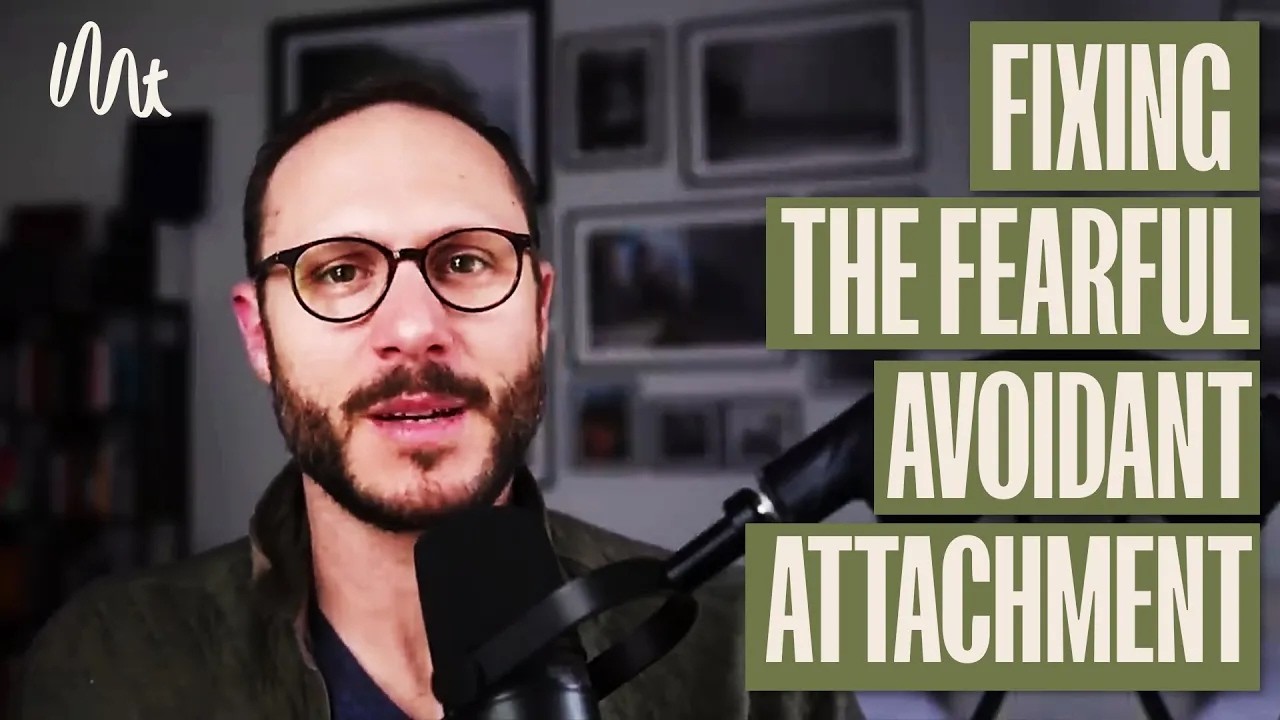
In this introductory segment of the video, Connor Beaton outlines the focus of the guide: moving from a fearful avoidant (disorganized) attachment style toward a secure, healthy attachment. He defines fearful avoidant attachment—also known as disorganized attachment—as a blend of high anxiety, fearful thinking, and strong avoidant behaviors, emphasizing that it is more complex than simply combining anxious and avoidant traits. For clarity throughout the video, he chooses to refer to it as "fearful avoidant" rather than "disorganized attachment" to avoid confusion.
We're gonna be talking about a man's guide to fearful avoidant attachment and how to move to a secure, healthy attachment.
I didn't realize that this was such a big thing.
But when I did the avoidant one and the anxious one, so many of you guys were like waiting for this. Where is this? Like, when are you going to do this? So here we go.
First off, let's start with what is the fearful avoidant? What is it? Right out the gates, this is also known as the disorganized attachment, disorganized attachment.
And it's called disorganized for a number of reasons, which we're going to get into. But really, the fearful avoidant can be characterized by a few things. Number one is a good amount of anxiety, high levels of anxiousness, high levels of fearful thinking. And secondly, the the high levels of avoidant behaviors. So it's kind of a combination of the anxious and avoidant. However, it's not as simple as just like smashing those 2 together and thinking that you know what it is. All right? It's a little bit more complicated than just somebody that's avoidant and has anxiety. Generally speaking, the fearful avoidant, and for the exercise of this video, for the intention of this video, I'm going to just call it fearful avoidant, not disorganized attachment, because that can get a little bit confusing.
And so the fearful avoidant is going to have some intense emotions internally, but they're going to have trouble regulating those emotions and communicating them in an effective way. At the core of healing your fearful avoidant attachment is a dual nature of being afraid of connecting to an attachment, And feeling anxious internally with whatever your experience is. And so there is a simultaneous process that needs to unfold. 2 things need to happen in your life ongoing over time. Okay? And those 2 things are very, very simple, but they're going to be super freaking challenging for you to implement. Number one is a very strict regimen of self-soothing. You are going to need to develop an infrastructure internally, methods, rituals, behaviors, you know, daily habits that are helping you to soothe your internal system. Because every fearful avoidant that I have ever worked with in my life, and I've talked to many experts in this field, it's not just me, it's like mentors that have 40-plus years working with people. Everybody says the same thing. The fearful avoidant is really struggling because they're struggling to regulate internally. So you have to start to learn how to self-soothe. And I'm going to talk more about that in a moment. That's part 1. So part 1 is learn how to self-soothe. Part 2 is learning how to consistently stay connected and trust your relationship. Consistently stay connected and build trust in the relationship. That's the second big piece. Because again, the duality of the fearful avoidant is, I do not feel safe in myself, I can't regulate myself. But I also don't feel safe with you. I don't trust you. I don't trust you to be consistent, to care about my needs, to care about my wants or my desires, to care about my well-being. And so that's the duality. I need to soothe me, stay connected to you, soothe me, stay connected to you, soothe me, stay connected to you. That's the dance that the fear avoidant needs to commit to. That's the mission that you as the fearful avoidant need to commit to for probably a good 7 to 9 months minimum. And it's going to be a consistent process of you daily having self-soothing practices, self-regulation practices, and then building trust in the person that you're with. And if you're not in a relationship, you can start to build that trust with a friend, with Somebody in your life, right? With a family member. You don't have to do this work per se in a relationship, but it can be helpful to do that. A couple of things are important. If you start to use things like box breath, breathing in for 4, holding for 4, exhaling for 4, holding for 4, inhale for 4, it's just a 4, 4, 4, 4. Box breath is a regulation tool that you can deploy on a daily basis. And what I would suggest to you if you're a fearful avoidant is that you practice this box breathing at regular intervals throughout the day. So maybe you do it once in the morning, you do it once at lunch, it only takes 5 minutes. You do it once after you're done work, and you do it once before you're going to have a conversation with your girlfriend or your wife, right? So you choose a tool and you implement it multiple times a day. And thank you so much for tuning in. I look forward to diving into more of these guides and more of these deep dives for you. Talk soon.