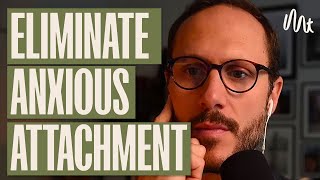
A short instructional talk by Connor Beaton aimed at men (but applicable more broadly) explaining the core features of anxious attachment and practical steps to move toward secure attachment. The speaker defines anxious attachment as dependence on another’s emotional state ('I'm not okay unless you're okay'), contrasts anxious and avoidant styles, and emphasizes bodily regulation (breathwork) as a primary intervention.
Chapters
Foreign.
Welcome back, team. Today we're going to be talking about how to deal with and how to end anxious attachment. Now, this is a man's guide to. And so I'm going to be approaching this from a very male centric point of view. But if you are a woman listening to this or watching this, there is going to be a lot of this that applies to you.
If you haven't seen my other parts of this series, I have done A Man's Guide to Ending Codependency, which is about an hour long, and I do a deep dive into it and I've done A Man's Guide to Ending Avoidant Attachment. I will be doing others in this series, so stay tuned. Now, where do we begin? I want to begin with the sort of core essence of anxious attachment. What is actually at the core of this attachment style? And at the very center of it is a very simple notion. And that notion or that belief or that physical experience that people have who have anxious attachment is, I'm not okay unless you're okay or I need you to be okay in order for me to feel okay, Right? So there's this dependency that has emerged for the anxious person that says, I need to make sure I'm constantly hypervigilant on you. How you're feeling, what you're thinking, what you're doing, how you're relating to me and how you're doing will predicate and dictate how I'm doing. Now, as we are going to talk about, as you're going to discover, this essence, this core of anxious attachment is developed early on in life. And there's a lot of different factors that can play into a person's development of anxious attachment. But at the very essence of it, what I want you to take is that for the anxious person, their needs, their wants, their desires, their sense of safety even, are always secondary to someone else's. And I want you to remember one thing because this is going to be very, very helpful as we talk about moving towards secure attachment. And it's the simple idea that secure people seek support, whereas anxious people seek validation. Secure people seek support, whereas anxious people seek validation. So the anxious person, whereas the avoidant pulls away and isolates, the anxious person is hyperexternalized, hyper externalized. So the avoidant person is more internalized, they're more recluse, they're more aloof. There's a less likelihood you're gonna know what's going on with them or what's happening inside of them. So learn how to Regulate your body. You have to learn how to use the breath. Big, big, big piece. If you are an anxious person, check in with your breath as often as possible and do a couple things. Number one is slow it down. Slow it down. Okay, so number two is breathe in and out through the nose as often as you can. I'm a little congested right now, but here we go.
So deepening the inhale and extending the exhale, letting the exhale be longer than the inhale. Okay, really big piece. And as often as you can throughout the day, just start to get in the habit. If you're an anxious person, start to get into the habit of just checking in with yourself. How's my breathing? Deepen the inhale.
And extend the exhale.
And as you do that, a couple of things are going to happen. Number one, by extending the exhale and letting the exhale be longer than the inhale, you are going to force your breath rate per minute down, meaning that you're going to take less breaths per minute, which in turn is going to force your heart rate to lower. So the more breath, the more breaths you take per minute, the higher heart rate, the. The lower the breaths per minute, the lower the heart rate. And as you lower your breath rate and you lower your heart rate, you move your body out of the anxious state, out of the stress state, and into what's called more of a parasympathetic dominant state or more of a calm rest and digest state. So learn to use the breath, but go through this work with somebody else. So thank you so much for tuning in. Let me know your thoughts on this until next week. Thanks for watching. This is Connor Beaton signing off.