Is It Hard To Turn A Boy Into A Man?
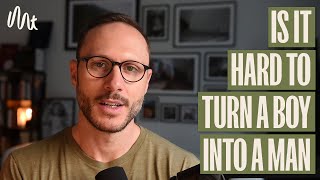
Connor Beaton argues that becoming a man is harder now because society has removed initiation rites and male role models. He says boys have primal energy that needs channeling, not erasing, and that calling men the problem doesn't help them grow up.
Chapters
All right, team, welcome back to the Man Talk Show. Connor Beaton here today we're going to be diving into two main things. One, what are some of the key steps of moving into a more mature masculinity, to being, to actually maturing as a man, which I think is something so fundamental that we all need to know and understand what makes that really difficult and hard, and that is going to tie into why so many men are in decline in our society. So let's just dive straight in. I've been having way more conversations with people as of late where I noticed this common theme showing up. And the common theme is, I think what my friend Chris Williamson has summed up, which is, men don't have problems. Men just are the problem. And this, this notion has really permeated into our culture and into our society. And I think that it is, you know, I don't want to use the word toxic because I vehemently loathe and hate that that word gets used all the time, right? Toxic masculinity, toxic this, toxic that. I don't think it actually does anything to move anything forward. But that's besides the point. This notion that men don't have problems, men are the problem is so prevalent within our culture and society, and what it ends up doing is it tells men and women that if men were just different, if men were just more like women, because there's a kind of female supremacy that has emerged within our culture and our society. This notion that whatever is woman, whatever that might be, is better than men, and that if only men were more like women, if only they adopted more female traits and orientation and characteristics and behaviors and decision making processes, et cetera, then that culture and society would be fundamentally better and residing in that is this kind of intrinsic notion that patriarchy is the root of all evil, that men are bad and wrong, and that men are the problem. And this has really distorted our ability socially, culturally, communally, politically to look at the actual problems that men are facing and say, hmm, okay, men are doing worse in school than young girls, period, full stop, pretty much across the board. Why is that? And what can we do to support them? How do we change the system? How do we alter the system and the infrastructure that we currently have in order to support better outcomes for our young boys? That's actually not what we end up doing. What we end up doing is saying, how do we just fix boys? There's something wrong with boys that they aren't performing in the same way as young girls, right? They're more Active, they have a harder time sitting still. So there's something wrong with these boys. And so we need to alter them, and we need to demasculine them. We need to sort of feminize them and put them into a different orientation so that they can perform in the way that we need them to. And I think that this is not only very damaging, but. But it points to a bigger kind of problem that has emerged within our culture and within our society. And that bigger problem can sort of be summed up as follows. And I think I've started to notice it more and more and more, which is that it is extraordinarily challenging to make a man. It is extraordinarily hard to take a boy and have him go through adolescence and turn him into a mature, functional, healthy, potent man. And the challenge with that is that it has become so distorted by a lot of these messages and these narratives. We've stripped initiation out of our culture and out of our society. We have completely deconstructed and demolished and male role models and any type of infrastructure, communities where boys would have male role models to look up to. I think in general, you know, male role models have become something to be feared, right? They're mocked in TV shows. There are, you know, you got Peter Griffin and Homer Simpson and all the sort of the classic, you know, borderline losers that don't really. They don't really have anything to offer. They're just this, you know, caricature of the average American, you know, the sort of, like, modern, average American man, which I don't think is actually true. I think that the average, average American man is far more substantial and capable and competent than he is portrayed through modern media. But there is an archetype of that man that sort of fits the bill of the Homer Simpsons and the Peter Griffins. I get it. I understand it. But this really. This fundamental problem still exists, which is the truth and the reality that turning a boy into a functional man that is able to really contribute more to culture and society than he extracts is a difficult challenge. And it always has been, and it always has been for a number of reasons. It's not just because, you know, men are socialized to be more aggressive or more dominant or, you know, less agreeable. It's not just a socialization process. It is also a biological imperative that exists within men. And my wife and I were talking about this the other day, and we were talking about what it's like for her to have given birth and to have a menstrual cycle. And what that's like for women. And she was like, oh, you know, men don't have anything like that. And I was like, no, men do have their own version of that, but most people don't like talking about it, which is that men have to contend with, oftentimes a kind of violence that exists inside of them and an aggression or a level of energetic intensity. Okay? A level of energetic intensity that society and culture and parents often do not know what to do with, that energetic intensity. And you see this all the time in the cultural conversation, right? Like, young boys, they can be so hard to raise. They're so wild, they're so crazy. I've even found myself saying that about my son, you know, where I'm like, he is a feral animal. You know, it's like, this is a feral, feral creature, you know? And I know guys that only have daughters, and they're like, oh, yeah, some of my daughters are wild. And I'm like, no, I don't think you. I don't think you quite get it. And then they spend time around boys. They spend time around the sons that are growing up that aren't just, you know, completely castrated in front of a computer or an iPad, you know, 24 7. Like, my son doesn't get TV. My son doesn't get iPads. My son doesn't get technology. And so he is out on the land with sticks and trees and branches and wearing a tiger suit. And, you know, he's getting to be the child that so many of us experienced growing up in the. Whatever it was, right? 70s, 80s, 90s, early 2000s, where you weren't just plugged in front of an iPad. So there's this huge challenge, which is, how do you take a young boy and turn that young boy into a man? How do you get him through the hellscape that can be adolescence for a young boy? Because I can tell you, no man that I have ever talked to said, oh, yeah, going through puberty as a young man was just the easiest thing in the world, right? The reality is that there are these very primal parts that come online biologically inside of an adolescent teen boy that are very different. And for better or for worse, whether we like it or not, we can't simply socialize that out of a young boy. We can't simply say, you shouldn't feel any of that aggression. You shouldn't have any of those violent or destructive predispositions. You know, you shouldn't want to get angry and then punch a hole in a wall. You shouldn't want to, you know, ride your bike as fast as you can down a hill or steal a shopping cart from the grocery store and, you know, jackass three it down a hill with a helmet on into a, you know, into a stream. You shouldn't want to do those things. But the reality is that that is a part of being a man. Part of being a man is learning how to contend with the more aggressive, more violent, more primal part of your physical being. You know, it's almost like we've forgotten that we are, you know, not primates necessarily, but that we are mammals. And when you look at every other mammal and you look at the males that are in every other mammal species, you look at chimpanzees, you look at, I mean, lions and deer and caribou or moose or whatever you want, there is a kind of aggression and violence baked in to them biologically. Now, I get that that is fundamentally different. They don't have the same developed prefrontal cortex that we do, and the consciousness and the morality and all those types of pieces. I understand all of that, but what I'm saying is you can't extract the fact that. That we are still mammals at our core and that we do have these biological differences. And as much as we might want to raise very subdued. I mean, I don't want to raise these types of men, but some people want to raise very subdued, very docile young men. And I think that that is a detriment to that young man, because part of man moving into a more mature quality of masculinity is learning how to contend with violence, with learning how to contend with aggression that is not only out in the world, but that is inside yourself. And this is one of the most challenging things that the majority of men will do is contend with the part of them that is naturally dangerous, the part of them that wants to be more aggressive, the part of them that feels more anger than maybe the average person does. And learning how to build some level of containment around that primal instinct, around that primal instinct. And I think that we have done a disservice in the west, especially in Canada and America, where we are kind of living in this Hopeville that we hope that maybe that's just not a part of man or that we can socialize any type of aggression or violence or this sort of urge towards domination out of young men. And I'm not saying that we shouldn't evolve as a species. Don't get me wrong. Don't misinterpret what I'm saying. Saying we absolutely should continue to evolve. What I am saying is that we also have to be realists. We also have to look at the reality of how we as men operate. I remember having a conversation recently at a dinner, and there was a gay couple, two men, and then a woman. And they were all older than I was. They were all in their, like, 50s or 60s. And the woman was saying, like, well, you know, men are so violent. Men cause a lot of violence. Men are the ones that cause a lot of harm and physical abuse and da da, da da. Why that's male culture. And the way that men are socialized is so bad, and if only we can fix that. And I said, don't you think that there's a kind of biological underpinning to that? Don't you think that there's a difference biologically between males and females in the animal kingdom and. And how those males and females operate and that. That. That we're not, you know, we're not. We're not excluded from that animal kingdom. That we're actually a part of that just because we have sentience and. And we're able to rationalize things and think logically. We still have the lizard brain, you know, we still have this mammalian core processor that when push comes to shove, it is about protection, is about survival, is about reproduction. And that's a very strong part of our nature. And when we just want men to be different than they are, and we ignore the fact that that primal part in many cases is actually extremely important and is also the thing that many women are attracted to. Right. This very primal nature. When you look at a lot of. And I know I'm going off a little tangent here, but I'll come back. When you look at a lot of the sort of archetypes or the sort of sex symbols of what women are attracted to, a lot of the times it is the embodiment of a dangerous man that has some level of containment or control over that dangerous element. Whether he's dangerous in, like, a potentially violent sense. Right. That he's extremely, you know, he's a Brazilian jiu jitsu person, a martial artist, a boxer. He's in the military. He's very physically capable. Right. When you see a man like that, you're like, oh, that man is capable of being physically dangerous. And so, you know, a lot of women are attracted to that, but they're attracted to the edge, the very fine edge of the kind of beast that needs to be tamed a little bit. Right? It's like the beauty and the beast archetype. It's this notion of wanting to tame that beast. And part of the attraction is almost always being able to know that you as a man are capable of some type of dangerous notion, behavior, et cetera, but that you have containment over it. Now, this is the fundamental issue that I take with how we are raising young boys. We are raising young boys to completely eliminate any type of aggression, any type of move towards anger, any type of competition, any type of, whether you want to call it conquest or a more dominative spirit, a more competitive nature and spirit. We are attempting to completely remove that from young boys and young men. And then we wonder, why is that boy just sitting in the basement playing video games all day, not attempting to make any relationship or contact with women, not attempting to make any type of friends? He has no real ambition in life. Well, we have psychologically and emotionally and socially castrated that young man. We have actively told that young man that in order to be a good man within our culture and our society, that he should not be capable of danger or violence in any way, shape or form. And so, so many young men have become very docile, very soft young men. And what you see is the pendulum swinging in the other direction with a lot of young men, where there's a lot of anger, there's a lot of hostility, there's a lot of violence, there's a lot of not giving a shit at all. And it's a kind of pushback on this notion to completely soften or feminize young men within our culture. And I think that this is to the detriment of our culture, our society, our politics, the detriment to women. Right. Because the reality is, is that the majority of men are good. I posted this the other day. I posted this thing, and it was this woman talking about how, you know, citing all of these crimes and how all these crimes were committed, you know, disproportionately by men. And then somebody else posted all of this good that had been done disproportionately by men, all these lives that had been saved disproportionately by men. And it was this reminder of, yes, there is a small percentage of the population of men that really does harm, you know, and we as men, we know that. And we know that because we know what it feels like to be a man. Not just to be socialized, to be aggressive or to be dominant, but to have a kind of primal physicality inside of you that wants to go out and conquer, that wants to Go out and be competitive, that wants to go out and build something meaningful in the world or just build something with your hands or with your mind that wants to go out. And you know, it's like my buddy Trevor says, fight, fucking, feed, right? That there's like these three Fs, that there's this very primal orientation within men that is fundamentally different from women. And it's not to say that some women aren't more aggressive or more domineering or more assertive, and that some women aren't violent. It's not to say that at all. It's to say that it is part of the rites of passage. It is part of creating a mature man. That that man must learn to contend with the aggression and the violence and the dangerous nature, the primal nature that exists inside of him. And my biggest concern is that we are raising generations of young men where they have not been taught how to contend with that primal nature inside of them. They have been shamed for that primal nature. We have completely eradicated the systems and the infrastructure that would normally teach young men what to do with that primal nature. And we have sort of feminized, overly feminized a lot of young boys to. To be very soft. And the problem with this is that it doesn't help them to be leaders or protectors or providers or functional men within our culture and our society because they are disconnected from a type of energetic potency and psychological truth and biological narrative, maybe not narrative, but imperative, that's inside of them that needs to be contended with. And this is the point of really good initiation. Richard Rohr said that unless a man goes through a journey of powerlessness, he will always abuse power. And so part of this is that a man, a young boy, an adolescent, needs to go through some type of experience where he's met with something that he can't dominate. That as much as he fights, as much as he tries to control, as much as he tries to exert every ounce of primal power inside of him, he cannot overcome it. He has to surrender. But it's not that he doesn't draw out that primal part. It's not that he completely sequesters that away from his being and put stuffs it into the shadows and represses it and ignores that he has the capacity for danger, that he has the capacity for primal force and energy. It's that he learns to contend with that part. And that is a very important element of becoming a man that we have demonized, we have shamed. And in some ways the cultural narrative now is you should be able to circumvent that process and still be a great man. You should be able to bypass this sort of grappling with this more primal, energetic nature inside of you and still be a great mature man. And what we're seeing is that that theory is wrong. That theory is fundamentally false, that great men are made by contending with this very primal nature that is inside of them. And every young boy feels that. And every man that has gone through it knows that it's one of the most important parts of his life. And it may have been hard and challenging and, you know, extremely isolating at times and frustrating, but every man knows what it's like to battle and contend with that primal part of himself that is geared more towards taking dangerous risks, being dangerous in some way, shape or form, or at least having the capacity to be dangerous. And I think that's sort of summed up by the quote, you know, it's better to be a samurai in a garden, a warrior in the garden, than a gardener in the war, right? And so it's this capacity, this ability to, this is what makes men men, you know, is that you have contended with this part of you. So if you haven't done that, if you, you know, were raised in such a way where you kind of circumvented that, that is an important element and step that likely needs to be taken. And it's something that you need to teach your sons, right? My son's four and a half. He's going to be five next year. He has a very primal energy to him that's wild and feral, but it's beautiful, you know. And I keep telling my wife, I'm like, man, when we help him harness that energy and that primal nature inside of him, he's going to do extraordinary, extraordinary things. And I believe that that is the case for all men. I believe that is the case for all men. That what all men ultimately need at the end of the day is a guide to support them in dealing with and contending with their own primal nature. Whether that primal nature is one that is causing them to sabotage a relationship. Whether it's one that's causing you to have a kind of self loathing and self hatred because you don't want to bring that primal energy out. And so you direct it back in it yourself. But whatever it is, if you are looking for a space and a place to find that support, check out the Man Talks Alliance. Opening doors are opening again in December. And that is a place with a thousand men that are doing this type of work that are learning self leadership. So check that out, but let me know what you think in the comments below. I would love to hear your thoughts on all of this. And as always, don't forget to man it forward and share it with somebody that you know will enjoy the conversation. Till next time, Connor Beaton signing off.
More from Connor







How to Raise Strong, Unshakable Boys in Today's Culture, with Dr. Shefali Tsabary



