Jason Silva - Shots Of Awe, Psychaedlics And The Future Of Artificial Intelligence
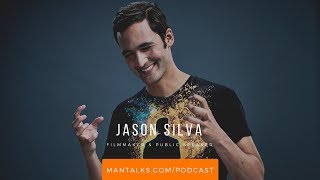
Podcast interview (recorded July 31, 2017) on the Man Talks YouTube channel: host Connor Beaton interviews Jason Silva (media artist, futurist, creator of Shots of Awe and Emmy‑nominated host of National Geographic's Brain Games). Silva recounts his background (born in Venezuela; studied film and philosophy at University of Miami; early work at Current TV), explains his Shots of Awe series and media trajectory, and discusses several core themes: the creative and world‑shaping power of language, the potential and risks of psychedelics (clinical research, harm‑reduction, MAPS, Johns Hopkins; microdosing and cannabis; emphasis on set/setting and integration), and the future of artificial intelligence (trend toward distributed cognition between biological and non‑biological systems; economic and meaning implications; references to Kurzweil and Yuval Harari). The episode ends with Silva promoting an October Canadian tour (cities: Vancouver, Kelowna, Toronto, Montreal) and a 20% ticket discount using code “genie.”
Questions this video answers
More than 13 million views.
He was the Emmy‑nominated host of National Geographic's Brain Games, airing in over 100 countries.
University of Miami; double‑majored in film and philosophy.
Current TV (Al Gore's network); active around 2004 (Silva's first gig out of film school).
Partnered with Discovery Digital Networks in 2013.
Chapters
Welcome guys and gals, to the Man Talks podcast. I'm Connor Beaton, the host and founder of Man Talks. Today is a bit of a different type of episode.
I have an incredible guest with me. I'm going to skip the intro.
We're just going to dive into who's.
With me and why we exist.
So the mission of mantalks is very simple. We are here to help develop more self aware, high performing and impactful men in the world. The type of men that you want to be and the type of men that you want to be around. So that's our mission. And joining me today is Jason Silva. He's an incredible, incredible guy. He's a media artist, he's a futurist, he's a philosopher, he's a keynote speaker and a TV personality. If you've never heard of Jason Silva, he is the creator of Shots of Awe, which is a short film series of trailers for the mind that serve as a philosophical espresso shot exploring innovation, technology, creativity, futurism and the metaphysics of the imagination. It's had more than 13 million views and he is also an Emmy nominated host of the national geographic channel's hit TV series Brain Games, which is airing in over 100 countries around the world. So he's a pretty cool guy. And on this short podcast episode, it's a little bit shorter than usual because he is a crazy busy guy. We dive into a few things. We dive into the future of artificial intelligence. We talk about psychedelics and how a lot of people are starting to use psychedelics for peak performance and, you know, drug reduction, a whole bunch of other, other components that we'll dive into. And, and lastly, we talk about the use of words as a creation tool for our reality. So this is some really, really cool stuff. He dives into some more existential and esoteric side of things, but it's really, really interesting. So without any further delay, I would like to bring on Mr. Jason Silva.
Hey, thanks for having me, man. Great to be here with you.
Yeah, yeah, awesome. So let's just dive in.
So I'm curious, I followed you for.
The last couple years and I got a chance to read up about you. You're born in Venezuela, I think. Cora, am I saying that right?
That's right. Yeah, yeah. Correct. Yeah.
And from what I understand, like you always had this like obsession with creating film and producing and documenting really, like even from a very young age. Is that right?
Yeah, I was always obsessed with explanations. I was obsessed with rendering things into language. It was a way of getting a grip around my own experiences. And a lot of people will say, oh, it's hard to explain, or you know, you had to be there, or whatever it is. I've always been a lover of language and I've been obsessed with figuring out ways of distilling things into language. My mother teaches high school English literature, so that probably had something to do with it, but just grew up in an environment where there was always a level of language. And I loved reading as well. I grew up like reading Michael Crichton and the Hardy Boys and I was just always into words, man. And then I used to love writing essays, but it really developed a love for video and then using video to express myself became a thing at a very fairly young age.
Yeah, he used to host salons, right? Is that.
Yeah, man. Back in high school I would have like all my friends come over. I'd hand pick the people and hand pick like a series of topics to discuss. And then I take everybody to my media room and we'd listen to special playlists. I mean, I was all into the master of ceremonies, like salon hosting, even way back then.
That's very, very cool. So you're like creating experiences and just creating the linguistic approach to understanding and explaining problems.
Yeah, exactly. I mean I was just always into. Into words, into language, into philosophy, into just. I was kind of a born existentialist in a sense. I just wanted, I wanted to know, I wanted to know.
So how did that translate into you creating shots of awe? Like obviously there's a natural progression to there. But what really inspired that manifestation?
Well, I went to film school in the us I went to University of Miami and I double majored in film and philosophy. I mean it was literally what had come out of those salons. It was like, well, I want to talk about this stuff and make these kinds of videos and that double major. It wasn't practical at all, but it was exactly what I wanted to think, talk and do. And when I graduated, I got a chance to get a hosting gig with a network that Al Gore started to called Current tv and he was the chairman and it was this whole thing about like democratizing the media. It was a couple. It was like a year after he lost to Bush. And yeah, it was this, it was the pioneer in citizen journalism. It was the first user generated content network before YouTube. This was like 2004. So that was my first gig out of film school to immediately make my own content, make my own media, do my own thing. And it was great. I was with them for five years. And in 2010, I left the network and then I started making what eventually became Shots of Awe. I started doing these videos about tech, about the future, about creativity. Doing them online, like, editing them with, like, different editor friends that I had, and putting them up on Vimeo and eventually YouTube. And by 2013, I partnered with Discovery Digital Networks, and it became Shots of Awe.
Incredible, man.
Yeah, it's crazy.
It's been.
It's.
I can imagine. It's been a pretty wild ride.
Yeah. Because that happened at the same time that I was invited by National Geographic to host Brain Games, and then Brain Games, like, blew up. You know, who would have thought, right? It just became a hugely successful international hit. Five seasons, you know, all over the world. And so between that and consistently making videos online, I was just in a situation where I was hitting everybody, like, digitally, and then I'm this TV network, and. Yeah, that's kind of how things happen, man. You know, 10 years of hard work for an overnight success.
Yeah, yeah, right. Exactly.
Exactly. I think.
I think Gary Vee says something similar to that, where it's just like, took me eight years to have my overnight success.
Right, Totally.
I love it. So one of your videos, you know, one of your videos, and even in this conversation, you talk about the importance of language, and it reminds me of that quote, words create worlds. Why feel like it's so important? Can you elaborate on that?
Well, I think that language patterns are thinking, and language also informs our subjective experience. There's a guy called Rich Doyle. He wrote a book called Darwin's Sex Plants and the Evolution of the Newosphere. And one of the coolest ideas in that book is this notion that.
Obviously reality, quote, unquote, is coupled to perception. And if you can mediate perception, you can mediate reality. In fact, he says, even the words that you use to describe your reality, tinge and color, said reality. So it's this idea that you can sort of have a sense of authorship over your experience through your interpretive frameworks. You know, it's like. It's like we know that our experiences affect our physiology. We know about epigenetics. But what's not quite so popular is the idea that your interpretation of what happens to you ultimately determines the physiological effect that said event has on you. So if you have a positive interpretive framework, you're less likely. It's less likely for the experience to cause you taxing stress markers like cortisol spikes and so on and so forth. So your reaction, your interpretation matters. So words matter. So that's that's heavy, heavy stuff, man. Yeah, yeah.
Very cool. It's. It's interesting because there's been some research done, I think, out of Stanford in the last couple years, has shown that consciousness actually does impact reality at, like, a molecular level. And so there you go, really trying to prove that our consciousness and the words that we feed our consciousness can actually impact the reality around us. And so.
Well, I definitely think. I definitely think that's the case because, you know, obviously, chemical reactions mediate mood, like brain activity mediates mood. But I also believe that intentionality and focus, you know, can in turn, affect brain chemistry. So that feedback loop is very interesting because the typical cause and effect, one will say chemical reactions and so on and so forth, result in brain activity, result in how you feel. But when you invert that and when you can deliberately induce a certain feeling, maybe through meditation, that then changes brain chemistry. Now you're having consciousness change matter. So it's like, whoa.
A whole other level.
Yeah.
How do you see things? Like, you know, there's been a big push lately, especially with, like, Steven Kotler's work and Stealing Fire, talking about, you know, psychedelics and some of these pieces that are on the fringe of moving sort of not only human consciousness, but human performance forward to a different level. What are some of the fringe pieces that you see having a big impact on some of this?
Yeah, well, I think that first and foremost, two things, right. So human performance is huge. We want to push the envelope of human performance, and we see this already in sports, Whether it's surfers or snowboarders or ultimate fighters, these bases where just what human beings are capable of just keeps being redefined and figuring out, like, what is going on in the brain of these elite athletes, whether what's, you know. And then. And then, of course, these advances that Cutler talks about in psychology, technology, neurobiology, pharmacology, like the four forces of ecstasy, as he calls them, they're giving us increasing access to the. To what's seen, to seeing what's going on in the brain, to deconstructing it, to reverse engineering flow states, elite human performance states. And, you know, a big part of it is, again, psychology and neurobiology, but another part of it is pharmacology. It's better living through chemistry. It's certain drugs. So that's really interesting.
And I think it's only the beginning. Then there's also just mental health, which is all these depression and anxiety levels are skyrocketing. People are suffering. Mental distress is a real deal. 800,000 suicides a year now, according to the United Nations. And what's happening with psychedelics is really interesting is because, you know, they're finally being reclaimed and repurposed by serious researchers. Were kind of done with the kaleidoscopic T shirts and like screw authority slogans from the 50s. Although, you know, Timothy Leary, he had his moment, I get it. But in the end it wasn't the right approach perhaps. I think what we're seeing now is the responsible, controlled, judicious use of these medicines to in some cases induce mystical experiences in people suffering from horrific bouts of anxiety and depression that seem to shake them out of their rut. Maybe like squirming before God has a way of getting rid of your depression. So.
However you want to interpret a psychedelic experience. But I'm excited because I'm really into the responsible exploration of this stuff. I think, you know, when I get on an airplane I want to know that the pilot is highly trained and there's really good protocols for maintaining flight. I'm not interested in like just throwing caution to the wind and seeing if, if the plane will just fly itself. So that's how I feel about psychedelics. I think protocols, I think best practices, I think harm reduction, all very, very, very important.
Yeah, that's kind of was gonna, gonna take the conversation there because I think one of the biggest pieces is that, you know, our brains are very much pattern recognizers. And I feel like one of the biggest pieces that psychedelics does is sort of deconstructs those pattern recognizers and allows us to see larger, larger patterns, larger pieces of the puzzle.
Very much so.
And what I've seen that can happen sometimes is when people go down that route in a non regulated way or non sort of like safe way, they can sort of detach from almost any regular patterns and then find themselves in this sort of like mental ethereum, you know. And I feel like we've met so many of those people who are sort of like so out there, we're just like, what are you even, what are you talking about? So.
Well, yeah, because, because it's almost like putting somebody in a sensory deprivation tank. You know, human beings are interpersonal beings. We require consensual vetting at all, at all levels of exchange, whether it's verbal or nonverbal, or touch. I mean we, everything is, you know, it's mutual mental modeling. It's me talking to you and modeling what I imagine you're thinking and reading your cues and assessing and adjusting. I mean, we need to be beamed into one another. That's not to say that we don't want to be alone sometimes, sure. But too much isolation, the mind turns to mush. Like we're social beings. And so I think that what happens is people who are doing too many psychedelics in an unregulated environment, not integrating that, not bringing that back into consensus, not so you can spiral where you're no longer living in a consensual reality anymore. And for all purposes, you're somewhere sort of unhinged or depersonalization or derealization. Look, a lot of crazy stuff can happen if you don't have the right set, setting and guide. And I certainly don't endorse the reckless use of potentially very dangerous tools.
Yeah, I like that. So.
In your insight, what do you feel like are some of the pieces that people should look at when entering into psychedelics? Because you see microdosing happening in places like Silicon Valley, and it really is starting to be leveraged more and more on a mainstream platform. So how can people that are maybe curious about entering into the space do it responsibly?
Well, I think they should check out a lot of the publication coming out, follow the work of maps, the Multidisciplinary association of Psychedelic Studies. You know, they're doing some of the most responsible research out there. There are phase three clinical trials for MDMA for psychotherapy. Now I think they could look at some of the stuff that's happening at Johns Hopkins University with psilocybin for end of life anxiety. There's, you know, there's a lot of responsible people working really hard. They can check out the work of Fundamental nyc. They're doing a crowdsourcing, crowdfunding campaign to raise money to do more clinical trials. So I think all of this stuff is, you know, legitimate research that's happening that people can get sort of really highly, highly educated on before they decide to partake.
Awesome. Yeah, I think that's. I think that's a great idea.
Also, Also, you know, cannabis is legal in places like Colorado and it is a very potent psychedelic. Most people don't treat it that way, but in moderate doses and in the right set and setting, it'll take you as far as LSD if you let it. And this has been confirmed to me by some of the premier psychedelic researchers in the world. So don't underestimate the good old cannabis to teach you about your mind. But also, don't abuse, don't be careless.
Yeah, I was going to say, I feel like one of the core pieces of your messages is intentionality around the usage. If you're going into it using it as almost an escape like most people use alcohol, you're going to get a very different result than if you're going into it from an exploratory purpose or intention.
Well, especially because these tools, these tools don't, they don't numb the brain like alcohol. It's like Bob Marley said, the herb will reveal you to yourself. These things will make the unconscious manifest. And so if there's things that you need to resolve, even uncomfortable things, that's going to be front and center before you can have any fun. So these are tools for psychotherapy above all. That's why they call them spiritual tools. They're tools for introspective contemplation. They're not just euphorians, although that would be nice too.
But they're not just that. They're not just buzz tonics. They're tools that force you to look within.
I want to dive into AI really quick because this is something that I'm really fascinated by. You know, we have artificial normal intelligence sort of very prevalent everywhere right now. And it seems like there's just this gap between ANI and AGI where it's interesting because a lot of the research that's happening right now and a lot of the studies that are being done to sort of like map the brain and the neuroscience behind emotions, I think we'll start to unlock some of these pieces for AGI to be possible. But yeah, what do you see as a possibility once AI starts to become more prominent? Because there's a lot of people that are sort of on the negative side of artificial intelligence, that it's going to be the destruction of humanity. And I'm curious twofold. Where do you stand with AI and what do you see as being possible with artificial intelligence?
I mean, look, I think that progress is inevitable. I mean, I think that we're increasingly offloading cognitive loads onto non biological props, scaffoldings and algorithms. Personally, I think there's. I've been told multiple times, including by a psychedelic psychotherapist, that her prescription for me was getting an assistant.
Half of the things that I was anxious about could be resolved if I could just outsource a certain cognitive load to somebody else. I think when all of us can have Scarlett Johansson's voice as our personal assistant in the movie her, a lot of our problems will be resolved.
There's a reason why heads of state travel with a staff of five to six people just running their Life. It's really a lot to deal with all the complexities of managing our lives nowadays. Our smartphones help, algorithms already help. But we could use more algorithms that are designed to get out of the way to be seamless and to allow the offloading of cognition to occur. Now, I also don't think that the AI is just going to rise up and turn on us. I think it's more that what we call intelligence will be a network of distributed cognition between biological and non biological parts. Parts of us in some way are already non biological. Like me interfacing with this phone. This phone is a part of me. It's definitely non biological, but it's still a part of my mental architecture in a very real way. And I think it's going to be more of that than the Terminator scenario.
Yes, Just more integrative than all of a sudden AI coming, you know, coming online. Because in a lot of ways we have online AI. You know, you see Watson and stuff like that.
Exactly, exactly. I think it's going to be a lot more subtle than people realize.
Yeah, yeah, that's awesome. That's awesome.
In terms of like how you see that moving forward from a job perspective, because. Well, I think what we started to see is like in a lot of these places, AI has started to cut back on workforce. What do you see in terms of the viability of like our current economic structure? I know that's like a really massive question.
Yeah.
But yeah, I mean, I crack at it. I remember reading something, I think Kurzweil mentioned it, this futurist, that 100 years ago 90% of the jobs in this country were farm related and today they're less than 1%. So we've seen these disruptions in the past. The difference I think is the speed at which they happen. If they happen from one or two generations to the next, not so much of a big deal. Yeah, okay. My kids will grow up in a different world, but when it's happening within your lifespan, you know, you just got a job and now five years later you're fired because of the robots. That's a problem. This guy called Yuval Harari, he wrote Sapiens and he wrote the new book Homo Deus. Talks about an economically useless class emerging. And he wrote this wonderful article in the Guardian called the Future of the Future of Meaning in a world with no jobs or something like that. How do we find meaning in the world with no work? And you know, he was saying that we'll probably have AIs and other advanced technologies Solve all the needs that we currently have. So we won't be poverty, won't be starvation. We'll probably develop some kind of universal basic income, the whole thing. But then there's the question of meaning, because for some people, their job, you know, fills the void. And he says that we're going to spend more of our time in virtual realities. And then of course, some people are like, oh, that's so lame. We're going to play video games. But he says, yeah, but we already inhabit virtual reality. It's called culture. It's called religion. It's called the sports team. You follow? These are all virtual reality don't exist in any objective way. They're virtual. They're constructs. So if you make some immersive virtual reality game where you get to slay the dragons and be the hero and it's just as high def as meatspace, why wouldn't you? So that's what he says, and I tend to agree with him.
That's amazing. Meatspace. I feel like that's just gonna be the quote. That's gonna be the quote that we make a meme out of. Just like meatspace. Jason Silva.
There you go. There you go. But anyway, since you have listeners in Canada, bro, I'd love to promote this tour I'm doing.
Yes, that's gonna be. My next question is, like, what is an event with Jason Silva? Like, because we're hoping to put this on in Vancouver and a few other cities.
Yeah. So I'm really stoked because most of the speaking events I do are corporate events for big companies like Microsoft and Intel. And it's great, you know, I mean, you know, I'm very privileged that I get to do that and inspire their employees and customers, but it's not, you know, my fans will often say, oh, my God, these talks you do are private or they're invite only. How can we come see you speak live? So the opportunity to do this tour in Canada with the IM Genie folks was amazing because, you know, they're actually selling tickets and the tickets are actually affordable. And so what that means is my real, real fans can come and spend an evening with me. And what it means for me is I don't have to do a talk that's focused just on disruptive tech and innovation. I can actually talk about existentialism and the human condition and life and death and mortality and love and all the topics of shots of awe. So I am really stoked. And we're going to be hitting Vancouver. We're going to hit Koloa, we're going to be hitting Toronto, we're going to be hitting Montreal, and it's all in October. And I do have the dates written here somewhere on my phone. If you'll excuse me, I'll pull them up. Yeah, unless you have them in front of you.
We will be putting them in the.
In the notes below so everybody can check that out. It'll just be in, like the.
In the.
In the. In the notes from the interview. So we'll have all the.
Links to the events, for sure.
Awesome. And the code word is genie. You can get a 20% discount. So all my friends and family, fans in Canada, please come. The tour is happening in October. All of the info is going to be underneath here with all of the dates. I'd love to see you guys there, man. And thank you for. Thank you for help letting me tell everybody.
Awesome, brother. Of course. Well, I'll see you at the Vancouver event. Thank you so much for joining in. I appreciate having you on the podcast.
Thank you, man.
And we'll see you in October. And this will just go out to everybody. And if you're out there listening, if you love Jason Silva, and even if.
You didn't know who he was before.
This, you do now, you should definitely go check him out.
Thanks, man. I appreciate it. Appreciate the opportunity.
More from Connor







How to Raise Strong, Unshakable Boys in Today's Culture, with Dr. Shefali Tsabary



