John Romaniello - What Guides Your Story, Emerging From Abuse, and Developing Empathy
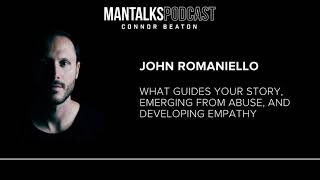
Conversation between Connor Beaton and John Romaniello exploring Romaniello’s personal journey from childhood abuse to healing and empathy. Romaniello recounts a turning point at Ryan Holiday’s 2015 wedding where discussions about entheogens (Tim Ferriss, Aubrey Marcus) prompted him to reassess lifelong drug-avoidance tied to his father. Over the following year he tried cannabis edibles and later MDMA, which he credits with opening emotional access and starting a process that included psilocybin ceremonies, trauma release, and relief from depression. He describes uncovering repressed memories of sexual abuse by a great-uncle, long-standing estrangement and eventual reframing/forgiveness of his father after realizing intergenerational abuse. He emphasizes storytelling (wrote a semi-autobiographical screenplay), long-term therapy, vulnerability, empathy, repairing friendships, ideas about initiation rites for men, and topics like polyamory and masculine cultural narratives.
Chapters
Foreign.
Welcome to the mantalk Show. Training for men, answers for women. I'm Connor Beaton and joining me today is John Romaniello. John is a writing mentor and business coach based in New York City. He helps entrepreneurs build and scale businesses through writing and branding. His work includes business articles, development essays, and all manner of half clever thoughts to improve your day. He also has a disclaimer on his website that says, definitely do not read my shit if you hate being successful or fun. So he's, as you can tell, right out the gates, a little clever, a little cheeky. So John has written a ton of stuff on a really broad.
Variety of subjects. He's talked about ayahuasca. He's talked about, really his main piece is storytelling and how we can use storytelling to elevate our brands, our businesses, our messages and get them out into the world. But that's not necessarily what we are talking about on today's show. So John and I sort of dive deep into his personal story and. And he shares about the abuse that he experienced growing up and how that abuse impacted his life, how he healed from that abuse, how he dealt with it. We talk about his relationship to his father and we go really into how his personal journey has not only led to his purpose in life, but how he tells his stories about the different challenges, the different obstacles that he's gone through. So this is a really direct and also very sort of vulnerable and authentic podcast where John is courageous enough to share his story in a way that I don't think he's done on very many other platforms. And this is a guy that gets interviewed a lot. And so I hope that you enjoy it is really. I really enjoyed this conversation with John and I think I'm going to have him back on the show in the near future to maybe talk about and expand on some of the things that we touch on in this episode. So I hope that you enjoy. I hope that you send this episode to someone that you know will benefit from it and I hope that you head on over to whatever platform you're listening to us on and leave us a little. Leave me a little rating and a review. I hope that you enjoy this show. And don't forget to share with just one person.
Person.
If you enjoy these episodes, please do.
Share them with one person. So.
All right. Without any further delay, please welcome John Romagniello.
Thank you so much for having me, Connor. This is very exciting.
Yeah, yeah. I've been reading your writing for quite a while now and had a few of the guys in the community reach out and request to have you on the podcast. And I can see why. So I'm looking forward to this conversation. So I have to start off with a question that I ask all guests, which is tell us a story about a defining moment in your life that made you who you are.
Absolutely. A defining. I love stories. Storytelling is my thing. Okay. The story is thus.
In February of 2015, I found myself in Austin, Texas, at the wedding of a very good friend, someone I'm sure with whom you are familiar and your listeners will be familiar. A guy named Ryan Holiday who's known for stoicism. He's written many books on it, and I was there. And I'm going to drop some names here because it'll be relevant. This is not me, like, you know, burnishing my network of exemplars. This is simply because this is what happened. I found myself at Ryan's wedding along with another friend, Tim Ferriss, and Aubrey Marcus, Lewis Howes and a few other people. And at the ceremony, I was in Congress with these people in council. And it was an interesting mix. Lewis, to that point in his life, had never had a sip of alcohol. And he, I think since, has had exactly one shot. And. But we were talking about substances because we were drinking, and it turned into a conversation about entheogens, psychedelics. And in particular, Aubrey and Tim were discussing the merits of, and the difference between psilocybin, ayahuasca, lsd. This was very new to me at that point. I was familiar with the substances, but I had no experience. And so to some degree, the conversation was strangely triggering to me. I had never done a drug in my life. I was 33 years old, and I grew up in an abusive household with a father who had a cocaine problem. And. And so it would become clear to me later that in addition to growing up in the post Reagan, just say no 80s and 90s, and that marketing working very well on me, I had decided early on that drugs were never going to be a part of my life. But in large part, it was because of the association with my father and my association with drugs as substances used by people who abuse people. And that was not my experience of my friends, but I was listening to these conversations, and there was something happening inside me. And so I went to the restroom and I took a minute to sort of figure out what this emotional thing was. And in that moment, I realized that I was letting my father, a man with whom I had not had a relationship in over 25 years, still control me and just by his action or inaction or his relationship with. Let's put the umbrella over the word drugs. Although he certainly wasn't using entheogens, he was using narcotics. But that had so fundamentally cemented my perception that to hear other people talk about it was triggering. And it seemed that there had been an erosion to the point where now I was ready to let that go. And so I asked myself, why should I let that continue? Because here are the experiences of people like Tim and Aubrey who have said these substances have changed their lives in many, many profound ways. And Tim, in particular, had sent me articles on psilocybin. And he had said that I think this would be really, really good for you. Not in a drug pusher kind of way, but in a very genuinely not, but a place of genuine belief that this could be beneficial for me. And I walked out of the bathroom and I sat down, and I was listening to these conversations of all the unbelievable ways that entheogens had changed their lives. And I realized that I was letting a man with whom I hadn't had a relationship in 25 years, a man who did not have a place in my life because he had sacrificed it through his actions.
His opinion, or his. The way that he interacted with substances was being weighed much more strongly than the opinions and words of men who had earned their place in my life several times over. And I thought to myself, I'm ready to let this go. And at the very least, I don't know if I will begin that exploration. I will. I will let whatever the last remnants of judgment I have about substance usage go completely. And I asked questions, and I was. I found myself feeling.
The difference between being educated and simply collecting information is, I think, the way that you receive it. You know, I had all of the information prior, but now it was landing differently. And I. At about three months after that wedding, for the first time ever, I tried a cannabis edible at the recommendation of my therapist, who recommended I use this for nighttime anxiety because I didn't want to add a medication for that. And so that began my foray into drug use or into substance use for treatment rather than escape or anything like that. And I'm a big nerd. So I had a little drug notebook, and I was like, all right, 5 milligrams of edibles on an empty stomach and then record it, and then up to 10. And like, this is how long it takes to effect when I have eaten. And then about six months after that, through someone in my network, I was introduced to a person who was connected to the university, one of the universities where they're.
Producing MDMA to treat ptsd. And this person gifted me with some MDMA and instructions on how to use it. And I kept it for another two months. And then at some point I decided, I'm ready to do this. I had done all the research, I had lived in the Reddit forums and I'd read three books on ecstasy and I felt very well equipped. And I took MDMA for the first time. And about 45 minutes later, my life changed. It radically shifted everything for me.
MDMA or Mali or whatever you call it, it's not a psychedelic, but it's very, very powerful. It's a heart opener. And the experience, its very, very good. But the thing I got out of it was realizing how wrong I had been about the value of these substances. And that began, that opened the door for me to then begin the exploration of things like psilocybin and, you know, with which I've had several ceremonies now, now, you know, five years later, these things are very much a part of my life and have been so beneficial for me in terms of growth and development and releasing trauma and getting over depression and getting to know myself. And when you ask about a story that is integral to understanding who I am, it's that night at the wedding in conversation with Tim and Aubrey. Because without the weight of my love for them, without the weight of my respect for them, I might never have moved from that position. And when I look at the person I was five years ago and the person I am now, those men, despite having very similar histories and having gone through the same things as children, no longer relate to those experiences the same way. They're two fundamentally different guys. And so the person to whom you are speaking today exists in a very real sense because of that night at that wedding.
Yeah, so. So well said and so well articulated. And I think a lot of, I mean, at least for me, I resonate with a deep understanding of what you mean when you say the man that sits in front of you is radically different because of that conversation and because of the experiences that that preceded that conversation or, sorry, could coincide with that conversation. So what, what would you say was one of the liberations from that relationship with your dad? Because it sounds like it wasn't just, you know, that conversation helped to sort of open it up. But I think, you know, a lot of us have these tumultuous relationships with some. Someone in our life. I know a lot of, you know, a lot of my listeners do at least where they, you know, have experienced abuse or, you know, someone who was neglectful or abandoned them or, you know, just wasn't able to show up for them in the way that they really wanted to. And it's something so challenging for us to. To move through. So it sounds like that conversation sparked this motion towards shifting that relationship with your father. But what, what were some of the other pieces along the way that helped you to sort of heal, resolve, move through, like, whatever sort of descriptor word you want to put onto it.
The first piece of it was that conversation wherein I recognized that.
Despite all my efforts, and I think this is very true for so many people. When you grow up in a. In an environment of violence or any other type of abuse.
And you don't have an example for how to be, for how to be, period.
The North Star then becomes one of opposition. I don't know how to be a father. I don't know how to be a good man. I will simply do the opposite of what I saw. And if that's bad, then the opposite must. Must be good. And that created a series of behaviors in avoidance with conflict and difficult conversations, and a number of other things that I would begin to be able to work through. So by. It was an interesting thing to be confronted with, right? You spend your entire life trying not to be like someone. And then. And thinking he doesn't have any influence over me, I've gone in a complete opposite direction. And then you're like, oh, fuck, he's still here in that way, even just by the act of gearing the entirety of what I do. My thesis for behavior is doing the opposite of what he might do is still allowing him to have that influence. And it was, it's. It's the kind of thing like, it was my first realization. I would call it a psychedelic realization, despite it being relatively sober in a bathroom at a wedding hall. But it was the first time I was like, ego, you got me, okay. And so the big piece of it, that was the first real thing. And I began to look at like, well, where else is that? Not just with him, but where else is it showing up in my life and just really working through the things that had happened that weren't. You know, it seems so easy. If that's bad, you just do the opposite, which must be good. If he is violent and very conflict prone, then just don't have conflict. Don't get in fights, be conflict avoidant. And then you don't have difficult conversations. You never speak up for what you want and that leads to a whole host of others problems. You're constantly repressing, and then eventually you act out and you hurt people in a whole different set of ways, which for me, manifested with infidelity. And because I couldn't just say to someone I was with whom I was in a relationship, I'm unhappy. We need to change something here. I would push it down and pretend to be happy, and then I would be miserable. And then at some point, something would crack inside me, and I'm like, well, I'm going to do this other thing, because that'll make me happy. And.
So that was certainly something that I was able to then address because I had this greater realization and further, a big, big thing, an integral thing. Pivotal, really, was my second experience with mdma. I unearthed memories, repressed memories of child sexual abuse at the hands of a great uncle. Now, my great uncle was not a particularly fixed presence in my young life, and so for him, these were crimes of opportunity. He was, however, a very fixed presence in my father's life. And that began to really coalesce for me. And I realized that he himself had been abused for the entirety of his life. And once I had, I recognized this abuse and I was analyzing my own behavior. The times of feeling such intense frustration that I would get angry and just shake. I remember flashes of my father just, you know, in that same way, this repressed rage, because you've never processed your pain. And I was able to work through a lot and forgive him because I realized as he was doing what we all do, which is even when we're at our worst, I believe we are in that moment doing our best. And he was not able to show up for me and not able to help me and teach me and the things that I would have wanted from a father, the things that when I see a father do with a son now, bring me tears. But he was doing his best. He was a victim of abuse, and that probably started when he was very young. And that arrests development in many ways. And I recognize that his outlet of physical abuse was, in some strange way, it was a step away from sexual abuse. And it was.
It's.
It's better. And you know, that it was some way of breaking the cycle. And the commitment for me became just now, break it completely. And really being able to sit with that and hold that and talk to other people about it and other men. And in some of the work I do with my clients, just being able to bring that into the room and say, these things happen to me. And here's how I feel. And I'm not saying that I'm a therapist and that I can help heal you, but there is space for this to exist here. And there is, there is so much here. And it really has worked its way into my work. I was in before I had ever recognized the childhood sexual abuse. I was in therapy for 10 years trying to process my anger with my father. And then after I recognized the childhood sexual abuse, I had taken a screenwriting course. And this is where storytelling really kicks in. I wrote a semi autobiographical screenplay about my relationship with my father and in doing so, making him a character that couldn't be a two dimensional monster, trying to flesh him out and try to see what his motivations were and understand him from a different perspective, really, really sitting with how his experiences must have affected him and, you know, formed him that not the therapy, not the 10 years of therapy, not the psychedelics, not the MDM. It was really that story, that perspective, that objective look at him as a, as a person unrelated to me, just him. That was what allowed me to forgive him to the extent that I could really move on.
Yeah, yeah. So, so powerful. You know, I think one of the things that stands out for me there, just about what you're. Where you're talking, talking about in relationship to and some of these other experiences, is the context and the opening that empathy can provide for us. But I think, I think that, I think that this is. There's an interesting distinction in here between forced, forced empathy and sort of like faux empathy that we want to move to quite quickly, right. When we're sort of like, oh, yeah, they must have had trauma. Right. I've read in the book that that people that are abusive have probably been abused and so they probably had that abuse. And I find that some people sort of bypass their own pain and bypass their own healing with like this pretend empathy. But I love what you're saying because in the way that you told your story, it's like empathy was a felt experience that emerged out of your work, that emerged out of this introspection and sort of understanding that the fullness of the story that had come before for you. Can you say a little bit more about just being a man who has started to, or at some point learned this, this empathy? Like, was it something. Was empathy something that you had always had access to or did it deepen through this process?
I would love to say that it was always there, but it was, it was hard and it was reserved for people who had earned it, which I think Is really a very backwards earned empathy is not real empathy. A lot of it was. I was enacting the behaviors of a person who felt empathy because I had been told that was the right thing to do. But there was a lot of emotional confusion and blockage around feeling it. And because I had so aggressively developed these protective layers around the core wounds from which I had suffered and about which I was not at that point, fully aware, it was difficult for me to feel empathy because it was difficult for me to truly understand how the suffering was happening. Why are you. Why are you behaving like this? Why? You know, and sitting there internally being like, I really just wish this person was not being upset. This is really. This is. And. But externally trying to soothe and placate, thinking that's the way to make people feel better, to get them, you know, just like, it's okay, don't cry. Just, it's, you know, as opposed to sitting with them and saying, it's okay to cry. This is okay, you're. This is allowed. There's space. And when I. When I began to heal these things, my ability to show up in my relationships changed fundamentally. And it. There was. It was so interesting that it was always manifesting as frustration in my romantic relationships, whereas in my friendships it was frustration of another kind because I craved intimacy from men because I had never had it. And with the. With women, with romantic relationships, it was. I pulled away from the intimacy and it was. I would feel isolated in my male friendships because I had always questioned, does it mean as much to them as it does to me? And not ever, like, not knowing how to develop these friendships on a deeper level and have these conversations. And now I have some of the deepest friendships I've ever had in my life, some with friends that I have known, who I have known since I was 16. And our friendships have gotten so much deeper and more honest and raw. And then many who have come into my life in the subsequent five years, and I know they'll be there forever. And it really. The empathy and the compassion really change so much. And they make you better at everything. And so much of that is just sitting instead of doing.
Yeah. I'm curious just a little bit about going back to what you were talking about before with this relationship with dad. And you mentioned a crime of opportunity with your great uncle. Now, I would like for you to just, if you could just expand a little bit more, like, how would you define a crime of opportunity? And what does that constitute? Because I think for some people, they're like yeah, I'll just leave that there and we'll explore it.
So this is trigger warning for those who need such things. We're going to talk about sexual assault. And so keep in mind I was unaware of these events. I had suppressed them for 25 years between the time I was five and eight. My great uncle sexually assaulted me penetratively a few times. I don't know exactly how many.
That I can clearly Recollect is about 4 or 5. And I have some fragments. And during the initial stages of.
Remembering of the reminiscence where things would start to come back in either some sort of meditative reverie or during conversation, something would spark and it would percolate up. The resurgence was the hardest part. It was the most difficult as I would begin to recall events in their.
Most visceral, specific way. Smells and tastes, images. And when I say crimes of opportunity, I mean my great uncle was. And when I say he wasn't a fixed presence, I mean he was a person who lived with my grandmother and when we would visit them, he was around, but I was very, very rarely with him and just alone. And then there were a number of, number of occasions within like a three year span, I suppose, during which I was left alone with him. And.
That is, that's when these assaults happened. And it says so much about the predatory mind that during all the times I was alone with him prior to the assaults happening, but other people were in the house when there was no opportunity.
And the conditioning to stay silent.
And even now, though any other human being saying these words to me, I would put my arm around them and say, it's not your fault at all. You were a child. There is a part of me, even so, that I'm working through. There's a judgment there of how could I have not said anything after these events. And the answer is, that's what happens. It is how we react. We are presented with this violence and there is this threat that if we do not remain silent, there will be more violence, greater violence of a different kind, and you experience real existential threat of annihilation. And. Yeah, but I couldn't imagine what it was like for my father and to grow up in a house with him as a child and probably those opportunities were so much greater. I'm not sure if that answers the question.
Yeah, yeah, no, I think it answers a very articulately. You know, one of the reasons why I asked is because I'm. I hear this, I hear part of your story being so, just, just so present with like healing your relationship with men, you know, and having to go on this journey of, of reparation and repairing trust. And like so, so much of that I'm sure was, was.
Not only challenging, but constitute a large part of who you've become.
Right.
Because I can sort of see that very felt real embodied experience in your writing. So can you maybe just give us a little bit of context as to what has the story been in repairing that trust with men? I know you've alluded to some of these men that have come into your life, but what are some of the things that you've done actively with these older friendships that you've talked about? About? Because I think one of the hardest things that a lot of men go through is one, as they grow and develop or if they enter into doing self work and cultivating self leadership, it's very easy to have those old friendships just fall by the wayside and lose connection. Right? Lose that continuity. And there's a natural, just sort of like, well, I'll just leave those behind and go find new ones. So I know I said a few things in there, but maybe I'll just, I'll let you take it and run.
Was that I think part of the.
The circumstance of, of the friendships lent itself to maintenance. I have three friends with whom I'm four with whom I'm very, very close from the time I was a teenager. And what's really interesting is although I met them when I was 16, I didn't get particularly close with any of them until I was around 20, 19, 18, 19 for some of them and then 20 for others. Which meant that for some people it took two years to get past my wall of distrust. And then for others it took four. And they earned their way in over time, proximity and shared experience and gentle reverence. And then when I started doing the self work, they, they've always been incredibly supportive of me. These are the people who knew me before, you know, before, not just before this, before anything before I had a best selling book or a seven figure before any of the accolades or triumph. They saw me change majors four time in college. And then when I found the path that I was meant to be on, they were always my biggest fans and that had always meant so much. So I always had their support. And when I started doing this or when I really started learning about myself and when I was, when I was able to say to the world I am my, my alignment, my relational orientation is polyamorous or at the very least not monogamous, there was Something about I thought they would judge me. And they were just like, yep, that's. Yes, that's what it is. Okay, cool. Yeah, that's it. And that was such a relief to not be rejected. And, you know, they had been there with the writing, and so then they would start following up with things like, when are you going to write a poly book, man? This is, you know, and just so even though they were not doing a lot of self work themselves, you know, they're like hyper, articulate New York academic lawyers, which is, like, really amazing for me to have. There are things that in our conversations are just like a little bit problematic at times. Not, you know, not in terms of, like, they're, you know, they're all incredibly, like, woke, but just every now and again when they're talking about their relationships and they'll say something. And my thought, my response is, why don't you just talk to her about it? And then it's very much this narrative, like, if I do that, there's danger. So they haven't done that sort of relational self work. But for me, I don't look down on it with any sort of condescension. It's just like, that's, you know, it's not my place to guide them. And I think a lot of that comes from the fact that in my marriage, which had ended, my ex, who I maintain to this day is one of the most incredible people I've ever met. And she had the misfortune to meet me right as everything was going to come up for me. She would try to encourage me to read books and try to help me and try to get me to do the self work. And I had all these walls up and I negated it. And the more she tried, the more I didn't just reject her, I rejected the idea of whatever she was presenting. And so having had that experience and now looking at my friends, I don't want to force anything on them because I realize they'll come to whatever it is in their own time. And so it. I can. I can have these conversations about the work that I'm doing, and they support me with the same interest.
And enthusiasm with which they supported my choices to be, you know, an entrepreneur or my. My identification as polyamorous. It's not their stuff, it's not for them, but they're just like 100% in my corner. And so I have never felt that I need to adjust those friendships in any way. There might be things that I can't get from them in terms of the type of maybe the conversation or support I need, they're not. But there's so many other things. There's, you know, there's 20 years of history there. And what is really interesting to note, when you're friends with people for that length of time, you can see who they were and now you see who they are and you begin to recognize, or at least I do. If I met them now, if the person I am now met the person that he is now, we probably wouldn't be friends. We just wouldn't have the opportunity to develop enough of a spark to create impetus to build a real friendship. And I suppose that could push people away. But for me, it, it is just intense gratitude that we did meet when we did because they are great men and I'm very, very grateful for them. And so recognizing that 38 year old me is friends with 38 year old them because 16 year old friend with 16 year old me was friends with 16 year old them, it doesn't feel incongruous, it just, it feels fortunate and there's a lot of gratitude there. And then in my newer friendships, it's, you know, many of them, many people are either in the entrepreneur space or the consciousness community and there's a greater openness there and the healing there for me was like, how do I let people in faster? How do I get to, how do I, how do I release the facade that I'm perfect? How do I stop trying to be whatever they, I think people want to see? And especially because people came in through maybe my business brand following, whatever. How can I, how can I not be like the person who is elevated by virtue of that? How can I just like get to honesty, like authenticity as quickly as possible? And I'm very fortunate to have.
Several, several men in my life who I know I would be dead without because they were there. As all of the trauma became a rampant and started stomp around in my, in my life. And the way that I was able to get there faster was by just slowly doing it and then modeling them. I would reveal something, they would reveal something. And now it's practiced. It's so much practice, it's easy for me to come on with you. We've never had a full conversation before and all of your listeners just said yes. Here's the story of my childhood rapes and how I was estranged from my father and all the things that takes practice. And now when I meet someone, I meet a man and we're connected and I like, I think this guy could be in my life. He could be a, you know, part of my adventuring party, to use Dungeons and Dragons parlance. I just get to vulnerability as quickly as possible. And sometimes that's like, let's do a journey together. Let's see what's here. Let's let our inner children out and, like, play in the mud and then see what happens. And it really is. It's such a gift to be at that place now instead of at a place where I've got to keep walls up for. For four years. So I think if there's something to be gained for the men listening, get to vulnerability as quickly as possible. Drop your guard as fast as possible. Maybe you'll get hurt, but, you know, it's so much better than carrying the armor.
Yeah. Yeah. Well said. So when's. When's the Polyamory book coming out?
I've got four other books I'm writing, so that one. That one is, you know, I don't. I don't know that I'm the guy to write it. I love the way that I am able to talk about it, but, you know, it's. It would be more of an experiential, journalistic book rather than a book of essays because I, you know, my. The way I live Polyamory is not the way other people do. And, you know, I'm like a mostly straight, mostly white guy, and the community is so vast. It might be better to have those stories continue to be told by other people. And, you know, I'm open to continuing the conversation about it, and we'll see how things are after the next four books that I've got lined up. But at the moment, it's, you know, it's a nice idea on a theoretical shelf.
Well, maybe we'll have to dive into that maybe in another conversation. So I feel like. Feel like we just, like, opened the box a little bit on that one, and now we're going to close it again. People are like, wait, what? But keep going down that path. I am curious for you, you know, since we're talking about a lot of stories, I'm curious what you've seen. Some of the main stories are that we as men buy into, like, masculine stories that prevent us from doing what, you know, what you just talked about, which is get to vulnerability quickly. So what are some of those stories? And how do we start to write a different script? How do we start to write a different narrative?
I think the biggest story is one of scarcity and that it's a zero sum game. And that for you to.
Succeed, someone else has to fail. And if someone else is succeeding, that makes you a failure. And I love competition, I love the way it drives us. But I look at what it is to be. Nobody has any sympathy for men. And I totally get that because it's like in the current construct of society, we're winning. It's pretty dope. It's like we have tons of privilege and it's on us to change that. But we don't have much to do complain about. So whenever I talk about this, I like to talk about boys because it's very easy to have sympathy for boys for eight year old boys who were being taught to be men. And I promise you, running that gauntlet of experiential education is hell. And if we can change that, then everything will get better for everyone else in the world. Because the stuff that we are forcing into the minds of young men about not being able to create cry, about not being able to express our feelings about, you know, like it's, you know, so much of the way that we experience sex. And again, there's nothing wrong with casual sex and being virile and I've been doing whatever, but it's, it's more about collection than connection. And we do that in so much of our lives, right? And we even joke about it like, yeah, your 20s is pretty much like, fuck bitches, get money. And that's a whole decade of your life where you're just like, I'm going to accrue as much stuff as possible. And then in my 30s I'll like figure out that this has made me deeply unhappy and I would love to not inculcate that behavior and sort of see how we can remove those trappings. And so much of what I really talk about is the idea of should is not helpful to anyone. Like what men should do. Like all men should know how to change a tire. I don't know, I feel like if you drive a car you should know how to change a tire. It doesn't matter what your gender identification is. I'm really big into capability. I think that feeling capable is a really amazing thing for anyone to feel. But men in particular, we are hardwired to feel useful. And I love being like, oh, I could do that, I can fix that. Or I have a guy for that. But the big thing is the idea that young boys are being leveraged like pawns. And by young boys, I don't mean not, yes, individual young boys, but also the idea of young boys, these hypothetical eight year Old boys that in conversation were moving around like pawns, right? So this avatar of the current young American man or boy, you know, there's this war for his soul right now where there are people like us who are saying this is, you know, like we're. You're gonna have to get here eventually. May as well get here sooner. Like, you know, cry and be okay crying and stand up for what is right and not what, you know, not just be strong to put other people down. And then you have all of these other people who use words like feminization or pussification and are trying to say that we are emasculating boys, which I don't believe is true. I believe that what we are doing is gifting boys with empathy. I do think it's important to know how to stand up for yourself. I think it's important to know how to handle yourself physically. I think it's. I maybe again, this is. I casualize violence because I grew up with it. I think that it's okay to have a threshold after which you're just going to open somebody's face up. But I don't think that should be your opening salvo. I don't think that diplomacy is weakness. I don't think that love is folly. I think that strength is sacred and holy and we should teach the judicious application of it along with the idea that it isn't the only tool in your toolbox and that expressing all of these other things is what is going to make you feel okay. Because it's not just about how do you show up for all these other people. It's how can we get through life with the fewest amount of like, true horrific scars. And when you are at. I'm not sure exactly how old you are. I'm 38 now. Like, I'm not. It's like I'm not old, but I'm not young anymore. I'm like, I guess I'm like decidedly middle aged. And as you, you crest the rise of the twilight of your youth and look backward, you can see the landscape of your past and really accept that the significant majority of the things that caused you pain were things you did yourself. And that regret is so avoidable. I think some of it isn't. I think you need to learn those lessons experientially and make those mistakes. But also, you don't have to be a dick. And if I can leave people with one piece of advice, it's something that took me so long to learn. Never become so obsessed with being a great man that you forget to be a good one.
So well said. I would agree with that thousand percent. And you know, I think a lot of what you're talking about is this perpetuation of like the male separation myth, you know, that, that we as men should separate ourselves from vulnerability, that we can separate ourselves from sadness, that we can separate ourselves from feminine qualities, you know, whether it's emotions or art or whatever the case may be. And that separation inherently propagates repression. Right. It's like as soon as we tell an 8 year old boy, don't cry, real men don't do X, Y and Z, you're actually just perpetuating some form of repressive behavior somewhere down the road.
And the tragedy of it is that we are doing it, we're saying it to spare them from pain. Not because we want our children to repress it, but because our fear is if we don't tell them not to cry, then they're going to cry at a time when it's quote unquote inappropriate and then they're going to be mocked and ridiculed and they'll.
Incur more pain. And that scares us. And so we tell our children to be strong and silent and hold it within to avoid mockery, when in fact as, as men and as parents, we should all be telling our children, if you see someone crying, go put your arm around them and be like, I got you, bro. And not look at that kid crying. And that's the issue because there, that there is a consideration there. If we don't teach our children that they might be judged for showing weakness and then they have to deal with that energy coming out at them that can, that can alter their social lives in a way that really creates difficulty for them going through school. And so these are conversations that need to be had one on one in the home, but then in within the tribe and then within the community and then within the greater community and then sort and globally. And that is the conversation that I am excited to be a part of and in whatever way I can facilitate.
Yeah. So how do you see this, how do you see this masculine story right now.
Perpetrating our mainstream narratives?
I think that Gen Z is killing it. I really think that people like myself, elder millennials and millennials, where we think that, you know, because we're in, we've divided ourselves along political lines, right? There are the woke crowd and those who are in favor of social justice and queer rights and just generally like being cool. And then there are people who have you know, it's a very strong reaction to that. And it's almost like there's this.
This feeling of needing to retro, you know, to like go backwards on the other side. And like, I won't explicitly call that like the right, but it is a more conservative thing. And then there's people in like the men's rights movement who think men are under attack, but Gen Z, they've got it really well figured out. And so the big issue is the, where the conflict is happening is in the generation of children who are being raised by those two factions of millennials. So you know, kids who are anywhere between like 0 and probably 10 right now, that generation of kids is having conflict and they will be in conflict one another because their parents have different sets of ideologies, whereas the Gen Z, I think they're, there's a little bit more uniformity of wokeness and just general like acceptance along the, that generation in general. And so I think like their kids are going to be fine. So what we really need to do is continue to facilitate these conversations among ourselves as elder millennials or maybe you know, like late Gen X, early Gen X, late millennials all the way into the, into our children and have small groups, councils, tribes, and then work it into communities like schools and really make it part of the conversation. And not in an after school special or a special assembly type way, but in a way in which every single kid really does feel it's okay to cry. And the, the reaction that I see is like the anti bully bullying, like you know, the 1990s bully who would make fun of you for being fat now kind of gets shouted down by everyone who's like, why are you fat? Shaming this dude. Like, don't body shame. And you know, I don't think cancel culture is a good thing, but I think that if acceptance of individuation is so much a, is being discussed and is a value held by the majority instead of the minority, that's progress. And so I think continuing that is important.
Yeah, yeah. I think one of the interesting things that's starting to emerge and has been growing over the last few decades is men like yourself and myself and other guys in the community. You mentioned Tim Ferriss and whatnot.
Telling stories of their personal initiation into manhood. You know, like, I think what's interesting about what you talked about today is like, it's almost like unintentionally or inadvertently you're telling us, you're telling me and the listener like your story of initiation. Right. And the different phases and stages that you went through. And I think that largely we're missing a lot of initiation, a lot of these markers or like demarcation lines as human beings, not just as like boys and men, but just as human beings. A lot of that has sort of faded away as we move through these like different systems and cycles and phases and stages of our lives. And so I'm curious for you is, do you still feel like there is a space in place for initiation within masculine culture? And if so, what does that, what does that look like? I know it's a big question too.
So big question.
I believe that there is a place for it. I don't know where it would be. I know that considering a 13 year old, a man, because he has stood in front of his friends and family at a temple and recited a prayer is probably too little and too early. I think that sending a 21 year old out into the world or into the jungle with a spear and then come back in glory or on your shield is probably too far and too late. So I really think that the, the real irony of it is that this happens. The initiation into pre manhood is what sets the stage for the initiation into manhood. And there is, in the Campbellian model, there has to be, and by Campbellion I mean Joseph Campbell in the Hero's Journey there is, there has to be some sort of action, some sort of quest or adventure. And for many people, like high school is that thing, but for so many people it is, it's a terrible experience. And these formative years from I really think 16 to 20, how can we create this community of that and without it becoming toxic or without over managing it, micromanaging it. And then so I would consider that like sort of pre manhood and then when you hit like 22 and you're more fully on your own and then there's like another marker and we have replaced so much of that experiential learning with education. And now our demarcation of these is like, all right, you've gone through four years of university, you're 22, you have the degree and now you are a college graduate. And so we give these words. It's post grad life, there's undergrad and then there's postgraduate life that is like, you know, your, your quarter life crisis as you begin to figure out that there's no place in the world for you as you, you can't get a job now. And I, what we're certainly seeing with the way that education has become too Expensive. There has to be something else there. And.
I, I think.
Some sort of retreat where men can go off, away from their existing communities, where they can go into an independent social context and not just like all the boys from high school. Because now you're bringing with you these judgments that people who've known you forever, you know, go off and, you know, maybe a week or two week retreat where you learn life skills and you have to make friends with these strangers and it's not, you know, not like a summer camp, but like a real life experience and you, you get through some of the stuff that's blocking you and then you can go back to your core group and, and bring back what you've learned. Because in the hero's journey, the most important step is stage 12, the return with the elixir. It's after, after the hero's been through the thing. It's not the reward, the gold, the sword, whatever it is. It's not the physical treasure that you bring back. It's the, it's the knowledge, it's the experience. It's the way that you have become better so that you can better serve the tribe and better serve the world. And I think starting those things, you know, however they could be set up. And I'm certainly not a policymaker or really involved in the logistics of planning post adolescent retreats, but I think that some of the scouting trips I went on where I, you know, I mean, it was very safe and we were in, you know, but, but just like going out and being in the woods and pitching tents and fishing and like just connecting with that. And I don't, I don't think those are hallmarks of masculinity or manhood. They simply were different than living near a city. So, you know, just experiencing something else somewhere else and having, and not it, not it just being you're going to go off for two weeks and you're going to get drunk and party, but creating this feeling of you're going to learn and you're going to be better and building it up from the time they're young where you get to go off. You know, I'm in much the same way that a bar mitzvah is brought up or even in the Amish community like rumspringa is brought up, there's an excitement for it and just you're going to go do this thing and you're going to learn and sanctifying it in some way just communally and just in the conversation. That is my on the spot idea. But Every time I've gone away for a weekend or a retreat and come back, like, this has changed me. And however we can give that to our youth would be. Would be really beautiful.
Yeah. Yeah. I love what Francis Weller has to say about initiation. He talks a lot about. Initiation is not for you, it's actually for the community. Right. And as you're talking about coming back with the elixir, it's that integration piece back into the community that sends a ripple effect through the community that you, you come back and there's a different interaction that you experience and that others experience with you. So anyway, we didn't talk at all about the ego or about death like we thought we were going to. And so I'm going to have to have you back on the show if you're fine with it at some point. And we can talk about the ego, we can talk about death and maybe at some point Polly. But listen, man, this has been such an honor, such a pleasure to connect with you and jam for everyone that's wanting to learn a little bit more about you and what you have do to coming up. Where can they go and stalk you?
Well, thank you for the kind words. Yeah, the conversation was far ranging and very satisfying and I appreciate you having me and appreciate everyone listening. So if you, if you got something out of the conversation, first of all, just do me a favor and like DM me on Instagram. That's where I'm the most active, which is at johnromaniello. I would love if you just sort of like screenshot the, you know, the podcast and share it and I'll reach out. I'm just, I'm always curious to know what landed for you and if you want to have a conversation about why we can do that and keep that private. So Instagram is where I am the most active and then my website is also just cleverly johnremanello.com and that I publish articles. My newsletter touches on a lot of this stuff. But whatever it is that you guys want to talk about, I am, I'm happy to hold space if I have the opportunity option.
Awesome. Awesome, John, thank you so much for being on the show. For everyone that's out there listening, don't forget to man it forward. Share this episode with just one person that you know has been a find value in parts of the conversation. Leave a rating and review. And until next week, this is Connor Beaton signing off.
More from Connor







How to Raise Strong, Unshakable Boys in Today's Culture, with Dr. Shefali Tsabary



