Men: Stop JUST Talking About Your Emotions - Owen Marcus
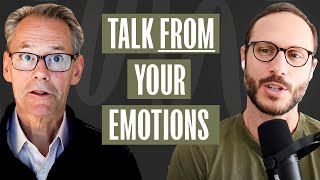
Owen Marcus argues that many men intellectualize emotions instead of actually feeling them. Real maturity means combining emotional openness with leadership, which requires somatic work to reconnect with your body and complete developmental gaps that left you frozen or disembodied.
Chapters
My partner is a couples therapist, and we just did one of our couples weekends last weekend. So inevitably, I'll sit down with a couple. The guy's really trying to be emotional.
Yeah.
And I sort of laugh. I go, hey, Joe, you're using all the emotional words, but look at her. She's not getting it. She's getting pissed. And I go, can I channel what I think you're feeling, but in an emotional way? And of course, he says, yes, within 30 seconds. 60 seconds. Almost always the woman starts to cry because she knew this, but she didn't feel it from him. And he's going, yeah, that's what I feel. I said, look, we've been trained as men to be emotional in these ways, but they're not connected. So you're talking about your emotions, not from your emotions. That's what you need to practice. And that's something that, as guys, we never got to see. I didn't see anything like that from my father or any other men.
All right, Owen, welcome back to the Man Talk Show. How are you doing today?
I'm doing great, Connor, thank you.
It's for those that are listening. Owen and I had to hit record because otherwise we were going to just basically shoot the catching up. We just spent, like, the last 20, 20 minutes catching up, and I feel like we could have just. We could have just caught up for. For the entire time and forgotten about the podcast. So I feel like you're going to have some insight into a very friendly conversation today. But where I wanted to begin, Owen, is on this, just the topic of masculinity. It's funny because I don't. It's not something that I engage a lot with this dialogue about masculinity. And for a number of reasons, I think in mainstream media, it's talked about a tremendous amount. It's talked about as being toxic. It's talked about as being harmful. It's talked about as needing to be redefined. It's, you know, all these types of things. And yet a lot of men come out to our work, and I would imagine come out to your work and are kind of questioning, like, what is masculinity? Am I masculine? And so what's your take on? Maybe a couple things. One, how do you view what masculinity is? Which is a very big question. And number two, why do you think it's getting so much attention within our culture right now?
So my view of masculinity is, yeah, men never come to us saying, I want to build my masculinity. We never hear that term from our men. We only hear it really from the media and academia. And I think because they're looking for some broad term to describe the whole male experience. So I. And it just continues to be used or overused. And then you get the toxic masculinity and all of it, all of it sort of placed on masculinity. I do think there's something valid with it, and particularly in terms of the cultural frame that men are dealing with and struggling with and fighting against. We did a big study several years ago, and the takeaway was men don't feel good enough. That was the bottom line. And I think that goes to what you're saying, Connor, is that I think men are struggling with, you know, because we're so performance oriented. How do you know how to. How am I a better man? And I got into this work. One reason was because I couldn't call myself a man. I felt embarrassed to call myself a man. And so I think a lot of that gets lumped as masculinity, which is fine, but I think for men, it's way more personal. And so recently I came up with a new way for us to frame it. So the name of our company is Man's Emotional Leadership Development. And what I saw was the emotional part is sort of the hypo masculine. What might be called the more feminine, the more sensitive part of being a man or masculinity, and the hyper part, the more macho.
Strong, you know, 1950 kind of masculine is the other extreme, but that's more associated with leadership. And I think what men are really looking for is. Is what you call that mature masculine, which is sort of the best of both, where it forms this third place where men are emotional, but they're leaders. And one of the terms I came up with years ago was assertive vulnerability, the ability to be vulnerable, open, which, you know, women are really good at, and they train us how to do that or at least model that for us. But this is other part that I think it's inherent in men. Not that women don't have it or need it, but men really are going towards it is that assertive part without being angry or reactive. And so when I'm being assertive, vulnerable, or vulnerably assertive, you know, I'm present, I'm in my body, I'm in my emotions, and I'm open, and I'm willing to allow my emotions to be seen and felt, but at the same time, I'm taking a stand. And I'm willing to assert myself and take the risk of not getting what I want or being rejected. And what I find is that's really what men are going for. But we haven't had that model as a conceptual model. We certainly haven't had it as an experiential model because I never saw a man doing that. And now we're starting to develop ways to support men in doing that.
Yeah, it's, it's interesting because in like in the alliance, one of the big things that we talk about, which is just our online group, one of the main things that we talk about is something that I call a self led man. And this, just this notion of having some type of leadership and authority and autonomy within ourselves. I think that when we as men, and this is my personal experience, but I've also seen it in thunder, thousands and thousands of men over the last decade. But when we as men lose a connection to having impulse control, being able to make good decisions, feeling like our decisions are negatively impacting other people, not really having a sense of direction in life or not being able to make the decisions that move us towards the direction that we want to move in, that is incredibly damaging for us. You know, I think back to the darkest times in my life and it's when I felt the least effective to lead myself. And I think that this is what's interesting. I've been talking quite a bit about how some forms of therapy or the therapeutic industry writ large is kind of missing out on some of these pieces that they're missing out on speaking a different language or engaging men in a different way that is, that is direct, that's actually going to land with them. So I'm curious on your thoughts of this self leadership piece. What have you seen with men in terms of when do men feel the most effective? When do men feel the most sort of aligned, congruent, confident? Because I think that's something that a lot of men want. What are some of the traits and, and characteristics of being very confident and then lacking that confidence?
Yeah, I think a lot of it, I don't think it's all of it but a lot of it comes from being disconnected, disconnected from our own experience. And so we're one, we don't have the models and we often don't have a safe place to really mature which goes to the whole thing of not having secure attachment or co regulation. So we learn, so we learn how to self regulate. So part of it is the ability to take care of ourselves, but we learn that from Having good co regulation, you know, like from our parents modeling that so that we just inherently learn that as a kid. But I think ultimately it's being connected to, you might say your source, but in a simplistic way to your own somatic and emotional experience. Because I find that when men start to feel what they're feeling in the present moment, physically and emotionally, and then that sort of ignites some passion or maybe purpose, and then they start taking the risk of asserting that or expressing it. And then like I'm sure in your community and in our community and groups, they get positive reinforcement because so much out in the world they get pushback, there's competition, they get shamed if they're vulnerable. But we need this space that we didn't have growing up and as an adult to, you know, to see other men doing it, to have maybe a conceptual model, but really a place to practice this to and you know, work out where we build this strength where, oh, I can feel these things that in the past were strange and express them and actually have an effect. And I'm sure you also see in your community that men really enjoy and get a lot out of helping other men. And it's not, you know, a cognitive little. Let me give you this brilliant insight. It's more like, hey, Connor, you know, when you talked about your father, it really reminded me of my father and I felt really sad. And you know, and I'm, you know, you're, I'm feeling you're sad but you're not talking about it. Oh, and then you go, oh, yeah, you're right. And so it's in our work we say take the man deeper into his own experience. And so I think as the man drops more and more into his own experience, he is more self led and he's leading from his own experience and in consort or relationship with others.
Yeah, that's such a good way of describing it. And it's funny because I led a masterclass two nights ago on how to work with men because I've launched this training program for coaches and therapists and counselors and men's coaches and whatnot. And it was funny because part of what I was talking about was how do you get a man out of his head and into his body and into what I call it the DFE or direct felt experience. Like what's actually happening in internally for you, what you're actually experiencing. And it was funny because in the chat box I could see a few questions of like, why is that important? Why, you know, as A man, why do I need to know what's happening in my body? And it was one of those funny things because I said, you know, you can't solve emotional problems with rational equations. And we try and solve relational problems or emotional problems in our relationship or our life with just purely calculated rational thinking. And it doesn't work for most of the time. It might work sometimes. And so I was like, well, you need this other data, right? You need this other data set and information. And I just look at it like that, that what's happening in our bodies. I had this quote I was working out the other day, and I'm curious to get your thoughts on this. But I said, just like your thoughts are the language of your mind, your emotions are the language of your body. And I think as men, we actually haven't been taught how to speak that language, but it's incredibly important for us to be able to speak in order to move forward. Right. Or sometimes that language is just so loud that we get overrun by it and we lose our cool and become, you know, whatever. So I'll just pass the baton to you. What do you want to add into any of that? What are your thoughts on.
Oh, I fully agree.
Yeah. I sort of. I do say pretty much the same thing. I think our body, our emotions, and our unconscious, like the dream time and all that, but are like three aspects of the same thing. And then we have our mind and this culture, as we know all too well, it's all oriented towards that, particularly for us men. And so we end up, as you said, start doing battle. And we want to use our mind to control our emotions, which is a lose, lose proposition. And a little aside is that my partner is a couples therapist, and we just did one of our couples weekends last weekend. And what's really interesting is that, you know, we do a little teaching and some other things, and then we send the couples off to, you know, to do that little exercise. So inevitably, I'll sit down with a couple and the guy's really trying to be emotional.
Yeah.
And I sort of laugh. I go, hey, Joe, you're using all the emotional words. But look at her. She's not getting it. She's getting pissed, she's checking out, she's doing what she normally does. And I go, can I channel what I think you're feeling? But in an emotional way, of course. He says, yes. And within a 30 seconds, 60 seconds, almost always the woman starts to cry because she knew this, but she didn't feel it from him. And he's going, yeah, that's what I feel. I said, look, we've been trained as men to be emotional in these ways that we got these words and these little models that we use, but they're not connected. So you're talking about your emotions, not from your emotions.
That's right.
And what I just did was I talked from my emotions. I just spent a second, dropped into my body, connected to you, connected to her, and just spoke and I said, now you practice this, you know? And so he does. He starts to get a little traction. And I said, look at her. See what she's doing. She's your reflection. You're doing it right now. That's what you need to practice. And that's something that, as guys, we never got to see. I didn't see anything like that from my father or any other men.
Yeah. What do you think? So just to go back to this notion of masculinity and whether we want to call it mature masculinity or whatever, I think there's, you know, a lot of different names that we could. Or labels that we could put on it. But if I asked you the question, what happened to this more mature masculinity that seems to have. We seem to have had a vacancy of it in a big way within our culture over the last hundred years. And. And because it does seem to me as though when you look at history, there were really powerful initiation processes for young boys and men to go through from the elders, you know, that men had elders in their life, whether it was their. Their dad's friends or uncles or grandfathers or your friend's grandfather. And there was just kind of passing down this lineage of this more elder version of masculinity that was transmitted to us as men that seems to have, like, disappeared in some way and become replaced by this very youthful, very adolescent form of masculinity that has become much more rampant within our culture. So what would you say has happened?
Several years ago, I did a TEDx talk where that was sort of the theme of it. I think it started with, you know, 10,000 years ago, we were in a tribe, and our genome is 99.9% the same. So, you know, our body's the same body that we had, and all the instincts are the same that we had when we were in a tribe. And then, you know, we left a tribe for the farm, which shifted it some. But when we left the farm for the factory, that's when it happened. Really started happening, like, a couple hundred years ago, because simply, men weren't around. And women stepped up because they had to. They were the sole parent. They were the teachers, the nurses, and now the therapists. So it's not a manipulative kind of taking over, but the, you know, the feminine sort of, that model has just taken over. And we assume, you know, naturally or consequently that, you know, we are like women and we should feel and express like women. So that has sort of.
Corrupted or shifted this model of what is the masculine, let alone the mature masculine. And then, you know, we're hungry for, how am I a man? What do I do? So we're looking and where do we go now? Social media. We go to, you know, all these pseudo experts and we get these pseudo, what I call junk connections through social media. But we don't have an opportunity to really connect. I mean, the churches are going down, the fraternal organizations are going down. And that's creating an opportunity for guys like us who are offering authentic connections for men through, you know, groups and memberships where guys can be real. And the beauty of that, what I've seen, you probably see this, Connor, is that you create a safe space for guys. You're given some simple protocols, starting with, you know, confidentiality and maybe a little teaching. And they, we teach each other because it's buried in our instinct. We just need a space to do it and we'll teach each other.
Yeah, I think that's so true. I think that there is something instinctual about it, you know, that's, that's buried into us. And I, I, I don't want to take us too far down in the rabbit hole because this is, you know, always an interesting. There's some, there's some, there's some pockets about this conversation that sometimes get people listening, heated. And one of them is the notion of, is masculinity and femininity purely a social construct or does biology play into it? And I've always found that a fascinating one because as a, as a, as a man who, you know, went through puberty and had all of that happen to me, I was like, I don't know how to extract biology out of the equation of what masculinity is. And it's not to say that a, a biological female can't have really, you know, wonderful masculine traits or characteristics. However, I do think that that biology and, you know, obviously things like testosterone play a pretty significant role into that. And I think part of the transmission of mature masculinity is also helping a young man or a man, period, regardless of how old he is to navigate his biological circumstances. You know, like I remember going through puberty as a teenage boy and holy man, I was like punching holes in walls and wanting to everything in sight and like, you know, I'd like joked, I, I joked around with my, with my men's group. Like I'm lucky that I didn't like masturbate myself to death. You know, like that was, that was a very real know in there at some point. And so you know, that it's that type of stuff that I think.
I, I struggle when people are like, well, masculinity is just a social construct. I'm like, sure, it's influenced by social constructs and narratives and those types of things, but I'm curious to get your thoughts on that and is that even relevant? Does it even matter to the conversation around masculinity?
I think I agree with you. I think there's a huge biological factor and there's certainly a social factor and they're often competing against each other. And.
Again, I think in the culture because of how it's designed and how we're trained and everything is that we're, we're trying to understand this stuff from top down. Now I'm sure, you know, you're very familiar with Richard Reese book Boys and Men we had on our program. The guys brilliant. I love him, but he freely admits that's what he's doing and I think that needs to be done. But what we're talking about is a bottom up, you know, in the organic part from, yeah, the biology, but yet the rawness of being a man or a boy. And we don't. I didn't either. And most men or boys don't have an opportunity to in this culture. Maybe in traditional ancient cultures it was different, but in this culture to sort of to work it out, play it out, maybe fight it out, you know, have mentors that said, all right, you know, these are the parameters, stay in these parameters and you'll be fine because you know, we'll get the energy moving. You'll, you know, not so much outgrow it, which you will, but you'll integrate it. But we never got a chance to have that, to integrate it, to settle down in it. And I know in a lot of our work guys, like, particularly in a group that's more longitudinal, almost inevitably that part of their maturation comes up and they're working through it. Because what I've seen just from decades of working with people, we have, we have holes in our maturation because we, we could, there was trauma, or someone wasn't holding the space for us or shaming us in the space that we sort of jumped over it. But it's a hole in our maturation, and we keep falling back into these holes, particularly in our relationships. So when a guy can sort of go back and fill a hole with some experience, not just thought or understanding, but complete either the trauma or the learning or whatever that needs to be to complete, he starts to settle down. And so I've had to go fill in a lot of these holes in my maturation to be confident in saying that, you know, I'm a man.
Yeah, I agree entirely with you. And I think what's interesting about what you're saying, these sort of, like, holes and maturation. I want to frame it a couple different ways, and please tell me if there's anything that doesn't resonate. But I also think that a hole in a maturation could be an interruption to our development psychologically. And what I think what your saying is that when we get into conflict in our relationship, or there's like this big, seemingly unresolvable thing that's happening in the relationship, or you feel lost in your life and you're not really too sure why, or you can't seem to find your purpose, and it feels like there's something just fundamentally blocking you, you know, etc. We just go down the list. That's likely a sign that there has been something that has disrupted your development at. Somewhere along the way. And the work that I think you're talking about, that you and I do, which is similar in a lot of ways, is to go back and find those interruptions. And then to help a man again, not just to conceptualize it or think about it, but to actually feel into it and fill in that experience that he never got. Is that an accurate way of putting it?
Exactly. I mean, never got. Yeah, it needs to complete. You know.
I was friends with him and studied with Peter Levine back in the early 80s, and, you know, and his whole model of trauma and. And that freeze response, because when we can't fight, we can't run, you know, our biology just goes to freeze, which is disassociation, which is essentially what a hole is. We just checked out in that period or maturation. And inevitably, particularly in relationships, as you said, we sort of fall into these holes, but we need to complete it. So there's a physiological completion, there's a relational completion, there's an emotional completion, and then the last thing that happens is sort of the intellectual completion. And we need opportunities. We can't just understand it, we have to experience it.
Yeah, I think I want to give a couple examples on this, just so that the listener can, like, really have a tangible sense of what we're talking about. So I'll use myself as an example. I didn't get healthy discipline in a way that taught me how to have impulse control as a child. I just did not receive that. What I received was shaming and physical abuse and verbal abuse. And so anytime that I was out of control or making the wrong decision, it would result in some form of punishment. And because of that, the hole that I experienced in my maturation or in my development was nobody really taught me how to have impulse control. No one stayed with me and sat me down and actually, you know, helped me to regulate the energy in my body that was coming up. And so what ended up happening was I became a young man who had no impulse control. And so as soon as my brain would say, go watch porn or drink that, or smoke that, or text her or whatever it was, there was a very weak system of, I shouldn't do that, or I'm not going to do that, you know, or I'm going to say no to that. And it was something that I remember when I first started working with one of my first mentors. This is over a decade ago. That's one of the first things that we talked about. And he was this little French Canadian guy named Bernard. And he was in his 70s, and he had. He. He bred Rottweilers, which gives you a little bit of an insight into the type of man that he was. He just had this. He wasn't more than like 5 foot 7, 5 foot 8, but he was fierce. Like, there was something about him. Like, I'm. At the time, I was like 6:1 and like £230. And there was something about him that just made me almost like, tremble a little bit internally because he felt so congruent and so sure of himself. I remember we worked on impulse control relentlessly, and. And it really shifted and changed my life. And so I think it's these types of things that.
Just as an, you know, just as sort of an example, like, being able to say no to yourself, being able to say no to that impulse of opening the web browser to watch the porn or, you know, whatever. Anything else that you would add into that as an example, just the listener can sort of. I think they probably got it, but anything else you want to add in?
Yeah, I think. Yeah, I think it goes to the co regulation, you said.
You know, I, you know, I had more of the control than you did, but I didn't have the connection. And so what was missing was the emotional connection. And so it was subtle. And that's what this is, what I see a lot of guys, because you talk to a guy and go, yeah, I had good parents and I thought I had good parents. But you know, because it's the water, I was swimming, I didn't know what was missing, but there was no emotional. And I didn't see or feel my parents ever getting upset in any way. Positive, negative. So I learned to be, to have no emotional affect, which I think was a setup in part to my whole Asperger's thing. But regardless of that, you know, I didn't have any guardrails on emotions because they didn't exist. And so I didn't have that CO regulation there. And I think in both of our cases, particularly for a young man, there's an urge. And so we don't want to thwart the urge, we just want to contain it.
And so it's that balance of, so you have this impulse, but what's driving the impulse and what's deeper than that impulse. So we think the impulse is, you know, the masturbation, the, you know, the porn, the this and the that. Yeah, that's an affect. But in its essence, it's pure and it's wholesome and it's innocent. And when someone can just be with you and connect to that part, all the rest of it downregulates. The rest of it is the affect. Just like with me in my adhd, you know, my hyperness, that was an affect for my essence. Just wanting someone to resonate with it or co regulate with it and go, hey, Owen, it's okay, I'm here with you. And once we really get that, and I'm sure you see it in your work and we see in our work, the guy just relaxes because that purity is finally seen and accepted. And we didn't have that.
Yeah, yeah. And it's interesting because I see it in my son. He just turned 3 in March. And so he's in this phase of.
Really rambunctious big energy. Constantly in the morning, at night, after work, just like wrestle, data wrestle, data wrestled out. All he wants to do is be physically active. And he's in that phase as well where the tantrums are there. Right when he's told no or it's time to transition from something that he really wants to be doing, then it's like big energy. And, and so I've found myself having to really like sit with him, have good guard rails with it, not become so disrupted by it and, and help him to learn one, that big energy is okay, right? Because I think for a lot of young boys what they get is do not let that big energy out. So they're shamed around that big energy, whether it's anger or frustration or sadness or whatever it is. And then two, sitting with him to help him regulate. And sometimes it's so funny because sometimes he'll do breath work with me in the morning. And so when he starts to throw a tantrum, sometimes I'll say, okay, inhale through the nose, exhale through the mouth. And it first he's like, no, no data. He'll get so pissed off, like, screw you, stop trying to co regulate with me. But after a while, after time, he'll, he'll usually calm down quite a bit. And so it's just interesting to see it in real time. But I think that, I think that it's interesting because one of the core things within our modern culture about masculinity is this notion that you should be able to do it all by yourself. Whatever it is, whatever challenge you're facing, you should be able to figure it out. Whatever problem you're dealing with, you should be able to deal with it on your own. And I think that it's really disconnected, not just emotionally, but I think it's disconnected relationally. A lot of men, from other men and from the women in their lives. So I just love for you to speak to that and the value of being able to bring some of our shit, for lack of a better term, the clinical term, to the people in our lives.
I think you're right on with that. You sort of touched on it before I was going to come back to it, which is, yeah, we're told that we need to be self reliant and certainly we need to be in some way, but it's overemphasized. And I was like, or I tried to be a master of self reliance. And I studied with a guy named Ron Kirch, which comes out of the Reich tradition, which William Reich was, along with Freud, along with Jung, a contemporary of Freud and he went down the body track and, and so what these guys figured out was in our maturation from, you know, really conception all the way to puberty, when we have trauma, we will get stuck in a particular place or that's a big hole and our body will form around that Our body shape and quality and certainly structural or posture will form around that. And I was the classic self reliant type. You know, my shoulders were back, you know, I tried to be tough. And Ron used to call that the gunslinger, you know, the guy or the cowboy out in the rain on the lone range alone, going, I don't need anyone. I could do it all on my own, you know, you know, I'm not weak. I can, you know, I can survive on my own. And that was sort of my mantra. I remember arguing that in a college class.
But doing all this work, I realized that was a denial of what they might call my orality or my need, my need for connection.
And I think as a society, particularly for men, we've been trained to be self reliant.
And we think it that strong. And it's not because, you know and I know from our own work and working with all these men is that they really become stronger when they have this sense of what you were calling that mature, masculine, but they also have this connection with others and the other starts to feel this trust in you when you have this, because you're not out there trying to prove anything, you're just strong and it's strong. I think ultimately comes down to how present can you be in that moment. And my work for all these years is to increase my ability to be present under more and more circumstances.
Yeah, I love that. I mean, I, I got a text message from one of my close friends this morning and he was sharing with me a really hard conversation that he had with his partner yesterday. And you know, a decade ago, I never got any of those text messages. I never sent any of those text messages. That was not a part of any relationship that I had with the men in my life, period. You know, it was like if something was wrong in my relationship, I didn't talk about it, you know, I just stuffed it down and tried to figure out a way to deal with it. And so.
Yeah, I do think that a huge part of self leadership, of course, is developing the competency in order to move your life in the direction that you want to go. But I think that in tandem with that, we have to also develop relationships that are going to support us and that we want to invest in them. And it's like the cliche saying, right, iron sharpens iron. We've all heard it, we all know that there's some intrinsic value in that statement. But then to actually enact that is something completely different, right? To text a friend and saying, hey, I have this problem in my work, and I really don't know what to do. Or I have this financial situation happening. I'm not too sure how to handle it. Or there's this big conflict that I just had with my wife or my partner, and I'm devastated, and I don't need anything, but other than to just tell you what just happened, you know? And I think that it's. That it's those simple things that most men are lacking in their male friendships. And what would you say gets in the way? Is it simply just a narrative that we as men need to overcome in order to develop deeper relationships with other men? Or there are some other ingredients that we need?
I think there's a societal pressure, which you just sort of mentioned. There's the external, which is huge, and we're so accustomed to it that we don't realize how impactful it is. And there's, until recently, really been no conversation around that. But at least equally important is the physiological emotional component, because, you know, I can't do what we're talking about if I'm not somewhat connected to my own experience. And to be connected to my own experience, at least initially, can be scary, can be vulnerable, like you or me to call a friend first, we need to feel that I'm scared or I'm sad or whatever that is. And we don't have a model, we don't have teaching around that. So there's this whole component of being aware of, at least somewhat aware of our own real experience, not our mental experience. Again, not the analysis, because that's where we usually go, but the somatic and emotional vulnerability of, oh, you know, I had this fight with my partner. I might lose her. I'm really scared. I up. What do I do about this? And. And inevitably, it gets back to what we were saying before Connor, is that we fell into one of the holes.
And in that hole, there's this chronic sort of disconnection, and we're lost. And we need someone to sort of. Not necessarily take us out of the hole, but maybe take us a little deeper into it and us to feel what we really can't feel. Because once we start to feel it and our body and our emotions can start releasing or cycling it, then we can get ourselves out, maybe with others, but until we connect to what we were disconnected from, we're just going in circles.
All right, well, that's a pretty good segue into what I wanted to talk to you about next, which is what is the science of emotional physiology, AKA what we feel.
So I take a lot of that from a fellow named Stephen Porges. He's a scientist. He developed what's called the polyvagal theory. Sounds complicated, but in essence it's pretty simple. He studied the vagus nerve, the 10th cranial nerve, which is the biggest nerve in our body, goes from here all the way down. And what's interesting, what he discovered is that 80% of the impulses go this way from the gut and these other organs up into basically the base of the brain. And 20% goes down. So really our body is informing our brain now we think, we want to think that our brain's in control. Well, it really isn't. And other research shows that before we are consciously aware of something we emotionally feel, and before we emotionally feel it, our body feels it. It. And this is what he called interoception, our ability to feel our bodies and then with that, interpret not in a cognitive sense, but in a, in a more emotional sense. And as Porges would say, we are first orienting, orienting to any threat response. So even on a zoom call, I'm looking at Connor and going, you know, is he safe? And now we instinctually are hardwired to do two things. To read people. Their facial movements, you know, the little muscles of the face, their eyes, the voice tone, the body. All this is instinctual to know if this person's safe, is he or isn't he a threat? And if he's not a threat and Connor isn't a threat, I'm going to start to down regulate. I'm more likely to get out of any threat response or survival response and start to relax. And where this becomes important is if we're really going to connect with someone, we need to be in this relaxed or parasympathetic state to be connected. And in this relaxed state is where all healing happens, all creation happens and really all connection happens. Any real serious connection, even sexually. I mean we, and this is a problem we see with men is you, you can't get an erection if you're stressed. And I've worked with guys where just down regulating them, getting relaxed, getting them out of the threat response or the performance response, starts to have them relax, gets the blood going to where they need to have it go and not to the limbs, which is where it goes when we're in a threat response because we either need to run or fight. And so what we're dealing with, with emotional physiology is working with men and getting them not just cognitively aware of this, but really experientially Aware of what's my body feeling. And for men, when we can feel our body immediately, we downregulate a little. Because when we're in survival or disassociation or disconnection, we're not aware of our body. But by just becoming aware of our bodies, even if it's just something uncomfortable like tension or pain or whatever, that's telling ourselves on a subtle level that we're safe. And it starts to create a positive spiral, like, oh, okay, I can feel more. Oh, I'm even safer. Oh, I can tune into my breath. Oh, my breath. I can sort of control. If I slow down my breathing, I slow down my, my whole body. And so as men start to connect to their physiology, they innately connect to their emotions. Either the emotions just come in on their own or, you know, if I to ask you an emotional question, when you are down regulated and you feel safe and you don't feel like you have to perform, you're a lot more likely to be able to go, you know, yeah, I feel sad and I feel that here in my body. So a lot of our work that we do with men is taking the science of this stress physiology and utilizing it as a portal for deeper connections, first to ourselves and to others.
Yeah, it's interesting. I always, I remember one of the first times that I learned this notion of like communication is 80% non verbal or however much it was. Right. Just different, different things. It used to be 90% and it was 70%. There's 80%, but it's a very high percentage. And it was kind of an interesting. It's one of those things that you hear it, it's like, well, that's an interesting fact. But then when you actually think about, well, what the hell does that actually mean? What it means is that your body, our bodies are all transmitting a tremendous amount of data. And our bodies are also receiving a tremendous amount of data about where the other person is at, what they're feeling while they're communicating, what they're communicating. And we have to be able to interpret some of that data by actually experiencing it in the body. And that's such a, When I, when I put those, maybe it sounds so simple to the listener or to you, but like when I put those two things together, I was like, oh, I fucking get it. Like, communication is largely non verbal. And so we have to be able to understand the non verbal part of our own communication. And this is why in relationships what I usually say to a lot of guys is like, we are usually disconnected from what we're experiencing so that when we speak to our partner, it doesn't feel safe. Right. So lots of women have had the experience of being like, you know, seeing that their partner is angry, seeing that the man that they're with is angry, and then saying, why are you so angry? And the guy's saying, I'm not angry. But what she's feeling from him and what he's transmitting from his body is like, I'm really pissed off right now. And so that's a really, you know, that's a sort of a threatening experience to have as a partner when you can feel something from his, you know, from another person's body, but then you can't actually, you know, they're not connected to it. So what are some of the tools, the ways in order to get more into our body, Whether we want to call this embodiment practices or somatic work or, you know, what have you. But how do we start to interpret some of this data that that's already present?
Let's just take a half a step back and just say yes. Another way that our partners are going to feel threatened is if we check out and disconnect it. And I see more of that. So we might not be angry, but if Dial is my partner and she feels that I'm not present, she's going to. Her threat response is going to go up. So we don't need to be threatening to be. To create a threat response. If we're just not there. Our bodies are there, but we're not there, which is more likely to be happening. Our partners or others are going to feel a sense of threat. And with that, and I've had women say this to me consciously and unconsciously, they will push us, they will get us angry because at least they're feeling us. Because men tend to be more connected, as a typical saying goes with anger, than any other emotion. And so women will often get us to get angry so they can feel some kind of connection.
So, you know, how do we work with all this?
Yeah, understanding it helps, but really, you know, experiencing it is the key. So going into a situation and tracking your body.
And so what I do a lot of my clients is I teach a little somatic mindfulness. And not even as a meditation, but just as, look what's happening with your body. The more you can check in, the more you're going to be present. And if you start to notice that you're getting tense, that's great that you're noticing some. And then you can choose to relax it. And often what happens is when we relax our bodies, we feel an emotion that we don't want to feel.
And that's sort of the critical thing that happens. We check out, we disassociate by getting tense. So when we start to relax, we reassociate, we connect. And in that connection we might feel some emotion.
And when we can feel that emotion, the energy starts to move, and always internally, externally, internally. And inevitably we start to feel a little safer. We might not feel safer in that instant because I'm feeling fear. But if I'm congruent, I'm feeling it, my body's showing it. I'm not denying it. The other person suddenly, as you were saying, going to pick up that congruency and in some way they're going to relax. Because when there isn't congruency, they're going to feel that dissonance and they're at least unconsciously going to respond to it.
What do you say to the men who are in a good place in their life? Because I've heard this a lot from guys of like, I am worried that if I start to feel it's going to screw up my ability to do my work. That is surprisingly a very common thing that I hear from men. So how do you traverse that? Because I think it's very common that a lot of guys think that if they start to feel the grief, they start to feel what's in their body, they start to, whether it's the anger or whatever is in there, that it's going to interrupt their ability to perform usually in their work life.
Well, it probably will.
That's the bad news, because I remember one years ago, I had this guy that was a motivational speaker and a great sales guy, and I warned him, I said, this works and you're going to disrupt your mask. And he did. And we ended up going to see him speak. This guy that was like, you know, internationally known speaker was screwing up because he didn't have his mask anymore. That's an extreme situation. And so it's sort of like we get really used to using our right arm and we get really good and we're, you know, a lot of dexterity, a lot of strength. And then you're, you know, someone's saying, hey, I want, maybe you want to use your left arm occasionally. And it's awkward at first, but gradually, you know, I use it and I start to be ambidextrous and I can use that left arm when I need to. So it will be A little awkward. And you got to be able to do that. I mean, I've had many a situation going back, you know, a few decades where I'd be in business meetings and I start to feel that sort of survival response come in or my old trauma get activated and I start to feel a subtle shake. And I remember the first meeting I was in, I said, what am I going to do? Am I going to repress it or am I going to go with it? I said, the hell I'm going to go with it. I started shaking, I started crying, my voice cracked and I, you know, I certainly didn't get what I wanted in terms of the outcome. But what I got was a release of a lot of stress and trauma rewiring in my nervous system. And ultimately it worked out better because I ended up firing that person. But.
I probably should have sooner. But it will be awkward and it will feel more awkward than it really is because we're so conditioned and we've been trained so much to perform well that if we lose a little bit of our edge, it gets scary. But here's the deal. Particularly in our intimate relationships, we gotta lose that edge. Because that edge is our coping mechanism or survival strategy that worked back then because we're alive now, but it's not going to give us everything we want in the future.
Yeah, I found that there is this very strange stage and period that everyone goes through where it's cumbersome and it's awkward and you know, it's funny, I was just talking to a client the other day and he's a really, really, really well known famous musician. And he's in the middle of this right now, you know, where he's going through some pretty big transitions and he's starting to, you know, there's, there's, he's like, this is awkward, you know, and sometimes I don't know how to act or behave. And he's like, I have these big interviews that I'm going on. And, and really what it, what he came to the conclusion of, which I thought was so wonderful, was that he realized that he before never knew how to just be authentic in so many of these environments and actually be relational. And so he's going into these interviews and performances and, you know, meetings and whatnot. And all of a sudden he's much more authentic than he's ever been in his life. And it feels risky, vulnerable, it feels a little raw and a little open. And what he's starting to notice because he's starting to come out the other side of it is like, things are changing for the better in ways that he couldn't have expected. But it's almost like when we start to do this, it creates this fear response that emerges and this resistance. And so I'm curious if you can just speak a little bit to the importance of a man having resistance and how to work with that resistance. Because I think for many men, the walls that we have can be quite intense. And I would love for you to just speak to that, because I think a lot of guys, like, I don't know how to just get through this.
Yeah, that's a good question. I certainly were. For me, I mean, it's. We don't realize how much the culture and the expectations have impacted us. You know, having a mental model helps. You know, trusting your authentic, vulnerable experience helps. But a big thing is having a group or a group of guys that can support you so they hold that space for you so you don't have to hold it because. And this goes, Peter, with Levine, would say a little differently, but essentially what, you know, I've done for myself and try to do for others and say is that what happens is, you know, we go through life and normally it's, you know, in this range of experience, we have a trauma that's like. Or an intense experience that's this big. But when the emotional space is only this big, everything that can't fit in that space, we sort of disassociate with, we disconnect from or whatever, and when. And then we hold on to it or we try to survive, but it's a coping mechanism. It's not being authentic, not being present. And so when this stuff gets activated and you got someone else, could be a friend, could be your group, could be a training or whatever and says, hey, it's okay. Lose it. I'm here. It's okay. You can melt down, you can rant, you can do this. You can cycle through what you need to what you couldn't have done as a kid. And I got you. I got the space for you, and that is huge. One, you get the release. Two, you rewire your nervous system through that neural process, plasticity. You literally internally change your model, and you do that a few times, and then you're able to do it for yourself, because then, you know you're going to survive. But often, and this is, you know, I've done for years in my practice is, you know, catalyze these kinds of things for people and then just be there for them. And I got Hundreds of little stories about, about what would happen, you know, and all I had to do is be there for them. And this is what I tell guys. You don't need to be a therapist. You just need to be present. And then the skill comes into maybe how to activate or catalyze a situation or person. But most of it is just being able to hold an experience that that man couldn't hold for himself.
I feel like we could talk for many, many hours about these things. And it's wild how quickly time flies when you're enjoying a conversation. And so thank you so much for joining me and us, the listeners today. Where can people learn more about you and your work and the work that you and your team are doing.
Through Meld Community? It's M E L D community, not com, but.community. and we're doing our first retreat, Mendocino in July. We have.
Really dialed in four week course that we've been doing for years and then group coaching and other things. And yeah, we really want to give men these tools that we never really had. And then Dalia and my partner, my partner and I are doing a, a week long couples retreat down in Costa Rica for Valentine's Day 2025, which we're excited to do, which is, you know, essentially taking this physiology stuff and the attachment theory research and really applying it for couples. And all this work, as you know, is pretty simple in one way because we're hardwired for it.
Yeah, we really are.
So it's really not much more than learning something that we never had a chance to learn. Yeah.
Well said. Well, thanks, Owen. We'll have all the links for that in the show, notes for people to check out. And as always, don't forget to man it forward team. Share this episode with somebody that you know will enjoy it. This might be a good one to listen to with a buddy and chat about in your men's group or to share with a partner. And as always, until next week, this is Connor Beaton signing off. Be well.
More from Connor







How to Raise Strong, Unshakable Boys in Today's Culture, with Dr. Shefali Tsabary



