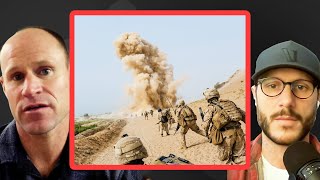
This is a first-person interview transcript (Connor Beaton interviewing Dan Cnossen) recounting Cnossen’s 2009 deployment to Afghanistan as a platoon commander and a night operation where he stepped on a buried improvised explosive device (IED). The chunk describes pre-deployment posture, the nighttime assault to seize high ground, the IED blast that caused severe femoral artery injuries, rapid life-saving actions by teammates and pilots, and Cnossen’s reflections of gratitude and luck in surviving.
Chapters
All right, so you're leading a platoon, you're commanding a platoon in Afghanistan. 28 years old, 2009.
Walk us through a little bit of what that deployment was like, what obviously you can't give details of like the mission, the missions that you were on or what you were doing, but just a little bit of detail around what, what life looked like. And then maybe just walk us up to, to the incident and what happened.
Sure. I was, as a platoon commander, scheduled to go on the deployment early in advance of the rest of the team. This is something that is very common. You would just, as key leaders and key personnel within the platoon, go early. Just what you do, you take a little extra burden. You know, a six month deployment might be seven months, because you want to get on the ground early and link up with the unit that you're going to be replacing and to see how they're planning, executing and debriefing operations and to learn some of the tactics and techniques and procedures that are, you know, used in, on our side as well as on the enemy side and meet all relevant players. And it just takes time so that by the time the rest of the team shows up, you're in a position of a bit more experience on the ground so that you can flow more seamlessly into operations. And so it's a phased turnover, which just makes sense. But I had gone out early and advanced the rest of my platoon and on this first.
Turnover operation where I would really just be shadowing, just kind of seeing how they're doing it and not in any sort of leadership position on this one and getting a feel of the landscape and just how things are going on. So we launched on this particular night for this turnover operation, two helicopters and it's going to be a nighttime assault operation, really, just kind of a pre dawn, pre first light, late night kind of target assault. Very, very standard. Just trained to do this kind of thing, but more rural environment, so more kind of like a land warfare kind of situation. And there was a key piece of terrain that overlooked the target. And I was part of a side element that was assigned to go to the top of this large hill and clear and hold the land. Really, you know, high ground could be an advantage like this. So that was our task. We knew that there was a structure up at the top of this hill, that it needed to be cleared. And we didn't know if there's going to be, be anybody up there. But once we, according to the plan, had cleared the hilltop, owned it, we would radio down at the main assault force, and they'd get going with their job. So in the course of launching this operation and in the middle of the night, climbing up to the top of the hill, I stepped on a buried improvised explosive device underground. I think it was a pressure plate. I don't really know, but I'm just kind of told after the fact. And I saw a flash of light under my night vision goggles, but I didn't hear anything. But I'm told from a friend later, years later, who was down with the main assault force, also from the same team, he just was down with the main assault force, that it was a massive explosion. I didn't hear anything. I think your ears blink or I'm so. So I'm told. But he looked up with his night vision goggles at the top of the hill and saw a massive mushrooming column of dirt and thought everybody up there was dead. And there were 10 of us or so up on the hilltop. Nobody was responding to the radio calls, so just silence. He's thinking, everyone's gone. And I'm laying in the dirt, realizing something like this must have just happened, not knowing exactly what I had stepped on, but a bomb must have gone off. This is not good. Are my teammates even alive? I didn't know if any of them were alive, and I didn't hear anything. And I couldn't really move, and only my arms seemed to work. Couldn't see anything. Night vision was gone because so was my helmet that they were mounted on. So really just not a good situation. I remember kind of feeling panicky for a second or two because I couldn't do anything. And I knew this, like time, just time is of the essence. The next thing I know, though, my teammates were upon me and none of the. I think their bells had been rung, but none of them had been critically injured. And that was so important because the situation that they faced was, I have a double femoral artery bleed. I'm not going to make it more than two minutes unless they start doing, you know, tourniquet application immediately, that we're now compromised in vicinity of enemy forces, and we have to get out of here. And that's going to require lifting me and dragging me down off of this hill. And there are likely going to be additional. And indeed there were buried improvised explosive devices that need to be either cleared or avoided. And so that's the situation they faced. And what's remarkable to me is that these were not my platoon mates. These were from the other platoon, you know, and they're responding like this. These are sons.
Husbands in some cases, brothers, fathers in some cases, you know, and they're putting their lives in the line. And I just met them recently, and a couple, one I knew really well from a previous assignment and a couple I knew from before, but, you know, some I just, just met. So that's just remarkable to me, to be part of a community like this where you're putting. You're putting a teammate, even if you don't know that teammate specifically. But, but because of the, the community and, and, and just the culture, that you're going to put your life on the line and try to save me. And it's not just my teammates up on the hill, although first and foremost, I have to express gratitude to them. But the pilots, because the helicopters that had got like, gone all the way. It was a long flight from the airfield for this operation. They had gone all the way back. Now the plan was to bring them back to offload another detachment of army special forces and Afghan commandos. But the pilots were getting really low on fuel. This is a deviation from the plan. And they really were throwing it out there to hang on scene to get me onto the helicopter. My teammates were dragging me off of this hilltop over sharp, craggy rocks. It was just the most. The most pain I've ever been through. But you don't. The choice here for me is either pass out or stay awake. And that. That was my struggle, was to just try to stay awake. And most likely I was in and out of consciousness, but I was fighting, trying to hang on, trying to hang in there and, and, and. And stay. Stay in this. Stay in this, you know, and not thinking anything else, really. Truly, I don't have any. I remember this, and I don't recall ever, ever thinking that I wasn't going to make it through this, that. That I wouldn't see my family again. Those thoughts, they're just. They weren't in my head. It was staying awake, staying. And then the pain, the pain. And I think the pain really brought me into this, this moment right now right here. And my teammates were getting me off the hill. They got me loaded onto the helicopter within one minute of it nearing the bingo fuel point, where they would. The pilots would have had to leave because the. The helicopter will chop out of the sky from lack of fuel. So they don't screw around with that. If, if they hit bingo Philip, they're. They're gone. It's just. They're not gonna. So they got me on board within one minute. And I am told all this later that that this was so precarious that everything had to line up. It had to line up exactly the way that it did to get me out of there, because from this, this, the moment that that explosion happened, the ground force commander down in the senior the senior enlisted advisor were immediately starting to do the casualty evacuation plan, immediately respond. Like all of that had to happen like clockwork in order to get me out of this very remote, exposed position in the middle of nowhere in southern Afghanistan. And so, I mean, for so at so many different levels, I have a lot of gratitude to even be alive here, not to mention the fact that what I stepped on, the bomb, was enough power to potentially destroy an armored vehicle, but not all of the explosive powder detonated. And so for that as well, I'm just incredibly lucky to be here.