Stanford Psychiatrist: HYPNOSIS Amplifies Your Ability To Control Your Body - Dr. David Spiegel
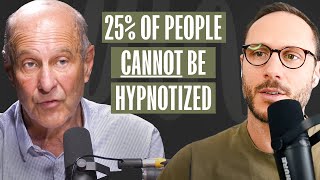
Dr. David Spiegel explains how hypnosis works in the brain: it quiets the default mode network and strengthens the connection between your executive and insula regions, letting you control pain, trauma responses, and sleep. He describes it as a self-directed state, not mind control, and discusses an app called Reverie that delivers hypnosis programs.
Questions this video answers
About 7,000 people.
About 20% of the adult population.
About 25% of the adult population.
81% increase in gastric acid secretion.
39% decrease in gastric acid secretion.
Chapters
I've used Hypnosis with about 7,000 people in my career. The brain can control a lot more that's going on in your body than you realize. So it's an amplifier of your ability to manage your body. Nobody has been killed using hypnosis. It just doesn't happen. So while people fear it as being terribly dangerous or weird or something, it's none of those things. It's just a naturally occurring state. I had a woman who was seven months pregnant and had bad lowered back disease. And so as the baby grew, of course the back pain got worse. They couldn't give her meds because she was pregnant. They implanted a nerve stimulator. It didn't work. And her pain was like 7 or 8 out of 10 when we started. And after a few minutes, I had her floating in a bath at home. And she said the pain was down to three. And she opened her eyes and she looked angry. And I said, what are you angry about? She said, why in the hell are you the last doctor I got to see instead of the first?
All right, Dr. Spiegel, welcome to the Man Talk Show. How are you doing today?
Fine, Connor. Pleasure to be here with you.
Likewise, likewise. Very honored to have you on the show. Sometimes I. I give myself a little. A little pinch when I get to interview people who I admire and respect, and it's. It's moments like these that I get very excited about. I've had some very wonderful people on the show over the last seven years and. Yeah, you know, from astrophysicists to cosmologists to psychologists and, you know, entrepreneurs and stuff like that. But, yeah, it's really, truly an honor to have you here and.
Well, I'm honored to be in that company. Thank you.
Yeah, yeah, absolutely. I spent some time thinking about how I wanted to frame this conversation because as you and I were talking about beforehand, hypnosis is often a very underutilized modality and tool, but it's also something that I think maybe people don't look at as a. As a resource. And so where I wanted to begin was just what are some of the basic myths about hypnosis that you wish people knew about? Or why do you think that it's not really framed as the potent tool that it actually is?
Well, I've spent my career trying to figure that out. Somebody said that myths are things that never were true and always will be. And, you know, the problem is that, you know, the kind of perspective many people have about hypnosis is, you know, from that recent movie where the woman, you know, bangs her spoon on a teacup and forces somebody to do something he doesn't want to do. Hypnosis is not a loss of control. It's a gain of control. It's not something someone does to you. It's something you do for you, for yourself. All hypnosis is really self hypnosis. It's a state of highly focused attention coupled with dissociation, putting outside of conscious awareness things that ordinary be in consciousness and what used to be feared as suggestibility, which is really cognitive flexibility. So most. Most of your audience, if they got any experience with hypnosis, it would have been at some cheesy stage show that they went to in high school or something where the guy had the football coach dancing like a ballerina and making a fool of himself. I don't like that. But there is a message there. And the message is that it's a state in which you can sort of let go of yourself and try out being different and see what it feels like. So in traditional psychotherapy, you start from the history forward, from the head down, and you think, why am I like this? Why do I have this problem? And then gradually, what can I do to change it? And hypnosis is more from the body and the bottom up, where you say, I want to get into a state. The kind of state I get into when I go to a good movie where I just lose myself in the movie and enter the imagined world and judge it later. In the same way, you can reduce activity in the part of the brain, the default mode network, where you think about who you are, who you should be, what people think of you, sort of constraining, but defining. And you say, let me just put that aside for a minute and see what it would be like if. If I were a ballet dancer or if I were someone with chronic pain who didn't have to feel as much pain all the time, even though I'm recovering from some injury. If. What would it be like if I were someone who had experienced a traumatic event but could see it from a different perspective? Take a. Get a new hit on it. What if I were someone who was trying to stop smoking and instead of worrying about dealing with the urge to get more nicotine into my body, if I could think of my role as a respecter and protector of my body the way I do my child or my pet, would I ever do to my child what I'm doing to my own body? So it's a way of doing a fast shift in your orientation about who you are, Focus on that and then try out being different. And if you like it, try, keep doing it.
I like that frame because I think that for quite a few people that the perceived loss of self.
I think is. Maybe that's just the language that I would use based off of having conversations with people. But the perceived loss of self or voluntary control is something that I think for a lot of people is. That's a. There's like a. There's a nervousness and an anxiousness that I think shows up for some people. And I think, I mean, the analogy that you gave with the ventriloquist or not the ventriloquist, the person hypnotizing the football coach on stage, that kind of made me chuckle because I think I remember seeing a hypnotic show when I was younger and thinking like, that's sort of a strange thing, like, is that person choosing to do that? Are they not choosing to do that? And it brought up a lot of questions around, are all of us that pliable and susceptible, or are there people who are simply not able to be hypnotized? I think that's one of the things that I was curious about.
Yes. Well, there are two separate questions, so let me take them separately. The hypnosis itself. You can suspend your understanding of yourself and try being different, but you're not losing control. You may be allowing someone else to structure your experience for a little while, but you're in control of it. You decide to do it. You decide to stop it all. Hypnosis is self hypnosis. We are social creatures, Connor, and God knows a lot of people get influenced by other people to believe things that are just pure nonsense. And that doesn't have to involve hypnosis, you know, and there are plenty of examples floating around this year that many of us might recognize. So, you know, the fact that we are susceptible of being influenced is a human trait, period. Hypnosis allows you to let yourself try out something different and see what it feels like. But you can also end the experiment anytime you want so you're not taken over and made into some zombie that, you know, people control forever. In fact, to the extent, and this gets to your second point, that you are highly hypnotizable, which about 20% of the adult population is, but most 8 year olds are all the time. It's good to know it. I had a patient who said, you know, I'm a disciple in search of a teacher. You know, that's what I'm like all the time. And so if you are very open to other people, helping you change your view of who you are. Good to know it so you can protect yourself. At the same time, some people just aren't hypnotizable at all. It's about 25% of the adult population, and most of us are in the middle somewhere. So it's good to know how hypnotizable you are. But I think we've all had that, you know, it seemed like a good idea at the time experience at one time or another. And hypnosis, hypnotizability can be part of it, but it's not the whole story. So in general, it's more of an ability and a skill to be cognitively and experientially, experientially flexible and try out things that are different and see what they're like.
All right, team, this episode is sponsored by Better Help. Now, one of the most important things that I've ever done in my own life was go and get help was to go and see a therapist, a counselor, a mentor, a coach, and to get the support that I needed to better my relationship with myself, to have better choices, to make better decisions, to get into alignment with what I wanted in the direction that I was moving in my life. And that benefited the rest of my life. It benefited my career, it benefited my. My relationships. And so I've benefited a lot from going to seek help. And that is why BetterHelp is here. So if you're thinking about starting therapy, if you have tried it before, if you've never tried it before, if you've had years of experience, going to see a therapist, or none whatsoever, definitely go and check out betterhelp. You can go to betterhelp.com mantalks and get 10% off of your first month. So give it a shot, give it a try. If you've been thinking about going to talk to somebody about the issues and challenges that you're facing in your life, then this might just be the thing that you've been waiting for, for the permission that you've been looking for to go and give it a try. So head over betterhelp.com mantalks to get 10% off of your first month, the difference between somebody that is able to be hypnotized and somebody that's not, is that about trait openness? Like, is it a psychological thing? Is it a neurological thing? Do we know what is causing some of us to be open and some of us not to be?
It's more neurological than psychological, Connor. And one of the big mysteries has always been that, you know, the big seven, you know, personality traits. Hypnotizability doesn't correlate with any of them, but it does correlate with a trait called absorption. A tendency to lose yourself, to get so lost in a sunset or a movie that you kind of forget what you're doing. You enter the imagined world. It's been called believed in imagination. It is related to that. And so, and we don't. We know what's going on in the brain. We've done a number of studies using functional magnetic resonance imaging. And we see three things happening in the brain when you go into a state of hypnosis. The first thing is you turn down activity in the dorsal anterior cingulate cortex. That's part of our salience network. It's a part of our brain that does pattern matching. And when something is a sudden mismatch, you know, you hear that and you think, oh my God, what's going on? Is it a gunshot? What is it? And derails your concentration. That's the anterior cingulate. We have the cingulate cortex is like a C in the middle of your brain on its ends. And the dorsal, the front part is involved in your sort of internal alarm system. Hypnosis turns down activity in that part of the brain. So you're less likely to distract yourself by worrying about something else. Why am I thinking about this? Why I should be doing something else. And in fact, there is more. In people who are highly hypnotizable, there's more gaba, gamma aminobutyric acid. It's an inhibitory neurotransmitter present. That's the same neurotransmitter that anti anxiety drugs stimulate, you know, alprazolam and.
Other anti anxiety drugs stimulate gaba. And so you have your own little internal pharmacy there saying, okay, you want to calm down? Here it is. And you shut down activity in that area. So hypnosis calms you you and allows you to focus. The second thing that happens is you have inverse connectivity. So when one part is active, the other isn't. With the default mode network in the back, the posterior cingulate cortex. And it's. So it's a way of turning down the part of your brain that normally worries about what people think or who you're supposed to be or what you usually like. So it frees you to be more flexible. And we found on psychological testing that that highly hypnotizable people in the continuous performance task are more likely to Catch on to a new rule, which the task does to. To see if you can catch on that the rewards are now coming from a different source. And so the capacity to be more open to changing your algorithm for how you respond is associated with hypnotizability.
The second thing is. So you're getting. You're cutting loose the part of your brain that says, I don't usually do this, why should I do it? You know? And that can be a therapeutic advantage. You can say, well, what it would be like if I talk differently to my girlfriend, or if I didn't immediately get angry when she says a certain kind of thing, you know, it might be better, you know, I might give it a try instead of feeling self righteous and I have to be this way. The third part is more functional connectivity between the executive control network and the insula. The insula is a little island. It means island in Latin, in the middle of the front part of the brain. That is a mind body relay center where you send commands to your body and you experience interoception. You feel what's going on in your body, in your gut and elsewhere. And we did one fun experiment where we took highly hypnotizable people. I met with them first thing in the morning. Neither of us had had breakfast. They would eat an imaginary meal in hypnosis for an hour. And it was so realistic that one woman said, after half an hour of visiting good restaurants around town, she said, let's stop. I'm full. And it turned out that we put down a nasogastric tube and measured secretion of gastric acid in the stomach. And the hypnotized people doing this had an 81% increase in their gastric acid secretion. So their stomachs were acting as though they'd actually eaten food and needed to digest it. When that's not what happened, we then tried the opposite. We said, imagine being on a desert island and swimming or sunbathing, anything except food or drink. We got a 39% decrease in gastric acid secretion. They were so relaxed and not thinking about food, they didn't. And then we injected them with pentagastrin, which is a drug that stimulates maximal output from the parietal cells in the stomach. And we still had a 19% decrease in gastric acid secretion. So the brain can control a lot more that's going on in your body than you realize. And hypnosis is a powerful way of amplifying that ability one way or the other. So it can help you relax. It can help you prepare yourself to go to sleep. It can help you get your body floating regardless of what stressor you're dealing with. So it's an amplifier of your ability to manage your body.
A couple of things really stood out to me there. I think one was reducing the noise of the part of the brain that is very much responsible for that self chatter and self criticism. And I like that notion because, you know, sometimes, I mean, I used to have a very, very high level of self deprecation and self criticism and self shame. And that, that part of me was very, very loud for a long time. And I can imagine stepping back into that moment and having something shake me out of it. You know, to experience what it would be like to not have that constant voice, you know, chirping at everything that I was doing. And I think for a lot of people, that state change or that shift or that experience of not having that be there as you're, you know, communicating or talking with somebody or, you know, whatever activity that you'd be doing where it would normally show up can be quite liberating because then you have.
A reference point that you can then return to. Is that roughly accurate of how that would work? I know I'm kind of pulling us into the weeds for a moment and we'll come back out, but is that roughly accurate?
Yeah, you're absolutely right. It's like the experience you have of getting so caught up in a good movie that you forget you're watching the movie. You enter the imagined world. So in the same way you lose yourself in an experience and immerse yourself in parts of it, but turn off parts that may interfere with your ability to enjoy it. There was a guy went to a couples therapist and he said, my girlfriend and I have the classic love hate relationship. We both love her and we both hate me. And.
That negative internal chatter can really contaminate experiences. But in hypnosis you just kind of narrow the field. You know, I think of it sometimes as like skiing. You know, you're just, you better be in what you're doing and not worried about what's going to happen or something bad will happen. So you narrow that focus of attention.
I like that. I think the other thing that stood out to me and then I want to, you know, we'll go through some of the use cases for it, how it functions and that kind of stuff. But one of the things that you said as well before, which was that it, it can quiet the default mode network. And if I'm not mistaken, that is a very similar state that psychedelics can put us into where there's a reduction in the noise of the default mode network. And so for the people that are listening is when they enter into that imaginative state in hypnosis, Is that something akin to a psychedelic experience? Is it a little bit more curated? I know I'm asking for maybe some more like, nuanced description, but, um, I think for the people that are out there that, that hear that, it's like. Oh, that's. That's quite interesting.
Well, it is, it's a change in your state of consciousness. Yes, it is. And it's. It's sort of less extreme and more controlled than what would happen if you take psilocybin or mdma. But it, it's. It is an experience you have of seeing what it would like to be different. And the best example I can think of, I've worked with dying cancer patients and there have been very good studies out of Hopkins and NYU showing that people even who are dying of cancer, you know, take one or two doses of psilocybin and they face something they'd had tremendous understandable difficulty facing, which is what it meant that they were dying. And they, they said, you know, I. For the first time, I could experience. And I, you know, frankly, I would worry about having a bad trip if I were dying of cancer and doing something like that. But they say I could see that my life is going to end, but I could also see what a miracle it is that I'm alive at all. You know, how incredible that is. And I can appreciate the privilege I've had of living even though I'm facing dying. You know, one of my breast cancer patients said that talking about it is like looking into the Grand Canyon when you're afraid of heights. You know. You know, if you fell down, it would be a disaster. But you feel better about yourself because you can look at it. I can't say I feel serene, but I can look at it. So people who just have that altered, radically altered experience of, of being someone who is dying of cancer somehow emerge from it, feel silly feeling settled about it in a way they had not before. And it's so. It's not like you have to keep taking the drug. It's that you've had that experience and you're different. And that's what I mean, that hypnosis does that too, in a less extreme way, because you can step in and step out of it anytime you want, but you can try out facing a situation in a way that's different. I had a patient who was a Vietnam veteran who just freaked out in the middle of the war. He'd been there, he was in combat for years, and he just went off and went out into the jungle and tried to kill Viet Cong. He did all kinds of. So he was mustered out of the Army. He was put in a mental hospital, tried on meds. It didn't help him. And when we. I got to talk to him, he. At the va, he said that what set him off was he had informally adopted a Vietnamese orphan child. And they became very close. He looked after him, took care of him. And he came back one day and found that there had been a. An attack in the Tet Offensive. And the boy was dead. And he just lost it. He just lost it. Well, it turned out he was the youngest of, like, eight children. And he, you know, so he identified with this child. The one good thing he felt he was doing was helping him. And I had him in hypnosis.
Picture. I said, let's go through your. Your. Your burial of the child. And he put out his hand and said, ashes to ashes, dust to dust, I guess. Then I said, now I want you to remember sometime when you were really happy with him. And a big smile burst out on his face. And he said.
He called him Chi Town because he was from Chicago. He said, chi Town, I got you a railroad train. My aunt sent me a railroad train kit for you. And you've never seen a railroad train before. And. And he said, you're so happy. And he started to smile and laugh. And I said to him, I want you to remember this. You lost him. It's a tragedy. But the happy times you had with him are still real and they're still inside you. And his spirit is with you even though he's gone. And he said. And I asked him to come out of the hypnosis. What do you remember? And he said, all I remember is a grave and a cake. So I remember burying him, but I remember that cake. And it was a way for him of kind of recalibrating his memory of the boy and that loss. And the loss was real, but it wasn't total. And so he could experience it from a different point of view. And he wound up getting out of the hospital after a long time in the hospital, going out and teaching kids how to do mountain biking and things like that. So.
Can really. Even a relatively brief encounter, if done right, can help people change their perspective on what it is they're dealing with for over the long haul.
I, I really appreciate that example for a number of reasons, but I think it's very poignant because in, in many ways, you know, like my, my wife is a couples therapists, incredibly skilled couples therapists, and sometimes we'll work with couples together. And it's very interesting because what can happen in a relationship is that two people start to only see one aspect of the relationship. They start to see the non functioning dysfunctional parts of the relationship and they miss out on all these small, beautiful, tender moments that start to, almost like the light of those moments starts to turn down and the, the intensity and the volume of what's not working can just be hyper fixated on and ruminated about. And then resentment builds. And you know, what I've usually said is that resentment is corrosive for intimacy, it's corrosive for love. It's just very hard to maintain intimacy and closeness when resentment is present.
That's absolutely right. Yeah.
I think one of the things you're saying is that these experiences can pull us back into the, the brighter moments, the what's working when we are stuck on this pathway of, you know, I almost think of like trauma or PTSD where somebody's just stuck reliving the same experience over and over and over again.
That's right.
And whether that's mentally or physically somatically in the body. And so we're gonna, we're gonna get to some of these pieces, but I wonder if you can maybe just lay out for the listener some of the. I'm going to ask one question because I was about to ask two, but some of the functionality of how hypnosis works. We've talked about the default quieting and the default mode network, but what's the, like, real neurobiology behind what's happening in our brain while we are hypnotized? All right, team, so as many of you probably know, I have been on a mission to get into the best shape of my life by 40. I was on that mission last year. And one of the most influential and impactful factors in that is nutrition. It's just a very important element to getting into shape, feeling healthy, feeling good. And one of the big things that has helped me in that journey is factor. And factor is a very delicious ready to eat meal that makes eating healthy and eating better every day easier. Now for me. I like to eat for efficiency. I like all the nutrients in one place. I don't want it to take a long time. I've got a family, I've got a business to run. And so having ready to make and ready to eat meals prepped for me is super, super, super helpful. So if you're interested in something like that, then head on over to factor meals.commantalks50 and you will get 50 off your first month. You can try it out. I love it. Their meals are clean, they're tasty, they are simple to make. There's not a big mess afterwards. And it is delicious food that's portioned out for you. So check it out. Go to FactorMeals.com Mantalks50 and get your 50 off and try it today.
Well, you're, you're turning down the part of your brain that reacts when you, when suddenly you get angry and bitter about something, you, you, you just become less reactive and more proactive in how you manage your responses. And actually you often start with calming your brain. You know, when you have these startle reactions, when you get instantly angry, your muscles tense, you start to sweat, your heart rate goes up, your breath rate goes up, you breathe more shallowly and, and then it just, you know, it's like a snowball rolling downhill. Cause you notice it, you think, oh God, this is really terrible. And your body reacts more and you know, on it goes. So hypnosis helps in part by giving you more control over how your body's reaction reacting. So I advise people to start out getting your body comfortable and then we'll deal what's going on in your head. Imagine you're floating in a bath, like hot tub or floating in space, and just affiliate with an image that makes your body more comfortable. And I say, you know, like in this couple situation, I say, this is your problem, it's not your body. So comfort your body first and then we'll deal with this. So it's the one thing about a stressor that you can actually do something about, which is how your body's reacting to it before you start dealing with the stressor. And so then once you've done that, it's your body, you're comfortable now, floating, safe and comfortable. And this can be a matter of just a couple of minutes, of just getting your body comfortable. Say I want you to picture an imaginary screen and divide it in half and picture what's bothering you on the left. But with the rule that no matter what you see on the screen, keep your body floating and comfortable. And then you picture it. And then you say, okay, I see it, I feel it. And then you say, well, now picture on the other side of the screen one way you could respond that would help the situation. That would not be, you know, your usual recrimination. But.
You know, I guess if I were you, I might feel that way too, or something like that. That is a different way of approaching the problem, and it allows you to disconnect your psychophysiological reaction from your psychological reaction and try out being different. That's what I was saying before. Just see what it would be. You don't have to do it, but see what it would feel like if you did. And so it's a way of being more flexible. So you're turning down, to the extent you're engaged in this, you're turning down activity and thinking, what do I. What do I need to do now? What is my usual reaction? Just put that aside.
Control your body. That's the. The executive control network to the insula saying, calm your body and turning down the alarm system. Just saying, this is not an existential threat, it's just a problem, and see if you can deal with it differently. So it's a way of focusing clearly and calming your body and dealing with a situation in a way that's different from what you usually do.
Yeah, it's. I appreciate you laying that out because I think for people, that's very helpful. I've heard you talk about ADHD and some of the benefits that the modality of hypnosis can have when it comes to adhd. I'm curious if we can dive into that, because I think, you know, I think ADHD has been on the rise. It's gotten a lot more sort of public attention. That's something that, I mean, admittedly I struggled with when I was younger. I don't know if that's ever really gone away, but I've definitely learned to manage it more effectively than. Than when I did as a kid. But let's just enter into that, because I think a lot of men identify with that.
Yeah, well, ADHD is a. It's a whole array of. Of problems that. That some people have to varying degrees. And it can involve a kind of cognitive rigidity. You know, you have to do things in a certain way, in a certain order, and you get really upset if you can't. And. And a sort of discomfort with doing things that aren't ordinary. And in a sense, you're right that. And. But there's a huge spectrum from people who are actually highly functional and, you know, better at some kinds of cognition than most people are, to others who have more difficulty.
It turns out, actually, that there are studies that show that people who take Methylphenidate or other stimulants, which sometimes helps people with ADHD actually become more hypnotizable. It's very interesting that they, it helps settle them down. And that's the interesting paradox about ADHD that that medication that would disorganize a lot of people because it gets them overstimulated, kind of puts them right in that sweet spot where they're not too overstimulated and they turn out to be more hypnotizable. So hypnosis, I would say to the extent that you can use it to calm yourself, to turn down that salience network and be less likely to be overstimulated by a trigger that's mildly annoying, can be helpful in adding to your arsenal of things that can enhance control.
So it's going to help you in some ways refocus and not bounce so much.
It kind of reduces the automaticity of your response to an unpleasant situation or something that you perceive as unpleasant. So it can be a way of just soothing.
Yeah, because I think from my understanding part of ADHD is.
I'm not sure exactly how to say it, but part of it is that there's sometimes a difficulty controlling certain emotional responses and the intensity with which that emotional response rises up into the brain and then the brain's response to it can be quite intense. And so for a lot of people that are dealing with adhd, it's not just that you have trouble focusing, it's that the intensity or the volume with which emotions come up into consciousness or into the brain are quite challenging to then deal with and it causes them to bounce around a little bit. Is that how would you reword that?
Yes, I, no, I think that's right, that it, it, it sort of too intense and too fast. You know, it's just hard. By the time you figured out what's going on, you've already done it, you know, and, and I, but oddly enough, I think the way hypnosis can help with this is to start out, oddly enough, not trying to control your brain, but trying to control your body. To say, look, there are a lot of things I don't control around here, including what that guy just said to me over there. But I do control the way my body reacts to it. So I'm. First thing I'm going to do is calm myself and, and then I'll be able to deal with it better. So if you have a kind of go to self soothing technique can be self hypnosis, can be certain kinds of breath work that help you calm yourself, it can be a pattern. You can learn to not react too quickly, to just be able to, but deal realistically with what the stimulus is causing in you. That is, some things people say or do will really set you off. And you know, and sometimes for good reason. But you can learn to manage your reaction in a way that you're making more choices about how to do it. And that's again, you know, the paradox with hypnosis about losing control. It's not losing control, it's gaining control. You're gaining better control over your body and you're mind when you use it.
I think that's. I want to just pull on that thread a little bit there. Gaining control of the body instead of the mind. One of the things, you know, I've been running my company now for about a decade and working with men for a very long time from all over the world. And one of the things that I've noticed time and time again is that for a lot of us men, we can be or have lived in a conditioned way where we sort of live here and you know, from our, from our collarbone up, right from our shoulders up, and we just live in our head. And every once in a while we, we pop down into the other part of us that's important.
Oh, that we pop back up?
Yeah, it's like, oh, yeah, that's down there and then we pop back up. But there's not a lot of living in the body of tuning into what we're experiencing. And I like that notion. In, in Zen, there's. Have you ever seen that single paintbrush circle? I think it's called an ensho. In Japanese it's called an ensho. And it's supposed to represent the moment where your mind clears enough for you to access the body in, in a more robust way where you can actually experience the body or live through the body. And that's what that circle, that entrance is supposed to represent. And I've always been fascinated with that because I think part of the work that I always lean on, depending on the men that I'm working with, is actually helping them to get into the body more and to start to experience. Because for some of us, you know, we're, we're frozen or there's not an accessibility there, or there's such an intensity of what's sort of lingering in the body or living in the body that there's a fear of like, well, if I go down there, I'm going to have to deal with some shit that I don't actually want to. To navigate through, but I like the way that you're. You're positioning that.
You know, there's a saying that men, you know, our mind, body interaction is usually, you know, fight or flight. You know, if you. We're ready to defend ourselves and to defend physically. So if we have a physical reaction, it's often a negative one. That just makes things worse, not better. And, you know, they're sort of out of style now. But what you described about men's heads here and their bodies there, you know, think about the symbolism of the necktie. We don't wear them anymore, but it was a line between your brain and your body. And when you went to work in those days, you demonstrated that by having this thing around your neck. Clerical collars are the same thing. You know, it's the spirit here and the body there. And I think you're absolutely right that, you know, we have to live with our bodies. We ought to learn to get along with it better. And hypnosis is a good way to do that, to access the body in a more interesting, complex way and to rest and digest as well as fight or flee. That we can do both. And our brains can help our bodies to do that.
One of the things that I've heard you talk about, and I feel like this is probably a good segue, is how we can leverage or utilize the modality of hypnotherapy to support with navigating through trauma and the narratives that can come along with them and the imagery that can sometimes stay with us. And as, you know, a lot of people know, right, the body keeps the score, which has been very popular amongst people, that our body keeps the score of those traumas.
How would you describe what it looks like to work with somebody to. To move through a traumatic event, whether it's something that happened in childhood or, you know, an accident that happened later on. What's actually happening? Is it a sort of a rewiring of the brain? Is it a, you know, creating a different connection point? I'd love to hear your thoughts on that.
Yeah, I think it's a way, you know, you can't. You try to avoid it and it chases after you. And, you know, the more. The more you try to avoid it, the more it catches up with you and you feel re attacked by the memory. And so most psychotherapies for trauma involve some combination of exposure, you know, in a controlled way. So you're making the choice now to address it with a kind of cognitive restructuring or reframing of the traumatic event. And typically, you know, people would rather feel guilty than helpless. You know, they'd rather, you know, at least blame themselves, then just feel, you know, what trauma is. Trauma is really the essence of it is just being made into an object, a thing devoid of control over. Over what's going on, of agency. And that's a horrible feeling. It's just horrible. And God knows we've heard enough about that in recent months. And so the idea is, can you find a way to sort of come to terms with it by exposing yourself to a traumatic memory, but seeing the trauma from a different point of view? So I had a guy who was in, in the hospital here who was a caltrance worker who had. Was getting ready to go on his honeymoon with his. His bride and some idiot driver had ignored the warning signs and just plowed right into him. And so his leg was badly damaged and, you know, the honeymoon was a mess. And he, you know, he couldn't, he. And he just couldn't forgive himself for having been hit, although it was not in any way his fault. He was in the. In the work zone on the freeway. And. And so I had him relive it and he was depressed and, and you know, I had post traumatic stress disorder, intrusion avoidance, hyperarousal. And he was quite hypnotizable. And I said, all right, I want you to sort of picture this in slow motion. Tell me what happened. And so as he tells me, he says, all of a sudden I see this car coming at me, and he was sitting on something, and he said, I just pushed myself away. And he said, and. And the car got my leg, but it, it didn't get me, you know, so my leg was very badly damaged. And I said, I want you to think about this for a minute, look at it and recognize that you probably saved your life. That if you hadn't done that, it wouldn't have just been your leg, it would have been you. And that he hadn't experienced it from that point of view before. He just felt terrible that he let himself get hit, only he didn't let himself. You know, he was an object that this idiot didn't see. And he came out of it feeling different about the trauma. You know, there was something terrible about it still, but there was also something he could feel great good about himself for, which is that he'd saved his life. And, and so you can have the. By letting go of the usual way you think about things, but allowing yourself to experience it and controlling your physiological reaction. You can learn about the same situation and experience it and process it from a different point of view. And that's where hypnosis is very helpful in helping people re approach problems, control their physical reaction to it, but reprocess them, restructure their understanding of what happened.
Yeah, so just so that I think, I always like to just sort of reaffirm a mirror back what I think you hear you saying for the listener. So one of the keys from what you're saying to moving through trauma or healing trauma that we've experienced is to restructure the story about what we experienced or orient ourselves differently towards that experience. Is that what you're saying?
That's right, but in an honest way. Not making up something, but seeing the reality of what happened from a, from a different point of view. And, and everybody I've met and I've, you know, talked with hundreds of people who have been traumatized in various ways and used hypnosis with them. And they all had. The common theme is people tend to just feel guilty. It should, I shouldn't have let it happen. As if they could have known, you know, what was going to happen before it happened. And just say, face it honestly, but see it from two points of view. One, you know, the way you have and another, a different way of thinking of it. I, I worked with a woman who was in the World Trade center when it was attacked. And she, she said to me, I was just putting one foot in front of the other, just trying to get down the stairs to get out. And I promised myself that if I got to the ground floor, I'd be okay. And when she did, the other building came down and she was blown through the window of the, of the ground floor there. She said, I just feel terrible that I deceived myself. And I said to her, look, you, you don't want the big picture. When you're in a situation like that, all you've got to concentrate on is what to do to save your life and get the hell out. And you did that. Congratulations. And so, same story, same situation, but seen from a different point of view. And that's what people can learn to do. And hypnosis can be a highly focused, effective way of doing it. You can talk about it for a long time, but she was re. Experiencing it. You know, she was going through it again. And so the, the, you know, the truth of what, the new truth that she came to had the vividness of what it was like to live through that. And it was terrible. But she came out feeling Better. And so it's a way of helping people expand their understanding of the truth of what happened and take it to heart and feel different about it.
Yeah, I feel like that's very, very important because with trauma or ptsd, there's this continual reliving of almost like one very specific part of it that gets hyper fixated on. And there's, you know, all of the somatic responses come back through that, whether it's hostility and anger or, you know, whatever it is. And I think part of the. Part of the Interesting, interesting. I'm just going to use that word, I guess, but part of the interesting thing about trauma is that sense of powerlessness, that extreme powerlessness that is oftentimes embedded into it.
Right.
I was completely helpless. I was completely, completely powerless. And then that continues to perpetuate every single time that that individual is going through that traumatic experience again or starting to emerge in their body.
Right.
Does hypnosis, does it allow you to go into helping the individual to deal with more effectively the somatic intensity that can often happen with trauma?
Right.
The anxiety, the depersonalization that can sometimes happen. The, you know, those types of experiences where somebody's having, they, you know, they're. They're having trauma responses, whether it's showing up in their relationship, et cetera.
Yes. And that's where that, you know, executive control connection to the insula is very important in hypnosis because the tendency is when you're reliving it as opposed to remembering an event, you feel it. You know, you feel it physiologically. You feel the arousal and the. And the tension, the muscle tension, you break into a sweat. And the fact that you can re. Experience the memory of it as though it were happening. But keep your body feeling different, keep your body floating, safe and comfortable. Your body is not in danger now. It was then, it is not now. So the dissociation that happens in hypnosis is a valuable tool because, you know, the body keeps the score. Bessel van der Kolk, who wrote that wonderful book, was a residency mate of mine back at Mass Mental Health center at Harvard many years ago. And it's absolutely true. But with hypnosis, you can help the body keep the score in a different way. You can help modulate the automatic physiological reaction even to the recollection, and experience it, but experience it differently. And that frees your mind to see a different way of understanding what happened.
Yeah, interesting.
It's.
I appreciate. I'm glad that we stuck with that because I think that, that, that unpacking is Very, very helpful because I think that any good trauma work is going to do exactly what you're talking about.
Right.
It's, it's reorienting that individual's body towards being able to not necessarily relive, but see that experience, see that traumatic event, see that traumatic experience without having the full physiological response that has traditionally coincided with the traumatic event. Yeah.
And that's why hypnosis can be so effective, because you can, you can see that you can reshape the experience. It's real, it happened, it was terrible. But it allows you to be different in the face of that experience. So I can face the emotional trauma. I can see more clearly what was going on because I'm able at the same time to comfort and protect my body. So they have a here and now experience that it's different. And that's what's so powerful about hypnosis. And I, you know, I want to mention before our time is up, we may be going for a while longer, that part of what I decided to do was build an app called Reverie, which is a digital interactive self hypnosis app. You get to hear my mellifluous voice anytime you want. People like you friend. Thank you. I, I, you know, I used to wonder at for we, we use it to help people go to sleep. It's the most popular use. And I used to think, is it almost as good as being in the office with me? And then I thought, you know, if you're, if you wake up at three in the morning, you want to get back to sleep, you probably don't want me in your bedroom. But you know, you have me, you have me with the app. So it's, it's downloadable from the App Store or Google, Google Play or we have a website where you can get to a www.reverie.com. and I did it, Connor, because I've used Hypnosis with about 7,000 people in my career, patients and research subjects. That's a lot of people. I feel glad that I could help a lot of them. But it occurred to me that there are so many more people out there. You know, 30% of the world has an anxiety or depressive disorder and you can be sure that a small minority of them actually get to any kind of help at all. And then there are the people who are dying of opioid overdoses from using too much opioids for, for pain. And I wanted to make it available to anybody who wants it who has a smartphone. And that's sort of my legacy project is to make it available. And it is now. So we have nine major programs. We've had about half a million downloads. And I want people to see it as being able to step in my virtual office and get help with whatever the problem is with pain, with stress, with, you know, intrusive thoughts about traumatic experiences, help stop smoking, eat better, get to sleep. Those are all things that we can help people with. And we find that the majority of people who use it feel better within 12 minutes. You know, it just. It doesn't take long. And so you can see for yourself. You can see whether you feel better or not. But you'll know right away that's faster than a prescription drug because you got to get to the pharmacy, get it filled, and then see what happens when you take it. And there are no side effects. You know, 88,000Americans died last year from opioid overdoses.
Nobody has been killed using hypnosis. It just doesn't happen. So while people fear it as being terribly dangerous or weird or something, it's none of those things. It's just a naturally occurring state that you can learn to use. So we built Reverie to. To make it available to anybody who wants to try it and see if hypnosis can help them.
Why Reverie? Why the name Reverie? Where'd that come from?
It's without the e at the ends or E V, E, R, I. It's Reverie. You know, I didn't. I thought the word hypnosis in the title would be, you know, would scare people too much. Reverie. It's sort of like a dream, you know, it's a pleasant kind of entering into a state of your imagination and feeling better when you have it. So we just thought that Reverie would. Would have a positive connotation. But it does imply a shift in consciousness. And so it's a good shift in consciousness. And frankly, that's what it is.
Yeah, I dig that. It also elicited, like, reverence, you know, that there's like a reverence for the process. And, you know, I think that.
I like that it kind of evoked.
That for me as I was hearing about it. And I mean, it's in. It's. I definitely am going to go try it out and I'm going to put great link for everybody in the show notes to go and check it out, because I think it's one of those things where, you know, sometimes people are skeptical or they're afraid of a new or different modality that they've never tried before. And I Think there is something empowering about being able to do that from the comfort of your own home. And, you know, because I think. I do think that for a lot of people, when they've talked about, at least, you know, what I've heard people say is that there's a fear of having somebody else control them or being out of control while somebody is there in the room with them. And I think for a lot of people, that's a very, extremely vulnerable state. It's just a vulnerable state, plain and simple. And you really have to have. I don't remember who. Who I heard say this.
It's totally escaping me, but it was. I think he was saying that one of the most important elements in the therapeutic process is actually the rapport between the clinician and. And the client. And that that is one of, you know, the skill set, obviously is very important, but the rapport is. Is very, very important because there has to be that trust in place in order for. For the individual to really drop the guards and open up and expose and be vulnerable. And so I think I get.
Some of that resistance that people probably have in and around hypnosis.
Yes, that's true, Connor. But first of all, I'm a really nice guy and trust me. But the second thing is, the nice thing about this is you really do control it. You stop anytime you want, you know, push the pause button, and the first week is free with Rev. If you don't like it, you know, you'll. You get your money back. It. You can try it and see what it feels like. But the. The real truth, Connor, is that while in hypnosis, you're more likely than at other times, especially if you're quite hypnotizable, to allow the other person to, for a while, structure your inner experience, help you do that. You're always free to say no. You're always free to stop. And when it's just me and your smartphone, you call the shots. You know, you decide when you've had enough and people don't lose it, that, you know, they're not unable to stop or change or think about what's going on. And we give you a series of signals that makes it even easier. You know, your hands floating in the air. So when it's your hand float back down, it's your signal that you're coming out of the state of hypnosis. So we, you know, we have lots of pathways in and out that make it easy to decide, okay, I've had enough. But I gotta say, we've had, you know, adverse reactions. You know, we've had maybe four. I, I was surprised, you know, and for a little long time, I like it. And none of them were serious, you know, some, somebody's headache got worse instead of better, you know, that kind of thing. So it's, it's remarkably safe. It is much safer than any medication. And I prescribe medications, I like them, I use them to, for patients, but it's far safer than that. So that people over exaggerate the fears and dangers and under appreciate the potential for benefit that they can get with hypnosis.
Yeah, I appreciate that. And it's interesting, I was just interviewing a gentleman named Henry Schuchman the other day and he is, he's a specialist in Zen and koans and meditation and he's developed an app, a meditation app called the Way. And it's just a singular path for meditation. And one of the interesting things about our conversation was as I was doing research for the show, I found that in the UK they actually prescribe medication. Sorry, they actually prescribe meditation. Sorry. Because what they found was that in most cases for things like depression and generalized anxiety, it was as effective, if not more effective than almost all of the medications that were out there. And so it's interesting that a lot of the times these modalities that we have, meditation, hypnosis, they can be just as potent, if not more powerful than the medications that we have out there. And that's not to villainize those drugs because those drugs can help a lot of people.
People. What we're, what we're teaching is a health and wellness skill. It's a way of helping to manage problems that include anxiety and sadness and trauma, traumatic grief and things like that. There are times when, you know, medications are important, particularly when people are depressed, particularly when they're suicidal and depressed. And there are other treatments that work very well for more severe kinds of depression and anxiety. But that said, and if, you know, if you're concerned about it or you think you might arm yourself, by all means get medical help in a hurry. But there are a lot of people who can try out that kind of self management with meditation, with hypnosis, and just see if at least, even if it's not in place of other treatment, it helps you better manage the tension, insomnia, other symptoms that go along, or the symptoms that exacerbate depression, like chronic pain, for example. And so it's not, it doesn't have to be an either or, it can be a both and people can try it and See to what extent they can manage better by using this technique. And I have seen a whole lot of people who do and who can do that. And it's a low risk, low cost way of enhancing your ability to be different. Try out being different and feeling different and better manage problems that have made your life miserable. And so I encourage people to, you know, I, I had a, a woman who was seven months pregnant and had bad lower back disease. And so as the baby grew, of course the back pain got worse. They couldn't give her meds because she was pregnant. They implanted a nerve stimulator. It didn't work. And her pain was like 7 or 8 out of 10 when we started. And after a few minutes I had her floating in a bath at home and she likes taking a warm bath and feels better. And she said the pain was down to three. And she opened her eyes and she looked angry. And I said, what are you angry about? She said, why in the hell are you the last doctor I got to see instead of the first? And, and there's a message there, you know, and I. And that's my message. Try it. You'll like it. If you don't, fine. You can still do a lot of other things, but it's, it's easy to learn, easy to use. You'll know what within the first session, whether it's likely to help you or not. And if it is, you'll feel it right away. So give it a try. You know, little to lose, a whole lot to gain.
You talked about sleep and insomnia and the fact that hypnosis can help with getting to sleep. I know a number of people, especially in today's day and age, where, you know, we just live in this sympathetic dominant state constantly from the time we wake up and check our emails to the time we go to bed after checking our emails. And that can be.
That can be a very.
I never noticed that. Yeah, right.
Yeah, yeah, yeah. But that can, you know, that can make it very challenging for people to fall asleep. And so talk to me about that. The sleep process to, you know, I think, what does it take for us to actually go to sleep? What gets in the way? You know, obviously everybody's kind of heard that, like, blue lights are not great for us to go to sleep. So, you know, your screens aren't great. How can hypnosis support with that process of getting to sleep?
Well, sure, the key psychophysiological switch is switching from sympathetic to parasympathetic autonomic control. The autonomic nervous system can both stimulate your.
Arousal and activity and that's and, and, and, and inhibit your ability to go to sleep. So that's why you know, when a loud noise goes off in the middle of the night or your alarm goes off in the morning, you wake up and suddenly you're aroused and it's hard to get back to sleep because your sympathetic nervous system kicks in. It basically goes to sleep when you go to sleep. And the parasympathetic system, the rest and digest system, slows your heart rate, lowers your blood pressure, is the one that takes over and regulates your body arousal during sleep. And that's why even when you're having dreams, rapid eyeball sleep, you're, you know, physically inhibited from moving during a dream, but you're also not so aroused psychologically that you wake up when you're having a dream. And you dream about every 90 minutes during a typical sleep cycle. So the things you want to do are, number one, the bedroom's for two things. It's for sleep and sexual pleasure. And that's it. You should not have a laptop or you consult your email on your phone in your bedroom because you associate the bedroom then with arousal and annoyance. And you'll know. You know that lousy email you got from somebody at 10:30 or 11:00 clock at night and you, oh, you wake up the next morning and say, oh that idiot, I know what to do with him. And you just handle it. But, so you don't want your bedroom contaminated with that kind of annoyance and arousal. You don't want to look at your clock if you wake up at night because the time it is is an arousal cue. You think, oh shit, it's two in the morning, or oh shit, it's six in the, or whatever it is. So turn your clock away, don't check what time it is. You'll get up when you have to get up. And then, and you want to have it as dark as possible because light suppresses melatonin in your brain and makes it harder for you to sleep.
The other thing is that you can do things with self hypnosis and, and breath work too to calm yourself if you're not yet in that sort of parasympathetic nervous system state. So one thing I have people do is look up, close their eyes, take a deep breath, let the breath out slowly through their mouth and picture themselves somewhere they feel safe and comfortable. A bath, a lake, a hot tub, or floating in space. Get your body floating and comfortable. I sometimes teach them to combine it With a technique that is also on the Reverie app called cyclic sighing. And what you do and you can, you can try it Connor this and just see what it feels like. You start out inhaling through your nose using your belly. Diaphragmatic inhale about halfway or a little more. Hold. And now expand your chest and fill your lungs completely. And then slowly exhale through your mouth.
Try it again. Inhale through your nose using your belly.
Hold. Expand your chest all the way and slowly exhale through your mouth.
How are you starting to feel now?
Pretty damn good.
Pretty damn good. It's very fast.
Relaxed. Yeah.
But you're shifting into a parasympathetic state because as you exhale, you increase venous return to your heart. The heart is signal to slow down. It's a parasympathetic signal because it's getting plenty of blood. And so the interesting thing is that the real relaxing thing in the respiratory cycle is not taking a deep breath in, but slowly exhaling. It's that slow exhale that really calms you down. And then I have people do that and picture themselves being somewhere they feel good bath like a hot tub, floating in space and just let your body float. And then.
If you're having thoughts anyway, that bug, you just project them onto an imaginary screen so that you don't trigger the physiological arousal. You just say, all right, the thoughts are watching a movie, you know, that's it. And so you can calm your body doing this cyclic sighing and just project your thoughts out there. Don't fight with them, don't argue with them. Just pretend you're watching a bad movie. And usually then people fall asleep or if they wake up in the middle of the night, they get back to sleep. So it's a simple, straightforward, non pharmacological, no side effects way to help you. And you got it with you all the time to help yourself and your body get to a position of comfort so you can just go to sleep.
It's.
I. My background was classical music. I was an opera singer for a number of years. And yeah, and so I, I traveled and sang. But I, I joke around that I, my like my degree was in breathing, you know, controlled breathing and yelling. Controlled yelling, really, that's really what it was, was controlled yelling.
But, but it's interesting because I went through a phase of. I mean this is, you know, this is, geez, 18 years ago, I went through a phase of sort of studying different breath techniques before any of this was cool. And I remember one of the things that I read about was in Zen, the monks would meditate and they would aim for like six or seven breaths a minute. And I remember when I was a young man, you know, trying to practice this in my early 20s and just, you know, initially frustrated, like, this is stupid. Why am I even doing this? This is ridiculous. Why do people put themselves through this? But I was a young man with a tremendous amount of physical tension, of emotional tension, of, you know, trauma that I hadn't yet dealt with. And I just remember that when I was able to slow down my breath, I just felt better.
And I hadn't.
I didn't really put those two things together until later, later on in life, you know, where I started to learn the physiological reasons for that. That when we slow down our breath, we slow down our heart rates, and then we actually dial down or down regulate into the parasympathetic. And it was, you know, it was like one of those things where I was like, I wish somebody had told me that information while I was playing around with these things earlier on in life, because I know to help me.
Most of us breathe twice as fast as we should. It's 11 or 12 breaths a minute, and it's shallow, and it just, it. It arouses you. It does the opposite. So while the slow, deep breaths and especially the slow exhale calm you, the rapid inhalations make you anxious. And that's why when people are starting to have a panic attack, they hyperventilate. And what most of us don't realize is that what drives you to breathe more is, is drops in. In CO2, not. Not need for oxygen. It isn't oxygen need, it's the. The product of our metabolism is carbon dioxide, which we exhale. But if you keep blowing it off, your respiratory drive gets greater and greater. And that's why the old trick for someone having a panic attack in an airplane is to have them breathe into a paper bag, you know, a barf bag that the planes have. And that elevates your level of CO2 because you're blowing it off, but you're inhaling it in. And that will help you calm your respiration. But you're absolutely right that.
That, that we all breathe too fast and it just makes us more tense, not less. So the slow, deep exhale in particular will calm you very quickly.
Yeah, it's a very, very helpful tool. Well, listen, I feel like I could talk to you forever in a day about this topic and about many other topics, actually.
Admittedly, there's. There's a number of other things I was like, I got to focus in on, on this one topic on hypnosis because I've never actually covered it on the show. And I was like, who better to talk to than you? But I sincerely, I sincerely enjoyed this conversation and thank you so much for your time with me. It means, means a lot and I would love to have you back on the show at some point for, for all those other topics that I wanted to discuss if you're, if you're open for it.
I am. It's my day job. Connor.
Wonderful. Well, and for everyone that's out there, they should go check out the Reverie app. We'll have the link for that in the show. Notes, anything else that you would like. People, if they want to follow more of you and your work and what you're up to, where can they go?
Well, they can go to www.reverie.com. we have all kinds of explanations about hypnosis, what we do, how you can get access to it, studies that provide evidence, how it works and that it works. I have a recent perspective article just came out in Neuron, which is a really first rank cell press journal on neurobiology about what I call transformation. T R a n C E F O r M a T I o n describing what the physiological findings are with hypnosis. They're welcome to, to look at that and I would welcome people taking advantage of what we're offering and giving us feedback about the effects that it has for you because we're hoping to help a lot of people help themselves a whole lot more effectively.
Wonderful, Wonderful. Well, as always for everybody that's out there listening, don't forget to man it forward. Share this with somebody that you think would enjoy it with, would benefit from it. And as always, if you have further questions, reach out to me and we'll go from there. So thanks for joining and until next week, this is Connor Beaton signing off.
More from Connor







How to Raise Strong, Unshakable Boys in Today's Culture, with Dr. Shefali Tsabary



