Stephen Jenkinson - What Patriarchy Really Meant, And Dying Cultural Myths
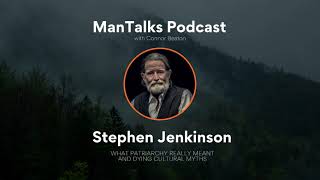
A long-form interview (Connor Beaton interviews Stephen Jenkinson) exploring cultural decline of shared myths, the role of elders, and what "patriarchy" originally meant. Jenkinson recounts a formative childhood hospital experience that shaped his sense of witness, argues that modern culture has deprioritized elders' remembering, reframes "patriarchy" etymologically as a functional "first fathering" (not a gendered power structure), and urges a practice of "faithful witness" or being "awake" to present consequence rather than future-focused solutionism. The episode closes with brief notes on Jenkinson's bardic music project and touring.
Chapters
Knowledge in an information drunk, confidence addicted culture like our own must be the life tested skill of gathering what is needed to make life without killing life in the gathering of it. Wisdom is the place where knowledge is fired, forged and annealed to become something of great beauty useful to the world. Human culture is made when that beauty swells into life and dies to nourish a time we won't live to see. Knowledge gathers wood and flint and gut. Wisdom conjures a cranky playable fiddle from the gatherings. People who have been bathed in the grief and love for life play some small magnificence on those fiddles together and sing their unknown songs and make human culture.
So those are the words of my guest today, Mr. Stephen Jenkinson. I was going to read you one or two more of his words because I mean they are prophetic. I believe in nature. So this is him speaking of the elder, the role of the elder in our culture. He says the work of the elder is determined entirely by what prevails and what ails a people at a given time. I really love that sentiment because in many ways it speaks to the time that we're in, that in some ways there is chaos in our current midst and that the elders that we are surrounded by are in are really in some ways entrenched in that same chaos. One more, one more, one more of his excerpts here. The future remains, as best as I can understand it, an allegation. Nobody's experienced it yet, so it's not clear that there is such a thing. But it's a useful conceit to get to take the pressure off the current situation, I guess. So in some ways this is what Stephen and I are going to talk about today. So Stephen Jenkinson is a teacher, an author, a farmer, an activist. He is the founder of the Orphan Wisdom School in Tramore, Canada, which is kind of out in the midst, out in the boonies in Ottawa. He's the author of four books that include Die Wise A Manifesto for Sanity and Soul, which I'm currently consuming and is absolutely wonderful and breathtaking. And he has a very poetic way of writing the award winning book about grief and dying and the Great Love of life. In 2015 he created Nights of Grief and Mystery with Canadian singer songwriter Gregory Hoskins with a five piece band. They have mounted international tours and released three albums, Most recently Dark Roads and Rough Gods.
Most recently a four part live stream speaking series, A Generation's Worth was presented in winter 2019, 2020. So Stephen has a very interesting one of the things that's not in his bio here, is that he spent decades in what he refers to as the death trade. And basically he was a therapist within palliative care. So he would tend to and visit and console people in their final weeks, their final days, their final hours. And he did that for years. And he got the sort of ins and outs of the medical system, medical religion, as he calls it. We are not going to talk about those things on this podcast today, although I do believe that Stephen will be back on the show to talk about some of these components. What we do talk about is a few things. We get into the dying cultural myths within our society, and he really talks about and is able to frame why our culture is in such a chaotic time.
And.
And it's quite fascinating the way that he frames it. So I really hope that you take a deep listen to that. And secondly, we get into the sort of essence, reason and origins of patriarchy and the need for patriarchy in some ways, which I touched on in a recent video about why Jordan Peterson is so popular and so hated. So we touch on that and talk about what those things mean, what they look like, how we can embody those pieces and what we need to sort of, quote, unquote, do in order to have a sort of quality of resurgence to the type of patriarchy that Stephen speaks about. Not the sort of framework that is constantly spouted within our modern culture, but the essence and the origin and the etymology of what patriarchy and patriarchy stands for. So I hope that you listen to this with an open mind before maybe writing any of this off. I hope that you dig in, take notes, challenge some of what he's saying. He's certainly open to that. And let me know what your thoughts are. Share this podcast episode with somebody that you know will enjoy it because it is ripe with wisdom and insight. So thank you so much for tuning in without any further delay. Please welcome Mr. Stephen Jenkinson. All right, Stephen, welcome to the show. How are you today?
How am I? Well, there was an earthquake here last night. There was a rupture in the highway. Trying to get into the studio to do this today, I had to run down the road in Tom Cruise movie style, find a taxi, and make it here in the nick of time. I'm great. How about you?
I mean, it sounds like quite an adventure. That sounds like quite an adventure. I'm. Well, I just recently brought a son into the world, which was. He was ahead of time, but on time, you know, in perfect timing. So I'm very Well, I'm running on adrenaline, excitement and joy and newness and just tremendous amounts of new experience. So I'm quite well.
I remember those days. I can hear it in your voice. Congratulations.
Thank you. Thank you so much. Well, we'll begin our conversation. I've interviewed hundreds of guests now, and I've asked them all the same question, and it usually derives a very fruitful story. And so I'll start with that, which is tell us a story about a defining moment in your life that has possibly made you who you are today.
Oh, boy.
Well, first thing to say is I don't really tend to exercise dominion over the ebbs and flows of my days. You know, it's the only humility I'm able to routinely achieve. Everything else is fitful. But I don't know how I got like this. You know, I remember things, but I think. And I'll give you a story in a second as soon as I come up with one. But I would say that the process of elimination has been my closest friend, really. I suppose in my 20s, 30s, and even into my 40s, I was unwittingly experimenting with a lot of other people's styles, abilities, inclinations and what have you. And I just ran out of all that. I, like nothing else, stuck. And what I was left with was the guy that you thought was a good idea to interview. So it's not a lot to brag about, but makes, you know, spending a lot of time with yourself bearable, I think. But, I mean, here's one. It just leaps, and I suppose it's a defining moment, though I was too young to know at the time, and maybe those can be the most compelling. So I'm three and a half years old, and the particulars I don't recall, except from my mother's point of view. But I'm hospitalized for something nobody can figure out, and within about a day or less, I'm diagnosed with spinal meningitis. Now, spinal meningitis in the late 1950s was, for an infant, was all but a death sentence.
And so I was dying, and this part I do remember very clearly. There was a moment, and I was lucky enough to recall it in vivid enough detail to write about it in a book called Die Wise, where in those days the visiting hour arrangement was heavily policed. I suppose we're back in those days again, from what I hear. But it fell to the nurses, like they didn't have enough to do back in the 1950s that they actually had to police and enforce the end of visiting hours. So imagine if you can, and since you're a new parent, I don't think it'll be a leap for you to imagine it, that your child's in the hospital, had been diagnosed with a life threatening illness which is going to turn one way or another, you know, presently, like in any hour, over the next day or so, and the mythical bell rings and you're obliged to return home and the nurse comes and basically shows you the door and you're obliged to turn your back on this one that just a few years before you brought into this world, never knowing, of course, if you'll see them again alive. I mean that it's just unthinkable at some level. For as a parent, I'm saying that.
But I do remember this distinctly that.
In those days they had that kind of safety glass in the door, in the middle of the door, so somebody could look in and out from the hallway. And I remember my mother stopping at the door on the outside. Once the door had been closed by the nurse, she turned and looked back at me through the window. And the quality of that look, I've never been looked at or to like that since and never expect to again. I was looked at as if I were someone who would not be seen again.
And I don't think that's ever left me. And I don't say that from a sort of traumatized point of view because it's certainly not the memory. When I think of it, I think of it really in wonder, almost in rapture at the kind of emotional depths my mother must have had to go to just to obey, you know, the visiting hour regime and how she made herself walk, I. God only knows, I don't know how she did it. And I came out the other side finally, but that has never left me. And when I ended up, you know, many decades later working in the death trade, although I don't say that I ever looked at anyone quite that way from a parental point of view, but I didn't know what it meant to be in the presence of someone that you would not see again. And I had some sense of how to conduct myself. And I would credit that moment and my mother and probably that nurse with entrusting me with that memory.
It's beautiful. I mean, certainly as a new parent, you know, that elicited a response in me that is, that's quite emotional, I think. You know, becoming a parent is. I was doing some writing on it the other day and it's, it's, I think it brings us to a precipice or a threshold past the threshold of meeting a group. You know, potential grief, potential loss, potential joy in a way that maybe is harder to access on an individual basis. And I don't know if that's true or not, if that's unique to me, but that's been my experience thus far. And so I am curious to circle back around to that look, because one of the reasons why I wanted to have you onto the show is. I mean, there's many reasons. I feel like I selfishly would enjoy sitting and speaking with you for days on end. But there's something about your message that feels like medicine to a part of me that I've recently been discovering. And I don't necessarily have words for that part, but I think I'll leave that there. And I think one of the pieces that is very important about what you're saying, at least to me, is that look that you received and that created that moment for you. So can you speak a little bit more about the importance of that experience in a world where maybe we've designed a culture to avoid it?
Yeah. One of the things you should tell.
All of us who are listening to it, myself included, is the power of witness. Maybe I could use that word. The willingness of each of us to entertain the possibility and the fact that the existence of another person leans heavily upon our willingness to acknowledge that existence. In other words, people, particularly in North America, no matter what we think, are not self made. Think, for example, of the word automatic or its noun form automatically, automaton. Now, this is a word that's used, obviously, to discredit habituated people and circumstances and so on. The actual word, though, is much more odious than you might imagine. The word is two Greek words. The first one, first part of it, sorry, if you look it up in the dictionary, it usually says something very close to self moving the first word. I agree that that's the proper translation of auto. It means it's Greek word for self or one of them. But the root word of the second part, the mat part, is ma, which anyone listening to us now instantly recognizes as mother.
So the actual meaning of automaton means self mothered, which is clearly a crime against nature. So with that in mind, I would say that the story I just told you is a kind of deep running tutorial for me in the consequences of looking at someone, and let's say, the rest of the story, the consequences of withholding that look are refusing to give that look and thereby signing up for a whole cascade of consequence none of which we suspect.
My guess is that many people listening now would think that not looking at someone really has no consequence because you didn't do anything. But life is full of things you didn't do. Of course it is. And the consequences that ensue from all the unsaid things as well as the said ones and all the undone things and all the unmeant things and so on. These are not gaps in the historical record. They are part of the historical record, personally and culturally. So I suppose I revel in that little vignette, probably at my mother's expense. Because it gave me the chance to know what it meant to be on the receiving end of someone's willingness to really see you.
And what it does, among a host of other things, is create in you a sense of occasion and of merit, believe it or not. In other words, there's something in the depth of that look that translates internally as you are, in some fashion or other, worthy of being on the receiving end of such a thing. And, of course, that's a subset of love that I'm describing. And this is one of the principal ways, I think, that we learn love by being on the receiving end of it way before we were ever on the giving end of it. And if there's enough of that, then the giving, although it's an adventure at the best of times. Trying to love somebody with that skill in your back pocket, the skill of being able to be loved, which is a different skill entirely from the ability to be loved. Those two things together are a remarkable partnership with which to.
Let'S say, both burden and recognize the world and the people in it. And not just the people. I mean, while we're at it, let's exercise our animism to the full. And imagine that there is some consequence, perhaps for the rocks, the trees, the animals, the sky, the planets, and the rest of the story. For our willingness just to see them, not to pass judgment, not to, you know, gush about what they make us feel, because that's not why they're in the world. But all of that together, maybe we're on the. We occupy a minor God function there temporarily. Our willingness to see the world might be as close as we can come to making a world. And we practice with each other.
And the world benefits. We withhold this from each other. And my guess is the world suffers, too.
Yeah, I agree wholeheartedly, and I appreciate you unpacking that. And just being able to put a different quality of experience to it. I feel like it dovetails A little bit into one of the reasons why I actually wanted to speak with you. One of the many reasons why I wanted to speak with you. I've dug into a good amount of your work and really curious to get your thoughts on a number of things. But for the sake of brevity, I've really tried to distill it down into maybe one overarching topic that we can get into, maybe two if we're lucky. But to me, it feels like we're in a time, we're in a place where the cultural myths and archetypes that sort of hold the fabric of our society and cultures together are somewhat tearing apart and dying. And it sort of seems like maybe I'm incorrect in this, but I'm curious to get your thoughts. And it sort of seems like for me, you know, a lot of the work that I do is with men, with fathers, with husbands. I see a lot of this in the perception of, and the absence of the void of the father and the viewpoint of patriarchy within our culture and the role that men play in some ways. And so I was really curious to get your thoughts on this. I heard you do a little bit of a conversation on a different podcast specifically about the patriarchy, and it was fascinating to me. I really appreciated your perspective. But maybe I'll just pause there and sort of see, like, what is your take on that? Do you feel like we are in that sort of time and place where the cultural myths and archetypes are sort of fraying? And secondly, what role? Maybe not what role, but how do you see patriarchy and the roles of fathers sort of fitting into that decomposition?
That's a two for one question.
Yeah, yeah, I'm cheating there a little bit.
Well, do I think things are fraying? Jesus, I hope so.
I mean, I really hope so.
And I don't say that frivolously. I. I say that because.
This is the vantage point for what it's worth of somebody in their mid-60s.
And I. I don't think that immediately.
Or inevitably confers any kind of merit on anything somebody of my age has to say. Maybe the depth of the years appears in something I say or somebody my instance, but just as likely it doesn't. Just as likely people my age are as much a casualty of the fraying.
Of the times and in no way.
Are inured by from it or protected or defended from it. They may. In fact, the point I tried to make in a book called Come of Age about this very matter, is that certainly older people, along with Very young people have become in your lifetime something I call the sentinel species of the Anthropocene age. Very briefly, since we're dealing in brevity here today, it goes something like this.
It's very clear that there is a rising diagnosis and incidence of neurodegenerative disease amongst old people, older people, not exclusively, but predominantly. Another way of saying that, with a little bit of mythopoetic nuance, is that people's capacity, older people's capacity to have recall is being compromised at the fundamental metabolic level, not at the level of social discourse. At the fundamental anatomical level, too. That tells me something's going on. It has a parallel or corollary amongst very young people who are enduring rising incidences of the diagnosis of attention Deficit disorder. A way of restating that would be kids are deeply challenged now to be persuaded of the merits of investing themselves deeply in paying attention, which is another way of saying, of caring and investing themselves at the level of care in the ordinariness of an ordinary day. They themselves also a sentinel species of the Anthropocene age. You put these things together and it seems to be telling us something that it's not clear to me most people want to hear about. And it's this. Older people's ability to remember is not relied upon by anyone else, any other generation anymore. Your ability to remember is being compromised by the circuitry that you and I are speaking back and forth on right now. And you may not believe or imagine or be concerned about this fact, but I can promise you that by the time that your. It was a son that was born to you just now.
Yeah, it was. Yeah.
Okay. By the time. The time your son is old enough to make decisions on your behalf, those days are coming. By that time, it's not clear at all that anyone will have anything more than an incidental functioning memory.
Why not?
They won't need one.
Why not?
Because they're surrounded by gimmickry and gadgetry that does all the remembering for them. That's why. And it won't take many generations for that function to come into some kind of eclipse. And we're already getting the early warning system that older people's capacity to remember is not being employed by the people around them, not as elders, not as repositories of any kind of cultural wisdom or even. Even record. Forget wisdom, just record.
Right.
And kids, well, the rate of change is happening so explicitly and rapidly, relentlessly, ruthlessly now, that it seems to me that kids are expected to invest themselves in the everyday rather than encouraged and nurtured, tutored to do so. Because it's. If there were ever a time for survival of the fittest, it wasn't Darwin's time. It's this one. It's this one where, you know, people don't even have time enough to be. Belong to a generation, because a generation takes too long to unfold. Nobody's got the time or the give a shit to invest in it. So what you have instead is decades.
Perhaps people of your age invented the notion of a decade as the unit of allegiance, not a generation. Right. And a decade means you feel a kinship with people. Basically five years on either side of you, not 15. 5. A generation used to be something like 30 years. But nobody's got the time to be generationally committed to people 15 years on either side of them. I'm quite sure that you might look at somebody 15 years older than you and decide without really realizing it that they occupy something of another planet from yours as well as somebody 15 years younger than you. The language, the stylings, the music, or they're all obvious examples, but there's something subtler at work and more calamitous at work. So that's a very brief overview for the first question. The second question, the one about patriarchy. Well, I trust the language on this matter. I trust the English language. I seem to be in a minority in that regard, But I trust etymology in particular. And the etymology of the word patriarchy very clearly instructs us that we're misusing the word in a vehement and disrespectful and frankly, frankly injurious fashion. Now, I am not saying by this that there's no such thing as the things that are attributed, to quote patriarchy. But you yourself use the term the patriarchy as if it were a freestanding kind of social construct that can be isolated by talking about it that way. And so it can be dissected and bisected and refracted and finally demolished and perhaps recycled, or better still, refused. The word patriarchy actually means this. The first word part of the word is not the word for husband, it's not the word for man, it's not the word for male, it's not the word for masculine, it's the word for father. In other words, it doesn't refer to an identity, it refers to a function. Fathers are as fathers do. See, that's where the notion actually comes from. The second part of the word, this would take a long time to do justice to. But very briefly, this is a Greek word that we find in the word archery and arch, the architectural form in the word architecture, archetype. I think you used the word earlier. All of these carry the same word. And what does it mean? When the Greeks entrusted us with the word, it meant something like this. That which stands under in a foundational way to sustain every visible thing that's above the ground. The arche is that which is below the ground, literally upholding all the known and visible world and all the ideas contained in it. That's who elders are, and that's what the elder function is. So you restore the word to its original unity. And patriarchy means the first fathering. And it's a cultural attribute. It has nothing to do with gender specificity. Excuse me, specificity or exclusivity. It has everything to do with what's recently become of you. We could ask this without making it too personal for you. How did you become a father? And the answer is a child occurred. And you're alert to extraordinary consequence as a result of that, most of which you have no control over. You have no choice in the matter. To use a word that I've coined some time ago, you have become a parentling a new one. You barely know how to fly. Your feathers aren't even out yet. And yet, of course, the expectation of the culture is that you're a full blown father as a result of the advent of a newborn in your house. But you have a sense already that the learning in this matter is immense and will take some serious time.
To.
Do justice to what's come to you. Obviously, I'm almost speaking on your behalf here, but I'll stop in a minute. Of course, your shows, you can respond as you see fit. So patriarchy is where we come by our understanding of what it means to father. So when you destroy and demythologize and deconstruct patriarchy by virtue of the things attributed to it, the consequences for your capacity to father, I think, border on the unspeakable, to the point where you as a father are discredited by the language that's applied to patriarchy. And if fathers are discredited, is there any reason to believe that mothers won't, in some fashion or other, endure some unintended and not very obvious consequence for that kind of derision? And I think the answer is this is already underway. And so ironically, and I know I'm leaving a lot of subtle things out here, but this is the nature of trying to talk about something. But it seems to me that the cultural fraying that you were talking about can be attributed in part to the uncritical employment of the word first fathering to characterize a degree of gross privilege and historical, you know, colonialism and on and on and on. And there are, there are actually people in the story of discreditation that are corroborating, what did Reagan used to call it? Collateral damage. That's the word. There's immense amounts of collateral damage now in the, in the diatribing that's going on about allegedly, you know, social justice work. And my invitation to people who are troubled or offended by what I've said is consider employing another word, a word that doesn't require the assassination of a gender to prove a point.
So well said. I would agree wholeheartedly, again with all of that. And I mean, I don't think that your statements about my entry into fatherhood are, are off base at all. I do feel like quite the fledgling. And so that's, that's, that's not, no, no issue there. I have no qualms with that at all. And I, you know, I do think that part of the work that, that I do around working with men who are going through whatever they might be going through in their lives, part of what I see consistently and almost on a daily basis is that fallout that you're talking about, the fallout of constant messages from.
Women who have sort of suffered or endured the consequences of what you're speaking of, that we haven't maintained that this, I don't even know what words to put around it, but that we haven't maintained a sort of honoring within our own culture, whether that's as men or as women or whatever culture we want to wrap that in, that we haven't maintained an upholding of fathering in some way of that patros. And I think that it's sort of bleeding out into many different avenues. I mean, we can see through the research, if we wanted to go there, we can see it through the research that, you know, a lot of the troubles that children face, you know, those, those children often come from fatherless homes, whether it's runaways or addicts or, I mean, you know, the list sort of goes on. Dropouts from, from school. Much of that comes from a disconnected, disinterested, unsupported, un. Upheld father figure, whether he's, you know, physically present or not. And so much of the work that I do oftentimes is within that realm of helping those navigate through those waters. And I'm curious for your perspective. Maybe curious isn't the Right word. Maybe the right word is actually more sort of like hungry for your perspective on. Outside of that recommendation of, you know, us finding a sort of different word or lens culturally to be able to have these conversations. What, like, what direction do we move in, you know, what role do we as men play within this conversation of upholding one another as fathers? And is it. Is it a cultural piece? Do things have to die away? You know, I had Francis Weller on the show previously, who I really respect and admire as well, and he talked about us sort of culturally entering into the negredo, right into this sort of the blackening, where things fall apart from an alchemical perspective. And I'm sort of left wondering, are we as men, as fathers, sort of left to watch things unfold and fray apart further, or is there action in some way that we can take? I know that's sort of a very logical and linear question that's pragmatic and asking you for almost to give some form of advice to the men that are listening to this. But I can't help but pose the question.
Allegedly it's a guy thing, what you just did, but right. Not exclusively, though.
Yeah.
Well, I myself don't traffic in solutions. First of all, there's plenty of them out there. Most of them aren't going to be worth much when they're applied to the circumstance. There's no sense adding to them. But more importantly, there is a function that you alluded to early on in the question that I have come to treasure. I learned it deeply when I worked in the death trade years ago, and I came to refer to it this way. Crafting the ability to be a faithful witness and to craft a language in particular that speaks as if what's happening is happening. And the problem with solution mongering is that the circumstances as they actually are, are often the first casualty of the addiction to what do we do next? And I go further and say, you know, the addiction to fix is one of the things that got us here. So at the risk of using a barnyard epithet, my recommendation is slow the down.
And you'll be just stymied by how difficult that will be, because the world, as the one that you and I have been referring to, and that, frankly, we are probably the products of, has no interest in slowing down, has no. Sees no merit in slowing down. Accelerated rate of change is what we mistake for things getting better. So I think one of the fundamental responsibilities of a real and radicalized citizen of a time and place like this is the willingness to occupy the prophetic function by which I mean that it is the nature of prophecy to have nothing to say about the future. Okay, that's a matter of inference at best.
What do I mean by that?
I mean that prophecy's principal obligation is bearing witness to the minutiae of the present moment, all its turmoil, all its trouble.
It's not to say that, that it becomes nothing more than a full time job for every living person to report fatesly on how drastically bad things are. Okay, you can take a break from it. You can enjoy being alive and remind yourself that you remain alive, for example, not as an antidote to prophecy, but as the unspoken other half of prophecy. In other words, there's got to be a reason for bearing witness how difficult, how troubled and stymied our time is. There's got to be a reason for it. There's got to be a purpose beyond simply faithfully reporting it. My answer would be there certainly is. It's called being alive. This is my effort to try to translate the responsibility of being alive. Finally, we have a word in the English language which is used routinely.
In these matters. It's the, the word to awake. Awake as an adjective. We all think we know what it means because we tend to use it as the opposite of asleep. Where if we're being slightly more sort of poetic in our nuance, coming to some kind of alertness, let's just say not being easy to be the subject of conspiracy or the victim of conspiracy, things of that kind. And you investigate the words. It's amazing, amazing the tuition that it gives for free. And it goes like this. The, ah, the, the letter A in front. Because this is an Anglo Saxon word and not a Greek or Latin word. It doesn't mean that it doesn't have the negating meaning that so many words that begin with they have in the English language. It's a preposition and it means something like of course pertaining to. But of is a better translation. And then the root word. Well, we use this word in contemporary English with some frequency. The word wake. Generally speaking, it appears in two contexts. One, the consequence that ensues from your death. Ideally if you're Irish or Italian. Failing that, hopefully you have enough raucous and rowdy friends that can mount some kind of event subsequent to your demise. That's awake. The other meaning of the word is the thing that happens when you make your way through water. The thing that emanates out behind you as you make your way through water and through life. Of course, it's no less true Then reassemble the word. And what is the condition of being awake? It's the condition that I was meaning by the term faithful witness. It literally means to be gathered into or of the wake of consequence intended in otherwise that emanates from everything you do, everything you don't do, everything you say, everything you don't say, and the list is quite long. The condition of being awake is the condition of being encumbered, not of being enlightened. And that's my advocacy. This is what I would deeply recommend as an alternative to trying to have a better time of it personally or just trying to get by.
Yeah, okay. Well.
That required a large inhale for me to just sort of absorb.
Absorb everything that you just took in, gave. Gave out. Sorry that I just took in. And you know, I feel if I could, to just rephrase it for my own sake of remembering and, you know, you can sort of confirm that hopefully I got some of. Some of this accurately.
But it almost sounds like to me that what you're advocating for is a letting go of sort of preaching or prophesizing about what is to come and focusing intently and vigorously in on the present and all that it entails and holds. And to do so, to speak about it, to be an embodiment, maybe not of it, but to be an embodiment of the. Speaking of what we witness. Is that roughly accurate?
Yeah, it's very good to be an.
Occupant, not an owner.
You see, when you're trafficking in the future, this is what hopeful people do. See. And the great undoing of hope is that it requires the future to legitimize anything you undertake. Exhibit A. You and I are talking right now. One of the things that's not required of either of us is hoping that we're talking right now.
Right?
We don't have to hope that we are. We're doing it instead of hoping that we get to do it or hoping that we're doing it, or hoping that we're pulling it off, we're actually doing it. Hope would get in the way of being able to do it. If I kept saying to you, I hope I'm making sense. I hope this is clear. You hear that? For the third time you go, enough already. It's less and less clear every time you say it kind of thing. No. So we don't need hope. Adults I'm going to live here don't need hope to craft the beginnings of a better day. They need the willingness to fully occupy the troubles of the times and to Become articulate so that their particular kind of eloquence can be an eloquence that serves the trouble, not the alternative to the trouble. Only if you think about what you reserve your eloquence for. It tends to be the thing you like, that you approve of, that you benefit from and feel good about. In other words, eloquence is reserved as another kind of approval, but that's not what it's for. Eloquence, if you happen to be gifted with it, is a moral and political responsibility of citizenship that by virtue of being able to do it, other people experience the capacity to see clearly. This is the very least of your obligations to your fellows. And this is why, you know, we tend to throw heroes up the pop charts, as Paul Simon said, in hopes that one of them will do that for us. What they tend to do instead is continue to illuminate the inner landscape. And that's not the landscape I'm talking about now.
Well, I appreciate that. I think the sentence that you said towards the end there about the responsibility of the adults as us, as adults.
Really.
Connected with me deeply. And I feel like I'm going to go back and listen to that a few times over and over and over again because I feel like in some ways it really captured the essence of a weight that I have felt within the work that I do. Personally, I can only speak for myself. And so, I mean, I'll just thank you from myself. You are acting in accordance with what you are saying right now.
Certainly because of the impact that that's having within me. And I also want to be respectful of our time and your time. And so as much as I would love to take this conversation on for another few hours, I'll have to sort of wrap us up here. And one of the things that I did want to just sort of leave us off on is outside of the work that you do, outside of the work that you've done, outside the books that you've written, I've really been enjoying your. Your music, which I stumbled across on your website. Dark Roads, Rough Gods. I know that you have a tour, hopefully impending. I would like to. I would like to come and take part in that in some capacity. So can you tell me just a little snippet about the, you know, what the music sort of encapsulates for you and when people might be able to come and see you.
Oh, the second part, I know no.
More about that than you do. We'll just have to see. Yeah, but it's, you know, it's not. It's musically enhanced. But you wouldn't call it music. You'd probably call it something closer to bardic storytelling.
That'S not overly careful with the prevailing sentiments and feelings of the age. In a nutshell, it's a bit anarchic. But that's another secret way of re establishing an old arche by being anarchic for a while, not for the sake of it, but deciding that it's enough already with the therapy and it's enough already with trying to leapfrog over the things that trouble us so that we can just have an easier time of it and maybe the adults among us can occupy the obligation to stand and deliver in a time of trouble so that the people who come recognize the trouble and in so doing experience the possibility of proceeding otherwise. That's what it is.
Wonderful.
Wonderful. Well, thank you so much, Stephen, for your time and your words and your wisdom today. I deeply appreciate it. And you know, I would, I hope to have you back on the show at some point in the future just to, just to sort of put that out to loop back around to what we were talking about before. But I hope to find myself in the present moment with you again speaking to you.
So, yeah, I hope the same thing. I appreciate the time today and your, your questions and, and your invitation to, to wonder aloud about these things. You please take care of yourself and, and blessed your new family.
Thank you. Thanks, Stephen.
More from Connor







How to Raise Strong, Unshakable Boys in Today's Culture, with Dr. Shefali Tsabary



