Steve James - The State And Complexity Of Masculinity
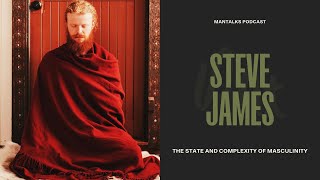
Connor Beaton talks with Steve James about what men actually worry about: meaning, relationships, money, fatherhood. James pushes back on sweeping claims about masculinity and instead traces specific patterns, the paralysis of too many dating choices, and how grief and love tangle together. He walks through embodiment practices like movement and mindfulness that actually work.
Chapters
All right, Steve, welcome to the mantalk show.
Thank you, Connor. Thanks for having me.
Yeah, such a pleasure. You know, I've heard some wonderful things about your work. I've consumed some of your ideas and some of the content of previous interviews, and I appreciate your perspective. So I'm looking forward to this. Looking forward to this conversation. So I'm going to start off with the question which threw you a curveball in the beginning before we jumped on, which is tell us a story about a defining moment in your life.
Yes, it did throw me a curveball when you did most of you give me the heads up before. A few minutes before we started, I was thinking, gosh, because defining moments, you know, as we were saying, very often.
Very personal, aren't they? And.
You know, you're talking about my podcast and I was interviewing recently a memory expert who's also. My podcast is Groove Viking Podcast interviews all kind of people, meditation scholars of meditation and contemplative things and so on. And this memory expert has very unusual meditation practice, which is he memorizes large passages of Sanskrit and recites them as his practice. Really fascinating. Anyway, but as we were talking with him, as I was talking with him, we talked also about memory, and he was talking about how when you tell a story.
It changes one's memory of it. There's a sort of in the requirement to reconstruct a story, it becomes something other than was before, and it's somewhat redefined. I think there is a case to be made for I know that there's a trend, I think, isn't there, to disclose all one's most profound and personal intimate moments. And I think it can be a good learning experience for others to. To see that. And I think it can also perhaps be used more cynically to engender trust, the kind of vulnerability move, in a way. But I think an unintended effect.
Is that it can in a certain sense.
When you take something that's personal, private, an interior, and you put it on public display, I think it changes it, basically. It makes it solidifies it in a way in the telling of can do that. But anyway, yeah, so I was thinking, gosh, what one would say, here's a funnier story. In my teens, I had a period, brief period of being rather got caught up a little in fundamentalism, Christianity. It's kind of embarrassing to say, but you asked for a defining moment. So I think by nature, by definition, it's going to be a bit embarrassing. And I was raised in a sort of Catholic context, but my mother didn't like the doctrine side. So we never went to the doctrinal trainings that the children go to to be indoctrinated with the tenets of the religion. She had this idea of a private faith. So you go to the Mass, and I was an old boy, actually, and you sort of take it as a ritual, as a contemplation to connect with God yourself or peace or whatever. Really quite open in that sense. So very open, contemplative oriented.
Experience of Catholicism, actually, which I think was excellent. But then of course, I came to my teens and as teenagers often do, one's looking to individuate oneself. One's looking for, you know, right and wrong and what's. What's the meaning of life and what. You know, how does the world work? And I think teenagers can be a little prone to black and white thinking because at that age we lack the nuance of life experience, don't we? So you come across a good idea, perhaps the first good idea, coherent presentation of something. And it can be very compelling. The certainty. I think the certainty at that age is very compelling. And Eric Hoffer wrote this marvelous book called True Believer. And he's talking about ideologies and religious movements and so on and analyzing the structure of how it is that people of all types and all intellects and all strata of society can be caught up in such movements. It's a very fascinating study. And he said that the appeal of a doctrine, or the effectiveness of a doctrine is not in its accuracy, but in its certitude. In its certitude, the degree to which it can sell or grant certainty relief from ambiguity and.
Uncertainty. I suppose there's something very appealing about that. And it doesn't. It really doesn't really matter that much if the doctrine is particularly accurate or well reasoned or argued. Those things are less important, the more important thing. That's why we have to be trained to think critically, because we're prone sometimes, I think, aren't we? People, I mean, in general can be prone anyway to being caught in certainty traps. So anyway, that's all sort of my excuse, I suppose. Eventually I sort of grew out of it, actually. Did two, three years. But I was a bit intolerable for a couple of years at parties, certainly, you know. And so I was. So I was walking along the street and I had this habit, which I had since I was quite young actually, before all that fundamentalism business, which was often enough I'd see a homeless person.
I would give them a coffee or this sort of Thing I just had. I don't know where I got that idea from as a kid, but I would do that. And I was walking along and sure enough, there was a homeless person there. So I thought, okay, I'm going to get this person a coffee or a tea or something like that. So I went into the coffee shop, came back out, and I had the coffee and I gave them the coffee. And then that was it. That was the end of the exchange. But then I did another step. I said, do you know why I gave this to you? And he said, why? And then I lied to him. I said, because Jesus loves you. I said that. Right.
Which wasn't true. That's not why I did it. But then I watched him, his face transform into a performance.
Towards the religious do gooder. You know, he learned. It seemed to me. It seemed to me that when dealing with such a person, one has to act a certain way. And he had a whole routine how you deal with someone who's religiously sort of motivated in that sense. And it was sort of horrifying to watch him dehumanized like that and have to dance to this, you know, this tune that he's presumably had to dance it before. And of course, that was horrifying to witness that. That consequence of my.
Deceit. But the other thing that was funny was that the deceit was really clear. I didn't give it to this homeless person because Jesus loved me. And I wanted to sort of pass that on. It was actually because I loved him. I felt compassion and care and human connection with him. That's why I gave it to him. And so in discharging what I felt was my religious duty, I departed from the basic motivation of human. Human kindness and saw the effects. And that really stuck with me. That really stuck with me. The difference between. Yes. The discerning of those different motives and the effects of that kind of an action. Yeah.
Yeah.
Beautifully said. Well, thank you for. For sharing that. That moment in that period of your life. And I do think that we seem to live in. And maybe this has always been the case, I'm not sure. But we do seem to live in a period of time where vulnerability has become a sort of staple nutrient of consumption from society. It's sort of like a barrier to entry. If you want to be on social media, if you want to gain acceptance and validation, if you want to gain power in many ways, then vulnerability seems to be this. This sort of like tool and resource, as you said. I think you said it can become cynical or it can be used for sort of like, almost like menacing means.
But so, you know, culture does seem to have a. An interesting relationship with that. I'm going to shift gears because one of the things that I wanted to talk with you about is I do want to talk about the path out of our thoughts and into the body, or at the very least talk about some of your methods because you do a lot of somatic work. And I think that there's a lot of men that will benefit from that and have benefited from that. But I want to first start with a broader context of how you see the state of men in our current society. And I'm going to leave the question fairly broad and vague, and I'll let you do with it and take with it as you will. So what do you see as being the state of men within our current. Current culture? And what do you think that men are being asked to do, Asked to see, asked to build either within themselves or within the world around them? And. Yeah, well, I'll leave that there.
Sort of a broad and very large question.
I wonder if we might narrow it down.
I'm reluctant or hesitant to comment on men in society as a. As a general whole.
Actually.
I'm a little reluctant to do that because.
My experience of men tends to be as individuals or small groups. I don't tend to have much contact with this sort of body of general men in society, in which society in general, and I think even, you know, even in.
The countries in which we live, of course, we live in different countries, but we share. I think our societies share a lot in common, of course, but even within those, there are subsections and layers, aren't there? There's all different kinds of groups of men and individual men. I'm reluctant to do that. I'm skeptical of.
Of that. However, I think there are valid means to talk about that. Statistical analysis. We could do statistical analysis of various different trends, polling of various kinds. And there are people who are better at that than me. They can tell you, well, this is the divorce rate, this is the male suicide rate. This is these things. I think that's an interesting way of getting pointers towards what might be societal trends. But of course, sometimes statistics can be misleading. One might think that a univariate analysis of a certain statistic can be misleading. We think, well, this differential here between these two groups is due to their being in different groups. But there may be other factors at play.
So I think even statistics have to be taken within some sort of a broader analysis, and they can Lead the way or hint the way or they don't tell the whole story. Is there something more specific or maybe that's enough of an answer?
Yeah, no, no, no, it's, it's, it's good. I had a, I had a feeling that that was the path that you were going to take and I, I, I appreciate that. And the reason why I asked the question in that way is because I, I do think that it's important to not have a sort of broad brush stroke. So can you just say a little bit more about why you don't want to or why you think that it's not.
Beneficial to sort of talk about men as a whole or women as a whole society and culturally? Because I do think that that's happening quite a bit right now. You know, I do think that, that there is just this sort of over generalization of men or of women within our culture.
Yeah. I would just be curious before we sort of drill down into a more nuanced question. Why do you feel it's important to not go down that path?
Well, I, I said I'm reluctant to do it. I don't think it's necessarily always a bad idea.
To do that.
But I think it's probably usually a bad idea.
Well, it depends, you know, who's, who's speaking. You know, is it somebody who just feels a strong conviction of an opinion based on anecdotal evidence of their own lives and you know, their friends or what they're, what they've seen on YouTube or on the television and they get in a sort of, they take a certain position, they get. The world seems to be this way to me, this idea. The world seems to be this way. Well, the thing that seems to be happening to men is this, that and the other. Well, maybe, but the problem with, I mean, of course we have to navigate the world as it seems to be to us, but we having a bit of epistemological humility that how it seems to you is of course, all you can really do in navigating a lot of your life. But it doesn't mean it's not especially accurate. If one wants to make the sort of pronouncements on the scale of, say, all men, I think one needs to have a better basis for that. One needs to think very deeply and very seriously about that kind of a pronouncement. It can't just be based on what seems. I mean, I know people do it, but I think it's not so wise to just what seems to me to be the case.
I think it's an important subject. You know, this group of men is. Contains many individual people.
And it's not just a sort of. A sort of ideological chess piece. So these individual people have their own lives and so on. And one has to be, I think, respect speaking into people's lives like that. And those people are. Those men are associated with other men and women and all kinds of. They're embedded within relationships. And so I think one has to be cautious.
Before making grand pronouncements that are likely unless one's done some really deep thinking and some actual research that takes one beyond one's assumptions. One's likely just to be sort of repeating what one's picked up somewhere else. A mouthpiece of somebody else's idea. That happens a lot, it seems. One imbibes it, absorbs it. It feels so right. And then we talk it as if it's our truth, but it's secondhand. So I'm reluctant to. First of all, I think the scope is so large. Men, society, it's so large that I said I'm reluctant to do it. I'm not saying nobody should do it. I just think that I'm reluctant to do it. And of course, what's the downside? Well, I've just listed some, I think. I mean, there are many downsides of talking at the group level, but, you know, if you cross the road, you might get hit by a car. So just because it's a downside doesn't mean you shouldn't do it. It just means that you have to be aware of the possible pitfalls. I think that's wise, isn't it?
So when it comes to some of the men that you individually see and interact with, whether it's in group or on a one on one basis, what are. What are some of the things that you see those men being confronted by in their life, needing to sort of tackle what the. Whether that's on a spiritual level, a sort of unconscious, mythological level. What do you. Do you see any patterns happening within the men that you interact with?
Yes, I think.
If we limit it to that sample size. Yeah. It seems to me men are.
Many men that I talk to.
There are some specifics. They're dealing with the basic sort of human. Human needs.
Meaning, what's the point? Relationship.
Should I have one? Increasingly, that actually is a question. Not how do I get one, but should I have one? Which is kind of interesting. You're nodding there. Perhaps that's something you've noticed and, you know, justify to me Why I should, you know, I think I want to, but my analysis tells me it's not, you know, a good deal. Right, or something like this. Some guys say that. I've heard that, which is interesting, or now I'm in one. How do I do the right thing? How do I be a good person in this relationship and how do I, you know, navigate that? I want to understand it more so I can do it better because, you know, for my partner, I love my partner, whatever it is. How do I. About being a father becomes very important. Then how do I become a good man in terms of being a father? That seems very, very important. And lots of people.
I think, are really thinking hard about that.
How should I navigate the economic landscape? What sort of job should I do? How should I spend my time, and so on, so forth. I don't get too many guys wondering about how to find their purpose that only say that sort of thing if they've heard that somewhere else. Generally, it's more like, how can I do something meaningful, meaningful work? How do I find an outlet from my energy? Because, of course, life is like pouring out. You're just constantly pouring out your life every day. It's sort of running out, you know, like the sand in the hand sort of thing. So given that it's pouring out.
How can I give that to something greater? I think that also ties into meaning or something meaningful, useful. A lot of men talk about that, you know, some men are worried about health, of course, as well, money, financial management, things like that. Some guys, health, you know, and so on. So I think it's all these sorts of basic sort of things, and depending on who they are and their upbringing and their cultural context and various other factors. There's some variation on those themes, but it seems to be health, wealth and relationship and family and meaning, these sorts of things.
So I want to return to the relationship component, because I've heard that as well. I think increasingly I've noticed a rise of men who are questioning whether or not they should be in a relationship or whether that is whether a relationship is for them. For a number of reasons, right? I mean, financial reasons and political reasons and.
Legal reasons. You said, is it a good deal? I think that there's a lot of men that have seen.
Their fathers go through something or read stories and forums online and that kind of stuff. And it sort of embeds this question of should I? And is it worth it? And I'm curious to just sort of get your take on that. Do you think that that's A byproduct of. Well, what do you think that's a byproduct of? Like, are more men being drawn to a monastic way of living or is it something to do with the changes, the sort of like climate changes between men and women?
Just light questions today, only light questions.
No, this is great. I think I'm very pleased to be thinking about things like this with you.
I've heard a lot of.
Hypothesis about it. The answer is, I don't know. I think there's always been something of that. There's always been something of that. That's why we have things like.
You know, the monastic, you know, path or whatever, or even, even career or military service and so on, so forth, you know, so.
But probably something. It's a bit like.
Here's a positive way of saying it, okay? I mean, I know we could list all the usual analysis about it, but maybe a positive way of saying it is as choice.
And gender roles you could say, open up for better or worse, you lose something.
You lose the template, you lose the autumn, you know, the sort of.
This is what a good man is kind of thing. You lose that.
Because some of those things become not just province of men. Right. So anyway. But what you gain is choice. So I think with more choice comes more.
A burden. I think of. There's a burden that comes with choice. Is it? They say.
Freedom isn't Spider Man. Freedom comes responsibility. So, you know.
Great, yeah. With great response.
Yeah.
With great power comes great responsibility.
Right, okay, well, then freedom. I think one, you know, if you can do. If you, if, if there's more options, theoretically anyway available to you, which is a, you know, this is a very positive spin, but I think. What.
May as well make lemonade out of lemons, you know, so if there's someone has a positive. I mean, you can think very depressed about it. Oh, I don't know what to do with my life. Well, that's. Yeah. But the positive of that, you could say, is that there's quite a bit of freedom there, but it's very hard to navigate and to figure out what to do next. That's especially as you're young, growing up and so on, because you don't know very much. I think this might be a good idea. I'd like to be an astronaut, you know, I'd like to be a superhero. I'd like to be a spy, you know, whatever, you know, you don't really know what you're doing. I wanted to be so many things growing up. I wanted to have My own karate school, you know, at one point, and I wanted to be a priest for a hot minute, which I think, you know, all altar boys think about that. I mean, I didn't know what a priest did. I just liked, you know, the walking around with a candle and, you know, I wanted to do so many different things, so. But, you know, that's what kids do. So perhaps it's something to do with that. You know, there's a choice there that you can, you know, I mean, that's a bit of a dodge of an answer, I must say.
I don't know. We want to get, you know, what do you think?
No, no. I mean, I don't think we need to get super into the weeds, but I do think it's an interesting experience that a lot of men are having, you know, as. As relationships begin more and more online in the digital realm, you know, something like 42% of relationships start online now. I think as. As that migration happens, there seems to be a technological shift where a lot of these dating apps are constructed in a way to give women the primary choice. And I think what has been interesting is that you see, you see some of the selection metrics coming out of these platforms like Tinder or Hinge or, you know, whatever the, whatever the platform is. And you have, you have something like, you know, I think it's the majority of women are choosing 10% of the men, and then you have men choosing 50 to 60% of the women. And so you see this sort of like, selection dynamics starting to show up within the data, within how people are choosing one another online. And I think it's becoming. I think a lot of men are becoming maybe frustrated. That might be a generalization, but I think a lot of men who aren't in what would be classified as maybe an upper echelon, like the top sort of 5% of what women deem men to be as valuable.
I think a lot of men that are sort of like average everyday guys are starting to see that maybe it's not worth as much of the effort to put into having the perfect dating profile photo and the perfect bio and all those types of things, and instead to just go and, and go and live their life. So I see a lot of men sort of shifting away from trying to really go and date as much as humanly possible and into developing themselves right into the questions that you were sort of proposing before, like, how do I make meaning in my life? It's almost like a lot of men are feeling into a sort of void of meaning in their life and they're moving in search of that question versus in search of a partner. And so I, I don't, Again, I don't know if that's 100% true or not, but that's just my observation is that there's this sort of pull towards, I want to find meaning in my life and maybe a partnership will happen after I find a deeper quality of meaning in my life. So. Yeah, well, I mean, I'll, I'll let you just comment on that and then we'll, we'll move on past this because I want to get into your, your work and your teachings.
Yeah, I expect that's got something to do with it, perhaps, you know, of course it can. Yeah, it can be very nihilistic, I think, and dark. If you really want to know. Of course, you know, I'm sure, Connor. But if you really want to know why. What's behind these ideas, The MGTOW movement, Men Going their own way movement elaborates a lot of ideas. Now, whether or not the ideas are true isn't the point. The point is that there are strongly held convictions that are.
Resonate with certain people. Yeah. And perhaps for some they're on the wrong end of that distributional curve. But also, you know, a lot of the.
Relationship itself, I think is up for grabs, up for discussion. What is the point of a relationship? This is generally, and I'm talking about men necessarily. Anybody in relationship with anybody romantic. I mean, is it for family? Well, maybe. But one of the things I emphasize with people when we're talking about relationships and we're discussing it, I ask them what's their why? Why are they in relationships? Turns out a lot of people don't ask that question. Do you want to have a family? Well, you better make sure your partner wants to do that too. Do you want to, you know, travel the world? Do you want to have a relationship in which you can grow? Right. In which you can grow, which of course, very difficult relationship a lot of the time because growth can sometimes be difficult and painful. So if you want to orient that, just make sure you really want that. You know, what do you want? Do you want somebody who you can, you know, indulge your hobbies with and, you know, live a certain kind of lifestyle with and so on? You know, what is it that you want relationship for? Because the usual templates of relationship, they're still available, but there's much more diversity now than there used to be. So you do actually, I think, have to define that. And when you say about online dating. Another interesting thing about online dating is that you meet people who are geographically.
Related to you, but that might be about the only other thing. And you're both using the app that you have in common, so you're not meeting these people in the course of your day to day lives, carrying out your normal interests and occupations. So whilst it does give you an abundance of choice, in a certain sense, compatibility needs to be, I think, emphasized. You know, you can't, you can't just. Whoever will have you. Whoever will have you. Oh, great. I think that worked probably, I don't know, throughout a lot of human history.
The doors unlocked, you know, but I.
Don'T know if that's, I do think great strategy. Yeah, I mean, I do think you've, you've talked about choice a few times and I do think that there is a sort of paradoxical nature to having more choice leading to.
At least, I think, within us as men. Maybe I'll just speak from my own individual experience, which is that the more choice that I have, the harder it seems to be to choose and the more in my logical, rational brain I can be prone to becoming. You know, I can find myself if it's like walking into a restaurant where there's five items on the menu or walking into a cheesecake cafe where there's an almanac, you know, of thousands of choices of what you can choose from. And if you're not intentional of going into that space already knowing what it is that you want, which I think, you know this, it's kind of a terrible analogy, right? A restaurant and a menu versus versus dating. But we'll, we'll stick with it nonetheless. If you're not intentional of knowing what you want, then you can be met with a tremendous amount of confusion of what to actually choose, of what's right for us as individuals. So I think I see, again, I'm sort of speaking for some of the men that I have worked with and I'm speaking for myself when I was single. I'm married now and have a child. But I know that that was a challenge because there was so many options and there were long periods of time in my life where I actually didn't know what I wanted. Right. I didn't know the quality of relationship that I wanted or the type of woman that I wanted to be with. And so it was just sort of like a sample selection, you know, going through the menu and trying a whole bunch of different types. And so any, any thoughts, Any thoughts on that?
Yeah, I mean, a great Virtue is being able to make do with what little you have. There's a great virtue there, isn't there? But I think one also has to learn how to navigate abundance. It feels less virtuous because it's almost an abundance, an embarrassment of riches. There is such a phrase, an embarrassment of riches, right.
But nonetheless.
One has to learn to say perhaps no more than once says yes, and how to navigate that. And I think there are a few ways to do it. And one of the ways is.
To look around for people who you admire and look around for inspiration also from the past, from the great thinkers of the past, the great figures of the past in their writings. I think that's very important. Don't read a men's coach book. I mean, okay, do. But read some great thinkers of the past who've wrestled with similar things. I mean, we might think it's particularly new. The dynamics are not that new. These dynamics have been going on throughout history. I know, for instance, stoicism has become very popular lately, or becoming increasingly popular as a sort of less nihilistic version.
Of.
Some of these philosophies we've been talking about or referring to. Some of these writers faced great difficulty and challenge in their life, had a lot of responsibility and dealing with very difficult people and difficult. And a lot of people under their rule and so on and whatever. Very smart people, too. And these texts very often have survived many hundreds of years. There's something there to be gained, I think, to go back the council of the elders, so to say, rather than taking it through the intermediary of, say, a men's coach, which I'm very suspicious of such a person or skeptical of such a person just because anyone can do it. You know, it's like, well, now we're talking once again about abundance of riches. So that's one thing.
Another thing, I think, is to notice how one feels after consumption.
Of. I'm thinking of food, you know, using the menu, right? So you go into the restaurant. You don't know what to buy, so you buy this, this and this. And then how do you know if you like it or not? Well, maybe afterwards you can tell. How do you feel afterwards? So I think that's very often the case. After. Afterwards. After, say, a date. We're talking about dating. Or, you know, your restaurant analogy. How do you feel? Or after you've spent some time with somebody, how do you feel after you've made love with somebody, how do you feel very often? Me. Blank off that part, cut off that part, onto the Next thing, on to the next thing. And especially if it doesn't feel good, onto the next thing. Because the next thing occupies the attention. So you don't have to feel what doesn't feel good. So I think this is why meditation can be quite useful. Because life is so full of things and interesting things to do that if we don't actively stop, then there's not many natural ways of stopping life doesn't present us with many natural stopping points. So the meditation, you know, perhaps often the purview of people attempting to get enlightened. But it can also be just an actual stopping time to catch up, to see if there's something that needs to come out or some processing. So I think noticing, how do you feel afterwards? Do you feel drained? Do you feel replenished? Do you feel afraid? Do you feel avarice? Do you feel greed or neediness or whatever? Navigate those things? Because a lot of times those responses are driving the next action, the next behavior, even if we don't feel them. So I think that's another way of. When one is presented with an embarrassment of riches in navigating.
Through. Like I say, you know, refer to the great thinkers and writers of the past and see how you feel after you do things. You know, those are pretty good. Those are pretty good ways. And see how little you can get away with. What I mean by that is see how little as an experiment, this is something actually one sees in stoicism. I'm not a stoic myself. I just come to mind at this point, gets Aurelius or talks about spending time. And I can't remember now exactly the details, but, you know, putting on sackcloth and ashes and imagining everything's gone and you've lost everything, you know, and sort of coming back to zero, starting at zero, that's a good thing to do. Sometimes I do that when I'm sitting on my boat here. I live on a boat, and I have books here and, you know, coffee, and it's just so nice. So sometimes I sit here because I do meditate. I. And sometimes I sit here and I imagine myself dead.
And I imagine people coming on and distributing my books, my precious books, you know, everywhere, moving them from their proper place. But, you know, and I imagine the boat, you know, being used by somebody else, lived in by somebody else, or maybe even scrapped eventually, presumably. And try to imagine this sort of thing to sort of reorient a little bit, come back to.
Myself.
Often so dispersed. I find myself anyway among my activities and my belongings and my relationships. So sometimes it's nice to come back to oneself and recognize that when one dies, the world will continue. So it's not that the stakes are not, you know, you're not holding the whole world up like Atlas.
I mean, it's interesting. As you were talking about this meditation practice, I got a memory of when I moved out to New York.
I was living in Vancouver and I had an apartment out there. And I had all this stuff, right? Books and I mean, I guess I didn't have a lot. I had books and I had some audio equipment because I really like audio. My background is in music. I have a degree in music. And so I had sort of like a whole setup with a record player and the whole thing. And those were sort of my prized possessions in my apartment, right? Was my music set up and my books. And when I decided to move, I decided to just leave everything behind. And I had a bicycle, I had my audio equipment. And so I gifted a bunch of it to friends. I let go of it and gave it to.
A local charity. And then the apartment I actually let go of to a friend. And I said, whatever's in this apartment that you want, you can just take and just let it all go and just walked away from the whole thing. And it was such an interesting experiment in releasing attachment to the things that I had accumulated. And it was an interesting kind of experiment because in some ways there was a freedom and a liberation that was in that moment, but there was also a grief. I found myself, in moments even since then, thinking about a specific book that I want to go read again and go reference. And it's like, oh, no, I gave that away. And it's such a unique. It's so interesting, speaking of relationships, to just see the relationships that we can develop even with objects like a book or information, these keepers. And so I guess that brings me back to the thinkers and the writers of the past and who you have really immersed yourself in, who has sort of captured your attention, and who do you find yourself returning to and the thoughts that you find yourself returning to the human you really appreciate.
Well, that's a very interesting question. Perhaps I could comment a little on love and loss, Grief. I think those two things go hand in hand. There's this interesting book.
Called Grief and Praise by Martin Prechtel. I'm not sure if you've ever read that interesting book. I think it's called Grief and Praise. Or at least he's done some talks on grief and praise. Anyway, I think it's called that. But anyway, he sort of makes the point, and he's not the only one to make the point, but that love and loss come together. You can't really feel the loss of something that you don't, on some degree, love or have some kind of connection with.
For whatever, or you don't value to some extent. So I think perhaps to the degree to which one can reconcile loss.
Or be sensitized to its inevitability, I think that enlivens the enjoyment of whatever it is that one actually has at that moment. Because very often if we're attempting to keep something, we're no longer really relating to that thing.
We're sort of in the future with it, attempting to keep it worrying, planning.
And, you know, there is an aspect of that, I think, that needs to be done, planning. I'm not suggesting we should all live in the moment in a kind of sort of strange way, but in the sense of love and enjoyment, to feel the grief. I think if one really, really deeply loves one, one can't help but feel loss at the same time. When I've mostly deeply loved, I found that to be the case. There's something very poignant about the transience of the relationship or the person or the circumstance or just the moment. You know, some moments are just so beautiful, but they're part. They're beautiful partly because of their. Of their transience as a musician. You know, I expect it's like the improvisation. You know, there's something about the gig, right, that has a certain quality that the recording doesn't. Although the recording has qualities that the gig doesn't. And there's something about that. Like the Japanese have this idea of sakura, right? The cherry blossoms. I think this is a sort of perennial theme, isn't it? And of course, life and death. When one ponders one's death, you might think, oh, it would be very depressing. And for some, it is actually. It can be depressing and produce a lot of anxiety. But it can also have an odd effect which is a sort of polarizes, a vivacity or enjoyment of life somehow. Proximity to death polarizes life somehow. It's very interesting. And what holds back living fully sometimes is a reluctance to feel death because one's always tempted to protect oneself from what? From what this person thinks of this or that or the other. But if you go further, further, further, and you realize that actually you can't protect yourself at the end of the day, fundamentally none of us gets out of here in one piece. We're going to show up at death, probably injured to Some degree bashed emotionally, physically, psychically, whatever, and eventually will die. Okay, okay. I can't ultimately protect myself. Maybe self protection is not the highest.
Value. Of course, it's got to be in there, otherwise you become a martyr. But it's not the highest value. Give. Given that you're guaranteed to fail at it.
You know, so then it says, oh, okay, okay, okay. You get a little less precious, perhaps. I think. I think I've noticed that with myself actually sometimes thinking about death and realizing that whatever it is I'm attempting to guard against and so on, is fundamentally that self protection is based on an illusion of continuity. Fundamentally that self protection. Now, of course, each instance is not.
You know, it's its own case, but the fundamental root, protecting me, protecting me against.
Whatever. Enforcing the separation between me and the outside, enforcing that duality. Now, we could say it also spiritually, I think, you know, in a sort of esoteric sense or contemplative sense that constant self contraction.
You know, it's very amazing.
It's, it's. I mean, it's wonderfully said and I mean, immediately my mind and.
Intuition wanted to pull the conversation into the question of somatic practices because it would seem as though.
It'S almost easier. And maybe I'm wrong about this, but this is. I'm curious to get your thoughts. It's almost easier to avoid the realities of death in some capacity if we are caught only in our thoughts and not in the experience of our body, which almost has an innate sense of its finality. You know, that it's not limitless, that it's not infinite. And we can, I think we, at least through my own meditations and readings and whatnot, is that it's almost like an escape route to get caught in the ego, to get caught in the thoughts and to rationalize is almost a way to distract ourselves from the realities of death. And so I'm curious to get your thoughts. You do a lot of work around getting out of the thoughts and into the body. And are there practices? You know, first off, do you. Do you have anything to add to what I said? But then secondly, are there practices that men can undertake to help move them out of the mind and into the body and to help them come into a deeper form of contact or communion with death?
Well.
I don't know if I want to help them come into a deeper contact with death necessarily, but I know what you mean, of course. I'm just being silly. Yeah. Well, actually, it seems that there are many routes to the sorts of things we're talking about and the mind is one of them. Philosophy. Many philosophers have great thinkers who have lived primarily in their, let's say, their thoughts or through their thoughts, have thought their way into or inquired their way into the same sort of territory we're talking about now, whatever it is we're talking about some kind of contemplative territory. We're in, I think maybe philosophy, religion, spirituality, contemplation. We're in that kind of, you know, meaning myth, as you mentioned. Myth and meaning this kind of liminal space, right.
And seeing through some of the usual preoccupations and illusions. I think people can do that intellectually, philosophically, and there are traditions of that. And yeah, also it can be done through the body. It can be done, I think through many. Through many different ways.
Yeah. I don't know if I try to get people out of the thoughts into the body. I think it's good to be able to be in your thoughts. It's good to be able to be in your body. The body can also be an anesthesia, a bit of a numbing. So one can become so sort of bodily focused in a sense, so anti intellectual. I think it can be a little regressive, but can also be an escape. Everything can be something bad, right? That's the thing. If you cross the road, you might get hit by a car. It doesn't mean you shouldn't cross the road. We said that when we're talking about making pronouncements about all men, right? Probably not a great idea to do that willy nilly, at least not in public, maybe in the pub, you know. But it doesn't mean that you, it's. It can't be done intelligently in some way. Getting stuck in the head is another matter. So one has to live in the head sometimes if you're doing intellectual work, difficult, you know, things that require that. So you really go to the head for that. And the body is just sort of there to pump oxygen, you know, to the brain and maybe type the keys. I think that's okay. But how. But people can get stuck there, right? They get stuck there because it has a momentum, that momentum.
And also stress, right, can accumulate, etc. So more relevant question for me when it comes to the head versus body thing, is an easy transition between them. How do we get from the head to the body? You know, how when we're stuck in our head and we want to disconnect from that and reconnect with the body for all kinds of reasons, you know, for intimate connection like you mentioned, or for just enjoyment or for relaxation, DE stressing, etc. Plus the body has good things to tell us. I like to think of it coming to the board of advisors. How do we bring the body to the Board of Advisors? Like King Arthur's round table. Can we bring the body's signals and feelings and intuitions and etc. To the board of advisors along with the intellect, along with the cultural conditioning, along with the education and the analysis and everything else that makes up. So it's become sort of part of the.
Round table, but not the dictator. People can go through a phase of that. The body leaps onto the center and one can live under a dictatorship of the body for a period of time. I don't get out of bed without my green juice and that kind of thing, you know, Often we have to override the body. I don't feel like getting up today. My body would like to sleep, you know. Well, we're going to override that. Or if you, you know, you said you have a child, you have to get up. From what I understand, I don't have children, but I was one once, so I have some reference. But from what I hear, you have to get up in the night and do all kind of things that your body doesn't feel like doing. You're tired, your body would like some more sleep. But you get up, you override the body to tend to your child or meet that deadline, or do this, that and the other. I think it's good to do that, but ideal, that one can feel what one's overriding so that you don't burn out or the body is withering, then eventually the mind, the brain withers too. You know, if you're overstressed, so tired, so depleted, eventually even that brilliant intellect will begin to blunt. So that cohesiveness, I think is beneficial. Or an ability to go between two. Some people are more focused in one or the other. I think that's fine. But can we get out of the body? Best way to do it, I think is movement. Going for a nice walk, taking a shower and just feeling the contact the hands have with the body. Yeah, do yoga. I have movement Cohen method. Right. You probably seen that in your research. These DVD downloads about different ways of moving, joint nourishing movement, body based mindfulness stuff is really great for that. My teaching partner Mikayla has this whole modality nonlinear movement method which is really, really great for promoting embodiment. Embodiment I define as feeling the sensations of the body. Just that feeling. What's there to be felt, you know, tai chi, running exercise, whatever. I think movement seems to be the quickest way to de stress. So if one can insert that when one wants to transition from that heavy intellectual work to a more relaxed state, or, you know, wants just to get out of that or de stress to some extent, it seems inserting some degree of mindful movement doesn't always have to be physical. Rigorous exercise can be also be, as Paul Czech would say, working in. Right, I like that phrase. I heard that. Or as opposed to working out. Right. All these sorts of things are really good strategies. You mentioned meditation can also be a good strategy, but once again, it can also be a way of escaping, etc. But, you know, like we said, so can everything, you know, but all these sorts of things that stop reconnect with the body. But movement seems to be a real, really good hack, you know, really good hack. And you can do it in two ways. If you have a regular movement practice, and that could include regular walking, it doesn't have to be some modality, but if you do a regular movement in your life, then that transition is already lubricated. It's not so difficult. That's. If you want maintenance. You can also do remedial movement work where you think, gosh, I'm so stressed, I'm overwhelmed. I need to do some work now to deal with this acute situation. There's that and then there's also explorative stuff you're not trying to get from the head. You're using those modalities to explore or deepen your resources or investigate different themes and so on. So that's. I know our time is 60 seconds left, so that's why I'm landing the plane at this point. But that's a quick zip file of some musings on the body.
Good, wonderful. Yeah, I appreciate you orchestrating all of that in a condensed manner so that we can end on time. Well, listen, I would absolutely love to have you back on the show and maybe talk about meditation and consciousness and explore that at some point because I feel like the audience and the listeners would really appreciate your insight on those things. And so, yeah, so thank you very much for being here today. We'll have links in the show, notes to your website, but just coming from you, where is the best place for people to follow along with your work and your journey?
Guruviking.com www.guruviking.com is my site, but thank you, Connor. It's been a real pleasure and I've enjoyed talking with you very much.
Likewise. Likewise. Well, for everyone that's out there, don't forget to share this episode with somebody that you know will appreciate it. And until next week, this is Connor Beaton signing off.
More from Connor




How to Raise Strong, Unshakable Boys in Today's Culture, with Dr. Shefali Tsabary





Anxious, needy, overthinking in love? That's a pattern, and it can change. Check the description 👇
