The Morning Routine That Changed My Life
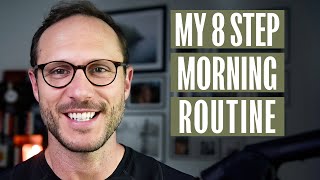
Connor Beaton outlines the morning routine that transformed his life, emphasizing gradual habit change (5–10 minute wake-time increments), immediate hydration (a full mason-jar of plain water prepared the night before), stretching and sunlight exposure, breathwork, alternating workout modalities, cold exposure timed to training type, stream-of-consciousness journaling, and prioritizing connection with family and friends. He stresses tailoring routines to individual needs and using small, repeatable rituals to move behaviors from conscious effort to automatic habit.
Chapters
All right, guys, welcome back to the Man Talk Show. Connor Beaton here. And today I'm going to be sharing with you the morning routine that absolutely changed my life. Before we get into it, I want to say one quick thing. Number one is I used to hate morning routines. I used to hate morning routines and I used to judge the living crap out of guys that were like, I wake up at 5am and I drink my coffee with butter in it and then I do all my push ups and my squats and I just like, I think that was maybe a Duke Nukem voice. I'm not really too sure if you know, Duke Nukem. You know, lay that in the comments below. But I really had a judgment about it because I couldn't do it. Like, I had this story in this narrative of like, I can't seem to get my shit enough together to even have a morning routine. I couldn't wake up early. I couldn't have consistency. You know, I would stay up late and sabotage myself. I really, really, really struggled with it. And so not only am I going to share with you what I do for my morning routine, I'm going to share with you some tips and tricks that will help you to develop and maintain your morning routine. Now, maybe you already have one. Stick around because there's going to be some very useful helpful insight and science about morning routines. But I'm also going to be sharing how you can ingrain these new habits and rituals into your life in a meaningful and effective way. So. So let's dive straight in. Don't forget to hit subscribe, hit the like button and man it forward. Share this video this episode with somebody that you know will enjoy it. All right, first step, get your ass out of bed early. Wake up early. Now, I know you've probably heard that a bazillion times where people are like, I wake up at 5am and you've got the Robin Sharma 4:30 club and you got the miracle mornings and you've got all of these different forms of different people telling you to wake up early. And honestly, for me, for a long time, I probably struggled with this longer than any other part of my morning routine. I hated getting up early. It wasn't something that my body enjoyed. And that's because of my other habits and routines. You know, smoking weed before bed and watching porn and, you know, none of that stuff helped me get out of bed early in the morning, which we'll talk about in a second. But I just genuinely didn't like getting up in the Morning I liked sleeping in. It felt good. And so I struggled for a long time to get up early until I tried this one trick. And the one trick was that I used a five to ten minute increment to get up early. What do I mean by that? If my normal time getting out of bed was 8am, I started setting my alarm for 5 or 10 minutes earlier than I would normally get up. So for example, if you normally get up at 8am and tomorrow you wanted to wake up early, don't try and wake up at 5am that shit's not going to work, or at least it's probably not going to last. What you do is if you normally wake up at 8, you set your alarm for 7:55 or 7:50, and you incrementally move the time that you wake up back earlier into the morning. And what this does is it allows your brain and your body to acclimate to the time that you want to get up. So I normally get up at 6am, sometimes a little earlier, sometimes a little later. But it is kind of ingrained into my body now. So I don't really even set an alarm most morning I just pop up. I have an Alarm set at 6:15 just in case I'm not already up. But most mornings my son is up at 5:30 or 5:45 and so am I. So I wake up at 6:00 clock in the morning. And I did that incrementally over time. It took me about three months to move from the 8am down to the 6am I went down to 5.30am for a period of time. And I have found that to be a very, very effective tool for getting out of bed earlier in the morning. Next step number two, in my morning routine, after I get up nice and early at the butt crack of dawn, I drink a big ass jar of water. Not a cup, not a glass, but a big jar, big glass, Mason jar. And I do this for a number of reasons. One, when you're sleeping at night, your body moves into a more dehydrated state because of all the stuff that's happening in your body that I'm not gonna necessarily get into for the sake of brevity, but in the morning is usually one of the places in your life where you are the most dehydrated. And so you need water first thing in the morning to rehydrate your body. I don't put any electrolytes in it, I don't put any lemon in it, I don't put anything in my water. I just drink H2O with nothing else. And how I got into this habit, very quick trick and hack, even though I hate that word is I get that ready before bed. So my morning routine starts before I go to sleep. Now I'm not one of those intense guys that like, you know, needs to put gym clothes on to sleep in my gym clothes that I wake up in the morning, I'm ready to go. I studied, like, did some research for this video because there are so many morning routine videos and commentaries out there. And it was two things stood out to me. Number one, the level of insanity that some people go through in order to get up early and have a like four hour morning routine. And number two, the fact that nobody really talks about how effing hard it is to develop a proper morning routine for most people, right? If you are like me, it took me ages to develop a rigorous healthy morning routine. Anyway, back to the plot, back to the story. I get my water ready at night. So before I go to bed, I go get my water jar. I have a very specific cup. Again, you want to ritualize these things. The more that you can ritualize these things and anchor them in, the more you are going to embed and ingrain into your brain this habit. Our brain remembers patterns. Your brain is a pattern recognition machine. And so if you want to have healthy morning routines and habits, you have to create these patterns that allow your brain to move things from a conscious, laborious choice into a subconscious and unconscious decision and response that your body naturally has. So every night I just go get a big jug of water, something like this if you're watching me, and I go upstairs and that sits by my bedside so that when I wake up in the morning, I have that there, I chug that in the morning. I drink a full mason jar of water first thing in the morning. And then it's time for the double S stretch and sunlight. Now caveat to this is that normally my son is up with me and so part of my morning routine is giving him a banana and peanut butter because he has his own morning routine and that includes banana and peanut butter every single day. Uh, he's three and he just loves that shit. So we'll have a banana and peanut butter and then we go outside for stretch and sunlight. Now depending on the time that you are waking up, you may not have sunlight. So you will want to get a, a red light of sorts and something that's low in emf and that is going to simulate the type of light that is going to Be good for your skin, your eyes, for helping you get into your proper sleep cycle later on in the day, hitting your circadian rhythm, yada, yada, yada. All the scientific benefits that are there that you have probably heard about. If you don't have sunlight early in the morning or it's wintertime, like here, the sun doesn't come out until, you know, 8am in the morning. And. And I've been up for two or two and a half hours, so get that red light and then stretch. So what my son and I do, he comes outside with me and we will stretch outside. If it's winter, I will put, you know, jacket and a toque on. Yes, a toque, not a beanie because we are Canadian and the proper word is toque. Uh, but we will get dressed and we'll go outside and we will stretch. I have a stretching song that I sing with him, that he sings with me. And he usually participates in the first two stretches and then he, you know, screws off and does his own thing. But I will do a certain series of yoga stretches. Downward dog sun salutations. I'll do some Tai chi. I will do some stretches that actually incorporate breath work into the stretches. I'm actually in the process of producing something called the men's morning toolkit. So I will give you that soon, which will have all of the guided meditations, guided breathwork practices, guided stretches that I have, um, that will help you with your morning routine. So that's coming soon. Just know that. So I'll do SNS stretch and sunlight. If it's in the summer, I'm usually doing it in shorts, no T shirt on. I'm trying to get in as much sun as possible. Then we move to breath work. I will either do Wim Hof breathwork. I will do some form of Kundalini breath work or Pranayamak breathing, or I will do some. Some breathing techniques that I learned when I was singing. It all depends on, on where my body is at and what my body is needing that morning. And this is the really crucial part that I learned about a morning routine that I wanna share with all of you. You have to find a routine that works for you and your body. I tried to do everybody's routine that I could find. You know, I listened to Tim Ferriss and did his routine. I listened to this person who did their routine. I listened to Robin Sharma, did his routine, and most of them just didn't work for me. They felt rigid. They felt they didn't really fit in. With my mind and my body, and they just didn't really feel right for me. And so take all of what I'm saying and implement what works and throw out what doesn't. You are going to have to find the right morning routine jacket, as it were, that fits for you. So I do my breath work after my stretching and then I'll go into a heavy workout. Now there's two forms of workouts that I have. I'm going to have another video on this soon probably. Um, I split my workouts up into one week. I'll do HIIT training, so high intensity interval training. The next week I will do very heavy hypertrophic strength training. And sometimes I will do stuff like gvt, which is German volume training, which is not for the faint of heart. It's a very intense format. You do basically 10 reps, 10 sets at 60% of your max. And so, like, if you're gonna do chest, as an example, you would do bench press and you would do 10 sets of 10 reps at 60% your max, which is a hundred reps. It's a lot of weight to press. It can be taxing on your body. So make sure that you stretch, don't skip the stretching part if you're gonna start doing something like gvt. But I'll split them up. Mostly because I noticed that for my body personally, when I do really heavy weight training consistently, you know, five, six days a week, because I like to work out a minimum of six days a week, well, minimum of five days a week, but mostly five, six days a week. I noticed that for my body, when I'm doing stuff like GVT or really heavy strength training, if I do that repeatedly, then that's taxing on my body. Whereas if I do one week heavy weights and strength training, one week HIIT training, which is very, very good for fat loss, very, very good for your cardio, very, very good for chiseling, then that offsets and it actually improves my ability to strength train. I also do mixed martial arts, so I do Muay Thai. I do that once or twice a week, just depending on my schedule. Next is the cold. Now I will either do a cold plunge before or after, just depending on the workout that I'm doing. While when I am doing heavy lifting, strength training, then I will do a cold plunge before, but I will not do it after. Research and studies have shown that if you do a cold plunge after doing hypertrophic training, it can actually decrease your gains, which why would we want that? You don't want that. However, if I am doing high intensity interval training, cold plunges are exceptional for recovery. And so I will usually do a high intensity interval training and then maybe I'll do a cold plunge after or I'll have done it before and if I don't have time in my morning, then I will just take a fully cold shower, which is, oddly enough, much more uncomfortable than just doing the cold plunge anyway. After the cold therapy, after the cold plunge, I will do journaling. So there's two more steps. There's just this one and one more I will journal. And what I would recommend is very, very strongly I would recommend what I call stream of consciousness journaling. Stream of consciousness journaling SCJ and stream of consciousness journaling is exactly how it sounds. You write down whatever is in your head. You write out the challenges that you're having in your relationship. You write out the questions that you are trying to figure out, the problems that you're trying to solve. You write out the existential angst that is bouncing around in your noggin on a day to day basis. But you just let everything that is churning in your head out onto a piece of paper. And when I first started this practice, it was both illuminating and frustrating because one, I realized how much was in my head that didn't have an outlet and number two, it was a little frustrating at first because I was like, what do I do? Like, there's no real direction to this and I'm literally just supposed to like write out. And so, you know, sometimes for the first few weeks it was just me writing out. Like this feels dumb and I'm not really too sure what I'm supposed to be writing. And you know, what do I put on this paper? And so set a Timer for minimum 10 minutes, usually 10 to 15 minutes or more. When I was journaling extensively, I would do like 45 minutes of journaling every day. I found it to be incredibly helpful and has been one of the most revolutionary tools, transformational tools in my life. Stream of consciousness journaling allows you to, allows you to work through some of the problems that you are dealing with, allows you to see it on a piece of paper, allows you to get it out of your brain. And usually what happens is a good amount of clarity after you're able to get it out of you. Right? It's kind of like, oh, this is going to be a great analogy if you know what post nut clarity is. Stream of consciousness journaling is kind of like a post putting it on paper clarity where just the simple act of getting it out of your head can. Sometimes there's the pun, there it is just the simple act of getting it out of your head.
Shit. Can, can be a very, very helpful resource and tool. And for me personally, I have found that to be much more effective than any other journaling, any other type of journaling that I have ever come across. And I've tried a lot. Now the last piece I'm gonna leave you with is connection. You've probably noticed that I spend a lot of my morning routine, or I spend some of my morning routine with my son and my wife and they're a part of my mornings. Even before I was married and had a kid, connection and friendship was a very important part of my morning routine. And I think that for so many men, we walk through life in silos. You know, we do our morning routine in silo, we go to work in a silo, we're traveling in silo. You know, we're not talking to anybody as we commute, we come home, you know, we barely talk to the people that we're around and we feel alone. And so part of my morning routine has always been to find connection. Even when I was single, I would, you know, go work out with buddies in the morning at 6:30am Even when I was single, I would have, you know, coffee connections before I went to work with buddies, with friends. And that for me is a very integral part. And so I love trying to find ways to have connection as a part of my morning routine. Because it's not. Morning routines aren't just about how you lead yourself, becoming a more effective self led man, having a deeper sense of discipline. It's also about setting yourself up to do life well. And part of doing life well, it's relationships. And so you've probably noticed me talking about I stretch, my son is a part of it. I do breath work, my son is a part of it. He might not stay for very long, but there's a connective tissue that's there. And so I would encourage you to find ways to embed connection into your morning routines. All right, thank you so much for joining me. Thank you so much for tuning in. Leave your comments, thoughts and questions below. If you're watching this on YouTube and if you're tuning in on the podcast, hit me up on Instagram. Mantalks. Thank you so much. And as always, this is Connor Beaton signing off.
Sam.
More from Connor







How to Raise Strong, Unshakable Boys in Today's Culture, with Dr. Shefali Tsabary



