The Power of Being Present, with Light Watkins
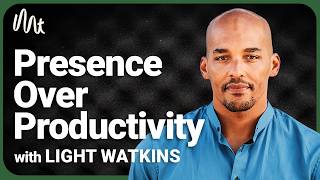
In this interview, host Connor Beaton talks with Light Watkins about why people repeatedly fall into familiar, self‑sabotaging patterns and the psychological and evolutionary forces behind that tendency. Watkins explains that humans are wired for comfort and familiarity, which creates a strong resistance just before change—a phenomenon likened to the mythic "guardian of the threshold" and manifested as "important‑sounding excuses" (e.g., lack of time, family obligations). He explores masculine tendencies to gamify life, endure hardship, and chase home‑run results, arguing that this often leads to burnout and a lack of presence. Presence is defined as the absence of worry (future‑oriented anxiety) and regret (past‑oriented depression), allowing a person to be fully in the moment and see opportunities. Watkins outlines a practical three‑step system for cultivating presence: daily seated meditation, a gratitude practice, and intentionally avoiding complaints. He introduces the "tortoise approach" to habit formation—starting with minimal, enjoyable actions and incrementally building consistency—contrasting it with the fast‑track, home‑run mentality. Through anecdotes such as a doctor who integrates music into his medical practice and references to cultural figures (David Goggens, Steven Pressfield, Alex Hormozi), he illustrates how aligning passion with work can create meaning. The conversation also touches on modern economic pressures, the illusion of escaping via retirement, and the need to find fulfillment within existing constraints. Watkins promotes his books (including Bliss More and The Year You Transform) and his website as resources for deeper exploration.
Chapters
All right, Mr. Light Watkins, how you doing, my friend?
I'm amazing. I'm happy to be here.
Good. Well, glad to have you here as well. And I feel like it's been a long time coming. There's a couple of people over the last, like, year or two have sent me your stuff and you should have this guy on the show. And so when, when your team reached out, it was like, okay, yeah, let's do it. Let's start with why do people keep going back to the same patterns that keep them stuck, unhappy, and unhealthy? They know that that's the pattern that they don't want. They try and get away, and it seems like it's like a black hole that just has like a gravitational pull that sucks them back in. Why does this keep happening?
I think we want to start getting honest about the fact that these are human tendencies. It's not something that's a character flaw. In anyone. We're wired for comfort. We're wired for familiarity, even if it's better the devil you know. You know, if that's what we've been experiencing, it feels safer than initiating some stark level of change. And so, um, it's just— that's just what we do. You know, it's just what we do. And And if we are honest about that, then we can be a little more intentional about making different choices.
When you say that we're wired for familiarity, what do you mean by that?
Well, familiarity equates to safety when you're operating from a tribal mindset. And we have to remember that we are still operating on the 10,000-year-old model of the human biology, which is very much living in tribes, you know, not coming across more than a couple hundred people a year, not doing anything that's going to get us ostracized from the tribe, not making any crazy choices, falling into line, and, you know, etc., etc. And so it's not that we have to be consciously aware that this is what's happening, but this is what's happening. And we can tell this is what's happening because this is our tendency. It's been our tendency. Forever. Even people like David Goggins, who's kind of like the icon for, you know, pushing yourself to the limits, he talks about waking up in the morning and staring at his shoes for 2 hours before he goes on his run because he's having to constantly overcome his own internal resistance in order to do that. And if you've read books like The War of Art by Steven Pressfield, he does a great job of laying out every single iteration of resistance. And I think anyone reading that, especially if you're a man, especially if you're in your 30s or 40s or beyond, you can relate to all of those moments and how the resistance is strongest just before you make the change, just before you decide to intentionally choose something different that's not familiar. And it's scary. It's a very scary, scary choice. And that's why a lot of people don't make it.
Yeah. I mean, you were saying that the resistance is strongest right before the change happens, right? It's like the calm. I mean, it's the inverse, right? It's like the storm before the calm almost. But in mythology and in Jungian psychology, there's something called the guardian of the threshold. There's an archetype called the guardian of the threshold, and it sort of represents this part of the psyche creates an ultimate test for you to see if you are actually really willing to take the leap of faith to create the change, to step into this new way of being.
Yeah.
Is that, is that kind of what you're talking about, that as we get closer to change, like, what is that? Outside of the sort of like mythological part, why is it that the closer that we get to change, the more resistance that we have? It's just fear.
I think fear is a part of it. I call them important-sounding excuses in my latest work, The Year You Transform. We have these important-sounding excuses to not do the thing, and usually it involves stuff that no one would ever debate if we said, oh, I'm tired, I haven't worked, you know, haven't slept in a long time. You talked about sleep deprivation before we started recording. Uh, work is really busy. The, the, the big joker of important signing excuses, the kids, the kids need something. Uh, the kids are sick, the kids this, the kids that, and therefore we can justify delaying a little bit longer, pushing the thing a little bit further down the road and, and succumbing to our comfort zone. So I think a good way to kind of think about it is we have our comfort zone, which is what we're in right now. That's our status quo. And it doesn't have to be necessarily comfortable, it's just familiar. That's what the comfort zone really indicates is there's these familiar aspects of our life. And we know how it kind of plays out. And so we can kind of, you know, position ourselves to try to get the most out of whatever is happening. And this is our container. And we probably have filled that container up with as many things as we think we need in order to make that as comfortable as possible. And then on the perimeter of the comfort zone, we have the gateway to our growth zone. And if you can imagine, just as a visual, along that perimeter are billboards. And on those billboards are all the important-sounding excuses. You're too busy. There's not enough time. The kids need this, that, and the other. You have to remember your mortgage. You have to make sure that the wife is happy and all the things that are meant to sort of scare you into staying in the status quo, staying in the familiar. And for those of us who are able to find the courage, 'cause I don't think it's necessarily that we have it, we have to find it, we have to find it from somewhere, and it can come from different places. But if we find the courage to move beyond those those important-sounding excuses, we can access aspects of ourselves and a layer of potential that we probably didn't even realize we had. And I think this is really a big part of manhood, is putting ourselves in those positions. And they call it voluntary stress or inoculating yourself with discomfort on a local basis, meaning in your day-to-day environment, so that when you are finding yourself at that perimeter, which we all do at some point in our lives, we have taken enough of the poison that whatever poison we think lies beyond the comfort zone is not going to affect us.
Yeah. So it's almost like choosing stress intentionally and proactively so that when the stress that you haven't chosen shows up, Correct. You're able to tolerate it and bear it more effectively.
Microdosing the stress.
Yeah, yeah, yeah, yeah, yeah. I feel like, I feel like social media does a good job of inundating us with a little bit of that now. It seems like that's part of the challenge. Okay, so we don't necessarily— would you, would you say that we don't necessarily want to change, that we're actually wired to stay in the state that we're in?
So I love these kinds of questions, and I love offering definitions for these words that we all kind of take for granted that we have a shared meaning. And I don't think that's the case a lot of the time. We all know this with, you know, safety, the word safety. What we as men define safety as is usually physical safety. Nothing's gonna gonna harm you. You're protected. But what the women in our lives define as safety is something completely different, right? When they say, I don't feel safe, they're not necessarily talking about physically protected. What they're talking about is emotionally. You're not making me feel safe. In other words, I don't feel like I can give you my heart. I don't feel vulnerable. You feel shut down. You need to be more emotionally available. That's what they're talking about. And it can be really confusing to us. To hear these terms defined in different ways. But when it comes to change, I would argue that people don't necessarily want to change. Nobody really wants to change. What we ideally would like if we could just snap our fingers is we'd like everything to happen the way we want it to happen. We'd like our life to show up in the way that just makes us completely feel at ease. But obviously, that's not the case. So what we ultimately want through the change process— like, change is just the airplane to get us to the place, the thing that we really want— is we want to have more fulfillment. We want to feel more connected to the moment. We want to have more meaning in our life. And we want to ultimately have more presence. I would say presence is sort of the umbrella term, and then fulfillment, connection, and meaning fall underneath that. And so if we're in a— if we're experiencing a life that lacks fulfillment, that lacks connection, that lacks meaning, that means we don't— we're not very present. Those are the symptoms. We're not very present. And that's what we crave. We crave more presence. We crave more presence. Presence with our kids, presence with ourselves, presence with our partner, presence in our, you know, job. Because when we don't have presence, things tend to become very transactional very quickly. Our relationship with our kids becomes transactional. They just want to play with us, you know, to satisfy their, their craving to throw balls and, and do fun things. And partners just want us to provide and, and make sure that they can go out and get whatever they want without worrying about things. And the job wants us to perform, you know. And so it just feels like, as men, just feels like we're just constantly being— we're human doings. We're just doing, doing, doing. Everyone just is pulling from us, and, and there's not a lot of people giving back to us and feeding into our soul. And so that's what we— we— that's when we start having these ideas of changing things up. Whether it's leaving a marriage, whether it's leaving a job, whether it's changing our dynamic with whatever we feel is drawing down from our happiness. And the answer usually lies just in putting ourselves in position to have more of that, more presence, more meaning, more impact, more fulfillment.
It does seem like we as men have a like a stronger predisposition towards wanting to stay in things that are unworkable. You know, like there's some strange correlation between I'm going to stay in this relationship or job or dynamic or situation that isn't working for me, but if I just stay here long enough, maybe it will change. But also, I'm going to try and present my value as a man by just withstanding the discomfort of the reality that this isn't working for me. I don't know if you've heard the old story of the postman delivering the mail to the old man on the porch, and the old man sitting in a rocking chair, he's rocking back and forth, and there's a dog sitting next to him, and the dog is whimpering and crying. And the postman has been coming and delivering mail every single day, and the same scene has been going on for like a week now. And the postman says to the guy, like, what's wrong with the dog? And the old man on the porch says the dog's in pain. He said, well, how come? He said, he's laying on a nail. He said, well, why doesn't he get off? And he says, well, he'll get off when it's painful enough, when he decides that he's had enough of the pain. And I feel like that's what we as men do in some ways. Like, we're the dog sitting on the nail. And it seems like we stay in the marriage longer, we stay in a situation longer, we stay in a relationship longer. Have you seen that? Is there something inside of the masculine psyche that kind of says, if I can just grit and bear it through this? Because even when you look at divorce rates, it's like 75% of divorces are initiated by women. So, men have a predisposition, it seems, towards staying in something that's not functioning, whether they're denying that it's not functioning or they're just trying to grit and bear it. All right, guys, really quick aside. First off, thank you so much for tuning in to the show and to the channel. If you are wanting to go deeper, if you're a man that's working on himself in some way, shape, or form, you're wanting to be more self-led, you want to trust yourself more, you want to have a deeper level of self-worth, or maybe you're looking to improve your relationship, then I encourage you to check out the Man Talks Alliance. You can go to mantalks.com/alliance. We have over 1,000 men in this incredible community from around the world. Men who are just like you, working to better themselves, to be a better husband, a better father, a better leader in your own life. So check it out, mantalks.com/alliance.
Yeah, that's a good— that's a really interesting point. And I would say I'm not an expert in this particular area, but I would say that as men, we have a tendency to gamify things, right? This is why we are— we men play more video games than women tend to gravitate towards video games is because we want to master this level so we can get to the next level. And it's not a question of is it possible. This question is, are you going to put in enough time and effort and energy and ingenuity and creativity to master that level? So maybe a part of that rubs off into real life situations like working a job that you don't necessarily feel completely satisfied by, but you know that if you stay long enough that you're going to be able to optimize for more money and more security and more investment and a greater ability to provide for the people that you care about. And maybe that's where a lot of the meaning is extracted, is in the ability to do things for other people. And we have this we don't need as much novelty as women need. We don't need as much newness and different environments as a lot of times women need. Obviously, there are exceptions, but for the most part, we can do the same thing. We can be kind of isolated, and we can find all kinds of justifications to continue down that path. And, you know, I was thinking about this the other day. I think everybody Everybody kind of thinks that they have it figured out and other people are kind of stupid. You know, if you look at social media, a lot of these quote cards, they are communicating that there's, you know, that a lot of people just don't— are just ignorant of how life works. And you should never do this, you should always do that. You know, these are the 3 steps to this, that, the other, and why is nobody talking about, you know, all these different hooks are implying that people are just stupid and nobody really has it together and people haven't put 2 and 2 together. And, and yet I, I haven't met anybody who doesn't feel like they have it all together and they can put 2 and 2 together and they are the smart ones in the room, even though obviously everybody can't be that way. So there's some kind of effect that happens with us as humans where we don't realize we don't have it figured out until, like your story, until the pain gets so bad that you just have to ask yourself different questions. And probably even then you still think, well, maybe there's just something I haven't done it long for long enough. You know, we get indoctrinated by the Alex Hormozes and people of the world who who, you know, have a lot of great things to say, but their whole stance is you just have to stick with it long enough and just do one thing and don't get distracted and stay in it and don't, you know, don't hit the eject cord yet. You just have to go, keep going, keep going, keep going, and then you'll figure it out. There's that little cartoon of the guy digging the mine, and then he gives up when he's just this close to hitting the diamonds and You know, so don't give up and it's going to be hard. Life is hard. And I think it's an interesting indoctrination to question if you are— if you're able to tap into a more sort of thoughtful approach to whatever it is that you're doing in life. Now, what I would say from my perspective, from this whole presence fulfillment perspective, is they're thinking that change, that they're thinking that the accomplishment or the achievement that they're striving for is going to bring about a different level of meaning. And usually, that's not really the case. And what I would advise people to do is to find the meaning first, and let that inform the thing that they want to commit their lives to. And again, this flies in the face of, you know, a lot of our conventional wisdom. But I find that to be a much more sustainable approach to doing the work because you're going to have to do the work regardless. You may as well do the work with something that has some degree of meaning for you. Like the process of doing it itself has meaning and fulfillment for you versus just working yourself to the bone, hoping that once you strike the gold or hit the diamond mine, that you're going to somehow be happier and more fulfilled inside because you're not.
One, like, sadly, I think from working with so many of those guys, when they hit the gold mine or the diamond mine, they don't know how to enjoy the treasure that they've dug up, you know, because they're just so used to being in this brutal grind, you know, like a lot of the men that I ended up working with. It's very interesting. I'm working with them on the other side of them winning the music award or getting some big accolade within sports or within their business, hitting some big benchmark, and then having a collapse because it's like, well, I'm still not happy. I still don't feel fulfilled. I still don't— like, what the hell was this? What do I do now?
Yeah.
So you've mentioned this word presence quite a bit, which I think we should actually go deeper into, because I think for a lot of men, they hear this word, they might have a context for it. I think it's also one of those things that a lot of the times when women describe a man that they're drawn to, they'll usually articulate something about his presence. And so what is presence? How do you define it? Why is it important? Let's just sort of go down that path a little bit.
So very simple definition for presence is the absence of worry, and regret. In other words, when you are worried about something, that usually means you're focused on the future. When you're regretful about something, it means you're focused on the past. The extreme version of worry is anxiety. The extreme version of regret is depression, circumstantial depression mainly, meaning you're stuck in the past or you're stuck in the future. When you're stuck in the past or future, then it's very difficult to feel like you're in the moment. Presence is not a state where you're walking around going, "I'm so present right now. Oh my God, this is wonderful to be so present." You are able to be the best version of yourself, the most authentic version of yourself when you're not worried about what's going to happen next and when you're not regretful about what just happened. 5 minutes ago, 5 months ago, or 5 years ago. And so when you're able to fully show up to the moment, that allows you to be able to say things, to cognize things, meaning to think things and to see things that you probably would have missed otherwise. And life becomes like a walking Magic Eye puzzle. You know, the Magic Eye puzzles where you have the wallpaper, the pattern, looks like a bunch of chaos, but if you soften your gaze, an image will pop out from the background— a sailboat or whale or palm tree or something. Well, opportunities are all around us. Opportunities to connect, opportunities to love, opportunities to be compassionate, generous, to see the best in others, to slow down, to appreciate the little things that are all around us.. And if we're not present to those opportunities, then it'll just continue to look like chaos and disconnected patterns. But the more, the more we can show up to that moment in a relaxed way. Now, relaxed doesn't mean calm. You may not be a calm person naturally, and that's fine. But relaxed means you're not trying to rush through the thing to get to the thing that you think is going to bring you happiness. You know, this whole idea of success, love, speed is a scarcity mentality. I get it. I get the concept. The faster you go and you break things, you're going to make more money in the short term. I agree with that. What I disagree with, though, is that you're thinking that that money you're going to make is going to make you feel differently inside. And that's kind of the whole point of getting the resources is that people think it's going to make me a different version of myself, and it's not. It's just going to reveal all of the insecurities and all the holes that you have within yourself. I'm not anti-money, by the way. I'm not anti— I'm not an anti-capitalist. I'm not a socialist. I love money. I agree that we need lots of money. And, you know, to get the kind of relationships we want to get, we have to be good, reliable providers. But only optimizing for money and hoping that it leads to more connection and more fulfillment and meaning in your life is kind of like just doing bench press when you go to the gym. We see these guys, they go to the gym, they just do bench press, bench press, bench press, and they're walking around with little chicken legs. And so a lot of men are just bench pressing, thinking that it's going to cause their legs of fulfillment to get stronger, but they're walking around with chicken legs of fulfillment. They got massive chest, massive success, massive material achievement, and chicken legs of fulfillment. And the way it shows up is, again, your relationships are all transactional. You're never really there. You're never really in the moment. You're always thinking about the next thing because in the back of your mind, in places where you're probably not willing to admit, you think that next thing is going to bring you the happiness that the past thing didn't bring you. And so it continues. You're on a— you're just on a bigger hamster wheel, right? We're all on some sort of hamster wheel, and yours is constantly dangling this idea of fulfillment beyond the next thing that you achieve. And yeah, you're going to have to get on the deadlifts and the squat rack and all of that for fulfillment, which is another sort of hamster wheel, but that requires you to to commit to doing more inner work, meaning you change from the inside out. And you can do that through practices like stillness and gratitude and, and even things like walking and random acts of kindness and slowing down and, you know, practicing patience intentionally and things like that.
So it does feel like, um, I think for most people it's a bit of a conundrum, right? It's like so many people are just trying to make some type of a living. You know, they're just trying to, quote unquote, get by or make enough money to pay for the mortgage and, you know, whatever else that they have in life while trying to find fulfillment. And it's interesting because I do think that modernity and modern culture in a way promotes and sells this idea that if you just work hard enough, long enough, fast enough, et cetera, that you will reach a kind of escape velocity where you can then enjoy your life. It's like retirement, right? I always think about retirement as like this really kind of fucking weird thing. It's like, okay, why would I agree to sign up to a contract to work for 40-plus years, 45 years of my life, to then at the end of my life maybe have a chance at going on that vacation that I want? Like, that sounds so strange. How did we as human beings agree to this nonsense? But it does seem like a little bit of a trap, because if you don't do that, if you don't sort of play the game to make enough money and yada, yada, yada, then the game becomes exponentially harder. So, how do you look at that? Is it about opting out of the game? Is it about reorienting yourself to a different game, changing the rules of the game, not playing a game at all? Or is it about how you find more meaning and fulfillment within the circumstances that you currently find yourself in?
I, you know, we found ourselves in this era of life on planet Earth where you just, you need a lot of money to exist. And yeah, I used to live in New York City back in the '90s and we used to joke with my friends that you can't leave your house without spending $20. Now it's probably at least $200.
$200 for sure.
Just to walk out of your front door and by the time you get back, you spend a couple hundred bucks. So that's just how it is. And we, you have to, you know, you have to do what you have to do in order to make sure that you have all of your basic needs met. Right? So you can't opt out of that, unfortunately. And on top of that, though, you have to also do what you have to do in order to ensure that you are getting your, your spiritual needs met, your emotional needs met, your relational needs met. And it falls, it falls on each one of us. Now, you and I probably come into contact with guys who have a very difficult time with the sort of standard paradigm. I'm sure there are guys out there who don't mind it. You know, there are people out there who love going to a 9 to 5 and just not taking their work home at night or on the weekends and getting that paycheck and and, you know, going on a vacation a couple of times a year and retiring at some point. And that's fine. There's always going to be exceptions. But if you're one of those people, man or woman, who feels the friction, the internal friction going to that kind of situation, and you're thinking that that friction is going to somehow just magically change or fade away, that's delusional. We can't do the same thing over and over and expect a different result, as we all know. So it's not to say that you need to go out and quit the job. Maybe there's a way that you can show up to the job differently. Like, for instance, on my podcast, I interviewed this guy. He was a doctor. Actually, he was more of a musician posing as a doctor, meaning he was a lifelong musician, loved music. Nights and weekends, always played, was in bands. But he thought the right thing to do and the responsible thing to do was to go to medical school and become a doctor. And he thought there was a point that was going to come where he was going to wake up one day and be happy that he made that choice. And he just needed to invest a little more time. He needed to get a little bit more success. He needed to have his own private practice, all the different milestones. And he kept checking those boxes and he never woke up feeling like he made the right choice. In fact, he just felt more and more disconnected from the work. And again, nights and weekends, he's on his guitar, he's always thinking about his music, he's writing songs. And one day, this thought occurs to him, "Bring your guitar to work. Bring it to the office." And he thought that was the most bizarre thing. But the thought didn't go away. It just kept recurring, bring your guitar to work. So he thought, you know, it can't do any harm. Let me bring my guitar to work. And now he keeps the guitar propped up in the corner of his, you know, exam room. And he continues on seeing patients. He eventually, he's a cancer doctor. He eventually gets cancer. He said, I got so sick because I was just, I was feeling so disconnected in my life. And he was 100% certain that that was a manifestation of the friction that he was feeling internally. And then one day another thought comes to offer to write a song for one of his cancer patients going through treatment, like a customized song. And then he thought, I really can't. This is crazy now. I can't. This is embarrassing. People aren't going to take me seriously. The word's going to get around the medical community. I'm going to be ostracized. You know, all the resistance. All the important-sounding excuses, the thought didn't go away. And this is how our heart— this is how, if you believe in the universe or, you know, spirit— this is how it communicates with us. There's a thought that you have that's recurring, recurring, reoccurring, doesn't go away. Doesn't matter where you are, what you're going through, the thought is always in the back of your mind. So this whole thing with like following your heart, it's not like you have an emotion one afternoon and you blow your whole life up to follow it. No, it's tapping into those internal nudges that are not harmful inherently, right? Your understanding of the consequences may not be that comfortable, but the thought itself, which is to play music, that's a beautiful thought. That's an expansive thought. That's something that taps into something that this person had been experiencing since they were a young kid. So anyway, he gets permission to write a song for his patient following that thought. And it's just like the most serendipitous, beautiful moment. He writes a song, he plays it. The guy ends up passing away 'cause he had terminal cancer. The family invites him to come to the funeral, the memorial service, and play the song for the whole extended family. So this is really a wonderful moment. Talk about connection, talk about meaning, talk about fulfillment. He's checking all those internal boxes now. And he gets this expansive tingling sensation and he's like, "Oh my God, this is what I'm meant to do." So he goes to his other patients and starts writing songs for them. And he becomes known as the singing cancer doctor. And word gets around. And instead of people ostracizing him, he gets written up in journals, newspapers, he gets featured on the Today Show. He starts writing books, he starts doing keynotes. And he found this really beautiful way to combine the thing that lights him up inside with the 9-to-5 job that he has. And it allows him to do it in a way that's completely unique to him. And I would argue that everybody listening to this has their version of that. And you probably already have the thought in the back of your mind on how you can bring more of you into the things that you are already doing that may be causing some friction, but you recognize that I'm good at this thing and it pays the bills and it allows me to provide for my family. So, my invitation for you, listeners and viewers, is just to experiment. I'm not saying you're going to figure it all out in 5 minutes, but just open yourself up to the possibility that there could be a way for you to combine the thing that you're passionate about with the thing that you're doing to make money. And maybe that is even just a transition for you to do more of the thing you're passionate about eventually, and you graduate from the thing that you were doing previously to make money. You never know until you actually try it. But it doesn't have to be overnight. It doesn't have to be black or white. It can be both. I love the power of both/and as opposed to either/or.
Yeah. That's great, man. It's such a good story. I remember, have you ever read the book "When Breath Becomes Air"? You ever heard of that book? It's years and years ago. It came out, I don't know, maybe 2016 or '17 or something like that, or maybe 2018. And, it's the story of this guy and it's his memoir. And, I think he's a neurosurgeon or he's a spine surgeon. I can't remember which one, but he's like in his early 30s and he knows that he has spinal cancer. Like, he just starts to have these symptoms because of his career. He's like, I'm almost certain that I have spinal cancer. And so he goes and realizes, you know, gets that confirmed. And the book is so interesting because it's him grappling with this deep desire to be a writer. And to write and to sort of like put his thoughts and his experience and his life out onto paper. And I actually, oddly enough, this is an interesting story. I, when my wife and I got married, we got married in British Columbia and her father has a phobia of flying, so he wouldn't fly. And he was like, I'm not, you know, I'm going to miss the wedding. And I was like, you're not going to miss your only daughter's wedding. Like, I'll drive you across the country if I have to. So he took me up on that, and I ended up driving my father-in-law across the country. And we listened. Part of the exchange was, you're going to listen to some audiobooks that I want to listen to. And so we listened to this audiobook. I remember very distinctly listening to it. And it's this guy's process of he gets diagnosed with spinal cancer. He wants to be a writer. He kind of in some ways ignores that his cancer goes into remission and he goes back to doing the medical career that he has, working 36 hours straight, doing surgeries and whatnot. And the cancer ends up coming back, and he finally writes this memoir as he's going through his terminal cancer. And it's like one of the most intensely human experiences because he's really grappling with this, what you're talking about, that there's like this desire in his heart that he's really struggling to honor, you know, that he's really struggling to prioritize and that his life has really geared him towards just being this whatever it was, neurosurgeon or whatnot. Anyway, I won't give the rest of the book away. It's really worth a read. It's phenomenal and heartbreaking and Yeah, it's brutal in some ways, but so real and raw and human. Because I do think that that's something that so many people are trying to sort through, is that there's a desire inside of them that they can't seem to access or bring forward, or they don't know how to integrate it into their life, which I do want to double-click on with you in a moment. But first, I want to come back to this this concept of presence. How can the everyday guy that's listening to this who says, "I want more presence in my life, what do I do? Where do I begin?" How can a man start to just sort of cultivate a practice of presence in his life?
3 things. One, I would say you want a foundational practice of meditation, daily seated eyes closed meditation. None of this walking around meditation, bike meditation, swimming. People say whatever the activity that they're excited about doing, which is what a lot of guys do. I love running. I love, you know, that's my meditation. Climb, rock climbing is my meditation. And look, here's what you really mean. Those are meditative activities, meaning they allow you to be singularly focused for the most part. Okay? But it's not the same thing as the biochemistry that your body experiences when you sit down and close your eyes and meditate. That regulates your nervous system and it has a ripple effect, meaning if you invest enough time in doing it, your nervous system will actually stay regulated for longer, even though you're not technically sitting down and meditating. That doesn't happen from rock climbing, cold plunging, running, biking or any of those other activities. So I'm not saying stop doing your activities. What I am saying is, or suggesting, is that you start your morning with 10 minutes eyes closed meditation in your bed. And if 10 minutes feels like too long, start with 5 minutes. If 5 minutes feels like too long, start with 1 minute. And then reward yourself for consistency, which means don't even try to be consistent at first. Just do it for an amount of time that leaves you wanting more. So if it's 1 minute, just start with 1 minute and just do it as often as you feel like doing it. Okay? If you don't feel like doing it, all that means to me is that you're doing it for too long. That's all it means. It doesn't mean something's wrong with you. It doesn't mean you have a monkey mind or any of this kind of nonsense that people talk about with meditation. Do it for 1 minute. The next morning, if you continue on doing it for another minute and then another minute the next morning and you do it for 7 days in a row, then bump it up to 2 minutes. And then as you're going through that process, rewarding yourself for an additional minute every week that you are consistent, start learning more about the best practices. Now, I've written previous books. Um, one is the book I wish I had come across. When I was first hitting my head against the wall when it came to starting a daily meditation practice. It's called Bliss More: How to Succeed in Meditation Without Really Trying. Men love this book because it systemizes meditation. You don't have to sit there and think about what am I going to do and how do I breathe and how do I interact with my thoughts. It tells you everything to do. Bottom line is less is more. So Less focusing, less noticing, witnessing, concentrating about evaluating, managing, and visualizing, imagining, and all the things that people tell you you should be doing to meditate. You don't need to do any of that stuff. The most important thing is having a free-range mind and sitting in a comfortable seat. So, and if you have a Spotify account, you can listen to the audiobook for free. Speaking of audiobooks, um, with your Spotify account. So Bliss More: How to Succeed in Meditation Without Really trying. So get a daily meditation practice up and running. And then in tandem with that, you also want to have a daily gratitude practice. Gratitude practice— all that means is you're just thinking of a few things you're grateful for. You can even stack it with your meditation. So you do your 1 or 2 minute meditation, and then right after that you say to yourself 3 things that you're grateful for in that moment. And it doesn't have to be anything impressive. It could be just, "I'm grateful that I'm awake. I'm grateful that I can see. I'm grateful that I have food in my belly or food in my refrigerator," or things like that. Okay? Keep that practice going as consistently as possible. And then the third thing that gets you the most present, in tandem with the meditation and the gratitude, is you are going to intentionally practice not complaining. You can think about complaints all day long. You can think about who's a moron, who's an idiot, who is stupid around you. You're just not going to say it. You're not going to type it. You're not going to say it. And what that does is it drops you right into the moment. And the first thing that people start noticing is that, oh my God, I'm surrounded by people complaining all the time. And then the next Phase of that is instead of complaining or even being silent, you're going to intentionally express appreciation for whatever it is you were going to complain about. In other words, you're going to redirect your attention away from what's not working to what is working. And then when that starts to get repeated and becomes more habitual, it'll be hard to get you out of the present moment. Hmm.
Beauty. Love the system. Love the ease. I know in your latest book, The Year You Transform, you talk about the— I think it's called the tortoise approach. Yeah. Is this something similar or can you kind of break that down? Because I think you're right. For us as men, like, we want systems in terms of how to create change. And I think for a lot of guys, when it comes to creating change, whether it's a change of habit or a change in a relationship or how they're showing up at work or whatnot with their health, I call it the home run effect. Like, we always want the home run. We want to knock it out of the park immediately. And it's like, okay, I'm going to do this one thing today, and then by tomorrow, everything will be fixed. It'll be totally changed. I've used the GoldenEye analogy. Did you ever play Nintendo 64? 4 growing up? Long time ago.
GoldenEye. Long, long, long, long time ago.
Oh man, in GoldenEye there was this cheat code where you could get the Golden Gun and it was like a one-shot kill. And I feel like as men, like, we're constantly looking for that. Like, what's the— what's gonna be the silver bullet? What's gonna be like the one-shot kill that just like instantaneously changes it? And oftentimes it's, it's something different, right? It's like we have to have these slow systems. So what's the tortoise approach?
So the tortoise approach is basically what I described with the meditation, like not trying to be consistent, but optimizing for enjoyment. And so what's the least, what's the minimum viable action step that I can take with this new habit that I want to build that's going to leave me wanting more as opposed to making me come up with important-sounding excuses about why I can't do it. I heard this stand-up comedian one time, he said, I masturbate every single night, but I don't floss my teeth because it's too much of a hassle. And so that's good. With these practices, we want to get them in the masturbation category, right? That's right. As opposed to the flossing your teeth category, Because when it's in the flossing your teeth category and feels like a chore because you're going too far too quickly and you're trying to hit the home run every single time, it's going to leave you uninspired and unmotivated. But if you do it, if you do less, like let's say for instance, you want to jog 3 miles a day. A lot of people, you look at David Goggins, he'll call you all kinds of pussies and bitches if you don't just put your shoes on and go out and jog 3 miles. In fact, Double it so that 3 miles don't feel like that long. I take the opposite approach. I say, don't worry about jogging 3 miles a day right now. Just walk around your block. It'll take you 5 minutes, maybe 3 minutes. Walk around your block. If you enjoyed it, do it again the next day, and then do it again the next day, and then maybe skip a couple days and come back and do it the next day. And eventually you will start to see, oh, walking around my block is very easy, very quick. I can brag about the fact that I walk around my block after dinner every and eventually you find yourself doing it every day for a week, and then bump it up to 2 laps. And it may take you a few weeks to do it 7 days in a row, and then bump it up to 3 laps. And you keep doing it like that, you're creating the habit of doing something on a— at a predictable time every day. It kind of leaves you wanting more, and then eventually you think, you know, Let me speed walk. And then eventually you think, oh, let me just start doing a light jog. And then eventually, let me jog a little bit longer, right? I never forget the first time I started jogging back in the early 2000s. Never was into running or jogging at all. And I had a friend of mine, a really good friend of mine, who had run marathons, and he would go running all the time. And one day he invites me running, and the first thing I thought about was, there's no way I'm going I'm going running with you because I'm just going to feel horrible. And sure enough, we go running and I'm cramping up after like, you know, after like 500 feet. I'm having these severe cramps. And to his credit, he didn't try to push me through it. He didn't say, let's just, you know, take a break for a minute and start running again. He just, he said, let's walk. And we walked the rest of the way., and we had a wonderful conversation. And then the next day when he invited me to go running, I said, "Yeah, sure, I'll go," because I just enjoyed the experience so much. And then after about 3 months, I was jogging, and I had enough experience now to get the runner's high. And then a year later, I'm going on my own. And he and I continued doing that for years. We would go for— and I considered myself to be a runner at that point. So again, success, love, speed is the scarcity mentality. Take the long approach. Go slow and steady. It may take you 8 months to jog those 3 miles. But now you're a jogger, and you got the rest of your life to continue doing something that you enjoy instead of forcing yourself to do something that feels more like a chore. There's no rush. Just optimize for enjoyment. For delight. And then that is what leads to consistency. Consistency— there's two types of consistency. There's consistency that you look forward to doing, and there's consistency that you're having to grit yourself, grit your teeth, and white-knuckle your way through doing. I would argue that's not going to be sustainable. That's not going to be sustainable. You're not going to feel that great. You're going to get anxious. It's going to yank you out of the present moment. I think it's much better to go slower and to do things that you enjoy and let that inform your consistency than trying to force anything. And so that's the essence of the tortoise approach is just taking the longer route. And it obviously comes from the tortoise and the hare fable where the tortoise wins the race from just being slow and steady instead of trying to leap and hit home runs and rush their way to the finish line, but then needing all this time to recuperate because they went too hard, too fast. They overdid it. Their nervous system got wrecked and they had to stop all these times.
Yeah, it sounds— I mean, I've certainly experienced this in my life in so many different areas where I've tried to go full blast, you know, to like be the hare and just— it's like, okay, I should be able to do this very quickly. I should be able to get this routine. I should be able to wake up at 6 o'clock in the morning, like, no problem. And it's never worked. It's always been a brutal, frustrating, obnoxious experience. And but with any, you know, whether it's been journaling, breathwork, meditation, working out, like whatever I've been trying to institute, taking this much slower approach, it's, it's harder and easier at the same time. I think the big piece for me, and maybe this will resonate with some of the guys listening, is it's humbling, which is why I haven't traditionally liked it. There's like a humbling in, okay, I should be able to just sit and meditate for 30 minutes, but I don't want to, or there's so much resistance, or my body's uncomfortable. I remember when I first— I got into this in university. I got into this huge phase of reading different forms of Buddhism, and I went down the Zazen meditation route. And part of the Zazen meditation tradition is that you have to sit full lotus. I remember trying to like get into full lotus and it was just this really frustrating experience. And I think that that's what most of us do. So, I appreciate this approach. Where can people find a little bit more about you? Where can they find the book, the year that you transform. Where can they find a little bit more about you and your work?
Because I think the book is on Amazon and all my books are on Amazon. And my central hub is LightWatkins.com. I'm on the socials @LightWatkins.
Beauty. Beauty. Well, we'll have the links for all that in the show notes. And thank you so much for jumping on. For all the guys that are out there listening and ladies, Don't forget to man it forward. Share it with somebody that you know is going to enjoy it. This might be one of those things where there's somebody in your life that's always trying to smash it out of the park and they need a different approach and this is going to support them. So don't forget to share it with them. And as always, until next week, Connor Beaton signing off.
More from Connor







How to Raise Strong, Unshakable Boys in Today's Culture, with Dr. Shefali Tsabary



