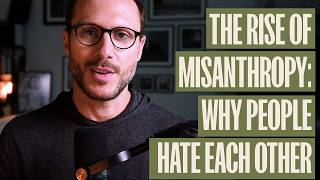
In this monologue, Connor Beaton defines misanthropy as a growing dislike and othering of humanity, describing it as an antisocial, cynical, and reclusive mindset that has become increasingly prevalent. He attributes the rise of misanthropy to multiple intertwined factors: the fear‑driven mental diet fed by social media, virtue signaling, and bite‑sized rage‑bait content; economic insecurity for people under 45 compared to their parents; the collapse of traditional family structures and shifting gender dynamics, especially among Gen Z women; mass migration without effective integration; and heightened political polarization that labels dissenters as enemies. Beaton emphasizes that these narratives are not his own but reflect the current online cultural perspective. He argues that despite the pervasive hatred, the antidote is not naive optimism but a disciplined, radical faith in humanity—cultivating compassion, curiosity, and a higher personal standard to see others as capable of better. He calls for individuals to choose love and acceptance over hatred, acknowledging that policy disagreements should not justify personal animosity or violence. The video concludes with an invitation for viewers to share their thoughts in the comments.
Chapters
You've likely felt the temperature increasing in recent days, weeks, months, and years. The temperature of people hating other people. Now, the word for this, the term for this is misanthropy. Misanthropy literally just means the dislike of other people, specifically humankind. It's kind of like a dislike for humankind, for mankind. It's an antisocial behavior, a cynicism, a skepticism, a kind of reclusiveness. But the other part of this is the othering that happens when misanthropy is on the rise, when the hate of people is on the rise. And with virtue signaling and this sort of core virtue for people becoming a staple ingredient in most people's psychological diet, the average person is running a more fear-based mental caloric intake than ever before. But realistically, there are other factors that play into this, right? There are other things just besides social media and the virtue signaling and the narratives that happen. There is the very real fact that you watching this, depending on your age range, I mean, if you're under 45, you are far more likely— far less likely, sorry, to be successful financially, to have financial abundance and freedom than your parents. The family system is somewhat collapsing in the sense that when you look at the data, I mean, you know, ignore the divorce rates because everybody hears the divorce rates all the time. But even if you look at the younger generation, women in Gen Z are much less likely to want to have children than men. And you could just go down the list, right? You can continue to go down the list of the things that are contributing to this misanthropy, right? Mass migration, talked about all the time, which, you know, migration— I'm an immigrant in the United States, I migrated from Canada— it's not inherently a problem, but migration without integration is going to always create a problem, and it's always going to feed into this narrative of misanthropy. And all of this, everything that I just talked about, the gender war, the immigration, the collapse of family systems, the othering of people, the political divide, all of this is being filmed, is being recorded, is being chopped up into bite-sized pieces and little rage bait content for people to get into a kind of frenzied froth oblivion. We live in this perpetual state of there's so many people to hate. Everyone you disagree with is now the enemy. Everyone who thinks different, who prays different, who values different things, who votes different from you is a target for hatred and anger. Anyone who disagrees with you is either now a fascist or racist, a beta cuck soy boy, you know, who should just crawl into a hole and die. These are the narratives that we are now holding. And again, these aren't my words. I don't believe those things. I'm just saying that this is the narrative online. This has become the cultural perspective. If I disagree with you, it's now commonplace for me to, to, to just cut you out of my life. And it's not just the extremists anymore. This is the part that I think for, for the last few years, it's like, well, it's just the extremists, just the extremists feel that way. I'm, I'm Ukrainian, and I should hate you because you are Russian. I mean, you just go down the list. Yes, atrocities have happened. I'm not denying those things. This isn't any denial of those things. It is simply to remind human beings that at our core foundational level, you and I and every other person on the planet share one unified experience of being human. Without understanding, with just hatred and animosity, there's really no way through. And the harder, nobler path, in my opinion, and maybe I'm wrong, I'm open to being wrong. You might be watching this thinking, what a load of shit. I hate what this guy is saying. Okay, great. The nobler path for me is to hold a kind of radical faith in humanity in the face of this misanthropy, in the face of this bubbling up volcanic quality of hatred for the other. Not a naive belief that people are perfect or they're just going to magically change, right? That the religious people that you dislike are going to magically change their perspective or their belief, that the political— the opposing political party that you dislike are magically going to wake up and change tomorrow and have so much compassion and empathy for you. But a disciplined practice of seeing others as capable of better and to hold ourself to a higher standard of getting there. So the question is not whether the world really deserves your love. The question is whether you will choose to be the kind of person where the world is worth being in. That you continue to perpetuate the quality of love and compassion and acceptance and curiosity that is actually necessary in a time of vile misanthropy, of vile hatred for anyone and all people that are different from you. And yes, I understand that there's a whole other conversation about policies, about politics, about the people that are running our governments and our countries, and that sometimes how you feel and how I feel and how another person feels about what should happen within policy is wildly different. That doesn't mean that I should hate the other person on the other side of the policy, and it doesn't justify my violence towards them ever. So, man it forward. Share your thoughts and your comments in the comments section below. I'm curious to hear your thoughts on this one. And until next week, Connor Beaton signing off.