The Rise of Misanthropy - Why Do So Many People Hate Each Other?
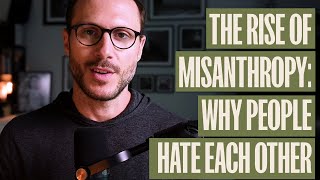
Connor Beaton’s YouTube monologue diagnoses a recent rise in misanthropy — a growing, curated dislike of other people — and links it to social media virtue-signaling and rage-bait, worsening economic prospects for younger generations, intensifying gender conflict and weakening family systems, migration without integration, and political polarization. He coins the term “virtuous misanthropy” to describe hatred framed as moral righteousness, argues this trend fuels isolation, mental distress, and declining interest in having children, and urges a disciplined, non-naive practice of compassion (a ‘radical faith in humanity’) rather than dehumanization or severing relationships. The piece blends anecdote, cultural observation, and prescriptive ethic rather than empirical analysis.
Chapters
You've likely felt the temperature increasing in recent days, weeks, months and years. The temperature of people hating other people. Now, the word for this, the term for this is misanthropy. Misanthropy literally just means the dislike of other people, specifically humankind. It's kind of like a dislike for humankind, for mankind. It's an antisocial behavior, a cynicism, a skepticism, a kind of reclusiveness. But the other part of this is the othering that happens when misanthropy is on the rise, when the hate of people is on the rise. And with virtue signaling and the sort of core virtue for people becoming a staple ingredient in most people's psychological diet, the average person is running a more fear based, mental caloric intake than ever before. You scroll through social media, you see hate, you see violence, you see animosity for people, for other people, for the other, for people that are different than you. And there has been, in my opinion, without question, arise in this specific kind of dislike and disdain and mistrust of human beings over the last few years to such a degree that it's become almost like a badge of honor to hate people based on some arbitrary ism or ist, right? You look at somebody, they disagree with you, they disagree with your political stance, they disagree with how you vote, they disagree with some, you know, social value. And immediately this becomes the, the reason with a kind of like righteous indignation for you to dislike them, for you to see them as the enemy. And slowly this is poisoning the waters of the human psyche. It's poisoning the water of how we interact with one another. Because there is no longer a we, there is an us and a them. And we are beginning to dehumanize individuals, groups, collectives, based on experiences. But what's caused all this? And is there anything that we can actually do about it? Of course, there's the usual suspects, right? Being virtuous has become weaponized and in some places a status symbol going online and being fed a consistent, healthy dose, unhealthy dose really, of content that is made so that you continue to perpetuate certain stereotypes, certain beliefs, and to have a kind of internalized narrative that people are genuinely bad. On, on average, people are bad, people are not good, that there's evil in the world. And of course there are bad players. There are, there are people who genuinely have bad, bad intentions. There are people who genuinely represent that trickster archetype, the, the one that wants to sew chaos and destruction. But realistically, there are other factors that play into this, right? There are other things just besides social media and the virtue signaling and the narratives that happen. There is the very real fact that you watching this, depending on your age range, I mean, if you're under 45, you are far more likely, far less likely, sorry, to be successful financially, to have financial abundance and freedom than your parents, AKA for the majority of people, especially when you're in your 20s or your 30s. The truth is that the economy sucks and most people will be incentivized to hate the people that are doing better than you. I remember feeling like that, you know, in my 20s, I was like, man, the people that have money have it so good and they have such an easy life. And, you know, and. And then I look at how much worse the economy has gotten for the average person and what it must be like to be 20 years old in today's economy and think, I've seen some of the data, I've seen some of the reports, I've seen the news. How in the hell am I supposed to get ahead? And so it feeds into this hatred of people, right? That's another group that I can dislike. That's another group of people that I can dislike. Then there is a kind of massive gender war that is contributing to this. There is a power battle, much like happens in a relationship between a man and a woman sometimes, where a kind of power struggle will take place because people have forgotten how to get along. They've forgotten that they. That they need each other. They have forgotten that each individual, each other person brings a certain value and importance to the table. And when that starts to dissolve, what you're left with is this power struggle that happens. And this gender war that is going on in our culture and society right now has caused men and women largely to not enjoy the other person's company. It has caused men to blame women for all the problems that men are facing and women to blame men for all the problems that they're facing. And when you look at that, what's starting to happen is that the family system is starting to collapse. Family systems are really under attack. And so in this space where you would normally have grown up in an environment where there's some level of cohesiveness and getting along and a kind of ideal.
Foundational blueprint of how to get along communally, because that's kind of what a family system is, right? It's a little tiny community and a little tiny sort of commune that uses you, then go out in the world and have some reference point for the family system is, is somewhat collapsing in the sense that you, when you look at the, the data, I mean, you know, if you, you know, look, ignore the divorce rates because everybody hears the divorce rates all the time. But even if you look at the younger generation, women in Gen Z are much less likely to want to have children than men. And this is especially true when you look at the data between Republicans and conservatives. For Republican, sorry, Republicans and Democrats, right? Republican men, they see, and this is again in the data, Republican men see having children as one of the top priorities in their life. Whereas for Democratic women, for liberal women, that, that's like number seven on the list. You know, it's far down the list. And so you have this disincentivization between men and women who are moving in different directions politically, they're moving in different directions in terms of values. And you have this perspective that's getting pushed out online through different, you know, people that are creating content and conversations around relationships that is continuing to perpetuate this notion that the other sex is the, the enemy, that women are the enemy, that men are the enemy. And you can just go down the list, right? You can continue to go down the list of the things that are contributing to this misanthropy, right? Mass migration. Talked about all the time, which, you know, migration. I'm an immigrant in the United States, I'm migrated from Canada. It's not inherently a problem, but migration without integration is going to always create a problem and it's always going to feed into this narrative of misanthropy. And all of this, everything that I just talked about, the gender war, the immigration, the collapse of family systems, the othering of people, the political divide, all of this is being filmed, is being recorded, is being chopped up into bite sized pieces and little rage bait content for people to get into a kind of frenzied froth oblivion, right? We live in this perpetual state of there's so many people to hate. Everyone you disagree with is now the enemy. Everyone who thinks different, who prays different, who values different things, who votes different from you is a target for hatred and anger. Anyone who disagrees with you is either now a fascist or racist. A beta cuck, soy boy, you know, who should just crawl into a hole and die. These are the narratives that we are now holding. And again, these aren't my words. I don't believe those things. I'm just saying that this is the narrative online. This has become the cultural perspective. If I disagree with you, it's now commonplace for me to just Cut you out of my life. And it's not just the extremists anymore. This is the part that I think for, for the last few years, it's like, well, it's just the extremists. Just the extremists feel that way. It's just the loudest voices feel that way. No, this has started to permeate into our modern culture. But here's the thing. People have always disliked the other. Yes, you know, misanthropy is the dislike of humankind. But the problem that has started to happen is that the people that we have, that we accept, the people that we are allowed to like, has shrunk so, so rapidly and so exponentially because of all of the things that I just described. It's like the people that you are, that are acceptable for you to like as now this little tiny echo chamber of the people that go to your church and the people that have the same gender pronouns as you, the people that have the exact same belief system and values and voting, you know, decisions, has shrunk exponentially. And so in the age of misanthropy, you know, sort of general like, of people, of mankind as it's upon us, it's being led by the people who have adopted it as a primary weapon and tool in the acquisition of power. And this is what I have come to coin virtuous misanthropy. Virtuous misanthropy, meaning it has become a kind of badge of honor to wish harm upon the person or the general population that you view as the other. This kind of disdain and hatred that is being perpetuated through modern conversations that says all people are bad and wrong and the enemy, except for your tiny, tiny little cohort. And people have really lost the thread because, you know, it used to be funny. It used to be somewhat comical to openly joke about hating people. Right. I remember growing up and me and my buddy, you know, in junior high and high school, it was just like we would pretend to kind of be curmudgeons. You know, it was like a. A funny and enduring thing to joke around about, like disliking people because of their differences and, you know, different lifestyle, different way of dressing, different way of. Of of speaking. Like, it was just. It was something that allowed you to have curiosity, have a lightheartedness around it. You know, if you're a Democrat, you could joke about, you know, the Republicans. If you're Republicans, you could joke about the Democrat. And there was kind of an enduring force. There's that. That counterpart it's normal to have a kind of othering there and it's normal to, to look at them and say, you know, I kind of dislike some of your decisions and choices, but now, however, anyone who disagrees with you is a racist, fascist, fascist, commie cucktard, right? I mean, it's just you, you've. The dehumanization has gotten to the point where people can't hold, I can disagree with you and still maintain relationship with you. And I've seen all of the reasons, right? I see all the like, well, when your beliefs and your values oppress me, then how can I have a relationship with you? And it's like, well, that's actually been the way that it's been throughout human species, throughout human existence, right? Is that adversity and disagreement between people eventually leads to a better way of coexisting and that we have to be able to cross the barriers and cross the divides and have the conversations with the person on the other side, right? The main message of love thy neighbor seems to be an outdated and antiquated program that the current servers of our modern human psyche and modernity no longer wish to run, no longer values in so many people. Because this disdain of mankind has been positioned as something that should be normal, should be acceptable, that it should be okay for you to dislike anybody that deviates from your way of being. And it's a kind of narcissistic self centrism that has taken a hold of our psyches that says I am the ultimate version of what is right. It's an omnipotence. I am the ultimate version. This version of being a human is the ultimate form of rightness, of righteousness. And anything that is any different from me should be canceled, should be obsoleted, should be banned from society and discourse, shouldn't be allowed to debate, shouldn't be allowed to express their opinions. And I want to be super clear on something. None of this, none of what I'm saying is a noble stand for Palestine or Israel or Russia or Ukraine. It's not a commentary about trans people or liberals or Republicans or Christians or Muslims. It's actually not a commentary about any of the things that up until this point you may have been trying to find. What side is Conor on? We have been so indoctrinated and conditioned to listen to people through the lens of what side are they on? Are they somebody that I agree with and it's okay for me to like or are they somebody that disagrees with me? And so it's okay for me to slander them and wish harm upon them and absolutely loathe them. So if you're making it mean that if you're reading through what I'm saying in this kind of zombie programming that our modern culture has dished out to all of us, that's actively taught you to consume all content through the lens of is this a friend or a foe? Based on whether or not they agree with me, you're not doing anyone any favors. You're not doing yourself any favors. You're not doing your kids, your family, your friends any favors for treating your cat any better than the person that you come across online or at the coffee shop simply because they might hold a different opinion or value than you. Right? Misanthropy should never be touted as a virtue. We should never allow or condone in any way, shape or form for racist purposes, for religious purposes, for political purposes. We should never allow or condone the deep hatred for someone as a virtue, because this, as a species, is a recipe for disaster. But besides this rapid rise of seeing and allowing this misanthropy, this deep hatred for all people, unless it's our specific subset that fits exactly into our mold, except for the rapid rise of this, what we are left with is a kind of solitude and isolationism.
That has left so many people hurt, alone, mentally unwell, scared, afraid of what to do next. And I see this all the time, people commenting, I don't want to have kids because I don't want to bring them into this world the way that it is. You know, I remember having a conversation with Esther Perel, one of the most amazing couples therapists, and we were talking about this, and I said, people don't want to have kids because they're afraid of the future. And she said, you know, Connor, the. The most important times for people to come together and build really united bonds with other people, to build families, to build friendships, to build communities, is in the moments where it seems like there's no hope for humanity. And I thought that that was such a wise piece of information that in these moments where we can move into cataclysmic, catastrophic thinking, that the end is just around the corner, right? AI is going to end things tomorrow. World War III is going to break out and end things tomorrow. Climate change is going to destroy the world, you know, before. Before I die. So why bother having children, whatever it is that you hold as the ultimate catastrophe? Because we have been indoctrinated into an ideology and a narrative, a socially constructed narrative of catastrophe, of cataclysmic thinking and belief structure. And it is a kind of suicidal ideation that has begun to permeate throughout our culture, throughout the cultural thought process that people are holding right. We have adopted this kind of death mentality that is becoming more and more prominent, more and more prevalent within the modern narrative as polarization continues to rile. And you know, we could go down and I'm not going, I'm going to wrap it up here in a moment. We could go down the rabbit hole, as I see many people do, of. Well, this is what the elites want. This is what the powerful one. This is how the government does X, Y and Z. You know, it's a mass psyops and all that kind of stuff. I see all this stuff online. And regardless of whether or not that is true, my message for you remains the same. That misanthropy and the hatred of people, of anyone that is different from you, it may feel like a clever or even a righteous stance. It might leave you feeling a sense of ego and entitlement. It might leave you feeling with a sense of strength and righteousness and a conviction. But it fundamentally corrodes the very soil that you and I stand on collectively. Disagreement should never be the foundation of severing relationship or at the very least, disagreement should never be an excuse for us to wish fundamental harm on one another as a species. And we have to remove so many of the labels that we have layered into our culture. I'm a man and so I should hate you as a woman. I'm. I'm a white man and so I should hate you because of your skin color. I'm a black man and I should hate you as a white man because you're inherently racist and you're always going to come after me, right? Or, you know.
I'm Ukrainian and so I should hate you because you are Russian. I mean, you just go down the list. Yes, atrocities have happened. I'm not denying those things. This isn't any denial of those things. It is simply to remind human beings that at our core foundational level, you and I and every other person on the planet share one unified experience of being human. And they are all iterations of it, right? It's like Ram Dass said, being, being a human is like being God in drag. Right? There's so many different versions of what it looks like to be a human. And some of them I fundamentally disagree with. You know, I mean, I could just list them all off right now. There's, there's ways of being that I fundamentally disagree with. And that doesn't mean that I hate those people. That doesn't mean that I wish that they would die. That doesn't give me the right or the permission to want to cause death and destruction on the people who I fundamentally disagree with. That is where we begin to collapse as a species, right? This is the aurora borus snake, right? It's the snake that wraps around and eats its own tail. That is what we are beginning to do now, right? To despise humanity is to despise yourself. To despise humanity is to hate your children, your future. And to continue to perpetuate that is to actively, even if it's unconscious, but to actively contribute to the destruction of our species. And if you look closely, you'll find that cynicism is actually a very easy way out. Hatred of another is a very wonderful way out. It spares you from the vulnerability of hope. It spares you from the real effort of having to engage with somebody who is fundamentally different from you, to seek understanding. And through understanding, there is always some type of a portal for change and connection and transformation. Always without understanding, with just hatred and animosity, there's really no way through. And the harder, nobler path, in my opinion, and maybe I'm wrong, I'm open to being wrong. You might be watching this, thinking, what a load of shit. I hate what this guy is saying. Okay, great. The nobler path for me is to hold a kind of radical faith in humanity in the face of this misanthropy, in the face of this bubbling up volcanic quality of hatred for the other. Not a naive belief that people are perfect or they're just going to magically change, right? That the religious people that you dislike are going to magically change their perspective or their belief that the political, the opposing political party that you dislike are magically going to wake up and change tomorrow and have so much compassion and empathy for you. But a disciplined practice of seeing others as capable of better and to hold ourself to a higher standard of getting there. So the question is not whether the world really deserves your love. The question is whether you will choose to be the kind of person where the world is worth being, in that you continue to perpetuate the quality of love and compassion and acceptance and curiosity that is actually necessary in a time of vile misanthropy, of vile hatred for anyone and all people that are different from you. And yes, I understand that there's a whole other conversation about policies, about politics, about the people that are running our governments and our countries and that sometimes how you feel and how I feel and how another person feels about what should happen within policy.
Is wildly different. That doesn't mean that I should hate the other person on the other side of the policy and it doesn't justify my violence towards them ever. So Ben it forward. Share your thoughts and your comments in the comment section below. I'm curious to hear your thoughts on this one. And until next week, Connor Beaton signing off.
More from Connor







How to Raise Strong, Unshakable Boys in Today's Culture, with Dr. Shefali Tsabary



