Thoughts On Afghanistan
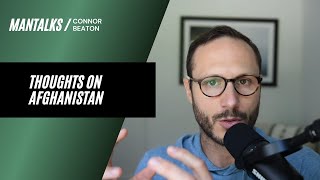
Connor Beaton reflects on the human cost of the U.S. withdrawal from Afghanistan, criticizing how media coverage has politicized the event and dehumanized service members. He emphasizes the need for empathy toward returning military personnel and veterans, citing veteran suicide rates among the consequences.
Questions this video answers
September 9, 2021.
"something like $2 trillion."
"nearly 2,500 lives lost."
"it's something like 22 veterans take their lives per day."
Chapters
So over the last few weeks, specifically over the last few days, I've had a number of men reach out to me that have been former military, Navy SEALs that have served within Afghanistan. Some men really needing support, trying to make sense of what's happening in this withdrawal and trying to make sense of the time and effort and energy and life that that they gave to this cause, to this war in Afghanistan over the past two decades. So I've been getting quite a few questions on, you know, can you speak to this? What are men going through? What do we need to know about? And for just a moment, I want to come at this from a non political perspective. I think it's important to extract some insight about the real humanness of this conversation because I think if you talk about, turn on the news, whether it's CNN or Fox News or MSNBC or you read a Wall Street Journal article or New York Times or wherever you're picking up your news, for the most part it's just being turned into this political debauchery about Trump and Biden and how the presidents have handled this. And what it misses out on are, as per usual, the real human beings who were there and their experience and why they served. And after two decades and something like $2 trillion that America spent and you know, nearly 2,500 lives lost, it's interesting to see some people's response on social media. You know, I saw somebody's post the other day, it was something like, you know, more lives have been lost in Florida to Covid than were lost in Afghanistan over the war. And that kind of nonsense is unhelpful. You know, that kind of commentary is divisive and it serves to segregate. And it's so interesting to me that when these things happen within our society and culture, right, we, we go to war, whatever the reason is, you know, we experience a pandemic, there's mandatory, whatever mask wearing, vaccines, et cetera, that people lose the capacity for neutrality, people lose the capacity to stay in a neutral state, to stay grounded in their nervous system, to stay grounded on what it might be like to sit in a seat of empathy for the people that are on the other side of that news article, right? The real people that had to go and serve, the real people that had to go and see the Afghani people and what they were experiencing day in and day out for weeks, months and years on end. And regardless, again, of the political perspective, regardless of whether you believe that America should be there or should not have been there, whether they should have extracted years ago, or whatever your opinion is. We can all.
I think, look at this situation and realize that there were real people that were there, and there were real people that are being affected by this. And when we lose the capacity to look at the news and we lose the capacity to look at current events through a very humanistic perspective, one that remembers that there are fathers and sons and daughters and mothers on every side of the spectrum. We, in some way, not only other, the people that we're talking about, whether, you know, it's a Republican or a Democrat or, you know, somebody in a different country, but we lose.
A connection to our own humanity in some way. And I think that's the most appalling thing that I've seen through throughout the past five years, is that people have fundamentally started to disassociate from their own humanity. So there are men and women, tens of thousands that are returning from Afghanistan. And these people, a lot of them have been through a tremendous amount. And we, for the most part, I think there's a culture of celebrating them and honoring their, you know, their. Their service. But there's also this culture, because some people within the country don't see it as being deemed as necessary, feel that that warrants degrading and diminishing and attacking what people have gone through. And these people are real human beings who are struggling and suffering. Sometime, you know, with PTSD, you know, it's something like 22 veterans take their lives per day, right? 22 per day. Imagine that. Imagine being a part of a group, part of a culture, where you knew consciously that 22 people within your society, within your cultural group, were going to commit suicide that day, every day, as the price that you paid for serving your country, for. For upholding the ideology and the patriotic notion of what the country is supposed to stand for. And to come back and see social media and the media inundated with hate campaigns and smear campaigns and disrespecting the people that were there. And we allow for this kind of dehumanizing to happen, and it's so pervasive in our culture that it's. It's almost become this insidious thing. And it's quite disheartening in many ways, because I think that when we allow our peers to dehumanize and other. Anyone in particular, we begin to pull at the stitching, the fabric of society, right? The sort of stitching that brings our society together, that brings the melting pot of our global world together, whether that's within your individual country or in A more global perspective. And we lose out on the opportunity to really have empathy and compassion for people who fucking need it. For people who really, really need it. I have had the honor and the privilege to speak with some of these men who have served. And for the most part, they are really incredible individuals. Very, very smart, very high functioning, very capable men and women who have dedicated themselves to what they believe to be a worthy cause, to support, to serve, to protect, to honor the freedom that so many of the people in this country inhabit, both in Canada and the United States and abroad. And we've kind of found ourselves in this predicament where as America has extracted themselves and there's this sort of debauchery, right, Leaving military equipment and helicopters and tanks and I mean, it's. It's a bit of a. You're watching videos of people destroying the equipment in Afghanistan, but then just leaving it behind, sort of abandoning all of these, all this weaponry.
We sort of look at this as like, well, what was the point? Why were we there? And we can debate that for, you know, days, weeks, months and years. We can debate whether or not America should have been there. We can have civil discourse about how to not go down this path again, to not make the same mistake again. And all of those things are useful to some degree. But I think the most useful aspect of this whole experience, when I pull back and I look at, at this one example, right, the United States pulling out of Afghanistan and ending the war in Afghanistan, which I highly doubt that's going to be the case long term, that's a different story. When I pull back and look at it, I think the real thing that gets missed is that there are real human beings that are coming back and many of them are struggling, many of them are witnessing a country that is in complete disarray, attacking their service, attacking the sacrifices that they've made. And I think that a lot of people within the public service space are experiencing this, right? Nurses, doctors, scientists, researchers, experts in different field military agents, Navy SEALs, generals, et cetera. I mean, it's just, it's such an interesting thing that, that because we have politicized almost every single decision in our culture, and we have turned all of these decisions into some sort of moral fear mongering. We have allowed for a complete dehumanization of the people on the other side. And that is a very terrifying thing in some ways. It's a very terrifying thing to realize the level of dehumanization that you probably actively participate in. You watching this, you listening to this have probably caught yourself in at some point or another in the last year, year and a half, whether it's, you know, on a Instagram or Facebook or YouTube or Snapchat or, you know, going off on, on the news or, you know, in a, in a sort of debate with your family or friends, that you have participated in this. I've participated in this. You know, as grounded and as centered and as focused as I try and be. There's still situations and circumstances where I get caught up and hijacked in this sort of the disarray and discombobulation that seems to be happening, the fear mongering that seems to be so widely pervasive, the polarization where there's no coherence really at all. And the justification of morally attacking and annihilating people who have a different opinion from you, have a different perspective from you, is justified. And I think that's the saddest part of this whole thing, is to watch these people come back who have given so much of themselves and to be met with this complete melting pot of disorientation within North America and to be met with, for many of them, not really feeling honored, not feeling respected, wondering why they gave so much of their time and their effort and their energy, feeling a sense of purposelessness. And not only that, but, but feeling hated. You know.
I think that's the hard thing, feeling hated and feeling ostracized from their own society, from their own culture that they have risked and given their lives, the lives and the blood of their, of their friends and their brothers and their cousins, that they have stood shoulder to shoulder with, you know, for years and sometimes decades. And, you know, whether you're pro war or anti war.
Whatever your political leaning is, I think that we really all need to take some form of a step back and be able to see human beings again, to see the humanity in people's eyes. When I have these calls with some of these men, I make a point to try and get on video call with them so I can see in their eyes what they have experienced. And I think that we've lost that capacity as we've tried to navigate this pandemic in a virtual fashion where we extricate ourselves from having to sit in front and feel another human being. And there's something so vital to that. And so my invitation for you is to look your opponent, the people that you perceive to be your enemy, in the eye and see if you can see within them what they are experiencing. See if you can see within them the humanity the humanness that you have likely extracted from them. See if you are courageous and bold enough and brave enough to look another man and woman in the eye that you disagree with, that you have a differing opinion with, and if you can connect your heart to theirs, if you can surpass, go above and go beyond the limitations and the smallness and the constriction that our current media state and the current polarization and political polarization that's occurring is trying to press upon every single individual and extract yourself from the hysteria and extract yourself from the frenzy. And remember that on the other side of the political line, of the religious line, of the racial line, of whatever the line is that you perceive yourself to be and the other person to be on the other side, see if you can just dissolve that line a little bit by reconnecting with the humanity in the other person. So that's my invitation. And if there are men if you are watching this, or women if you're watching this and you served and you need support, please reach out if you need anything. DM me and talks on Instagram. And please share this with somebody that you know will appreciate or could use this reminder. Use this perspective. Because that humanity, that love, that connection, that sense of belonging, is so vital to our world right now. And if we get caught in this dualistic, polarized nature of hysteria that is manifesting in our collective consciousness, in our collective societies, in our collective culture, we're on the losing side. We're just fundamentally on the losing side because we lack coherence and we lack humanity and we lack compassion and we lack the courage that it actually takes to say, I disagree with you, but I can still respect you. And that is absolutely and fundamentally imperative. So thank you for tuning in. Don't forget to rate and subscribe wherever you are listening to this. Don't forget to leave a comment if you're watching this on YouTube. And until next week, this is Connor Beaton signing off.
More from Connor







How to Raise Strong, Unshakable Boys in Today's Culture, with Dr. Shefali Tsabary



