What A Year Of Sobriety Taught Me
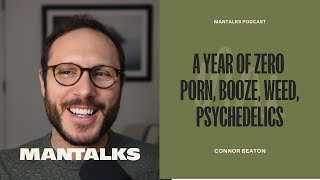
Connor Beaton (host of the Man Talk Show) describes choosing to try a year of complete sobriety and reflects on the outcomes. He reports over a year sober with no recreational drugs, no alcohol, no psychedelics and no prescription medicine (only coffee and chocolate consumed). Major benefits he cites include greater emotional and energy stability, better sleep, stronger discipline around health rituals (breathwork, cold plunges, meditation, exercise), and a substantial increase in productivity (business growth, course production, men’s group, hiring, beginning a book, family milestones like having a son and building a house). He emphasizes that sobriety forced him to replace substances with generative routines and allowed him to celebrate life’s moments fully conscious.
Questions this video answers
Coffee and chocolate.
No.
In October (after the year).
Over a year.
Chapters
All right, men. Welcome to the Man Talk Show. I'm Connor Beaton, and today, after Popular Demand, I'm going to be talking about my year of sobriety, and I'm going to share a little bit about why I went completely sober, why I decided to just try on sobriety as a. To see how it fits, I guess you could say. But I'm also going to talk about not just why I did it, but what the results were, what I was really surprised about, and share a little bit about how I got through the hard times, because there definitely were hard times where I wanted to have a drink or, you know, smoke a joint or something like that to just kind of, like, mellow out and chill. Here's where I want to start. I've never really considered myself to be an addict, but I certainly have a more addictive personality, and I'm someone who has addiction in his family. You know, I'm a child of an alcoholic. I've seen alcoholism be pervasive in my family. I know friends who have struggled with alcohol. And so I'm very keenly aware that there's this line that we can cross, oftentimes unconsciously, into this unhealthy relationship with alcohol specifically, and being somebody who has been addicted and had addictive behaviors and addictive. Addictive patterns in his life, right? With various different things, with porn and food and social media and alcohol in my early 20s. And there's even periods in my life where I definitely smoked too much weed. You know, like, people say that weed isn't addictive, that marijuana isn't addictive. But it's like, I've known enough people now to know that there are certainly a behavioral pattern or a habit that people can get into where they can be smoking too much weed. You know, where waking up in the morning, like, I remember a guy that I went to university with, and he was basically high all day long. You know, like, he would get up in the morning and smoke his bong and go to class and then come, you know, go to. Go to rehearsal afterwards, and he would just be high all day. And it's like, well, that's probably a problem. You know, if that was alcohol, we would call that person a functional alcoholic. And so there are people that use marijuana in that way. Anyway, the point is, I didn't choose to be sober for a year, and I'm carrying this on. I'm going to just keep going because I've really enjoyed it. But I didn't choose to do this out of some altruistic Bent of wanting to prove to someone or wanting to show other people who are addicts that what's possible or anything like that. Because what I've really learned about being around alcoholics, being around addicts, is that you, as the loved one, as the child, as the partner, as the friend, as the family member, are powerless to shift their mind. You are powerless to change that addict's perspective on their addiction because their addiction really takes. It's the primary function and driving force in their life. It's what they are going to protect above all else, usually above their own health, above their relationships, above their career, above. Above their own mental, emotional, physical, spiritual wellness. They're going to protect that addiction at all costs. And so doing something like this, I knew, wasn't going to be a gesture trying to convince other people not to drink. And that's what I want you to know, is that this video is in no way trying to convince you of anything. This is just my journey with sobriety, knowing that I have been a man who has certainly had various sort of addict. Addictive behaviors and addictive tendencies in my life. Okay, so what did it look like? Well, I have been for over a year now entirely sober. And when I say that, I mean no recreational drugs, no alcohol. Somebody asked me, I made a post about this the other day, and they said, have you taken any prescription medicine? No prescription medicine. The only things that I've continued to consume are coffee and chocolate. I refuse to give those up. You know, some people say that the coffee is an addictive substance, which. Sure, absolutely. It has addictive qualities for, for sure. But I. I enjoy it. And so maybe one day I'll go without coffee or chocolate. I certainly sometimes have done that, but. But that's what it looked like. So I gave up. I gave up and stopped drinking entirely and didn't do any recreational drugs whatsoever. Didn't do any psychedelics, which I've talked about in the show. I've done psychedelics before. I've done quite a bit of it, and I'll probably talk more about that in the future. And the results were really kind of shocking, actually, when I sat down after the year, and the year happened in October when I sat down after the year and really kind of looked back on the last year. I had been journaling some of the results and how I'd been feeling. But to look back at the year and be like, wow, I really accomplished a lot without any substances. And I really feel internally, mentally, emotionally, physically, spiritually way sharper than I think I ever have. Before in my life. And now I don't think that that's only because I got sober. You know, it's not only because I stopped drinking. It's also because of what I decided to do in that space, you know, in the void of not drinking, of being sober, right? Because as the saying goes, nature abhors a vacuum. And so it's very common for people to say, I'm going to get sober. And so they stop drinking, but what happens is their porn usage goes up, or they say, I'm going to stop watching porn. And so they stop watching porn, but suddenly they're playing way more video games. And, you know, their social media usage goes up. And they're on social media three, four hours a day, or they're, you know, surfing the Internet, watching YouTube videos endlessly, and they're not being. Not productive. I don't want this to be about productivity, right? It's not about, like, getting sober so you can be more productive. It's about being a more functional human being. That's what I actually found that was the fascinating part for me, is that I have never felt in my life like such a functional, competent, capable human being. In fact, to such a degree that a decade ago, I didn't think that this type of capacity and ability and functionalness was even possible. Truly. Like, I really didn't think that that was possible. So here are some of the things that I got along the way. The biggest thing was emotional stability and just stability in general, right? Stability in my energy levels, stability in my thoughts, stability in my emotions. I found myself being much more grounded, right? Because a lot of people use substances like alcohol to, in a way, cope with or regulate their internal system because of all the stress they feel or the anxiety or the anger or the grief and the sadness or to escape the depression or whatever it is that they're experiencing. And so that creates this sort of feedback loop or the cycle wherever, whenever you're feeling too stressed out or, you know, angry or anxious, that you want something external to help you cope with that overwhelming internal sensation. And what I realized is that I had been doing that in the past as well. I'd been, you know, sometimes using alcohol, sometimes using marijuana to stabilize my system. And. And not to a huge degree, but what I realized in taking away those substances, I had to work in order to maintain that stability. I had to implement rituals, routines, new habits, and I had to be a little bit more structured and disciplined with those habits in order to maintain that stability. Otherwise my nervous system would get dysregulated I'd become too stressed out, too anxious, too angry, you know, too disconnected. And the. The urge to want to engage in one of those substances again was very, very high. So the stability was probably the biggest shock outside of that. And when I say shock, I mean shock in a good way. Outside of that, better sleep, I found myself having much more regulated sleep, you know, because obviously when you go out drinking, even if you only have, you know, two beers or a big glass of wine or something like that, that's going to disrupt your sleeping pattern. There's a lot of research to show that. So I found that my sleeping pattern started to balance back out. I found myself being much more grounded and engaged, and I found myself more willing after a period of time. It took probably about three months in order for all these changes and these shifts to sort of happen where I found myself really wanting to engage in healthy rituals, right? I. I really wanted to go and work out, even if I was, like, just so freaking tired that I didn't want that. Like, my body was like, no, let's go do this. I found myself wanting to go and do breath work, wanting to do the cold showers and the cold plunge, really wanting to do the meditation and do the yoga and, like, move my body, go hiking and be in nature. Whereas before, I kind of had to, like, talk myself into it. You know, it's like, this is good for you, and this is part of what you talk about and what you teach and, you know, it's good for your body. And it's like, it was like a cognitive sort of dance. But when I took away all of my substances, what I really found was this beautiful space of the discipline coming more naturally. And my internal state, the dial somehow got moved to, I want to go do those things naturally, I want to go work out, I want to go and move my body or do breath work or, you know, sit in the lake in the freezing cold or in the ocean. I, like, really, really crave and desire those things. Not so that I can feel better after, you know, having drank last night or having smoked weed with friends or whatever, but because it just fuels my system, you know, just charges my battery even more. And I feel phenomenal. So that was part of the. That was one of the other pieces that I got from it. And then lastly, I would say is that. And I am going to make this part about production. I was able to get in a tremendous amount done. Like, I was able to grow my business in a pretty big way. I produced a course. I Developed the Man Talks alliance, which is a men's group. We grew that, we developed that. I hired people for social media. Now I have a team of quite a few people. And I started writing a book. I had a son, we started building a house, we bought property. So in the last year, since being sober, I've taken on a lot of. And I was able to do more without needing more substances to help me cope with it. Now what I will say is that somebody asked me, how did you get through the hard parts? How did you get through the times where you really just wanted to, you know, light up a joint or have a beer or, you know, have a, have a glass of scotch? What did you do in those moments? And it's in those moments that truly I can't stress this enough. I did a couple things. Number one is I doubled down on my rituals and my routines. They're what I call generative habits, right? Generative routines, generative rituals. And I use the word generative because generative means that you are not producing something, but you're allowing something to flourish, to grow. It's productive in a way. It's expansive, right? Whereas drinking, even though it tastes great for most people, it's not generally generative because there are adverse side effects, right? You're going to feel lethargic and tired and it's going to downregulate your system and you're going to feel disoriented and it's going to impair your cognitive functions. And all of these other things are happening when you're drinking that are certainly not generative. Right? They are more negative in, in their orientation. So I found that in order for me to maintain in those moments where I really just wanted to go have a beer, it's like that's when I went and sat and meditated. That's when I went and did breath work. That's when I, you know, went and did 50 burpees or worked out or gotten a cold shower or said, you know, I'm going to go in the lake. I really pushed myself to implement and use the tools and the rituals that I knew were good for me. And that's hard. I really hope that no one listening to this underestimates how frickin challenging, confronting and hard it is to use the healthy tools that we know in our minds and in our hearts and in our bodies are good for us when we need them the most. Right? It's like, it's like when you feel the most stressed and you know, you could use meditation that's when you're going to want to drink the most. That's when you're going to want to watch porn the most. That's when you're going to want to, you know, fill in the blank of whatever your sort of addictive coping mechanism or behavior is. And so I doubled down on those things and I actively coaxed myself at first into doing those rituals and acting out in those behaviors and using those tools that I knew were really, really helpful and beneficial for me. And in doing so, it allowed me to feel more stable and it reinforced those behaviors. So they started to come as second nature. So now in the morning I get up, you know, I'm with my son, I make some coffee and I crave stretching, doing some yoga, doing some breath work, doing some meditation, even though he might, my boy might be crawling over me as I'm doing that. Right. So it just became second nature. So those are some of the things that I got. That's why I decided to get sober. I'm going to keep being sober. I don't know how long, I don't know if this is a lifelong thing or if this is just a for now thing, but I feel phenomenal. And what I have been capable of has truly shocked me. And it's been such a beautiful experience to.
To be in the world, fully conscious of the world, and not intoxicated while trying to take in its beauty. And here's what I mean by that. I've seen a lot of people who use alcohol or marijuana or any kind of intoxicant substance to help them feel better, to help them avoid some sort of pain, and to help them experience a deeper kind of pleasure. And it can be a trap because what can eventually start to happen is you don't know how to have a good time without that substance. You know, like yesterday, literally last night, I handed in the first draft of my manuscript for my book. And normally that's where I would have celebrated because there's this social permission that we have and this social narrative that we've all kind of unconsciously bought into that says in order for you to have a good time and in order for you to celebrate, you should get intoxicated, you should be inebriated, you should have some sort of mind, body altering substance. Or are you really celebrating? Are you really having a good time? And what's been really fascinating. This is the last piece and I'm going to sign off. What's been really fascinating and arguably the, the, the most incredible and I think underrated Part of this whole beautiful experience of sobriety is that I have got to experience the awe and wonder of celebrating some of my life's most important moments. Watching my son be born, watching my son crawl. I mean, I could cry at this, right? Like, watching these beautiful, beautiful moments. Handing in my manuscript for a book that I've. I've worked tirelessly for to publish and to find an agent to celebrate these moments unencumbered by some intoxicant or by some substance. And what I've realized is that that's actually not necessary, that I really, truly have come to a place where I don't need those things to celebrate, to have a good time. I can have equally, if not more of a beautiful, good, incredible time, and to celebrate the, you know, the wonders of my life without a stimulant, without an intoxicant, without a drug of any kind. And I think that that is such a beautiful aim for us to have, to see if we can find ourselves in a place in our life where we have. And for you, I hope that you, maybe you take this away, I hope, I want this for you, is that you find yourself in a place in your life where you can celebrate and you can see the awe and the wonder and the beauty of existence completely without any form of stimulant or intoxicant or psychedelic or drug or anything like that. And to be able to reconnect to it in those moments, I think is such a wonderful, beautiful thing. So thank you for tuning in. I hope that you share this, and I hope that the, you know, what I shared today is supportive. And so if you know somebody that's considering being sober, you know, not smoking weed, not drinking, not watching porn. Right. Sexual sober.
I hope that you share this with them, and I hope that you found something helpful in this. And so whether you're watching this on YouTube, put your comments below and ask the questions that you have, or if you're listening to this on the podcast, thank you so much for tuning in. And until next week, this is Connor Beaton signing off.
More from Connor







How to Raise Strong, Unshakable Boys in Today's Culture, with Dr. Shefali Tsabary



