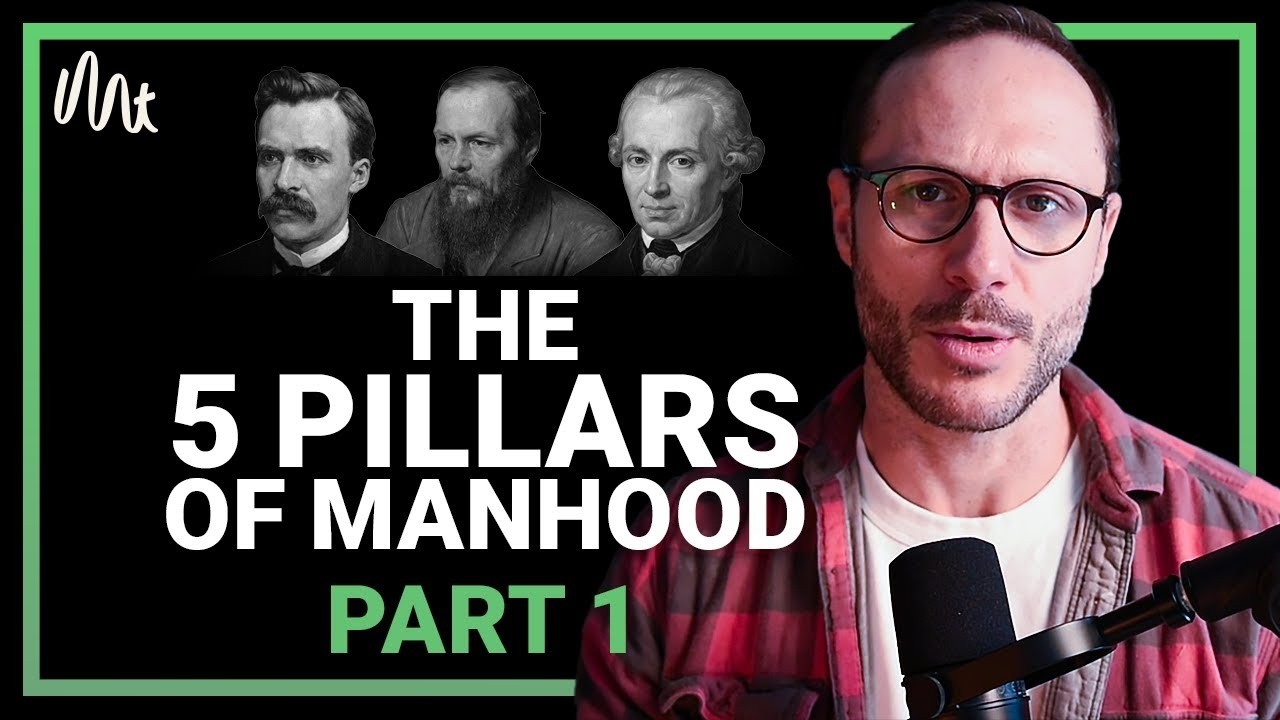
In this ManTalks episode, Connor Beaton outlines three of his five "psychological pillars" for men, each drawn from a major philosophical thinker. He begins with Fyodor Dostoevsky, arguing that contemporary culture encourages men to adopt a victim mindset, shirking personal responsibility, which he says leads to psychological decay. He cites Dostoevsky’s characters (e.g., in Notes from the Underground and The Brothers Karamazov) as exemplars of the danger of freedom without responsibility. Next, Beaton turns to Immanuel Kant, presenting the pillar of "inner sovereignty"—the idea that true freedom is self‑governance and self‑mastery, not the ability to act on every impulse. He critiques modern “keyboard warriors” who moralize without personal discipline. Finally, he discusses Friedrich Nietzsche (and parallels with Jung), proposing an integrative approach to aggression: rather than suppressing or explosively acting out anger, men should consciously incorporate their aggressive energy, avoiding the trap of becoming the very monster they fight. Throughout, Beaton frames these philosophical insights as practical guidance for men to develop responsibility, self‑control, and integrated aggression, while also condemning cultural narratives that promote victimhood or emotional repression. The episode ends with standard channel calls‑to‑action.
Chapters
All right, team, welcome back to the ManTalks Show. I'm Connor Beaton, and today I'm gonna be giving you 5 psychological pillars that you can deploy as a man from philosophical thinkers. We're gonna start with Dostoevsky, with The Russian. I think this is one of the main things that he's become so prominent in our culture and society, and that is the shirking of responsibility, the letting go of responsibility, and the adoption of a victim mentality and a victim orientation and identity. So much so that you never get out of being a victim. You never get out of identifying as a victim. What I'm saying is that we can trade healthy responsibility and owning and choosing responsibility in our life for blaming everyone else for the circumstances of our life while actively rejecting any type of ownership and responsibility. And this is psychologically damaging. It will psychologically undermine you, especially you as a man, because the masculine and men are grown through challenge. And when you take this path of rejecting personal responsibility, wholesale and trade it in for, uh, my life looks like it is because my dad did this and my mom did that and society this and government that and, you know, women this and blah blah blah, what ends up happening is that you never have to take responsibility for the outcomes in your life. If you look at Dostoevsky's stories, the men in his stories teach us the opposite of my life is a result of everybody else's actions. It's their fault. It actually teaches us that freedom without personal responsibility is a kind of madness. Freedom without personal responsibility becomes madness. And you see this in the characters in "Notes from the Underground" and "The Brothers Karamazov." You see this in the story where the most dangerous character, the most kind of insidious character, you're like, "Whew, that person," is really lethal, it's not the tyrant, because the tyrant is very clear and concise. You can see it for what it is. You can see the tyrant for what he is. It's actually the resentful man who refuses responsibility but demands moral superiority. So he refuses to take responsibility for his own actions, the things that he's contributed, the things that he's done that have created the circumstances that he's in, while simultaneously demanding a kind of moral superiority, a virtuousness, a righteousness, demanding respect. And this is where many men get caught. Pillar number 2 is going to come from Mr. Immanuel Kant. And this is really gonna be about self-mastery before moralizing, which again is kind of antithetical to our culture, where we have a bunch of people that are keyboard warriors that think that, they have the moral obligation and right to tell everybody else how they should live without having any quality of self-mastery or self-impulse control over themselves. It could be very easy to interpret some of what he's saying as be rules-oriented, be very polite. But his life and his work is really a representation of develop inner sovereignty. Develop inner sovereignty. And this, you could relate it with inner authority, or you can relate it with inner mastery. But I like this notion of inner sovereignty. Kant's work really says freedom is not doing whatever you want whenever you want. Freedom is, I have the ability to govern myself even when my impulses rebel. I have the ability to govern myself, to say, here's the direction I'm going. I'm not willing to I'm not willing to fall prey to this sabotaging behavior. I'm not going to cave and give in. So our modern culture tells men, the less aggressive you can be, the more you disconnect and repress your own aggression, the safer you are, the better man you are. Instead of the more that you can curate, cultivate, understand, have a relationship with your own aggression, with your own anger, the more that you will be able to provide a sense of trust and safety for other people, okay? So men are usually taught, suppress your darkness, right? Be nice, suppress the aggression, suppress the anger, or it's totally okay to act it out unconsciously, right? Rage, addiction, domination. And these are the sort of two polarities that, again, maybe not socially acceptable, but that men generally choose. And Nietzsche had an alternative, which is very similar to Jung. There's a lot of similarities between how Nietzsche saw the development of a man and how Jung would have talked about it. But Nietzsche, his path was integration. Can you bring your aggressiveness, your anger, this, force inside of you, this intensity that exists inside of you? Can you not cut yourself off from it, not castrate yourself from it, but can you actually begin to embody it in a way where it's not the constant sword that you're using to be aggressive, to try and dominate, but to have it be a part of your being? And he said, "He who fights monsters should see to it that he does not become a monster. But if you gaze into the abyss, the abyss also gazes back into you. It is the man who is quote unquote harmless, gotta put the air quotes in the proper place, right? It is the man who is quote unquote harmless, who is oftentimes the most controlling, vindictive, passive-aggressive, angsty, angry below the surface, sabotaging, judgmental, critical, and you can just go down the laundry list. So, or he really truly is just getting walked over in life. Thank you so much for tuning in. Don't forget to share this with somebody in your life that you know will enjoy it. Don't forget to like and subscribe if you enjoy this type of content. Until next week, Connor Beaton signing off.