Why are 66% of young men single
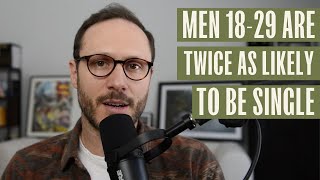
Connor Beaton breaks down why 66% of men aged 18-29 are single compared to 34% of women. Women tend to date older men and those who out-earn them, while fewer young men graduate college. His advice: build friendships, develop skills, and stop waiting for motivation to improve.
Questions this video answers
66%
34%
About 41–42%
Chapters
Why is it that 66% of young men between the ages of 18 and 29 are currently single, but only 34% of young women in the same age bracket are single? Pew Research center put out this very interesting piece of research recently that talked about the historic rise in unpartnered Americans. And what they found was interesting and it sort of left them with a lot of question marks, but some proposed answers as to why this is happening. But one of the things that was very fascinating is that young men are twice as likely to be single than young women, right? 66% of young men are single and not dating and unpartnered, but only 34% of young women are single and not partnered. So what's happening? Where's the discrepancy going? The reality in what they've started to find is that young women are just dating older, right? They're just dating men that are in their early 30s that maybe are more financially stable or more mature. Maybe they're more stable in their career, right? They finished their degrees, they've started paying off their student loans, they've got, you know, a mortgage or, you know, a car or whatever the case is. And to a lot of women, that is very appealing and attractive, right? A lot of the studies have shown that on average women still want men who are making as much of them, if not more. And the emphasis there is on the, if not more, the average woman in the dating market Today between ages 18 and 29 or above are still wanting men who are able to acquire more resources than them, who are able to out earn them. So the, the challenge that I think has happened is that we can talk about social media and dating apps and all those things, but one of the biggest discrepancies that I think has started to emerge is that as women have become more and more financially independent, their mate or selection preferences haven't adapted or changed along with that financial independence. So the reality is that women, even though they don't need a man, they don't need a man to pay for anything. They, there's still in many cases this underlying expectation or this underlying desire to have a man who out earns them. So as women are starting to make more and more money, right? 50, 60k, a hundred k, 200,000, a million dollars, whatever it is, their expectation and what they want in a partner is that that person still out earns them, that that person is still somebody who is able to provide more than them in some capacity. And this, I think is really impacting young men. Because if You're a woman who comes out of college, you have a college degree, maybe you get a, you know, a job or at a college, you're making 50, 60 grand or whatever it is, however much you're making out of college, your dating pool, maybe you're, you know, looking around at the men that you went to college with or, you know, maybe you're looking at the men on Tinder and Bumble and Hinge or whatever know platform you're on. First and foremost, you're starting to see that less men have a college degree. So suddenly for women who have a college degree prefer men that have one, right? It's something like 70 to 80% of women who have college degrees will not or don't want to date men without a college degree. And so as you have this rising rate of men who are not graduating college, who are not even going to college, and you have this ballooning number of women that are going to college and graduating from college, because it's now flipped, right? It's like the vast majority of college graduates are women. It's only like 41 or 42% of college graduates are now men. So that's inverse from what it was in the 1960s and 70s, right? In the 1960s and 70s, it was the opposite of that. It was only 41 or 42% of women that were graduating with a college degree. So now it's switched and less men are going to college than ever before and less men are getting college degrees. And so you start to see that part of the challenge that's emerging within the dating market is that women's selection preferences, what they're looking for in a man and in a mate, that pool is shrinking and shrinking and shrinking, right? So if you're a college educated woman and this isn't to put the blame on women, right? I just want to be super, super clear because I think anytime that we have these conversations, it's very easy for people to all of a sudden say, oh, you're just blaming women. You're just, you know, blaming what women want. No, no, no, no talking about the challenge that's happening here. We can talk about some potential paths forward after. And I'm not trying to blame anybody. This is just what's happening. So as women have become more educated and are making more and more money, their meeting and selection preferences has stayed the same. Okay, no problem. But the decline of young men, right? Less young men going to college than ever before, less young men entering into the labor market than ever before. More young men it's like 2/3 of young men underneath the age of 28 are living at home, right? So more young men living at home. The pool that women are looking for is getting smaller and smaller and smaller and smaller. And what has started to happen very clearly is that young men between the ages of 18 and 29 are not seen as viable of an option, as viable of an option to a woman who's maybe gone to college, got her degree or her master's and come out and she's making 50, 60k a year and she's wanting a man who is going to match her in some capacity. And when she goes on to hinge or bumble or Tinder or whatever platform she's on, or she's out at the bar with her friends and going to the grocery store and the men that she's meeting aren't meeting her requirements, then she looks out at the dating world and says, well, there's no viable candidates in my age range, so what do I do? I'm going to go to where some of those men are. And so they start to date men, right? 24 year old women, 20, 26 year old women, 28 year old women, they're dating men that are in their early to mid-30s because those men are generally a little bit more established, right? They've, whether they've gone to college or not, there's a higher percentage of men that are in their early to mid-30s that have gone to college. But whether they've gone to college or not, it's much more likely that they are more established financially, they're more established in their career, they're more established in their social network, maybe they're a little bit more emotionally mature. And so a lot of young women are starting to look at older men as a viable option. And so a lot of these guys are starting to date younger women. And what I find interesting is that I found that to be very true for myself, which was in my early 20s. It was very challenging to date. And I mean, I didn't have a ton of problems per se, but I think there was definitely some limitations, right? First and foremost, I was broke most of the time. You know, I was a college student. I didn't go to college until I was like 23 years old. I worked construction before that. And so, you know, the optionality that I had in terms of the type of woman that I was dating, the caliber of woman that I was dating and the type of woman who was looking to date me was pretty specific. But then once I Graduated university and I had a degree and I, you know, worked for a corporation and, and in my early 30s, you know, I sort of matured and started to not be as volatile in, and erratic in my social life. I started to really focus in, on responsibility and building my company and building my business and honing into my craft and all of that became very attractive to women. And so dating in my early 30s, I don't think that I ever had as much success or got as much attention or felt as comfortable and confident as a man than I did in my early 30s. Because the reality was I knew that there was a larger pool of women who were very interested in dating me for a vast number of reasons. Whereas in my early 20s, I kind of knew that my perceived value to women was maybe a little bit hindered or limited. Right. I had the motorcycle, I had the bad boy thing going on, but I didn't have a college education. I was working construction and, you know, so there was definitely some, some limitations on that. The second thing is I think that in the rise of social media, there's so much information about dating and mating that has started to emerge that I think that the average person has become inundated with so much information about what women want and what men want and the problem with dating and the, the challenges that men are facing and the challenges that women are facing and the unrealistic expectations and blah, blah, blah, blah, blah. So I think that the average person is just overwhelmed at modern dating. And I think that a lot of young men, what's starting to happen is that they're just checking out, right? If you're a young man and you're 24 years old and you've been on Tinder for a year and Bumble for a year and Hinge for a year, and you've maybe got one date that's going to be wildly discouraging. You know, you, you, you struggle to get women to swipe right on you, to say yes to you. And again, all of the data that's being revealed from these dating platforms shows that men have a harder time getting a woman to say yes, getting a woman to swipe right on them or whatever it is on their platform than women do. It's just statistically proven. It's not even an argument. Men are much more likely to say yes than a woman is to a profile to initiate a conversation. And women are sort of the gatekeepers of those conversations.
Relationships being formed and initiated in the first place. So if you're a young man, this is a Very discouraging time. And I think part of the problem is that a lot of young men are going on to online platforms and they're hearing about things like hypergamy or hypergamy, however you want to say it. And you're hearing about, you know, women only wanting to date more affluent men and resource heavy men. And you know, you got to hold your frame and all this stuff. And so I think that a lot of men are starting to slowly check out that are in their late teens and early twenties with the ease of being able to watch porn that becomes an option and are just starting to maybe fade in the background a little bit. And I think that that's so not disappointing. But I can see how if I was an 18 year old guy or a 21 year old guy in today's culture, I'd probably want to fucking check out too. You know, I'd be like, this is crazy. You know, this is insane. Like all the women that I'm, I'm wanting to date or wanting guys that are making six figures and are, you know, six foot four and you kind of hear all the unrealistic expectations online and that frustration can very quickly set in. And so I think I just want to speak very directly to the young men that are out there because I've been that young man before. I have younger brothers that are in this age, age range and age bracket. And one of the things that I want to say is, number one, is prioritize male relationships immediately. Like just prioritize having really solid, kick ass friendships with good men in your life. And I want you to know why. Do not underestimate the resource that a friendship is. Right? If you are a young man who's 18, who's 21 years old, and you have really solid men in your life, older, the same age as you, etc. That's a kind of social resource that adds to your perceived value as a man. One of the biggest red flags for any woman, any woman anywhere is going to be a man who has zero male friends, period. It's just a fact. And there's a number of reasons for that that we could get into. But I think the biggest thing that you can do for yourself, whether or not you are interested in dating, whether or not you're interested in being in the dating market and being on dating apps and whatnot, is to prioritize building powerful, potent male friendships to go hiking with, to have fun with, to go and explore the world with and have adventures and create experiences and create memories. Because that down the road is a something that you're never going to regret, right? That's an investment that you're never going to regret. You're not gonna forget it. It's going to make you fundamentally more interesting. Regardless of what, you know, how tall you are or how much money you make or how funny you are, you will just be fundamentally more interesting if you have prioritized developing real male friendships and then doing shit with those guys. You know, not just like I remember, I spent a summer in my mid-20s playing Diablo 3, I think it was with two of my buddies that I lived with and I didn't do much else, but when I went out and I went adventuring with them and, you know, we went out and hiking and stuff, stuff like that, it was those moments that I remember most. You know, it's those moments that really made my life interesting, fun, fascinating. And to get off of this sort of Internet nonsense that can happen over, over time where we can get sort of sucked down the rabbit hole. So number one is make really good male friendships, do stuff with them. You know, go hiking, plan trips, even if it's on a budget. You know, even if you're just broke and you've got like 100 bucks to go on a trip, it's like you can still go camp in the wilderness. You know, you can still learn how to start fires and do, do fun things, right? Rent a kayak or a canoe and go off on the water. So do those types of things and not only will you find yourself developing valuable skills, but you will just become more interesting to women. And you, you will have done something with your time that will have been rewarding and fulfilling. And I think one of the things that makes me kind of reticent about the current culture right now is how many men, I think are in their late teens and early 20s and are just stuck, you know, on a computer in a basement, not getting out and seeing the world, not getting it out and enjoying nature. And I think that the long term impacts of that are more damaging than just being single. I don't think that the data that 66% of men, you know, between age 18 and 29 and only 34% of young women are single, I don't think that that data is actually that bad or cause for like, wild concern. I think it's what you are doing as a young man between those ages, you know, if you're spending time working on your body, working out, getting to know yourself intellectually, pursuing hobbies, pursuing things that are meaningful to you building friendships, taking adventures and trips, you know, whatever you can afford. All of those things are going to lead to a much more meaningful life. They will make you more interesting to other people. They will give you life experience that just sitting on the Internet and debating things in YouTube comments cannot. Right? That's not something that you can put on your resume. But having backpack through Czechia or, you know, having spent a month in Germany, those are things that are interesting that people want to know about because it shows that you're capable of facing things that others aren't. You're capable of rejecting the sort of status quo. And I think the over domestication of young men right now is causing a lot of us to just retreat into basements, retreat into online forums, retreat into conversations of, well, this is terrible. And it means that there's something wrong with me or my generation. And I don't think that that's it at all. I think just find your own path. And even though there's data that's coming out like this, don't let it phase you to such a degree that you're like, oh, women, you know, women are at fault for this. And I have it so bad. And do not allow yourself to read data like this and become the victim. Because I think one of the things that I have started to see online more and more, and of course I think that there's systemic things that we could change. There's, you know, education things that we could change. There's things that we could change within the dating apps. But one of the things that I've seen more and more online is this kind of portrayal of the younger generation of men between the ages of 18 and 29 as broken, you know, as really going through some existential crisis. And. And maybe they are, and maybe some of you are right, maybe some of you are going through that right now. But I'm going to end with a story about why I gave the advice that I gave. I watched season one of White Lotus, and the most fascinating part of it was the young man that's in it. I can't remember his. His name right now. I think it was Quinn. And Quinn is sort of the epitomization of what I think a lot of young men in our culture in North America are going through today. They're checked out, they're online. You know, their sisters have friends and they're very connected, and there's, you know, all this sort of stuff going on around them, and they're sort of left to their own devices and literally left with their own device, right? Their computer, their iPhone, their whatever gaming platform they might be on. The fascinating thing about Quinn's story, I don't want to give too much away, but he essentially, through a series of events, spends time in nature, wakes up on the beach by the ocean, and ends up connecting and making real male friendships where he's not on his device. And this young man finds a sort of community of young men where he starts to go out on the ocean every single morning with these guys. And it really alters his perception, it alters his being at a substantial level. And I think that this is the calling that a lot of young men, I hope that a lot of young men step into because one of the things that fundamentally and radically has changed my life is, is being out in nature with other men, getting myself into these uncomfortable places of maybe going backpacking by myself for five or six days, out into the wilderness, right? Setting up my own tent, starting my own fires, teaching myself how to do those things, going off into the wilderness with guys that I like to spend time with, and getting off of my technology, creating these habits and routines to be out in nature, doing things that are engaging. All of that is going to lead to a much more fulfilling and substantial life where the pressure and the focus of being a man of value, of being a high value man, will start to fade in the background. And instead of obsessing about being a high value man, you will just naturally start to become one because you will be doing high value things. You will be spending your time in ways that you want to be spending it with people that you want to be spending it with. And that ultimately is what high value people do. So comment below. Let me know what you thought about this. This is certainly longer than I expected it to be. I'm curious to get your thoughts. DM me on Instagram, mantalks or if you're watching this on YouTube, comment below. Do not forget to subscribe to the channel and to share this video. Man it forward with somebody that you know will enjoy it. And until next week, this is Connor Beaton signing off.
More from Connor







How to Raise Strong, Unshakable Boys in Today's Culture, with Dr. Shefali Tsabary



